I see that a new Star Trek movie is in the offing, to be produced and directed by J.J. Abrams. I used to really love Star Trek a whole lot (see the Star Trek Redux posts linked in my sidebar for more), but the franchise went out with nothing resembling any kind of bang whatsoever -- rather it limped out with a final movie that was so bad that it even managed to boast a dud of a score by Jerry Goldsmith.
Honestly, this smacks of desperation on Paramount's part. Here are a few reasons why I'm less than enthused about this (as opposed to, say, Hercules at AICN, who claims to be "having a geekgasm" over this:
:: First, I gotta be honest here: J.J. Abrams has yet to do anything that really makes me stand up and take notice. I know that he's one of the reigning god-emperors of geek stuff, but his previous projects have never caught my attention much at all. I bored quickly with Lost once I realized that the show's purpose was going to be to maximize the mystery for as long as humanly possible, and the few episodes I've seen since I stopped watching regularly (about a third of the way into the first season) have done nothing to dispel that: it's just people wandering around the island, speaking in hushed tones about mysterious stuff and lots of problems with trust intercut with flashbacks of which I only found a few interesting. Alias never caught my sustained interest, either, feeling to me like a blend of James Bond and The X-Files. Going back into Abrams's body of work, I see that he was behind Felicity, a show which slid in one eye and out the other (Keri Russell was cute, but that's about it), and that he was at least partly responsible, writing-wise, for two forgettable movies (Forever Young, Regarding Henry) and one downright bad one (Armageddon). And given what I know of Abrams's last attempt at reviving a moribund franchise, I'm kind of wary about what he'll do with Trek.
(Full disclosure: I definitely plan to see Mission: Impossible III, even if I generally don't think Abrams is a genius and even if I know that Tom Cruise has gone so far 'round the bend that he's coming back out the other side now.)
:: The film's purported subject matter bugs me a bit, on Trek geek grounds. According to the Variety article linked above, the film will be a prequel, and "will center on the early days of seminal "Trek" characters James T. Kirk and Mr. Spock, including their first meeting at Starfleet Academy and first outer space mission." Now, no script has been written yet, so the resulting movie -- if a movie even results at all -- may not actually resemble this. But if this "Kirk and Spock: The Early Years" idea turns out to be true, here's my reaction.
Ugh.
Ugh, ugh, ugh.
Firstly, I don't care what the "official Trek timeline" says. I simply do not believe that Kirk and Spock were in the Academy together, at the same time. I just don't. If anyone can cite something from either a series episode or one of the films that contradicts me here, then fine, but I've never once had any other impression than that Spock is at least twenty years older than Kirk, or that Spock's been in Starfleet a lot longer than Kirk has.
There's no real problem here, timewise, that I can see. First of all, Kirk is something of a "wunderkind", one of the youngest Captains in Starfleet and a guy who's been driven by the idea of command his entire life. Spock is not driven by command at all; by the time he becomes a Captain, it's as the commander of a starship that's being used for training new cadets. And if we assume that the TOS episode "The Menagerie" happens early in Kirk's command of the Enterprise -- perhaps even in his first year -- then it's possible that Spock was already serving on the Enterprise, under Captain Pike, while Kirk was still at the Academy. (The events of "The Cage" are clearly stated to have taken place thirteen years earlier.
Additionally, the episodes "Journey to Babel" (TOS), "Sarek" (TNG), and "Reunification" (TNG) all clearly establish that Vulcans have significantly longer lifespans than humans. In "Babel", Dr. McCoy comments that Sarek is "only 102", clearly implying that for a Vulcan, 102 is sort of like what being 55 or 60 is for a human: middle to late-middleaged, but still with years of productive life ahead. Sarek lives another eighty years to die during TNG's run, and Spock is also alive and kicking vibrantly in TNG, as well. Putting this all together, it makes more sense to me that Spock is ten to twenty years older than Kirk, as opposed to being the same age as Kirk.
Of course, none of this is carved in any kind of stone; but then, neither (to me) are the "official timelines". It's always been really hard to nail Trek down as far as continuity and time go. A strict reading of the evidence of the shows, for instance, strongly implies that the Enterprise is around forty years old by the time Star Trek III: The Search for Spock rolls around, and yet there's Admiral Morrow, claiming in that film that the Enterprise is twenty years old. So even if I personally find the idea of Kirk and Spock being the same rough age (give or take a year or two), maybe that's just my problem. Fair enough.
But then there's another problem: the idea of exploring just Kirk and Spock's first meeting. And the big problem with that has a name: Leonard H.
In other words, where is Dr. McCoy?
Making a movie centering on Kirk and Spock alone commits a serious error, misunderstanding the character dynamic that made the Star Trek: TOS so iconic that it spawned decades of spinoffs and sequels. It's not the Kirk-and-Spock dynamic that lies at the dramatic heart of Star Trek; it's the Kirk-Spock-McCoy dynamic. It was the way McCoy's passions and Spock's cool logic, often set in conflict, informed Kirk's eventual decisions that made the original show work. And the very best moments in Trek history so often involved these three characters. Making a movie about young Kirk and young Spock and their very first adventure together seems to me to potentially constitute a serious misreading of what made Star Trek so good in the first place.
Of course, as noted, I could end up being completely wrong here. We'll see.
(But really, isn't it pretty damned obvious that if anyone's going to resuscitate Star Trek, it should be Joss Whedon?)
The personal blog of author Kelly Sedinger, chronicling the adventures of one overalls-clad wanderer.
Sunday, April 23, 2006
What are these "playoffs" of which you speak?
From my vantage point as a Buffalo sports fan, I've accustomed myself to the grand old idea that it matters not whether you win or lose, but rather how you play the game. This has made slightly more palatable the reality that Buffalo sports teams, over the last half-decade, have tended to lose. A lot.
But now the Buffalo Sabres, a squad of men who routinely engage in something called "Hockey" in a national league of some sort, have uncovered a heretofore unrealized reality: that if you don't suck, and if you do play the game well enough to win quite a bit more than you lose, then, by Golly, you get one of a limited number of invitations to play some more games, after the scheduled end of the "regular season". And as long as you keep winning, you get to keep playing! And if you win enough until there's nobody left to beat, well, they give you an oversized drinking vessel made of silver and they engrave all your names on it and everybody basically dances into the streets with glee.
Who knew, eh? Go Sabres! Win thatgrail chalice mug stein snifter beaker cannikin goblet tumbler CUP!
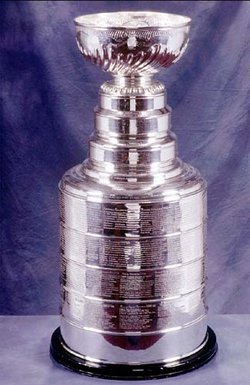
(The Sabres won Game One of their playoff series against Philadelphia last night, by the way. 3-2, in double OT. Game on!)
But now the Buffalo Sabres, a squad of men who routinely engage in something called "Hockey" in a national league of some sort, have uncovered a heretofore unrealized reality: that if you don't suck, and if you do play the game well enough to win quite a bit more than you lose, then, by Golly, you get one of a limited number of invitations to play some more games, after the scheduled end of the "regular season". And as long as you keep winning, you get to keep playing! And if you win enough until there's nobody left to beat, well, they give you an oversized drinking vessel made of silver and they engrave all your names on it and everybody basically dances into the streets with glee.
Who knew, eh? Go Sabres! Win that

(The Sabres won Game One of their playoff series against Philadelphia last night, by the way. 3-2, in double OT. Game on!)
Thursday, April 20, 2006
The Merchant of Rochester
Ever since I started working at The Store, it's been my policy in this space to mention as little as possible about my day-to-day doings there, because I don't want anything I write in this blog to be interpreted in any way as a "statement by an employee" of my company. I've taken this policy to such a degree that I do not even mention The Store by name in this space, although it doesn't really take an investigative mind of Colombo-like ability to figure out just where I work.
But I'm going to set that personal policy aside for just this post, because my company's chairman and, well, beloved patriarch died this afternoon. While this man wouldn't know me from Adam were I to approach him, he is directly responsible for the creation of a company in which I believe strongly and for a working environment which I'd never thought possible before I worked there. The people at The Store, both my supervisors and my co-workers, were of immeasurable support to me and to my family all during Little Quinn's life and in the terribly hard days that followed after Little Quinn's life ended, and it all began with the man who passed away today at the age of 87. I owe him my gratitude, and I honor him today.
So farewell, Mr. Wegman.
But I'm going to set that personal policy aside for just this post, because my company's chairman and, well, beloved patriarch died this afternoon. While this man wouldn't know me from Adam were I to approach him, he is directly responsible for the creation of a company in which I believe strongly and for a working environment which I'd never thought possible before I worked there. The people at The Store, both my supervisors and my co-workers, were of immeasurable support to me and to my family all during Little Quinn's life and in the terribly hard days that followed after Little Quinn's life ended, and it all began with the man who passed away today at the age of 87. I owe him my gratitude, and I honor him today.
So farewell, Mr. Wegman.
Wednesday, April 19, 2006
Iran, Iran so far away....
Matthew Yglesias on war with Iran:
The United States military is, for one thing, in much worse shape today than it was in March 2003 with far fewer resources at its disposal (see the Iraq War). The Iranian military, meanwhile, is in better shape than Iraq’s army was, since it hasn’t been subjected to more than a decade of stifling sanctions. Iran is geographically larger than Iraq. Its population is about twice as large as Iraq’s. Perhaps more to the point, the vast majority of the trouble in Iraq has been made by a distinct minority of the population -- the one Iraqi in five, more or less, who is Sunni Arab, the dominant group in the Baathist ancient regime. Fully half of Iranians are Shiite Persians, so we’re talking about a nationalist backlash with a population base about four or five times as large as the one we're facing in Iraq.
Michael Kinsley on the same subject:
So, after more than half a century of active meddling—protecting our interests, promoting our values, encouraging democracy, fighting terrorism, seeking stability, defending human rights, pushing peace—it's come to this. In Iraq we find ourselves unwilling regents of a society splitting into a gangland of warring militias and death squads, with our side (labeled "the government") outperforming the other side (labeled "the terrorists") in both the quantity and gruesome quality of its daily atrocities. In Iran, an irrational government that hates us with special passion is closer to getting the bomb than Iraq—the country we went to war with to keep from getting the bomb—ever was.
I'm truly astonished that we're actually discussing another war, when we haven't finished the last one -- and that one against a weaker foe.
I suspect that, a hundred years from now, someone will pen the definitive history of our time, and the title of that book will be Batshit Crazy.
Not what you think....
Steven Den Beste seems less than thrilled that Oliver Stone is making a 9-11 themed movie. Well, if SDB is assuming that Stone's going to make something along the lines of Fahrenheit 9-11, he can by all accounts stop worrying. Here's an original press release about the film, and everything I've read since bears this out: Stone's film focuses tightly on one tale of heroism from the World Trade Center attacks: the rescue of two Port Authority policemen who were trapped in the rubble. Maybe not everyone's cup of tea, but every report I've read about this film's production has gone out of its way to make clear that this will not be Oliver Stone in "left-wing conspiracy theorist" mode.
(Speaking of which, it's always bothered me when people refer to JFK as advancing a conspiracy theory, because it really doesn't advance a theory at all. It's more of a "fantasy on a theme", with that theme being "conspiracy". JFK doesn't so much advance a theory about the Kennedy assassination as it advances all of them -- minus the ones involving aliens and UFOs -- basically throwing everything up on a wall for all to see. Just watch JFK and try to sum up the film's "theory". It can't be done. Incidentally, JFK is one of my favorite films of all time. I've been for years in awe of how much Stone was able to pack into those three hours.)
(Speaking of which, it's always bothered me when people refer to JFK as advancing a conspiracy theory, because it really doesn't advance a theory at all. It's more of a "fantasy on a theme", with that theme being "conspiracy". JFK doesn't so much advance a theory about the Kennedy assassination as it advances all of them -- minus the ones involving aliens and UFOs -- basically throwing everything up on a wall for all to see. Just watch JFK and try to sum up the film's "theory". It can't be done. Incidentally, JFK is one of my favorite films of all time. I've been for years in awe of how much Stone was able to pack into those three hours.)
Declaring War
Via Glenn Greenwald, I see that Glenn Reynolds thinks that the Congressional authorizations of military force in the case of Afghanistan and Iraq constitute "declarations of war". Reynolds tosses out a whole lot of legalistic stuff to argue that what we've got is a declared state of war, but -- well, he's wrong. By way of illustration, let's look at the actual language used in Congressional declarations of war.
Here are the texts of both joint resolutions of Congress declaring war on Germany and Japan in December, 1941 (World War II):
Here are the texts of both joint resolutions of Congress declaring war on Germany and Japan in December, 1941 (World War II):
Germany:
Declaring that a state of war exists between the Government of Germany and the government and the people of the United States and making provision to prosecute the same.
Whereas the Government of Germany has formally declared war against the government and the people of the United States of America:
Therefore, be it Resolved by the Senate and House of Representatives of the United States of America in Congress assembled, that the state of war between the United States and the Government of Germany which has thus been thrust upon the United States is hereby formally declared; and the President is hereby authorized and directed to employ the entire naval and military forces of the government to carry on war against the Government of Germany; and to bring the conflict to a successful termination, all of the resources of the country are hereby pledged by the Congress of the United States.
Japan:
Declaring that a state of war exists between the Imperial Government of Japan and the Government and the people of the United States and making provisions to prosecute the same.
Whereas the Imperial Government of Japan has committed unprovoked acts of war against the Government and the people of the United States of America:
Therefore be it Resolved by the Senate and House of Representatives of the United States of America in Congress assembled,
That the state of war between the United States and the Imperial Government of Japan which has thus been thrust upon the United States is hereby formally declared; and the President is hereby authorized and directed to employ the entire naval and military forces of the United States and the resources of the Government to carry on war against the Imperial Government of Japan; and, to bring the conflict to a successful termination, all of the resources of the country are hereby pledged by the Congress of the United States.
Here is the text of the joint resolution of Congress declaring war on Germany in April, 1917 (World War I):
Whereas the Imperial German Government has committed repeated acts of war against the Government and the people of the United States of America; Therefore be it Resolved by the Senate and the House of Representatives of the United States of America in Congress Assembled, that the state of war between the United States and the Imperial German Government which has thus been thrust upon the United States is hereby formally declared; and that the President be, and he is hereby, authorized and directed to employ the entire naval and military forces of the United States and the resources of the Government to carry on war against the Imperial German Government; and to bring the conflict to a successful termination all of the resources of the country are hereby pledged by the Congress of the United States. (Emphasis added)
Here is the text of the joint resolution of Congress of war against Spain in 1898 (Spanish-American War):
DECLARATION OF WAR WITH SPAIN
Be it enacted by the Senate and House of Representatives of the United States of America in Congress assembled, First. That war be, and the same is hereby, declared to exist, and that war has existed since the 21st day of April, A. D. 1898, including said day, between the United States of America and the Kingdom of Spain.
Second. That the President of the United States be, and he hereby is, directed and empowered to use the entire land and naval forces of the United States and to call into the actual service of the United States the militia of the several States to such extent as may be necessary to carry this act into effect.
I couldn't find the text of Congress's war declaration with Mexico in 1846, but here's the resolution of Congress declaring war on Great Britain (the War of 1812):
An Act Declaring War Between the United Kingdom of Great Britain and Ireland and the Dependencies Thereof and the United States of America and Their Territories.
Be it enacted by the Senate and House of Representatives of the United States of America in Congress assembled, That war be and the same is hereby declared to exist between the United Kingdom of Great Britain and Ireland and the dependencies thereof, and the United States of America and their territories; and that the President of the United States is hereby authorized to use the whole land and naval force of the United States to carry the same into effect, and to issue to private armed vessels of the United States commissions or letters of marque and general reprisal, in such form as he shall think proper, and under the seal of the United States, against the vessels, goods, and effects of the government of the said United Kingdom of Great Britain and Ireland, and the subjects thereof.
By contrast, the text of the Congressional resolution authorizing President Bush to use military force against Iraq can be read here. It's too long for me to quote here, but it's worth noting that the resolution never uses any of the turns of phrase common to the above declarations: the specific existence of a "state of war". No "state of war" has been declared to exist between the United States and the government of Iraq.
As Glenn Greenwald points out, this is mainly about a confusion of the difference between a formal declaration of war and an authorization of military force, and about Glenn Reynolds's insistence that the authorization of force against Iraq actually was a declaration of war.
My problem is with the whole way the Iraq war is being appreciated. In reading a lot of pro-war blogs, I see a lot of wiggle-language in reference to war in general. Specifically, the phrase "this war" is invoked a lot. Sometimes "this war" refers to Iraq; sometimes to Afghanistan; sometimes it refers in a larger, general sense to the entire "war on terror".
I'm bothered by the difference between "war" in the specific legal sense (World War II) and "war" in the historic sense (say, the Gulf War) and "war" in the metaphorical sense (see just about any major policy focus of the last thirty years -- our "wars" on terror, drugs, poverty, you name it). The "Global War on Terror" at times has the strange feel to it, as though it's being pushed as some kind of substitute for the Cold War (which was itself only a metaphorical entity), and that it will last for decades in some kind of hazy and undeclared state as we bounce from armed conflict to armed conflict, assured by the Glenn Reynoldses of the world that it's all good, it's just all part of the War on Terror. Somehow.
Tuesday, April 18, 2006
Shoulder high, we bring you home
This article about the final homecoming of a Marine from Iraq is long. It's also profoundly moving.
Inside a limousine parked on the airport tarmac, Katherine Cathey looked out at the clear night sky and felt a kick.
"He's moving," she said. "Come feel him. He's moving."
Her two best friends leaned forward on the soft leather seats and put their hands on her stomach.
"I felt it," one of them said. "I felt it."
Outside, the whine of jet engines swelled.
"Oh, sweetie," her friend said. "I think this is his plane."
As the three young women peered through the tinted windows, Katherine squeezed a set of dog tags stamped with the same name as her unborn son:
James J. Cathey.
"He wasn't supposed to come home this way," she said, tightening her grip on the tags, which were linked by a necklace to her husband's wedding ring.
The women looked through the back window. Then the 23-year-old placed her hand on her pregnant belly.
"Everything that made me happy is on that plane," she said.
They watched as airport workers rolled a conveyor belt to the rear of the plane, followed by six solemn Marines.
Katherine turned from the window and closed her eyes.
"I don't want it to be dark right now. I wish it was daytime," she said. "I wish it was daytime for the rest of my life. The night is just too hard."
Suddenly, the car door opened. A white-gloved hand reached into the limousine from outside - the same hand that had knocked on Katherine's door in Brighton five days earlier.
The man in the deep blue uniform knelt down to meet her eyes, speaking in a soft, steady voice.
"Katherine," said Maj. Steve Beck, "it's time."
That's but a tiny portion of the piece. I strongly encourage reading the whole thing.
Sentential Links #46
This week's links abide:
:: To be sure, the delightful irony of a race that sold Manhattan Island for $24 bucks getting some of its own back from the Budweiser-bloated Bermuda shorts set is not lost on me, but that's not the sort of city I want to live in. Let the chumps go somewhere else to be fleeced. Let them go to Biloxi, or Davenport. Duluth, or Thackerville. There's no shortage of places to go to gamble, a fact that speaks volumes about the credulity of the American public-- we really don't need to have it here. (There's an anti-casino argument I haven't heard advanced much. To be honest, I don't see how a casino is going to do anything but hurt things here. Taking city land off the tax rolls, give the city a pittance of slot machine revenue, in all likelihood not spur any significant development that wouldn't happen anyway, enrich a few Indians but not much else, establish a casino that really won't be much of a tourist attraction since just about everybody lives within a few hours of a casino anyway no matter where they are -- screw the casino.)
:: I know I know, cool is elusive, undefinable. But when your personal style makes the cover of THAT magazine, you got it. (I'll be keeping an eye on that mag for the "long hair and overalls" look, then! Probably in vain, but you never know....)
:: I dreamed an episode of The Dick Van Dyke show last night. (I just don't know what to add to that....)
:: Refusing to do any extras whatsoever on a film that made this large a cultural impact is hubris, and it's that attitude that continues to leave a bad taste in my mouth about the movie. (Interesting criticism of the DVD package of the movie The Passion of the Christ. I watched the film a few weeks ago, and I was surprised that the film actually seemed less visceral than its reputation holds, and that Gibson apparently fell in love with slow-motion at some point, since I'd guess that a quarter of the film is shot that way. As a movie, it didn't move me one way or the other -- it was just kind of "there". Oh, and I hated the music.)
:: I am going to castrate the developers at Mircosoft and Apple. (Isn't there a whole club of people who want to do that? They could all get jackets!)
:: Anyhow, I got to thinking about which towns will never, ever have a vehicle model named after them; the kind of towns with a weird name that doesn't conjure up the kind of imagery that, say, Malibu or Seville does. (Go check out the ones he came up with, and add some yourself. For myself, I'd love to mosey about down behind the wheel of my trusty Tonawanda!)
:: Can oatmeal be consumed during Passover?
:: And poor Judas has been so reviled that no one will even name their dog Judas. He has been portrayed as this evil man, when even the gospels tell of his remorse. He did kill himself over it, after all. I'd say he was pretty damned sorry.
:: I speak to my wife nearly every day while I'm at work. It helps keep the relationship hot and steamy when we make sure to discuss the consistency of our boys' bowel movements and whether or not the living room furniture has acquired any more permanent stains in the past day.
:: Moreover, I've never seen anything supporting the idea that people who don't go to classical music concerts or who are ignorant of classical music don't do so because they think it's elitist or the music of a superior intellectual or culture class. (Exactly!)
:: Lately I've been reading of concerns that Lost is being plotted one episode at a time rather than with a long-range story planned. Yet this off-the-cuff creation is celebrated in jazz improvisation. (I stopped watching Lost a few episodes in because it just seemed directionless, but I'm not sure that the jazz metaphor is the best one, since even in jazz the improv is melodically based and revolves pretty strictly around the chart's chord progressions.)
All for this week. Tune in next week to hear someone say...well, something.
:: To be sure, the delightful irony of a race that sold Manhattan Island for $24 bucks getting some of its own back from the Budweiser-bloated Bermuda shorts set is not lost on me, but that's not the sort of city I want to live in. Let the chumps go somewhere else to be fleeced. Let them go to Biloxi, or Davenport. Duluth, or Thackerville. There's no shortage of places to go to gamble, a fact that speaks volumes about the credulity of the American public-- we really don't need to have it here. (There's an anti-casino argument I haven't heard advanced much. To be honest, I don't see how a casino is going to do anything but hurt things here. Taking city land off the tax rolls, give the city a pittance of slot machine revenue, in all likelihood not spur any significant development that wouldn't happen anyway, enrich a few Indians but not much else, establish a casino that really won't be much of a tourist attraction since just about everybody lives within a few hours of a casino anyway no matter where they are -- screw the casino.)
:: I know I know, cool is elusive, undefinable. But when your personal style makes the cover of THAT magazine, you got it. (I'll be keeping an eye on that mag for the "long hair and overalls" look, then! Probably in vain, but you never know....)
:: I dreamed an episode of The Dick Van Dyke show last night. (I just don't know what to add to that....)
:: Refusing to do any extras whatsoever on a film that made this large a cultural impact is hubris, and it's that attitude that continues to leave a bad taste in my mouth about the movie. (Interesting criticism of the DVD package of the movie The Passion of the Christ. I watched the film a few weeks ago, and I was surprised that the film actually seemed less visceral than its reputation holds, and that Gibson apparently fell in love with slow-motion at some point, since I'd guess that a quarter of the film is shot that way. As a movie, it didn't move me one way or the other -- it was just kind of "there". Oh, and I hated the music.)
:: I am going to castrate the developers at Mircosoft and Apple. (Isn't there a whole club of people who want to do that? They could all get jackets!)
:: Anyhow, I got to thinking about which towns will never, ever have a vehicle model named after them; the kind of towns with a weird name that doesn't conjure up the kind of imagery that, say, Malibu or Seville does. (Go check out the ones he came up with, and add some yourself. For myself, I'd love to mosey about down behind the wheel of my trusty Tonawanda!)
:: Can oatmeal be consumed during Passover?
:: And poor Judas has been so reviled that no one will even name their dog Judas. He has been portrayed as this evil man, when even the gospels tell of his remorse. He did kill himself over it, after all. I'd say he was pretty damned sorry.
:: I speak to my wife nearly every day while I'm at work. It helps keep the relationship hot and steamy when we make sure to discuss the consistency of our boys' bowel movements and whether or not the living room furniture has acquired any more permanent stains in the past day.
:: Moreover, I've never seen anything supporting the idea that people who don't go to classical music concerts or who are ignorant of classical music don't do so because they think it's elitist or the music of a superior intellectual or culture class. (Exactly!)
:: Lately I've been reading of concerns that Lost is being plotted one episode at a time rather than with a long-range story planned. Yet this off-the-cuff creation is celebrated in jazz improvisation. (I stopped watching Lost a few episodes in because it just seemed directionless, but I'm not sure that the jazz metaphor is the best one, since even in jazz the improv is melodically based and revolves pretty strictly around the chart's chord progressions.)
All for this week. Tune in next week to hear someone say...well, something.
Monday, April 17, 2006
GRRRR!
Sorry for the lack of content, folks, but in addition to some domestic stuff like picking up our sorry excuse for a living room, I had Firefox go belly-up for some strange reason, which forced me to re-download and re-install it. Back tomorrow. Look for "Sentential Links" then.
Sunday, April 16, 2006
(moving) IMAGE OF THE WEEK
I linked a QuickTime version of this a while back, but I found it today on YouTube: the classic "Mahna Mahna" skit from The Muppet Show.
To me, this one skit perfectly illustrates the utter genius of Jim Henson and company in the 70s. Here we have two pink muppets who seem female, although there's not really anything that indicates them as such (unless it's just that they're pink and they have giant eyelashes), singing a jazzy little tune -- and then in wanders a hippie-looking muppet with a beard, wild-ass hair, and shades for eyes, who tries repeatedly to derail the jazzy tune with something more rock-like, only to be worn down as the two pink ladies just look at each other and shake their heads every time the hippie breaks into his scat singing.
What gets me is that these two pink ladies, aside from being able to flex their mouths for enunciation of their song (whose one word is "doot"), have absolutely no other means of expression or movement. Their arms can't move, their eyes never waver from a bug-eyed stare -- and yet their reactions to the wandering hippie are always clear. It's all achieved through nothing but the way the muppets are moved by the "muppeteers". The humor of the sketch is achieved entirely through body language.
To me, this one skit perfectly illustrates the utter genius of Jim Henson and company in the 70s. Here we have two pink muppets who seem female, although there's not really anything that indicates them as such (unless it's just that they're pink and they have giant eyelashes), singing a jazzy little tune -- and then in wanders a hippie-looking muppet with a beard, wild-ass hair, and shades for eyes, who tries repeatedly to derail the jazzy tune with something more rock-like, only to be worn down as the two pink ladies just look at each other and shake their heads every time the hippie breaks into his scat singing.
What gets me is that these two pink ladies, aside from being able to flex their mouths for enunciation of their song (whose one word is "doot"), have absolutely no other means of expression or movement. Their arms can't move, their eyes never waver from a bug-eyed stare -- and yet their reactions to the wandering hippie are always clear. It's all achieved through nothing but the way the muppets are moved by the "muppeteers". The humor of the sketch is achieved entirely through body language.
Sunday Burst of Weirdness
This is probably not safe for work, but it just cracked me up repeatedly: a blog devoted to investigating the phenomenon of really attractive women being in the company of guys who are, well, a bit dorky.
(And no, I'm not discounting the possibility that I'm one of those dorky guys.)
(And no, I'm not discounting the possibility that I'm one of those dorky guys.)
Jed: The Final Days
Well, the Bartlet Administration is in its final days as it witnesses its transition period with President-elect Santos, who somehow managed to get elected despite picking an admitted alcoholic and drug addict with a history of heart trouble as his running mate, and then seeing that same running mate dying of a heart attack on Election Day. Luckily, he was able to pull out a squeaker of an election by carrying Texas and defeating a Republican nominee who had somehow won his party's nomination despite being a pro-choice non-church goer. Well, who ever said that TV needed plausibility? All that stuff is no less plausible than all those times Data or Wesley managed to save the Enterprise by reversing the flow of dekyon particles from the ship's Bussard collectors*.
Nothing much to say about the show, really, except that it just occurred to me that it would be funny if the very last scene of the last episode had President Santos, on his first day in office, sitting down at the Resolute Desk, taking a deep breath...and then a knock at the door:
Nothing much to say about the show, really, except that it just occurred to me that it would be funny if the very last scene of the last episode had President Santos, on his first day in office, sitting down at the Resolute Desk, taking a deep breath...and then a knock at the door:
SANTOS: Come in!
MANDY walks in, looking dissheveled and holding some kind of incredibly thick report.
MANDY: Mr. President, I know it's taken a while for me to get this done, but I've been working real hard in the basement on it and...I'm sorry, who are you?
Fade out.
Yeah, I know, it's lame. But then, I'm a guy who came away from the last episode of Happy Days wondering whatever happened to Chuck Cunningham.
* When he got the notice from Starfleet Academy that Wesley was to leave the ship and actually, you know, earn a spot in Starfleet by actually attending the Academy, do you suppose Captain Picard went alone into his ready-room and said to himself, "My God, I gotta fly this thing by myself? We're all f***ed!"?
Saturday, April 15, 2006
Contraceptives for Me, but not for Thee
Another thing I suddenly thought of regarding the whole "Pharamacists versus Morals" thing: I read, a while back, that the Target Corporation was actually going to allow its pharmacists to behave in this moralizing way.
Funny thing is: even while a Target pharmacist could be denying the pill to women, the Target health products section -- which is not run by the pharamacists -- carries condoms.
Tell me again how this isn't about punishing women and paternalistic moralizing.
Funny thing is: even while a Target pharmacist could be denying the pill to women, the Target health products section -- which is not run by the pharamacists -- carries condoms.
Tell me again how this isn't about punishing women and paternalistic moralizing.
An Easter Interrogative
After he rose from the dead, why didn't Jesus appear to Caiaphas and say something like, "Here is the Temple I have rebuilt"?
Buffalo in the Spring
It appears that spring has finally arrived in Buffalo, pretty much when it always does: mid-April, when the temperatures start reliably hitting the 60s more often than not and we get to see that big yellow thing in the sky more often than not.
I've long maintained that spring is Buffalo's worst season, seeing as how it's more of a gray and muddy two-month segue from winter to summer, but it is nice when the spring weather that the rest of the country is enjoying finally blossoms here.
Up for today: finding an Easter bunny, so we can take part in the pagan parts of the ritual celebration of Easter. And then, some laundry. Tomorrow, we take part in the non-pagan ritual celebration of Easter. And then, some ham and more laundry. And maybe a walk in the sun or something similar.
(And if I could trust these lumbering oafs in cat-form whom I actually suspect are some kind of fiendish crossbreed of a Siamese cat with an Irish setter to not push out the screens, maybe I could even open our windows more than an inch or two.)
I've long maintained that spring is Buffalo's worst season, seeing as how it's more of a gray and muddy two-month segue from winter to summer, but it is nice when the spring weather that the rest of the country is enjoying finally blossoms here.
Up for today: finding an Easter bunny, so we can take part in the pagan parts of the ritual celebration of Easter. And then, some laundry. Tomorrow, we take part in the non-pagan ritual celebration of Easter. And then, some ham and more laundry. And maybe a walk in the sun or something similar.
(And if I could trust these lumbering oafs in cat-form whom I actually suspect are some kind of fiendish crossbreed of a Siamese cat with an Irish setter to not push out the screens, maybe I could even open our windows more than an inch or two.)
Wednesday, April 12, 2006
Maybe we should license Internet surfers?
Steven Den Beste reported something amusing in his referral logs. In a political debate that cropped up on this message board, a poster tries to draw a historical analogy in defense of George W. Bush:
May I remind people that Teddy Roosevelt was promptly despised and voted out of office after winning WW1.
And this person apparently hails from Texas. I guess that was one child that got left behind.
Thank God for the Moral Guardians
Via Bitch Ph. D I note a new wrinkle in the thing about pharmacists refusing to fill certain prescriptions to women, such as the "morning after" pill, birth control, and other women's health drugs, on "moral" grounds: now they may be refusing to fill prescriptions for drugs they do actually carry because they don't approve of the medical professional writing the script.
What nauseating rubbish that is. And I really wish reporters covering stories like these would ask these moralizing pharmacists if they fill men's prescriptions for Viagra.
And frankly, the argument that pharmacies are businesses and businesses should be allowed to decide for themselves what products they'll sell is crap. Yes, pharmacies are businesses -- but they're not like the corner 7-11, and this isn't like Wal-Mart deciding to not stock nudie rags in the magazine section. Pharmacists are medical professionals who have to undergo a lot of schooling to attain their license, and there are ethical guidelines for medical professionals. If you don't want to fill certain prescriptions, then don't become a pharmacist. It's that simple.
What nauseating rubbish that is. And I really wish reporters covering stories like these would ask these moralizing pharmacists if they fill men's prescriptions for Viagra.
And frankly, the argument that pharmacies are businesses and businesses should be allowed to decide for themselves what products they'll sell is crap. Yes, pharmacies are businesses -- but they're not like the corner 7-11, and this isn't like Wal-Mart deciding to not stock nudie rags in the magazine section. Pharmacists are medical professionals who have to undergo a lot of schooling to attain their license, and there are ethical guidelines for medical professionals. If you don't want to fill certain prescriptions, then don't become a pharmacist. It's that simple.
Tuesday, April 11, 2006
Buffalo Bills?
Over at Random Thoughts, the question is posed: Will the Bills still be here in five years?
Honestly, I don't know. If the Western New York economy is still something resembling then what it is now, then I'd suspect they're gone unless something very dramatic happens -- say, a Tom Golisano/Tim Russert partnership buys the team. But there will be a new Governor next year, and the Buffalo Prefecture of Blogistan seems to alternate between heady optimism for the city's future and a sense of fatalistic doom for same, so...I don't know.
I'd pose a follow-up question, though: If the team does get moved, will you still follow the fortunes of the franchise?
And still one more follow-up: How will you react if the Bills leave town and then win a Super Bowl within two or three years of leaving?
Honestly, I don't know. If the Western New York economy is still something resembling then what it is now, then I'd suspect they're gone unless something very dramatic happens -- say, a Tom Golisano/Tim Russert partnership buys the team. But there will be a new Governor next year, and the Buffalo Prefecture of Blogistan seems to alternate between heady optimism for the city's future and a sense of fatalistic doom for same, so...I don't know.
I'd pose a follow-up question, though: If the team does get moved, will you still follow the fortunes of the franchise?
And still one more follow-up: How will you react if the Bills leave town and then win a Super Bowl within two or three years of leaving?
A retroactive gripe
I forgot to bitch about this a few weeks ago, but a few Thursdays back, one of our fine local TV stations ran promos all night about "an animal that has escaped from the Buffalo Zoo! Details at eleven!"
And I'm thinking, Cool!. So I dutifully tuned in at eleven, to hear all about the terror of the beastie on the loose, our mighty wayward...
(wait for it)
...peacock.
Man, talk about a letdown. A peacock was on the loose. If you want to see a peacock on the loose, just go to the Toronto Zoo -- they just let their peacock wander freely around the grounds, and it's about as threatening as a sleeping Ernest Borgnine.
I, of course, was envisioning that the escaped animal was an underfed Bengal tiger. Who'd maybe found his way into a school. A school for the blind.
Yeah, that would have been a show.
Stupid news promos: "If it bleeds, it leads -- unless we got nothin' in the 'bleeding' department, in which case we grab something that we can make people think might bleed."
(And for you Buffalo viewers: how thick do you think that stack of e-mails they keep displaying on Channel 2 will get before they stop having Scott Levin hold it up every night as a display of our public outrage about the tolls on the 190? I'm thinking, four and a half inches.)
And I'm thinking, Cool!. So I dutifully tuned in at eleven, to hear all about the terror of the beastie on the loose, our mighty wayward...
(wait for it)
...peacock.
Man, talk about a letdown. A peacock was on the loose. If you want to see a peacock on the loose, just go to the Toronto Zoo -- they just let their peacock wander freely around the grounds, and it's about as threatening as a sleeping Ernest Borgnine.
I, of course, was envisioning that the escaped animal was an underfed Bengal tiger. Who'd maybe found his way into a school. A school for the blind.
Yeah, that would have been a show.
Stupid news promos: "If it bleeds, it leads -- unless we got nothin' in the 'bleeding' department, in which case we grab something that we can make people think might bleed."
(And for you Buffalo viewers: how thick do you think that stack of e-mails they keep displaying on Channel 2 will get before they stop having Scott Levin hold it up every night as a display of our public outrage about the tolls on the 190? I'm thinking, four and a half inches.)
Exploring the CD Collection #13
Resurrecting a series....
Alexander Borodin: String quartet #2 in D major
Bedrich Smetana: String quartet #1 in E minor, "From My LIfe"
The Cleveland Quartet
As I've noted in this space before, as much as I love classical music, there are great whacks of it with which I am almost completely unfamiliar. By far the largest of these realms is the giant category known as "chamber music". I've always adored the large-scale symphonic works -- as might be expected by my now-nearly twenty year obsession with Hector Berlioz -- but the smaller scale works for small ensembles just seem to always elude my interest.
Actually, "elude my interest" isn't even a fair way to put it. It's not that I'm not interested in chamber music, it's that my other musical interests so outweigh my putative chamber music interest that I just end up continually putting the chamber stuff off for another day. Well, I've started to slowly rectify that a bit. After all, it's not as if I'm totally adverse to the small ensemble; much of Celtic music is performed by groups of precisely the scale one normally encounters in classical chamber music.
I've started with the string quartet, which is arguably the "basic" chamber ensemble, in that more music has been composed for the string quartet, much of it by the great masters, than anyone else. I actually got to hear a local string quartet live at my church's Christmas Eve service, and I was struck by the warmth of the ensemble, the singing tone that comes from the seamless blending of four distinct voices.
Why start my quartet collection with this disc, with one quartet each by Borodin and Smetana? Well, I can't lie: it was cheap, for one thing. Budget-price CDs are a good thing. For another, I want to save, for now, the "Mount Olympus" of string quartets (the ones by Beethoven, especially the later ones, of which I have heard naught but superlatives over the years). I've always responded well to the Russian Nationalist composers of the nineteenth century, and I already had a small familiarity with the Borodin quartet in D owing to its use in the James Bond film The Living Daylights. (Yeah, so what? The Bond girl was a cellist in that movie. It makes sense.) And yes, the Borodin quartet is a wonderful example of Russian Romanticism in music. I've already listened to the Borodin twice. It's absolutely captivating.
I've only listened to the Smetana partway through, so I can't comment much on it as of this point, except to note that it too has been used in an espionage movie: Sneakers. Small world, eh?
One thing of special interest with regard to this particular recording: at the time it was made, in 1990, the Cleveland Quartet was performing with the "Paganini quartet" instruments. These were four instruments -- two violins, a viola, and a cello -- owned by the great violin virtuoso Nicolo Paganini in the 1800s, and made by none other than Antonio Stradivari in the 1600s. (These instruments are now being used by the Tokyo String Quartet.) Of these four instruments, it's the viola that is of particular interest to me.
This is the viola that, upon its acquisition, inspired Paganini to commission a work for viola and orchestra from Hector Berlioz. The resulting work, Harold in Italy, was Berlioz's second symphony. Paganini never played it, judging the work not virtuosic enough; I've always found it surprising that Paganini didn't realize in the first place that Berlioz was not particularly well suited to a concerted work. But even though Paganini didn't perform the work, he did eventually hear it -- and judged it so fine that he gifted Berlioz with 20,000 francs. Without that monetary gift, it's unlikely that Berlioz would ever have composed Romeo et Juliet -- which is my favorite Berlioz work.
So when I was listening to this CD, I was listening to the very viola that set in motion, almost 170 years ago, a chain of events that resulted in two of Berlioz's greatest masterpieces.
There's just so much synchronicity to be found in the following of classical music.
Alexander Borodin: String quartet #2 in D major
Bedrich Smetana: String quartet #1 in E minor, "From My LIfe"
The Cleveland Quartet
As I've noted in this space before, as much as I love classical music, there are great whacks of it with which I am almost completely unfamiliar. By far the largest of these realms is the giant category known as "chamber music". I've always adored the large-scale symphonic works -- as might be expected by my now-nearly twenty year obsession with Hector Berlioz -- but the smaller scale works for small ensembles just seem to always elude my interest.
Actually, "elude my interest" isn't even a fair way to put it. It's not that I'm not interested in chamber music, it's that my other musical interests so outweigh my putative chamber music interest that I just end up continually putting the chamber stuff off for another day. Well, I've started to slowly rectify that a bit. After all, it's not as if I'm totally adverse to the small ensemble; much of Celtic music is performed by groups of precisely the scale one normally encounters in classical chamber music.
I've started with the string quartet, which is arguably the "basic" chamber ensemble, in that more music has been composed for the string quartet, much of it by the great masters, than anyone else. I actually got to hear a local string quartet live at my church's Christmas Eve service, and I was struck by the warmth of the ensemble, the singing tone that comes from the seamless blending of four distinct voices.
Why start my quartet collection with this disc, with one quartet each by Borodin and Smetana? Well, I can't lie: it was cheap, for one thing. Budget-price CDs are a good thing. For another, I want to save, for now, the "Mount Olympus" of string quartets (the ones by Beethoven, especially the later ones, of which I have heard naught but superlatives over the years). I've always responded well to the Russian Nationalist composers of the nineteenth century, and I already had a small familiarity with the Borodin quartet in D owing to its use in the James Bond film The Living Daylights. (Yeah, so what? The Bond girl was a cellist in that movie. It makes sense.) And yes, the Borodin quartet is a wonderful example of Russian Romanticism in music. I've already listened to the Borodin twice. It's absolutely captivating.
I've only listened to the Smetana partway through, so I can't comment much on it as of this point, except to note that it too has been used in an espionage movie: Sneakers. Small world, eh?
One thing of special interest with regard to this particular recording: at the time it was made, in 1990, the Cleveland Quartet was performing with the "Paganini quartet" instruments. These were four instruments -- two violins, a viola, and a cello -- owned by the great violin virtuoso Nicolo Paganini in the 1800s, and made by none other than Antonio Stradivari in the 1600s. (These instruments are now being used by the Tokyo String Quartet.) Of these four instruments, it's the viola that is of particular interest to me.
This is the viola that, upon its acquisition, inspired Paganini to commission a work for viola and orchestra from Hector Berlioz. The resulting work, Harold in Italy, was Berlioz's second symphony. Paganini never played it, judging the work not virtuosic enough; I've always found it surprising that Paganini didn't realize in the first place that Berlioz was not particularly well suited to a concerted work. But even though Paganini didn't perform the work, he did eventually hear it -- and judged it so fine that he gifted Berlioz with 20,000 francs. Without that monetary gift, it's unlikely that Berlioz would ever have composed Romeo et Juliet -- which is my favorite Berlioz work.
So when I was listening to this CD, I was listening to the very viola that set in motion, almost 170 years ago, a chain of events that resulted in two of Berlioz's greatest masterpieces.
There's just so much synchronicity to be found in the following of classical music.
Sentential Link (special edition)
In yesterday's posting of this week's Sentential Links, I focused on the bloggers whose work has been featured this week at Jayne Says as Jayne's been out of town. However, I thought Jayne was returning to blogging today, which turns out to not be the case: she's returning tomorrow, so there's one more blog I have to feature sententially. So here it is:
:: Last night, something unprecedented happened: I went a whole evening without downloading any internet porn.
There. A great wrong, rectified. At last I can rest in peaceful slumber! (But not until after I feed and bathe The Daughter. And watch American Idol. And drink some cola laced with Spum. My work is never done, it seems.)
(Oh, and the post above reminds me of something. As much as I think YouTube may be the greatest damn thing in the history of the Interweb -- and that's coming from a guy who once thought that Gopher was the coolest possible thing on the Interweb -- it turns out that there are, indeed, less than ideal uses for YouTube. For example, you can watch in awe as some person demonstrates some mad Minesweeper skills. Hoo baby!)
:: Last night, something unprecedented happened: I went a whole evening without downloading any internet porn.
There. A great wrong, rectified. At last I can rest in peaceful slumber! (But not until after I feed and bathe The Daughter. And watch American Idol. And drink some cola laced with Spum. My work is never done, it seems.)
(Oh, and the post above reminds me of something. As much as I think YouTube may be the greatest damn thing in the history of the Interweb -- and that's coming from a guy who once thought that Gopher was the coolest possible thing on the Interweb -- it turns out that there are, indeed, less than ideal uses for YouTube. For example, you can watch in awe as some person demonstrates some mad Minesweeper skills. Hoo baby!)
Bill the White House for three tons of caulking and window sealant.
I'm not possessed of the keenest legal mind -- hell, there were episodes of Matlock that had me confused -- so I've generally been avoiding the whole "George W. Bush and the leaks" thing. But I have noticed that the general Republican spin seems to have settled on this: "Ach, so what? Bush can leak whatever he wants, and it's all perfectly legal."
I guess my problem with that is that it doesn't make sense when considered as part of the timeline of what actually transpired. If the Administration's actions were legal the whole time, why have we endured several years of stonewalling, meta-narratives, grand jury investigations, indictments, and all that? Why didn't the President just stand up and say, "You know what? Here's a document I'm declassifying. The document says _____, and I'm declassifying it in response to _____."
In reference to this whole deal, John Scalzi posted a comment in the thread (connected with this post), in response to just such a "Hey, Bush did it, so it's perfectly legal!" claim:
I guess my problem with that is that it doesn't make sense when considered as part of the timeline of what actually transpired. If the Administration's actions were legal the whole time, why have we endured several years of stonewalling, meta-narratives, grand jury investigations, indictments, and all that? Why didn't the President just stand up and say, "You know what? Here's a document I'm declassifying. The document says _____, and I'm declassifying it in response to _____."
In reference to this whole deal, John Scalzi posted a comment in the thread (connected with this post), in response to just such a "Hey, Bush did it, so it's perfectly legal!" claim:
Oh, you mean his "Let's declassify certain information that helps us, and then not tell anybody that it's declassified and then present it as a leak and then act all indignant that people are leaking in our administration, but then pull out this excuse when the leak eventually gets traced back to us" maneuver. Yeah, it's legal. However, there aren't very many words in the English language that fully describe the utterly repugnant moral and political cynicism of a maneuver like that, Brian, and I feel very sad for you that "it's not illegal if it's the president" is the only argument this administration allows you to present for its behavior.
Over at The American Prospect, Greg Sargent had a good response to the "What Bush does is legal" argument the other day, concluding thusly:
So to recap: Libby has revealed that Bush authorized a leak of classified info for political purposes. End of story.
I just want to know, if the President's actions here are completely legal and justifiable, just why it is that everybody's acting so damned guilty over there until now. Maybe it's because they suddenly realized that lots of their supporters have already bought into the "What the President does is legal" argument once (in reference to the NSA wiretapping scandal).
I do know one thing: these guys wouldn't have made it to the first commercial break against Ben Matlock.
Monday, April 10, 2006
It BURNS!
I have to admire the PhotoShop effort on the cover of Ann Coulter's new book. There's no way that woman could actually wear a cross around her neck without the flesh around it bursting into flame.
And looking at that photo, her freakishly long left arm reminds me of that scene in Terminator 2 when the T-1000, having assumed the form of John Connor's foster mom, morphs its arm into a giant dagger to kill the foster dad.
Ann Coulter as an emissary of Christianity? Please.
And looking at that photo, her freakishly long left arm reminds me of that scene in Terminator 2 when the T-1000, having assumed the form of John Connor's foster mom, morphs its arm into a giant dagger to kill the foster dad.
Ann Coulter as an emissary of Christianity? Please.
Sentential Links #45
A bit of a different approach this week. Jayne Says has become a favorite blog of mine, of the "personal diary" variety. Her own content tends to focus on spirituality, with a little politics and a bit of pop culture thrown in. It takes a good writer to make subject matter like that interesting, and Jayne is certainly that.
But this week Jayne's been absent, and she's turned her blog into a showcase for some of her own favorites, presenting posts she's borrowed from those blogs (rather than just allowing them to post new material to her blog). So this week's "Sentential Links" will provide links to posts from the blogs that have been featured on Jayne Says, only not from the actual posts from those blogs that have actually been used on Jayne Says. I hope that makes sense. My head hurts a bit from typing that.
(Oh, and there will be a couple additional links at the end, from my own trekking 'round Blogistan.)
Here we go:
:: Twice a year, my system and life is screwed up for nearly an entire month as Mr. Body Clock tries to figure out why the freakin' hell I am suddenly reprogramming him to get up or sleep in early or later, and why I'm going to bed earlier or later. I think it affects me so severely because Mr. Body Clock, bless his heart, is an A-type personality over-acheiver. (Heh! Luckily for me, my own Mr. Body Clock is easily mollified with generous quantities of rum. BTW, I love the effect this blog uses when mousing over links. A little cheesy, but great!)
:: My coworker and I had been typically getting on each others nerves all day and it boiled over when he brought up the coffee late in the afternoon. In addition to ripping into him for his breakdown in logical thinking that while strong coffee could be watered DOWN… the lightly colored water he called coffee COULD NOT BE MADE STRONGER!!! (Remember the old chorus from the Letterman show: "Decaffeinated coffee -- it's useless warm brown water!")
:: Mostly I've found pieces of consolations from various easter religions and I continue to do so, but if I knew I wouldn't fail, I'd try to embrace Catholicism in the interest of having a spiritually cohesive family. (If you like knitting, this blog's for you. I've never knitted; I'm more of a knotting kind of guy.)
:: Can you feature seeing this on your commute??? I mean, every road in Salt Lake has one of these looming up at the end of it. just about. (Lots of photos at this post.)
:: I like old stuff, I like being the caretaker of old stuff. I have a primitive pew like bench in my great room that is over a hundred and twenty five years old. I paid forty five dollars for it. I wonder how may people have sat there, where, and when.
:: Sometimes we change so much that we have to rid ourselves of the people that we have outgrown.
:: The thing is, when someone gives you their heart, even if it’s a bit battered and bruised and some pieces are sold separately, YOU TAKE CARE OF IT.
:: I followed the story and in time all charges were dropped against the Rabbit. I knew then that I had moved to the right town. (Heh!)
:: It only took 20.7 months, but my daughter has finally reached the point where she is insistent on pooping in private. (I'm not telling how long it took with The Daughter. Suffice it to say, modesty ain't her thing, and I have some trepidation about what kinds of productions she'll appear in if she majors in theater in college.)
That's all of Jayne's blogsitters. (I think Jayne is back tomorrow.) Here are a few links from my own Fellow Travelers:
:: There are things about other people smoking that I miss though. I miss the sounds---of a match being struck, the snick of a lighter, the first satisfied exhale of the contented nicotine addict getting her fix. (This is a great post. Go read it, if nothing else.)
:: But I’m tired of people telling me when and how I have to remember 9/11. Don’t worry, folks. I remember. I remember even though I’m a Democrat. I remember even though I don’t go to church. I remember even though I voted for Kerry. I remember even though I can’t stomach George W. Bush not for one second.
:: This disk held fast an event I had shared with my father: 71 minutes out of the 16 years we had together. Soon after, as an "enemy of Reich and Führer," my father also disappeared into Hitler's abyss. (OK. After reading Lance's post, read this one.)
All for this week!
But this week Jayne's been absent, and she's turned her blog into a showcase for some of her own favorites, presenting posts she's borrowed from those blogs (rather than just allowing them to post new material to her blog). So this week's "Sentential Links" will provide links to posts from the blogs that have been featured on Jayne Says, only not from the actual posts from those blogs that have actually been used on Jayne Says. I hope that makes sense. My head hurts a bit from typing that.
(Oh, and there will be a couple additional links at the end, from my own trekking 'round Blogistan.)
Here we go:
:: Twice a year, my system and life is screwed up for nearly an entire month as Mr. Body Clock tries to figure out why the freakin' hell I am suddenly reprogramming him to get up or sleep in early or later, and why I'm going to bed earlier or later. I think it affects me so severely because Mr. Body Clock, bless his heart, is an A-type personality over-acheiver. (Heh! Luckily for me, my own Mr. Body Clock is easily mollified with generous quantities of rum. BTW, I love the effect this blog uses when mousing over links. A little cheesy, but great!)
:: My coworker and I had been typically getting on each others nerves all day and it boiled over when he brought up the coffee late in the afternoon. In addition to ripping into him for his breakdown in logical thinking that while strong coffee could be watered DOWN… the lightly colored water he called coffee COULD NOT BE MADE STRONGER!!! (Remember the old chorus from the Letterman show: "Decaffeinated coffee -- it's useless warm brown water!")
:: Mostly I've found pieces of consolations from various easter religions and I continue to do so, but if I knew I wouldn't fail, I'd try to embrace Catholicism in the interest of having a spiritually cohesive family. (If you like knitting, this blog's for you. I've never knitted; I'm more of a knotting kind of guy.)
:: Can you feature seeing this on your commute??? I mean, every road in Salt Lake has one of these looming up at the end of it. just about. (Lots of photos at this post.)
:: I like old stuff, I like being the caretaker of old stuff. I have a primitive pew like bench in my great room that is over a hundred and twenty five years old. I paid forty five dollars for it. I wonder how may people have sat there, where, and when.
:: Sometimes we change so much that we have to rid ourselves of the people that we have outgrown.
:: The thing is, when someone gives you their heart, even if it’s a bit battered and bruised and some pieces are sold separately, YOU TAKE CARE OF IT.
:: I followed the story and in time all charges were dropped against the Rabbit. I knew then that I had moved to the right town. (Heh!)
:: It only took 20.7 months, but my daughter has finally reached the point where she is insistent on pooping in private. (I'm not telling how long it took with The Daughter. Suffice it to say, modesty ain't her thing, and I have some trepidation about what kinds of productions she'll appear in if she majors in theater in college.)
That's all of Jayne's blogsitters. (I think Jayne is back tomorrow.) Here are a few links from my own Fellow Travelers:
:: There are things about other people smoking that I miss though. I miss the sounds---of a match being struck, the snick of a lighter, the first satisfied exhale of the contented nicotine addict getting her fix. (This is a great post. Go read it, if nothing else.)
:: But I’m tired of people telling me when and how I have to remember 9/11. Don’t worry, folks. I remember. I remember even though I’m a Democrat. I remember even though I don’t go to church. I remember even though I voted for Kerry. I remember even though I can’t stomach George W. Bush not for one second.
:: This disk held fast an event I had shared with my father: 71 minutes out of the 16 years we had together. Soon after, as an "enemy of Reich and Führer," my father also disappeared into Hitler's abyss. (OK. After reading Lance's post, read this one.)
All for this week!
Sunday, April 09, 2006
How about "Secretary of Music"?
A couple weeks back I linked an interview with Secretary of State Rice, on the subject of classical music. Now today there's another, similar piece, in the New York Times. There's nothing terribly new here for people who are already familiar with Dr. Rice's history and views on music, but there it is.
How does one become an FVI?
This will probably get linked all over the place, but here it is anyway: a New York Times article describing what things are like in El Salvador, eight years after that country's complete outlawing of abortion.
It's a pretty powerful piece. Two tiny details struck me: the fact that women still find ways to get abortions if they feel them necessary (rich ones can just fly to Miami, we're told), and there are actually people in El Salvador called "forensic vagina inspectors".
I also noted the mental gymnastics common among prolifers, one of whom insists that the woman getting the abortion has both "murdered her baby" and become a "victim" of the abortion providers.
Sigh.
It's a pretty powerful piece. Two tiny details struck me: the fact that women still find ways to get abortions if they feel them necessary (rich ones can just fly to Miami, we're told), and there are actually people in El Salvador called "forensic vagina inspectors".
I also noted the mental gymnastics common among prolifers, one of whom insists that the woman getting the abortion has both "murdered her baby" and become a "victim" of the abortion providers.
Sigh.
On This Date
All the cool kids over in LiveJournalopia are apparently doing this: you plug your birthdate into Wikipedia and then report back a handful of notable things that happened on your birthdate, a few notable folks who share your birthday, and a few unfortunate folks who chose your birthday to shuffle off this mortal coil. SO what the hey? All of the following happened on September 26.
1580: Sir Francis Drake circumnavigated the globe. (I'm a tad baffled by this, since it implies that he did it in one day. Did he embark on his journey on 9-26, or did he complete it?)
1957: West Side Story opened on Broadway.
1969: Abbey Road was released.
Births on 9-26:
1774: Johnny Appleseed
1891: Charles Munch
1898: George Gershwin
1956: Linda Hamilton (although I may go back in time and see if I can't undo this one)
Deaths on 9-26:
1820: Daniel Boone
1945: Bela Bartok
2003: Robert Palmer
Also, I note that September 26 is the date of "Bureflux", a holiday of the Discordian religion: the "Season Holyday of the Season of Bureaucracy". Ummm...OK.
Go ahead and play, folks. To make it easier, instead of doing an actual Wikipedia search on your birthdate, here's the form of the URL you'll eventually reach:
http://en.wikipedia.org/wiki/26_September
Just change that date as it appears above, and make sure to capitalize the month before plugging it into your browser.
1580: Sir Francis Drake circumnavigated the globe. (I'm a tad baffled by this, since it implies that he did it in one day. Did he embark on his journey on 9-26, or did he complete it?)
1957: West Side Story opened on Broadway.
1969: Abbey Road was released.
Births on 9-26:
1774: Johnny Appleseed
1891: Charles Munch
1898: George Gershwin
1956: Linda Hamilton (although I may go back in time and see if I can't undo this one)
Deaths on 9-26:
1820: Daniel Boone
1945: Bela Bartok
2003: Robert Palmer
Also, I note that September 26 is the date of "Bureflux", a holiday of the Discordian religion: the "Season Holyday of the Season of Bureaucracy". Ummm...OK.
Go ahead and play, folks. To make it easier, instead of doing an actual Wikipedia search on your birthdate, here's the form of the URL you'll eventually reach:
http://en.wikipedia.org/wiki/26_September
Just change that date as it appears above, and make sure to capitalize the month before plugging it into your browser.
I've heard all the lines; I have cried oh so many times....
My first exposure to Madonna* was the song "Like a Virgin", which I still hate to this day. But I quickly warmed up to Madonna herself in subsequent years and songs, even though Madonna herself has turned out to be, well, a tad weird. Anyhoo, my favorite song of hers is the little bubble-gum confection "True Blue", which is as perfect a pop song as I've ever heard. Madonna's voice was somehow perfectly suited to this tune -- and its exclusion from Madonna's Immaculate Collection greatest hits album still annoys me. (I later got the song during my three-week experiment with file-sharing a few years back.)
Anyway, in the mid-80s, when "True Blue" came along, music-video was the name of the game, and every major single had a video made for it to air on MTV. What was different about "True Blue" was that before Madonna made her own video, MTV held a "Make Your Own Video" contest, with "True Blue" as the song. They played a lot of the entries during a marathon one day (just about all of them sucked), but the winning amateur video was actually pretty good. It can be seen here, albeit with pretty crappy video quality. Madonna's eventual "official" video for the song can be seen here, but for me, the amateur one will always be the superior version.
* Yes, I realize that referring to one's "exposure" to Madonna is a troublesome metaphor. Oh well.
Anyway, in the mid-80s, when "True Blue" came along, music-video was the name of the game, and every major single had a video made for it to air on MTV. What was different about "True Blue" was that before Madonna made her own video, MTV held a "Make Your Own Video" contest, with "True Blue" as the song. They played a lot of the entries during a marathon one day (just about all of them sucked), but the winning amateur video was actually pretty good. It can be seen here, albeit with pretty crappy video quality. Madonna's eventual "official" video for the song can be seen here, but for me, the amateur one will always be the superior version.
* Yes, I realize that referring to one's "exposure" to Madonna is a troublesome metaphor. Oh well.
Saturday, April 08, 2006
Signs of Desperation
I very rarely do these kinds of quiz-things, but I saw it over on Craig's blog, and it struck me as kind of funny, so here are my results:

Which Historical Lunatic Are You?
From the fecund loins of Rum and Monkey.
The details on this guy are as follows:
Which Historical Lunatic Are You?
From the fecund loins of Rum and Monkey.
The details on this guy are as follows:
Born in England sometime in the second decade of the nineteenth century, you carved a notable business career, in South Africa and later San Francisco, until an entry into the rice market wiped out your fortune in 1854. After this, you became quite different. The first sign of this came on September 17, 1859, when you expressed your dissatisfaction with the political situation in America by declaring yourself Norton I, Emperor of the USA. You remained as such, unchallenged, for twenty-one years.
Within a month you had decreed the dissolution of Congress. When this was largely ignored, you summoned all interested parties to discuss the matter in a music hall, and then summoned the army to quell the rebellious leaders in Washington. This did not work. Magnanimously, you decreed (eventually) that Congress could remain for the time being. However, you disbanded both major political parties in 1869, as well as instituting a fine of $25 for using the abominable nickname "Frisco" for your home city.
Your days consisted of parading around your domain - the San Francisco streets - in a uniform of royal blue with gold epaulettes. This was set off by a beaver hat and umbrella. You dispensed philosophy and inspected the state of sidewalks and the police with equal aplomb. You were a great ally of the maligned Chinese of the city, and once dispersed a riot by standing between the Chinese and their would-be assailants and reciting the Lord's Prayer quietly, head bowed.
Once arrested, you were swiftly pardoned by the Police Chief with all apologies, after which all policemen were ordered to salute you on the street. Your renown grew. Proprietors of respectable establishments fixed brass plaques to their walls proclaiming your patronage; musical and theatrical performances invariably reserved seats for you and your two dogs. (As an aside, you were a good friend of Mark Twain, who wrote an epitaph for one of your faithful hounds, Bummer.) The Census of 1870 listed your occupation as "Emperor".
The Board of Supervisors of San Francisco, upon noticing the slightly delapidated state of your attire, replaced it at their own expense. You responded graciously by granting a patent of nobility to each member. Your death, collapsing on the street on January 8, 1880, made front page news under the headline "Le Roi est Mort". Aside from what you had on your person, your possessions amounted to a single sovereign, a collection of walking sticks, an old sabre, your correspondence with Queen Victoria and 1,098,235 shares of stock in a worthless gold mine. Your funeral cortege was of 30,000 people and over two miles long.
The burial was marked by a total eclipse of the sun.
Yup, that's the life for me!
Aslan is on the move
We watched The Chronicles of Narnia: The Lion, The Witch and the Wardrobe last night.
It's a good movie. Very good, actually. So I feel kind of bad that I'm now going to rip on it for not being as good as The Lord of the Rings.
I am not an expert on the Narnia books at all. In fact, I haven't even read them. The only one I've read is, appropriately enough, Lion, Witch, and Wardrobe; but even that wasn't of much use, since it's been literally twenty-five years since I read it. This was another of those "Kid, you're being annoying, so here's a book that you're to read and not say a word until you're done with it" volumes forced upon me by my mother. She gave it to me while we were on the road as a family, literally: we were moving from Portland, OR to Western New York in early summer of 1981. I was riding in our Ryder truck with my father, while my sister rode in our pickup truck with the camper in tow behind it. We were about halfway across the country -- somewhere in Nebraska, I believe -- when Mom gave me the book, and I read it in a single day, finishing up as we arrived at a Holiday Inn somewhere near Gary, IN.
Sadly, my mother didn't figure that I would read the book in one day, so she didn't keep any of the subsequent volumes around when packing her "Not-quite-emergency stuff, but stuff we might wanna have around anyway" box. No matter, though -- I tried a number of times over the next couple of years to read whatever the next book was (Prince Caspian, or Voyage of the Dawn Treader), and I just was never able to get back into the series again. I'll try again someday soon, however: last fall I bought a single-volume omnibus of the Narnia series.
(On a side note, just to place things in their proper place in my literary life, a week or so before my mother gave me Lion, Witch and Wardrobe, she had also made me read The Book of Three by Lloyd Alexander, which is the first book in the Prydain Chronicles. There, too, she failed to keep the second book, The Black Cauldron, available; but unlike Narnia, I was more than able to finish that series, reading all five and the handful of extraneous stories Alexander wrote in that same summer. I would read The Hobbit a year later, and The Lord of the Rings a year after that -- but only after reading Stephen R. Donaldson's The Chronicles of Thomas Covenant the Unbeliever in between. Oh, and somewhere in there, Mom also infected me with John Bellairs. In a sense, my whole reading life since then has been an attempt to rediscover the sense of discovery I enjoyed in those two years between the ages of ten and twelve. I guess my own "Golden Age" of speculative fiction came a little early.)
Anyhow, back the movie of Narnia. It really is good. I honestly can't be sure how faithful it is to the original material, but it feels pretty close, although I'm pretty sure CS Lewis didn't open up with a harrowing scene depicting the bombing of London. To be honest, that entire scene felt dreadfully out of place to me, and because of it, I felt like the movie took longer to set in that it should have.
So the kids are packed up and sent off to live in countryside England (the Shire, perhaps?), where they have another round of brief adventures before Lucy finally discovers the enchanted wardrobe and the world it "contains". All this prologue stuff is necessary, I suppose, to establish certain bits of character on the part of the kids: Lucy's the adventurous one, Susan's the cautious one, Peter's the "stiff upper lip, lads!" one, and Edmund's the rebellious and easily tempted one. (We are, of course, forever indebted to Lewis that he didn't just go ahead and name Edmund "Judas", but more on that later.)
Even though all this prologue helps to establish who our characters are, it all has this weird, almost unnecessary feel to it, and about five minutes into it, I'm thinking, "OK, I get it. Let's get going here." I'm not adverse to stories that take their time unfolding, but this movie didn't feel slow in unfolding, but rather hesitant in unfolding. Here's a bit of story, but now we're going to pull back and meander a bit; now here's another bit of story, but now we're going to pull back again; and still yet again. The movie doesn't feel comfortable in its own skin for something close to half an hour, and maybe more, when all the kids finally go to Narnia.
And then -- well, I won't summarize the whole thing here. As always, the best way to find out what happens in a movie is to see the movie, which I recommend, anyway.
For all the wonderments of the Lord of the Rings movies (and really, I don't think I'm likely to see that much wonderment on the movie screen at once again in my lifetime), one thing that niggled at me in each film was that once in a while Middle Earth felt too small. Not always, mind you; for the most part, Peter Jackson was pretty good about suggesting the vastness of Middle Earth. But once in a while he frankly dropped the ball in that regard, making everything seem like it was within an easy day's ride of everything else. (And to be bluntly honest, this same flaw afflicts the Star Wars movies, when we really consider the timelines and events involved therein.) Just to give one example, one scene in The Two Towers that always bugs me has Captain Faramir's second-in-command (I can't remember his name) bringing him a map and briefing him on everything that's going on, even as it's happening: "Our scouts report that Theoden is making for Helm's Deep, but Saruman is about to attack him there." And I'm wondering, absent a palantir or the services of the Great Eagles or Shadowfax, how on Earth did that scout get that information from Helm's Deep to Ithilien that fast? And one thing for which I really value the Extended Edition of The Return of the King is that the film's theatrical cut makes it seem as though Mount Doom is about a mile and a half from Cirith Ungol.
This problem, though, really prevails in Narnia, which frankly feels about as large as Walt Disney World and, until the film's final act, seems to be populated by about a dozen beings of various sort. A few attempts are made to convey scale, but these mostly involve throwaway shots of wide vistas that are surmounted in mere minutes. (And I have to cry foul, to a certain extent, on the very first scenes set in Narnia: that winter-shrouded forest just screams out "forest set on a soundstage with fake snow"). And in that third act, when we finally meet the cast of hundreds that form the armies of Aslan and the White Queen, I'm wondering, "Where did all these folks come from?" And even that final battle lacks a sense of major scale.
And then there's the Christian allegory element of the story.
I have no problem with any of this, per se, except that it all feels fairly perfunctory. Maybe it worked better in the book, and when I read it I'll be able to report back on this, but in the film, I felt as though Aslan's Christ-like nature just came out of nowhere (even though I knew it was coming). I suspect that the filmmakers had to leave some backstory out, which is why the slaying of Aslan doesn't work quite so well in the movie: all of a sudden, here's the Queen and Aslan talking about "the deep magic" and whatnot. Aslan's act of self-sacrifice is explained, but the rationale for why there has to be a sacrifice at all is given the tiniest lip-service. I got the feeling that something of Lewis's mythological underpinning to Narnia got omitted from the film, perhaps for reasons of running time. For all the ink that was spilled around the time of the film's theatrical release about its Christian allegory content, upon seeing the movie last night I was left wanting more of that, not less. What's there just doesn't feel like enough, and I'm not saying that as a Christian. I'm saying that as a lover of story who felt that a deeper aspect of this particular story was given short shrift. I don't care if your tale springs from a Christian, or Jewish, or Vedic, or Icelandic skaldic wellspring, but if it does, don't do it halfway.
Visually, I found the film a mixed bag of influences. The talking animals and various makeup effects all worked extremely well, and that was easily the best part of the whole production. And frankly, that would easily have been the easiest part of a movie like this to get wrong (and if you don't believe me, go look at this, swallowing any liquids you may be ingesting before you do). I loved the chemistry between Mr. and Mrs. Beaver, and the White Queen's look is pitch perfect -- especially at the end, when she strikes one of the most fearsome poses I've ever seen in a movie villain. (Seriously, that pose of hers as she drives her chariot into battle might be iconic.) I liked how the filmmakers, seeing that Lewis's world involves less sophisticated worldbuilding than Tolkien's, mostly opt for a color scheme of bold primary colors. I did think that Aslan, although perfectly animated, should have been physically larger. And frankly, I loved the Minotaur.
I do question the making of the English countryside to be this idyllic, warm, sunny place. (Maybe Lewis had it this way in the book, though.) And I couldn't help but watch the brief scenes of the train going from London to the English countryside and wonder if the filmmakers realized that their train looks exactly like the Hogwarts Express. I'm almost certain this was a cinematic in-joke.
What else to say about the film? I thought the film was cast very well: the four kids were all excellent, and the film's numerous voice actors were great. The music score was just OK, though. Film music fans keep telling me that Harry Gregson-Williams is a talent to reckon with and the best thing to come out of Hans Zimmer's "Media Ventures" stable of cookie-cutter composers, but I'm just not hearing it. Gregson-Williams's effort for Narnia is your standard Big Epic Sword Fantasy kind of a score, but its level of sophistication is nowhere near to what Howard Shore accomplished for The Lord of the Rings -- just a couple of big themes that pound out in the big scenes, none of which are especially memorable. And the damn pop songs on the End Credits were especially grating. The music is just generic, which is disappointing but hardly unexpected these days. This would have been a perfect film for a James Newton Howard or a Gabriel Yared. (If you doubt me on Yared, track down his rejected score for Troy. That guy's got some epic-scoring chops.)
Narnia, despite my misgivings noted above, is a good movie, and further evidence that we're experiencing some kind of high point in fantasy these days. Fantasy readers are always complaining about the state of the genre, but we've come a long way from twenty years ago when all the books were Tolkien clones and the rare fantasy movie was some kind of crap like Legend or Krull. The Lion, The Witch, and the Wardrobe may not have been perfect -- but I'm still going to be there when Prince Caspian opens.
It's a good movie. Very good, actually. So I feel kind of bad that I'm now going to rip on it for not being as good as The Lord of the Rings.
I am not an expert on the Narnia books at all. In fact, I haven't even read them. The only one I've read is, appropriately enough, Lion, Witch, and Wardrobe; but even that wasn't of much use, since it's been literally twenty-five years since I read it. This was another of those "Kid, you're being annoying, so here's a book that you're to read and not say a word until you're done with it" volumes forced upon me by my mother. She gave it to me while we were on the road as a family, literally: we were moving from Portland, OR to Western New York in early summer of 1981. I was riding in our Ryder truck with my father, while my sister rode in our pickup truck with the camper in tow behind it. We were about halfway across the country -- somewhere in Nebraska, I believe -- when Mom gave me the book, and I read it in a single day, finishing up as we arrived at a Holiday Inn somewhere near Gary, IN.
Sadly, my mother didn't figure that I would read the book in one day, so she didn't keep any of the subsequent volumes around when packing her "Not-quite-emergency stuff, but stuff we might wanna have around anyway" box. No matter, though -- I tried a number of times over the next couple of years to read whatever the next book was (Prince Caspian, or Voyage of the Dawn Treader), and I just was never able to get back into the series again. I'll try again someday soon, however: last fall I bought a single-volume omnibus of the Narnia series.
(On a side note, just to place things in their proper place in my literary life, a week or so before my mother gave me Lion, Witch and Wardrobe, she had also made me read The Book of Three by Lloyd Alexander, which is the first book in the Prydain Chronicles. There, too, she failed to keep the second book, The Black Cauldron, available; but unlike Narnia, I was more than able to finish that series, reading all five and the handful of extraneous stories Alexander wrote in that same summer. I would read The Hobbit a year later, and The Lord of the Rings a year after that -- but only after reading Stephen R. Donaldson's The Chronicles of Thomas Covenant the Unbeliever in between. Oh, and somewhere in there, Mom also infected me with John Bellairs. In a sense, my whole reading life since then has been an attempt to rediscover the sense of discovery I enjoyed in those two years between the ages of ten and twelve. I guess my own "Golden Age" of speculative fiction came a little early.)
Anyhow, back the movie of Narnia. It really is good. I honestly can't be sure how faithful it is to the original material, but it feels pretty close, although I'm pretty sure CS Lewis didn't open up with a harrowing scene depicting the bombing of London. To be honest, that entire scene felt dreadfully out of place to me, and because of it, I felt like the movie took longer to set in that it should have.
So the kids are packed up and sent off to live in countryside England (the Shire, perhaps?), where they have another round of brief adventures before Lucy finally discovers the enchanted wardrobe and the world it "contains". All this prologue stuff is necessary, I suppose, to establish certain bits of character on the part of the kids: Lucy's the adventurous one, Susan's the cautious one, Peter's the "stiff upper lip, lads!" one, and Edmund's the rebellious and easily tempted one. (We are, of course, forever indebted to Lewis that he didn't just go ahead and name Edmund "Judas", but more on that later.)
Even though all this prologue helps to establish who our characters are, it all has this weird, almost unnecessary feel to it, and about five minutes into it, I'm thinking, "OK, I get it. Let's get going here." I'm not adverse to stories that take their time unfolding, but this movie didn't feel slow in unfolding, but rather hesitant in unfolding. Here's a bit of story, but now we're going to pull back and meander a bit; now here's another bit of story, but now we're going to pull back again; and still yet again. The movie doesn't feel comfortable in its own skin for something close to half an hour, and maybe more, when all the kids finally go to Narnia.
And then -- well, I won't summarize the whole thing here. As always, the best way to find out what happens in a movie is to see the movie, which I recommend, anyway.
For all the wonderments of the Lord of the Rings movies (and really, I don't think I'm likely to see that much wonderment on the movie screen at once again in my lifetime), one thing that niggled at me in each film was that once in a while Middle Earth felt too small. Not always, mind you; for the most part, Peter Jackson was pretty good about suggesting the vastness of Middle Earth. But once in a while he frankly dropped the ball in that regard, making everything seem like it was within an easy day's ride of everything else. (And to be bluntly honest, this same flaw afflicts the Star Wars movies, when we really consider the timelines and events involved therein.) Just to give one example, one scene in The Two Towers that always bugs me has Captain Faramir's second-in-command (I can't remember his name) bringing him a map and briefing him on everything that's going on, even as it's happening: "Our scouts report that Theoden is making for Helm's Deep, but Saruman is about to attack him there." And I'm wondering, absent a palantir or the services of the Great Eagles or Shadowfax, how on Earth did that scout get that information from Helm's Deep to Ithilien that fast? And one thing for which I really value the Extended Edition of The Return of the King is that the film's theatrical cut makes it seem as though Mount Doom is about a mile and a half from Cirith Ungol.
This problem, though, really prevails in Narnia, which frankly feels about as large as Walt Disney World and, until the film's final act, seems to be populated by about a dozen beings of various sort. A few attempts are made to convey scale, but these mostly involve throwaway shots of wide vistas that are surmounted in mere minutes. (And I have to cry foul, to a certain extent, on the very first scenes set in Narnia: that winter-shrouded forest just screams out "forest set on a soundstage with fake snow"). And in that third act, when we finally meet the cast of hundreds that form the armies of Aslan and the White Queen, I'm wondering, "Where did all these folks come from?" And even that final battle lacks a sense of major scale.
And then there's the Christian allegory element of the story.
I have no problem with any of this, per se, except that it all feels fairly perfunctory. Maybe it worked better in the book, and when I read it I'll be able to report back on this, but in the film, I felt as though Aslan's Christ-like nature just came out of nowhere (even though I knew it was coming). I suspect that the filmmakers had to leave some backstory out, which is why the slaying of Aslan doesn't work quite so well in the movie: all of a sudden, here's the Queen and Aslan talking about "the deep magic" and whatnot. Aslan's act of self-sacrifice is explained, but the rationale for why there has to be a sacrifice at all is given the tiniest lip-service. I got the feeling that something of Lewis's mythological underpinning to Narnia got omitted from the film, perhaps for reasons of running time. For all the ink that was spilled around the time of the film's theatrical release about its Christian allegory content, upon seeing the movie last night I was left wanting more of that, not less. What's there just doesn't feel like enough, and I'm not saying that as a Christian. I'm saying that as a lover of story who felt that a deeper aspect of this particular story was given short shrift. I don't care if your tale springs from a Christian, or Jewish, or Vedic, or Icelandic skaldic wellspring, but if it does, don't do it halfway.
Visually, I found the film a mixed bag of influences. The talking animals and various makeup effects all worked extremely well, and that was easily the best part of the whole production. And frankly, that would easily have been the easiest part of a movie like this to get wrong (and if you don't believe me, go look at this, swallowing any liquids you may be ingesting before you do). I loved the chemistry between Mr. and Mrs. Beaver, and the White Queen's look is pitch perfect -- especially at the end, when she strikes one of the most fearsome poses I've ever seen in a movie villain. (Seriously, that pose of hers as she drives her chariot into battle might be iconic.) I liked how the filmmakers, seeing that Lewis's world involves less sophisticated worldbuilding than Tolkien's, mostly opt for a color scheme of bold primary colors. I did think that Aslan, although perfectly animated, should have been physically larger. And frankly, I loved the Minotaur.
I do question the making of the English countryside to be this idyllic, warm, sunny place. (Maybe Lewis had it this way in the book, though.) And I couldn't help but watch the brief scenes of the train going from London to the English countryside and wonder if the filmmakers realized that their train looks exactly like the Hogwarts Express. I'm almost certain this was a cinematic in-joke.
What else to say about the film? I thought the film was cast very well: the four kids were all excellent, and the film's numerous voice actors were great. The music score was just OK, though. Film music fans keep telling me that Harry Gregson-Williams is a talent to reckon with and the best thing to come out of Hans Zimmer's "Media Ventures" stable of cookie-cutter composers, but I'm just not hearing it. Gregson-Williams's effort for Narnia is your standard Big Epic Sword Fantasy kind of a score, but its level of sophistication is nowhere near to what Howard Shore accomplished for The Lord of the Rings -- just a couple of big themes that pound out in the big scenes, none of which are especially memorable. And the damn pop songs on the End Credits were especially grating. The music is just generic, which is disappointing but hardly unexpected these days. This would have been a perfect film for a James Newton Howard or a Gabriel Yared. (If you doubt me on Yared, track down his rejected score for Troy. That guy's got some epic-scoring chops.)
Narnia, despite my misgivings noted above, is a good movie, and further evidence that we're experiencing some kind of high point in fantasy these days. Fantasy readers are always complaining about the state of the genre, but we've come a long way from twenty years ago when all the books were Tolkien clones and the rare fantasy movie was some kind of crap like Legend or Krull. The Lion, The Witch, and the Wardrobe may not have been perfect -- but I'm still going to be there when Prince Caspian opens.
Friday, April 07, 2006
Geez, who left this blog here? It's all dusty and stuff.
Sorry about the lack of posting this week, folks, but things have been fairly busy in the Real World lately, and this heightened level of activity combined with a backlog of materials to review for GMR and a very hectic weekend last week which had me starting this week off fairly tired already and the traditional uptick in maintenance work at The Store as Spring rolls round led to a blogger who found himself staring slackjawed at the monitor during "Bloggin' Time" most of the time this week.
My plans for this weekend involve sleeping, watching a movie or two on the TeeVee, more sleeping, doing a bit of laundry, buying food, some more sleeping, drinking a bit of cola laced with spiced rum (if "spiced ham" is the idea behind "Spam", shouldn't "spiced rum" likewise reduce to "Spum"?), and the like. We'll see if I can't reawaken the little guys upstairs who actually determine in what order I strike the keys on my computer keyboard.
My plans for this weekend involve sleeping, watching a movie or two on the TeeVee, more sleeping, doing a bit of laundry, buying food, some more sleeping, drinking a bit of cola laced with spiced rum (if "spiced ham" is the idea behind "Spam", shouldn't "spiced rum" likewise reduce to "Spum"?), and the like. We'll see if I can't reawaken the little guys upstairs who actually determine in what order I strike the keys on my computer keyboard.
The 92nd Law of eBay Acquisition
If you purchase a trilogy of books on eBay, buying one volume of the trilogy each from three different sellers, Book One of said trilogy will be the last to arrive on your doorstep, even if the seller of Book One was the very first to send you an e-mail reading "I shipped your book today".
Tuesday, April 04, 2006
DeLay-ing the inevitable
[WARNING: Unseemly political gloating here.]
Tom DeLay, then:
Tom DeLay, now:
Couldn't happen to a nicer guy.
It strikes me that I found it nearly impossible to find a photo of DeLay actually frowning as he's "forced" out of Congress. I'll give the Devil his due here: the man is a mean bastard, but he certainly seems to enjoy it.
In the course of reading news about DeLay's exit from Congress, I found a couple of telling quotes. First, from DeLay himself:
Tom DeLay, then:

Tom DeLay, now:
Couldn't happen to a nicer guy.
It strikes me that I found it nearly impossible to find a photo of DeLay actually frowning as he's "forced" out of Congress. I'll give the Devil his due here: the man is a mean bastard, but he certainly seems to enjoy it.
In the course of reading news about DeLay's exit from Congress, I found a couple of telling quotes. First, from DeLay himself:
It was obvious to me that this election had become a referendum on me.
Well, no shit. Really. That's what elections are: referenda on the people holding offices. Ultimately, though, DeLay turns out to be the most pathetic kind of loser: not just one who will do whatever it takes to win, but who also will only play the game if he's guaranteed to win.
I also saw this, from current House Majority Leader John Boehner:
He has served our nation with integrity and honor, and I’m honored to call him my colleague and friend.
Integrity and honor. Well, in a party that seemingly defines "integrity" and "honor" as meaning "conservative who's never received extramarital fellatio [at least within the last ten years, before which any such instances are filed under 'youthful indiscretions']", I guess DeLay's the poster boy for integrity and honor.
And I have to recollect once again the bold prognostication offered once upon a time by the "Republicans can do no wrong, EVER!" guys at Powerline, a little over a year ago:
Sorry, folks, but, like it or not, DeLay is the Majority Leader and likely to stay such for many years to come.
Ahhh, Powerline -- the blog whose motto ought to be, "We get it right less often than even the most stopped of clocks!"
So long, Eric
BFLOBlog reports that Buffalo Bills receiver Eric Moulds has been traded to the Houston Texans. I always liked Moulds, and I'm sorry to see him go, although it's been obvious that his salary has outstripped his value to the team. He's on the downside.
For me, Moulds is a Don Mattingly kind of guy, in that he's been the one indisputably good player on this team during a period of sustained mediocrity or downright badness. I don't expect his luck to improve much in that train wreck of a franchise that exists in Houston, which is kind of a shame. I'd like to see Moulds end up as a champion somewhere (well, other than New England).
For me, Moulds is a Don Mattingly kind of guy, in that he's been the one indisputably good player on this team during a period of sustained mediocrity or downright badness. I don't expect his luck to improve much in that train wreck of a franchise that exists in Houston, which is kind of a shame. I'd like to see Moulds end up as a champion somewhere (well, other than New England).
Angels and Stoners and Fruit Bats, oh my!
Last night I finished reading Christopher Moore's novel The Stupidest Angel, which is a Christmas tale set in Moore's little town of Pine Cove, California. It's always hard to describe a Moore novel, plot-wise, since so much in his stories is based on pure absurdity, so I'll just note that in this tale, an archangel comes to Pino Cove in order to perform a Christmas miracle. Trouble is, this particular angel is, as the title indicates, stupid. And stupid plus divine power equals...well, you'll have to read the book to find out.
The problem with that is that I can't recommend reading The Stupidest Angel unless one has also read the previous Moore novels Practical Demonkeeping, The Lust Lizard of Melancholy Cove, Island of the Sequined Love Nun and Lamb: The Gospel According to Biff, Christ's Childhood Pal. The Stupidest Angel recycles characters from each of these novels.
Now, reading those books really isn't essential to understanding what's going on in Angel; the book does work, I suspect, as a standalone. However, there's a "vibe" that the book takes on by virtue of my being familiar with the characters already. There's a subtext, for example, in the somewhat antagonistic relationship between Theophilus Crowe and Tucker Case that one won't realize if one hasn't read the novels in which they appeared before. Not essential, as noted, but still pleasurable.
I found the ending of The Stupidest Angel fairly lackluster (especially in the new final chapter appended in a later edition of the book), as if Moore's inspiration petered out just a bit. The book feels faintly self-indulgent, with all those characters coming back for more, but there's more than enough Moore whackiness to compensate. This isn't Moore's best work, by any means, but it's still a lot of fun to read. Self-indulgent exercise or no, you won't find too many stories out there in which a drunken marine biologist bemoans his disastrous love life with a paraphrase of "The Little Drummer Boy":
The problem with that is that I can't recommend reading The Stupidest Angel unless one has also read the previous Moore novels Practical Demonkeeping, The Lust Lizard of Melancholy Cove, Island of the Sequined Love Nun and Lamb: The Gospel According to Biff, Christ's Childhood Pal. The Stupidest Angel recycles characters from each of these novels.
Now, reading those books really isn't essential to understanding what's going on in Angel; the book does work, I suspect, as a standalone. However, there's a "vibe" that the book takes on by virtue of my being familiar with the characters already. There's a subtext, for example, in the somewhat antagonistic relationship between Theophilus Crowe and Tucker Case that one won't realize if one hasn't read the novels in which they appeared before. Not essential, as noted, but still pleasurable.
I found the ending of The Stupidest Angel fairly lackluster (especially in the new final chapter appended in a later edition of the book), as if Moore's inspiration petered out just a bit. The book feels faintly self-indulgent, with all those characters coming back for more, but there's more than enough Moore whackiness to compensate. This isn't Moore's best work, by any means, but it's still a lot of fun to read. Self-indulgent exercise or no, you won't find too many stories out there in which a drunken marine biologist bemoans his disastrous love life with a paraphrase of "The Little Drummer Boy":
I have no sex appeal, pa rum-pum-pum pum.
My social skills are nil, pa rum-pum-pum pum.
Monday, April 03, 2006
Sentential Links #44
GAHHH! I was just happily collecting this week's Sentential Links when Firefox crashed, and I lost the post. Damn it all! I had some good ones, too. I'll try to remember the ones I picked, but I'll probably miss one or two.
:: "Beaver in disloyalty kisses the drizzle's price" (Huh?)
:: It's too bad that teaching courtship/sex to young men is no longer a respectable occupation.
:: Indeed, DST is a huge pain in the ass for everyone. (Yeah, I hate DST too.)
:: At forty years and two months, I came to the birds.
:: So aside from slogans, what's the Republican plan?
:: One of the reasons I write in this space is because I consider well crafted prose a form of art and refuse to adopt a blasé attitude as concerns my own writing.
Well, that's it. I had more before, but then the post got scorched, and I need to do some other work. More next week.
:: "Beaver in disloyalty kisses the drizzle's price" (Huh?)
:: It's too bad that teaching courtship/sex to young men is no longer a respectable occupation.
:: Indeed, DST is a huge pain in the ass for everyone. (Yeah, I hate DST too.)
:: At forty years and two months, I came to the birds.
:: So aside from slogans, what's the Republican plan?
:: One of the reasons I write in this space is because I consider well crafted prose a form of art and refuse to adopt a blasé attitude as concerns my own writing.
Well, that's it. I had more before, but then the post got scorched, and I need to do some other work. More next week.
"Oh my Gosh!"
That's what stood out in my mind as I watched the trailer for the upcoming film United 93. At the moment the second plane hits the World Trade Center, a character utters the words "Oh my Gosh". And she says the line in roughly the same tone one would use if one saw something mildly unusual, not something that I remember as being pretty horrific. But then, hey, maybe my memory's faulty.
I just don't know what to make of this movie. We don't know what really transpired on Flight 93, but we sure know what we want to have transpired on Flight 93. The trailer is cut like the standard trailer for just about any action thriller that involves ordinary citizens placed into extraordinary circumstances -- which is exactly the case with Flight 93, but the ending was not what was expected and I don't see how it can be framed as such in a Hollywood movie.
I should probably reserve judgement for the actual film, since trailers are so notorious for not conveying accurately what a film is really like. But I don't know how else to say it: this trailer left a bad taste in my mouth. I wish I could tell exactly why.
I just don't know what to make of this movie. We don't know what really transpired on Flight 93, but we sure know what we want to have transpired on Flight 93. The trailer is cut like the standard trailer for just about any action thriller that involves ordinary citizens placed into extraordinary circumstances -- which is exactly the case with Flight 93, but the ending was not what was expected and I don't see how it can be framed as such in a Hollywood movie.
I should probably reserve judgement for the actual film, since trailers are so notorious for not conveying accurately what a film is really like. But I don't know how else to say it: this trailer left a bad taste in my mouth. I wish I could tell exactly why.
6-4-3
One of the major epiphanies of my college years was my discovery that the Abbott-and-Costello "Who's On First" sketch is actually funny.
Watch it here.
Watch it here.
Hey Ma! I'm on thuh Inter Net!
Watch as some poor schlub attempts to swallow an entire spoonful of cinnamon.
And then wonder where you can file the proper forms to get your minute back.
And then wonder where you can file the proper forms to get your minute back.
Oft interred with our bones
One of the persistent memes about the Iraq war that's bothered me almost since the war's first putative "ending" is the idea that the news media (or "MSM") is persistently over-reporting the bad news, thus causing public opinion to shift against the Mighty War Effort. I've long thought there was something fishy about this idea, which has come in such goofy varieties as "Per capita, the number of deaths in Iraq this month doesn't even equal the number of car traffic deaths per year in Casper, Wyoming!" Well, yeah; so?
I've read two highly interesting things the last two days pertaining to this very "Blame the media" idea. First is this post by "Armed Anonymous Liberal", over at Glenn Greenwald's blog, which specifically takes down an article by the unfathomably-popular Mark Steyn:
I've read two highly interesting things the last two days pertaining to this very "Blame the media" idea. First is this post by "
That sounds like something I might write. After all, this war has been "spun" from the very beginning. The American people were told that Saddam posed a grave and gathering threat; that he was in league with Al Qaeda and six months away from getting his hands on nuclear weapons. They were told the war would be quick and easy and would pay for itself. They've been treated to a string of premature declarations of victory and assured repeatedly that everything is going swimmingly when their own eyes tell them that it's not. It's no wonder they're a little disillusioned at this point.
Sadly, however, Steyn wasn't referring to any of these things I just mentioned. No, Steyn thinks the problem is that President Bush and Tony Blair have not made it sufficiently clear to the American and British people that this is really a war against Islam.
Oy.
What scares me about the analogy between "this war" and the Cold War is that with Communism, we weren't opposing an ideology that really had a great chunk of the world devoted to it -- not in the same sense that Islam does. Communism is a political ideology that was used to pave the road for totalitarians over several decades; Islam is a religion that has been a major player on the world stage for almost 1,400 years. The historical lessons from the Cold War that can be brought to bear on "this war" are, in my estimation, very limited.
I also read this article in the Washington Post:
Anyone taking potshots at the "mainstream media" should read the description of what it's like to cover Baghdad that appears in the April/May issue of the American Journalism Review. The story opens with a description of NPR's Deborah Amos, dressed in Arab clothes, anxiously scanning the street for bombers and kidnappers as she heads for an interview in the protected Green Zone. And that's an easy assignment.
...
Jeffrey Gettleman of the New York Times showed what you learn out in the Red Zone in stories Sunday about the spread of gruesome revenge killings: "By conservative counts, nearly 200 civilian men have been executed in the past two weeks and dumped on Baghdad's streets. Many have been hogtied. Some have had acid splashed on their faces. Others have been found without toes, fingers, eyes." Gettleman, who had been away from Iraq for more than a year, wrote that something fundamental had changed: The violence had "turned inward" into sectarian warfare.
Lots of folks read something like that and say, "Why do they only report the bad stuff?" This always makes me want to scream.
Look at that bit again, about the sectarian violence: two hundred civilians executed, and their bodies mutilated, in two weeks, in Baghdad. And consider some perspective: According to this site, Baghdad's population is about 7.4 million people. Now, imagine if one of the two American cities of similar population, New York and Los Angeles, had become so violent that in two weeks, two hundred men had been murdered and their corpses mutilated.
And then imagine our outrage if, while an American city saw two hundred violent murders and executions on its streets, if the news media focused instead on the painting of schools and the opening of clinics and who knows what else.
As someone with issues of my own with the media, it would be nice if they'd realize that no matter what they do, they're going to get bashed by the Right. Every single network could become a mirror of FOX News, and they'd still get bashed by the Right as the "liberal MSM".
EDIT: I misattributed the post at Glenn Greenwald's blog.
Sunday, April 02, 2006
Mere points on a compass, each as stupid as the other!
Time for a matching quiz! Below is a list of witticisms uttered by James Bond, followed by a list of villains to whom Bond uttered them. (In some cases, he's uttering them at their dead bodies.) Match the Bond line to the villain!
1. "She's had her kicks."
2. "Oh, the old handgun in the back of peanuts. What will they think of next."
3. "Oh, luck? Well, I shall have to use players' privilege, and use your lucky dice."
4. "I never miss."
5. "Well, he certainly left with his tails between his legs."
6. "How about an earthquake?"
7. "It'll take more than cutting your earlobes off to make you a Count."
8. "We have a saying too, [name omitted] -- and you're full of it."
9. "Don't you want to know why?"
10. "He had no head for heights."
Villains:
a. Mr Kidd, Diamonds are Foverever
b. Electra, The World Is Not Enough
c. Ernst Stavro Blofeld, On Her Majesty's Secret Service
d. Rosa Klebb, From Russia With Love
e. Emil Locque, For Your Eyes Only
f. Francisco Scaramanga, The Man With the Golden Gun
g. Franz Sanchez, Licence to Kill
h. Gyorgi Koskov, The Living Daylights
i. Kamal Khan, Octopussy
j. Kananga, Live and Let Die
And for bonus credit, name the villain who utters the line that is the title of this post.
This is all occasioned by the Indestructible Mr. Jones, who provides a bit of info about Casino Royale, the upcoming Bond film that essentially restarts the franchise. Restarting a franchise like Bond is nothing new -- look at Batman Begins, which did the trick with the Batman character. And, of course, the ultimate restarting of a franchise would have to be DC Comics's Crisis on Infinite Earths, which restarted the entirety of the DC Comics universe. (Interestingly, at the time, Crisis seemed like just a DC version of Marvel's Secret Wars, which had run a year or two previously -- but now, Crisis is widely noted as the better and more important comics event.)
It's probably time for Bond to be relaunched, anyway; it's just no longer plausible to assume that it's the same guy in each film having all those adventures, when the first film appeared in 1962. If there are going to be more Bond films, rebooting the character is really the only way to go. It'll be interesting to see how much of the "traditional" Bond mythos sticks around -- debonair stuff in tuxes, the wooing of ladies, the femme fatales, the nifty gadgets.
One thing that interests me is that the Bond character is often seen as a "relic of the Cold War"; in fact, in GoldenEye, Judi Dench as M uses exactly those words to describe Bond. Or, as Wayne and Garth put it on a Wayne's World bit back in the day on Saturday Night Live, in citing "boring spy stuff" as one reason they were "bummed the Soviet Union fell": "Who's James Bond gonna spy on now? The Guatemalans?"
But when you look at the movies, there is surprisingly little Cold War vibe for most of the series. All of the Connery films involve SPECTRE as villains, and the only ones that reference the Cold War at all are From Russia With Love (when Bond at first thinks he's up against the Russians, but turns out to be involved in a SPECTRE plot) and You Only Live Twice (in which SPECTRE's plot involves capitalizing on Cold War nuclear trigger-happiness on the part of the Americans and Russians).
We don't hear anything at all about the KGB in a Bond film after YOLT until The Spy Who Loved Me, in which Bond teams up with KBG agent Anya Amasova against a non-Cold War villain. It's not until 1981's For Your Eyes Only, the eleventh film in the series in nineteen years, that we saw Bond involved in genuine Cold War intrigue. The next film, Octopussy, also has a strong Cold War plot; but in 1985's A View to a Kill, Bond-versus-KGB again became a mere background thing. The Living Daylights returned to Cold War stuff, but in a muted way, and that was it for the Cold War in the Bond films. Licence to Kill in 1989 involved Central American drug trade, and then the series stalled until 1995, when GoldenEye depicted a distinctly post Cold War Bond.
Anyway, bring on the new Bond -- and I want to know who's writing the score! I'd vote for Howard Shore or James Newton Howard. None of that boring Media Ventures, cookie-cutter stuff for Bond, please.
Oh, and for more opinionation on All Things Bond, check out my old "Bond Redux" series of posts. These are linked in the sidebar at left, and were the first things of mine to get linkage in Blogistan at large. Almost four years ago those articles caused my daily traffic to jump from 12 hits per day to over 30!
1. "She's had her kicks."
2. "Oh, the old handgun in the back of peanuts. What will they think of next."
3. "Oh, luck? Well, I shall have to use players' privilege, and use your lucky dice."
4. "I never miss."
5. "Well, he certainly left with his tails between his legs."
6. "How about an earthquake?"
7. "It'll take more than cutting your earlobes off to make you a Count."
8. "We have a saying too, [name omitted] -- and you're full of it."
9. "Don't you want to know why?"
10. "He had no head for heights."
Villains:
a. Mr Kidd, Diamonds are Foverever
b. Electra, The World Is Not Enough
c. Ernst Stavro Blofeld, On Her Majesty's Secret Service
d. Rosa Klebb, From Russia With Love
e. Emil Locque, For Your Eyes Only
f. Francisco Scaramanga, The Man With the Golden Gun
g. Franz Sanchez, Licence to Kill
h. Gyorgi Koskov, The Living Daylights
i. Kamal Khan, Octopussy
j. Kananga, Live and Let Die
And for bonus credit, name the villain who utters the line that is the title of this post.
This is all occasioned by the Indestructible Mr. Jones, who provides a bit of info about Casino Royale, the upcoming Bond film that essentially restarts the franchise. Restarting a franchise like Bond is nothing new -- look at Batman Begins, which did the trick with the Batman character. And, of course, the ultimate restarting of a franchise would have to be DC Comics's Crisis on Infinite Earths, which restarted the entirety of the DC Comics universe. (Interestingly, at the time, Crisis seemed like just a DC version of Marvel's Secret Wars, which had run a year or two previously -- but now, Crisis is widely noted as the better and more important comics event.)
It's probably time for Bond to be relaunched, anyway; it's just no longer plausible to assume that it's the same guy in each film having all those adventures, when the first film appeared in 1962. If there are going to be more Bond films, rebooting the character is really the only way to go. It'll be interesting to see how much of the "traditional" Bond mythos sticks around -- debonair stuff in tuxes, the wooing of ladies, the femme fatales, the nifty gadgets.
One thing that interests me is that the Bond character is often seen as a "relic of the Cold War"; in fact, in GoldenEye, Judi Dench as M uses exactly those words to describe Bond. Or, as Wayne and Garth put it on a Wayne's World bit back in the day on Saturday Night Live, in citing "boring spy stuff" as one reason they were "bummed the Soviet Union fell": "Who's James Bond gonna spy on now? The Guatemalans?"
But when you look at the movies, there is surprisingly little Cold War vibe for most of the series. All of the Connery films involve SPECTRE as villains, and the only ones that reference the Cold War at all are From Russia With Love (when Bond at first thinks he's up against the Russians, but turns out to be involved in a SPECTRE plot) and You Only Live Twice (in which SPECTRE's plot involves capitalizing on Cold War nuclear trigger-happiness on the part of the Americans and Russians).
We don't hear anything at all about the KGB in a Bond film after YOLT until The Spy Who Loved Me, in which Bond teams up with KBG agent Anya Amasova against a non-Cold War villain. It's not until 1981's For Your Eyes Only, the eleventh film in the series in nineteen years, that we saw Bond involved in genuine Cold War intrigue. The next film, Octopussy, also has a strong Cold War plot; but in 1985's A View to a Kill, Bond-versus-KGB again became a mere background thing. The Living Daylights returned to Cold War stuff, but in a muted way, and that was it for the Cold War in the Bond films. Licence to Kill in 1989 involved Central American drug trade, and then the series stalled until 1995, when GoldenEye depicted a distinctly post Cold War Bond.
Anyway, bring on the new Bond -- and I want to know who's writing the score! I'd vote for Howard Shore or James Newton Howard. None of that boring Media Ventures, cookie-cutter stuff for Bond, please.
Oh, and for more opinionation on All Things Bond, check out my old "Bond Redux" series of posts. These are linked in the sidebar at left, and were the first things of mine to get linkage in Blogistan at large. Almost four years ago those articles caused my daily traffic to jump from 12 hits per day to over 30!

Avast ye, Maties!
Heave that sail to the starboard, for a battle for the ages is brewin' on the high seas! Yes, two of the greatest Commanders to ever set sail on the high seas will set their cannon on one another's ships, in me own kitchen! Behold!

Yarrrrr!
(My money's on the Captain, because he's got his cutlass at the ready. No leaving it in the scabbard for him! But that Admiral's got a cannon at the ready. Hmmmmm. And yes, I'd probably eat Lutefisk if you sold it to me in a package with a pirate on it.)

Yarrrrr!
(My money's on the Captain, because he's got his cutlass at the ready. No leaving it in the scabbard for him! But that Admiral's got a cannon at the ready. Hmmmmm. And yes, I'd probably eat Lutefisk if you sold it to me in a package with a pirate on it.)
Trying Buffalo, one bite at a time
I finally addressed a long-standing hole in my "Buffalo Street Cred" resume this weekend by eating my first ever pirogi. Pirogi are filled dumplings that are a staple of Polish cuisine, which is big in these parts owing to Buffalo's fairly large Polish population. And until yesterday, I'd never tried one.
But I'm not sure if I get credit yet, because while I didn't like the pirogi, I'm not sure I did it right, either.
First, I used frozen pirogies, and I'm pretty sure I probably should have tried fresh. Second, I executed a rookie mistake and pan-fried them at too high a temperature, resulting in an almost blackened dumpling as opposed to a nicely crispy one.
The main thing that keeps me away from pirogies is that the fillings I almost always see available at The Store are potato and sauerkraut, neither of which thrill me much. The ones I tried yesterday were "garlic potato", so I thought that might be yummy, but eating the thing, I kept returning to the fact that I love the garlic but not so much the potato, and the texture of the dumpling was too tough anyway owing to my failure to cook the damn things right.
So I'm thinking I'll have to try some cheese pirogies next time, and I'll have to bake them so I get some idea of the texture before I next attempt pan-frying.
But I'm not sure if I get credit yet, because while I didn't like the pirogi, I'm not sure I did it right, either.
First, I used frozen pirogies, and I'm pretty sure I probably should have tried fresh. Second, I executed a rookie mistake and pan-fried them at too high a temperature, resulting in an almost blackened dumpling as opposed to a nicely crispy one.
The main thing that keeps me away from pirogies is that the fillings I almost always see available at The Store are potato and sauerkraut, neither of which thrill me much. The ones I tried yesterday were "garlic potato", so I thought that might be yummy, but eating the thing, I kept returning to the fact that I love the garlic but not so much the potato, and the texture of the dumpling was too tough anyway owing to my failure to cook the damn things right.
So I'm thinking I'll have to try some cheese pirogies next time, and I'll have to bake them so I get some idea of the texture before I next attempt pan-frying.
Sunday Burst of Weirdness
After last week's bumper crop of Weirdness, followed by the fact that yesterday was April Fool's Day and thus saw tons of Weirdness on the Web, I'm at a loss as to what to link today. Roxanne had a spoof of a popular right-wing blog; Alan rejiggered his masthead image a bit (you have to be up on your New York State politics to get the joke); and over at Making Light, there's a big grab-bag of April Fool's stuff from around the Interweb.
I did try something for April Fools myself, but it was something of a misfire: I concealed a link on the main page of the blog to a post that I stashed somewhere in my back archives, which in turn linked to a photo of me doing something unusual. (No, not that. This is a PG-13 blog, for Christ's sake!) My idea was that the link would be an "Easter Egg", like all the cool DVDs have nowadays -- except that I obviously hid the thing too well, because to my knowledge nobody noticed it at all. Oops. I'll file that idea away for next year, then.
Anyhow, since the Major League Baseball season starts tonight (sorry, Lance, but the game tonight counts in the standings, so it's real), here's an article about a possible new baseball pitch called the "Gyroball". Problem is, nobody's sure the "Gyroball" even exists. But if it did, it might start tilting the balance of power in the game back toward the pitchers after decades of advances in hitting. (Of course, one could argue that the steroid crackdown could accomplish the same thing.)
(As for my thoughts on baseball this year: the Pirates will stink again, so who cares; Barry Bonds -- once my favorite player -- can bite me; and...well, that's about it. I used to absolutely adore baseball, and maybe one day I will again. For now, I only follow it very casually. A shame, really, because it's such a beautiful game and it's got so much amazing history behind it. I'm left feeling like the last really genuine moment I saw in baseball was Joe Carter's home run that won the 1993 World Series for the Blue Jays. Next year came the strike, and after that, just one moment after another that seemed brilliant and wondrous at the time but later felt false.
I'd like real baseball back. The time between football seasons is long enough without it.)
I did try something for April Fools myself, but it was something of a misfire: I concealed a link on the main page of the blog to a post that I stashed somewhere in my back archives, which in turn linked to a photo of me doing something unusual. (No, not that. This is a PG-13 blog, for Christ's sake!) My idea was that the link would be an "Easter Egg", like all the cool DVDs have nowadays -- except that I obviously hid the thing too well, because to my knowledge nobody noticed it at all. Oops. I'll file that idea away for next year, then.
Anyhow, since the Major League Baseball season starts tonight (sorry, Lance, but the game tonight counts in the standings, so it's real), here's an article about a possible new baseball pitch called the "Gyroball". Problem is, nobody's sure the "Gyroball" even exists. But if it did, it might start tilting the balance of power in the game back toward the pitchers after decades of advances in hitting. (Of course, one could argue that the steroid crackdown could accomplish the same thing.)
(As for my thoughts on baseball this year: the Pirates will stink again, so who cares; Barry Bonds -- once my favorite player -- can bite me; and...well, that's about it. I used to absolutely adore baseball, and maybe one day I will again. For now, I only follow it very casually. A shame, really, because it's such a beautiful game and it's got so much amazing history behind it. I'm left feeling like the last really genuine moment I saw in baseball was Joe Carter's home run that won the 1993 World Series for the Blue Jays. Next year came the strike, and after that, just one moment after another that seemed brilliant and wondrous at the time but later felt false.
I'd like real baseball back. The time between football seasons is long enough without it.)
Saturday, April 01, 2006
Those fantastic Victorians
Via Warren Ellis I see that Jess Nevins's book Fantastic Victoriana has been published (Amazon link). Assuming that the book contains much of the same content as Nevins's long-standing website (which was reporting an exceeding of bandwidth when last I checked an hour or two ago), the book must be wonderful indeed. It's been a long time since I checked out Fantastic Victoriana.
Nevins himself used to be a commenter on this blog, although he doesn't seem to have been around much in a while. I hope that's because he got too busy for blog reading, as opposed to other plausible explanations, like he found my content too repetitive and dull after a while, or that he finally got fed up with my mouth-foaming about the NFL team from New England (he's a fan).
Anyhow, I hope that the book stays at that discounted price for a while, because I'd like to buy it next month maybe.
Nevins himself used to be a commenter on this blog, although he doesn't seem to have been around much in a while. I hope that's because he got too busy for blog reading, as opposed to other plausible explanations, like he found my content too repetitive and dull after a while, or that he finally got fed up with my mouth-foaming about the NFL team from New England (he's a fan).
Anyhow, I hope that the book stays at that discounted price for a while, because I'd like to buy it next month maybe.
A Plea to the Democrats
If you all manage to put it all together this year, and win back the House and Senate -- or just the House -- please, oh please, do not let Cynthia McKinney anywhere near a position of leadership. We just don't need that.
In the immortal words of Melvin Udall, "Go sell crazy somewhere else. We're all stocked up here."
In the immortal words of Melvin Udall, "Go sell crazy somewhere else. We're all stocked up here."
So do the years go by....
Aaron and Krista's kid turned one year old last week. Geez, doesn't seem that long. The kid's getting cuter, which is nice to see. (Not to imply that Elsa wasn't cute to begin with. But it's just that her already-ample cuteness supply has increased.)
They also had a recent scare when Little Elsa clunked her head on the floor or some such thing. They think that Elsa is fine, but I would suggest withholding judgement: if, some years hence, Little Elsa expresses a liking for the clarinet, we'll know what damage was done!
They also had a recent scare when Little Elsa clunked her head on the floor or some such thing. They think that Elsa is fine, but I would suggest withholding judgement: if, some years hence, Little Elsa expresses a liking for the clarinet, we'll know what damage was done!
Subscribe to:
Posts (Atom)