Showing posts with label Events of the Day. Show all posts

Saturday, September 11, 2021

Twenty Years

 I thought about writing a long remembrance of that horrible day, a walk-through of the weird mix of terror and business-as-usual that played out in the office where I was working at the time. I just...don't want to do that.

I remember that for several days after I tried listening to music, and I just...couldn't. It took, I think, until Friday when I was finally ready to listen to something. I chose one of the most emotional pieces of music I know, a work I played in my freshman year of college. It seemed, in terms of mood and title, appropriate: Elegy, by composer Mark Camphouse.

It was the saddest day I can remember as an American, and it's even sadder now in retrospect as we went forth from that day and proceeded to learn all the wrong lessons and undertake all the wrong responses.

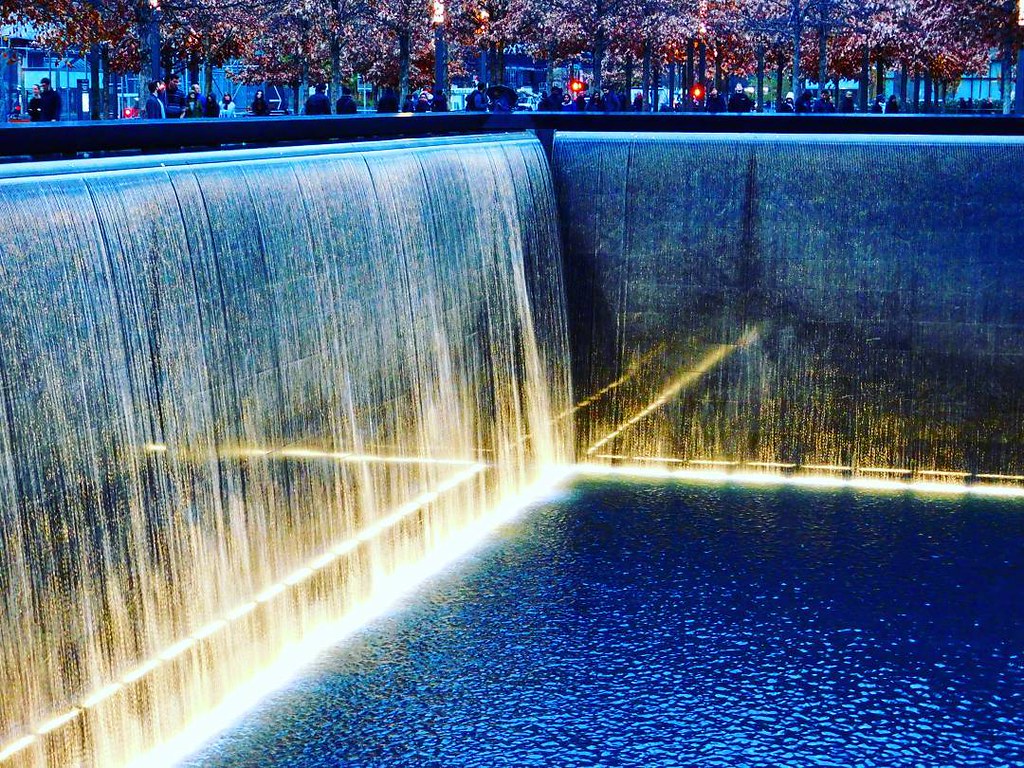
We went to New York City in 2015 for Thanksgiving, and we did go to "Ground Zero". We weren't there long, but we did want to see the place where this thing happened. It was a damp, cloudy, cold day...and for the location, somehow very beautiful.


There is always beauty to be found, eventually. I wish America would remember that more. Americans, myself included, are too quick to respond with anger and rage to the ugliness of the world.

I eventually wrote a short story in response to the emotions I was feeling at the time, called "The City of Dead Works", and I used to post it annually here. I don't do that anymore, but you can read it here. And please do read Sheila O'Malley's post about one life that was lost that day.


Wednesday, September 01, 2021

For the Record

 I support the right to abortion. Moreover, I do not think that anyone who gets an abortion has done anything the least bit morally wrong. I believe that conservatives in America, for all their blather about "freedom", will keep chipping away at real freedoms until there aren't any left.

If this is a problem for you, the "Back" button is to your upper left.

And no, I am not interested in debating this.

Tuesday, August 03, 2021

Happy Birthday...

 ...to the person whose influence on my life includes, among many other things, a love of these various musical numbers.

And so many more!

(The person in question is my mother, who turns 80 today!)


Monday, August 02, 2021

Sure, we got a billion bucks lyin' around someplace


 Looks like the shoe is finally dropping in Buffalo and WNY, regarding the future of the region's NFL franchise: the team's owners, Terry and Kim Pegula, are floating the idea of a new stadium to replace the team's existing venue, which would be publicly funded to the tune of over $1,000,000,000.

Hold on, let me count the zeroes to make sure I have that right...thousand, million, billion. Yup, that's right.

Newer reports have the team citing possible other locations for the franchise if the stadium doesn't happen. Locations like Austin, Texas.

My position on this is simple: I am against any public funding for stadiums at all. None. Not one penny.

A sports team is an investment on the part of billionaires that in almost every case ends up making many more billions for those owners. If someone who is worth a billion dollars wants something that costs a billion dollars, well, let them put up their own money for it. The notion that the public should put up the money so the owner can reap further billions is ludicrous.

And don't come at me with "Stadiums spur development!" and "Stadiums create jobs!" We all know this is complete nonsense. Study after study after study has confirmed it. I live less than a mile from the local stadium, and believe me when I tell you, the area around the stadium is not a hotbed of massive economic development. There's about half a dozen bars, a convenience store that was a 7-11 once, a Tim Hortons, and one of those really seedy motels where people who, ahem, are required to register their whereabouts and living arrangements with the local constabulary (and whose presence might be communicated to local parents) go to live.

I consider spending a billion dollars on a single project that will literally benefit a small number of people and enhance the profits for literally one family, and I think of things like...local schools. Parks. Water and electrical infrastructure. Libraries. Museums and arts projects. Streetlights. (This last one sounds prosaic, but I think of it every time I drive through another city that has streetlights on its main expressways. Buffalo does not.)

On a larger point, I am sick of living in an economy which is largely organized around the precept that the natural and preferred course of money is ever, ever relentlessly upward. The idea of giving money to people at the bottom of the economic spectrum is seen as socialist nonsense, but the idea of public money being spent in gigantic amounts so that a single married couple can pocket more millions in profits before eventually selling their investment for a gargantuan return is never even questioned.

When sports stadium talk comes up, I think of Atlanta, Georgia. In the early 1990s, an aging facility--Atlanta Fulton County Stadium--served both the NFL's Atlanta Falcons and MLB's Atlanta Braves. The state of Georgia funded the building of the Georgia Dome for the Falcons, which opened in 1992, and the Braves got their new park, Turner Field, four years later when the stadium build for the 1996 Summer Olympics was converted to ballpark status.

In the last few years, both of those venues, built not just in my lifetime but in my adulthood, have been replaced, and for all the usual reasons cited, each and every one of which could be reduced to one very simple reason: the teams' owners could make more money if they had new venues.

And now here come the Pegulas, the owners of the Bills. When they bought the team they tabled new stadium talk for several years, even though everyone around here knew the subject would come up, if not by them then by the NFL itself (which is an organization that is made to further the football-related investment goals of the owners). As the team is finally good again after many years of not being good, it's clear that the Pegulas basically wanted to wait until the local mood was favorable toward the Bills again. It's no accident that the year after the team went 13-3 and nearly made the Super Bowl that the owners are shaking the money tree for a new stadium.

Where will it be built? Current discussion is a new stadium pretty much across the street from the current one, so at least we seem to have abandoned the notion of building it in downtown Buffalo. But still: local money? Over a billion dollars of it?

This local citizen says no. And if the Bills move to Austin (or Toronto, or San Antonio, or Portland, or anywhere else), this local citizen says, "Thanks for the memories, good luck." I saw the point being made all over social media the last couple days that the Bills "bring Upstate NY together" and that the Bills shape the local mood, and that losing the Bills would be an irrevocable blow to the local psyche. This seems deeply unhealthy to me. Plenty of successful and fine cities exist in this country with no major sports teams. It is my firm belief that we can have a very nice and vibrant city, with all of the things that nice and vibrant cities have, without major-league sports teams. I like sports and I get excited by the prospect of Josh Allen leading the Bills to a championship too, and I'd like to see the hockey team stop being awful and win a Stanley Cup...but I'd hate to lose the Philharmonic, the Albright-Knox, Shea's, or our waterfront much, more more. I'd hate to see local schools get worse and for jobs and people to keep migrating away.

Regional identity, self-image, self-worth, and major economic policy should not be based on the existence and/or the performance of local sports teams.

If the Pegulas want it, let them build it. And if they can't afford it, well--Terry Pegula once boasted that if he needed more money he'd just drill another well.

Start drilling, Terry. Better start now.


Sunday, July 04, 2021

Seven Four Twenty One

 As another Independence Day arrives, I find myself increasingly unable to really understand what's happening in America. I find myself these days oddly optimistic about the future of humanity, but a good deal less so about my country.

Here's a piece I just saw for the first time this morning. It was written last September, before the election, but you don't have to change many words to make it relevant for this day, today, this morning.

From "A New American Manifesto":

From the People of the United States of America: From time to time in human societies, things get so bad with the governments that we set up that we have to take a step back, stop being citizens of that government and just be basic humans again, loyal only to the primary needs of humanity. This is one of those times and it’s only fair if we are going to take such a drastic step, that we first explain why. We owe everybody that.

First of all, we start by taking for granted that nobody’s life should matter more than anyone else’s. Everyone should have the right to live their life without people oppressing them. At minimum everyone should have the right to live. Nobody should be prevented from moving around freely or doing whatever they want as long as they are not causing harm to someone else. More than that, every human has the right to seek out things that bring them joy.

These are basic things that humans need.

The whole reason we create governments is so that communities can come together and agree among themselves to set up structures that make sure that ALL the humans among them have access to these fundamental needs. If the structure that they set up stops functioning properly, if it becomes corrupted, if it stops serving the needs of the people, then it is critical that those humans be allowed to dismantle that structure in order to build one that does a better job. They need to be allowed to create new structures that are better at keeping them safe and happy.

Sounds familiar, doesn't it? Not unlike a similar missive, written in ink on parchment, and signed two hundred and forty-five years ago by a gathering of wealthy white men in Philadelphia. Later, some of those same men would gather to bang out some ideas for how to go about forming a more perfect union. Imperfect men, imperfectly representative of their new nation, doing incomplete work in forming a nation that somehow always feels...incomplete.

Well, that's America, and we do still have it in ourselves to make a more perfect union. 

This is a harder and harder country to love, but hope still flickers. A little, anyway.

Flicker on, America. Flicker on....


(Comments are closed on this post)

Wednesday, June 30, 2021

"I'd rather die living"

 I suspect these little controversies have been erupting all over the United States over the last few months, as the COVID-19 vaccines have rolled out. My local version had a prominent member of the Buffalo Bills, a wide receiver named Cole Beasley (who is quite a good player indeed) opining quite loudly that he will not be getting vaccinated, because of, well, reasons. As his reasons are almost entirely transparently goofy anti-science BS, his entire position ended up boiling down to amorphous concepts like "Freedom!" and "Personal choice!" and "Respect my opinion!" and, in one very strange utterance, "I'd rather die living."

I'm not going to prosecute the scientific case against the vaccinations, because in my estimation there simply is no such case and I'm not going to pretend there is just for the sake of balance. (And if you intend to use my comments section to make your own anti-vaccine arguments, don't bother. Moderation is on and no such comments will be published, nor even read past the point it takes me to recognize the game.) I am, however, interested in this notion of "I'd rather die living", because it represents a deeply strange way of looking at life.

I've heard various versions of this sentiment all throughout the pandemic, and in some contexts, even farther back than that. A particularly weird individual, an Ayn Rand-loving Objectivist, with whom I occasionally crossed swords on a particular geeky forum before I realized how far out the dude was and stopped engaging entirely. But at one point he was holding forth on the "metaphysical consequences" for not thinking logically (i.e., conceding the superiority of every one of his opinions), though he could never exactly say what those "metaphysical consequences" might be. I do recall him quoting a line from the movie Braveheart, in which our hero, on the eve of his public execution, says "Every man dies, but not every man really lives." Seems to me the same kind of notion as Beasley's "I'd rather die living".

Here's my question: I got vaccinated, just as soon as I was eligible to do so. Does this mean that I'm not "living", in Beasley's head?

Seriously, what does that mean?!

The idea seems to be an expression of a particularly annoying brand of American individualism. I've seen a lot of the past 18 months in America as yet another in a lifelong (and longer, actually) sequence of events illustrating just how spectacularly bad Americans are at thinking collectively, in terms of being a part of a community and the idea that a society has moving parts, and those moving parts are people. The very notion of doing any one thing that you might not want to do, on the basis that by doing so you will assist others, is anathema to a great number of people in this country. I mean, sure, they'll do voluntary stuff, because that makes them feel good. They'll donate to charities and attend the Basket Raffles to benefit some cancer victim, but suggest that we all contribute via our taxes to a nationally-administered health program that meets the healthcare needs of the people at significantly less cost per capita and ends the possibility of bankruptcy for people who get sick? Well, that is unacceptable.

We've seen this all over the place in the last year: You can't tell me not to go to a packed theater! I'm an American! I have freedom!

You can't tell me not to eat at a packed restaurant or get takeout only! I'm an American! I have freedom!

You can't tell me not to go to a baseball game with forty thousand other people! I'm an American! I have freedom!

You can't tell me not to wear a mask! I'm an American! I have freedom!

And now?

You can't tell me to get a vaccine! I'm an American! I have freedom!

Just imagine that: thinking that your freedom to refuse a vaccine to beat a pandemic that has killed more than 600,000 of your fellow citizens as of this writing is somehow more important than protecting the lives of those people in the first place.

To me, this represents a pretty sick version of freedom, and it's pretty clear to me that there are limits beyond which protecting life is a finer goal than preserving certain "freedoms" that aren't exactly existential in nature. In fact, I believe the ways that life might be made better through collective action greatly outweigh the benefit of any abstract "freedoms".

I don't mind giving up my freedom to drive my car 90mph whenever I want.

I don't mind giving up my freedom to drink a bottle of scotch and then go out driving.

And those are just the obvious examples. I don't mind giving up my "freedom" to quit my job tomorrow, because the benefit of showing up to work and doing a good job far outweighs the exercise of my "freedom".

And you know what? I'm still living, in every sense that matters.

By choosing to accept wearing a mask and by getting vaccinated against COVID-19, I wasn't choosing to not live. I think I was choosing to live more than Beasley is: I'm choosing to do my part in squashing this pandemic, and hopefully bring about the ability to do the things I love all the sooner. And while doing those things, it's not like I was sitting in some sort of ascetic withdrawal from society. We went out, we went for walks in the woods, we went on long drives, we got takeout food from favorite restaurants. We watched movies, had fires in the backyard, read books, walked dogs. We adopted two cats. We listened to music. We lived.

For Cole Beasley's "I'd rather die living" notion to be true, then the converse would also have to be true: By choosing the mask and social distancing and vaccination, I chose not to live. Beasley thinks his existence is somehow richer than mine, simply because he's taken the ignorant path against vaccination. And I find that notion...stupid and insulting.

You know what I've been doing, Cole Beasley? I've been living. And part of that has been helping to ensure that other people live, and that the people who need me and rely on me will still have me.

I've been living. And I'd rather continue living.

Because show me a person who died living, and I'll show you a dead person.

I'll get there soon enough, I guess. But for now, I'm not going to elevate it in some weird way.

(Comments are closed.)


Monday, May 31, 2021

On Memorial Day

Here is my annual reposting of some things that pertain to Memorial Day. This particular year's iteration of this day gives me pause to consider my sense that many of the things for which the men and women we honor today fought and died may be slowly, or quickly, passing into memory. I hope not....

First, a remembrance of a soldier I never knew.

Fifteen years ago I wrote the following on Memorial Day, and I wanted to revisit it. It's about the Vietnam Veteran whose name I remember, despite the fact that I had no relation to him and clearly never knew him, because he was killed four years before I was born.

Memorial Day, for all its solemnity, has for me always been something of a distant holiday, because no one close to me has ever fallen in war, and in fact I have to look pretty far for relatives who have even served in wartime. Both of my grandfathers fought in World War I, but both had been dead for years when I was born. I know that an uncle of mine served during World War II, but I also know that he saw no action (not to belittle his service, but Memorial Day is generally set aside to remember those who paid the "last full price of devotion"). My father-in-law served in Viet Nam, but my own father did not (he had college deferments for the first half of the war, and was above draft age during the second). So there is little in my family history to personalize Memorial Day; for me, it really is a day to remember "all the men and women who have died in service to the United States".

One personal remembrance, though, does creep up for me each Memorial Day. It has nothing at all to do with my family; in fact, I have no connection with the young man in question.

When I was in grade school, during the fall and spring, when the weather was nice, we would have gym class outdoors, at the athletic field. On good days we'd play softball or flag football or soccer; on not-so-good days we'd run around the quarter-mile track. But the walk to the athletic field involved crossing the street in front of the school and walking a tenth of a mile or so down the street, past the town cemetery. I remember that at the corner of the cemetery we passed, behind the wrought-iron fence, the grave of a man named Larry Havers was visible. His stone was decorated with a photograph of him, in military uniform. I don't recall what branch in which he served, nor do I recall his date-of-birth as given on the stone, but I do recall the year of his death: 1967. I even think the stone specified the specific battle in which he was killed in action, but I'm not sure about that, either.

That's what I remember each Memorial Day: the grave of a man I never knew, who died four years before I was born in a place across the world to which I doubt I'll ever go. And in the absence of anyone from my own family, Mr. Havers's name will probably be the one I look for if I ever visit that memorial in Washington. I hope his family wouldn't mind.

I looked online and found these images, first of Mr. Havers's obituary and then of Mr. Havers himself. The things you remember. I wonder what kind of man he was. He has been gone for more than half a century. His name is not forgotten.


Mr. Havers's service information can be found on the Virtual Vietnam Wall here. He was born 14 October 1946 and died 29 October 1967, in Thua Thien.

Next, my annual repost for Memorial Day.

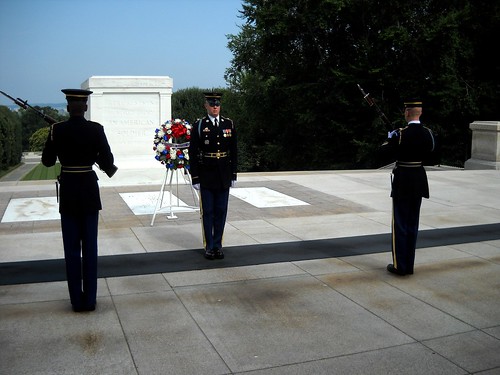
Tomb of Unknown Soldier


Know, all who see these lines,
That this man, by his appetite for honor,
By his steadfastness,
By his love for his country,
By his courage,
Was one of the miracles of the God.


-- Guy Gavriel Kay


"The Green Field of France", by Eric Bogle

Well, how do you do, young Willie McBride,
Do you mind if I sit down here by your graveside?
And rest for awhile 'neath the warm summer sun,
I've been walking all day, and I'm nearly done.
I see by your gravestone you were only 19
When you joined the great fallen in 1916,
I hope you died quick and I hope you died clean
Or, Willie McBride, was it slow and obscene?

Did they Beat the drum slowly, did they play the fife lowly?
Did they sound the death-march as they lowered you down?
Did the band play The Last Post in chorus?
Did the pipes play the Flowers of the Forest?


Did you leave a wife or a sweetheart behind
In some faithful heart is your memory enshrined?
And, though you died back in 1916,
To that faithful heart are you forever 19?
Or are you a stranger without even a name,
Enshrined then, forever, behind a glass pane,
In an old photograph, torn and tattered and stained,
And faded to yellow in a brown leather frame?

Did they Beat the drum slowly, did they play the fife lowly?
Did they sound the death-march as they lowered you down?
Did the band play The Last Post in chorus?
Did the pipes play the Flowers of the Forest?


The sun's shining down on these green fields of France;
The warm wind blows gently, and the red poppies dance.
The trenches have vanished long under the plow;
No gas and no barbed wire, no guns firing now.
But here in this graveyard that's still No Man's Land
The countless white crosses in stand mute in the sand
To man's blind indifference to his fellow man,
And a whole generation who were butchered and damned.

Did they Beat the drum slowly, did they play the fife lowly?
Did they sound the death-march as they lowered you down?
Did the band play The Last Post in chorus?
Did the pipes play the Flowers of the Forest?


And I can't help but wonder, no Willie McBride,
Do all those who lie here know why they died?
Did they really believe when they answered the call,
Did they really believe that this war would end wars?
Well the sorrow, the suffering, the glory, the pain
The killing and dying, was all done in vain,
For young Willie McBride, it all happened again,
And again, and again, and again, and again.

Did they Beat the drum slowly, did they play the fife lowly?
Did they sound the death-march as they lowered you down?
Did the band play The Last Post in chorus?
Did the pipes play the Flowers of the Forest?


Friday, May 14, 2021

Happy Birthday to the Maker!

 Happy birthday to George Lucas!

Happy birthday George Lucas! #StarWars #GeorgeLucas

It's no accident, or exaggeration, when I say that George Lucas is the biggest influence on my storytelling. Star Wars imprinted on me at a very young age, and it is still my guiding star, even with all the other influences that I've blended (and, let's be honest, pillaged and stolen from).

I've gone so far as to dedicate The Savior Worlds to Mr. Lucas. In terms of the stories that are in my heart, I may not owe him all of them, but I owe him a whole damn lot of them.

Thank you, Uncle George!

The dedication page for THE SAVIOR WORLDS. I would not be the storyteller I am today without George Lucas's work. It's just that simple. #HappyBirthdayGeorgeLucas #StarWars


Sunday, April 25, 2021

A Year of Masking

 It's been a little over a year since Governor Cuomo issued an executive order requiring people to wear masks when in public. I remember the week or two leading up to that order, as it was pretty clear that masks were coming, and soon. People were saying things like "I hope we don't all have to wear masks!", but I was thinking, It's just a matter of time. And sure enough, it was.

And now, a year later, we're still wearing them...or at least, we should be wearing them. I've still got mine:

Masked

Yes, I took that picture outside, just [day]. And yes, I still wear mine outside...depending on where I am. More on that later.

Like many people, it took me a while to figure out the whole mask thing. The first mask I had was the "tissue paper" variety of disposable surgical mask, which left me feeling like I was struggling for oxygen and unable to see because just two months earlier I had returned to wearing glasses most of the time. It didn't take me all that long to figure out how to shape the little wire thing to my nose, thus cutting the glasses-fogging down significantly. I also got accustomed to breathing through the mask pretty quickly; my brain was pretty fast in getting over the Oh shit I can't breathe all my exhaled CO2 isn't going anywhere and I'm going to faint for lack of oxygen OH NOES!!! thing. Yeah, that was complete nonsense that my brain was cooking up, as demonstrated by people all over the interwebs posting photos of their blood-O2 readings after hours of mask-wearing.

(I did buy an blood-O2 device, which I was at one point using daily to make sure I wasn't heading into trouble. I never was; I have received exactly three readings less than 97%, and each of those became a 97 or better when I took it off my finger, waited ten seconds, and re-tested.)

A week or so later, my company provided white cotton masks for all of us to wear. This wasn't entirely an improvement, as these didn't have the wire in the nose and it wasn't entirely clear which end was up. I didn't much care for this one, as it was thicker and made my mouth a bit hotter and the glasses problem got worse with this one.
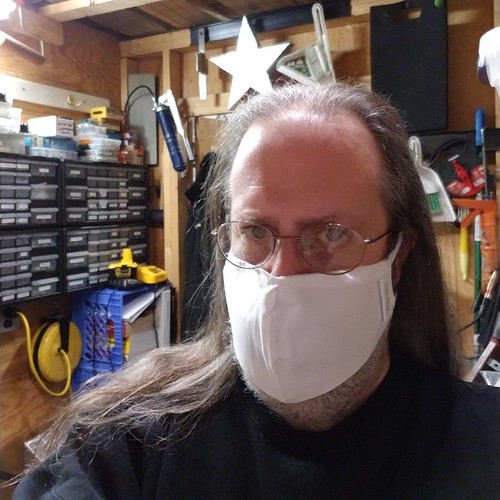
This may make my RBF worse. #Mask

For me, the main comfort issue was not with breathing or the warmth around my mouth and nose, which are things I actually got used to. The serious source of discomfort came from the ear loops. I don't know how many other people had the same problem, but the flesh behind my ears would start to ache after an hour of wearing the mask, and after several hours, the pain was bad. I am lucky at my workplace in that I have a small workroom that's all mine, into which I can go and where only one person is allowed at any time, due to social distancing guidelines. Thus I could get a "mask break" when I needed one, but long-term, this kind of mask wasn't the answer. I did see gadgets on the market where you could tighten the loops to fasten around a strap that then tensioned against the back of the neck, thus relieving the ear issue...but instead I bought some hand-made masks from a guy I know who just happens to be an artisanal denim maker who makes, among other things, designer bib overalls.

Here I am with his mask and a pair of his overalls:
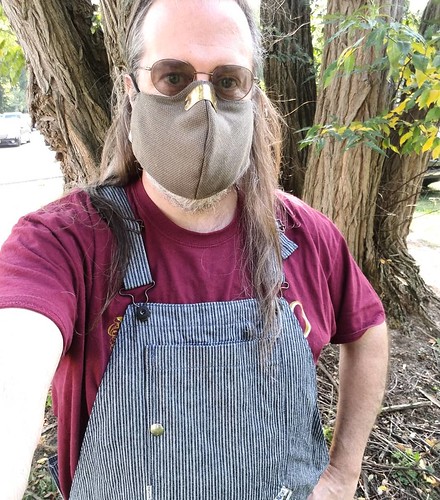
At the Farmers Market! Rocking the @zacebrand overalls AND mask! #ootd #overalls #dungarees #biboveralls #zacedenim #hickorystripe #denimoveralls #overallsarelife

Not only was I able to purchase from an artisan directly, but these are very well-made, with good thick layers of cotton, an opening for a filter, and the brass nosepiece that folds to the nose easily and holds its shape. Best of all, though, is that the elastic loops go around the head and tighten via a spring clip. At last I had masking comfort and safety!

If you're interested, those masks are still available, I believe! His current site is https://buttonbandana.com/; his usual web address, ZaceDenim.com, currently points to the Button Bandana site.

As the pandemic dragged on, I did buy another trio of masks, these from Proper Cloth. These also come with around-the-head loops, a nose-bridge stiffening wire, an internal filter and are made with thick-weave cotton. And if you want color choices, these are good, too. (I got navy blue.)

Out and about #winter #WinterInThe716 #ootd #overalls #dungarees #biboveralls #vintage #lee #leeoveralls #hickorystripe #denimoveralls #overallsarelife #vintageoveralls #sweatersandoveralls #scarf

When I bought my masks, I bought three each time, so I still have one of each that I haven't even worn yet. This seemed wise to me, given that it does not seem that masking is going to go away completely in the foreseeable future.

So that's the mechanics of my mask-wearing. But how do I feel about masks in general?

Meh, I'm fine with them.

An awful lot of people have seized on mandated mask-wearing as the kind of tyrannical government overreach that fuels the fevered nightmares of all libertarians, which is in all honesty an over-the-top reaction that makes me either laugh or shake my head every time I encounter it. Masks are a pretty simple thing to do, but a whole damn lot of folks in this country hate them and go out of their way to make their feelings plain. I've seen people wearing MAGA masks, and masks reading "Worn by FORCE not FEAR!!!" (as if fear is the motivation, as opposed to thinking collectively about being a member of a functioning society). Once I was in a store and saw a woman wearing a mask that was imprinted: "THIS MASK IS USELESS!!!" That's a big claim for the anti-mask folks, that mask-wearing is utterly useless and serves no purpose whatsoever. I've heard a lot of very bizarre claims, like "How can masks protect you from COVID if you can still smell a fart!" Thus demonstrating the speaker's complete ignorance of the size difference in gas molecules and respiratory droplets. Or the goofy claims about how masks make your exhaled CO2 cloud around your mouth, stealing your oxygen, which I've already noted as disproved.

And then there are people who note the stubborn persistence of this pandemic, usually with a simple and pithy "I thought you said masks work!" Thus proving that they don't understand that nobody ever said that masks were a simple cure-all. So it goes.

Oh, and the woman mentioned above with the "THIS MASK IS USELESS!!!" mask? I was deeply tempted to walk up to her and say, "You're right, your mask IS useless, since you're not wearing it over your nose, you idiot." I did not do this, but damn, was I tempted.

I have not found mask-wearing in any way an impediment to my life or my job, and I do work that is occasionally fairly strenuous. In truth, sometimes I forget that I'm actually wearing the thing! More than once I've gone to sip from the mug of coffee in my hand, only to remember that I've got a mask on and I need to wait. Some commenters, usually right-wingers, will gripe about seeing people wearing masks in their car when they are driving by themselves; my response is that I do this because I'm usually combining multiple errands and multiple stops into the same trip, and I am simply not bothered enough by the mask to put it on, take it off, put it on, take it off, lather rinse repeat, all day until I'm done.

I also tire of the performative mask-removers. These are the people who will, upon exiting the store or business in which they've had to wear a mask to enter, will rip it from their faces and take in a huge breath of air, as if they're breaking the surface of the water after a deep dive to the limits of their lung capacity. Cut the shit, folks. You're not fooling anybody. Ditto the "I have mah rights!" crowd who insist that some tortured reading of the Constitution gives them the right to not wear a mask in a private business.

The newest wrinkle on mask-wearing, now that the vaccinations are proceeding nicely across the country*, is to insist that now we should all be able to stop wearing masks at least outdoors, and they should be a lot less necessary indoors. And yet, you can see by the topmost photo, I'm still wearing my mask outdoors. Why? Well, I don't always wear a mask outdoors. When I take The Dee-oh-gee(s) for walks, either around the neighborhood or at a local park, I am very much still social distancing, and in nearly all such cases I am not encountering anyone at all other than to wave hello from the other side of the street.

However, when we venture into, say, the Village of Hamburg for our weekly trip to the local bakery we like, I'm putting the mask on. It's a village, and I run into a lot more people there for fifteen minutes than I do in an hour of walking in the woods. Even though we're outside and the outside breezes should disperse respiratory droplets pretty quickly, I'm not comfortable risking that...even though I'm vaccinated. The vaccines we have are amazing science, but all the science isn't in yet, and we don't know enough about whether fully-vaccinated people** can carry the COVID virus in sufficient supply as to pose a threat to non-vaccinated individuals. I choose not to risk it.

I choose to think collectively. I have thoughts on the recent history of America's ability to think collectively, but I'll save them for another time; suffice it to say that right now, the American addiction to "rugged individualism" is starting to strongly appear to me like the thing that's going to ultimately doom this country to receding into the historical fog. But that's for another time.

And you know what else is nice? When I'm wearing a mask, if you irritate me, you're not going to be able to read my lips when I mutter, "F*** you!" And it's over a year since the last time some self-appointed Enforcer Of Required Happiness told me to smile, so that's something.

So yeah, I'm gonna keep wearing my mask. And if that bothers you, well, that's your problem, not mine.


(swiped from someone on Facebook; actual credit unknown)


* If you haven't had your vaccine, and you don't have a doctor telling you not to get your vaccine for whatever reason, go get your damned vaccine. Anti-vax preciousness is absurd and indefensible.

** I reached the "fully vaccinated" threshold of two weeks past my second dose of the Moderna vaccine over a week ago.

Comments for this entry are closed.
Thursday, March 11, 2021

How do you measure, measure a year.... (Something for Thursday)

 One year, give or take, more or less.

There's a famous song from the Broadway show Rent, called "Seasons of Love". The song talks about the measure of time, specifically, a year:

Five hundred twenty-five thousand six hundred minutes
Five hundred twenty-five thousand moments so dear
Five hundred twenty-five thousand six hundred minutes
How do you measure, measure a year?

In daylights, in sunsets
In midnights, in cups of coffee
In inches, in miles, in laughter, in strife
In five hundred twenty-five thousand six hundred minutes
How do you measure, a year in the life?

That's how many minutes there are in one year: 525, 600.

As I write this (a few days before I'm publishing it), the COVID-19 death toll in the United States, according to the CDC website, is 519,064. We're just under a death a minute from this disease, over the last year.

"How do you measure, measure a year." Indeed.

I'm not sure when I consider the COVID-19 virus to have really "begun", in terms of being a major concern in my personal world. Maybe it was when the World Health Organization declared it a pandemic (March 11, 2020). Maybe it was when Tom Hanks announced that he and his wife, Rita Wilson, had tested positive (March 12, 2020). Maybe it was when the National Basketball Association had to start canceling games because players were testing positive (the same day). I remember watching this segment on John Oliver's Last Week Tonight, which aired on March 1, 2020, a few weeks before everything went haywire. The segment is worth watching again, because it's astonishing how wrong everybody was at the beginning...but even given that proviso, note Larry Kudlow confidently saying, "We've got this thing contained already."

What strikes me most about that video--and this was not only before vaccine development was even at a hopeful stage, but when our best science still hadn't homed in on COVID-19's respiratory nature and was still not really endorsing mask use and was instead focusing on rigorous hand-washing and avoiding face-touching--is what Oliver says at the 18:25 mark:

"At this point, you may be wondering, how scared should you be? And the answer is probably, a bit. A bit. I don't want to be alarmist here, but I don't want to minimize what we might be facing here."

It turned out that we should have been a bit more than a bit scared, but then, we didn't know then what was to come or how Americans would react to it all. Those first weeks, though? Those were...incredible.

It's all a bit hazy right now, but as COVID-19 began to take hold in the US, and as we all realized that Mr. Kudlow's lying aside, we most certainly did not have this contained, and as we all saw in the news stories of massive lockdowns in China and Italy and other places with soaring case and death counts, Americans started to panic. For those of us who work in grocery stores, that panic turned into something pretty epic. The run on cleaning supplies was obvious, as were the runs on a number of food staples. People were suddenly wondering: Are we about to be locked in our homes for weeks on end? Are we going to be forbidden to go outside? Will we not be able to buy food or other supplies?

By the end of those first days, the shelves at The Store looked like...well, I struggle to come up with a metaphor, but we've all seen the pictures from grocery stores in the South when the hurricane that's on its way has been upgraded to Category Four. Our delivery schedules were thrown into serious awry as individual stores were suddenly ordering two, three, four times as much supply as they usually did; this surge got passed on to corporate warehouses and then to suppliers. Some brands disappeared from our shelves and have yet to show back up, even now. Buyers scrambled to get stocked with brands we'd never heard of (and if I may say so, Sugardale pepperoni is really tasty!), and of course there were the buying limits that seemed to go on forever. One can of beans. One jar of peanut butter. One package of toilet paper.

And oh, toilet paper. Somehow that one item became the "poster child" for the pandemic's early run of panic shopping, didn't it? I came in to work on Saturday morning for a sixth day, just to assist our overwhelmed Grocery department, and the first thing I did at 6:45 am was to pull a pallet of toilet paper out onto the sales floor. The entire pallet was emptied by eager customers in minutes. So was the second one. So was the third one.

At that point, no one had any real idea of how to best combat the virus. The best advice was to wash your hands constantly and avoid touching your face. My hands were absolutely raw after all that washing, and that's when hand lotion became an indispensable part of my life. We didn't know yet that the virus was mainly transmitting via respiratory droplets, but that became clear pretty quickly (I remember a horrifying story about a choir someplace in Washington that had a rehearsal that led to nearly all the choir members becoming infected), and then...masks were upon us.


This may make my RBF worse. #Mask

I never liked wearing masks as a kid, not even as part of a Halloween costume, so this took me some time to get used to. It took me a bit of experimenting to realize that the best masks for me were the ones where the straps or cords go around the head and not around the ears, and I bought several masks online from makers who knew what they were doing (i.e., not cheaply-made single-ply thin cotton ones). A year later, I've mostly become accustomed to wearing the mask, though I do consider myself fortunate in that my job affords me ample opportunity to take the mask off when I'm alone in my own work room. But even so, I have to admit to being shocked and dismayed at the reaction to masks by an awful lot of Americans.

I've seen people wearing masks with anti-mask slogans printed right on them, which strikes me as deeply weird. One said "This mask is USELESS!", and naturally, it was, given that its wearer had it below her nose. Another said "Worn by FORCE, not FEAR!!!", which is just goofy. I do not for the life of me understand that macho American attitude toward "fear", as if self-preservation is a non-manly thing to want. I periodically see snark online: Why would you wear your mask when you're DRIVING BY YOURSELF, sheeple! Well, speaking just for myself, I'm making several stops in one trip and I don't want to bother with putting the mask on, taking it off, putting it on, taking it off, each time I stop someplace or come outside. And don't get me started on the people who will, upon exiting a store or office, rip their mask off and take in a giant deep breath as if they've just broken the surface after a deep dive in the sea beyond the limits of their lung capacity.

I've reached a point where much of the time I'm wearing a mask, I don't even think about it and barely notice that I have it on, to the point that I've actually caught myself trying to do things like blow a bit of hair off my phone or take a sip of coffee while masked. I cannot understand the sheer levels of anger something so simple as a face mask has inspired. I am once again confronted by the degree to which a great many of my own fellow citizens hold beliefs with which I cannot even begin to remotely empathize...but this is not that post.

As crises go, it's been very strange for me that this one has been fairly well tailored to suit my particular lifestyle. As an introvert who is quite happy to live a mostly inner life, this pandemic has not been that hard to live with. I miss eating out with The Wife, and the festivals that we love visiting were all canceled last year: no Nickel City Con, no Sterling Renaissance Festival, no Erie County Fair, no Ithaca Apple Harvest Festival. But I still got to go on nature walks with the dogs, and while eating in restaurants hasn't been a thing in a very long time, we've had a lot of wonderful takeout meals. But we don't find ourselves missing out on desperately-needed human contact; we don't find ourselves starved for hugs and we don't find ourselves aching for a return to "normal". I would, in fact, be lying if I did not admit that some small part of me finds a bit of satisfaction in seeing the world's extroverts, so many of whom act like introverts like me are somehow problematic, being forced into my way of living for a little while.

Still, though: it's been a year, and it's been a hard year, a bad year, a terrible year. It's been a year that was always going to be bad, but didn't have to be as bad as it was (and I have a lot more to say about that, whether or not I actually do decide to say any of it). But there were moments along the way, moments of light, moments of goodness, moments that made me think that maybe, just maybe, this entire experience would be a learning experience for enough of us--a critical mass, if you will--that maybe we can still build a future to come in which we put aside the notion that we're all in this alone, that we're all marked for our individual fates and that our purpose here is just to serve as our own tiny cogs in the great machine that we call The Economy.

As the light grows at the end of this tunnel, I hope and pray that we take the lesson with us that nothing had to be this way, and that our world can be better. If a crisis does nothing else, it affords us an opportunity to look deeply at our society and ask serious questions about why we do certain things the way that we do. A "return to normal" would be so incredibly disappointing, wouldn't it? I don't know about you, but I was never in love with my "normal". I dare us to do better.

And I think that those 525,600 people--one for every minute, and counting--dare us to do better too.


Saturday, March 06, 2021

Onward Cultural Warriors, slipping on banana peels!

 In this week's entry in Right Wing Insanity, we have...Dr. Seuss.

I shit you not. This one has been amazing in its dishonesty and stupidity all at the same time. Here's the summary I put up on Facebook:

1. Dr. Seuss Enterprises, the private entity that owns the copyrights to Dr. Seuss's books, makes a decision to remove six books from the market, because the books contain racist imagery typical of their time.

2. The FOX News crowd freaks out about "cancellation", even though, once more for the people in back, this was a market decision made by a private entity. (These are the people who usually claim to love "freedom" and "the market", but invariably lose their shit when "the market" uses its "freedom" to recognize realities they don't like.)

Now the funny part:

3. FOX News fans buy Seuss books en masse, thinking apparently to show support for the cancellation-in-progress author, thus giving buckets of THEIR OWN MONEY to the very private entity that made the market decision in the first place.

Let's not forget that these are the same people who think the election was stolen, that masks are useless, that climate isn't changing, that tax cuts raise revenue, that trickle-down works, and so on.


That's about it. "We're so mad about this thing that we're gonna shovel money at the people who did the thing we're pretending to be mad about!" It's like deciding to prank the people down the street by ordering a dozen pizzas to be delivered to their house...but paying for the pizzas with your own credit card.

And why do I say "pretending"?

Because nobody in the media, no matter what Tucker Carlson or Ben Shapiro or any of the other talking heads on FOX News, is actually upset by this. It's just pretend nonsense, as cynical an attempt to whip up the base as anything I've ever seen. FOX News, for all its beating of the drum, won't even show the offending images on teevee; and here you see a Republican MAGA weirdo Congressional candidate spouting a staggering amount of lying for a single tweet:

Note that Ms. Bish is pretending that some cherry-picked random thing from Dr. Seuss is what is actually the issue, and also note her mention of President Biden as if he has the first thing to do with any of this. Hey, Ms. Bish! Want to show the offending pictures of African or Chinese people, and tell us why you think they're perfectly fine? No? Didn't think so.

The rubes have got to stop falling for this shit, and what's more, it would be helpful if they'd start to ask themselves: If they're being this dishonest in trying to fire me up, what else are they lying through their teeth about? That, friends, would be a far more profitable rabbit hole to explore than whatever nonsense the QAnon people are floating on any given day.

Comments closed on this post.

Saturday, February 20, 2021

Liberatopia isn't seeming like much of a topia these days

 Former Texas Governor and former US Secretary of Energy Rick Perry was quoted the other day as saying this:

"Texans would be without electricity for longer than three days to keep the federal government out of their business."

Well, now.

This, right here, is a perfect illustration of why I have always rejected libertarianism.

Whenever I ask how social issues and problems will be solved in a libertarian system, the answer always starts with what I call "the Soft Libertarian Formulation": the market will solve all problems. Freedom will solve all problems. In all cases, the markets in their free wisdom will always be better suited to solving specific social problems than the government.

My reply to this is always, "But what if it doesn't?"

No, really. Think about it. What if something, some problem, some disaster, comes down the pike that the free markets just can't fix? And what if that problem just persists, going on and on, getting worse and worse, possibly even to the point where people are dying?

The market will solve all problems better than the government...but what if it doesn't?

This possibility is never admitted, never considered. There is simply no problem that can't be fixed through freedom and markets and zero government interference!

But now, look what's happening in Texas. They wanted to be free of federal interference. They wanted their own power grid, with their own authority to manage their electrical needs in any way they wished. And they got their desire! Only problem is, they did it in the finest capitalist free-market way, taking the cheap way out at every opportunity. Texas does have winter storms now and then, so obviously it would be a good idea to winterize things, right? Only, that would cost money, and what rich capitalist wants to spend money they don't have to, right?

And now Texas is in a world of hurt.

Here comes Rick Perry, presumably asked if maybe Texas's weird obsession with energy independence from Washington policy makers has proven a bad idea.

Because here, Mr. Perry, is a bad social problem that the Free Market not only can't solve, it actually created.

And Mr. Perry says, "Nope, we're good being without electricity for days on end if it means we stay the way we are."

This is a version of what I call "the Hard Libertarian Formulation": It does not matter what problems come along. The Markets and the Freedom are so inherently good, all by themselves, that preserving them is preferable over any alleviation of human suffering by way of government. By way of collective action.

It's my experience that eventually every libertarian will eventually land on this position. Collective thinking is always bad. No problem can ever be approached in any kind of collective way, and if a problem arrives that can only be solved through collective action, through government, well then: the problem must not be solved. Individuals should simply swallow their emotions and live--or die--with the new facts of life, because nothing, nothing, is more important than avoiding government and collective action.

This is, incidentally, why I think you find climate change denialism so strongly ensconced in the political right: because climate change actually is a problem that has no solutions coming from the free markets, and they know this. Because libertarianism cannot be wrong, there can be no problem that libertarianism can't solve. And if there is, then the problem must not exist.

This isn't the first time Perry has said things like this. One time he said (I think he was running for President at the time, maybe in 2012) something along the lines of "No government has ever created a single job." This will, of course, come as news to anyone living in a city with a major military base. Or in a town with a state-run college. Or...in Washington, DC.

(I wrote this two nights ago and have had it in drafts since then. In the meantime, news is coming out that Texas's utility companies, in the great and wonderful tradition of unregulated capitalism, are gouging the hell out of their customers by issuing electricity service bills totaling in the THOUSANDS of dollars. People who are without power, heat, water, and easy access to food are getting electric bills for up to $10,000. This is what unfettered, unregulated capitalism will get you, each and every time. It continues to amaze me that people who don't have a prayer of ever being in the small club of capitalists who get to benefit from its inherent tendency to funnel wealth upward still advocate for its adoption, because of the Hard Libertarian Formulation.)

[Comments closed on this post]

Friday, January 22, 2021

When the House had a filibuster (a Repost)

Since the filibuster is back in the news--and hopefully because it's about to die, once and for all--I'm reminded of the passage from Barbara Tuchman's THE PROUD TOWER, which I excerpted back in 2009. Here it is again.

A number of the liberal-leaning blogs I read have been arguing of late that the filibuster in the US Senate needs to be done away with, as it is a fundamentally undemocratic thing whose use has become so frequent and entrenched over the last few years as to render the Senate into a body which de facto requires a supermajority in order to pass anything. (Example.) I tend to agree with this argument; the filibuster's main virtue seems to be that it's been that way forever, and that, in itself, is never much of a reason to keep doing anything. But I'm reminded of a historical episode I read about in a wonderful book by Barbara Tuchman, The Proud Tower, in which she describes a similar problem faced once by a Republican Speaker of the House named Thomas B. Reed, at the end of the nineteenth century.
He [Reed] was determined, on taking up the gavel as Speaker, to put into effect a plan on which he had long deliberated, consulting no one, and on which he risked his entire political future. He knew that the fight would focus upon him the nation's attention and also that if he failed his Congressional career would be over. The stakes were high: he would either break "the tyranny of the minority" by the which the House was paralyzed into a state of "helpless inanity", or he would resign. 
The system Speaker Reed had decided to challenge was known as the silent – or disappearing – quorum. It was a practice whereby the minority party could prevent any legislation obnoxious to it by refusing a quorum, that is, by demanding a roll call and them remaining silent when their names were called. Since the rules prescribed that a member's presence was established only by a viva voce reply to the roll, and since it required only a majority of the whole to constituted a quorum, the silent filibuster could effectively stop the House from doing business.
... 
To Reed the issue was survival of representative government. If the Democrats could prevent that legislation which the Republicans by virtue of their electoral victory could rightfully expect to enact, they would in effect be setting aside the verdict of the election. The rights of the minority, he believed, were preserved by freedom to debate and to vote but when the minority was able to frustrate action by the majority, "it becomes a tyranny". He believed that legislation, not merely deliberation, was the business of Congress. The duty of the Speaker to his party and country was to see that that business was accomplished, not merely to umpire debate.
...
He reached his decision to attack the silent quorum, and planned his campaign, alone, partly because no one else would have thought there was a chance of success and partly because he was not sure that even his own party would support him. There were indications that they might not. Because of Reed's known views on the silent filibuster it was clear that quorum-counting would be an issue in the new Congress. REED WILL COUNT THEM, predicted a headline in the Washington Post, and the story beneath it said that even Mr. Cannon, Reed's closest lieutenant, was, opposed to the attempt. The Democrats were manning their defenses. Ex-Speaker Carlisle let it be known that any legislation enacted by a quorum which had not been established by a "recorded vote" would be taken to court as unconstitutional. 
Reed, however, had satisfied himself that he would be upheld if it came to law, and on the attitude of his own party he was prepared to gamble. He shrewdly judged that the Democrats in their rage would provoke the Republicans to rally to his support. When the first of the contested elections appeared on the schedule for January 29 he was ready. As expected, the Democrats raised a cry of no quorum and demanded a roll call. Reed's moment had come. Without a flicker of expression on the great white moon face, "the largest human face I ever saw", as a colleague described it, without any quickening of the drawling voice, he announced, "The Chair directs the Clerk to record the names of the following members present and refusing to vote," and began reading off the names himself. Instantly, according to a reporter, "pandemonium broke loose. The storm was furious...and it is to doubted if ever there was such wild excitement, burning indignation, scathing denunciation and really dangerous conditions as existed in the House" during the next five days. Republicans were wildly applauding, all the Democrats were "yelling and shrieking and pounding on their desks" while the voice of their future Speaker, Crisp of Georgia, boomed, "I appeal! I appeal from the decision of the Chair!" The explosion was "as violent as any ever witnessed in any parliament," a member recalled later. "Mr. Blanchard, Mr. Bland, Mr. Blount, Mr. Breckinridge of Arkansas, Mr. Breckinridge of Kentucky..." 
Up jumped the Kentuckian, "famous for his silver hair and silver tongue." "I deny the power of the Speaker and denounce it as revolutionary!" he called. 
The resonant twang from the Chair continued unregarding, "Mr. Bullock, Mr. Bynum, Mr. Carlisle, Mr. Chipman, Mr. Clement, Mr. Covert, Mr. Crisp, Mr. Cummings" – through hisses and catcalls and cries of "Appeal" irresistably rolling down the alphabet – "Mr. Lawler, Mr. Lee, Mr. McAdoo, Mr. McCreary..." 
"I deny your right, Mr. Speaker, to count me as present!" bellowed McCreary. 
For the first time the Speaker stopped, held the hall in silence for a pause as an actor hold an audience, then blandly spoke: "The Chair is making a statement of fact that the gentleman is present. Does he deny it?"
It's a fascinating tale. It doesn't end there with that one act of Reed's, of course; few things of this nature ever do. The Republicans would later lose Congress so badly that the Democrats were able to raise a quorum by themselves, and they then restored the silent quorum. This backfired after the next election cycle, however; the Democratic majority was greatly reduced such that now-Minority Leader Reed was able to frustrate Democratic legislative aims by using the silent quorum himself, until the Democrats finally relented and allowed the silent quorum to end forever. (The Proud Tower is one of my favorite history books, by the way. It is a large-scale picture -- a historical snapshot, if you will -- of the state of the the world as it was moving inexorably toward World War I.)

ADDENDUM FOR 2021: If my views aren't clear enough, here it is: To hell with the filibuster. It was never a great wonderful thing to begin with, and now it has become something utterly perverse. Democrats should kill it, pass their legislative agenda, and then let Republicans try to run in 2022 not on Democrats' failure to pass anything, but on promising to repeal what they passed.

Oh, and the prospect of Mitch McConnell being rendered impotent is a truly delicious one.

Wednesday, January 20, 2021

Dear 45 (an Open Letter to the President of the United States)


As I write this, you are still President, for another 47 minutes. I guess it's time to reflect a bit. Here's part of what I wrote to you four years ago today

I do not support you, and I do not expect good things from you. I do not expect good policy choices, nor do I expect good outcomes. My expectations for you are astoundingly, confounding low, because that's where you put them. You did it by appealing, day in and day out, to the very worst instincts in the American psyche, right from your campaign's opening address when you warned us all about the steady stream and rapists and murderers surging into our country from across the Rio Grande.

You did it by lying day in and day out, so much that reporters had trouble figuring out how to report that you were lying. You lied so much that you were eventually lying about having lied in the first place. You ran the most dishonest presidential campaign I have ever seen, and yet somehow you managed to reap the benefit of an opponent whom most people seem to think is also a huge liar, even though she isn't.

You did it by cheering on the expulsion of people from your events of people who don't like you or who say things about you that you don't like.

You did it by several years ago making your first big claim to political fame by pursuing the stupid fiction that Barack Obama was not a natural-born American citizen.

You did it by showing on FOX News repeatedly to scoff at the very idea of global warming and climate change.

You did it with idiotic policy proposals like building a wall between the United States and Mexico, and then compounding this stupidity with the idea that Mexico will somehow be forced to pay for it.

You did it by filling your administration with people who are clearly on the take, people who are clearly going to make out like bandits, people who are obviously going to set to the tasks of destroying the missions of the agencies they are heading, and people who are simply downright ignorant (an Energy Secretary who didn't know what the department even does, or a HUD secretary who believes that the Egyptian pyramids are grain silos).

You lowered my expectations by attacking people left and right on Twitter, by egging on your bizarrely rabid followers, by threatening your opponent with investigations and prosecutions, and by scoffing at one's obligations as a citizen by saying "It makes you smart" that you managed to avoid paying income taxes at one point.

There is literally nothing you have said or done over the last eighteen months that gives me the smallest reason to think that you might be a good President. You have shown no curiosity about issues or insight into them. You have shown zero respect for the work of the job or the norms that surround it. You have demonstrated no foreign policy acumen aside from chest-thumping and Russo-philia. I can think of no issue that stands to improve for your having addressed it, and I can think of no aspect of American life that will be better for your having been President.

And the thing is? You're going to fail. No matter what. You're going to be able to do a lot of damage, and you'll ruin a lot of lives. Hell, if you and your cohorts in Congress repeal the ACA without a "replacement" (and let's be honest, none of you has the slightest idea what kind of "replacement" you'll offer), you might just kill people. But it won't matter. Not in the long-run, it won't. You're not going to reignite American manufacturing so that towns once more have big factories employing ten thousand people. You're not going to be able to push all of the queer people back into their respective closets. You're not going to make the young people like you.

Ultimately, though, I don't even think you care that much, and that may bother me most of all. You seem to expect the Presidency to be this easy thing that you can almost do on a part-time basis, and that your business experience is one hundred percent applicable to the challenges you will confront as President. As to the latter, your business experience isn't the unbroken run of amazing success stories that you often say it is, and that experience is not always applicable. What might be OK in a board room is not OK in a cabinet meeting.

In short, I expect your Presidency to be a time of awful policy making combined with amazing levels of corruption. The last administration that paired deep disengagement in policy and facts with willingness to profit from events did not result in good results. Your judicial appointees will be terrible people, and our Congress will rubber-stamp your stuff and you'll rubber-stamp their stuff. The idea of national government in the hands of you, Paul Ryan, and Mitch McConnell fills me with many emotions, none of them happy and most of them angry.

Not only was none of this wrong, you somehow managed to be even worse than I expected. I expected George W. Bush levels of incompetence, disengagement, and bad policy, but not only did you manage to crank up the settings on all of those, you added to the mix a casual type of cruelty that wasn't terribly surprising, but it was still unnerving. You seemed to take actual delight in the sufferings of the American people whom you were elected (if only by the deeply bizarre set-up we Americans have where someone with fewer votes can still be elected) to lead and serve.

I never had any expectation of you growing in office, but damned if you didn't seem to shrink to the occasion, each and every time. I knew that your general approach to policy would be terrible, and my only real hope was that things would somehow manage to not get super bad in America by the time we got our chance to vote you out.

Of course, this hope was in itself dangerous, since Americans don't tend to take a very long view of policy, which made it a very real risk that we'd hit 2020 with things just king of bubbling along, like they were for the first three years of your term, and Americans would look at the state of affairs and say, "Meh, he's doing OK, I guess." The inertia of history takes a long time to shift, and it often takes bad governance years to manifest in terrible results that hurt millions. Likewise, it takes good governance years to repair terrible results, which is where America often gets into trouble: we get frustrated when the Democratic Presidents we elect to get America out of the ditch that Republican Presidents like you steered it into don't quite get the job done in 18 months, and then we fill Congress with Republicans who have zero investment in doing anything other than keeping us in the ditch.

But here we are: you put the country in a calamitous position, by pursuing things that were unimportant and ignoring things that were. You ignored the warnings about likely pandemics, and then when one actually arrived, you dithered and you dallied and you ignored experts who were telling you what you didn't want to hear and you installed charlatans who told you what you did, and now here we are, four hundred thousand deaths and counting later, and we're a country that can't get on the same page about something so simple as wearing masks to protect each other.

No, you didn't create the climate in America, but you took advantage of it and you poured gas on its embers and fanned the flames at every opportunity you had. You used the power of your office in the most brazenly and transparently transactional way probably in history, and what of that? You're still heading off to face all manner of legal troubles, and the idea of anyone giving you giant sums of money to build some tall building someplace is laughable. (Maybe Boise will try; you could end up with Trump Tower Boise being the tallest building there, but then, in Boise, twenty floors will get it done.) You gave your ear to the Stephen Millers, Steve Bannons, Seb Gorkas, and Michael Caputos of the world. I expected your administration to be a Rogue's Gallery of the worst people in America, and you certainly met that expectation, head-on.

Meanwhile, our country's economic inequality continues to grow, student loans continue to break the backs of millions, our infrastructure (which of all things I expected you to do something about, even if it was a half-assed grifting something) is still crumbling and well behind the rest of the world, and we have lost another four years that we didn't have to fight climate change. I am not exaggerating when I say that there is no aspect of American life that is better for your having touched it. Yours is a perverse kind of mirror universe Midas touch, in which everything with which you come in contact is either terrible to begin with or becomes terrible because you touched it.

Well, while there is still the enormous problem that many millions of Americans still support you, and that a significant portion of those do so on the basis of irrational nonsense conspiracy crap that wouldn't even make an interesting X-Files episode, I can still take comfort in the fact that of the many problems America is facing today and in days to come, one of them has been definitively addressed.

You, Mr. Trump, are no longer America's problem. May the wind be forever in your face, and may the road crumble before you with each step you take.

Sincerely,

--An American citizen who has no more time or inclination to think about you at all.


Wednesday, January 13, 2021

T-minus Seven Days and Counting

 If nothing else, I hope that in seven days' time the world will start to transition to a state in which my usual emotional state is not some form of anger.


Saturday, January 09, 2021

"Common Ground"

 Of all the images from the failed coup the other day, there's one that I can't stop thinking about. I especially think about this image as I consider all the people who keep telling me that we need to "come together" and we need to find "common ground" and that both sides need to figure each other out if we're to prosper as a nation.

That image is this one:


It's just one of the rioters, right? Scampering through the House chamber. We've seen lots of images like this, and a whole lot of folks have tried passing all of this off as the adult version of the fantasy we all has as kids of getting free and unsupervised access to the school.

But...look closer.

That guy is holding a bunch of cable-tie handcuffs.

This is what law enforcement uses as hand restraints nowadays.

This guy showed up for the riot prepared to take prisoners.

And he wasn't alone. Among the other images from that day that stick in my mind? One, which I'm not sharing here, is of a gallows that these people set up near the Capitol.

It doesn't take the creative mind of a writer of space operas to imagine what might have transpired if these people had managed to corner a member of Congress someplace. It doesn't take a major feat of imagination to think of what might have happened if they'd managed to get hold of, say, Alexandria Ocasio-Cortez. Or Ilhan Omar. Or Nancy Pelosi, or Bernie Sanders, or Adam Schiff. Or, believe it or not, Vice President Pence, whom many of those rioters now view as a traitor for his failure to wave whatever magic wand they think he has to stop Congress from recognizing the Electoral College's election of Joe Biden as President.

These people stormed the United States Capitol and at least some of them were thinking in terms of violence: capturing lawmakers, and maybe killing them.

There is no common ground to be found here. There is no basis on which they and I can unify so we can work together to build a better nation. These people don't want a better nation. All they want is their nation, and they literally do not care how much of a shithole their nation is, so long as it's theirs. Well, they are not welcome in my nation...or in the nation belonging to many, many millions of us.

To hell with "common ground", and to hell with anyone who showed up in Washington to riot, and to anyone who stayed home to sympathize with them.

(Comments are closed on this post.)

Thursday, January 07, 2021

"We are who we were."

 Longtime readers know that one of my main ways of processing the world is through movies and teevee shows I've seen, and books I've read. I often find in the creative works of others a prism through which I can crystalize my own thinking on the issues of the day.

Today's attempted coup* in Washington is no exception.

I found myself thinking about the great John Quincy Adams speech that comes at the end of the movie Amistad. If you haven't seen the film, it involves a major court case that arose from a property dispute where the property was human lives. The captives aboard a slave ship somehow get control of the ship, but they are soon captured by another vessel, and what ensues is the legal fight for freedom. The legal case, being a bellwether for slavery and property concerns as America is heading toward the Civil War, ends up before the Supreme Court, and one of the lawyers working the case is John Quincy Adams, current member of the House of Representatives and former President of the United States.

It's quite a movie speech (historically, it's not terribly accurate, but so what?), and it ends with this remarkable passage after JQ Adams (played by Sir Anthony Hopkins six years after he played Hannibal Lecter, and you can see nothing of the previous performance in this one) has described how in the African tribe to which the man Adams represents belongs, in times of deep difficulty they invoke their ancestors, thinking them as great a force in their lives now as when they were alive.

James Madison; Alexander Hamilton; Benjamin Franklin; Thomas Jefferson; George Washington; John Adams: We've long resisted asking you for guidance. Perhaps we have feared in doing so we might acknowledge that our individuality which we so, so revere is not entirely our own. Perhaps we've feared an -- an appeal to you might be taken for weakness. But we've come to understand, finally, that this is not so.

We understand now. We've been made to understand, and to embrace the understanding, that who we are -- is who we were.

It's that one quote there that gets me: "Who we are is who we were." We don't escape history. Nothing happens without precedent, without its first principles being established years, decades, even centuries past. The road we walk is the one our ancestors paved, for good or ill. It's a road that leads to amazing things: a nation that helped defeat Fascism on opposite sides of the globe, and a nation that built itself on the stolen labor of some and the stolen land of others. We're a nation that visited the Moon and questions if we did. We're a nation that elected a black man President, and then turned around and enabled a four-year tantrum by people who hate that this ever happened.

"Who we are is who we were." We were racists and white supremacists and violent conquerors of people who lived here before us. We weren't just those things, but we were those things...and who we are is who we were.

But we were also something else. At least, I hope we were.

In the movie, JQ Adams continues, closing his speech:

We desperately need your strength and wisdom to triumph over our fears, our prejudices, our-selves. Give us the courage to do what is right. And if it means civil war, then let it come. And when it does, may it be, finally, the last battle of the American Revolution.

I suppose now we'd have to rephrase that: Let it come, and when it does, may it be the last battle of the American Civil War.

(You can read the entire JQ Adams speech from Amistad here, and there's a clip of the whole thing, so you can watch Hopkins deliver one of the best movie speeches in history.)

* Yes, it was an attempted coup. I will entertain no counterargument on this.

(Comments are closed for this post)

Wednesday, January 06, 2021

My Letter to Chris

 Tonight I did something I haven't done in quite a while. I e-mailed my Representative in Congress.

Unfortunately, I happen to live in a district that is currently as reliably crimson as any small town in Alabama, and my current Representative, Chris Jacobs, has thus far in his short career (he was only first elected in a special election last summer) proven to be a pandering empty suit, but today he managed to irritate even me by being not just a rubber stamp for the right wing, but a gutless one. He announced today his intention to join the chorus of Congressfolk who are "objecting" to the Congressional certification of the Electoral College results. Today. On the very day those results were to be certified, and on a day when he knew that there would almost certainly be violence.

Chris Jacobs took a cowardly stance because he knew that his base would demand it, and he took that stance when he knew the light would shine dimly on him if if shone on him at all.

Here's a rough paraphrase of what I wrote, since I didn't think to copy-and-paste it until after it was sent (via an email form on his web page):

As a liberal Democrat in your district, I have had no illusions that you would represent my beliefs or values in Washington much at all, but even so I was surprised to learn how cowardly you are in your service to those constituents you do claim to represent. I see that you have waited until the very last possible moment to announce that you, too, will object to the certification of the Electoral College's ultimate election of Joseph R. Biden as the next President of the United States.

I am sure that you know, as well as I do, that not a single shred of proof or actionable evidence of any voter fraud at all, much less a sufficient degree of it to swing an entire American Presidential election, has been advanced in any court in this country. I am sure that you know that this notion is simply delusional, and I am sure that you know that your endorsement of it is nothing but cowardly pandering to your base. What was surprising in your cowardice is that you waited until today, on the day the votes were to be counted in Congress, and on a day when you surely knew that many thousands of the current President's supporters would be in Washington to "protest", to make your announcement. You waited until you knew the light would not be on you, and then you stepped up to bravely say, "Me too."

Again, I know that there is zero chance of you advocating in Congress for MY values, but know that I will work tirelessly at home to oppose YOURS. While this district is currently as red as it gets, there is no law of nature requiring it to remain that way forevermore, and whatever the future holds, this moment will pass and you're young enough that you'll likely live to see at least some of history's judgment of you and those with whom you have made common cause. Your grandchildren will know what kind of man you were, and people like me will work hard to make sure that they know.

Sincerely,

and so on and so forth.

Maybe this was intemperate? I don't know. But I do know that what's happening now is not tenable, and that this country cannot long survive so much of its population being off its collective rocker. And it likely cannot survive so many of its elected officials being in thrall to such pure craven irrationality.

(Comments are closed on this post)