Showing posts with label Poetry. Show all posts

Thursday, April 01, 2021

Something for Thursday (National Poetry Month Edition)

 Today is April 1, which means that it's another National Poetry Month! This month, each of my Thursday music posts will involve poetry, either by direct setting or...something else. (What "something else" may be, I'm not really sure. It might just be settings.)

This is a gorgeous setting of a slightly revised version of one of my favorite poems by one of my very favorite poets, Alfred, Lord Tennyson. The poem is "The Lady of Shalott", and the musician is the great Loreena McKennitt.

John Atkinson Grimshaw - "The Lady of Shalott" - Google Art Project.jpg

This poem has appealed to me ever since I read in high school, either my junior or senior year. Its lyricism and its capture of the sadness of one of the tales that takes place at the periphery of the Arthurian legend (which is ultimately a collection of very sad stories). Tennyson's work continues to move me greatly; no matter how poetry changes or what has come after, I always find myself responding to his sense of rhyme and meter, as well as his content. Reading Tennyson is like coming home.

"The Lady of Shalott" begins thusly:

On either side the river lie
Long fields of barley and of rye,
That clothe the wold and meet the sky;
And thro' the field the road runs by
       To many-tower'd Camelot;
The yellow-leaved waterlily
The green-sheathed daffodilly
Tremble in the water chilly
       Round about Shalott.

As it's lengthy, I won't quote it here in its entirety. But you can read it here.

And here is Loreena McKennitt's setting.

Monday, April 20, 2020

Poetical Excursion: "The Ruin", from the Anglo-Saxon

This poem is fascinating in that it seems to anticipate Shelley and Ozymandias by almost a thousand years. It describes in some depth the ruins of a Roman city, which has fallen into decay and disrepair, and juxtaposing that imagery with the thoughts of life that must have once flourished there. By the time this poem was written in the 8th or 9th century, the ruins being described (it's not entirely clear which ones specifically are in the poet's heart, or if they're even meant to) had probably been abandoned for centuries already. It's often worth remembering just how much time really passed during the Middle Ages, and how distant a memory the glory of Rome truly was.

The Ruin comes to us from a manuscript called the Book of Exeter, and unfortunately the poem as we have it is incomplete because of fire damage to the book itself. This translation comes from one of my favorite poetry collections. The poem itself is anonymous.

The Ruin

Well-wrought this wall-stone which fate has broken:
The city bursts, the works of giants crumbles.
Roofs are fallen, towers in ruins,
The gate is gone, frost on the mortar,
The shelters in shards, open to showers,
Eaten by age. Earth has in its grasp
Ruler and workman, removed now, perished,
Held fast in the ground while a hundred generations
Went from the land. This wall remained,
Stood under storms, will all around perished.
Bright were the buildings, many bath-houses,
High-gabled homes, and the sound of soldiers,
Many a mead-hall where men enjoyed themselves
Until mighty fate overturned all.
Many men fell in the days of wrath;
Death took all the valor of earth.
Bulwarks became wrecked foundations,
A fortress in fragments. The builders perished.
Defenders gone unver. The courtyard is dreary;
The arch of red stone, the roof with its rafters,
Shed their tiles, and they slip to the earth,
A broken mound. Once many men
Glad and gold-bright, in gleaming array,
Proud and wine-flushed, shone in war-apparel;
Saw the treasure, the silver, the well-set jewels,
RIches, possessions, precious stones,
In the bright fortress of a broad kingdom.
Stone courts stood, the hot stream came
In its broad whelm; a wall enclosed all
Within its bosom. There the baths were,
Hot in the midst. It was a haven.

Translated by Michael O'Brien,
Printed in World Poetry: An Anthology of Verse From Antiquity To Our Time

Wednesday, April 08, 2020

A Poetical Excursion: "Love Has Seven Names" by Hadewijch

I read this poem--translated from the original Dutch--in my copy of World Poetry. I had never heard of Hadewijch before, so I did a little digging. It turns out that's about all one can do. Very little is known about the life of Hadewijch, a mystic and poet who likely lived at some point in the 13th century in Brabant, a duchy in what is now Holland. Hadewijch wrote in Brabantian, a language predating modern-day Dutch, and just about everything we know about her comes from the writings of hers that have survived. She had some influence, although she seems to have utterly disappeared from European consciousness in the 1600s, only to reemerge in the 1800s when some of her works were found in the Royal Library in Brussels.

An excerpt from Hadewijch's entry on Poetry Chaikhana:

Little can be said for certain about the life of Hadewijch. Unlike many other women mystics of the time, no biography was written about her, so all we know is what scholars have been able to deduce from her writings themselves.

Hadewijch was probably the head of a Beguine community. The Beguines were a sect of devout women in Belgium, Holland, Germany and northern France. Beguines did not take vows, but they gathered together to live in simplicity and service. Many Beguines were mystics and poets of the highest order.

Hadewijch's poetry has a rich love mysticism. Like her contemporary, St. Francis of Assisi, Hadewijch was clearly inspired by the courtly love poetry of the Troubadours and Minnensingers. The fact that she was familiar with this courtly art form suggests that Hadewijch was probably born to a noble family.

Love Has Seven Names is most certainly a mystical poem, full of lyrical mystery and very clear mysticism, right from the very first line. Seven names for love? Naturally, since seven is a number that is historically beloved of mystics of all kinds.

Love has seven names.
Do you know what they are?
Rope, Light, Fire, Coal
make up its domain.

The others, also good,
more modest but alive:
Dew, Hell, the Living Water.
I name them here (for they
are in the Scriptures),
explaining every sign
for virtue and form.
I tell the truth in signs.
Love appears every day
for one who offers love.
That wisdom is enough.

Love is a ROPE, for it ties
and holds us in its yoke.
It can do all, nothing snaps it.
You who love must know.

The meaning of LIGHT
is known to those who
offer gifts of love,
approved or condemned.

The Scripture tell us
the symbol of COAL:
the one sublime gift
God gives the intimate soul.

Under the name of FIRE, luck,
bad luck, joy or no joy,
consumes. We are seized
by the same heat from both.

When everything is burnt
in its own violence, the DEW,
coming like a breeze, pauses
and brings the good.

LIVING WATER (its sixth name)
flows and ebbs
as my love grows
and disappears from sight.

HELL (I feel its torture)
damns, covering the world.
Nothing escapes. No one has grace
to see a way out.

Take care, you who wish
to deal with names
for love. Behind their sweetness
and wrath, nothing endures.
Nothing but wounds and kisses.

Though love appears far off,
you will move into its depth.

Not exactly the stuff of Hallmark cards, is it? It's a very old view of love, not entirely positive and not entirely negative, either. Hadewijch seems to view love as a natural force in itself, neither positive nor negative. It's something that can go either direction. It is a binding rope, and it is light and fire. It is cleansing dew, and it is actually Hell. That's pretty amazing. Not every love poem is about comparing thee to a summer's day.

Monday, April 06, 2020

Poetical Excursion: A poem about overalls!

So, something cheerful...I'm going to try to post more of that sort of thing over the next few weeks, I think. The world has darkness a-plenty and I'll be occasionally writing about that, too. But here's a poem I found by an author named Tony Johnston. She is a prolific writer of books for children who lives in California. This is from a book called Once in the Country: Poems of a Farm, written in 1996.

My Overalls

The best thing is their color,
old-night or early-dawn.

No, the best thing is their limpness
when I hoist them on.

No, the best thing is their looseness
like the soft skin of a pup

No, the best thing is their buckles
like a suitcase snapping shut.

No, the best thing is their perfume
of cows and hay and dung.

No, the best thing is their many holes
to let in all the sun.

Obviously I don't own any overalls that are redolent of "cows and hay and dung", but I do have a couple of old pairs--vintage!--that aren't quite holey yet, but may get there sooner rather than later.


More poems to come!

Friday, April 03, 2020

Poetical Excursion: Edna St. Vincent Millay and Beethoven

I won't post a poem each day of this National Poetry Month, but I'll try to do so as often as I can! Here's one I found in a collection of music poetry I have, which fits right in with my year-long focus on Ludwig van Beethoven. This sonnet, by Edna St. Vincent Millay, is titled On Hearing a Symphony of Beethoven. Note that Millay does not specify which of the nine symphonies she has just heard! It could as easily be the light and good nature of the 1st, or the power of the 3rd, or the majesty of the 5th, the dance-like awe of the 7th, or the storm-turned-to-joy of the 9th.

Sweet sounds, oh, beautiful music, do not cease!
Reject me not into the world again.
With you alone is excellence and peace,
Mankind made plausible, his purpose plain,
Enchanted in your air benign and shrewd,
With limbs asprawl and empty faces pale,
The spiteful and the stingy and the rude
Sleep like scullions in the fairy tale.
This moment is the best the world can give:
The tranquil blossom on the tortured stem.
Reject me not, sweet sounds! oh, let me live,
Till Doom espy my towers and scatter them,
A city spellbound under the aging sun,
Music my rampart, and my only one.

The lines that hit me hardest here are the ninth and tenth:

This moment is the best the world can give:
The tranquil blossom on the tortured stem.

Unlike a painting or a sculpture or even a poem, a symphony (or any piece of music) can only exist in time. You can't linger on a particular melodic moment that especially strikes your ear, the way you might stop in an art gallery to spend more time gazing upon a particular painting on the wall. Music is only meaningful in time, and thus music only exists as a momentary thing. Beethoven's Fifth Symphony does not exist in the same sense that Michelangelo's David exists. Every performance is a singular event, ephemeral and blossom-like.

And since we're here, let's just go ahead and have a Beethoven symphony. We could hardly do better to honor Edna St. Vincent Millay. Here is the Symphony No. 2 in D Major, with Daniel Barenboim conducting the West-Eastern Divan Orchestra at the BBC Proms in 2012.

Wednesday, April 01, 2020

Poetical Excursions, National Poetry Month 2020: Thomas Nashe

National Poetry Month is upon us.

At last--at long, long, long last--it is finally April. This March was...something, wasn't it? In fact, there's a joke going around online; I've seen a number of variations on the theme and I've no idea who made this joke first, but it roughly goes like this:

Wow, I just realized that I've been alive in seven decades!

-the 70s
-the 80s
-the 90s
-the 2000s
-the 10s
-the 20s
March

Yeah, that about sums it up. And this April is likely to be, for many of us, even worse than March was. But here's hoping April sees some kind of turning-of-the-corner.

For me, the current crisis has yielded more time than I even usually have for digging into my internal world of music and prose and verse, and I don't believe I have heard anything about National Poetry Month being called off just because it feels like the world is spinning off its axis. So, in addition to other things, I plan to spend time in April digging into poetry. If the current pandemic has you feeling powerless, remember: you can still enjoy poetry and explore it. There are, after all, several thousand years' worth of the stuff to dig through.

Let's start, though, on a somber note, for obvious reasons. This year's celebration isn't going to be all joy and cheer; sometimes it will be huddling around a guttering candle as the wind roars without, and sometimes it will be waiting in the dark corner as a pounding comes at the door. But it will also be occasional cheer, or, failing that, at least a shaking of the fist at the booming thunderclaps (a worthy image, that, in this year of Ludwig van Beethoven's 250th anniversary).

Let's start with Thomas Nashe.

Nashe was a contemporary of William Shakespeare's, and reliable biographical information on him seems about as abundant. We have his dates as 1567-1601, but we know nothing at all about his death or where he was buried. Much of what is known about him is by inference. He did, though, live in London during outbreaks of the plague, which led him to write this poem. A Litany in Time of Plague is just that: a lengthy rumination on the inevitability and the finality of death, and the way it reduces everyone and everything, in the end, to the purest equality that exists.

Adieu, farewell, earth’s bliss;
This world uncertain is;
Fond are life’s lustful joys;
Death proves them all but toys;
None from his darts can fly;
I am sick, I must die.
   Lord, have mercy on us!

Rich men, trust not in wealth,
Gold cannot buy you health;
Physic himself must fade.
All things to end are made,
The plague full swift goes by;
I am sick, I must die.
   Lord, have mercy on us!

Beauty is but a flower
Which wrinkles will devour;
Brightness falls from the air;
Queens have died young and fair;
Dust hath closed Helen’s eye.
I am sick, I must die.
   Lord, have mercy on us!

Strength stoops unto the grave,
Worms feed on Hector’s brave;
Swords may not fight with fate,
Earth still holds ope her gate.
“Come, come!” the bells do cry.
I am sick, I must die.
   Lord, have mercy on us.

Wit with his wantonness
Tasteth death’s bitterness;
Hell’s executioner
Hath no ears for to hear
What vain art can reply.
I am sick, I must die.
   Lord, have mercy on us.

Haste, therefore, each degree,
To welcome destiny;
Heaven is our heritage,
Earth but a player’s stage;
Mount we unto the sky.
I am sick, I must die.
   Lord, have mercy on us.

Sunday, April 28, 2019

For National Poetry Month, a poem.

From An Anthology of World Poetry, edited by Mark Van Doren, a French ballad. No poet is named.

"The Bridge of Death"

"The dance is on the Bridge of Death
   And who will dance with me?"
"There's never a man of living men
   Will dare to dance with thee."

Now Margaret's gone within her bower,
   Put ashes in her hair,
And sackcloth on her bonny breast,
   And on her shoulders bare.

There came a knock to her bower door,
   And blithe she let him in;
It was her brother from the wars,
   The dearest of her kin.

"Set gold within your hair, Margaret,
   Set gold within your hair,
And gold upon your girdle band,
   And on your breast so fair.

For we are bidden to dance to-night,
   We may not bide away;
This one good night, this one fair night,
   Before the red new day."

"Nay, no gold for my head, brother,
   Nay, no gold for my hair;
It is the ashes and dust of earth
   That you and I must wear.

"No gold for mu girdle band,
   No godl work on my feet;
But ashes of the fire, my love,
   But dust that the serpents eat."

They danced across the Bridge of DEath,
   Above the black water,
And the marriage-bell was tolled in hell
   For the souls of him and her.


Monday, April 08, 2019

"January, 1795" by Mary Robinson (a poem)


Mary Robinson (1757-1800),
painted by Thomas Gainsborough

One of a series of occasional posts for National Poetry Month.

One of my major resolutions for 2019 is to read more poetry. I've always enjoyed poetry and I always try to read some here and there, but this year I'm trying to be even more serious about it, even to the point of starting a poetry reading journal in which I record thoughts about poems as I read them. I'm also reading some books about poetry in an ongoing attempt to strengthen this particular literary muscle of mine.

I discovered this poem purely serendipitously: by thumbing through one of my copies of The Oxford Book of English Verse. (I have multiple editions of this book, because its contents have not been constant through the many years of its publication, and alongside the eternals are the lesser-so works, and poems are like music in that many that deserve to live on don't always do so). I found a single poem by a poet named Mary Robinson, of whom I don't remember ever hearing before. Here is the poem:

January, 1795

Pavement slipp’ry, people sneezing,
Lords in ermine, beggars freezing;
Titled gluttons dainties carving,
Genius in a garret starving.

Lofty mansions, warm and spacious;
Courtiers cringing and voracious;
Misers scarce the wretched heeding;
Gallant soldiers fighting, bleeding.

Wives who laugh at passive spouses;
Theatres, and meeting-houses;
Balls, where simp’ring misses languish;
Hospitals, and groans of anguish.

Arts and sciences bewailing;
Commerce drooping, credit failing;
Placemen mocking subjects loyal;
Separations, weddings royal.

Authors who can’t earn a dinner;
Many a subtle rogue a winner;
Fugitives for shelter seeking;
Misers hoarding, tradesmen breaking.

Taste and talents quite deserted;
All the laws of truth perverted;
Arrogance o’er merit soaring;
Merit silently deploring.

Ladies gambling night and morning;
Fools the works of genius scorning;
Ancient dames for girls mistaken,
Youthful damsels quite forsaken.

Some in luxury delighting;
More in talking than in fighting;
Lovers old, and beaux decrepid;
Lordlings empty and insipid.

Poets, painters, and musicians;
Lawyers, doctors, politicians:
Pamphlets, newspapers, and odes,
Seeking fame by diff’rent roads. 
Gallant souls with empty purses;
Gen’rals only fit for nurses;
School-boys, smit with martial spirit,
Taking place of vet’ran merit.

Honest men who can’t get places,
Knaves who shew unblushing faces;
Ruin hasten’d, peace retarded;
Candor spurn’d, and art rewarded.

I read this poem three times in a row the first time I found it, and I've been returning to it ever since. More than that, this single poem has made me keenly interested in Robinson herself, who seems to have lived quite a colorful life. She wasn't just a poet. She was an early feminist, and an actress (she would be nickanmed "Perdita" after she did notable performances in that role in Shakespeare's The Winter's Tale), and later she became the mistress of the Prince of Wales, before he himself went on to become King George III. Though she eventually died in poverty, Robinson has come in for reappraisal in recent years. I have even been reading her own memoirs, and so far they are fascinating (I am only in the early going, before she had struck out on her own after a childhood of paternal neglect and maternal overwork.)

But back to January, 1795. The poem is simply a word painting, creating a sense of a specific place (London) at a specific time. There are no sentences in the poem, just fragments comprising a series of quatrains which are themselves comprised of rhyming couplets. Throughout Robinson juxtaposes specific details, often combining a beautiful one with an ugly one: "Lofty mansions, warm and spacious; / Courtiers cringing and voracious." This structure puts me in mind of Charles Dickens's amazing opening line to A Tale of Two Cities: "It was the best of times, it was the worst of times...." I wonder if Dickens had occasion to read Robinson's poem.

Stay tuned for more poetry!

Monday, April 01, 2019

April Fool's Day! (and the beginning of National Poetry Month)


It's April Fools Day! I'm not a huge fan of this day as a celebration of pranking people, seeing if you can embarrass them or get them to believe some false news story or the like. But I'd be all for a day in which we celebrate laughter and All Things Funny, whether it's sophisticated wordplay or gonzo silliness or a good old pie in the face. Here are a few things that always hit my funny bone:


(Here, on an episode of Cheers, Sam finds that his bar has been bricked in as a prank by Gary of Gary's Old Town Tavern...but all is well because he's got an Irish band coming....)


And here, because National Poetry Month is starting today, is a poem about laughter by Ella Wheeler Wilcox.

Momus, God Of Laughter

Though with the gods the world is cumbered,
Gods unnamed, and gods unnumbered,
Never god was known to be
Who had not his devotee.
So I dedicate to mine,
Here in verse, my temple-shrine.

'Tis not Ares - mighty Mars,
Who can give success in wars;
'Tis not Morpheus, who doth keep
Guard above us while we sleep;
'Tis not Venus, she whose duty
'Tis to give us love and beauty.
Hail to these, and others, after
Momus, gleesome god of laughter.

Quirinus would guard my health,
Plutus would insure me wealth;
Mercury looks after trade,
Hera smiles on youth and maid.
All are kind, I own their worth,
After Momus, god of mirth.

Though Apollo, out of spite,
Hides away his face of light,
Though Minerva looks askance,
Deigning me no smiling glance,
Kings and queens may envy me
While I claim the god of glee.

Wisdom wearies, Love has wings --
Wealth makes burdens, Pleasure stings,
Glory proves a thorny crown --
So all gifts the gods throw down
Bring their pains and troubles after;
All save Momus, god of laughter.
He alone gives constant joy,
Hail to Momus, happy boy!

I'll be posting about poetry off and on throughout the month. I don't promise a post every day, but most days.

Saturday, January 19, 2019

A toast to Edgar A

Happy birthday to Edgar Allan Poe. #poetry #books #bookstagram #reading #edgarallanpoe

Today is Edgar Allan Poe's birthday.

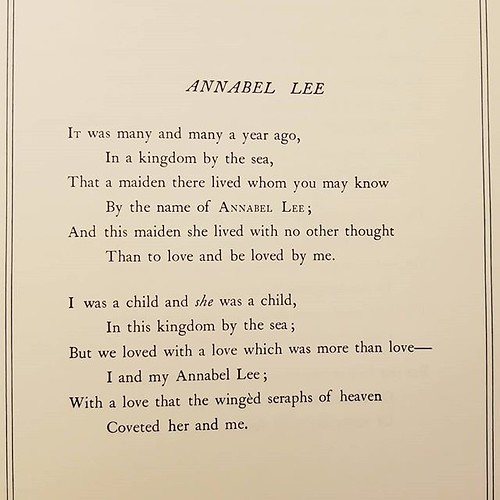
It's pure coincidence, of course, but a happy one nonetheless, that today I also managed to get the ebook of The Chilling Killing Wind finally available. Poe's poem Annabel Lee is central to this book's story, after all. Poe has been one of my favorite poets ever since high school. There's just no getting over him.

Monday, May 02, 2016

National Poetry Month, day thirty

Guess what? I wrote this and forgot to publish it, until Roger goosed me. Oops.

Today ends National Poetry Month, and I considered writing some kind of summation, but I'll just leave it at this: Read poetry. It isn't hard and doesn't have to make you feel like you're back in English class. (Unless you liked English class, as I did, in which case, hey, it can totally feel like you're back in English class!)

Here is one of my favorite of Tennyson's poems, whose concluding lines are often quoted in inspirational settings. It's a wonderful paean to the eternal desire for new life and new experiences, even when we are nearing the dusk of our lives.

See you next April!

Ulysses
by Alfred, Lord Tennyson

It little profits that an idle king,
By this still hearth, among these barren crags,
Match'd with an aged wife, I mete and dole
Unequal laws unto a savage race,
That hoard, and sleep, and feed, and know not me.
I cannot rest from travel: I will drink
Life to the lees: All times I have enjoy'd
Greatly, have suffer'd greatly, both with those
That loved me, and alone, on shore, and when
Thro' scudding drifts the rainy Hyades
Vext the dim sea: I am become a name;
For always roaming with a hungry heart
Much have I seen and known; cities of men
And manners, climates, councils, governments,
Myself not least, but honour'd of them all;
And drunk delight of battle with my peers,
Far on the ringing plains of windy Troy.
I am a part of all that I have met;
Yet all experience is an arch wherethro'
Gleams that untravell'd world whose margin fades
For ever and forever when I move.
How dull it is to pause, to make an end,
To rust unburnish'd, not to shine in use!
As tho' to breathe were life! Life piled on life
Were all too little, and of one to me
Little remains: but every hour is saved
From that eternal silence, something more,
A bringer of new things; and vile it were
For some three suns to store and hoard myself,
And this gray spirit yearning in desire
To follow knowledge like a sinking star,
Beyond the utmost bound of human thought.

     This is my son, mine own Telemachus,
To whom I leave the sceptre and the isle,—
Well-loved of me, discerning to fulfil
This labour, by slow prudence to make mild
A rugged people, and thro' soft degrees
Subdue them to the useful and the good.
Most blameless is he, centred in the sphere
Of common duties, decent not to fail
In offices of tenderness, and pay
Meet adoration to my household gods,
When I am gone. He works his work, I mine.

     There lies the port; the vessel puffs her sail:
There gloom the dark, broad seas. My mariners,
Souls that have toil'd, and wrought, and thought with me—
That ever with a frolic welcome took
The thunder and the sunshine, and opposed
Free hearts, free foreheads—you and I are old;
Old age hath yet his honour and his toil;
Death closes all: but something ere the end,
Some work of noble note, may yet be done,
Not unbecoming men that strove with Gods.
The lights begin to twinkle from the rocks:
The long day wanes: the slow moon climbs: the deep
Moans round with many voices. Come, my friends,
'T is not too late to seek a newer world.
Push off, and sitting well in order smite
The sounding furrows; for my purpose holds
To sail beyond the sunset, and the baths
Of all the western stars, until I die.
It may be that the gulfs will wash us down:
It may be we shall touch the Happy Isles,
And see the great Achilles, whom we knew.
Tho' much is taken, much abides; and tho'
We are not now that strength which in old days
Moved earth and heaven, that which we are, we are;
One equal temper of heroic hearts,
Made weak by time and fate, but strong in will
To strive, to seek, to find, and not to yield.

Friday, April 29, 2016

National Poetry Month, day 29

If poetry is dead, as they say, why do so many people still write poetry? Why is there so much poetry in social media outlets like Tumblr and Instagram?

I'm guessing it's because poetry isn't dead.

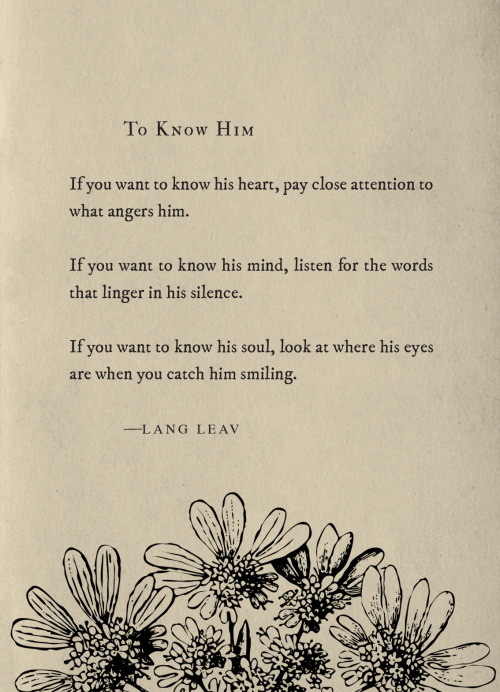
Like many readers, I discovered the poetry of Lang Leav through Tumblr, where she posts her own work. She's not just a Tumblr poet, but rather an artist who has been honing her craft for years, but it's amazing how much of her audience -- for poetry, one of the oldest art forms -- comes from so recent a development as Tumblr.


Poetry absolutely abounds online. Is it all good? Of course not. But much of it is intended as poetry has always often been intended: a snapshot, through words, of the thoughts and feelings of a certain soul.

it is a terrible thing
to love the unreachable;

i found this out
on a friday night
where in a whole room of people
the world starts and ends
on your lips and
i knew i was staring at
the dusting of your freckles
but couldn’t resist

it is a terrible thing to love
your friends

i am burning alive
for it.

(via)

at the tender age of 23
i received the Nobel Prize
for daydreaming
and everyone applauded
a standing ovation
and then i woke up
standing in the kitchen in my underwear
in front of an open refrigerator
with one hand on the door
and the other loosely in my side
as if i was just looking for some midnight snack
i looked down
at my body
in the pale refrigerator light
didn’t remember how I got here
must have been sleepwalking again
didn’t even know
for how long i was standing there
but my body felt
intensely cold

(via)

*toying #rambles #light and love ☺️

A photo posted by Christopher Poindexter (@christopherpoindexter) on


#jrrogue

A photo posted by All of my bullshit truths. 🔪 (@j.r.rogue) on


Hell no, poetry ain't dead.

Thursday, April 28, 2016

National Poetry Month, day twenty-eight

My favorite author, Guy Gavriel Kay, has a new novel coming out next month!

One reason I love Kay's writing is his luminous prose, which is greatly informed and shaped by his love of poetry and verse. Some years ago, Kay (or GGK as his fans call him) released a collection of his own poems, Beyond This Dark House, and below is a selection from that collection.

Wow...Poetry Month is almost over....

And Diving
by Guy Gavriel Kay

Late night
in a cold bed,
far away.

Yesterday I dreamed
that you had died,

arcing from a bridge
to black water.

I arrived too late
and diving,

could only bring
your body back to be
whitened by moonlight.

I was crying, holding
your still hands.

Late night,
cold bed, telling myself
I do not love you,

remembering your voice,
your hands in my hair.

Wednesday, April 27, 2016

National Poetry Month, day twenty-seven

Are song lyrics also poetry?

This isn't quite as easy a question as it seems up front. Here's an interesting article on the subject, and a key point is this:

Words in a poem take place against the context of silence (or maybe an espresso maker, depending on the reading series), whereas, as musicians like Will Oldham and David Byrne have recently pointed out, lyrics take place in the context of a lot of deliberate musical information: melody, rhythm, instrumentation, the quality of the singer’'s voice, other qualities of the recording, etc. Without all that musical information, lyrics usually do not function as well, precisely because they were intentionally designed that way.

Song lyrics, then, should not be assessed as a whole outside of their intended musical context, at least according to this particular view. I'm somewhat sympathetic to this, but I also think that it's too easy to undervalue lyrics as well. I've been guilty of this in the past, to the point that many times, I've completely ignored lyrics in songs, in favor of the musical elements.

Lyrics, though, almost always use the same literary devices that poetry uses. Lyrics employ rhyme schemes; they can make use of literary allusion; they have rhythm -- in fact, they really must have rhythm (or meter). So...are song lyrics poetry? I'll say this: I think it's far easier to make the case that they are than it is that they are not.

Here are some that I like. These are taken from musicals, but I think the point can stand for any musical genre.

The Sadder by Wiser Girl For Me,
from The Music Man,
by Meredith Willson (YouTube)

No sweet and pure, angelic lass or me.
That kinda gal can spin a web you see
She trades on wholesome innocence galore.
But it's my independence that she's trading for
The only affirmative she will file
Refers to marching down the aisle.
No golden, glorious, gleaming pristine goddess--
No sir!
For no Diana do I play faun.
I can tell you that right now.
I snarl, I hiss: How can ignorance be compared to bliss?
I spark, I fizz for the lady who knows what time it is.
I cheer, I rave for the virtue I'm too late to save
The sadder-but-wiser girl for me.
No bright-eyed, blushing, breathless baby-doll baby
No sir.
That kinda child ties knots no sailor ever knew.
I prefer to take a chance on a more adult romance.
No dewy young miss
Who keeps resisting all the time she keeps insisting!
No wide-eyed, wholesome innocent female.
Why, she's the fisherman, I'm the fish you see?
I flinch, I shy, when the lass with the delicate air goes by
I smile, I grin, when the gal with a touch of sin walks in.
I hope, and I pray, for Hester to win just one more "A"
The sadder-but-wiser girl for me.
No giggling ice cream soda drinker out to hook you line and sinker
No honey brooded beaconing siren
I plug me ears and I grab my horns and I flee
I cheer and I boo at the puritan hearted aun jeune
I yearn, I long for the women who's pa says what went wrong
I root and I clap for the dame in the gown less evening strap
The sadder-but-wiser girl's the girl for me.
The sadder-but-wiser girl for me.

C'est Moi
from Camelot
by Alan Jay Lerner and Frederick Loewe (YouTube)

Camelot! Camelot!
In far-off France I heard your call.
Camelot! Camelot!
And here am I to give my all.
I know in my soul what you expect of me,
And all that and more I shall be.

A knight of the Table Round should be invincible,
Suceed where a less fantastic man would fail.
Climb a wall no one else can climb,
Cleave a dragon in record time,
Swim a moat in a coat of heavy iron mail.
No matter the pain, he ought to be unwinceable,
Impossible deeds should be his daily fare.
But where in the world
Is there in the world
A man so *extraordinaire*?

C'est moi! C'est moi, I'm forced to admit.
'Tis I, I humbly reply.
That mortal who
These marvels can do,
C'est moi, c'est moi, 'tis I.
I've never lost
In battle or game;
I'm simply the best by far.
When swords are crossed
'Tis always the same:
One blow and au revoir!
C'est moi! C'est moi! So adm'rably fit!
A French Prometheus unbound.
And here I stand, with valour untold,
Exeption'ly brave, amazingly bold,
To serve at the Table Round!

The soul of a knight should be a thing remarkable,
His heart and his mind as pure as morning dew.
With a will and a self-restraint
That's the envy of ev'ry saint
He could easily work a miracle or two.
To love and desire he ought to be unsparkable,
The ways of the flesh should offer no allure.
But where in the world
Is there in the world
A man so untouched and pure?
(C'est moi!)

C'est moi! C'est moi, I blush to disclose.
I'm far too noble to lie.
That man in whom
These qualities bloom,
C'est moi, c'est moi, 'tis I.
I've never strayed
From all I believe;
I'm blessed with an iron will.
Had I been made
The partner of Eve,
We'd be in Eden still.
C'est moi! C'est moi! The angels have chose
To fight their battles below,
And here I stand, as pure as a pray'r,
Incredibly clean, with virtue to spare,
The godliest man I know!
C'est moi!

The Last Night of the World
from Miss Saigon
by Claude-Michel Schoenberg and Alain Boublil (YouTube)

Chris
In a place that won't let us feel
In a life where nothing seems real
I have found youI have found you

Kim
In a world that's moving too fast
In a world where nothing can last
I will hold you
I will hold you

Chris
Our lives will change, when tomorrow comes

Kim
Tonight our hearts drown the distant drums

Chris
And we have music, all right
Tearing the night

Both
A song
Played on a solo saxophone
A crazy sound
A lonely sound
A cry that tells us
Love goes on and on
Played on a solo saxophone
It's telling me
To hold you tight
And dance
Like it's the last night
Of the world

Chris
On the other side of the earth
There's a place where life still has worth
I will take you

Kim
I'll go with you

Chris
You won't believe all the tings you'll see
I know 'cause you'll see them all with me

Both
If we're together, that's when
We'll hear it again
A song
Played on a solo saxophone
A crazy sound
A lonely sound
A cry that tells us
Love goes on and on
Played on a solo saxophone
It's telling me
To hold you tight
And dance
Like it's the last night
Of the world

Kim
Dreams were all I ever knew

Chris
Dreams you won't need when I'm through

Both
Anywhere we may be
I will sing with you
A song

Both
So stay with me
And hold me tight
And dance
Like it's the last night of the world

Alexander Hamilton
from Hamilton
by Lin-Manuel Miranda (YouTube)

[BURR]
How does a bastard, orphan, son of a whore and a
Scotsman, dropped in the middle of a
Forgotten spot in the Caribbean by providence
Impoverished, in squalor
Grow up to be a hero and a scholar?

[LAURENS]
The ten-dollar founding father without a father
Got a lot farther by working a lot harder
By being a lot smarter
By being a self-starter
By fourteen, they placed him in charge of a
Trading charter

[JEFFERSON]
And every day while slaves were being slaughtered and carted
Away across the waves, he struggled and kept his guard up
Inside, he was longing for something to be a part of
The brother was ready to beg, steal, borrow, or barter

[MADISON]
Then a hurricane came, and devastation reigned
Our man saw his future drip, dripping down the drain
Put a pencil to his temple, connected it to his brain
And he wrote his first refrain, a testament to his pain

[BURR]
Well, the word got around, they said, “This kid is insane, man”
Took up a collection just to send him to the mainland
“Get your education, don’t forget from whence you came, and
The world is gonna know your name. What’s your name, man?”

[HAMILTON]
Alexander Hamilton
My name is Alexander Hamilton
And there’s a million things I haven’t done
But just you wait, just you wait...

[ELIZA]
When he was ten his father split, full of it, debt-ridden
Two years later, see Alex and his mother bed-ridden
Half-dead sittin' in their own sick, the scent thick

[COMPANY]
And Alex got better but his mother went quick

[WASHINGTON]
Moved in with a cousin, the cousin committed suicide
Left him with nothin’ but ruined pride, something new inside
A voice saying

[WASHINGTON]
“You gotta fend for yourself.” [COMPANY]
“Alex, you gotta fend for yourself.”
[WASHINGTON]
He started retreatin’ and readin’ every treatise on the shelf

[BURR]
There would have been nothin’ left to do
For someone less astute
He woulda been dead or destitute
Without a cent of restitution
Started workin’, clerkin’ for his late mother’s landlord
Tradin’ sugar cane and rum and all the things he can’t afford
Scammin’ for every book he can get his hands on
Plannin’ for the future see him now as he stands on
The bow of a ship headed for a new land
In New York you can be a new man

[COMPANY]
In New York you can
Be a new man—
In New York you can
Be a new man—

[COMPANY]
Scammin’

Plannin’
Oooh...

[HAMILTON]
Just you wait!

Just you wait!

[COMPANY]
In New York you can be a new man—

[WOMEN]
In New York—

[MEN]
New York—

[HAMILTON]
Just you wait!

[COMPANY]
Alexander Hamilton

We are waiting in the wings for you

You could never back down
You never learned to take your time!

Oh, Alexander Hamilton

When America sings for you
Will they know what you overcame?
Will they know you rewrote the game?
The world will never be the same, oh

[BURR]
The ship is in the harbor now
See if you can spot him

Another immigrant
Comin’ up from the bottom

His enemies destroyed his rep
America forgot him [COMPANY]
Alexander Hamilton

Waiting in the wings for you

You never learned to take your time!

Oh, Alexander Hamilton
Alexander Hamilton…
America sings for you
Will they know what you overcame?
Will they know you rewrote the game?
The world will never be the same, oh

[MEN]
Just you wait

[COMPANY]
Just you wait

[MULLIGAN/MADISON & LAFAYETTE/JEFFERSON]
We fought with him

[LAURENS/PHILIP]
Me? I died for him

[WASHINGTON]
Me? I trusted him

[ELIZA & ANGELICA & PEGGY/MARIA]
Me? I loved him

[BURR]
And me? I’m the damn fool that shot him

[COMPANY]
There’s a million things I haven’t done
But just you wait!

[BURR]
What’s your name, man?

[COMPANY]
Alexander Hamilton!


Tuesday, April 26, 2016

National Poetry Day, day twenty-six

If love has a rival for the most frequent theme in poetry, I suppose it's likely death. Poets have been grappling with the mystery of death for as long as they've been grappling with the mystery of love, and there are times when they meditate on both subjects in the same poem.

Walt Whitman seems to think of death as the ultimate journey, and that only upon death can a soul enter its truest nature:

Darest thou now O soul
by Walt Whitman

Darest thou now O soul,
Walk out with me toward the unknown region,
Where neither ground is for the feet nor any path to follow?
No map there, nor guide,
Nor voice sounding, nor touch of human hand,
Nor face with blooming flesh, nor lips, nor eyes, are in that land.

I know it not O soul,
Nor dost thou, all is a blank before us,
All waits undream'd of in that region, that inaccessible land.

Till when the ties loosen,
All but the ties eternal, Time and Space,
Nor darkness, gravitation, sense, nor any bounds bounding us.

Then we burst forth, we float,
In Time and Space O soul, prepared for them,
Equal, equipt at last, (O joy! O fruit of all!) them to fulfil O soul.

Another view of death can be found in this amazing poem by Christina Rossetti. She describes death as a destination to which we all come, and she frames it as a comfort: an inn at the end of a long day's journey, an inn that cannot be missed by the side of the road. She doesn't describe the inn in specific terms -- I suppose it could be something rather like the Bates Motel -- but I always picture Rossetti's inn as a brightly lit place where warm welcomes are given to those who arrive.

Uphill
by Christina Rossetti

Does the road wind up-hill all the way?
    Yes, to the very end.
Will the day’s journey take the whole long day?
    From morn to night, my friend.

But is there for the night a resting-place?
    A roof for when the slow dark hours begin.
May not the darkness hide it from my face?
    You cannot miss that inn.

Shall I meet other wayfarers at night?
    Those who have gone before.
Then must I knock, or call when just in sight?
    They will not keep you standing at that door.

Shall I find comfort, travel-sore and weak?
    Of labour you shall find the sum.
Will there be beds for me and all who seek?
    Yea, beds for all who come.

A far, far bleaker view of death can be found in this 11th century Chinese poem:

Sorrow
by Mei Yao-ch'en (1002-1060)

Heaven took my wife. Now it
Has also taken my son.
My eyes are not allowed a
Dry season. It is too much
For my heart. I long for death.
When the rain falls and enters
The earth, when a pearl drops into
The depth of the sea, you can
Dive in the sea and find the
Peal, you can dig in the earth
And find the water. But no one
Has ever come back from the
Underground Springs. Once gone, life
Is over for good. My chest
Tightens against me. I have
No one to turn to. Nothing.
Not even a shadow in a mirror.

(translated by Kenneth Rexroth, from the collection World Poetry

I am currently reading an amazing poetic exploration of death, Edgar Lee Masters's Spoon River Anthology. The book is a collection of free-form verse epitaphs for the denizens of a small town called Spoon River. In each epitaph we learn why each person died, and many other things as well, as death -- the ultimate leveler in status, since everyone from the Mayor to the town drunk will die -- allows people to tell the truth, or at least their version of it. Some characters' deaths are attributable to the callous actions of others, but then we read the others' own epitaphs and get a different side of the story. Or, in the case of Minerva Jones, we get this:

Minerva Jones
from Spoon River Anthology

I AM Minerva, the village poetess,
Hooted at, jeered at by the Yahoos of the street
For my heavy body, cock-eye, and rolling walk,
And all the more when "Butch" Weldy
Captured me after a brutal hunt.
He left me to my fate with Doctor Meyers;
And I sank into death, growing numb from the feet up,
Like one stepping deeper and deeper into a stream of ice.
Will some one go to the village newspaper,
And gather into a book the verses I wrote?—
I thirsted so for love
I hungered so for life!

Now, this seems pretty clear that Minerva Jones died after being violently assaulted, perhaps raped, by Butch Weldy. But what does Butch Weldy have to say about his own demise?

Butch Weldy
from Spoon River Anthology

AFTER I got religion and steadied down
They gave me a job in the canning works,
And every morning I had to fill
The tank in the yard with gasoline,
That fed the blow-fires in the sheds
To heat the soldering irons.
And I mounted a rickety ladder to do it,
Carrying buckets full of the stuff.
One morning, as I stood there pouring,
The air grew still and seemed to heave,
And I shot up as the tank exploded,
And down I came with both legs broken,
And my eyes burned crisp as a couple of eggs.
For someone left a blow—fire going,
And something sucked the flame in the tank.
The Circuit Judge said whoever did it
Was a fellow-servant of mine, and so
Old Rhodes' son didn't have to pay me.
And I sat on the witness stand as blind
As lack the Fiddler, saying over and over,
"I didn't know him at all."

That's not how Weldy goes, but anyway, it might be karma, or it might not. But it's telling that Weldy has absolutely nothing to say about Minerva Jones. He starts right off with "after he got religion," which might imply that he's managed to forgive himself for whatever he did to Minerva. That's pretty convenient, as she's dead.

Finally, one of my favorite poems, no matter that it's about death. A.E. Housman's famous poem is a testament to the fleeting nature of achievement in the face of eternal death, and the fact that very few of us get to die when our lives are spent and when we are truly going to rest.

To an Athlete Dying Young
by A.E. Housman

The time you won your town the race
We chaired you through the market-place;
Man and boy stood cheering by,
And home we brought you shoulder-high.

Today, the road all runners come,
Shoulder-high we bring you home,
And set you at your threshold down,
Townsman of a stiller town.

Smart lad, to slip betimes away
From fields where glory does not stay,
And early though the laurel grows
It withers quicker than the rose.

Eyes the shady night has shut
Cannot see the record cut,
And silence sounds no worse than cheers
After earth has stopped the ears.

Now you will not swell the rout
Of lads that wore their honours out,
Runners whom renown outran
And the name died before the man.

So set, before its echoes fade,
The fleet foot on the sill of shade,
And hold to the low lintel up
The still-defended challenge-cup.

And round that early-laurelled head
Will flock to gaze the strengthless dead,
And find unwithered on its curls
The garland briefer than a girl’s.

Monday, April 25, 2016

National Poetry Month, day twenty-five

John Keats wrote this wonderful sonnet, not about Homer, but about reading a specific translation of Homer. This fascinates me. The poem is also a powerful statement on how a great work of art can transform our perceptions, even of something we have seen many times before.

On First Looking Into Chapman's Homer
by John Keats

Much have I travell'd in the realms of gold,
And many goodly states and kingdoms seen;
Round many western islands have I been
Which bards in fealty to Apollo hold.
Oft of one wide expanse had I been told
That deep-brow'd Homer ruled as his demesne;
Yet did I never breathe its pure serene
Till I heard Chapman speak out loud and bold:
Then felt I like some watcher of the skies
When a new planet swims into his ken;
Or like stout Cortez when with eagle eyes
He star'd at the Pacific—and all his men
Look'd at each other with a wild surmise—
Silent, upon a peak in Darien.

Sunday, April 24, 2016

National Poetry Month, day twenty-four

We're down to the last seven days of National Poetry Month, so why not a bit of the Bard?

From Much Ado About Nothing
by William Shakespeare

Sigh no more, ladies, sigh no more.
     Men were deceivers ever,
One foot in sea, and one on shore,
     To one thing constant never.
Then sigh not so, but let them go,
     And be you blithe and bonny,
Converting all your sounds of woe
     Into hey nonny, nonny.

Sing no more ditties, sing no more
     Of dumps so dull and heavy.
The fraud of men was ever so
     Since summer first was leafy.
Then sigh not so, but let them go,
     And be you blithe and bonny,
Converting all your sounds of woe
     Into hey, nonny, nonny.

Saturday, April 23, 2016

National Poetry Month, day twenty-three

Here's a lovely poem about a train. Or is it?

Still Life
by Carl Sandburg

Cool your heels on the rail of an observation car.
Let the engineer open her up for ninety miles an hour.
Take in the prairie right and left, rolling land and new hay crops,
    swaths of new hay laid in the sun.
A gray village flecks by and the horses hitched in front of the
    post-office never blink an eye.
A barnyard and fifteen Holstein cows, dabs of white on a black
    wall map, never blink an eye.
A signalman in a tower, the outpost of Kansas City, keeps his
    place at a window with the serenity of a bronze statue on a
    dark night when lovers pass whispering.


Friday, April 22, 2016

National Poetry Month, day twenty-two

Wow, we're coming into the home stretch.

I wonder just what percentage of poetry can be accurately classified as "love poetry". I assume it's a pretty large percent, but who knows. It would be an impossible task to identify every love poem in the world, obviously, and there would be many that some would consider love poems and that some would not. But love is one of the great human themes, and it stands to reason that it would be also one of the great themes found in poetry. Just look at your local bookstore's poetry section, and depending on the size of the store, you will almost certainly see a good portion of the selection devoted to collections of love poems. (And yes, I own several myself.)

Here is one of my favorite love poems, written by the great National Poet of Scotland, Robert Burns. Burns is always a delight to read, with his use of Scottish dialect and his unerring sense of poetic rhythm. The third stanza here amazes me each time I read this poem, because it suddenly elevates what seems, at first, like a fairly simple little rhyming love poem. "While the sands o' life shall run" is a gorgeous, gorgeous line, ripe with wonderful metaphor.

A Red, Red Rose
by Robert Burns

O my Luve is like a red, red rose
   That’s newly sprung in June;
O my Luve is like the melody
   That’s sweetly played in tune.

So fair art thou, my bonnie lass,
   So deep in luve am I;
And I will luve thee still, my dear,
   Till a’ the seas gang dry.

Till a’ the seas gang dry, my dear,
   And the rocks melt wi’ the sun;
I will love thee still, my dear,
   While the sands o’ life shall run.

And fare thee weel, my only luve!
   And fare thee weel awhile!
And I will come again, my luve,
   Though it were ten thousand mile.

Thursday, April 21, 2016

National Poetry Day, day twenty-one

This poem seems to be about one thing...but when you reflect on when it was written (April, 1919), you realize that it's actually very much about something else.

Everyone Sang
by Siegfried Sassoon

Everyone suddenly burst out singing;
And I was filled with such delight
As prisoned birds must find in freedom,
Winging wildly across the white
Orchards and dark-green fields; on - on - and out of sight.

Everyone's voice was suddenly lifted;
And beauty came like the setting sun:
My heart was shaken with tears; and horror
Drifted away ... O, but Everyone
Was a bird; and the song was wordless; the singing will never be done.