Showing posts with label Passages. Show all posts

Thursday, August 05, 2021

Something for Thursday

 Last week, Dusty Hill died. He was the bass player for ZZ Top.


ZZ Top is one of those bands that has been a part of the soundtrack of my life pretty much ever since early-adolescence, when I first became aware of rock music. They're one of those acts that seems like they've been around forever, partly owing to their look: famous for their long beards, they cultivated an air of being old when they were still quite young. But there's also a timeless quality to their music, which plays equally at ease on a classic rock station and an 80s throwback station, and more.

ZZ Top was always known most for its look: black suits and very long beards. They never updated that look at all. ZZ Top was not one of those "chameleon" kinds of acts that shifted with the times; their musical style and their look was always the same. They knew what they wanted to do, who they wanted to be, and the kind of music they wanted to make. And they made a lot of very fine music, too! Maybe they're not quite at the level of, say, a Bob Seger or Tom Petty and the Heartbreakers, but ZZ Top is every bit as essential to knowing the last forty years or so of popular music in America. (ZZ Top's own history began in 1969, so they've been a thing for more than fifty years.)

By never much changing while maintaining a high standard of excellence, ZZ Top managed to seem like they'd been around forever and always will. They always had that air of "grizzled old veterans of rock", even if they were only in their mid-30s when I first encountered them, with their big hit, "Legs".

My favorite ZZ Top song is one of their less-known ones, a power ballad from the Afterburner album. "Rough Boy" is really quite a lovely song, with lyrics suggesting a boy trying to impress a girl even though he's, well, 'rough'. Those lyrics go well with Billy Gibbons's raspy tenor, and the verses alternate with some frankly beautiful guitar playing.

Here are three videos: first the song itself as recorded (and later remastered) for the original album, and then a live version in which the band is joined by guitar legend Jeff Beck. And finally there's an example of one of my favorite new genres, the "reaction" video, in which a listener with an open mind listens to "Rough Boy" for the very first time ever. (The reaction video is great, but her experience is slightly marred by the fact that she's also watching the song's official video for MTV, which is, I must admit, one of the weirder videos out there, and it's a video whose content has almost nothing to do with the song itself. But her enthusiasm is real; I love these reaction videos!)

And Dusty Hill: Thanks for the music. It will live long!


Monday, June 14, 2021

On Ned Beatty and HEAR MY SONG (in part, a repost)


Actor Ned Beatty has died at the age of 83. Beatty had a long and wonderful and varied career, and he played a wide variety of characters. I suppose he's seen more as a "character actor" than as a lead, but...I don't know, surely there should be something between a character actor and a proper lead, right? Beatty was always recognizable, but he never seemed the same, if that makes any sense. Every time I saw him in something he managed to create something all new. My first exposure to him was in Superman: The Movie, which remains my favorite superhero movie to this day, even after everything the MCU has done, and he showed up pretty reliably over the years. Even if the movie I was seeing was a total stinker--the Richard Pryor movie The Toy leaps to mind, and it's mindboggling that a movie that bad could result despite the presence of Pryor, Jackie Gleason, and Ned Beatty--there was always a total professionalism to Beatty's work.

My favorite of Ned Beatty's movies is Hear My Song, a comedy from 1991, which is not at all well-known. I take every opportunity that comes along to beat the drum for this movie, because it's just a warm-hearted joyful romp through the world of beloved Irish tenors, old seaside villages, skeevy concert promoters, and angry tax cops. I wrote about Hear My Song some years ago, and I repost that review below. I'm only sorry to note that I don't actually single out Mr. Beatty's performance in the movie for special mention, because the movie wouldn't work if he wasn't absolutely fantastic.

Please watch Hear My Song, if you can! It's available to rent on YouTube (and as I write this, the entire thing is actually available for free via some user I don't know, but who knows how long it will take the copyright folks to shut that down). You won't regret it, I promise.

Thanks for the movies, Ned Beatty! You were one of the greats.

Hear My Song (1991)


Years ago, when we'd been dating a year or so, The Girlfriend (now The Wife) rented a movie for us to watch. It was a British comedy that I'd never heard of, called Hear My Song. We both absolutely loved it, and it's been one of those movies that I've wanted to watch again ever since, even though it's been really hard to locate a copy, to the point where it then became one of those movies of which I have greatly fond memories that maybe I don't want to revisit, on the off chance that my memories of it are more nostalgic than accurate. Or, to put it another way, I was afraid that maybe this movie had been visited by the Suck Fairy.

Well, Hear My Song is, as of this writing, available for streaming on Netflix, which proved to be a temptation too great. So I watched it, and...absolutely loved it again.

Adrian Dunbar (who co-wrote the movie, and who would later secure semi-immortality in Star Wars lore by playing Senator Bail Organa in The Phantom Menace, only to see his scenes cut entirely from the film and the role recast with Jimmy Smits in the subsequent Prequels) plays Mickey O'Neill, a young man who runs a dinner club and musical revue. The place isn't making great money (in the first scene, Mickey has to take the stage himself) and he isn't popular with his landlords, who decide to evict after a scheme to let word of mouth sell tickets for a crappy singer named Franc Cinatra results in bad blood. His next money-making effort is to book Irish tenor Joseph Locke, who is legendary in this town but has lived in Ireland for more than thirty years because he's wanted for tax evasion.

Locke is the Maguffin of the movie. First, no one is sure if the guy claiming to be Locke is really Locke or not, and second, Locke didn't just evade taxes as much as he literally ran out of town, avoiding arrest by inches (and by pushing a cop off the boat on which he was fleeing) and running out on the affair he was having with a local beauty queen. This beauty queen turns out, later on, to be Mickey's girlfriend's mother, and after she has a late-night tryst with the man claiming to be Joseph Locke, she loudly announces that he is not. Ouch. Mickey loses the theater, his girlfriend, everything...unless he can get to Ireland and bring back the real Joseph Locke.

There's nothing in this movie that's really all that surprising at all, at least until the end, when things turn in a way that is reminiscent of endings like The Shawshank Redemption's, in that elements that have been in place the entire way suddenly turn out to be relevant in surprising and deeply pleasing ways. I don't want to spell it out, but this movie has one of my favorite endings, ever.

But an ending can't work as well as this one does by being clever; it also has to have the emotional heft to it, and this one does. This is a movie about likable people who have, occasionally in their lives, done unlikable things, but in most cases they are trying to atone for them, or recognize their misdeeds when they come back to haunt them. There isn't a single unflawed character in this film, all the way to Mickey himself, who seems emotionally stunted in some ways, and whose main skill in life seems to be a gift for bullshit. (One of his favorite tricks is to appeal to the older generation, who lived through World War II, by giving a speech that starts off with "I grew up in peacetime."

With comedies like this, it's easy to describe them in such a way that makes them sound like serious dramas. Hear My Song is most definitely a comedy; in fact, it ranks high on my personal list of funniest movies I've seen. A scene involving a bar full of Irishmen trying to assist one of their brethren with a dental problem is hysterical, and the best gag involves our two drunken heroes and their curiosity as to the depth of a particular well. More than that I must not say.

Hear My Song is, for me, so good that I don't understand how it's managed to fall so completely off the radar. It has a wonderfully witty script full of memorable characters, it's photographed beautifully, the music is fantastic, and the cast is tremendous, led by Dunbar and by Ned Beatty as Joseph Locke (the real one). And if you've ever watched Star Wars: A New Hope and wondered just how good an actor William Hootkins really was (he sadly died a few years back), well, Hear My Song will give you an answer.

What a wonderful, wonderful movie!

Friday, April 23, 2021

Mr. Mannion

 Blogger Lance Mannion, whose real-life name was David Reilly, has died suddenly. I've been reading Lance for...I honestly don't know. At least seventeen years, I would guess. He was a deeply literate man, with wide interests and voracious reading that informed his bright and curious writings. I didn't visit his blog daily, but that's OK, since he didn't post to it daily. He was one of those bloggers whom you could tell worked hard on every post. He ignored the often-cited "laws" of writing online that advised brevity at all costs; even when he did do a short post, there was a thoughtfulness at work that you don't find often.

Lance was also not precious about his tastes. He would write about literary figures and comic book movies at equal length, and that was just that. And he deeply loved his family, often posting about their own travails, like his sons' educations (oh, the pride that shone through at their accomplishments!) and his wife's own health struggles. There's no love quite so tender as the person whose spouse is suffering.

He often began his blog posts by indicating that the text to come was taken from his notebooks. Apparently he liked to go to Barnes and Noble and sit in the cafe with his coffee and his notebooks and...write. There's a certain charm to this, and it's a kind of approach that I've often considered adopting.

A quote:

Yesterday morning we Mannions made a pilgrimage to Barnes & Noble where I built this stack of books on our table in the cafe. I had no plans to buy any of them---as our poet pal Steve Kuusisto is wont to call it, B&N serves to its corporate dismay as a loitering library for too many of its customers, including me, most of the time. I’ve been known to buy more than a coffee on occasion---I was only looking through them to see which I wanted to put on reserve at the library. Mrs M looked aghast at the stack. She didn’t trust me to limit my choices. We’re in the process of being crowded out of our house by books I’ve taken out of the library that I intend to read, knowing I won’t get around to reading, but can’t bring myself to send back because, you know, just in case. I assured her I would be realistic this time.

Lance wrote easily about sports...

It’s been a long time since I was a football fan, and I haven’t watched it regularly in ages, since Joe Montana left San Francisco, in fact. But I watched Buffalo play Baltimore last week and I’m watching them play Kansas City tonight, because a good friend from my college days is an ardent Bills fan and I feel I have to root for them for her sake, but geez! Football is boring.

What are we watching? Two committees of old men playing eleven-level chess using young men as the pieces?

When I tweeted that point last week, a friend quoted George Will: “Football combines two of the worst things in American life. It is violence punctuated by committee meetings.” But Will was talking about the play on the field; the committee meetings he meant were the huddles. I mean the way football games are covered on television and the way we’re made to see them. The committees are the coaches, and the cameras and commentary focus on them as if what they’re doing is why fans at home are watching and who we’re rooting for.

...and politics (this post written in 2010, as it became clear to Democrats that the Tea Party was about to swamp them and there wasn't shit they could do about it)...

After reading the article, though, I see Palin selling them something else, a magic ingredient of her own concoction. She’s selling them her unhappinesses and resentments, her sense of injury, her insecurities based on her sense that she is not what she ought to be.

She is selling them her own self-loathing.

Which makes her like Glenn Beck and Rush Limbaugh, obvious self-loathers who’ve made careers out of peddling their own insecurities to audiences willing to feel abused, misused, exploited, and despised by their betters.

There were hypocrites who sat in the meeting houses and nodded along as preachers like Jonathan Edwards told them they were sinners in the hands of an angry God who was looking for a reason to drop them like spiders into the fire and thought, “Yes, that’s exactly what they need to hear.”

But there were more members of the congregations who wanted to hear how much God despised them, how unworthy they were of His mercy and even His notice.

It’s another perversion of pride.  “See, God, what a wretch and a sinner I am.”  People can become as addicted to their self-loathing as to any other feeling.

Palin, Limbaugh, and Beck are enablers.

Pointing this out won’t do us any good come November.

...and Star Wars.

But the core of the original movies is the tale of the last Jedi Knights, and now I am going to say something complimentary about George Lucas.

Lucas based his knights on the Knights of the Round Table.  Luke is King Arthur.  (Interestingly, but fittingly, in the Expanded Universe, it's Han and Leia who go on to rule over Camelot, while Luke becomes a version of Merlin.  The Jedi don't want power, after all.)  Obi-wan and then Yoda share the role of Merlin.  That's always been obvious.  The three prequels/sequels have underscored it.

And in the first three movies Lucas cared more about his main characters' stories as knight's tales than he did about their roles in the war that drives the plot.  The war is only the background to the important stuff, which is why Lucas allows the war to be mainly fought and won by secondary and minor characters.  Luke, Leia, and Han help save the day, but Lucas makes it clear that the rebellion itself doesn't need them.  This is why Wedge Antilles, Luke's ace pilot pal, is an important character even though he appears only briefly in each of the original three movies.  Wedge must be at least as good a pilot as Luke, but as far as we know he's not strong in the force nor is he a famous hero.  He's one very good pilot among many.  The Rebel Alliance has all the troops, all the Wedges, it needs to fight the war.

Which leaves Luke free to pursue his own ends.

Which he does.

That one kills me, because Lance name-checks me in it:

In Attack of the Clones, Obi-wan sets out to solve the mystery of who is trying to murder Padme, which reminds me that I promised Jaquandor that I would write a post about Obi-wan's career as the Jedi's top private detective.

I never got that post about Obi Wan Kenobi, Jedi detective. It's OK, Lance...but if there is an afterlife, I expect you to have that shit ready for me.

Lance wrote about his father a lot. His father only died a couple of years ago. I occasionally got a sense in Lance's writings, maybe a bit more frequently these past years, that he was beginning to sense that he was no longer the young man, that his own sun was closer to his own Western horizon than the Eastern one. I don't know for sure if he thought any such thing, but it's something I felt lurking in his writings.

This one I remember. He liked doing this kind of post, in which he just reported straight on things he saw unfold out there in the world. I think it was because of Lance that I started really noticing the intersection between "aggrieved white guy who votes Republican" and "owner of a pristine pickup truck"...but this isn't political. It's just a capturing-in-words of what happened when two people might have passed in the night...but didn't.

Tonight I was at Barnes and Noble, having a dad's night out, and not enjoying myself as much as I would have even five years ago---browsing through the new fiction I kept coming across author biographies that began, "So and so was born in 1980..."

While I'm in the cafe drinking my coffee, a barely 20 something girl sits down at the table next to mine.  A golden blonde, with languid, shy eyes and a determined chin. She wears a black tunic dress with spaghetti straps and a slit up to her thigh, a red cardigan over her shoulders (which she lets fall to her chair and onto the floor when she gets up to go to the counter later) and she stirs the ice in her iced latte a hundred times as she looks deeply into one of the books she has brought from home in a ragged canvass pouch. She reads with her lips slightly parted in a small, enigmatic smile.

My middle aged male vanity kicks in when I notice her. There are many empty tables all over the cafe, why pick the one next to mine?  I get the answer when I go to get a refill on my coffee.

At the table behind mine, and so directly across from hers, sits a young hero, another 20 something, with a granite chin, dark wavy hair, blue eyes, broad chest, a three day stubble and black rimmed Ben Franklins on the end of his nose. On the table in front of him is an empty coffee cup and a large cup of Pepsi.

Remember these props.  The coffee and the Pepsi.  They're Chekhov's gun, the one he said that if you bring it on stage in Act One has to go off in Act Three.

I wouldn't dream of spoiling it; you'll have to read the entire thing.

Sometimes when times got tight, Lance would reach out to his readers for a bit of financial help. One time I sent him $20...and a copy of Stardancer. I have no idea if he read it, or if he did, if he liked it. I'm not sure I need to know. There's a GoFundMe for his surviving family. 

Farewell, Lance Mannion. You inspired me to write better. I hope I did...and still will.


Thursday, April 22, 2021

Something for Thursday

 Songwriter Jim Steinman, one of the biggest contributors to the "bigger than life" aura of a lot of rock music of the 1970s, 80s, 90s, and beyond, has died. He was 73.

Steinman's songs were the stuff of excess: in a genre where radio play discourages songs much longer than four or five minutes, Steinman filled artists' albums with epic anthems eight, nine, even twelve minutes long. His songs were huge-sounding, too, seemingly written to take advantage of a singer's full range (and God help a singer of limited range who tries to enter the juuuust-this-side-of-campy emotional world of a Steinman song). In Steinman's lyrics, relationships are all about intensity and emotion and sensuality; Steinman's songs are the stuff of wild love affairs that leave the participants in a breathless, sweaty heap, lit either by the final flickerings of the guttering candles or by the lonely lights of the car's dashboard after a long night of...well, a long night.

Steinman's songs may seem to be a marriage of the adolescent and the epic, but I find them wonderful just because it's nice sometimes to remember what it all felt like in those awkward years when every emotion was a feeling large enough to tilt the world on its axis. That is what Jim Steinman captures in his best songs, that sheer, white-hot intensity of feeling that adult protestations aside, really is a lot more than just raging hormones. An inexperienced heart feels things wildly, in the kind of way of a Jim Steinman song.

While a lot of people might cite his work for Meat Loaf, my personal favorite Jim Steinman song is one he wrote for Celine Dion, "It's All Coming Back To Me Now". It's a song where passion and anger and rage and death and tragedy all come together, and say what you will about it, you surely have to admit that this song belongs to Celine Dion's enormous arena-filler of a voice.

Thanks for the music, Jim Steinman.


Tuesday, December 08, 2020

Tone Poem Tuesday

 In honor of the passing of Chuck Yeager (with a typically wonderful memorial by post by Sheila O'Malley), here is a suite of music by Bill Conti from the film The Right Stuff, which adapted the Tom Wolfe book that told the story of the early years of the American space program, with interesting focus on Mr. Yeager himself.

Godspeed, Mr. Yeager.


Monday, October 19, 2020

Julio

Fifteen months after his brother Lester departed, we have had to say goodbye to Julio today. They came to us as a package deal, and I hope there's some realm beyond the rain and the clouds where they can be so again.

Julio got sick recently and never really got better, and yesterday he had the kind of day that's hard not see after the fact as a farewell. He curled up in my legs last night on our bed while we watched a little teevee--one of his favorite things to do--and then he barely moved again. Today, we all agreed that it was time.

We don't know, really, how old he was, though when he came to us in early 2006 we surmised that he and Lester (who were obvious littermates, brothers through it all) were around a year old, maybe a little more. Fifteen years isn't so bad for a cat...except for it being too short.

We are not catless...but more on that another time. For now, goodbye, Julio. I guess now I'll keep my feet warm when I'm sitting at my desk by wearing socks. Seems boring and inadequate, but you're off for new adventures now.


Wednesday, October 07, 2020

Eddie

 Eddie's gone. This one hurts, folks.


It took me a while to start loving rock music. I heard a lot of it as a kid (benefits of having an older sister, which I did not appreciate at the time because there are things you need years to figure out, especially when you're a not-terribly-smart nine-year-old), but for various reasons none of it really captured my attention until the early-to-mid 1980s. Part of it might have been a kind of peer-pressure, as I did tire of being the kid who had no idea what all of my friends were talking about when they started discussing music. Another part of it was the arrival of MTV, which even I, as a geeky kid, thought was pretty cool.

We didn't have MTV at our house for a while, because it took several years before the cable company ran the lines out our road to where we lived. But I would watch a lot of MTV at a couple friends' houses, when I did sleepovers and the like. There's a lot of nostalgic hay to mine in the music videos of those first few years, but I'll keep it to just one group here, for what are probably obvious reasons.

There was one very strange video I enjoyed in particular. It actually had a filmed introduction; the music didn't start for a minute or two. Our opening scene has a spectacularly nerdy kid being put on the school bus by his mother. This dude is so nerdy that when his mother flattens his hair with her fingers, it squeaks. She's giving him the standard spiel about making friends and having a good year and whatnot, but our boy--named "Waldo"--is not having in, replying to her in a voice that can't possibly be his: "Awww, Mom, you know I'm not like the other guys! I'm nervous and my socks are too loose." No dice; off to school goes Waldo, after discovering that the bus is loaded with what the 1980s held to be the standard "degenerate" types of kid.

Then our music starts, with some wild drums, and then the most blazing electric guitar work I had heard to that point in my life. And that guitar work remains the most blazing guitar work I've ever heard. The song, and video, were called "Hot For Teacher", and the band was a hard rock group called "Van Halen". That astonishing guitar playing? That was a guy named Eddie Van Halen.

That song, and the others from the album 1984 were my introduction to Van Halen. I would learn not long after that while I'd just discovered these guys, Van Halen had actually been around in a big way since the late 1970s after toiling in obscurity for several years before that, and that 1984 was their sixth studio album. Soon after that album came out, some internal drama happened with the band that led to their lead singer, a charismatic but troublesome guy named David Lee Roth, to leave the group; luckily there was another lead singer available by the name of Sammy Hagar who was between bands at the moment, so he slid right in and the band accommodated him, making new music in new styles to reflect the style of their new lead man, all the while maintaining the focus on the hard-but-fun rock.

And through all of that was the guitar work of Eddie Van Halen.

The music of Van Halen was a big part of my teen years, and I've never lost my love of it, though eventually I didn't buy the albums anymore. 5150, the first Van Halen album with Hagar aboard, was the first rock album that I played almost literally to death, to the point where I knew each and every song on that album backward and forward. I'd quickly get up to speed on all of the Roth-era albums as well, each of which is full of great rock music (well, Diver Down is really kinda meh, isn't it?), but I am probably one of the only people around who can honestly say that I don't have a genuine preference between the DLR and Sammy eras...or, as some people phrase it, "Do you prefer Van Halen, of Van Hagar?"

In all honesty, though, if you put a gun to my head and said "Play the first Van Halen song that jumps into your head!" I will probably wind up selecting "Dreams" from 5150 or "Right Now" from For Unlawful Carnal Knowledge before I choose any DLR song. That might not be a "preference", but there it is.

Of course, Van Halen's history got even more convoluted later on, when I had kind-of moved on from listening to them on a regular basis. Hagar was out, Roth was back in; Roth was out, and a guy named Gary Cherrone was in (for one album, that most people speak of in the same hushed tones as the Star Wars Holiday Special). Hagar was back! Hagar was gone again! Roth was back! Roth was out! Roth was back again! And so on.

Eventually Eddie Van Halen's years of hard living started catching up with him, with news and rumors of his various health troubles, winding up in the end with cancer...and that's what finally took him away from the world, at the age of 65.

What to say about Eddie Van Halen's guitar playing? Well...yes, he could play fast and he could do astonishing things with the guitar. But what always got me was the tone of his playing. There was often a sense of cheer behind it, of happiness, of warmth. A lot of great rock guitar playing often seems obsessed with speed for the sake of speed, and the electric guitar can sound almost angry and snarling in a lot of guitar solos, especially in 1980s-era "hair band" hard rock. Eddie's tone was always clean and pure, and there was almost always melody there, even in the midst of his virtuosic displays of pure skill and talent. Eddie Van Halen made music with the guitar, and his solos always blend into the songs and seem a part of the song. Many guitar solos of the era sound like what they are: rhythmic cadenzas stuck in the middle of the song, where the singer stops singing but the bassist and drummer keep on going.

Eddie Van Halen made the guitar sing and laugh, and in a few songs he even made it seem like it was about to cry. The man wasn't just a guitar god, he was a musician. Eddie Van Halen was to the guitar, for me, as Vladimir Horowitz was to the piano or as Hillary Hahn is to the violin or as Tine Thing Helseth is to the trumpet. In his best work, he isn't just "shredding", he's making music. And that's what I'm going to remember Eddie Van Halen for: the music.

Thanks for the music, Eddie. It was always good, and quite a lot of it was great.


A word about this last one, the live performance of "Best of Both Worlds". My paternal grandmother died in 1986, when I was just about to turn 15, on the morning that this performance was recorded. It was a deeply sad day; she was the first significant loss of my life. It was a Friday. After making the arrangements that morning, my father drove all the way home from Philadelphia, where Grammy lived, and then I remember my parents going out to hang out with their friends on what was a difficult night. I stayed home, as I typically did. Grammy's passing didn't really hit me until my father told me, after he got home, that she had remembered me during her brief hospital stay; apparently someone had said something that had triggered her memory of me. I lost it after that, and I remember being deeply sad for the next several hours, until I idly turned on the teevee and channel-flipped to MTV, which had the Video Music Awards (MTV's big awards show--do they still have the VMAs anymore?), and not long after I tuned in, MTV went to a live segment of none other than Van Halen, in New Haven, CT. They were on their big tour for the 5150 album, their first big tour with Sammy Hagar. This performance is the one to which MTV cut. Maybe it seems weird, but watching them do "Best of Both Worlds"--which is one of the best songs on that album--jolted me out of my funk. It was still a sad time, and Grammy's death was just the start of what was a generally godawful sophomore year of high school for me, but...at least there was Van Halen. Always Van Halen. To this day, I can rely on Van Halen to cheer me up when I'm stuck in the mud.

So, yeah. Thanks again, Eddie. (And Sammy, and Dave, and Michael, and Alex. And heck, you too, Gary.)


Friday, September 18, 2020

Apropos

RICHARD: He's here. He'll get no satisfaction out of me. He isn't going to see me beg.

GEOFFREY: My you chivalric fool... as if the way one fell down mattered.

RICHARD: When the fall is all there is, it matters.

(From The Lion In Winter)

Thursday, September 10, 2020

Something for Thursday (Diana Rigg edition)

 Actress Diana Rigg has died. She lived a long life (82 years) and did a lot of amazing work, but for me, she will always be Contessa Teresa di Vicenzo, also known as Tracy...who would, very briefly, be Mrs. James Bond. Rigg was the greatest Bond Woman in the long history of Bond Women, and she is a huge reason why On Her Majesty's Secret Service is the greatest Bond movie ever made.

Thank you for the wonderful work, Diana Rigg! Here's Louis Armstrong with his signature ballad from OHMSS.


Thursday, September 03, 2020

Something for Thursday (Wakanda Forever edition)


 It's strange about comets. Except for a few notable exceptions, the vast majority of comets come quickly, brighten our sky, and then disappear forever (or for so long it's functionally forever). For the brief time they are in the sky, they are a wonder...and then they are gone, leaving us with only the memory of this wonderful thing that blazed amongst the stars for a short time.

That is how I keep thinking of Chadwick Boseman, a man of incandescent talent who blazed across movies and teevee for a few years...and now is gone.

Here is the End Credits suite from Black Panther, written by Swedish composer Ludwig Goransson.

Farewell, Mr. Boseman. You won't be forgotten. How could you be? You shone too bright in the sky to be forgotten.

(image credit)

Thursday, August 13, 2020

Memories of Maliboo

 My mother's cat, a beautiful red Persian named "Maliboo", died today at the fine age of 17. He had a fantastic life, truly winning the Cat Lottery. Oddly, Maliboo hated me until several years ago when he had no choice but to warm up to me while Mom took a 17-day trip to Wales. After that, he was fine with me.

Farewell, Maliboo. You were a good cat.


Thursday, August 06, 2020

Something for Thursday (Farewell, Leon Fleischer)

Pianist Leon Fleischer has died, at the age of 92.

Fleischer was one of the greatest American musicians of the twentieth century (and a chunk of the 21st!), and his story is one of consummate musicianship along with triumph to overcome and live with disability. Fleischer was already a pianist and teacher of great renown by 1964, when a neurological condition made playing with his right hand impossible. Fleischer didn't lose a step, though: because one-armed pianists are hardly unheard of, there is a substantial amount of repertoire for them, including today's feature piece.

Maurice Ravel, the great French Impressionist composer, was commissioned by an Austrian pianist named Paul Wittgenstein to write a concerto for him. Wittgenstein had lost his right arm in World War I, however, so Ravel wrote his Concerto in D for Left Hand. It's an amazing, bravura work, with such impressive piano writing that it is never obvious that only one hand is playing.

Wittgenstein appears to have been a rather prickly individual; he clashed with Ravel about the Concerto, revising it himself before playing it, to Ravel's displeasure. Later he commissioned another Concerto for Left Hand from composer Paul Hindemith, but Wittgenstein decided he didn't like the piece, so he refused to play it--but he also owned the rights to it, so he never let anyone else play it, either...until long after his death, when Hindemith's score was found in Wittgenstein's papers. The work was finally premiered in 2004, more than 40 years after Hindemith's death. The pianist who premiered it?

Leon Fleischer.

In the 2000s, even though he had a long career of left-hand piano playing, conducting, and teaching, Fleischer began undergoing experimental treatments in hopes of regaining control of his right hand. These treatments proved somewhat successful, enough for him to resume two-handed piano performance. In 2007 Fleischer was a Kennedy Center Honoree, inducted by President George W. Bush.

Here is Leon Fleischer performing Ravel's Concerto for Left Hand in D Major.

Thursday, July 30, 2020

Monday, July 06, 2020

Maestro Morricone


Ennio Morricone, one of the greatest of all film composers, has died. He was 91. His music was often expansive and melodic, evocative and emotional. I often find his work hard to characterize, to be honest, but his finest work is often meditative and introspective. He often took a non-intuitive approach to scoring certain films, like his famous work on the "Spaghetti Westerns" of Sergio Leone. He wasn't about to strive for the Americana-west sound of an Elmer Bernstein or a Dmitri Tiomkin

One of the finest albums of film music I know is a collaboration album he did years ago with Yo Yo Ma, performing selections from his film scores. I cannot recommend this album highly enough, especially if you're new to Morricone and you have no idea where to start. That can happen with composers as prolific as Morricone was.

Farewell, Maestro. Your music will linger!


Thursday, June 18, 2020

Something for Thursday


Dame Vera Lynn has died at the age of 103.

Lynn was a singer, songwriter, and entertainer whose stardom was brightest during World War II, when she was a big part of maintaining morale within the British forces. After the war she had a long recording career and became an icon of popular culture, even to the point of being referenced, in all places, in a song on the Pink Floyd album The Wall.

I spent some time today at work listening to Vera Lynn, and hearing her songs from the distance of almost eighty years, it's not hard to hear why she was such a star. Her voice in those songs is radiant, carrying the melodies with amazing ease and sonority. She had a nearly perfect voice for the kind of songs that were...well, at the risk of betraying a bit too much bias, I tend to be increasingly of the view that the 1930s and 1940s were the Golden Age of the popular love song.


Here are a few selections I found, including Lynn's best known song, "We'll Meet Again". It's an incredibly effective song, but the one here that really hits me between the eyes is one of my absolute favorite songs of all time, "A Nightingale Sang in Berkeley Square."

Here is Dame Vera Lynn.


Thursday, April 02, 2020

Something for Thursday (Thank you, Adam Schlesinger)

Singer and songwriter Adam Schlesinger has died of complications from Covid-19. He was an amazingly prolific singer and songwriter who worked on his own material with his own bands, as well as songwriting for movies and teevee. I've heard a lot of his work...and I haven't heard a whole lot more. My primary exposure to him came via the amazing, wonderful show Crazy Ex-Girlfriend, a show I adored with each and every episode. Here are some of the songs on which he worked.


Thursday, March 26, 2020

Something for Thursday: Thanks, Kenny

Kenny Rogers died this past weekend. He had a long and productive life of music-making, and I won't try to offer a major retrospective here. I will note that Rogers was just...always there, wasn't he? And he was always there in a good way. Never once did I hear Kenny's rough voice and think, "Uh, no, I'm not in the mood right now, Kenny." He was always good, always reliable, and in his best songs he always knew how to sell the emotion of the tune.

This song, I believe, was a favorite of my father's back in the day. Thanks for the music, Kenny Rogers!

Monday, March 09, 2020

Bring Back

Since St. Patrick's Day is approaching, I thought I'd listen to some Irish and Celtic music while at work today. A good starting point for such a mood is always The Chieftains, so I looked up one of my favorite albums of theirs, Fire in the Kitchen. This isn't exactly considered an "official" Chieftains album, as its selections were all recorded on the spur-of-the-moment as they toured in Canada and appeared with a number of that country's notable Celtic acts, but it is quite a wonderful album anyway. One of my favorite tracks is this haunting rendition of "My Bonny Lies O'er the Ocean", sung hauntingly by a woman named Laura Smith.

It suddenly occurred to me that I know nothing at all about Laura Smith, so I looked her up.

She died the day before yesterday.

Sigh.

Thursday, February 27, 2020

REPOST: Love, Logic, and Why I Don't Write Dystopia: Some Rambling Thoughts on the Occasion of Leonard Nimoy's Passing

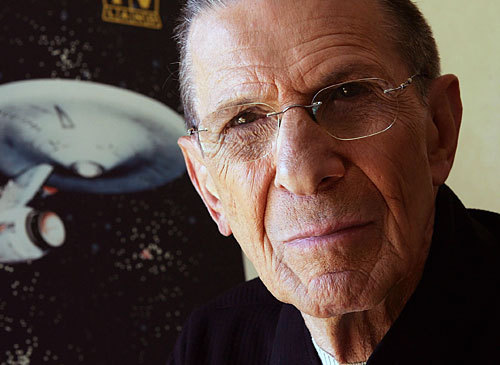
Leonard Nimoy died five years ago today. Here's the post I wrote on that occasion.


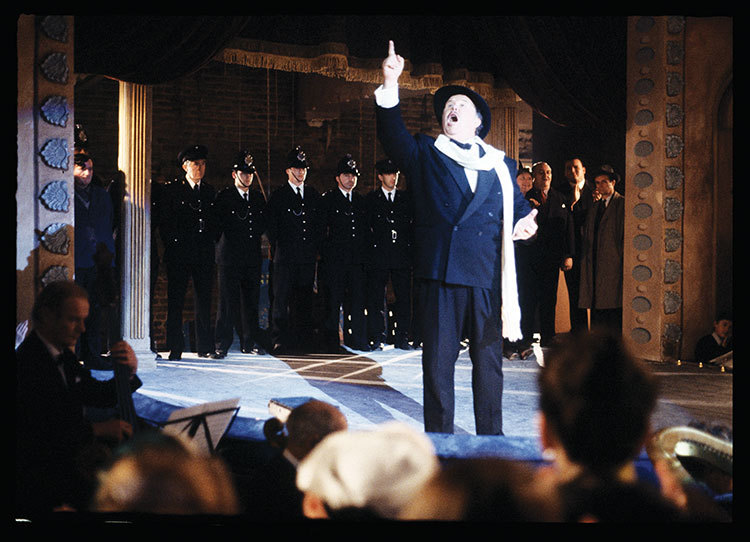
When The Wife and I were on our honeymoon, one of the stops was the Boston Museum of Science. I'm always a fan of science museums. During our visit, we saw a movie in their OmniMax theater. I don't remember what the movie was, to be honest, but I do recall a bit at the beginning of the show, when the lights dimmed and a voice sounded over the speakers, which said something like this:

Good afternoon! The movie will begin shortly, but before it does, we need to properly calibrate our theater's sound systems for use. To do this, we have enlisted the aid of a person who grew up in this very neighborhood. You may find his voice familiar.

This was followed by a beat of silence, and then another voice said:

Hello. Who put the BOMP in the BOMP shoo BOMP shoo BOMP; who put the RAM in the RAMALAMADINGDONG.

The second voice, the "local kid made good", was Leonard Nimoy's. I think most folks in the audience recognized that voice before he actually said "This is Leonard Nimoy"; his voice was, actually, one of the most familiar I ever knew. Gravelly and distinguished, that voice was, and Nimoy knew how to use it, which words to emphasize and where to pause just ever-so-slightly for effect.


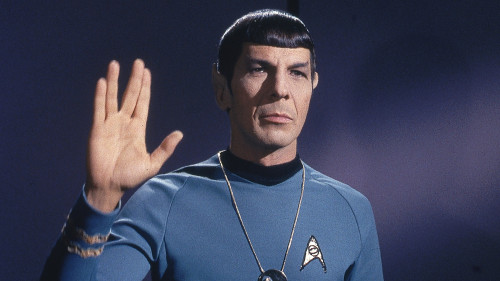
I don't remember a time when I wasn't aware of Leonard Nimoy on some level. More precisely, I should say that I don't remember a time when I didn't know who Mr. Spock was. I remember Star Trek episodes very early on, all the way back to the first house I ever lived in. Trek was my sister's thing, but I remember vague images from it. The most specific one I have is at the end of an episode called "Friday's Child", when, at the end, all is well and the female guest star's character has given birth, and observing Dr. McCoy making baby talk to the kid, Spock asks why baby talk is a thing at all.

A lot can be said about Nimoy and Spock, and a lot has been said about Nimoy and Spock over the years. Most fascinating to me was Spock's arc through the six "Original Crew" movies, from his attempt in The Motion Picture to purge himself of emotion to his own resolution of the "Kobayashi Maru" test to his rescue to his work to put his own brain back together (interesting that no fewer than three major Trek stories, one episode and two movies, devoted large amounts of time to putting Spock's brain and mind back together), and finally to the confident, competent officer we saw in The Undiscovered Country. In that film, when Kirk and McCoy get in serious trouble and are arrested, Spock just calmly assumes command and immediately begins the investigation to find the evidence to free them. Through that film, Spock acts with a calm acceptance that the truth will come out, that they will find the evidence, and that they will find it by searching for it calmly and logically. It is of a piece with his line in the film about the need for faith, to trust that "the Universe will unfold as it should".

My personal favorite Spock moment comes at the end of what is certainly one of the very best Trek episodes ever, "The City on the Edge of Forever". Knowing that if he allows Edith Keeler to live, the future will change and Starfleet and the Federation will never happen, Kirk stops McCoy from pulling her out of the path of the oncoming car. McCoy rages at Kirk:

"You deliberately stopped me. Jim! I could have saved her! Do you know what you just did?!"

And Spock -- ever calm, ever logical, ever accepting of what must be -- simply says:

"He knows, Doctor. He knows."

Nimoy knows that he can't express sadness in that line. He cannot express heartbreak or the awfulness of the choice that Kirk has just had to make, and all the same, Nimoy conveys that Spock knows these things. He knows these things, he knows that they are real, and he does not belittle them in any way.


Since I've no memories at all of a time before Star Trek, it's fair to say that it -- along with Star Wars, obviously -- are the biggest influences of mine in terms of my notion of what the world will look like, hundreds or thousands of years in the future. Will we always face problems and struggles and very real difficulties? Absolutely. But I don't believe in dystopia. I cannot, will not believe that there is a future in the offing when the world is wrecked and everything is in ashes and only a very few are living well while the rest of humanity exists in dimly-lit squalor. I cannot, will not believe that, and that's why I cannot, will not write it.

I believe that whatever difficulties and challenges we eventually face, we will do it from a brightly-lit viewpoint where it's always clear how far we've already come. I believe that when we take to the stars, our ships will be beautiful and that they will explore with grace, and that we will confront our futures with logic and science as well as warmth and a twinkle in the eye that's always there.

Why do I believe those things? In large part, because of a teevee show and some movies that Leonard Nimoy starred in.

After his long and prosperous life, Leonard Nimoy now belongs to the past. But he'll always be a part of my future...my "Undiscovered Country".