Mr. Tolkien was good enough to assign the birthday of two of my favorite fictional characters to the day when Autumn, my favorite season, generally starts. There's poetry there, I think.
Happy birthday, Bilbo and Frodo!


The personal blog of author Kelly Sedinger, chronicling the adventures of one overalls-clad wanderer.
Mr. Tolkien was good enough to assign the birthday of two of my favorite fictional characters to the day when Autumn, my favorite season, generally starts. There's poetry there, I think.
Happy birthday, Bilbo and Frodo!
Richard Feynman was an American physicist who contributed greatly to the field of quantum mechanics, eventually winning a Nobel Prize for his work. He also worked on the atomic bomb project and wrote a number of books about his colorful life and his views on science and technology, and in his time he was nearly as well-known a scientist as Carl Sagan. Toward the end of his life he notably served on the panel that investigated the explosion of the space shuttle Challenger, most notably bringing focus to a hypothesis that a failed O-ring seal led to the shuttle's demise--a hypothesis which went on to become the generally accepted idea of the disaster's cause.
Feynman's memoir Surely You're Joking, Mr. Feynman! (Adventures of a Curious Character) is a collection of anecdotes from Feynman's life, drawn from recorded conversations he had with a friend, Ralph Leighton. The book is a fun, entertaining, and lively look at various episodes from Feynman's life, though there are sober moments throughout, such as Feynman's experiences with the educational system in Brazil, which is the passage I quote below.
But we'll return to Feynman in a moment. First, though, the thing that made me think of this passage at all.
I recently saw a video on social media, shared by someone who has an axe to grind with the way arithmetic is taught to children these days under the guidelines of the "Common Core" curriculum. The video was a split-screen of a multiplication problem. I don't recall the exact problem, but it was something along the lines of 36x52.
On the left side of the video, there was a teacher and she was teaching her students (who we never see, so I have no idea what age group or learning level she was teaching) to solve this particular problem. Having never undergone the Common Core pedagogy, I can only summarize it in unfair terms: she was saying things like "OK, we start by figuring out how many groups of tens we have, and then we draw a big box so we can start to group it all together." But on the right side of the video, someone (we don't see who, we only see their hand holding a pencil) solves the math problem using the method familiar to probably most people: "2 times 6 is 12, put a 2 down here, carry the one, 2 times 3 plus the one we carried, put a 7 down here...." And so on. The person on the right whips through the calculation and has the answer before the teacher on the left has even started processing through the problem.
The point of the video, obviously, is to show how much more obviously superior the "old" way of teaching arithmetic is to the "new" way. Of course, anyone looking at this knows, or should know, that the video is utterly dishonest. Showing a person who has developed a proficiency on one hand is not remotely an indictment of showing someone teaching the thing on the other, for one thing. For another, I can remember by grade school math classes, and I can tell you with a high degree of confidence that the proficiency demonstrated by someone just whipping off the correct answer using the "Multiply the ones digit, carry the tens digit, multiply the tens and add what was carried, lather rinse repeat" method did not come as a result of a few minutes' instruction by a math teacher followed by an hour of doodle time. We spent days on that shit, and we got to take home page upon page of homework problems to practice the concept: "All right, we've spent an hour doing multiplications, so tonight do problems 1-50 in your workbook."
(An honest admission: more often than not I did enough problems to assure myself that I knew what I was doing, and then I blew off the rest. This strategy was not always successful, in several ways. First, I got caught by teachers not having done all the problems; second, my self-assessment as to my grasp of the material was not always as accurate as I hoped.)
A fair version of this video would show a teacher doing the Common Core method on one side and a teacher actually teaching the old method on the other, but I strongly suspect that wouldn't be as compelling, would it? Or maybe an adult doing the problem who learned via the Common Core method versus an adult who learned via the "old" method...but I expect that wouldn't be all that interesting, either. As always it would boil down to who was faster with math. I knew plenty of kids who weren't very fast doing sums in their heads, versus others who could glance at a problem and tell you the answer without even opening their pencil box. Again, this would not demonstrate anything at all.
(As I've been working on this post, this Sunday's Calvin and Hobbes repeat from many years ago managed to be relevant here:
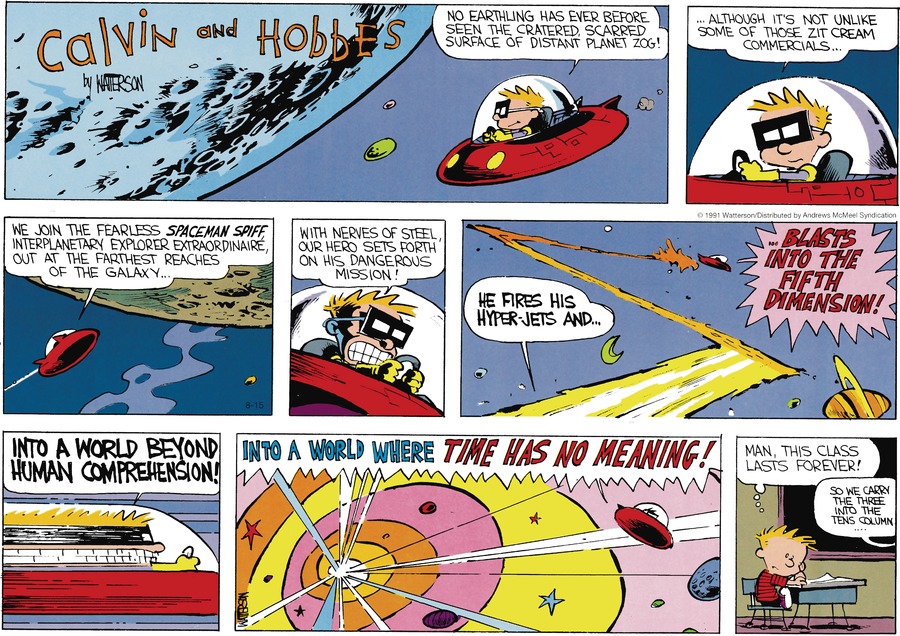
Yes, that's what it felt like.
But here's the thing with the Common Core method as I understand it, versus the "old" method (and I promise we're getting to a book excerpt eventually): the "old" method was a teaching of a rote algorithmic process to arrive at an answer. You learned multiplication first by being drilled until you know all your single-digit products: 7 times 9, 4 times 5, et cetera. Then you used those to work through a process that would give an answer. That's what an algorithm is, after all: a sequence of steps that, executed correctly, will yield the same result, each and every time. Kids in my day were being taught algorithms to complete multiplication assignments.
Today, though, it's clear to me that the idea is to teach a more conceptual approach, a way to think about what numbers are, what they mean, and what is actually happening mathematically when one does multiplication. (Or division, or whatever.) We were taught a process whereby we could calculate 36 times 52, but it appears to me that kids today are being taught what it means to multiply 36 by 52. Those are not the same thing. In my day, the "conceptual" stuff would come into play with annoying word problems ("Suzie has to give one toothpick to 52 kids every day for 36 days, how many toothpicks does Suzie need?"), but even that was more an applicative thing than a conceptual thing.
My father, who taught mathematics in college, got frustrated a lot of the time when students would arrive in his collegiate classes with good algorithmic skills but little ability to conceptualize just what it all meant in terms of mathematical concepts. In calculus classes he'd ask "What's the derivative of x," and students would say, "Oh, the derivative of x is [insert whatever the derivative is]." Then he's ask, "Good! Now what does that mean?"
Crickets.
And that is where we get to Dr. Feynman. One of the chapters in Surely You're Joking, Mr. Feynman relates Feynman's experiences in traveling to Brazil to see science education in action in that country, which at the time of his visit was just starting to really develop. Here is Dr. Feynman:
In regard to education in Brazil, I had a very interesting experience. I was teaching a group of students who would ultimately become teachers, since at that time there were not many opportunities in Brazil for a highly trained person in science. These students had already had many course, and this was to be their most advanced course in electricity and magnetism--Maxwell's equations, and so on.
The university was located in various office buildings throughout the city, and the course I taught met in a building which overlooked the bay.
I discovered a very strange phenomenon: I could ask a question, which the students would answer immediately. But the next time I would ask the question--the same subject, and the same question, as far as I could tell--they couldn't answer it at all! For instance, one time I was talking about polarized light, and I gave them all some strips of polaroid.
Polaroid passes only light whose electric vector is in a certain direction, so I explained how you could tell which way the light is polarized from whether the polaroid is dark or light.
We first took two strips of polaroid and rotated them until they let the most light through. From doing that we could tell that the two strips were now admitting light polarized in the same direction--what passed through one piece of polaroid could also pass through the other. But then I asked them how one could tell the absolute direction of polarization, for a single piece of polaroid.
They hadn't any idea.
I knew this took a certain amount of ingenuity, so I gave them a hint: "Look at the light reflected from the bay outside."
Nobody said anything.
Then I said, "Have you ever heard of Brewster's Angle?"
"Yes, sir! Brewster's Angle is the angle at which light reflected from a medium with an index of refraction is completely polarized."
"And which way is the light polarized when it's reflected?"
"The light os polarized perpendicular to the plane of reflection, sir." Even now, I have to think about it; they knew it cold! They even knew the tangent of the angle equals the index!
I said, "Well?"
Still nothing. They had just told me that light reflected from a medium with an idex, such as the bay outside, was polarized; they had even told me which way it was polarized.
I said, "Look at the bay outside, through the polaroid. Now turn the polarois."
"Ooh, it's polarized!" they said.
After a lot of investigation, I finally figured out that the students had memorized everything, but they didn't know what anything meant. When they heard "light that is reflected from a medium with an index," they didn't know that it meant a material such as water. They didn't know that the "direction of the light" is the direction in which you see something when you're looking at it, and so on. Everything was entirely memorized, yet nothing had been translated into meaningful words. So if I asked, "What is Brewster's Angle?" I'm going into the computer with the right keywords. But if I say, "Look at the water," nothing happens--they don't have anything under "Look at the water"!
[Feynman has several more experiences like this, after which he is to give a talk to students, professors, administrators, and government officials about his year in Brazil's science education system.]
The lecture hall was full. I started out by defining science as understanding the behavior of nature. Then I asked, "What is a good reason for reaching science? Of course, no country can consider itself civilized unless...yak, yak, yak." They were all sitting there nodding, because I know that's the way they think.
Then I say, "That, of course, is absurd, because why should we feel we have to keep up with another country? We have to do it for a good reason, a sensible reason; not just because other countries do." Then I talked about the utility of science, and its contribution to the improvement of the human condition, and all that--I really teased them a little bit.
Then I say, "The main purpose of my talk is to demonstrate that no science is being taught in Brazil!"
I can see them stir, thinking, "What? No science? This is absolutely crazy! We have all these classes."
So I tell them that one of the first things to strike me when I came to Brazil was to see elementary school kids in bookstores, buying physics books. There are so many kids learning physics in Brazil, beginning much earlier than kids so in the United States, that it's amazing you don't find many physicists in Brazil--why is that? So many kids are working so hard, and nothing comes of it.
Then I gave the analogy of a Greek scholar who loves the Greek language, who knows that in his own country there aren't many children studying Greek. But he comes to another country, where he is delighted to find everybody studying Greek--even the smaller kids in the elementary schools. He goes to the examination of a student who is coming to get his degree in Greek, and asks him, "What are Socrates's ideas on the relationship between Truth and Beauty?"--and the student can't answer. Then he asks the student, "What did Socrates say to Plato in the Third Symposium?" and the student lights up and goes, "Brrrrrrr-up"--he tells you everything, word for word, that Socrates said, in beautiful Greek.
But what Socrates was talking about in the Third Symposium was the relationship between Truth and Beauty!
What this Greek scholar discovers is, the students in another country learn Greek by first learning to pronounce the letters, then the words, and then sentences and paragraphs. They can recite, word for word, what Socrates said, without realizing that those Gr eek words actually mean somthing. To the student they are all artificial sounds. Nobody has every translated them into words the students can understand.
I said, "That's how it looks to me, when I see you teaching the kids 'science' here in Brazil."
This, it seems to me, is largely the difference between teaching the "old" way of arithmetic, with its rote memorization of times-tables and all that "Multiply the tens digit, carry the other number into the hundreds column" stuff, and the likely approach to however the Common Core method works. It's teaching what is actually happening in the mathematics, as opposed to teaching a method that can be robotized.
Here's some bonus Richard Feynman content, by the way: Ever wonder how a train stays on the tracks? Feynman answers, and it's not the answer everyone thinks:

What goes, "Click--do I have it yet? Click--do I have it yet? Click--do I have it yet?"
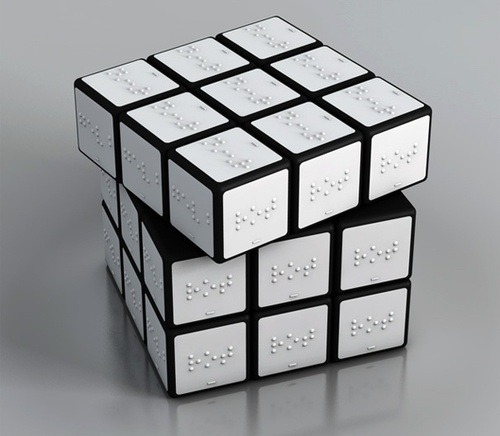
Answer: Stevie Wonder doing a Rubik's Cube.
The Magic Cube is much more than just a puzzle. It is an ingenious mechanical invention, a pastime, a learning tool, a source of metaphors, an inspiration. It now seems an inevitable object, but it took a long time to be discovered. Somehow, though, the time was ripe, because the idea germinated and developed nearly in parallel in Hungary and Japan and perhaps even elsewhere. A report surfaced recently of a French inspector general named Semah, who claims to remember encountering such a cube made out of wood in 1920 in Istanbul and then again in 1935 in Marseilles. Of course, without confirmation the claims seem dubious, but still titillating. In any event, Rubik's work was completed by 1975, and his Hungarian patent bears that date. Quite independently, Terutoshi Ishige, a self-taught engineer and owner of a small ironworks near Tokyo, came up with much the same design within a year of Rubik and filed for a Japanese patent in 1976. Ishige also deserves credit for this wonderful insight.
...
When I first heard the cube described over the telephone, it sounded like a physical impossibility. By all logic, it ought to fall apart into its constituent "cubies" (one of the many useful and amusing terms invented by "cubists" around the world). Take any corner cubie -- what is it attached to? By imagining rotating each of the three faces to which it belongs, you can see that the corner cubie in question is detachable from each of its three edge-cubie neighbors. So how in the world is it held in place? Some people postulate magnets, rubber bands, or elaborate systems of twisting wires in the interior of the cube, yet the design is remarkably simple and involves no such items.
In fact, the Magic Cube can be disassembled in a few seconds, revealing an internal structure so simple that one has to ponder how it can do what it does. To see what holds it together, first observe that there are three types of cubie: six center cubies, twelve edge cubies, and eight corner cubies. Each center cubie has only one "facelet"; edge cubies have two, corner cubies have three. Moreover, the six center cubies are really not cubical at all -- they are just square facades covering the tips of axles that sprout out from a sixfold spindle in the cube's heart. The other cubies, however, are nearly complete little cubes, except that each one has a blunt little "foot" reaching toward the middle of the cube, and some curved nicks facing inward.
The basic trick is that the cubies mutually hold one another in by means of their feet, without any cubie actually being attached to any other. Edge cubies hold corner cubies' feet, corner cubies hold edge cubies' feet. Center cubies are the keystones. As any layer, say the top one, rotates, it holds itself together horizontally, and is held in place vertically by its own center and by the equatorial layer below it. The equatorial layer has a sunken center track (formed by the nicks in its cubies) that guides the motion of the upper layer's feet and helps to hold the upper layer together. Unless you're a mechanical genius, you can't really understand this without a picture, or better yet, the real thing.
...
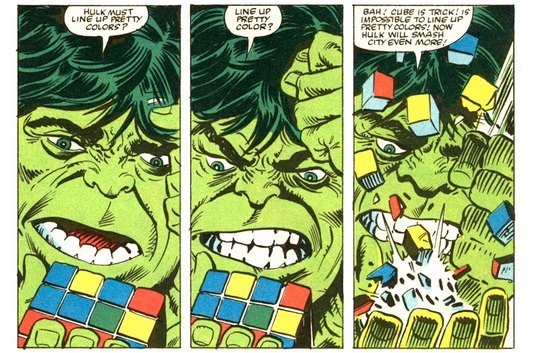
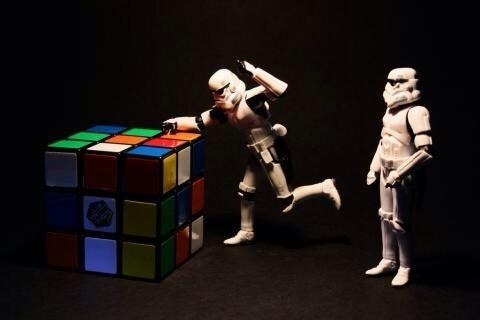
It is likely that many people will buy cubes, little suspecting the profound difficulty of the "basic mathematical problem". They will innocently turn four or five faces, and suddenly find themselves hopelessly lost. Then, perhaps frantically, they will begin turning face after face one way and then another, as it dawns on them that they have irretrievably lost something precious. When this first happened to me, it reminded me of how I felt as a small boy, when I accidentally let go of a toy balloon and helplessly watched it drift irretrievably into the sky.
It is a face that the cube can be randomized with just a few turns. Let that be a warning to the beginner. Many beginners try to claw their way back to START by first getting a single face done. Then, a bit stymied, they leave their partially solved cube lying around where a friend may spot it. The well known "Don't touch it!" syndrome sets in when the friend innocently picks it up and says, "What's this?" The would-be solver, terrified that all their hard-won progress will be destroyed, shrieks, "Don't touch it!" Ironically, victory can come only through a more flexible attitude allowing precisely that destruction.
I finally must confront the matter of the cube fad's passing. David Singmaster's Cubic Circular is going under after Volume 8. Many thousands of Megaminxes [a puzzle similar to a Rubik's Cube, but dodecahedral in shape] were melted down for their plastic. Uwe Meffert's puzzle club seems to have been a flop. The Skewb and many other wonderful objects I described never hit the stands. A few that did were almost immediately gone forever. So...have we seen the last of the Magic Cube? Are those cubes you bought going to be collector's items? Well, I am always loath to predict the future, but in this case I will make an exception. I am bullish on the cube. It seemed to seize the imagination wherever it went. Despite the line concluding my second cube column, the cubic fad finally did spill over into the Soviet Union.
In my opinion, the world simply overdosed on cube-mania for a while. We humans are now collectively sick of the cube, but our turned-off state won't last too long -- no more than it lasts when you tell yourself "I'll never eat spaghetti again!" after gorging on it. I predict that cubes will resurface slowly, here and there, and I am even hopeful that some new varieties will appear now and then. This is Mother Lode country. There may never again be quite the Gold Rush we witnessed a couple of years ago, but there's still plenty of gold in them thar hills!



I'm reading a book right now called Seasons of a Finger Lakes Winery, by John C. Hartsock. The book is just that: a year in the life of a single winery in New York's Finger Lakes region, a place where wine and winemaking have become a major industry and a vital part of the tourist trade there. I'll have more to say about the book later on (I'm greatly enjoying it!), but for now I want to highlight this lovely passage that captures some of the geographical appeal of the region for me.

I've enjoyed the Finger Lakes ever since the first time I visited them as a not-quite-ten-year-old kid when we moved to New York, but over the last fifteen years or so that region has become my dream place. If I were suddenly gifted enough financial resource to live any place on Earth, I would live among the Finger Lakes: maybe on the shores of Cayuga Lake near Ithaca, or perhaps on Seneca Lake up by Geneva, or maybe along Canandaigua or even a small cottage on one of the smaller lakes, like Honeoye or Conesus. I've been reading a bit about the Finger Lakes, off and on over the last couple of years, as research and story-fodder for a story sequence that I'd like to write one day, and this passage is from one of those books.
In this passage, Gary and Rosie--the owners of the winery on which the book focuses--are taking a day off from their winery operations, which are on the eastern shore of Cayuga Lake, to visit a different winery, which is on the western shore of Keuka Lake. As the crow flies, the distance is maybe fifty miles. The driving distance is at least seventy miles, depending on route, and a lot of that is two-lane roads.
Here is our author:
From Ithaca they turned west to Watkins Glen. It's one of the anomalies of travel in this part of the world that most through roads generally run north to south because the lie of the lakes is north-south. If you could go due west the trip might be cut to forty-five minutes. But there were those lakes, a mile to two miles wide and up to thirty-five miles long that you had no choice but to drive around. In certain place names you can detect references to a long-ago ferry, such as King Ferry. But the days when farmers ferried their teams of horses and wagons loaded with produce across the lakes were long gone. The result is that today, with the automobile, most of your travel is north-south, with occasional short jogs east-west between the lakes. This was particularly true because of Cayuga and Seneca Lakes, the two largest and longest of the Finger Lakes. But it was also true of the other Finger Lakes--Owasco, Skaneateles, Keuka (the crooked lake shaped like a Y), and Canandaigua. Then there are a number of smaller lakes. Glaciation had decreed the north-south disposition, and in losing the east-west orientation you lost your bearings--travelers bypassed the region. The result was that the necks of land between the lakes seemed forgotten by time. One could see it in villages such as Mecklenburg, where houses had weathered to a washed-out gray from lack of paint. This region is, after all, the home of the original Podunk (just northwest of Ithaca), which is little more than an empty crossroad.
This is all quite true. New York is in two distinct parts: a region that spans farther north-to-south than it does east-to-west, at the top of which is Lake Champlain and at the bottom of which is New York City. This region tapers toward the long, somewhat narrow region that extends several hundred miles east-to-west but is only maybe about a hundred to a hundred twenty miles wide at its widest. Here you find cities along the northern portion: Syracuse, Rochester, Batavia, Buffalo; and you also find smaller cities along what's called the Southern Tier, the counties that border Pennsylvania: Binghamton, Elmira, Corning, Olean, Jamestown.
And for about 75 miles in the middle, between the two tiers, is a sequence of eleven long, narrow, and deep lakes formed millennia ago by the glaciers that spread over New York and then retreated. These lakes, the Finger Lakes, make it so that for a large chunk of the middle portion of the state, east-west travel means going north and then south again, or vice-versa. You can drive straight across the state from Jamestown to Binghamton, and you can do the same thing from Buffalo to Albany...but if you want to drive a straight line from Dunkirk to Cortland? It's not going to happen, because of the lakes and their deep valleys. (And also the deep canyon of Letchworth State Park, which might be a Finger Lake that didn't work out because the Genessee River broke through and remained a river, instead of filling its canyon.)
When you read about the growth of the wine industry in the Finger Lakes, one word that always turns up is microclimate: the individual lakes, by the nature of their length and depth as well as the depth of their individual valleys (there are places where the vistas above the Finger Lakes put me in mind of pictures I've seen of the lochs of the Scottish Highlands), create very small regions where the climate is perfect for certain grape varietals. That climate vanishes just a few miles away in any direction, but amongst the lakes? Especially the bigger ones? That's where the lay of this relatively small portion of land makes magic happen.
With microclimate in mind, I would coin another word: microcharacter. Each lake feels like it is its own world in itself, and even though one lake is just a few miles from the next, there is always something rather unique about each one, and when you drive straight from one to the next, your course takes you up, up, up over a long rise--and then you crest and you know you've left that lake behind and are descending down, down, down to the next one. Every year when we travel to Ithaca we take one of these routes back at the end of the day, and since this annual trip is one of my most beloved rituals, it's when we crest the rise from the Cayuga Lake valley and cross over into the Seneca Lake valley that I'm always saddest. That's when I know that the day is over and that Ithaca is behind me for another year.
As a writer, this affect of the directions of the lakes is an important one as well, because this shows perfectly how geography affects character of a place. The nature of the land in the Finger Lakes region pretty much makes it impossible for an Interstate Highway to go through there: there isn't even a north-south Interstate through the Finger Lakes, much less an east-west one. Interstate 390 runs from Rochester south, skirting the western edge of the Finger Lakes region; to the east, Interstate 81 runs from Binghamton to Syracuse (and beyond). Ithaca lies entirely off the Interstate Highway system, and it's all the better off for that, I think. Could there be Interstates through the Finger Lakes? I suppose there could, but the question then would be...why? What would be gained from running, say, Interstate 286 from Owego northward to Auburn? Or a similar stretch from Corning, snaking between Keuka and Seneca Lakes, to I-90 someplace between Canandaigua and Geneva? And an east-west route between Geneseo and Cortland would be pointless, even setting aside the huge expense of constructing a series of really ugly concrete bridges across seven Finger Lakes.
Hartsock is right when he notes the "lost in time" feel of all the little villages in the Finger Lakes region, and he's astute in noting why. One thing you notice when driving through the region is lots of train tracks: there used to be a lot of railroading through the Finger Lakes, but even that has slowed to a crawl, and some of the railbeds are being converted into walking trails. Again the geography shapes the region: the ever-ongoing speedening-up of commerce of the last century has largely left behind a region where the land itself acts as barrier to commerce. I do drive through all of those towns, not just the ones between the Lakes but the old rail towns north of them, with a sense that it's a shame the world has left them in the dust, and a wish that they could capture a bit of their old prosperity again...but not too much. After all, if things get too rich, that's when powerful people far away start looking at maps and seeing things like roads that aren't there.
So, fiction writers (I'm talking about fantasy and SF writers here, who are working in made-up worlds) should think in terms not just of how geography affects things like commerce and trade and wars, but how geography affects a region's entire character. What's it like to be a young kid in a town that has gone several generations since the last trains ran? How does it feel to live in a village that was hewn from a rocky ravine more than two hundred years ago and watch the entire world heating up while your seasons remain pretty much the same?
And what's it like to live in a place like that and make your living doing something that requires huge investments of time in a world that values investments of time less and less?
I also recall one morning when we were gearing up for one of our usual Saturday (I assume it was a Saturday) road trips. A fixture of my childhood was all of us getting in the car and driving someplace an hour or two away, seeing what was there for a bit, and then coming home, usually with a stop at some tavern someplace for dinner. On this morning, I asked my mother where we were going, and she said, "Iowa!" I had no idea what "Iowa" was; remember, I was five years old and pretty hazy on the concept of states and stuff. I don't remember what we saw that day on our drive to Iowa, but that was the first time Iowa was ever on my radar. Maybe we went to Dubuque? I don't know.
I think back on that day, though, and I realize that as a kindergartner was hanging out with his parents, about a hundred seventy miles or so west there was a first grade girl hanging out with her parents, and that thirteen years or so later, that girl would meet that kindergartner in college, and a year after that, he'd ask her to go see a movie with him (Edward Scissorhands), and fast-forwarding to today, as that onetime kindergartner writes this very post, she's taking measurements for a new bed for one of our dogs. We grew up worlds apart, but then there was this one period when we weren't that far from each other. Just a few hours' drive apart, for that one day. Later in summer '77, we'd move to Hillsboro, Oregon...and a couple years after that, to Allegany, NY. That young girl I'd marry was a couple thousand miles thataway...and then she was a thousand or so miles thataway. Until finally the thataways converged, and we were together, hoping for as few thataways as possible.
I've been thinking about this a lot, after reading this passage from Aimee Nezhukumatathil's remarkable book World of Wonders: In Praise of Fireflies, Whale Sharks, and Other Astonishments. At this point, Nezhukumatathil is in sixth grade, living in Kansas with her family through a year she doesn't seem to have enjoyed very much:
I could not have known that just one hour south of Larned State Hospital the person I would eventually marry, the father of my sons, was likely practicing layups in his driveway or hitting baseballs into a field not too far from a buffalo range. Just one hour from my life's love! One hour! A white boy who would one day take my brown hand in his, putting it to his heart when he makes a promise so I can feel his heartbeat and the warmth residing there. If only the narwhal could have taught me how to listen for those clicks of connection, that echo reverberating back to me.
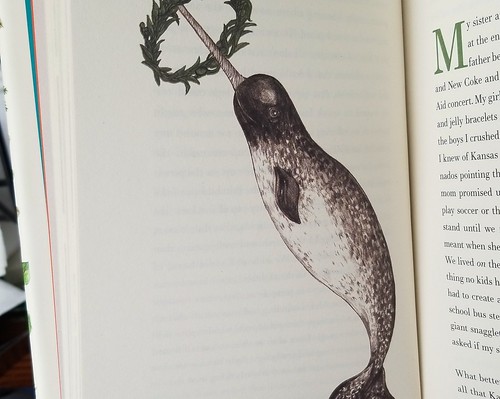
Wait, you might be asking. What's this about a narwhal?
The book is called World of Wonders, and as I flipped through it in the bookstore where I found it (a brand new bookstore in Ithaca that is one of the most beautiful little bookstores I've ever seen and had the terrible luck of opening as the COVID pandemic was apparently shutting down the world), I figured it for a poetical look at a quirky selection of the world's creatures, quirky and poetic. And it is certainly that, as Nezhukumatathil is a poet by vocation. But more than that, Nezhukumatathil uses all of these amazing creatures of the world as metaphorical gateways to discuss her personal biography and her experiences in the world.
Nezhukumatathil, being a poet, writes with language that is beguiling and lyrical. The book has the feel of being one long prose poem. Here she is on fireflies:
For a beetle, fireflies live long and full lives--around two years--though most of it is spent underground, gloriously eating and sleeping to their hearts' content. When we see these beacons flashing their lights, they usually have only one or two weeks left to live. Learning this as a child--I could often be found walking slowly along untrimmed lawns, stalling and not quite ready to go inside for dinner--made me melancholy, even in the face of their brilliance. I couldn't believe something so full of light would be gone so soon.
One aspect of Nezhukumatathil's life to which I can relate is moving a lot as a young person, but I cannot relate to her experiences as a person of color living in all these rural American locations. I can, though, readily envision the kind of experiences she had. There was an Indian family that moved to my town when I was a senior in high school, and one of their daughters (I think there were at least two kids in that family) was in my class, for all of one year. She was an incredibly smart and very nice (and, I might add, beautiful) person who was very well read; her favorite book was The Great Gatsby, which I myself read that year for the first time. She and I had some discussions on that book that I remember fondly. But some other things, I remember less fondly. As the year began to dwindle and as graduation neared, it was time for the yearly academic awards, and she won a bunch of them. Some of my classmates--all of them as white as anything--groused in the quieter moments of study halls that "Why should she get all the awards, she only came to town that year, she'd be gone soon, she was an outsider." This at the time reminded me of my sister's experience six years earlier in the exact same school district, when we'd moved in when she was a junior and she proceeded to win a lot of academic accolades. But of course her experience couldn't possibly map to Shazia's (that was her name), because Shazia had the added hurdle of moving to small-town rural Western New York as a person of color.
Throughout World of Wonders, Nezhukumatathil occasionally makes glancing reference to time she lived in Western New York. I had no idea of this when I bought the book, but it caught my attention. But when the subject comes up, it's a very quick mention, gone as quick as it comes, and I wondered if Nezhukumatathil had a bad experience here. I wondered where she lived in WNY, and how much of her experience here I would recognize, even as the person watching it unfold instead of living it. Late in the book, though, Nezhukumatathil names her town: Gowanda, NY. I know the town. It's a small village in the hilly country between Erie and Cattaraugus Counties, a very beautiful area that I value highly for its hills and valleys and gorges and streams and waterfalls. But Nezhukumatathil writes of a single year there, and I think back on my classmate Shazia.
Later, Nezhukumatathil writes of living in Western New York, during her chapter on the red-spotted newt:
These newts are one of the only amphibians to contain a ferromagentic mineral in their bodies, and that, combined with their incredible capacity to memorize sun and starlight patterns to return to their original pond waters, make them an animal on par with salmon for their excellent homing capabilities. What's particularly amazing is that in its lifetime--thanks to its innate magnetic compass--a newt doesn't usually stray farther than just over a mile from its origins pond, staying within the range of about eighteen football fields.
My own homing instinct was stronger than I ever could have thought. A decade after I left Western New York as a teenager, I was finishing up a fellowship year in Madison, Wisconsin. I scanned the academic job boards for entry-level professorships and had to blink twice when I saw there was an opening not too far from my old home. It was a long shot, I knew, but I applied anyway, even as I drove around to local bookstores and coffeehouses in Madison to apply for jobs there. Coffee barista, English professor--I felt guilty for even daring to hope I could land a tenure-track job--all I knew was that I wanted to stay in the classroom, but I also wanted to be able to spend time outdoors and write.
After a few days' worth of interviews, I received the magical call welcoming me back, and I spent fifteen more years in Western New York. I was married there. My babies were born there. But it wasn't my forever home. Though we still keep in touch, my best friends had long since moved away. I was still one of too few brown people in town. I was tired of acquaintances at the post office asking about "my people," meaning Filipinos or Indians; tired of people saying Namaste! to me in the grocery store, when I was least prepared for it; tired of the increasingly hostile climate at work if I dared to suggest more diversity on campus; and simply tired of being the one brown friend to so many people. On top of that, I spent fifteen winters navigating roads clogged with lake-effect snow. I was done with that pond. I would need to keep searching.
Everyone has to find their own home, their own place to belong. Nevertheless, it makes me a little sad that the place that's my home, my place to belong, wasn't someone else's. A bit selfishly, I mourn that my region had for a time someone living here who is capable of writing a book like World of Wonders...but for this reason or that, she felt that she couldn't really live here. This happens for a lot of reasons, not all of them bad...but still. A place is a bit sadder when it says farewell to its poets, and a bit sadder than that when it doesn't even realize its poets have left.

My years with the Dodgers were 1952 and 1953, two seasons in which they lost the World Series to the Yankees. You may glory in a team triumphant, but you fall in love with a team in defeat. Losing after great striving is the story of man, who was born to sorrow, whose sweetest songs tell of saddest thought, and who, if he is a hero, does nothing in his life as becomingly as leaving it.
--Roger Kahn, The Boys of Summer
I was once a huge baseball fan, mainly during the 1990s. It started with the Pittsburgh Pirates' string of three consecutive National League Eastern Division championships (they were in the NL East back then, before the realignment that created the NL Central), each of which was followed by a heartbreaking loss in the NLCS. Those three years gave my father and I a lot to talk about and a rooting interest in common, which was a lovely thing. (It's not like we especially needed that; it's not as if we had a wounded relationship that was somehow healed by baseball or some shit like that. But a shared interest and joy is always good!) Looking back, it's amazing how my college years were grounded by sports heartbreak: I'd watch the Pirates lose an NLCS in October, and then three months later I'd watch the Bills lose a Super Bowl.
As the 1990s came to an end, I still loved baseball even though by this time the Pirates had become bad (in an epic stretch of badness that would go on for twenty years), but as the 2000s arrived I had less and less opportunity to watch baseball on teevee, because we didn't have cable. I never lost my admiration for the game itself, though. I loved its rhythm, I loved how it created moments of fantastic tension without the breakneck pace that lots of people seem to think is essential to an exciting sporting event. And I loved how baseball, for some reason, lent itself to wonderful writing. Good sports writing abounds all over the place, I have to admit, but there's just something about baseball that makes it fodder for great writers.
I think it has to do with how much baseball there is. Each season lasts for six months, with games nearly every single day; unless there's a no-hitter or a perfect game or some other kind of highlight, few individual games linger in the mind, which means that an entire season can take on the feel of a long epic struggle that feels sad when it ends, whether your team finishes as World Champion, or a pennant winner, or as just another also-ran along the way.
And it's not just that the seasons are long; baseball itself has been around seemingly forever, too. The history of baseball lasts to around the time of the Civil War, if not before that, and its rise echoes evolutions of so much of America: the urbanization of our society, our ongoing struggles to find some semblance of racial justice, and the desire so many feel to hang on to aging traditions as our society seems to relentlessly speed up.
Baseball careers last a long time too, at least compared to other sports. A typical football career lasts, on average, only four or five seasons. A good baseball player, who manages to avoid catastrophic injury, can play ten, fifteen, even up to nearly twenty years before the inevitability of age takes its toll. And there's also the progression from the minor leagues to the Majors to take into account: a poetic questing nature seems to apply to players who toil on and on, always chasing the dream.
Roger Kahn, regarded as one of the finest of all baseball writers, died in 2020 at the age of 92, and when he passed, many paeans to his most famous book, The Boys of Summer, showed up online and elsewhere. I had never read Boys, so I added it to my reading list, and I finally got to it just a couple of weeks ago. (Hooray for borrowing e-books from the library--but that's for another time!) I finished Boys just a couple days ago, and it really is every bit as good as its admirers claim.
Kahn's book is billed as a chronicle of the Brooklyn Dodgers over a remarkable period in which they were always very good and yet only won it all a single time, but the book is more than that. It opens with a long reminiscence of Kahn's family life, of how he learned and grew and learned some more and eventually came first to writing and then to writing baseball. We don't arrive with the Dodgers until some time in the book, and if you expect the kind of long telling of a great team's championship season, well...that's not what Kahn is up to here. He writes about baseball in the larger sense, with baseball's dual feeling of being something unending, through which individual men come and go. In the book's latter half, Kahn catches up with many of the stars from those Dodgers teams, the last ones to play in Brooklyn before the team's eventually forsaking of Ebbets Field and Brooklyn for Chavez Ravine in Los Angeles.
Kahn doesn't draw much attention to the way time is a constant theme in his book, but it is always there. Everyone whom Kahn profiles here is now dead, and the first edition of The Boys of Summer came out in 1972. The oldest players in baseball today were not even born when this book came out, chronicling baseball events that were already decades old. Baseball keeps on keeping on, doesn't it?
Toward the end of the book Kahn discusses, almost in passing, the team's move to Los Angeles. Though he doesn't underline the point, it's hard not to sense a disapproval on Kahn's part of what he might describe as the corporatization of baseball. Even that, however, must be viewed through the lens of time. When Kahn was writing, Ebbets Field was still a living memory. Now, the Dodgers have been in Los Angeles over half a century, and the then-shiny and new stadium at Chavez Ravine is one of baseball's oldest and most beloved venues. Baseball keeps on keeping on.
Finally, I close with a few specific passages that struck me. Roger Kahn is, among other things, a hell of a storyteller and wordsmith. An anecdote about Gil Hodges, who played first base for the Dodgers before becoming a manager:
A sense of strength stays with a man. When Hodges managed the Washington Senators, he learned once that four players were violating a midnight curfew. Hodges believes in curfews and he convened his ball club and announced: "I know who you were. You're each fined one hundred dollars. But a lot of us are married and I don't want to embarrass anyone. There's a cigar box on my desk. At the end of the day, I'm going to look into that box and I want to see four hundred dollars in it. Then the matter will be closed." Hodges gazed. At the end of the day, he looked into the cigar box. He found $700.
As Kahn travels around the country to meet personally with the retired stars of those great Dodgers teams, he finds himself often well off the beaten paths in towns that were once something but which are now just doddering along. The town that I grew up in is one of those, a onetime "city" in New York's Southern Tier that is now just another small town with a lot of closed factories and empty buildings, but still enough people to keep the place being a place. Interestingly, my town--Olean, NY--is name-checked in The Boys of Summer, as the location of a tryout camp for guys who maybe wanted to play baseball. I have trouble imagining such a thing now, but that camp was Gil Hodges's route to the big leagues.
This passage, about Newport, PA, rings very true to me. The towns of my youth were very much like this town.
The reasons for which Newport was built died along with the tannery and ironworks. A river bend no longer makes a town and jobs are so short at the Penn Central that only men with twenty years' seniority survive recurrent layoffs. But Newport is not dying; the petrified village may even grow. It is a refuge for certain whites, raising young families, who talk about "the niggers stealing America." No black man lives in Newport, Pennsylvania. None wants to come and none is asked. A few blacks who work for Bethlehem Steel have built a cabin near Lost Creek Gap, but the Newport elders say these aren't bad ones.
And finally, a quote about the inevitable shifting of the world and how it appears to those living in as it shifts:
There is only so much space on the planet. Fathers perish to make room for sons. At the end, some go with grace, but the middle years--and these Dodgers are striding through middle years--shake with contention. Jack and Jackie Robinson; Clem and Jay Labine, father and son circling one another in a spiky maze of love.
It is too easy to lay griefs on the end of summer. Once I wrote the poet Robert Graves, asking, among other questions, how it felt to be seventy years old. He could not tell me, Graves responded, because in his own mind he was still twenty-one.
He [Reed] was determined, on taking up the gavel as Speaker, to put into effect a plan on which he had long deliberated, consulting no one, and on which he risked his entire political future. He knew that the fight would focus upon him the nation's attention and also that if he failed his Congressional career would be over. The stakes were high: he would either break "the tyranny of the minority" by the which the House was paralyzed into a state of "helpless inanity", or he would resign.
The system Speaker Reed had decided to challenge was known as the silent – or disappearing – quorum. It was a practice whereby the minority party could prevent any legislation obnoxious to it by refusing a quorum, that is, by demanding a roll call and them remaining silent when their names were called. Since the rules prescribed that a member's presence was established only by a viva voce reply to the roll, and since it required only a majority of the whole to constituted a quorum, the silent filibuster could effectively stop the House from doing business.
...
To Reed the issue was survival of representative government. If the Democrats could prevent that legislation which the Republicans by virtue of their electoral victory could rightfully expect to enact, they would in effect be setting aside the verdict of the election. The rights of the minority, he believed, were preserved by freedom to debate and to vote but when the minority was able to frustrate action by the majority, "it becomes a tyranny". He believed that legislation, not merely deliberation, was the business of Congress. The duty of the Speaker to his party and country was to see that that business was accomplished, not merely to umpire debate.
...
He reached his decision to attack the silent quorum, and planned his campaign, alone, partly because no one else would have thought there was a chance of success and partly because he was not sure that even his own party would support him. There were indications that they might not. Because of Reed's known views on the silent filibuster it was clear that quorum-counting would be an issue in the new Congress. REED WILL COUNT THEM, predicted a headline in the Washington Post, and the story beneath it said that even Mr. Cannon, Reed's closest lieutenant, was, opposed to the attempt. The Democrats were manning their defenses. Ex-Speaker Carlisle let it be known that any legislation enacted by a quorum which had not been established by a "recorded vote" would be taken to court as unconstitutional.
Reed, however, had satisfied himself that he would be upheld if it came to law, and on the attitude of his own party he was prepared to gamble. He shrewdly judged that the Democrats in their rage would provoke the Republicans to rally to his support. When the first of the contested elections appeared on the schedule for January 29 he was ready. As expected, the Democrats raised a cry of no quorum and demanded a roll call. Reed's moment had come. Without a flicker of expression on the great white moon face, "the largest human face I ever saw", as a colleague described it, without any quickening of the drawling voice, he announced, "The Chair directs the Clerk to record the names of the following members present and refusing to vote," and began reading off the names himself. Instantly, according to a reporter, "pandemonium broke loose. The storm was furious...and it is to doubted if ever there was such wild excitement, burning indignation, scathing denunciation and really dangerous conditions as existed in the House" during the next five days. Republicans were wildly applauding, all the Democrats were "yelling and shrieking and pounding on their desks" while the voice of their future Speaker, Crisp of Georgia, boomed, "I appeal! I appeal from the decision of the Chair!" The explosion was "as violent as any ever witnessed in any parliament," a member recalled later. "Mr. Blanchard, Mr. Bland, Mr. Blount, Mr. Breckinridge of Arkansas, Mr. Breckinridge of Kentucky..."
Up jumped the Kentuckian, "famous for his silver hair and silver tongue." "I deny the power of the Speaker and denounce it as revolutionary!" he called.
The resonant twang from the Chair continued unregarding, "Mr. Bullock, Mr. Bynum, Mr. Carlisle, Mr. Chipman, Mr. Clement, Mr. Covert, Mr. Crisp, Mr. Cummings" – through hisses and catcalls and cries of "Appeal" irresistably rolling down the alphabet – "Mr. Lawler, Mr. Lee, Mr. McAdoo, Mr. McCreary..."
"I deny your right, Mr. Speaker, to count me as present!" bellowed McCreary.
For the first time the Speaker stopped, held the hall in silence for a pause as an actor hold an audience, then blandly spoke: "The Chair is making a statement of fact that the gentleman is present. Does he deny it?"It's a fascinating tale. It doesn't end there with that one act of Reed's, of course; few things of this nature ever do. The Republicans would later lose Congress so badly that the Democrats were able to raise a quorum by themselves, and they then restored the silent quorum. This backfired after the next election cycle, however; the Democratic majority was greatly reduced such that now-Minority Leader Reed was able to frustrate Democratic legislative aims by using the silent quorum himself, until the Democrats finally relented and allowed the silent quorum to end forever. (The Proud Tower is one of my favorite history books, by the way. It is a large-scale picture -- a historical snapshot, if you will -- of the state of the the world as it was moving inexorably toward World War I.)
Back when I was in college, I decided that I needed to start learning to cook. One of the cornerstones of that effort was to buy all the cookbooks by Jeff Smith, also known by his PBS brand name "The Frugal Gourmet", and read them cover to cover while also cooking quite a few of the recipes. I learned a hell of a lot about cooking in that way ("Hot wok, cold oil, foods won't stick!), and while I think Smith's notions about food and peacekeeping were a bit out there (one of his last cookbooks has a very odd passage in which he envisions Bill Clinton and Saddam Hussein cooking together), I very much agree with his insights about food and memory. There's a reason why, when a beloved elder dies, a lot of times those left behind despair over being able to replicate their best dishes. "It's good," we say. "I've got it pretty close, but there was something she did that I can't quite get my finger on."
I still own most of Smith's output to this day, and a few of his recipes are in my permanent rotation. I have never stopped reading them or even watching some of his shows which have shown up on YouTube, even though...
Smith, it turned out, was really not the kindly pastoral gentleman he portrayed on his shows. I don't really want to get into that here, but suffice it to say that there were accusations of sexual improprieties in the late 90s that brought his career to a slamming, screeching halt. If you search around the Internet, you can find other testimonials about Smith that are, shall we say, less than flattering. He may have spent many years not even living with his wife (speculations as to why that may have been abound), and he seems to have been an unpleasant fixture in the Seattle food scene toward the end of his life. Again, I don't want to get into that.
It all comes back as we have discussions in society today, quite repeatedly, about what we do when people we admire, especially the creative folks whose works have touched and shaped us, turn out to not only be very human, but very disappointingly human, at that. JK Rowling turns out to be transphobic to a deeply creepy degree. Isaac Asimov...well, rumors abounded about his conduct at science fiction conventions for years, and they don't seem to have gone away despite his being dead for nearly thirty years. Marion Zimmer Bradley's private life was appalling, and Orson Scott Card turns out to be deeply homophobic. Michael Jackson.
We all have to struggle with to what degree our artistic heroes were real people who committed acts ranging from missteps to simply awful deeds. I've known this for years, since I obsessively read about music history as a kid. My favorite composer, Hector Berlioz, was an addict and a manipulative stalker weirdo. Robert Schumann obsessively pursued a girl who today would be a minor and basically forced her to give up almost all of her own musical career outside of helping to perform and advance his works. (Clara Schumann was, by all accounts, an amazingly talented woman who might well have become a beloved composer in her own right, had husband Robert not dominated her so completely.) Richard Wagner? Well, as David Dubal writes in The Essential Canon of Classical Music, in reference to Wagner's "Siegfried Idyll", a gorgeous piece he wrote as a wedding gift for his wife, "That this man, capable of such emotion, was enraged at Bismarck for not burning Paris to the ground will always tantalize and disturb."
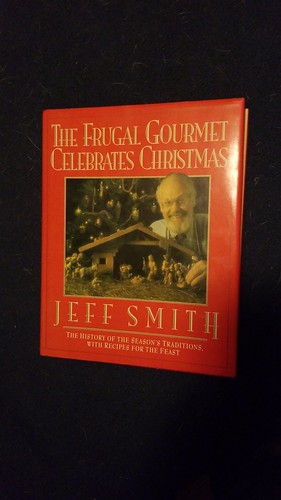
So...back to Jeff Smith, among whose cookbooks is the one pictured above, a quite wonderful volume of Christmas recipes and ruminations about our modern Christmas. (Well, not quite our modern Christmas! This book is almost thirty years old.) Smith presents an entire Christmas menu, based on those present at the Nativity: dishes for Joseph, for Mary, for the Innkeeper (whom Smith believed has gotten kind of a bum rap over the years) and the tax collector. There are dishes for the Wise Men, for the angels, and even for the donkey (who gets "Straw and Hay", which is now one of my best pasta dishes). The book has cookie recipes, recipes for mincemeat pie and two kinds of fruitcake--I want to like fruitcake but I can never get there!--and more. He finally presents several complete Christmas dinner menus...and the photographs throughout are wonderfully colorful, as well. There's a reason I love this cookbook: it's the kind of cookbook you can thumb through with pleasure, in addition to having good insights on food.
In the middle of the book comes this section, about Christmas traditions. This has been one of my favorite pieces of Christmas writing ever since I bought this book in the 90s, and if it is coming from someone who would later turn out to be quite a lot less than the sum of his parts, well...that's frankly the case with most art, isn't it? It's up to us to decide how much these things bother us, and which things are our personal dealbreakers.
Our Family Christmas
From THE FRUGAL GOURMET CELEBRATES CHRISTMAS
Our family traditions came about in much the same way as did your family traditions...they just sort of happened.
Patty and I originally made a prime rib of beef for Christmas, and then the boys came along. Somehow Patty got into the roast goose routine, and we enjoyed that for years. As the boys grew, we began to celebrate one of the Christmas menus that follow, and then on Christmas Day I would prepare a full Norwegian smorgasbord with baked beans, potato salad, several different kinds of herring, luncheon meats, special breads, fish balls in cream sauce, cold salmon or lox, lefse, Christmas bread, and, of course, the leftover roast beef or goose from the night before. We still do that.
Last year I did a Swedish meal of pickled pork. The Paulina Market in Chicago makes a Swedish pickled fresh ham that is just terrific. So, now we all have a new favorite dinner. The boys side with the goose, Patty with the roast beef, and I go for the pickled ham. Now what do we do?
One year I suggested to Jason that we make some changes in our Christmas dinners. Try something new. He was quite young at the time, but his response meant that we had established some family traditions that he wanted to maintain. I was so touched by his insight that I wrote the following letter to him, a letter that was circulated by the Roman Catholic parish in Chicago. You will probably recognize your own family in this letter.
My dear Jason,
I probably came very close to violating the meaning of tradition when I suggested that we try something a bit different this year. You are happily bound up in memories of Christmases past, and I expect that I will hear you say, "Dad, can't we have real dressing? I mean the old kind. After all, it is Christmas!"
You are right, son, it is Christmas. And on the day of the Mass, the feast of Christ, I should not go around breaking family traditions.
But I must consider anew the meaning of the Feast of the Christmas, and I think you and I should think about it together.
The term feast is very much involved with the meaning of memory. We feast because we remember certain events in our lives; sometimes wonderful events, sometimes painful events. That seems to be the way it has been with man- and womankind for a long time.
Christmas for me as a child was very different from our Christmas now. We would travel to greet my father's family at his mother's house, your great-grandmother, Nettie Smith. Oh how sad I feel that you did not know this tough old girl. She was a member of the state legislature and she was a left-winger from the start. But in the kitchen she was just terrible. She cooked turkey in the Old Testament style, burning the poor thing on the altar until smoke drifted up to heaven. Then, to the table it would come, though it was so dessicated, so dried out, so tasteless, that I could not understand why someone else in the family did not cook the bird instead. You know why they did not? Because it was job traditionally reserved for Gramma. To this day, when I eat dried-out turkey, I think of her...and how much I miss her.
Christmas morning in my family was wonderful. World War II was in the midst of every event, and candy and sugar were hard to find. One Yule morning my mother, your Grandma Smith, brought us to the table and presented us with marzipan candy shaped like eggs and bacon. My brother, Greg, sister, Judy, and I were amazed that Mom could find such things.
Some of our Christmas traditions are a bit strange, I will admit. But they are our traditions, our family. Each year we carefully unpack the papier-mache manger figures we made together when you and Channing were tiny children. And each year we spend precious time gluing the poor shepherd boy back together. Would it not be much more practical simply to go out and buy a new creche, a new king, a new Christ child? Ah, now, my boy, we are speaking of utter heresy, of violations against the meaning of our past...and I suppose therefore, our future.
A true feast actually has nothing to do with what you eat...but with what you remember. Many families in this nation have no traditions at all, few roots, and thus, few feasts. I am for feasting and celebrating in such a way that we will always remember we are a family. Sometimes I know that it is tough having me for a father, since I always want to add sherry to a gravy that you find perfectly in order already. Or I want to put mushrooms in a dressing, and you claim that they taste like dirt.
So, now, back to the kitchen. We have much to prepare before the star grows bright over the manger and you and I come to the creche, dazed by what we find, but carrying two gravies. One with mushrooms, and one without.
I love you,
Dad
Christmas is as much a time of memory as it is of anything else, and food is memory.
