Wednesday, April 10, 2013
A partial defense of personal blogging (Buffalo loves old things. This blog is old. Ergo....)
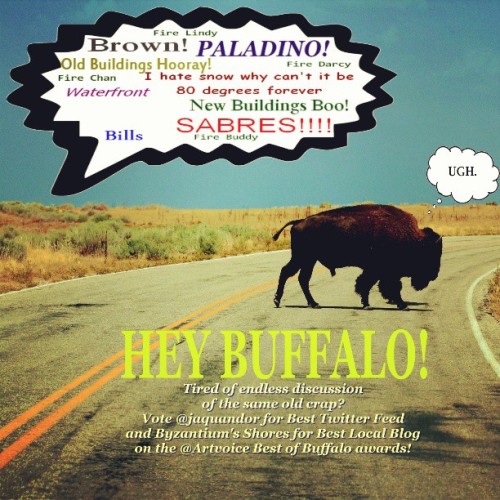
It's time for the annual popularity contest that Artvoice, Buffalo's local alt-weekly, runs. As usual, "Best Blogger" is one of the categories, and as usual, I assume that this blog has less than zero chance of winning. Alas!
Although I am interested a little in this phenomenon. 'Best Blog' contests always seem to focus on blogs that deal with one particular category, and in the case of the Artvoice awards, it's pretty much always gone to one of two local blogs or bloggers. One is a local blog for Buffalo-related stuff, and the other is a guy who writes about that kind of thing and also politics in general. A recent podcast by another sometime-blogger who pretty much only writes about politics listed some favorites, and they broke out pretty much the same way: a couple of general blogs about Buffalo-related stuff, a Buffalo-centric food blog or two, and a local Buffalo sports blog. (I am not snarking about the latter two fellows mentioned. Both are local favorites of mine, both for many reasons. The first is not a blog I frequent much because in all honesty, it tends to be about stuff that I don't much care about...and these days I think it's more of a 'group blog' anyway.)
Personal blogs tend to never, ever get noticed, except by (a) the people who happen to find them somehow and (b) other folks who come along if the person running the personal blog somehow manages to achieve notoriety or fame in some way. It seems that the only real way to have a blog gain any traction whatsoever is to run a blog focused on a single topic with only occasional forays into personal stuff. This is not a new development, in any way; in fact, it's pretty much been that way for about as long as I can remember, all the way back to 2002, when blogs first started to gain notoriety. But which ones gained notoriety? The personal ones? Did news outlets start noticing the explosion of people maintaining online journals, diaries, and records of their reading? No...they started noticing the political blogs. At the time it was mainly the conservative-leaning 'Warblogs', and their liberal opposition that got noticed. And that was it.
As time has gone on, blogging seems to have really settled into similar categorization. Fashion blogs, political blogs, food blogs, book blogs, comics blogs, sci-fi fandom blogs, movie blogs, and so on. Personal blogs just seem to generally slide, for the most part, under the radar. Some get more traffic than others, obviously, but in general, when it comes to 'Best Of' time, personal blogs need not apply. Why is this? Why does the conversation online so tend to shake itself out according to interest? This has always struck me as really odd, and it's one reason I gravitated toward blogging and away from newsgroup posting in the first place.
In the Usenet world, all discussion is organized by category, and there was rarely any crossover at all from one group to another. Thus you would see a certain group of people on rec.music.movies, and never encounter any of those folks on rec.arts.sf.written (the group for F&SF literature). And ditto those two groups and, say, rec.arts.books (for bookish discussions of ALL genres). Want to talk movies in general? Rec.movies was there, and various smaller groups in that domain. I once had a Usenet friend tell me that I should come over and participate in a group that was devoted to discussion of a particular teevee show, because he felt that my style of writing and my sense of humor would be appreciated there. I didn't go, however, because I didn't watch that teevee show!
As I've noted quite a few times in the past, I've been blogging for over eleven years, pretty much continuously except for a three-month stretch in 2008 when I got tired of the gig, for a time. I started in the hope of finally breaking through a sort of ghettoization of discussion...but that ultimately hasn't happened. Instead everything is still just as ghettoized as ever.
Additionally, I think there's a degree to which people like that. They like having separate places to discuss politics, sports, movies, and food. And I think that, for all the kvetching about how coarse our national dialogue is, people prefer that coarseness, because where people primarily go and rely upon as resources tend to be exactly the types of blogs where you get contentious discussion, vigorous disagreement, and generally, lots of argument. Which means that, sadly enough, the personal blogs out here in Blogland for the most part just keep trucking along. It's probably because this blog is so generally unfocused that it doesn't get any more traffic now than it ever has, and probably won't unless and until I manage to get a book into print.
For the most part, I'm fine with that. But it would be nice if, once in a while, the world admitted the existence of places online where the 'same old thing' isn't being discussed; where we're not rehashing the latest and greatest plan for the Bills and Sabres to stop sucking, where we're not arguing over where the best fish fry is, whether or not the latest old and crumbling building on the chopping block should be demolished. It would be nice, but I don't think it'll happen, because all those other blogs allow people to hold up their own interests and beliefs in reflection. Personal blogs like mine generally do not.
But oh well...vote for me, anyway, Because all those other blogs suck, and because this is one of Buffalo's oldest blogs and we tend to really like old things. This blog matters!
A to Z: Isasi
Time for an experiment, as promised yesterday: a work that I have never heard before, by a composer I'd never heard of until yesterday. The composer? Andres Isasi. Who is he? Well, here is the biographical information on Isasi from Wikipedia. As of this writing, this is all that is written on Wikipedia about this composer:
Andrés Isasi Linares (Bilbao 1890-1940) was a Basque composer.[1] He studied with Humperdinck in Germany and was better known there than in Spain.[2] He was made a citizen of honour of Getxo district of Greater Bilbao.
That's it. He lived fifty years and studied with Engelbert Humperdinck (who is now pretty much known for one work, his opera Hansel und Gretel), and after doing further research, I found the following fleshed out information on Isasi:
Andrés Isasi y Linares (known as Andrés Isasi) was born in Bilbao on 28 October 1890. Towards the end of the first decade of the 20th century he went to study with that ardent Wagnerian, Engelbert Humperdinck in Berlin. He returned to Bilbao in 1914 to a musical scene obsessed with song and the musical theatre. He stuck doggedly with romantic orchestral music and the style he had evolved while in Germany. The public were not supportive. Although his Second Symphony was performed throughout Spain during the period 1915-19, he found it increasingly difficult for his music to makes headway. Like Bax and Vaughan Williams he was not dependent on music to make a living. When his orchestral works found a lukewarm or cold reception he moved to the family home in Algorta where, in addition to acting as a Maecenas to various Basque artists, he continued to write orchestral works that found more success abroad than in Spain. His Second Symphony did well in Budapest in 1931. In total there are two symphonies, three suites, various tone poems, a piano concerto, many songs, choral items and piano solos. He died at Algorta, without the consolation of any musical revival, on 6 April 1940.
So he was basically like a lot of second-tier composers of that era: mildly prolific, and not much remembered today, outside of a few recordings. Composers like Isasi are really well-served by recording labels like Naxos, which put out cheaply-priced CDs by the armload; the 'premium' labels aren't going to put a lot of effort into having the great orchestras of the world record repertoire like this. I doubt very much if Isasi is going to turn up on any program by the Berlin Philharmonic any time soon.
Composers like Isasi represent a long-standing difficulty in classical music. Simply put, there's been more music written than can really be expected to be heard as much as it deserves to. Many, many composers languish in obscurity, their works either completely forgotten or only dusted off occasionally. That's a shame, but it's just the way things are. And it's not just in music; there is literature that doesn't deserve to disappear from bookshelves forever except for a few libraries where it only gets read by scholars who then lament its obscurity.
The 'test of time' can be a bit on the capricious side. When you dig into the history of classical music, you quickly learn this. The best example is Johann Sebastian Bach, who may well be the Isaac Newton of music, so towering was his genius and so long a shadow does he cast. But the thing is: Bach died in 1750 [edit -- error fixed], and then his music went mostly unperformed and unknown until 1830 or so, eighty years later, when Felix Mendelssohn championed a Bach revival. Eighty years, during which Bach was known to musicians but not to the main public. Eighty years have not yet passed since the death of Andres Isasi.
None of this is to argue that Isasi is a neglected genius, but rather just to note that the cream does not rise inexporably to the top. Sometimes it languishes, and after enough time has passed, the 'top' has calcified somewhat, which means that there's just no more room for more cream. This is why many works which people 'in the know' agree are works of true greatness never quite find their way into the standard repertoire. And it's also why it can be frustrating to thumb through the programs of major orchestras and see yet more performances of Beethoven's Seventh Symphony and the Tchaikovsky Violin Concerto and the Wagner overtures and so on. Try some music you've never heard before! You never know what you'll hear.
As for the work in question today, the Symphony No. 2 by Andres Isasi, it's a perfectly agreeable work. There's nothing earth-shaking here, and in all honesty, there's nothing about it to mark its composer's land of origin. There's nothing nationalistic here at all; this is just a nicely solid symphony in the Germanic tradition. The most interesting movement, for me, is the Scherzo, which starts with a fascinating segment for pizzicato (plucked) strings. There's really nothing much 'new' here...but I'm glad I'm hearing it, nonetheless.
Here's the symphony.
Tomorrow: Back to Czechoslovakia!
A Random Wednesday Conversation Starter
Tuesday, April 09, 2013
A to Z: Hanson
No, not the former boy band from the 1990s. We're talking about composer Howard Hanson (1896-1981), one of the more important American musical figures of the 20th century. A great deal of American musical culture over the last half century owes a huge debt to Hanson, who, in his forty years as director of the Eastman School of Music, presided over an institution that has become one of the premiere music schools in this country.
Hanson was also a noted composer and conductor. I first encountered his work at a summer music camp, when the concert band played a transcription of the second movement of his Symphony No. 1. A few years later, in college, I was blessed with the opportunity to play the Symphony No. 2, subtitled "Romantic". And Romantic it is: despite living in the age of Modernism in music, Howard Hanson's heart clearly beat with lyrical Romanticism, and it's that quality that shines through in nearly everything he wrote.
The Symphony No. 2 in addition to being loaded with gorgeous melodic material, is a dramatic work that employs a cyclic construction. When listening to the work, you'll hear in each movement references to what has gone before, especially in the third movement, when the entire piece builds to one of the more moving conclusions to a symphony that I know.
And speaking selfishly as a former brass player, I loved this piece from the standpoint of the principal trumpet part. So did our principal horn player, next to whom I sat. Each of us got a lot of cool stuff to do, which is always nice. One of the first things any brass player does when encountering a new piece in an orchestral setting is thumb through their part and say, "What do I get to do on this one?"
Here is Howard Hanson's Symphony No. 2. (UPDATE: I replaced the recording that I had used originally, because the third movement of the original recording had so many skips it was like listening to a worn LP.)
Tomorrow: a work I have never heard before. Seriously! I'm not even going to listen to it for the first time until tomorrow morning. That'll be fun!
Monday, April 08, 2013
Did the Ancient Egyptians invent the cardboard box?
Did the Ancient Egyptians invent the cardboard box? Hmmmm. #Lester #CatInBox, originally uploaded by Jaquandor.
It seems to me that there must be some kind of physics experiment to be done on the malleability of a cat's size, relative to the size of the box into which the cat is attempting to squeeze his sizable arse. I'm sure this has real-world implications, such as packing food for long space voyages.
A to Z: Grainger (and Gershwin)
I couldn't decide which 'G' composer to do, so since it's my blog, I'm doing both!
Percy Grainger was the very first composer I encountered when I got to college. I'd never heard of him before, but there on the music stands on Day One of concert band rehearsal was something called "Irish Tune from County Derry". Just two bars in, I fell in love with this guy.
At first listen, that sounds like just a lovely setting of a somewhat maudlin tune, but the more you hear it, the more the Grainger touch stands out. By using such a gorgeous melody and by utilizing such a rich sound, Grainger manages to sneak some really wild dissonances right past the listener.
Grainger was Australian by birth, but the major part of his legacy is his exploration and commitment, via settings for orchestra, wind band, piano, and others -- of English folk music. He was highly idiosyncratic, and he had a wonderful gift of brevity: there are Grainger pieces that are scarcely more than a minute or two long, and they're perfect in that scope. Here's Grainger's "Shepherd's Hey":
In terms of his settings of folk tunes, Grainger's masterpiece is the Lincolnshire Posy, which sets six different folk tunes over the course of six movements. I was lucky enough to perform this amazing work in my junior year of college. Note how Grainger makes little effort -- no effort at all, actually -- to push these folk melodies into any kind of regular form. Grainger noticed that regular people singing folk tunes tended to trouble little with things like regular meter or rhythm, so that's what he tried to recreate in his settings. The result is a work that takes a lot of effort in rehearsal to pull off. I'd have to show you the sheet music to really make it clear, but there are dual entrances that are offset by several beats. There are places where there are no bar lines at all, and the conductor just hammers out each note. And then you have Grainger's dynamic and tempo instructions: he didn't like the traditional Italian music terms, so instead of marking 'Crescendo', a Grainger piece will direct the performer to 'Louden Lots'.
I always found something deeply refreshing about Grainger, and it's probably from him that my fascination with Celtic music began. It's really a short line from Grainger to the Chieftains, after all.
Finally, here's an original piece by Grainger. This is not a folk tune, but it has that character. It's one of my very favorite marches of all time, from the opening, which sounds, to paraphrase Salieri from Amadeus, 'like a rusty squeeze box'.
And then there's George Gershwin, with whom I share a birthday. My perception of Gershwin has always been colored by Leonard Bernstein's writings about him, in which Bernstein opines that Gershwin's prodigious gifts for melody and the feel for American jazz and its new rhythms were his major gifts, and that Gershwin was just beginning to plumb the depths of his compositional gifts when he died at too young an age. Bernstein's view was that when it came to composition, Gershwin was lacking; the Rhapsody in Blue, according to Bernstein, is a collection of wonderful tunes that are stitched together loosely and so unconvincingly that the piece can literally be edited and re-edited and not lose much in translation. That's probably right. As Bernstein says: "What's good about the Rhapsody is so good that the entire piece is irresistable."
For Bernstein, the true Gershwin masterpiece was Porgy and Bess, which he viewed as Gershwin starting the process of melding opera and 'Tin Pan Alley' into something uniquely American -- a truly American music drama, developed here out of American traditions and musical vocabulary and less dependent than ever before on the entire Germanic tradition of musical development that shows up in the transitional passages in earlier works like the Rhapsody.
Here's the Rhapsody in Blue, performed by Andre Previn and the Pittsburgh Symphony Orchestra (a wonderful recording, by the way).
Tomorrow, we'll stay in America.
Sentential Links (A to Z 2013 edition)
I'm culling this week's links from the master list of bloggers doing the A-to-Z Challenge. So all of these are pretty much new to me! Go visit them. I still have some blogs I discovered on last year's A-to-Z on my daily read list.
:: Have you ever wished that there were more hours in the day? The good news is that, some time in the future there will be! The bad news is that you'll have to wait a few million years for it to happen.
:: I cannot go anywhere without a cup in my hand. This compulsion I have to always be carrying around water is not as bad as my compulsion to go nowhere without a book (I've stopped in the parking lot, turned around and gone back to my apartment to get a paperback while on my way to drive to Walgreens for a box of tampons. 95% of the time I never even touch the book), but it's definitely something I feel compelled to do. (I sympathize, on both counts.)
:: When I am writing my poetry I do my best to take out the words that really don’t add to the feeling of the poem. I’m not as good at that with my other writing but I think I do that with my poetry. When you are writing can you feel each word, does each word add value to your poem?
:: She’d fallen again. She’d leaned on the television instead of the wall for support. The television went down with her.
:: I'm not sure I'll ever come to terms with my mother's death, and the dreams don't always help. Just when I think I've finally found peace with it, I'll have one of these dreams and I will think I've made no progress at all!
Do you have experiences like this with your dreams? (I do, actually. I notice my dreams more and more these days, and I have noticed an uptick in appearances in them by people I had previously thought that I had left behind, some years before. I wonder what that means, sometimes. I hope it's just a result of random firing of synapses that are storing various memories, and not indicative of some issue or other that I never worked through. I'm never sure we really 'work through' issues, anyway -- I rather suspect that we just cope the best we can before we move on to the next thing that live throws our way. But that's the notion of someone who never once took a psych class, so take that for that it's worth....)
:: During the time we were trapped at home, Ron and I lit candles and I was reminded that fire is the first multi-tool, an element that can be manipulated to do either good or evil, to help sustain life or destroy it. A bonfire can be lit to keep a group warm, cook a large meal or burn the bodies of the infected so they can't come back and claim the lives of fellow survivors. Keep your fires lit, and a flame-thrower handy for any stray walkers that come shuffling into your yard. (Yes, more zombies. Deal with it, Zombie-haters!)
:: It was just that my Dad (93) discussed the Driving History in Daytona. So to honor a man I have the privilege to call Dad and the amazing luck at my age to still have a Dad. I chose Daytona in his honor.
:: Maybe it's in our blood, each and everyone of us. When humanity improved upon being hunters and gatherers, we became farmers, custodians of our own little plot of ground--even if it's a few pots on a city windowsill, or planters on a suburban deck. As humans, we emerged from a life of roaming, to a life of sinking roots, literally as well as figuratively.
:: I tried reading the brick once 'cause we had a really beat up Norman Denny translation of one of our shelves and the description on the back intrigued me. But, like many others before me, I got bogged down on the chapters about the bishop and since I didn't know what to skip and what to read, I gave up. (She's talking about the original novel of Les Miserables, the Victor Hugo doorstop. I'm still picking my way through it, at the unimpressive -- but really adding up -- pace of about ten pages a day. I think it's really the only way to go with a book like this. Hugo's book is perhaps the most unfocused book I've ever encountered. I'm a bit more than halfway through it, and it's something of a maddening book. There are times when Hugo's writing is incandescent, and other times when it's really not. And what's really maddening is that there are times when the incandescent writing takes place during one of his fifty-page digressions, such as when he inexplicably breaks off the main action so he can spend a long time (more than fifty pages!) discussing the Battle of Waterloo, all so he can establish that...[drum roll please]...Thenardier was there. And yet, the Waterloo stuff is really well written! Strange, strange book.)
That's all for this week. More next week!
Sunday, April 07, 2013
Sunday Burst of Weird and Awesome
Oddities and Awesome abound! Even if I almost forget to do the post. Sorry....
:: This one is...well, I'm not really sure if it's awesome or not. It's a video of a tarantula crawling along the ground someplace. Trust me, nothing creepy, just a tarantula in its natural habitat. (Unless you find that inherently creepy, that is.) But they claim that this particular spider can reach sizes of eight inches in diameter, making it "as big as your face". Well, I have no way of substantiating that, because when I click on a link that says "A spider the size of your face!", I expect to see said beastie making his way across someone's face. No such luck, here. For all I know, that's a really nice close-up of a spider the size of a quarter. Until I see something to give this guy some scale, I officially call Shenanigans on this. Cool looking spider, though.
:: This is one of my favorite Flickr streams. This lady, Shelby, is really, really skilled at composition, and she always manages to come up with really interesting and new ways to look at things. Check her out!

:: Here's a product that, while apparently popular in the 1970s, found itself with some serious branding issues in the 1980s. See if you can figure out why:

Via Retrospace, another one of my favorite Flickr streams. Also see the companion blog.
More next week!
:: This one is...well, I'm not really sure if it's awesome or not. It's a video of a tarantula crawling along the ground someplace. Trust me, nothing creepy, just a tarantula in its natural habitat. (Unless you find that inherently creepy, that is.) But they claim that this particular spider can reach sizes of eight inches in diameter, making it "as big as your face". Well, I have no way of substantiating that, because when I click on a link that says "A spider the size of your face!", I expect to see said beastie making his way across someone's face. No such luck, here. For all I know, that's a really nice close-up of a spider the size of a quarter. Until I see something to give this guy some scale, I officially call Shenanigans on this. Cool looking spider, though.
:: This is one of my favorite Flickr streams. This lady, Shelby, is really, really skilled at composition, and she always manages to come up with really interesting and new ways to look at things. Check her out!
:: Here's a product that, while apparently popular in the 1970s, found itself with some serious branding issues in the 1980s. See if you can figure out why:
Via Retrospace, another one of my favorite Flickr streams. Also see the companion blog.
More next week!
Note to self:
Revise the '100 Things About Me' thing. It's almost nine years old, and is therefore really out of date on many a particular.
Carmine Infantino
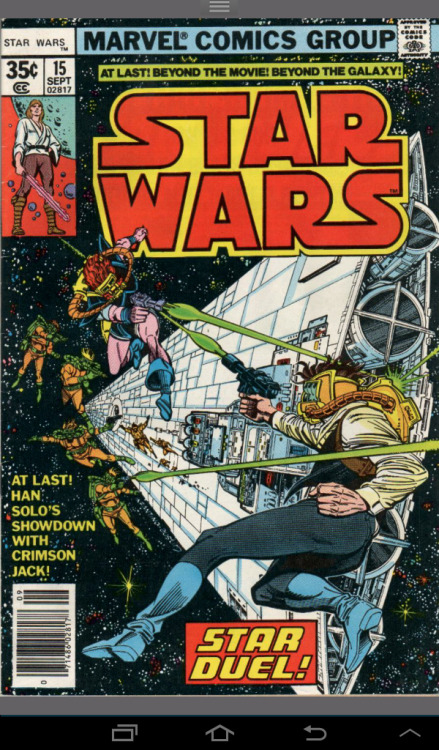
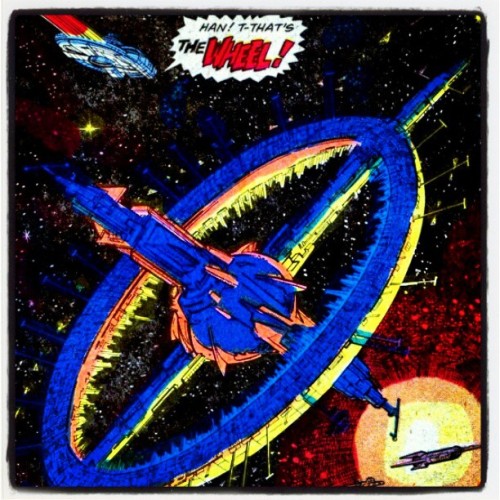
Comics artist Carmine Infantino died the other day. I primarily remember his work on the Marvel Star Wars series, which he drew during a hefty chunk of the period between A New Hope and The Empire Strikes Back, which was actually a really wild-and-wooly time for the Star Wars comics. At that point, nobody had any idea what was to come in terms of the Star Wars mythology and backstory and so on, so Marvel was flying about as blind as could be. The result was a sequence of issues that told some really fun and entertaining space opera adventure stories, and Infantino's art was a big part of that.
A fine, fine artist.
Saturday, April 06, 2013
A to Z: Finzi
I haven't heard a great deal of the music of Gerald Finzi, but what I have heard is always pleasurable, lyrical, and restrained, in the great tradition of the British composers who came to the fore after the Romantic period was winding down. That whole school of composers seems to stand in somewhat of a welcome contrast to the excesses of the full-bore Romantics; their music is generally more introspective than outgoing. Finzi is an interesting composer, who tends to be eclipsed by people like Ralph Vaughan Williams. Part of this is Finzi's relatively small output, but he labored intensively on his music, and it always shows, at least in what I've heard of his.
I've chosen Finzi's Cello Concerto for this post, because the cello is my favorite of the string instruments. Its wide range yields so many musical possibilities, and there are few things in music so beautiful as a cello singing out a lyrical melody set in the middle of its range. The cellos are where a string section gets the richness of its sound. There's even a kind of nobility in the way the cellist has to hold the instrument, almost enveloping it.
Here's the Cello Concerto by Gerald Finzi. It was premiered in 1955.
Fixing the Prequels: Revenge of the Sith (part seven)
six
five
four
three
two
one
Diving right back in with both lightsaber blades ignited...or something like that. Anyway, when last we left, Palpatine had engineered Anakin Skywalker's elevation to the Jedi Council, but the Council, angered at Palpatine's machinations, denied him the traditional promotion to Jedi Master that usually is part and parcel of a seat on the Council. Anakin is then asked to report to the Council on the Chancellor's dealings, which he is not comfortable doing. Then Palpatine revealed to the Jedi the location of General Grievous, forcing them to take action; he suggests that Anakin be given the assignment of going after Grievous, and again annoyed by Palpatine's machinations, the Council gives the job to Obi Wan. So, thanks to Palpatine, Anakin's already troubled relationship with the Jedi Order is now simmering, he's been left behind on Coruscant to do nothing while the war enters its most critical phase, and Palpatine reveals to Anakin a Sith legend about the power to defeat death.
The die is pretty much cast at this point. Palpatine has sown the seeds of Anakin's discontent with the Jedi, he has sown the seeds of Anakin's temptation for power he can't get with the Jedi, and he has sown the seeds of Anakin's desire for action. Well done, Palpatine! All he has to do now is keep pressing.
At this point in the film, we cut from the start of the battle on Kashyyyk to Obi Wan departing Coruscant for the Utapau system, so he can investigate the report that Grievous is there. In the script, however, two scenes happen before that: a scene in which Obi Wan visits Padme, and another in which Padme meets with the Senators who are concerned over the Chancellor's continued acquisition of power. I won't quote either of those scenes, because they really don't add much to the story, and I'm glad that Lucas cut them from the finished film. They're OK, but hardly essential.
Instead, Obi Wan bids farewell to Anakin:
EXT. CORUSCANT-CLONE LANDING PLATFORM-DAY
ANAKIN and OBI-WAN walk onto a landing platform overlooking a docking bay where THOUSANDS OF CLONE TROOPS and armored weapons, tanks, etc., are being loaded onto a massive REPUBLIC ASSAULT SHIP.
ANAKIN: You're going to need me on this one, Master.
OBI-WAN: Oh, I agree. However it may turn out just to be a wild bantha chase.
OBI-WAN starts to turn and leave.
ANAKIN: Master!
OBI-WAN stops and ANAKIN walks over to him.
ANAKIN: (continuing) Master, I've disappointed you. I have not been very appreciative of your training . . . I have been arrogant and I apologize . . . I've just been so frustrated with the Council. Your friendship means everything to me.
OBI-WAN: You are strong and wise, Anakin, and I am very proud of you. I have trained you since you were a small boy. I have taught you everything I know. And you have become a far greater Jedi than I could ever hope to be, and you have saved my life more times than I can remember. But be patient, Anakin. It won't be long before the Council makes you a Jedi Master.
OBI-WAN starts down the ramp, then turns back.
OBI-WAN: (continuing) Don't worry. I have enough clones with me to take three systems the size of Utapau. I think I'll be able to handle the situation . . . even without your help.
ANAKIN: Well, there's always a first time.
OBI-WAN laughs.
They talk for a few more minutes before ANAKIN watches OBI-WAN depart.
ANAKIN: Obi-Wan, may the Force be with you.
OBI-WAN: Good-bye, old friend. May the Force be with you.
OBI-WAN heads down a ramp toward the waiting Republic cruiser.
This is a nice little scene that I've always liked. The way the film ends up playing out, this is the last time Anakin and Obi Wan are together, as friends and comrades, before things go terribly awry. This, to me, only highlights the awful tragedy of what's about to unfold, because it so completely takes the Jedi, and Obi Wan among them, by surprise. Their undoing comes from within, and they never saw it coming. I'd make an addition here, though:
As the Republic cruiser lifts away from the platform, Anakin turns to depart as well, when a Clone trooper approaches him.
TROOPER: Master Skywalker? The Chancellor is requesting you right away.
Anakin sighs.
ANAKIN: Very well.
Next is some nice banter and stuff as Obi Wan gets ready to investigate Utapau for General Grievous. No need to quote that stuff, but it's another little character moment that I like. Real camaraderie has grown between Obi Wan and the clone troopers, at least a few of them. It's another example of the Jedi's complete lack of awareness of the tragedy to come.
Meanwhile, the following transpires in the script but not in the film. I'd restore it:
EXT. CORUSCANT-CITYSCAPE-CHANCELLOR'S TRANSPORT-DAY
The Chancellor's Transport races through the city and heads for the Senate Office Building landing platform. Waiting on the landing platform is a LONE JEDI. The Transport lands, and CHANCELLOR PALPATINE emerges with FOUR ROYAL GUARDS and MAS AMEDDA. The FOUR ROYAL GUARDS move off in another direction as PALPATINE greets ANAKIN, who has been waiting for him.
PALPATINE: Well, Anakin, did you see your friend off?
ANAKIN: He will soon have Grievous's head.
PALPATINE: We can only hope the Council didn't make a mistake.
ANAKIN: The Council was very sure in its decision.
They exit the landing platform.
INT. CORUSCANT-SENATE OFFICE BUILDING-MAIN HALLWAY-DAY
They enter the main hallway of the Senate Office Building. They pass SEVERAL SENATORS, including REPRESENTATIVE JAR JAR BINKS from Naboo.
JAR JAR: Helloo Annie. Good en to see yousa . . .
The Gungan waves to Anakin.
ANAKIN: Hi, Jar Jar.
JAR JAR: Oopsin da Chancellor!! So sorry, Your Highness, sir.
Anakin turns back to the Chancellor. [None of this appeared in the movie, but I would not restore the Jar Jar bit. Nothing against Jar Jar, but it's just a pointless bit.]
PALPATINE: There are rumors in the Senate about Master Kenobi. Many believe he is not fit for this assignment.
ANAKIN: Not fit? Why would anyone think that?
PALPATINE: They say his mind has become fogged by the influence of a certain female Senator.
ANAKIN: That's ridiculous. Who?!?
PALPATINE: (slyly) No one knows who she is ... only that she is a Senator.
ANAKIN: That's impossible. I would know.
PALPATINE: Sometimes the closest are the ones who cannot see.
ANAKIN becomes worried.
PALPATINE: (continuing) Idle Senate gossip is rarely true and never accurate. I'm sure your Master will do fine. But you and I both know they should have sent you.
In the script, the deleted scenes paint a picture that Palpatine is trying to drive wedges all over the place: between Anakin and Padme, between Anakin and Obi Wan, between Anakin and the rest of the Jedi. I'd keep a very small bit of it – this bit, to be precise:
PALPATINE: Well, Anakin, did you see your friend off?
ANAKIN: He will soon have Grievous's head.
PALPATINE: We can only hope the Council didn't make a mistake.
ANAKIN: The Council was very sure in its decision.
PALPATINE: As they always are. Master Kenobi is capable, but you and I both know they should have sent you. Well, since the Council has decided that you are to watch me and report on my doings, you can have the pleasure of watching me meet with one group of Senators after another.
ANAKIN: Anything important?
PALPATINE: From this faction? No. Just jockeying for power when the war comes to an end. It's all very silly...the usual business about taxation and trade routes....
ANAKIN looks bored as PALPATINE continues discussing statecraft.
Next, in the film, Anakin has another vision of Padme's childbirth, but this one is a bit different:
INT. POLIS MASSA-MEDICAL CENTER-DREAM
PADME calls out in pain. OBI-WAN is near her and softly speaks to her.
OBI-WAN: Save your energy.
PADME: I can't!
OBI-WAN: Don't give up, Padme. Don't give up . . .
That's interesting in that he's now seeing Obi Wan as involved somehow, as being present at the birth of Padme's children, and not himself. This is a pretty interesting vision because that's the one that ends up playing out, but in this context, it starts feeding into Anakin's anxieties.
The next scene is where we really start to see some of Anakin's internal turmoil. The scene as is works OK, but I'd still re-tool it:
INT. CORUSCANT-PADME'S APARTMENT-LANDING ROOM-DAY
ANAKIN snaps awake from the dream.
ANAKIN: No!
He is on the couch, where he had dozed off. He hears the sound of an approaching and slowing speeder, and he stands as PADME climbs out of the speeder that has just halted outside. C-3PO had been piloting.
PADME: Thank you, Threepio.
She smiles when she sees ANAKIN; they embrace and kiss.
PADME: I didn't expect you.
ANAKIN: I had some free time, I guess. Chancellor Palpatine is in his daily meditations, and the Council doesn't seem to think I'm to be allowed to do anything else.
PADME: It'll be all right. You don't always have to be on the front lines.
ANAKIN: I'm a Jedi. Yes, I do.
PADME lays down her parcels and pours a glass of water.
PADME: If you're with the Chancellor, I'll see you tomorrow. I'm part of a group of Senators who are meeting with him tomorrow about reducing the scale of executive power once—what is it?
ANAKIN: I sense someone familiar . . . Obi-Wan's been here, hasn't he?
PADME: He came by this morning.
ANAKIN: What did he want?
PADME looks at him for a moment. ANAKIN seems tense.
PADME: He's worried about you. He wanted to talk about you before he left.
ANAKIN: Did you tell him about us?
PADME: No! But...I think he suspects. Maybe. We can trust him, though!
ANAKIN: He's a Jedi.
PADME: You can't trust a Jedi? Anakin, listen to yourself!
ANAKIN: You're right...I just feel...weak. Like I'm not useful to anyone. And I shouldn't feel that way. I'm the most powerful of all the Jedi, but I'm stuck here.
PADME tousles his hair.
PADME: Here's not such a bad place to be.
ANAKIN: You know what I meant.
PADME: I know, but why worry about it? You said that you're going to leave the Order when the baby comes, anyway. Is that still what you want?
ANAKIN: I want you. More than anything.
He puts his hand on her belly.
ANAKIN: I have to know that you'll be safe from whatever is in my nightmares. I have to stop it.
PADME: Anakin, I'm sure you're worried about nothing.
ANAKIN: I don't think so. The Force shows me what will happen--
PADME: What might happen.
ANAKIN: I won't let this happen, Padme. I won't let you die.
They embrace and kiss again...not noticing the PROBE DROID outside their window.
INT. JEDI TEMPLE – MEDITATION ROOM.
MACE WINDU sits in the meditation chamber by himself, looking at holographic footage of ANAKIN and PADME kissing. Then he looks at a report on a computer screen, and shakes his head.
My purpose there is to get a lot of stuff in play: Padme's ongoing involvement in what will become the Rebellion, Anakin's anger at the Jedi and how it's starting to color his perceptions of the Order itself, and his continued fear of losing his loved ones. And the fact that for all Anakin's worrying about Obi Wan finding out about his marriage, it's Mace Windu who knows.
Next comes the arrival of Obi Wan Kenobi on Utapau, his discovery of General Grievous there, and the start of that battle. This is one of my favorite parts of the movie, and I wouldn't change a single thing about it. Not one bloomin' thing. This entire sequence is just cool, from Obi Wan's landing on Utapau (the music does this really cool rendition of the "Force Theme"), and then his jumping on the back of some beastie to ride, and then his confrontation with General Grievous which serves as a diversion as the clone troopers attack. I love this entire sequence. It's just terrific.
Back on Coruscant, though:
INT. CORUSCANT-JEDI WAR ROOM-EARLY EVENING
KI-ADI-MUNDI, ANAKIN, YODA, MACE, CLONE COMMANDER CODY, and AAYLA SECURA talk via holograms.
CLONE COMMANDER CODY: Master Windu, may I interrupt? General Kenobi has made contact with General Grievous, and we
have begun our attack.
MACE WlNDU: Thank you, Commander. Anakin, deliver this report to the Chancellor. His reaction will give us a clue to his
intentions.
ANAKIN: Yes, Master.
ANAKIN leaves the room. COMMANDER CODY's hologram disappears.
MACE WINDU: I sense a plot to destroy the Jedi. The dark side of the Force surrounds the Chancellor.
Kl-ADI-MUNDI: If he does not give up his emergency powers after the destruction of Grievous, then he should be removed from
office.
MACE WiNDU: That could be a dangerous move ... the Jedi Council would have to take control of the Senate in order to secure a peaceful transition . . .
Kl-ADI-MUNDI: . . . and replace the Congress with Senators who are not filled with greed and corruption.
YODA: To a dark place this line of thought will carry us. Hmmmmm. . . . great care we must take.
Interesting! The Jedi are scheming to put matters right if the Chancellor does not leave his office after the war ends. I'd clarify this scene just a bit:
INT. CORUSCANT-JEDI WAR ROOM-EARLY EVENING
KI-ADI-MUNDI, YODA, MACE, CLONE COMMANDER CODY, and AAYLA SECURA talk via holograms. ANAKIN enters.
MACE WINDU: You're late.
ANAKIN: I'm sorry, Master Windu. I was detained.
MACE WINDU: Indeed.
ANAKIN and MACE WINDU exchange glances, but nothing is said.
CLONE COMMANDER CODY: Master Windu, may I interrupt? General Kenobi has made contact with General Grievous, and we have begun our attack.
MACE WlNDU: Thank you, Commander. Anakin, deliver this report to the Chancellor. His reaction will give us a clue to his intentions.
ANAKIN: Yes, Master.
ANAKIN leaves the room. COMMANDER CODY's hologram disappears.
YODA: It has come. The last battles of the war, these are.
MACE WINDU: I sense a plot to destroy the Jedi. The dark side of the Force surrounds the Chancellor.
YODA: Manipulated by Darth Sidious, you believe he is?
MACE WINDU: That's the most likely way of it.
Kl-ADI-MUNDI: If Chancellor Palpatine does not give up his emergency powers after the destruction of Grievous, then he should be removed from office.
MACE WINDU: That could be a dangerous move ... the Jedi Council would have to take control of the Senate in order to secure a peaceful transition . . .
Kl-ADI-MUNDI: . . . and replace the Congress with Senators who are not filled with greed and corruption.
YODA: To a dark place this line of thought will carry us. Hmmmmm. . . . great care we must take.
I think it needs to be shown that the Jedi are on the right track, but they are also one step behind, which ultimately ends up destroying them. This is an important point and a subtlety that I think often gets lost amongst Star Wars commentators: the Jedi in the Prequel Trilogy are not at their best. Indeed, they are a slow-moving train wreck. Here they are planning to act to restore the Republic's democracy, but Palpatine will be able to use that very plot against them.
And that's where we'll stop. Next time, Anakin – who has been teetering on the brink – finally tips. Or...is he pushed? Hmmmmm...tune in!
Labels:
Fixing the Prequels: RotS,
Skiffy,
Space Opera,
Star Wars
Friday, April 05, 2013
O tempora! O mores!
Dear baseball players of the world:
You are ruining everything!
Even a fan of the pie-in-the-face like myself has to admit a certain amount of befuddlement over your adoption in recent years of this lovely ritual. But it's hard to find it a cool thing when what you're doing is just using a towel slathered with shaving cream. First off, shaving cream...ewwww. Second off, a towel? Really?
So, if you baseball players want me to take your slapsticky victory celebrations more seriously, stop doing this:
Or stop calling it pie. This is a pie:

That's what you've got to use. After all, a thing worth doing is a thing worth doing right. No compromise is possible on this point. A pie in the face is a wonderful thing! A shaving-cream towel in the face is...wildly not. Harumph!
Love,
-Me
You are ruining everything!
So some dope interrupted the Murdoch family's stammering and mumbling today by "throwing a pie" at Rupert Murdoch, which actually meant waving a styrofoam plate in Murdoch's direction as some sort of foam slid off it, till Mrs. Rupert Murdoch jumped up and clobbered the "pie" guy.
Back in 1998, when Bill Gates got hit by a pie, it was variously reported to have been a "cream pie" or a "custard pie," and Gates said through a spokesperson that the pie "wasn't that tasty" — suggesting that it was, at least, an actual, edible pie.
The decline from a real pie to a lazily produced plate of foam should be familiar to baseball fans. Over the past decade, the baseball "pie" has stopped resembling a pie at all, till players are content to celebrate victories by smacking the hero of the game in the face with a towel full of shaving cream.
Even a fan of the pie-in-the-face like myself has to admit a certain amount of befuddlement over your adoption in recent years of this lovely ritual. But it's hard to find it a cool thing when what you're doing is just using a towel slathered with shaving cream. First off, shaving cream...ewwww. Second off, a towel? Really?
So, if you baseball players want me to take your slapsticky victory celebrations more seriously, stop doing this:
Or stop calling it pie. This is a pie:
That's what you've got to use. After all, a thing worth doing is a thing worth doing right. No compromise is possible on this point. A pie in the face is a wonderful thing! A shaving-cream towel in the face is...wildly not. Harumph!
Love,
-Me
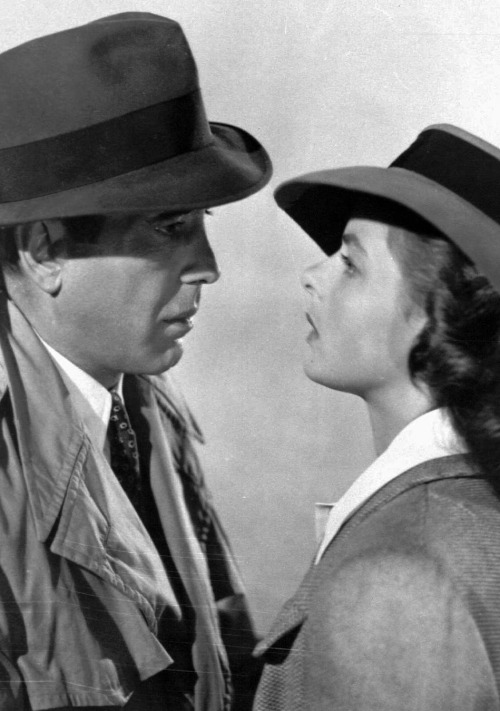
Film Quote Friday: Casablanca
In honor of Roger Ebert....
Rick: Last night we said a great many things. You said I was to do the thinking for both of us. Well, I've done a lot of it since then, and it all adds up to one thing: you're getting on that plane with Victor where you belong.
Ilsa: But, Richard, no, I... I...
Rick: Now, you've got to listen to me! You have any idea what you'd have to look forward to if you stayed here? Nine chances out of ten, we'd both wind up in a concentration camp. Isn't that true, Louis?
Captain Renault: I'm afraid Major Strasser would insist.
Ilsa: You're saying this only to make me go.
Rick: I'm saying it because it's true. Inside of us, we both know you belong with Victor. You're part of his work, the thing that keeps him going. If that plane leaves the ground and you're not with him, you'll regret it. Maybe not today. Maybe not tomorrow, but soon and for the rest of your life.
Ilsa: But what about us?
Rick: We'll always have Paris. We didn't have, we, we lost it until you came to Casablanca. We got it back last night.
Ilsa: When I said I would never leave you.
Rick: And you never will. But I've got a job to do, too. Where I'm going, you can't follow. What I've got to do, you can't be any part of. Ilsa, I'm no good at being noble, but it doesn't take much to see that the problems of three little people don't amount to a hill of beans in this crazy world. Someday you'll understand that.
[Ilsa lowers her head and begins to cry]
Rick: Now, now...
[Rick gently places his hand under her chin and raises it so their eyes meet]
Rick: Here's looking at you kid.
I think it's time to watch Casablanca again.
A to Z: Enescu
Form in music is a tricky thing. There are many forms, and they all determine how the melodic material is treated. Sonata form, passacaglias, toccatas, canons, fugues, double fugues, waltzes, theme-and-variations – lots and lots of forms, and studying nothing but form can consume a music scholar's time for years and years.
And then there are pieces like this, which are essentially formless. It's the Romanian Rhapsody #1 by Georges Enescu, and it's nothing more than a collection of tunes. That's it: just one tune after another, in this case, one dance tune after another. And at least one of them is a drinking song. This only goes to demonstrate that the most banal material, in the hands of a gifted composer, can rise well above its musical station.
I could go on for a while, but I won't. This piece is just pure pleasure from start to finish, even if I have recently learned that it (and its brother work, the Rhapsody #2) eclipsed the rest of Enescu's output to a degree that really irritated the composer. As for a performance, this one is absolutely scintillating. The video and sound quality aren't the greatest, as it's a videotape from 1978, but every single flicker of fire is there. The conductor, Sergiu Celibidache, was a native Romanian who obviously had the requisite affinity for this music, and you can really tell just by watching his conducting. The inspiration to dance is there, and he doesn't always quite resist it. (And if you listen closely during the more fiery passages, you can hear him shouting. That's always fun.)
So here is the Romanian Rhapsody #1, by Georges Enescu.
Thursday, April 04, 2013
Roger
I was trying to figure out something to write on the passing today of Roger Ebert, but nothing was leaping to mind, so I figured I'd just repost my original thoughts, from January 2012, on his book, Life Itself. I have loved and admired Ebert since I was nine, and his output of thoughtful writing even in the face of debilitating disease the last few years has been truly astonishing. It's something of the ultimate motivator: When I think "I don't really wanna write today", I then thing, "Roger Ebert's writing today, and that guy's got some hardcore difficulties. So get in the chair and write."
When I saw the news today -- my first report came via Sheila O'Malley on Facebook, and she is frankly the exact person I would have wanted to hear this from -- I commented thusly:
Farewell, Mr. Ebert. If there is some realm beyond this one...well, whatever. At least on this side we'll have your years and years and years of writings. I've come to see you as being to film what Carl Sagan was to science, and I mourn and salute you in the same manner. Congratulations on a life well-lived!
I was nine years old, and I wandered into the living room to find my mother watching some show on PBS. It was a show about movies – there would be a clip of a new movie that was out, and these two guys would then talk a bit about whether the movie was any good or not. One of these guys was a thin, lanky guy. The other was a squat, fat guy. The thin guy was named Gene. The fat guy was named Roger.
"What's this?" I asked.
"It's called Sneak Previews," my mother answered. "Those two men are film critics. They tell us if movies are good or not."
"Oh."
And I watched the thing. I didn't know anything about movies, but these two guys were interesting to watch. Another year or two later, their show was off PBS, which struck me as a bummer...but they turned up again, in a syndicated show that was on, like many syndicated shows, at whatever time some station or other felt like putting it on. No matter, it was fun seeing these two guys, Gene and Roger – who worked for newspapers in Chicago – talk about movies.
So I watched Gene Siskel and Roger Ebert for years, off and on, right up until Siskel's deeply saddening death in 1998. Then I watched Ebert and Richard Roeper (a good enough fellow, but no substitute for Siskel) for a few more years, until we no longer had cable and thus the show was beyond my grasp. And then, a few years after that, Ebert himself started to have health issues, which eventually resulted in unsuccessful surgeries that have famously left him unable to speak or eat (he takes meals through a G-tube, which is something I understand all too well, thanks to Little Quinn).
Siskel and Ebert were, in my view, one of the great duos in the history of anything. Those two had such astonishing chemistry together, that it was a joy to watch them agree positively on a movie, an even bigger joy to see them agree negatively on a movie (seriously, watching the two of them tag-team on a bad movie was always great), and the biggest joy of all when they disagreed. Then you could see some fireworks. I remember Ebert being astonished at Siskel's thumbs-down review of Scorsese's Casino; "Thumbs down?!" Ebert yelped. And there was another time – I can't remember the movie – where Ebert liked it and Siskel did not, and Ebert said something like "I don't think you wanted to like this movie", a suggestion that seemed to physically hurt the usually more acerbic Siskel. "I love to like pictures!" he protested.
One time on Late Night with David Letterman, there was a segment that had Mujibur and Sirajul, the two Indian owners of a local store, reporting to Dave from somewhere in the country. And Dave says, "If you two are out there, who's watching the store? Can we send a cameraman to see who's in charge at the store?" So a cameraman goes into the store, to reveal a very stern-looking Siskel and Ebert. OK, I guess you had to be there.
Anyway, Ebert has been writing about the movies for decades now, and he is, by nearly any measure, the critic whose work I find the most illuminating and the most evocative. I've been reading him nearly almost as long as I've been watching him on teevee, and for a number of years, his annual review collections were required book purchasing of mine. Now he has produced a memoir, which he has titled Life Itself.
Ebert's health struggles in recent years are well-known, and it's been truly fascinating to watch him take to blogging in the wake of the loss of his physical voice, a medium he had initially viewed with suspicion but which allowed his authorial voice to finally blossom to its greatest strength. Ebert has always been a fine writer, but oddly, his disability-due-to-cancer has, for many, made him even better. Maybe it's similar to that old saw about how when you lose one sense, the others somehow make substantial gains in acuity.
Reading his blog, I've mostly been struck by Ebert's ongoing zest for life, even when there were occasional posts that took an especially elegiac tone that made me wonder if he was preparing for his own departure from this world. Ebert is still with us, though, and now we have Life Itself.
The book is more a series of vignettes than a straight telling of Ebert's life. The vignettes are more or less in chronological order, but Ebert seems to be more exploring various themes in his life than the chronology of events. The book is something of a memory album that gives an impression of a life, which seems to me a good way to structure a biography. Sometimes when I read biographies, I get a sense of "plot" that couldn't possibly be there. Ebert is well aware that life is plotless, and that many of the things that shape the paths of our lives for good or ill are often accidental, a function of our coming into the circle of this person instead of that person, or even something so prosaic as taking this flight instead of that one.
It's telling that the book gives more of a sense of his development as a writer than as a critic; I suspect that Ebert believes that he would have been a writer no matter what, and it was just an accident of various circumstances that led to him writing about movies for the last forty years. There's no "Through all my life the cinema has grounded my being" or anything like that; Ebert grew up as a talented kid who liked going to movies with his buddies on Saturdays. I love when he recounts his first reviews of avant garde films; finding himself in confusion as to what the films were about, he took the approach of simply recounting his experience in watching the film. This is an approach that has gone on to inform his entire approach to movie reviewing and film criticism.
Sometimes, in the course of his blogging over the last few years, a tone has crept into Ebert's writing – that he seems to deny whenever it is pointed out, but it is there – that he is, in long form, saying goodbye to his life. I deeply hope that this is not the case. Ebert is, for me, to film as Carl Sagan is to science, and he'll be missed by me in equal measure when he is gone.
Here are some excerpts from Life Itself.
On Mike Royko:
On books:
On his wife:
On Siskel:
On movies:
May Ebert's spot in the balcony remain reserved for years to come.
When I saw the news today -- my first report came via Sheila O'Malley on Facebook, and she is frankly the exact person I would have wanted to hear this from -- I commented thusly:
Amazing how something you totally expect and don't find a surprise can still hit you between the eyes and make the world a little less shiny
Farewell, Mr. Ebert. If there is some realm beyond this one...well, whatever. At least on this side we'll have your years and years and years of writings. I've come to see you as being to film what Carl Sagan was to science, and I mourn and salute you in the same manner. Congratulations on a life well-lived!
I was nine years old, and I wandered into the living room to find my mother watching some show on PBS. It was a show about movies – there would be a clip of a new movie that was out, and these two guys would then talk a bit about whether the movie was any good or not. One of these guys was a thin, lanky guy. The other was a squat, fat guy. The thin guy was named Gene. The fat guy was named Roger.
"What's this?" I asked.
"It's called Sneak Previews," my mother answered. "Those two men are film critics. They tell us if movies are good or not."
"Oh."
And I watched the thing. I didn't know anything about movies, but these two guys were interesting to watch. Another year or two later, their show was off PBS, which struck me as a bummer...but they turned up again, in a syndicated show that was on, like many syndicated shows, at whatever time some station or other felt like putting it on. No matter, it was fun seeing these two guys, Gene and Roger – who worked for newspapers in Chicago – talk about movies.
So I watched Gene Siskel and Roger Ebert for years, off and on, right up until Siskel's deeply saddening death in 1998. Then I watched Ebert and Richard Roeper (a good enough fellow, but no substitute for Siskel) for a few more years, until we no longer had cable and thus the show was beyond my grasp. And then, a few years after that, Ebert himself started to have health issues, which eventually resulted in unsuccessful surgeries that have famously left him unable to speak or eat (he takes meals through a G-tube, which is something I understand all too well, thanks to Little Quinn).
Siskel and Ebert were, in my view, one of the great duos in the history of anything. Those two had such astonishing chemistry together, that it was a joy to watch them agree positively on a movie, an even bigger joy to see them agree negatively on a movie (seriously, watching the two of them tag-team on a bad movie was always great), and the biggest joy of all when they disagreed. Then you could see some fireworks. I remember Ebert being astonished at Siskel's thumbs-down review of Scorsese's Casino; "Thumbs down?!" Ebert yelped. And there was another time – I can't remember the movie – where Ebert liked it and Siskel did not, and Ebert said something like "I don't think you wanted to like this movie", a suggestion that seemed to physically hurt the usually more acerbic Siskel. "I love to like pictures!" he protested.
One time on Late Night with David Letterman, there was a segment that had Mujibur and Sirajul, the two Indian owners of a local store, reporting to Dave from somewhere in the country. And Dave says, "If you two are out there, who's watching the store? Can we send a cameraman to see who's in charge at the store?" So a cameraman goes into the store, to reveal a very stern-looking Siskel and Ebert. OK, I guess you had to be there.
Anyway, Ebert has been writing about the movies for decades now, and he is, by nearly any measure, the critic whose work I find the most illuminating and the most evocative. I've been reading him nearly almost as long as I've been watching him on teevee, and for a number of years, his annual review collections were required book purchasing of mine. Now he has produced a memoir, which he has titled Life Itself.
Ebert's health struggles in recent years are well-known, and it's been truly fascinating to watch him take to blogging in the wake of the loss of his physical voice, a medium he had initially viewed with suspicion but which allowed his authorial voice to finally blossom to its greatest strength. Ebert has always been a fine writer, but oddly, his disability-due-to-cancer has, for many, made him even better. Maybe it's similar to that old saw about how when you lose one sense, the others somehow make substantial gains in acuity.
Reading his blog, I've mostly been struck by Ebert's ongoing zest for life, even when there were occasional posts that took an especially elegiac tone that made me wonder if he was preparing for his own departure from this world. Ebert is still with us, though, and now we have Life Itself.
The book is more a series of vignettes than a straight telling of Ebert's life. The vignettes are more or less in chronological order, but Ebert seems to be more exploring various themes in his life than the chronology of events. The book is something of a memory album that gives an impression of a life, which seems to me a good way to structure a biography. Sometimes when I read biographies, I get a sense of "plot" that couldn't possibly be there. Ebert is well aware that life is plotless, and that many of the things that shape the paths of our lives for good or ill are often accidental, a function of our coming into the circle of this person instead of that person, or even something so prosaic as taking this flight instead of that one.
It's telling that the book gives more of a sense of his development as a writer than as a critic; I suspect that Ebert believes that he would have been a writer no matter what, and it was just an accident of various circumstances that led to him writing about movies for the last forty years. There's no "Through all my life the cinema has grounded my being" or anything like that; Ebert grew up as a talented kid who liked going to movies with his buddies on Saturdays. I love when he recounts his first reviews of avant garde films; finding himself in confusion as to what the films were about, he took the approach of simply recounting his experience in watching the film. This is an approach that has gone on to inform his entire approach to movie reviewing and film criticism.
Sometimes, in the course of his blogging over the last few years, a tone has crept into Ebert's writing – that he seems to deny whenever it is pointed out, but it is there – that he is, in long form, saying goodbye to his life. I deeply hope that this is not the case. Ebert is, for me, to film as Carl Sagan is to science, and he'll be missed by me in equal measure when he is gone.
Here are some excerpts from Life Itself.
On Mike Royko:
At about six p.m. On New Year's Day of 1967, only two lights on the fourth floor were burning – mine and Mike Royko's. It was too early for the graveyard shift to come in. Royko walked over to the Sun-Times to see who else was working. A historic snowstorm was beginning. He asked me how I was getting home. I said I'd take the train. He said he had his old man's Checker car and would drop me at the L station. He had to make a stop at a twenty-four hour drug store right where the L crossed North Avenue.
Royko at thirty-five was already the city's most famous newspaperman, known for compelx emoitons evoked with unadorned prose in short paragraphs. Growing up as the son of a saloon keeper, he knew how the city worked from the precinct level up, and had first attracted attention while covering city hall. He was ten years older than me and had started at the old City News Bureau, the copperative supported by all the dailies that provided front-line coverage of the police and fire departments. Underpaid and overworked kids worked under the hand of its editor, Arnold Dornfeld, who sat beneath a sign reading: If your mother says she loves you, check it out. When I met him he'd been writing his Daily News column for two years. It was his writing about Mayor Richard J. Daley that took the city hall word clout and made it national. He chainsmoked Pall Malls and spoke in a gravelly poker player's voice. He drank too much, which to me was an accomplishment.
That snowy night the all-night drugstore was crowded. "Come on, kid," he said. "Let's have a drink at the eye-opener place." He told me what an eye-opener was. "This place opens early. The working guys around here, they stop in for a quick shot on their way to the L." It was a bar under the tracks so tiny that the bartender could serve everyone without leaving his stool. "Two blackberry brandies and short beers," he said. He told me, "Blackberry brandy is good for hangovers. You never get charged for a beer chaser." I sipped the brandy, and a warm glow filled my stomach. It may have been the first straight shot of anything I'd ever tasted. I'd been in Chicago four months and I was sitting under the L tracks with Mike Royko in the eye-opener place. I was a newspaperman. A blackhawks game was playing on WGN radio. The team scored, and again, and again. This at last was life.
"Jeez, they're scoring like crazy!" I said, after the third goal in less than a minute.
"Where you from, kid?"
"Urbana," I said.
"Ever seen a hockey game?"
"No."
"That's what I thought, you asshole. Those are the game highlights."
On books:
Chaz [Ebert's wife] and I have lived for twenty years in a commodious Chicago town house. This house is not empty. Chaz and I have added, I dunno, maybe three or four thousand books, untold numbers of movies and albums, lots of art, rows of photographs, rooms full of comfortable furniture, a Buddha from Thailand, exercise equipment, carved elephants from India, African chairs and statues, and who knows what else. Of course I cannot do without a single one of these possessions, including more or less every book I have owned since I was seven, starting with Huckleberry Finn. I still have all the Penrod books, and every time I look at them, I'm reminded of Tarkington's inventory of Penrod's pants pockets. After reading it a third time, as a boy, I jammed my pockets with a pocketknife, a Yo-Yo, marbles, a compass, a stapler, an oddly-shaped rock, a hardball, a ball of rubber bands, and three jawbreakers. These, in an ostensible search for a nickel, I emptied out on the counter of Henry Rusk's grocery, so that Harry Rusk could see that I was a Real Boy.
My books are a subject of much discussion. They pour from shelves onto tables, chairs, and the floor, and Chaz observes that I haven't read many of them and I never will. You just never know. One day I may nee to read Finnegans Wake, the Icelandic sagas, Churchill's history of the Second World War, the complete Tintin in French, forty-seven novels by Simenon, and By Love Possessed. That 1957 bestseller by James Gould Cozzens was eviscerated in a famous essay by Dwight Macdonald, who read through that year's list of fiction bestsellers and surface with a scowl. I remember reading the novel late into the night when I was fourteen, stirring restlessly with the desire to be possessed by love.
I cannot throw out these books. Some are enchanted because I have personally turned all their pages and read every word. They're shrines to my past hours. Perhaps half were new when they came to my life, but most were used, and I remember where I found every one. The set of Kipling at the Book Nook on Green Street in Champaign. The scandalous The English Governess in a shady bookstore on the Left Bank in 1965 (two dollars, today ninety-one). The Shaw plays from Cranford's on Long Street in Cape Twon, where Irving Freeman claimed he had half a million books. Like an alcoholic trying to walk past a bar, you should see me trying to walk past a used bookstore. Other books I can't throw away because, well, they're books, and you can't throw away a book. Not even a cookbook from which we have prepared only a single recipe, for it is a meal preserved, in printed form. The very sight of Quick and Easy Chinese Cooking by Kenneth H.C. Lo quickens my pulse. Its pages are stained by broth, sherry, soy sauce, and chicken fat, and so thoroughly did I master it that I once sought out Ken Lo's Memories of China on Ebury Street in London and laid eyes on the great man himself, dining alone in a little room near the entrance. A book like that, you're not gonna throw away.
On his wife:
I sense from the first that Chaz was the woman I would marry, and I know after twenty years that my feelings were true. She had been with me in sickness and in health, certainly far more sickness than we could have anticipated. I will be with her, strengthened by her example. She continues to make my life possible, and her presence fills me with love and a deep security. That's what a marriage is for. Now I know.
On Siskel:
One of the things I miss about Gene Siskel is that he's not around to make jokes about my current condition. He would instinctively know that at this point I wouldn't be sensitive, having accepted and grown comfortable with my maimed appearance. He wouldn't have started joking too soon. His jokes would have the saving grace of being funny. Here's one I'm pretty sure he would have come up with: "Well, there's one good thing about Roger's surgery. At least he no longer needs a bookmark to find his chin."
On movies:
I have seen untold numbers of movies and forgotten most of them, I hope, but I remember those worth remembering, and they are all on the same shelf in my mind. There is no such thing as an old film. There is a sense in which old movies are cut free from time. I look at silent movies sometimes and do not feel I am looking at old films; I feel I am looking at a Now that has been captured. Time in a bottle. When I first looked at silent films, the performers seemed quaint and dated. Now they seem more contemporary. The main thing wrong with a movie that is ten years old is that it isn't thirty years old. After the hairstyles and the costumes stop being dated and start being history, we can tell if the movie itself is timeless.
What kinds of movies do I like the best? If I had to make a generalization, I would say that many of my favorite movies are about Good People. It doesn't matter if the ending is happy or sad. It doesn't matter if the characters win or lose. The only true ending is death. Any other movie ending is arbitrary. If a movie ends with a kiss, we're supposed to be happy. But then if a piano falls on the kissing couple, or a taxi mows them down, we're supposed to be sad. What difference does it make? The best movies aren't about what happens to the characters. They're about the example that they set.
Casablanca is about people who do the right thing. The Third Man is about two people who do the right thing and can never speak to each other as a result. The secret of The Silence of the Lambs is buried so deeply that you may have to give this some thought, but its secret is that Hannibal Lecter is a Good Person. He is the helpless victim of his unspeakable depravities, yes, but to the limited degree that he can act independently of them, he tries to do the right thing.
...
What I miss, though, is the wonder. People my age can remember walking into a movie palace where the ceiling was far overhead, and balconies and mezzanines reached away into the shadows. We remember the sound of a thousand people laughing all at once. And screens the size of billboards, so every seat in the house was a good seat. "I lost it at the movies," Pauline Kael said, and we all knew just what she meant.
When you go to the movies every day, it sometimes seems as if the movies are more mediocre than ever, more craven and cowardly, more skilfully manufactured to pander to the lowest tastes instead of educating them. Then you see something absolutely miraculous, and on your way out you look distracted, as if you had just experienced some kind of a vision.
May Ebert's spot in the balcony remain reserved for years to come.
A to Z: Dvorak
Antonin Dvorak is often cited as Czechoslovakia's greatest composer. His music is melodic and emotional, without being overly cloying; his orchestrations are always marked by clarity and deftness. He's not the most profound composer around, but I've never yet heard a piece of his that wasn't rewarding in some way.
His most famous work is likely his Symphony No. 9, which is subtitled "From the New World", because Dvorak composed it while living for a time in the United States, both in New York City and in a Czech community in Spillville, IA. (Spillville is not too far from Waverly, where I went to college, and I drove through it with my parents a time or two. It's a lovely small town in the hilly country of Northeast Iowa.)
While the symphony was inspired and influenced by Dvorak's time in America, it's overstating things to say that its musical content springs from American music of the day. A lot of the melodies are pentatonic in nature, which is a fact common to many folk regions of the world, not just the Americas, and in any event, Dvorak's orchestrations and developments of those melodies are purely in the Germanic symphonic tradition. So it's not really a symphony of "American" music; it's more of a musical gift to America from a very gifted Czech. And what a gift it is – the "New World" Symphony is one of the most purely pleasurable works to hear in the entire classical repertoire.
A personal story about this symphony: I heard it performed by the Buffalo Philharmonic years ago, under the baton of Semyon Bychkov. During the second movement – the gorgeous slow movement – for some reason the audience seemed to get a collective frog in its throat, and there followed the worst rash of coughing from the audience I have ever heard at a concert. It was astonishing, well and truly astonishing. But even more astonishing was when Maestro Bychkov, after completing that movement, laid down his baton, turned, and admonished the audience for all the coughing. It got a lot quieter in Kleinhans Music Hall after that...and after picking up his baton again, Bychkov added: "For those of you who missed the second movement the first time, we will now perform it again."
I got Bychkov's autograph after that concert. He was sitting on a couch smoking, but as soon as he saw me, he jumped up, asked around for a pen, and urged me to continue attending concerts and studying music. He struck me as a very warm and friendly man.
Here's a fine live performance of Dvorak's Symphony No. 9, "From the New World". As you listen, you'll hear hints of what's called a 'cyclical' structure, when melodic material from previous movements is referenced. Also note that the trumpet players in this European orchestra seem to be holding their instruments on their sides. Those are rotary-valved trumpets, which are common in Europe. Same instrument (albeit with a slightly darker sound), just made slightly differently from the American piston-valved instruments. Anyway, enjoy!
(And by the way: anyone claiming that the opening bars of the fourth movement are obviously where John Williams stole his Jaws theme from will be beaten over the head with a stale baguette. I meanit, folks!)
Tomorrow: Drinking songs, classical-style!
Something for Thursday
I've come to like the band The Killers a lot, and this song, even with its oddly incomprehensible lyrics, makes me happy as a lark. Here are The Killers, with "Human".
Wednesday, April 03, 2013
The Culture will mourn
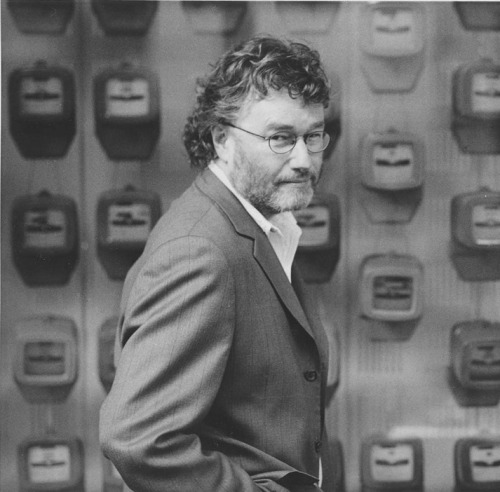
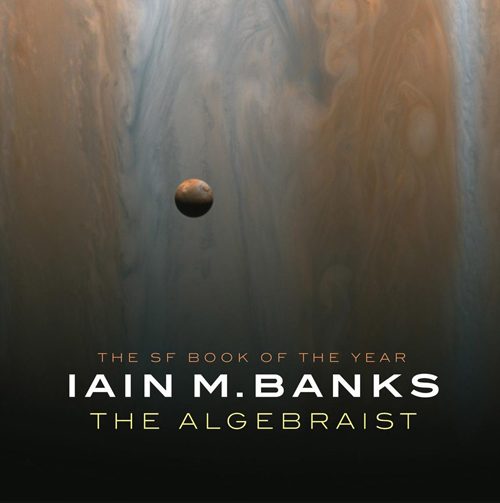
SF author Iain M. Banks has announced that he has terminal cancer and is unlikely to live more than a year. This is insanely sad. I've only read two of his books, and loved both. Time to read more, I suppose.
But when we have warp drive, it'll be a snap!
Visualizations that help convey the non-human scale of distances in space are always nice, but even so, they never really make it totally clear. I just don't think the human brain is wired to conceive of these kinds of distances.
Nevertheless, how far away would Mars be if Earth was only 100 pixels of your computer monitor in diameter? Find out!
A to Z: Chopin
One part of my character make-up against which I have struggled all my life is my tendency to simply not work that hard at stuff I don't care as much about as other stuff. I suppose everybody has that tendency to some degree, but in me, it can really get damaging sometimes. This isn't an example of that, but it is a coming-to-grips of sorts with the fact that I could have been pretty damned good at something, had I not wanted to be pretty damned good at something else.
The something I cared about a whole lot? My trumpet playing. The thing I cared less about? My piano playing.
I just never ever worked as hard at the piano as I did the trumpet. That's inevitable, as the trumpet was my serious focus back in my musical days. But I have to admit that I could have worked harder at the piano and been better at it. I'm sure that I was a terribly frustrating student for both my piano teachers, first a wonderful woman named Margaret Hooker, and then a fine college prof named Dr. Ted Reuter. There were a number of piano pieces that I was technically good enough to handle, but which I never mastered, simply because I didn't work hard enough at them.
One such piece is the Polonaise Op. 40 No. 1 in A Major ("Military") by Frederic Chopin. There's no reason that I couldn't have played the hell out of this. I just...didn't.
Chopin (1810-1849) is generally considered Poland's greatest composer, and he is one of the greats of the Romantic era. He wrote almost nothing for orchestra, except for a couple of concertos; the vast majority of his output is for piano, which makes his music an absolute staple of piano students all over the world. Nocturnes, etudes, mazurkas, and, in this case, polonaises. A polonaise is a Polish dance, performed in ¾ time, and Chopin wrote quite a few of them. This one, the "Military", is full of stately grandeur; in my ears it sounds less like a dance and more like a processional. Every time I listen to it, I wish I'd gotten off my arse and learned to play the thing.
I like this video because it shows the score of the piece in time with the performance. This kind of thing is extremely valuable!
A Random Wednesday Conversation Starter
Just how awesome IS 'breakfast for dinner', anyway?
Tuesday, April 02, 2013
Cats and Wife
I was lucky enough to get this lovely shot of our two feline doofuses in a cuddly moment with The Wife, who was snoozing in ever-lovely fashion.
Life ain't all bad.
A to Z: Bach
"Writing about music is like dancing about architecture."
--Somebody (we're not really sure who)
Yesterday I indicated that I don't much care for Baroque music, because of its inherent sanity. But as in all things, there are exceptions, and the major one for me is the music of Johann Sebastian Bach, whose music transcends nearly everything. Bach is one of the great transformational figures of all time, and there are very few figures in the history of Western music whose influence has been so wide-spread and so lasting.
Why is this? Well, the above quote provides a way in. Writing about music is slippery business, because it's just plain hard to capture in one medium the essence of another. As Leonard Bernstein once wrote, in discussing a Chopin etude, "If Chopin could have said in words what he was trying to say with the music, why would he have used music at all?" When writing about music, we can only ever get what feels to the writer an approximation of the essence of the work, which is why good music writing is so hard to find and so valuable.
The quote above also pertains to Bach in that, in the course of drawing an absurd metaphor in order to make a point, it uses precisely the word that leaps to mind when I think of Bach's music. That word is architecture.
Bach's music is, to me, architectural. It is mathematical. Now, to some that might make it sound like the music is clinical and sterile in emotion, but nothing could be further from the truth. Bach's music often suggests, more than any other composer's, something cosmic, and his work springs from the deep connections between music and mathematics. It's the primal sense of wonder that may well be the very first emotion we all experience, that sense of grandeur before a Universe that is vaster than we can conceptualize and yet we have innate abilities to conceptualize a great deal of it. That's what Bach means to me.
Architecture. Every great Bach work is an edifice, in which you can sense each musical building block as it is laid into place. In every great Bach work, you can see how each phrase relates to another, how each chord is structured together. The melodies that emerge from the unerring logic of his musical architecture make sense in a way that few other composers' do, and it's that emergent quality of his melodies that is so remarkable about them. Bach draws the ear to a certain place just as a great architect, or painter, knows how to draw the eye to a certain place.
Here is one of Bach's most famous works, and indeed, one of the most famous musical works in the entire history of the world: the Toccata and Fugue in D minor. I'm providing three versions here. First, you can hear the work as it may have originally been heard, as written for church organ. In the second, the Toccata is played as a MIDI recording (surprisingly good-sounding), but with an accompanying visualization that really clarifies the way Bach stitched this astonishing piece together. And finally, you can hear what many purists likely consider an abomination, but which I enjoy a great deal: Leopold Stokowski's arrangement of the Toccata for full orchestra, in the piece's segment from the Disney film Fantasia (Watching Stokowski here, I always wonder if he was mugging or if that's really how he conducted, because some of his motions are incomprehensible).
Tomorrow: a piece that chewed up the teenage me and spit me back out.
Remember, Buffalo!
This city seems to have a fetish for old things. Well, Byzantium's Shores is one of Buffalo's oldest blogs, dating back to February 2002! In blogging terms, that's like a house that Tom Jefferson might have walked by on his way to sleeping someplace. Vote for something old, Buffalo! THIS BLOG MATTERS!
(Yes, this is a capricious exercise -- but hey, somebody's gotta try to stand up for personal blogs that aren't about the Same Old Buffalo Niagara BS!)
A possibly depressing exercise
I've written of this before, but the names change every year, so let's do it again! For me, when I think of an 'old movie', my brain always defaults to Casablanca, which by the time of my awareness of its existence, had become a venerable classic movie. Now, when I was born, Casablanca was 29 years old. So here is a list of films that, as of this year, are as old as my brain's canonical 'old movie'.
Lots more, obviously, but those are stand-outs. Not all in terms of quality, obviously -- Red Dawn is trash, no matter how you slice it -- but it's interesting to note that of the ten movies I list here, all of them among that year's twenty top-grossing films, two have been remade. (So has a third of the 1984 top twenty, actually -- Footloose!)
Meanwhile, Casablanca has never been remade. Its story beats have been mined a lot, and the film has an enduring place in popular and wider culture, but no one has yet actually made a new version of the film. Will it happen? Who knows? Anyhow, all hail the newest Old Movies!
Ghostbusters
Indiana Jones and the Temple of Doom
Splash
Gremlins
The Karate Kid
Star Trek III: The Search for Spock
Amadeus
Revenge of the Nerds
Romancing the Stone
Red Dawn
Lots more, obviously, but those are stand-outs. Not all in terms of quality, obviously -- Red Dawn is trash, no matter how you slice it -- but it's interesting to note that of the ten movies I list here, all of them among that year's twenty top-grossing films, two have been remade. (So has a third of the 1984 top twenty, actually -- Footloose!)
Meanwhile, Casablanca has never been remade. Its story beats have been mined a lot, and the film has an enduring place in popular and wider culture, but no one has yet actually made a new version of the film. Will it happen? Who knows? Anyhow, all hail the newest Old Movies!
Monday, April 01, 2013
Art in SPACE!!!
I saw these two images on Tumblr yesterday, and both put me in mind of Princesses In SPACE!!! (not the actual title). The first seems like an actual possible location from the book, so I'll keep this in mind:
This one doesn't fit anything specific from the book(s) at all, but it does convey, to me at least, a bit of the sense of adventure that I'm trying to partly capture with these stories.
The first image is sourced on Tumblr to here, and the second, to here.
This one doesn't fit anything specific from the book(s) at all, but it does convey, to me at least, a bit of the sense of adventure that I'm trying to partly capture with these stories.
The first image is sourced on Tumblr to here, and the second, to here.
A to Z: Arutunian
Welcome to this year's Blogging A-to-Z Challenge! My topic this year, as I indicated yesterday, is Classical Music. My approach will be generally of a piece with my approach to all such things: personal reflections and whatnot.
So, let's get started!
As a trumpet player back in the day, I remember with quite a bit of clarity my frustration that a pretty sizeable chunk of the solo repertoire for the instrument sprang from the Baroque era. This frustrated me because, as a general rule, I've never been much of a Baroque music fan. I had a trumpet teacher in high school, Mr. Craig Fattey (huh – I wonder if he's still around? Note to self: look him up), who was of like mind, and he summed it up one night thusly: "There's a sane-ness to Baroque music that doesn't lend itself all that well to listening, for me." I think that's about right. I'm drawn to music that's got some insanity in it, and if that's your thing, you're not going to find it much in the Baroque.
(Bach is, of course, an exception, because he was such a towering genius that his lack of insanity is totally irrelevant. But that'll be for another day.)
So if you're a trumpet student, you find yourself playing a lot of Baroque stuff. And two major concertos of the Classical era, one by Haydn and the other by J.N. Hummel. Both are fine works, but it always bugged me that after those two, music for solo trumpet just doesn't exist until you get into the 20th century. For the Romantics, the trumpet was pretty much exclusively an orchestral instrument. For the most part I was fine with that, because I always wanted to be an orchestral player anyway, but I still longed for a nice trumpet concerto by a Schumann or a Berlioz or a Dvorak. Alas!
But in the 20th century, the trumpet became more popular as a solo instrument, and the Arutunian Concerto is of that era. And what a wonderful, amazing work it is! Alexander Arutunian (who died just over a year ago, March 28, 2012) was an Armenian composer who was apparently nationalist in his music (which means, he used a lot of Armenian folk melodies or characteristics of Armenian folk music in his work). The Trumpet Concerto is just teeming with wonderful melodies and interesting rhythms, and the orchestration is superb, with the soloist and the orchestra achieving a beautiful partnership. It's a technically difficult work, but it's difficult in the musical way, as opposed to being a virtuoso showpiece. This is one of my favorite classical works of all time.
The performance below sounds great, even if the camera work – plunk it on a tripod in one spot and never move it – is strictly utilitarian. The soloist is Tine Thing Helseth, with whom I was unfamiliar until I listened to this. Her sound is fantastic – she has a big, bold sound that meshes perfectly with the orchestra, and in her hands, the Arutunian by turns dances, trots, and sings its heart out. This piece is a great deal of fun for the soloist, with its unusual rhythms and places where you just get to belt out a high note and hold it while the rest of the orchestra does its thing. Listen for the recurring rhythmic motif that binds the entire piece together.
Tomorrow: One of the most famous works in the entire history of music.
Sentential Links
Links....
:: “I can’t believe we missed the ham party at the fire hall because we were sick.”
:: Well, there are multiple meanings. That's the point. Imaginative acts, stories, are told in part because of their polyvalence, their richness, their ambiguity. We can talk about how freedom hits us unprepared; how it always requires outside assistance, and cannot be accomplished on one's own; about how it requires various restrictions, symbolized by abstaining from leaven for eight days; about how it is communal and not individual. That our freedom was given, not earned; that it is not yet complete. It forces us to think about the nature of liberation and history and memory. It opens to the meanings we give it.
:: Shutting off the comments, even for just a few days now, has been such a positive experience. I still hear from you guys, but the conversation seems to be more in-depth, more useful. (See? I coulda killed the comments altogether!)
:: Finally, speaking of Shatner's age, does he look great for a man of 82 or what? We should all age so gracefully...
:: I am not sure why people will line up for stupid Spider-Man movies where Peter Parker goes out hunting for revenge but not for awesome movies about G.I. Joe. This seems rather silly to me.
:: Mars is such an odd place. Thick gray basaltic sand is everywhere, covered itself by fine dust (tinged red due to iron oxide: rust). Cratered, battered, barely holding an atmosphere, yet it still has ways of reminding us of home. Comparative planetology is a fascinating field.
:: I have been reading like crazy, writing every day, exercising every day, and pushing many projects forward, with my sheer force of belief in them. This is challenging but it’s also the only way. It requires a belief in the unknown. It requires the ability to see your own success, however much it is not manifested in the current moment. (It is the only way. It really, truly is. I wish they could find a way to put that lesson into the minds of people at 21, because I'd have a lot more done with my life had I realized this way back when I was younger and more energetic. But then, I didn't know shit back then, so it's a tradeoff, innit?)
:: You want to be a writer?
Keep writing. (That says quite a lot of it, doesn't it?)
More next week. Or not. Harumph.
Subscribe to:
Posts (Atom)