Fifteen months after his brother Lester departed, we have had to say goodbye to Julio today. They came to us as a package deal, and I hope there's some realm beyond the rain and the clouds where they can be so again.
Julio got sick recently and never really got better, and yesterday he had the kind of day that's hard not see after the fact as a farewell. He curled up in my legs last night on our bed while we watched a little teevee--one of his favorite things to do--and then he barely moved again. Today, we all agreed that it was time.
We don't know, really, how old he was, though when he came to us in early 2006 we surmised that he and Lester (who were obvious littermates, brothers through it all) were around a year old, maybe a little more. Fifteen years isn't so bad for a cat...except for it being too short.
We are not catless...but more on that another time. For now, goodbye, Julio. I guess now I'll keep my feet warm when I'm sitting at my desk by wearing socks. Seems boring and inadequate, but you're off for new adventures now.
The other night I was looking for some new Celtic music to listen to, so I hopped on over to Google and searched for "Best Celtic Albums of 2020" (or maybe it was 2019). This brought up several articles, and in one of those articles I found mention of an album by a band called "Soulsha". Soulsha hails from Boston, MA, and they aren't just a Celtic band: they perform a fusion of Celtic and African music, which is a mix that just sounds fascinating, doesn't it? Can you imagine blending those two highly melodic and rhythmic musical heritages?
Soulful call and response singing, masterful improvisation, traditional Senegalese and Scottish dancing and incredible energy make every Soulsha show an unforgettable live experience. Intricate rhythms, soaring bagpipe melodies, and New Orleans-infused horn lines come together seamlessly, and the joy of music rises above all differences, reminding us that we’re all in this together.
The band formed through a series of serendipitous meetings in the thriving and intersecting multi-cultural melting pot of Boston. Many of the members are virtuosic and highly esteemed tradition-bearers in their styles. In Soulsha, they saw a chance to bridge divides. The music they’ve created is a conversation between cultures that breaks down all the boundaries, moving the audience to abandon their assumptions as they lose themselves on the dance floor.
While it shares obvious roots with Afro-Celt Sound System’s electronic fusion, the funk-inspired sound of Soulsha puts tradition and interchange center stage, bringing the party energy of Rebirth Brass Band, and the cultural gravitas of masters like Malian Toumani Diabaté.
I listened to their debut album, Carry It On, and I found it an absolute delight. Their music just teems with energy, and the influences of both the Celtic side and the African side can be distinctly heard, and those two styles play together much more easily than one might think at first. Here is "Rhythm's In the Melody", a single from Soulsha's debut album. Enjoy!
Today I heard a striking choral work on WNED, but I missed the piece's introduction. I'm old enough to remember when this kind of thing was a pain! If you heard a song or piece but you missed the radio personality's intro, you had to wonder what the song was and hope to hear it again. Nowadays, with WNED, I can go to the station's website and look at their playlist to figure out what I heard...or I can actually hold my phone up to the speaker and let it listen to the piece and try to identify it. This works a surprising amount of the time. Yes, I'm still vexed that we don't have moonbases and giant spaceships under construction to launch Phase One of our colonization of Mars, but a device in my pocket that can (among other things) identify music? Now that is something.
The piece was "i carry your heart" by Eric Whitacre. It's a setting of a poem by e.e. cummings, whose birthday it is today, which I suppose is the "hook" that WNED cited to play the piece. You can read cummings's poem here (I would reproduce it here directly, but it's cummings, which means that the typography is important and I don't want to screw it up), and the ever-brilliant Sheila O'Malley has a big post about cummings here.
And here is "i carry your heart" by Eric Whitacre. It's quite a wonderful piece, at times evocative of plainchant or a medieval madrigal.
Admittedly, I am phoning it in a little this week. Here's a virtuoso showpiece for cornet and wind band, setting the Italian folksong "The Carnival of Venice", as played by Wynton Marsalis and the Eastman Wind Ensemble, conducted by Donald Hunsberger. Many a high school and college trumpet player was driven to heights of hero-worship which Marsalis released this album back in 1988 or so.
Autumn is turning out to be quite lovely this year. I remember a recent October--maybe last year's?--where it was just kind of rainy and unpleasant the whole month and then it was November and all the leaves fell at once and it felt like fall never actually happened. Anyhow, here's a photographic glimpse into how Autumn has been going in my neck of the woods. I hope yours is as lovely!
It took me a while to start loving rock music. I heard a lot of it as a kid (benefits of having an older sister, which I did not appreciate at the time because there are things you need years to figure out, especially when you're a not-terribly-smart nine-year-old), but for various reasons none of it really captured my attention until the early-to-mid 1980s. Part of it might have been a kind of peer-pressure, as I did tire of being the kid who had no idea what all of my friends were talking about when they started discussing music. Another part of it was the arrival of MTV, which even I, as a geeky kid, thought was pretty cool.
We didn't have MTV at our house for a while, because it took several years before the cable company ran the lines out our road to where we lived. But I would watch a lot of MTV at a couple friends' houses, when I did sleepovers and the like. There's a lot of nostalgic hay to mine in the music videos of those first few years, but I'll keep it to just one group here, for what are probably obvious reasons.
There was one very strange video I enjoyed in particular. It actually had a filmed introduction; the music didn't start for a minute or two. Our opening scene has a spectacularly nerdy kid being put on the school bus by his mother. This dude is so nerdy that when his mother flattens his hair with her fingers, it squeaks. She's giving him the standard spiel about making friends and having a good year and whatnot, but our boy--named "Waldo"--is not having in, replying to her in a voice that can't possibly be his: "Awww, Mom, you know I'm not like the other guys! I'm nervous and my socks are too loose." No dice; off to school goes Waldo, after discovering that the bus is loaded with what the 1980s held to be the standard "degenerate" types of kid.
Then our music starts, with some wild drums, and then the most blazing electric guitar work I had heard to that point in my life. And that guitar work remains the most blazing guitar work I've ever heard. The song, and video, were called "Hot For Teacher", and the band was a hard rock group called "Van Halen". That astonishing guitar playing? That was a guy named Eddie Van Halen.
That song, and the others from the album 1984 were my introduction to Van Halen. I would learn not long after that while I'd just discovered these guys, Van Halen had actually been around in a big way since the late 1970s after toiling in obscurity for several years before that, and that 1984 was their sixth studio album. Soon after that album came out, some internal drama happened with the band that led to their lead singer, a charismatic but troublesome guy named David Lee Roth, to leave the group; luckily there was another lead singer available by the name of Sammy Hagar who was between bands at the moment, so he slid right in and the band accommodated him, making new music in new styles to reflect the style of their new lead man, all the while maintaining the focus on the hard-but-fun rock.
And through all of that was the guitar work of Eddie Van Halen.
The music of Van Halen was a big part of my teen years, and I've never lost my love of it, though eventually I didn't buy the albums anymore. 5150, the first Van Halen album with Hagar aboard, was the first rock album that I played almost literally to death, to the point where I knew each and every song on that album backward and forward. I'd quickly get up to speed on all of the Roth-era albums as well, each of which is full of great rock music (well, Diver Down is really kinda meh, isn't it?), but I am probably one of the only people around who can honestly say that I don't have a genuine preference between the DLR and Sammy eras...or, as some people phrase it, "Do you prefer Van Halen, of Van Hagar?"
In all honesty, though, if you put a gun to my head and said "Play the first Van Halen song that jumps into your head!" I will probably wind up selecting "Dreams" from 5150 or "Right Now" from For Unlawful Carnal Knowledge before I choose any DLR song. That might not be a "preference", but there it is.
Of course, Van Halen's history got even more convoluted later on, when I had kind-of moved on from listening to them on a regular basis. Hagar was out, Roth was back in; Roth was out, and a guy named Gary Cherrone was in (for one album, that most people speak of in the same hushed tones as the Star Wars Holiday Special). Hagar was back! Hagar was gone again! Roth was back! Roth was out! Roth was back again! And so on.
Eventually Eddie Van Halen's years of hard living started catching up with him, with news and rumors of his various health troubles, winding up in the end with cancer...and that's what finally took him away from the world, at the age of 65.
What to say about Eddie Van Halen's guitar playing? Well...yes, he could play fast and he could do astonishing things with the guitar. But what always got me was the tone of his playing. There was often a sense of cheer behind it, of happiness, of warmth. A lot of great rock guitar playing often seems obsessed with speed for the sake of speed, and the electric guitar can sound almost angry and snarling in a lot of guitar solos, especially in 1980s-era "hair band" hard rock. Eddie's tone was always clean and pure, and there was almost always melody there, even in the midst of his virtuosic displays of pure skill and talent. Eddie Van Halen made music with the guitar, and his solos always blend into the songs and seem a part of the song. Many guitar solos of the era sound like what they are: rhythmic cadenzas stuck in the middle of the song, where the singer stops singing but the bassist and drummer keep on going.
Eddie Van Halen made the guitar sing and laugh, and in a few songs he even made it seem like it was about to cry. The man wasn't just a guitar god, he was a musician. Eddie Van Halen was to the guitar, for me, as Vladimir Horowitz was to the piano or as Hillary Hahn is to the violin or as Tine Thing Helseth is to the trumpet. In his best work, he isn't just "shredding", he's making music. And that's what I'm going to remember Eddie Van Halen for: the music.
Thanks for the music, Eddie. It was always good, and quite a lot of it was great.
A word about this last one, the live performance of "Best of Both Worlds". My paternal grandmother died in 1986, when I was just about to turn 15, on the morning that this performance was recorded. It was a deeply sad day; she was the first significant loss of my life. It was a Friday. After making the arrangements that morning, my father drove all the way home from Philadelphia, where Grammy lived, and then I remember my parents going out to hang out with their friends on what was a difficult night. I stayed home, as I typically did. Grammy's passing didn't really hit me until my father told me, after he got home, that she had remembered me during her brief hospital stay; apparently someone had said something that had triggered her memory of me. I lost it after that, and I remember being deeply sad for the next several hours, until I idly turned on the teevee and channel-flipped to MTV, which had the Video Music Awards (MTV's big awards show--do they still have the VMAs anymore?), and not long after I tuned in, MTV went to a live segment of none other than Van Halen, in New Haven, CT. They were on their big tour for the 5150 album, their first big tour with Sammy Hagar. This performance is the one to which MTV cut. Maybe it seems weird, but watching them do "Best of Both Worlds"--which is one of the best songs on that album--jolted me out of my funk. It was still a sad time, and Grammy's death was just the start of what was a generally godawful sophomore year of high school for me, but...at least there was Van Halen. Always Van Halen. To this day, I can rely on Van Halen to cheer me up when I'm stuck in the mud.
So, yeah. Thanks again, Eddie. (And Sammy, and Dave, and Michael, and Alex. And heck, you too, Gary.)
Edward Bland (1926-2013) was a composer and filmmaker who may be best known for a film he made in 1959, The Cry of Jazz, which has been deemed sufficiently significant in the history of Black filmmaking that it has been named to the National Film Registry by the Library of Congress. (You can watch the film on YouTube, here.)
I haven't been able to find a whole lot of biographical information on Bland, but he grew up in interesting circles: his father was a postal worker who moonlighted as an amateur literary critic, and thus knew such luminaries as Langston Hughes and Gwendolyn Brooks. Bland himself would study music at the American Conservatory before going on to a lengthy career as a composer and teacher.
This work, Piece for Chamber Orchestra, is an interesting work of stark modernism. Bland apparently described it as "the piece I wanted to write after I heard The Rite of Spring," and the debt to Stravinsky can definitely be heard in the demanding rhythms and harmonic language. The piece is strongly rhythmic and consists of a lengthy conversation between the instruments of Bland's orchestra. Listening to it, I can just imagine the level of musical awareness this piece demands of its performers, as the individual voices are almost improvisatory in nature, and yet everything has to mesh together. If you respond to Modern music at all, you will surely find Piece for Chamber Orchestra by Edward Bland a fascinating listen.
In Larry McMurtry's great Western novel Lonesome Dove, for much of the novel the point of view changes between the main story (a group of Texas cattlemen leading their herds north for selling) and a secondary plot in which we follow the nasty adventures of Dan Suggs and his brothers, who are a murderous trio of guys, killing and robbing their way across the prairie. About two-thirds of the way through the book, our lawful cattlemen meet Suggs and his brothers, and they manage to subdue them quickly and make ready to hang them from the nearest tree. But to their surprise, they find that a friend of theirs, a guy named Jake, has fallen in with the Suggs crew.
Jake is not a bad guy, but he's something of a ne'er-do-well who makes his living lurching from town to town, gambling and drinking and whoring and doing it all some more. It's been a while since I read the book, so I don't remember how it is that he falls in with Suggs and his brothers, but he does, and McMurtry captures his disquiet well as he witnesses murder and crime after murder and crime.
But when our heroes, William Call and Augustus McCray, defeat Suggs and company and get them all tied up in order to mete out cowboy justice, this brief conversation transpires:
Call went over to Jake. Deets [one of their companions] seemed hesitant to tie him, but Call nodded and covered Jake with his rifle while Deets tied his hands. As he was doing it Pea Eye and Newt [two more of their companions] came over the hill with the horses.
"Call, he don't need to tie me," Jake said. "I ain't done nothing. I just fell in with these boys to get through the Territory. I was aiming to leave them the first chance I got."
Call saw that Jake was so drunk he could barely sit up.
"You should have made your chance a little sooner, Jake," Augustus said. "A man that will go along with six killings is making his escape a little slow."
I've been thinking about that passage ever since our President made a video, aimed at his fans, regarding his experience with COVID-19 and his intention to leave the hospital later today. After having spent the last bunch of months spreading all manner of misinformation about the pandemic that is gripping the world, decided to record a video for his fans last night, in which he said, among other things, that he's "learned so much" about the disease.
He's "learned so much".
Imagine that. This many months after the pandemic began, this many months after lock-downs and scenes of horror in New York City, this many months after case spikes and the death rate never going down to zero, this many months of America just existing with this damned thing, arguing over masks and "mah rights"...now our President has "learned so much".
The time to learn so much would have been the beginning, sir. The time to learn so much would have been in the very beginning, when you would have learned so much from the pandemic team the previous administration left in place, had you not dismissed it.
You should have made your chance a little sooner, Mr. President. A man that will go along with two hundred thousand deaths is "learning so much" a little slow.
I know, another stretch of radio silence. And it's for the usual reasons! Busy at work, lots of writing tasks to complete, and last weekend and this coming weekend are long weekends for me, with lots of fun and exciting stuff, like our annual trip to Ithaca (though no Apple Festival, thanks to COVID), and a wonderful visit by my sister last weekend.
Also, I'm not gonna lie, folks, the impending election is taking up more and more of my brain cycles, the closer it comes. I try to maintain my optimism, but part of my brain keeps thinking about that scene from Schindler's List, when Schindler is bidding what he thinks is a final farewell to Itzhak Stern after the orders have come down to send everyone off to Auschwitz.
SCHINDLER: Someday...this is all going to end, you know. I was going to say that we'll have a drink then.
STERN: [reaches for glass] I think I'd better have it now.
And Schindler pours his unlikely friend and comrade a drink, as neither expects to see the other ever again.
I'm hoping, folks. I'm hoping.
On a somewhat cheerier, but also macabre, note, here's the most recent addition to my collection of Toby jugs. It's Anne Boleyn, whose fate is shown by the fact that the handle of the jug is the headsman's handle, with his hood.
"This is the weirdest three...combination of guys I've ever seen. One looks like a mechanic, the other one looks like he gets ALL the girls, and the other one looks like he's book-smart. They just decided to get together, like, 'Fuck it! We could all sing, let's do it!"
Here are four videos, all featuring the same song. But wait! There's a reason for this.
Earlier this year (or maybe it was last year!), Sheila O'Malley started linking what are called "reaction videos". In these, YouTubers record themselves in real time listening to something, usually a song, and they react in real time as they hear it for the first time. And it's not just new music, new hits: these reaction videos often feature young people digging back into the archives, to listen to old music, older music from their parents' or even their grandparents' generations.
And they are wonderful.
These people are encountering this music with an open-mindedness that is stunningly refreshing; they are coming to each song as if it's a new thing, and they aren't judging or being harsh in their summations. They smile and they laugh and they groove along with the music that they are choosing themselves. They are exercising their curiosity in a way that quite honestly gives me just a little hope in this point in history where, quite honestly, hope is a wee bit hard to come by.
So here are four reaction videos, in which four different young people react to the Bee Gees and "How Deep Is Your Love". They do occasionally pause the music to talk, they do swear, and the first guy is--gasp!--smoking.
A native of Buffalo who later moved to San Francisco to pursue her music career, Pamela Z is a composer and performer who works extensively with electronic sounds, vocal sampling, and other sonic augmentations to create works with an intriguing meditative quality. This particular piece puts her techniques on full display, as she augments a string quartet with electronica and recorded effects (much of which the listener will recognize) to create a piece that is at once meditative and disjointed, as the piece is continually interrupting itself.
I thought I had blogged about the current incarnation of the venerable comic strip Nancy at some point, but apparently I haven't! Or if I have, I can't find the post in the archives. Anyway, today's installment contains one sentence that almost made me literally squeal with delight when I read it. See if you can guess which sentence it was!
(I'll still write about Nancy sometime, but for right now, suffice it to say that its current incarnation is one of my favorite things. It has a very gonzo and off-kilter sense of humor right now that really does feel like Ernie Bushmiller's unique brand of zany, updated for 2020.)
Actress Diana Rigg has died. She lived a long life (82 years) and did a lot of amazing work, but for me, she will always be Contessa Teresa di Vicenzo, also known as Tracy...who would, very briefly, be Mrs. James Bond. Rigg was the greatest Bond Woman in the long history of Bond Women, and she is a huge reason why On Her Majesty's Secret Service is the greatest Bond movie ever made.
Thank you for the wonderful work, Diana Rigg! Here's Louis Armstrong with his signature ballad from OHMSS.
I haven't posted any Beethoven in a while, which is strange since it's supposed to be a focus, given that 2020 is Beethoven's 250th birth year. But here's an interesting tidbit: even though it's Beethoven, we're not completely taking a break from my recent delving into the history of Black figures in classical music history.
This is not a tone poem by any definition, so I shouldn't even be using it here, but my house, my rules. It's a sonata for solo violin and piano. Beethoven wrote ten violin sonatas, which are among the greatest works ever written for the instrument. Beethoven's compositional mastery of the violin is astounding (as I'll discuss more when I finally get around to writing about his Concerto for violin and orchestra), and it shines forth here, in the Violin Sonata No. 9 in A Major. This piece is often called the "Kreutzer Sonata", after violinist Rodolphe Kreutzer, to whom Beethoven dedicated the work.
But that's where things get a little interesting, because Kreutzer took one look at the score, decided the piece was unplayable, and rejected it. But the dedication stood, which seems weird, doesn't it? If I dedicated a piece to a specific musician who then insulted it, I'm not sure I'd let the dedication stand. And Beethoven was no stranger to removing dedications from his works, as we know from the Eroica symphony and...this very violin sonata.
For Rodolphe Kreutzer was not Beethoven's first choice of dedication. That honor went to violinist George Bridgetower, a Black violin virtuoso who had already disproved Kreutzer's notion that the sonata was "unplayable" by not only playing it, but by sightreading it. Bridgetower was one of the greatest violinists of his day, and he lived a long life mostly in England. He also did some composing of his own, but it's as the original honoree of Beethoven's Ninth Violin Sonata that he caught my attention.
Bridgetower's falling out with Beethoven is also a rather odd story. Apparently Bridgetower was out on the town with the great composer, when he made some insulting comments toward a woman, without knowing that the woman was a personal friend of Beethoven's. This was the impetus for Beethoven to rip off his original dedication and instead gift the work to a musician who didn't even like it and refused to play it. Isn't it weird how often the world of great art is as subject to human pettiness as everything else?
The sonata itself is a spellbinding listen as the mood shifts from moody darkness to the kind of joyful light that so often turns up in Beethoven's music. Is it a tone poem? Of course not...but it was first played by a Black man, and had that same man not made some inopportune comments one night, this piece would be carrying that Black man's name into history instead of some other guy who didn't even play it.
It's strange about comets. Except for a few notable exceptions, the vast majority of comets come quickly, brighten our sky, and then disappear forever (or for so long it's functionally forever). For the brief time they are in the sky, they are a wonder...and then they are gone, leaving us with only the memory of this wonderful thing that blazed amongst the stars for a short time.
That is how I keep thinking of Chadwick Boseman, a man of incandescent talent who blazed across movies and teevee for a few years...and now is gone.
Here is the End Credits suite from Black Panther, written by Swedish composer Ludwig Goransson.
Farewell, Mr. Boseman. You won't be forgotten. How could you be? You shone too bright in the sky to be forgotten.
There was a game going around Twitter the other day in which you post a photo of yourself from January of this year, when you were blissfully unaware of the jaw-dropping frightfest of a shitshow that 2020 had in store for us all. Here's the one I chose:
This was taken on January 22. How optimistic that guy looks! How hopeful!
Here's hoping that I can capture a similar mood on this coming January 22....
Born in Lexington, Kentucky in 1924, Julia Perry was a Black composer who studied widely, attending the Berkshire Music Centre and working with the great teacher Nadia Boulanger in Paris and then relocating to Florence for further study before returning home to the United States. She eventually settled into a life as a teacher and as a composer, working hard to integrate her African musical heritage with the Western musical language she had grown up with. She was apparently quite prolific, writing a dozen symphonies and a couple of operas in addition to her other works, until a series of strokes incapacitated her on the right side of her body. Undeterred, Perry taught herself to use her left hand to write, thus furthering her compositional career until she died in 1979, when she was only 55.
All that, and until last week I had never heard of her or her music [oops: this, it turns out, isn't entirely correct! I need to search my own archives before saying things like this]. I think that's the most sobering thing about this project I've been on in this space these past few months: realizing how all of these composers, who all wrote interesting pieces that should be heard, have never been on my radar before. There are a lot of reasons for that, of course. I, like many, tend to more easily gravitate to what I know than what I don't. But there's another, deeper, more insidious reason why these Black musical voices have been largely drowned out, and it's pretty obvious what that reason is.
Here is a sacred work by Julia Perry, her setting of the Stabat mater. Many composers have written the Stabat mater over the centuries, adapting the hymn and text to new musical language each time out. Perry's is a contemplative and modernist setting for string orchestra and contralto. The sound strikes me as somewhere between Black spiritual and Catholic chant, with the hypnotic qualities of each. Fascinating piece.
I may not remember the first place I ate a lot of my favorite foods, but I remember a lot of early favorites. Pizza? The ones I remember are Pizza Caboose in Hillsboro, OR and Rocky Rococo's in La Crosse, WI. I have no clue at all when or where I tried my first cheeseburger, but it was probably McDonald's or a chain in the northwest called Burgerville USA. I do, however, recall my first chicken wing (other than as part of a KFC bucket). It was this place:
That's The Roxy, an old dive bar in Olean, NY.
The other day I was scrolling through a Facebook group I had found dedicated to old photos and memories of one of my hometowns, Olean, NY. It's fascinating to look at the town's history, even if I haven't lived there in almost twenty years. Olean is a city in New York State's "Southern Tier", although it really isn't much of a city anymore, as decades of population drain have taken their toll. While I grew up as a child in the town of Allegany, a smaller town just west of Olean, I eventually lived and worked in Olean when The Wife and I got married, and Olean was my home from 1997 to the end of 2000.
By the time my family and I moved to the Olean area in 1981, the region's decline had begun, though maybe at that time it wasn't quite obvious yet. Olean still had several factories and lots of shops and even its own shopping mall, though it was on the smallish side. There were three supermarkets and a well-regarded university, and there were a lot of bars. Lots of bars. I remember that a lot of those bars were not "possessively" named, meaning, a bunch weren't named as a person's name in the possessive. There was a place called Sullivan's, and another dive bar called Buzzy's, but mostly the bars in Olean as I recall were "The Something". The Burton. The Village Inn. The Other Place. The Royal Ednor (not to be confused with The Royal). The Edgewood. The Birdcage. And, The Roxy.
As I scrolled through that Facebook group, suddenly I stopped dead because I saw that photo. The Roxy.
When I say that I ate my first chicken wing at The Roxy, it was my first chicken wing in the "split-wing" way, with the wings cut at the joints and the wing tips discarded, so what you end up with are a little drumstick and a "flat" (which is basically the forearm of the wing). I knew none of this wing-prep lore when we were preparing to move from Oregon to Western New York in 1981; all I knew was that my father said cryptic things about how we'd be eating chicken wings soon. My father actually lived in Olean on his own for one full semester in spring 1981, while my mother, sister, and I finished out the school year in Hillsboro, OR. So by the time we came along, my father already knew Olean pretty well, and he'd found this bar where I'd have my first chicken wings.
Now, I don't really know how or why that first wing experience ended up happening at The Roxy. It didn't make a whole lot of sense, really; we lived in Allegany, west of Olean, where The Roxy was on Olean's East side. Now, in 1981, wings weren't quite as ubiquitous as they are now, but still, lots of places had decent wings. Why that bar, all the way on Olean's east side? No idea, then or now. But that place was pretty cool, and in all honesty, I do kind of miss it.
The Roxy had two rooms: a dining room to the right when you went in, and the bar on the left. It was a blue-collar type of joint, which makes sense since it was right across the street from one of the local factories (a tile factory, if I remember right). Sometimes we'd sit in the dining area, other times in the bar, and I think they had other food there--maybe they even had a menu!--but for me, The Roxy was all about the wings.
And yet...I would soon discover, when I tried wings at other places, that what The Roxy served weren't actual "Buffalo" wings at all.
There are a great many ways to prepare chicken wings, but only one way to prepare Buffalo wings: They are fried unbreaded and then tossed in a sauce that is made of hot sauce and melted butter. To serve them, you dump them into a bowl or bucket or basket lined with wax paper. The Roxy's wings were breaded, though, and they came with the sauce on the side, not smothered on the wings themselves. And they were arranged nicely on a plate, like wheel spokes, around the little paper ramekin that had the sauce in it. You dipped the wings in the sauce to taste as you went. I want to say that a regular order of wings had fifteen in it, but I might be misremembering on that point.
When I discovered actual Buffalo wings later that same summer, I actually didn't like them as much as The Roxy's. At some point we stopped going out all that far for wings; maybe the place changed ownership or even closed. The bartender was a crusty old woman with a three-packs-a-day voice who had a wicked sense of humor, as I recall. Good times!
I looked at Google Earth the other day to see if the building still existed. I knew that it stopped being The Roxy at some point in the 1980s, and as of the last time the Google Mobile rolled through there, at least the building itself was still standing. It's a Hibernian Lodge now, though. I have no idea what the Hibernians are or what their thing is.
If anyone affiliated with The Roxy ever reads this, thanks for the wings! Oh, and for the pinball machine that gave out free games like candy. That was fun, too.
Apparently they made a movie about Sherlock Holmes's younger sister Enola, featuring Mille Bobbie Brown in the title role. The movie drops on Netflix just a few days before my birthday.
If it's good, this might be one of 2020's stopped-clock moments (even a stopped clock is right twice a day)!
I had a piece picked out for this week, but it's a pretty complex work that I want to hear a couple more times before I actually feature it, so this week I'll take an "easy" route. This is a short track called "Anthem" by composer Michael Abels, featured in the score he wrote for the Jordan Peele film Us. I haven't seen any of Peele's movies yet (and yes, I know this is a big gap in my media consumption), but I like what I've heard of Abels's music (previously featured in this space).
Here is "Anthem". It's atmospherically creepy, and reminiscent of Jerry Goldsmith's "Ave Satani" from The Omen.
I'm writing this on my new tablet, because my backordered keyboard folio finally came in. Huzzah! Now to begin my plan for World Domination...or, on a smaller scale, using this tablet as a content-creation device (blog posts, essays, maybe short fiction here and there). In terms of long form writing, I will almost certainly be a laptop guy until they literally stop making laptops, but I hope this little keyboard and tablet will yield dividends as well.
However...I am just now discovering that the Blogger app for Android devices doesn't reorient to landscape format when the tablet is rotated, so as I type this post, the words are appearing vertically on my screen. I have a pretty good ability to get used to change, but even this might--just might!--be a bridge too far. We'll see.
Obviously there is zero chance that I will vote for anybody other than Joe Biden this November (or October, really--early voting, here I come!), but I do want to highlight this segment of his acceptance speech last night. How strange a time it is, that we have to celebrate the very notion of electing a President of the United States who can feel genuine human emotions.
It's funny about "one-hit wonders": sometimes the hit is a genuinely enduring song, but other times the hit somehow endures despite being a very clear time-capsule piece that could only have come at a certain point in time. "Come On Eileen" by Dexys Midnight Runners is clearly an 80s song, but there's nothing about it other than its general sound that ties it to the 80s. But is there any other time than 1974 when "Kung Fu Fighting" by Carl Douglas could have come out? I very much doubt it.
Here's "Kung Fu Fighting". Such a catchy tune that you couldn't begin to get past the culturally-aware producers of today!
It's always struck me as strange that a lot of folks will, when they learn that my day job involves fixing stuff, make some remark about how I must use a lot of duct tape. I also get a particular Internet meme shared with me: It's a guide to fixes of all kinds, consisting of two questions:
1. Does it GO and it's supposed to stay put? (Answer: Use duct tape!)
2. Does it STAY PUT and it needs to go? (Answer: Use WD-40!)
Now, I do use WD-40 and other penetrating greases on occasion, but I have to admit: I hate using duct tape for general repairs, and I generally refuse to use it at work for any purpose other than taping thick rugs down over spots where our tile floor breaks. As a means of fastening things together, I personally feel that if I resort to duct tape, I've failed as a professional. Yeah, it's one of those weird "honor" things. We've all got an honor thing about something, and duct tape is one of mine. (Another? Papermate and Bic pens. Yuck!)
But there is one repair for which I used duct tape without regret. It was a repair--you know what, let's put quotes on that, because even I can't call this a genuine repair--there's one "repair" I made using duct tape. One time my car door wasn't closing all the way. It would feel closed, but it wouldn't be registering as closed. The "Door Ajar" warning light would come on, and even more annoyingly, the dome light would come on as well. I find the dome light enormously distracting when I'm driving in darkness, so this was a frustration. This went on for a few days until I realized what the problem was. It was related to...the seatbelt.
There's this weird thing that tends to happen to me in cars: the seat belt doesn't retract all the way, like it's supposed to. This happens to me a lot. I don't know if it's something about the shape of my body or something, if the belt twists in such a way when I use it that it doesn't snap all the way back, or if it's a thing that happens to everybody. But once in a while, the seat belt will stop retracting and just kind of hang loose. More often than not, then, the belt hangs into the damned door frame, so when I go to shut the door I close it on the seat belt itself, sometimes catching the entire buckle between the door and the frame. This in turn results in the door not closing properly, but latching enough that I have to unlock the door to fix things.
So: I turn the car off, unlatch the seatbelt and flick it to my left, from where its spring-loaded mechanism is supposed to retract it. Then I pay no attention as I grab whatever I need and get out of the car. Most times I shut the door and go about things normally...but once in a while, I hear an obnoxious metallic CRUNCH sound and notice that the door is not closed. The damned seatbelt has caught in the door frame again! I swear a few times, take care of business by opening the door and untwisting the belt so it can do its thing correctly, and then close the door again.
But.
One time, the buckle managed to get in between the door and the frame at the exact spot where the door's shape is supposed to depress the door switch that tells the car that the door ain't open. And of course the damned buckle dented the door at that exact spot. It's a tiny dent, so tiny you can't even see it unless you're poring over the door itself trying to figure out why the door-close switch isn't working. The switch itself is working just fine, see! With the car turned on and the door open, you can press it with your finger and make the car think the door is shut!
Yup. That tiny dent, barely a fingernail's thickness in depth? That was sufficient to make the door not click the switch. I couldn't see any feasible way of repairing the door to make the switch work myself, and I sure as hell wasn't taking the car to the shop for this dumb repair, which I could see resulting in a whole new door. Screw that.
So...enter the duct tape.
A disposable wipe cloth, folded up and taped to the door at that spot? That worked wonders.
Stupid duct tape.
I hope this doesn't come up too much when I'm sitting around the fires in the halls of Repair Valhalla.
While doing a bit of research for this post, I learned something that is actually a correction of something I've believed for years. Remember in the 70s when the ragtime piece "The Entertainer" was all the rage, because of its use in the popular movie The Sting? I don't know why, but for pretty much all the time I've been aware of that piece's existence, I thought that it was an original piece of ragtime music written by Marvin Hamlisch as a pastiche of the kind of thing that Scott Joplin wrote back in the late 1800s.
Well, as the kids say these days, "I was today years old" when I learned that no, what's heard in The Sting is an arrangement composed by Hamlisch, and Mr. Joplin actually did write "The Entertainer" in 1902. Joplin (1868-1917) himself was known as "the King of Ragtime", and ragtime music comprises almost all of his compositional output. He was trying to move beyond his ragtime reputation in his later years, but syphilis and dementia cut his voice short.
I know virtually nothing about ragtime, to be honest. My main impression of it is likely the same as many people: it's mainly kept alive not through active performance but by being the kind of music used by piano teachers to help young students develop rhythm skills. "Here's a piece that's fun to play!" is the likely selling point when a teacher is helping a kid choose the next thing they work on, and...well, in a lot of cases, ragtime actually is fun to play, especially if you've been spending months struggling with the chaste classicism of, say, a sonatina by Muzio Clementi.
Obviously, though, ragtime--a musical form that springs from Black culture and artistry--deserves better than to be reduced to a common teaching tool for young piano students, especially when the music's cultural context is virtually never discussed. "This is a piece by Scott Joplin, who wrote more than a hundred of these!" is about all you learn. At least, that's about all I learned when it came time to try my hand at a ragtime piece. Which one was it? Almost certainly "The Maple Leaf Rag", of course. Joplin wrote over a hundred rags, didn't he? And yet, every year at piano recital time, someone played "Maple Leaf Rag" and no other.
I don't mean to sound irritated at my piano teacher or at piano teachers nationwide, who can't always be true to the music at the same time they're trying to get little Billy interested in actually practicing for once. They can't teach the basics and try to keep some kid motivated enough to put in their half-hour a day of boring Czerny exercises while also doing anything more than the bare minimum in terms of music appreciation, but...well, anyway. Ragtime, an adaptation of the popular march form of the day coupled with the syncopated rhythms of African music, would help pave the way for the rise of jazz, so its place in music history is secure. But ragtime shouldn't be seen as merely a popular form for just a few decades that's important for blazing a trail for the extremely important work that came afterward. Ragtime is a musical moment that somehow captures a certain air of sadness at the same time that it's doing its "bouncy happy" thing, and while maybe it has its limitations, it should still be seen as more than just a thing to be viewed through a sepia veil.
Here is not "The Entertainer", or "The Maple Leaf Rag". This is "Solace: A Mexican Serenade", in which Joplin takes a slower tempo and incorporates tango rhythms into his normal ragtime language.
Joplin eventually wrote a ballet and two operas to go along with his ragtime work. As with many composers, I wonder what he might have accomplished if not for his illnesses and early death. The idea of Scott Joplin writing at the same time as George Gershwin is enticing, to say the least.
My mother's cat, a beautiful red Persian named "Maliboo", died today at the fine age of 17. He had a fantastic life, truly winning the Cat Lottery. Oddly, Maliboo hated me until several years ago when he had no choice but to warm up to me while Mom took a 17-day trip to Wales. After that, he was fine with me.
William Grant Still is not new to this series, but the goal is to highlight music as well as composers, and to just hear one work by a composer and then move on forever seems...well, weird, doesn't it? So let's get back to Still, one of the most notable Black composers in the repertoire. Still (1895-1978) had a lush, Romantic style that nevertheless displays a lot of influences, among them the Negro spirituals of his ancestors.
This piece is a string quartet (although I have discovered that it can also be performed by a quartet of clarinets or saxiphones), called the Lyric Quartette. In this work, which in my ears summons up hints of Copland and Debussy, Still depicts three of his friends in descriptive terms: the first movement is "The Sentimental One", the second is "The Quiet One", and the concluding third movement is "The Jovial One". All those descriptors do apply to the music, which is introspective and at times meditative. This is a beautiful work. Enjoy!
Here is the Lyric Quartette by William Grant Still.
Given that I want to use that device primarily as a secondary writing device for longer-form work, I will not be keeping any social networking apps on it at all, with the exceptions of the photo-based Instagram and Flickr. This seems to me a healthier way of going about things, moving forward.
So one thing I've been saving money for is a new tablet. My old one is pushing five years old (and may be over that already, as I'm not entirely sure when I bought it in 2015), so it's getting up there. Battery life isn't awesome anymore and apps don't always update, and in fact eventually a lot of apps become unwinnable. I've been squirreling away money so I could buy the new tablet outright, and now it's mine! In fact, I am writing this very post on the new tablet.
It's a Samsung Galaxy Tab A, in the 10-in size. This is the biggest tablet I've owned yet, which makes sense for reading comics and since I want to use this tablet as a secondary writing device. Of course, that particular bit of functionality will have to wait until the keyboard folio I also ordered comes; apparently it was backordered, which is a shame. (It was also included free, so I can't whine too much yet.) My plan is to use the tablet for writing in Google Docs, for things like blog posts and reviews for The Geekiverse, and maybe even short-form fiction if the whim allows. Google Docs doesn't handle very large files very well, and since brevity does not seem to be a thing I do as a novelist, that work will remain on the laptop and Scrivener.
Aside from that, who knows? I just have a nifty new gadget!
And the camera is decent on this tablet, too. Here is a selfie I took last night with this very device. Not bad, I must say.
And oh yeah, those are also new overalls...but more on those in another post. Cheerio, mates!
There are a number of favorite subjects of mine that I haven't used this blog to geek out about in a long time, so let's go ahead and do some of that right now, OK? Time to talk about bib overalls!
I think it's long past time to admit that my acquisition of overalls has come to a point where there's really only one way to describe it without making myself seem like a weirdo (or, maybe at least a little less of a weirdo), and that's to assert that I am a collector of overalls. That doesn't seem weird at all, right? When you're an avowed collector of a thing, owning lots of it and being willing to go to odd lengths to procure it aren't nearly as weird as if you're just some goof who owns a whole lot of a particular thing.
Well, that's what I'm telling myself, anyway.
Which brings me to one recent acquisition for my overalls collection: a pair of Hickory-striped overalls by the Washington Dee Cee company. I haven't been able to find much information out there about the Dee Cee company, but they were based in Nashville and they made a lot of denim Western-wear and workwear back in the day.
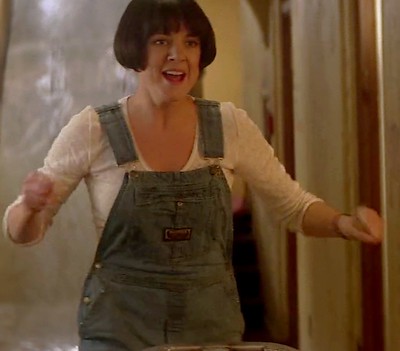
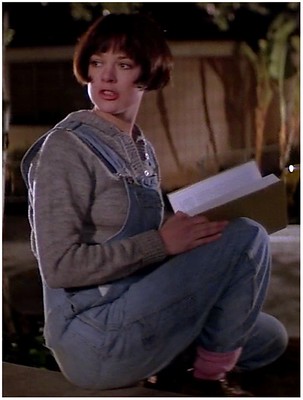
What makes their overalls distinctive is the styling of the large pocket on the bib. Instead of a dual-compartment pocket with two snap enclosures, which tends to be the norm (see Dickies or, my eternal favorite, Lee overalls for examples), the pocket is mainly one large enclosure with a snap in the middle over which a narrow flap fastens. It's a neat look that's a nice change from the usual style. Washington Dee Cee overalls were notably modeled by actress Michelle Meyrink in the wonderful 80s nerd-comedy Real Genius...
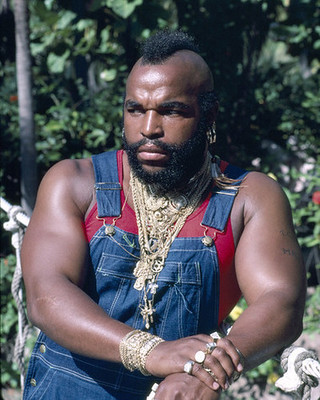
...and by Mr. T on The A-Team!
I've kept an eye out on eBay and other places for a pair of Dee Cee overalls, but usually they were either not in my size, or not in my price range. I did occasionally see this interesting variation, though--and never in my price range. It seems that the Washington Dee Cee people made versions of their overalls but to be branded for another great Tennessee institution:
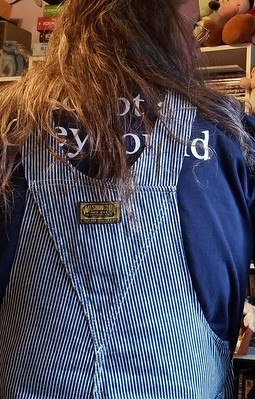
Well, anyway, luck finally turned my way and I got my hands on a pair of Hickory-striped Washington Dee Cee overalls! I've really taken a keen liking to Hickory stripes over the years (commonly thought of as "engineer stripes", because they're commonly seen on railroad worker clothing). Here are my new ones!
Some neat bib details here: While the Hickory-stripe pattern is always vertical on overalls, the Washington Dee Cee ones break with this in one place: the flap enclosure on the bib pocket. That makes for a neat visual contrast. At the far left of the bib pocket (the wearer's left, on the right as you look at them), there is a pencil-slot, and though it can't really be seen here, there is the traditional pocket-watch pocket that tucks into the seam just above the center tag. (For years I didn't know that this is what the "button hole" present on most pairs of "traditional" overalls, somewhere across the top of the bib, is for: the fob of a watch chain. It's one of those details that has held on for tradition's sake, even though most people who wear overalls aren't also carrying pocket watches.)
Close-up of the center snap. Back in the day, manufacturers engraved their names on the snaps and buckles.
Center tag. I love tags on overalls. Some people cut them off their overalls! I don't understand that. But, whatever. [shrugs]
I like them a lot, even if they are just ever so slightly too small, but they're definitely wearable and I like the way they look. So, huzzah!
Pianist Leon Fleischer has died, at the age of 92.
Fleischer was one of the greatest American musicians of the twentieth century (and a chunk of the 21st!), and his story is one of consummate musicianship along with triumph to overcome and live with disability. Fleischer was already a pianist and teacher of great renown by 1964, when a neurological condition made playing with his right hand impossible. Fleischer didn't lose a step, though: because one-armed pianists are hardly unheard of, there is a substantial amount of repertoire for them, including today's feature piece.
Maurice Ravel, the great French Impressionist composer, was commissioned by an Austrian pianist named Paul Wittgenstein to write a concerto for him. Wittgenstein had lost his right arm in World War I, however, so Ravel wrote his Concerto in D for Left Hand. It's an amazing, bravura work, with such impressive piano writing that it is never obvious that only one hand is playing.
Wittgenstein appears to have been a rather prickly individual; he clashed with Ravel about the Concerto, revising it himself before playing it, to Ravel's displeasure. Later he commissioned another Concerto for Left Hand from composer Paul Hindemith, but Wittgenstein decided he didn't like the piece, so he refused to play it--but he also owned the rights to it, so he never let anyone else play it, either...until long after his death, when Hindemith's score was found in Wittgenstein's papers. The work was finally premiered in 2004, more than 40 years after Hindemith's death. The pianist who premiered it?
Leon Fleischer.
In the 2000s, even though he had a long career of left-hand piano playing, conducting, and teaching, Fleischer began undergoing experimental treatments in hopes of regaining control of his right hand. These treatments proved somewhat successful, enough for him to resume two-handed piano performance. In 2007 Fleischer was a Kennedy Center Honoree, inducted by President George W. Bush.
Here is Leon Fleischer performing Ravel's Concerto for Left Hand in D Major.
Look at these two. I can't remember what yummy thing I had in my possession--I think it was bacon, on BLT night, but I may be wrong--but wow, they wanted it.
There are two possibilities with regard to this amazing piece of music, which I've just heard for the first time ever the day before yesterday: Either this amazing work has been studiously ignored for decades since its composition, when it should be heard every year around Passover time, much as The Ten Commandments is screened each year; or, it is heard every year around that time, and White Musical America is just that good at ignoring the amazing work of Black composers.
Sadly, I can see it breaking either way.
Robert Nathaniel Dett was a Black composer, native to Canada but who eventually spent most of his life and career in America after his family moved there when he was eleven. Dett was born in 1882 in Niagara Falls, Ontario, and would die in 1943 at the age of sixty, from a heart attack while touring with the USO as a choral director. In between he wrote a good amount of music, apparently making heavy use of Black folk songs and spirituals in a typically Romantic style.
Dett's oratorio The Ordering of Moses was premiered by the Cincinnati Symphony Orchestra in 1937. That performance was to be broadcast live by NBC, but the broadcast was cut short due to "technical difficulties" that apparently left many wondering if the issue had been technical at all, or due to large volume of complaints lodged with NBC for broadcasting a Black man's music. That doesn't matter now, because we can hear Dett's amazing work now.
Here is The Ordering of Moses by Robert Nathaniel Dett.
(The entire work isn't available in one video, so the above is an embedded playlist. As this doesn't always work well for me, here's the link to hear the work directly on YouTube.)
Today is Martin Sheen's birthday! He turns 80 years old, which I can hardly believe. In his honor, I'd like to note just one scene from his amazing life of work. This is from The West Wing's Season Two opener, called "In the Shadow of Two Gunmen". The previous season had ended with an assassination attempt on President Bartlet (Sheen), and as the finale ended we didn't know who had been shot or even killed.
When Season Two began with this two-part episode, we learned that President Bartlet and his Deputy Chief of Staff, Josh Lyman (Bradley Whitford), had both been shot. Bartlet's injuries weren't life-threatening, but Josh's were critical, and the episode unfolds as doctors work to save Josh and the White House and the nation react to the attack. Meanwhile, in flashbacks, we learn how the cast came together in a quixotic campaign to elect a long-shot candidate President.
Throughout all of the flashbacks, much is made of Bartlet's prickly nature, the fact that he's not especially nice to those in his inner circle, and that he simply isn't ready to be President. Aaron Sorkin's script even has a description: "There's something about Bartlet that seems smaller somehow." I don't know how Sheen managed to suggest "being somehow smaller", but at the end of the episode comes this scene.
It's one of the flashbacks. On the very night that Governor Josiah Bartlet wins the Illinois primary, thus becoming the almost-certain Democratic nominee, Josh receives the phone call that his father has suddenly died of cancer. As the campaign celebrates and gets ready for the trip to California, Josh instead has to go to the airport to fly home for his father's funeral. He's sitting at the gate when he notices Secret Service agents forming a perimeter around him...and then there's Bartlet, the last person he expected to see.
In this scene Bartlet finally shows some warmth to the people who have given up other careers to try and elect this guy, and it really is quite a wonderful scene between Sheen and Whitford. But the real amazing thing comes at the end of the scene, when Josh is heading off to catch his flight. Leo McGarry (John Spencer), Bartlet's oldest friend and campaign manager and eventual White House Chief of Staff, comes up from behind and asks Bartlet if Josh will be OK; Bartlet replies, "He's gonna be fine," and then...Bartlet turns around to face Leo.
And in that simple act of turning around and straightening up just a bit, we see that indeed Bartlet had been "somehow smaller", but now...he's not. He turns to face Leo, and he straightens just a bit, and he says: "Leo, I'm ready." I love when actors can create a completely different tone in their characters just by altering their posture in the tiniest bit.
Here is the scene, and Happy Birthday, Martin Sheen!
Author Samira Ahmed, writer of the amazing YA novel Love, Hate, and Other Filters as well as others, recently appeared on one of my favorite podcasts, 88 Cups of Tea. Her main takeaway that she pushed hard was the need for creative people to "say yes to themselves", because we live in a world that puts up an awful lot of roadblocks in front of creatives. We don't need to add to the roadblocks ourselves; self-obstruction is not healthy. It was a wonderful conversation (this podcast is always full of them), but there was one particular quote from Ms. Ahmed that knocked my breath away. Seriously, I almost had to pull my car over, so amazed was I to hear this.
She specifically referred to the habit a lot of writers have of describing their first drafts in extremely non-complimentary terms. There's even a quote that gets shared on the online writing communities a lot that goes along the lines of, "The first draft of everything is crap!" I've been pushing back on this notion for a long time (here's an old essay of mine about it, over on ForgottenStars.net), but to hear a published professional author echo my thoughts was unimaginably refreshing. And Ms. Ahmed frames the problem in a way that I had never considered. Here is what she said:
SAMIRA AHMED: One piece of that kindness to myself--and I say that this is just for me, but I hope maybe it can speak to just one of the other storytellers out there--which is, I am gentle with the language that I use about my writing. So what that means is, I never say to myself that my first draft is 'trash'. This is something for me; maybe this is OK with everybody else, your mileage may vary, but for me, when I was little one of those racist experiences that I had was a grown-ass man telling me, a kid, that I was 'trash that America needed to take out.' Words can be weapons, and I'm not going to use weaponized language against myself. So I don't say that my first draft is 'trash.' I don't say it's 'garbage'. I say it needs improvement. I say it needs work. I say I could make it better...but I don't say that it's trash.
I could not possibly agree more. Be kind to your own work, folks. It's yours, after all!