Saturday, July 22, 2017

Symphony Saturday

OK, after much hemming and hawing, it's time.


The symphonies of Gustav Mahler represent perhaps the apex of the symphony itself as a musical form. These are enormous works that make enormous demands on the listener. They are dense in concept and epic in scope, with musical architecture that is so complex that it calls to mind the large-scale works of JS Bach.

Mahler's symphonies are also deeply human, reflecting the loves and hopes and dreams and despairs of one of classical music's most driven and tortured figures. Mahler's vision was almost Herculean, and there is scarcely a moment in any of his symphonies when he is not plumbing deeply personal depths. In his symphonies one encounters entire worlds, with sunrises and songs to nature and starry skies and loves both found and lost. One also finds meditations, both fearful and elegiac, of death and what lies beyond. Mahler's art is a testimony to a depth of feeling that is only found in the greatest artists, and his ability to translate that feeling meaningfully into musical terms is one of art's great mysteries.

Mahler lived a relatively short life, from 1860 to 1911. He was a late Romantic, and thus did for the symphonic form what Richard Wagner did for opera. Where Wagner's work was lionized and celebrated and nearly worshiped, though, Mahler's was largely rejected and did not start to gain serious traction until after World War II, partly as the musical pendulum began swinging back from the modernism that was already astir as Mahler's life drew to a close. This was partly due to the very enormity of many of his works and the demands they placed on huge orchestral forces; the rediscovery of Mahler probably owes something to the arrival of long-playing recording technology in the middle of the 20th century. It's also hard not to suspect that the world's reluctance to embrace Mahler's music was partly due to anti-Semitism (Mahler was a Jew). It seems fitting that one of Mahler's greatest interpreters and champions was Leonard Bernstein (whose work we hear today).

Mahler's compositional output is relatively small, not consisting of much beyond his symphonies. This is not due to laziness, but because he was actually one of the hardest working musicians in history. In addition to his composition, Mahler focused strongly on conducting, serving for a number of years as the head of the Vienna State Opera. He ruled over that organization with a fiery, dictatorial zeal, micromanaging nearly every detail. A later experiment with the Metropolitan Opera in New York, and then the New York Philharmonic, ended poorly and Mahler had to return to Europe. By this time his health was failing.

By all accounts Gustav Mahler was a difficult person with few social graces, so it can be hard to square the coldness of the man with the depth of feeling in his music, some of which is filled with warmth. Mahler seems to have had no outlet for his deep emotion other than his music.

David Dubal writes:

Mahler's music seems to encompass the total range of human emotions. For countless numbers of people, it has become their Bible of sounded emotion. They feel Mahler's elation, rejection, panic, terror, sentimentality, and drunkenness as their own. In short, the music expresses dozens of sensations so pointedly that the true Mahlerite surrenders himself completely, becoming, it seems, at one with the composer's inner world.

The Symphony No. 1 opens mysteriously, like a dawn on an uncertain day, and descending motifs are heard in a kind of call-and-answer until we arrive at the main melody of the movement which is suddenly warm and genial. The entire first movement is filled with pastoral pleasure, even in a few stormy passages which lead to pleasing fanfares. The entire movement closes in a burst of rhythmic energy that leaves one smiling.

In the second movement we have not a traditional scherzo but a tune that sounds like a Landler, which is an Austrian folk dance that preceded the more famous waltzes to come. This dance is lumbering and forceful, but it too is laced with moments of genuine tenderness. The mood darkens further in the third movement, where Mahler's masterstroke is a minor-key rendition of the tune "Frere Jacques" in a funereal procession. Mahler's lyricism shows up here as well, and the verdant warmth of the first movement is mostly forgotten at this point.

Then we get to the finale, where all is storm and passion. A mighty cymbal crash ignites the fire which bursts forth in a torrent, and this long movement goes from violence to lyrical torture to violence again...but there are hints along the way of a triumph to come, when we hear a very soft passage of hope in the brass midway through. This is heard again a bit later, more loudly, and then at the end--after Mahler finally returns to the mysterious sounds of the symphony's opening pages--the triumph is complete. The symphony closes in tremendous, victorious light and the sense that a true journey has just been completed.

And that's in a little under an hour. Mahler's second symphony will take another thirty minutes, and his third will take even longer than that.

Here is Gustav Mahler's Symphony No. 1 in D Major, with the Vienna Philharmonic Orchestra conducted by Leonard Bernstein.


Next week: Hopefully, the Mahler Second. I will likely not be doing all of Mahler's symphonies in consecutive weeks, because I need to give them the hearing they deserve before I write about them. I'll probably alternate my way through them over the next couple of months.

Friday, July 21, 2017

Bad Joke Friday

One time I played poker with a Tarot deck. It was fun until I got a full house and three people died.

Thursday, July 20, 2017

Something for Thursday

So I'm always a little confused by the way a song's lyrics relate to the rest of it. Some songs have lyrics that are so indelible that it seems almost sacrilege to put any other lyrics to that tune and vice versa ("New York New York", for example). Other songs have wonderful tunes but awful lyrics that are so bad they almost make the rest of the song laughable in itself ("McArthur Park" is a good example here). And then there's a third category, where the lyrics aren't necessarily good, but rather...just weird. It's easy in songs like that to get wrapped up in trying to figure out just what the heck a song means, and if the melody and rhythm aren't good, the song just disappears.

Here's a song whose lyrics make no sense to me at all. I haven't the faintest idea what this song is trying to say, if anything. And you know what? Maybe it's not. Maybe it's just a rhyme that exists for no other reason to fit an incredibly catching melody and compelling dance beat. I dunno...but I know that I love this song.

Here are The Killers with "Human".

Wednesday, July 19, 2017

On Fantasy and Film

George RR Martin lists his Top Ten Fantasy movies. Of course I have thoughts!

First off, a stipulation: lists like this are mainly meant to inspire discussion and debate and, being that this is the Internet, rock-throwing and name-calling and aspersion-casting-upon-one's-children-and-parentage. OK? OK!

Second: Well, Martin actually has a pretty good list here. You'll have to click through to see his comments on each film (worth doing, also for the honorable mentions), but here's the Top Ten by itself:

1. The Lord of the Rings (complete)
2. The Princess Bride
3. The Wizard of Oz
4. Ladyhawke
5. Dragonslayer
6. Monty Python and the Holy Grail
7. Dark City
8. Pan's Labyrinth
9. Beauty and the Beast (1946, dir. Cocteau)
10. Raiders of the Lost Ark

Martin's "honorable mentions" include some Disney movies (more on that below), Dracula, Frankenstein, Legend, Labyrinth, and Excalibur.

So. Discussion!

As noted, Martin generates a pretty decent list. I've seen seven of his ten (Dark City, Pan's Labyrinth, and the 1946 Beauty and the Beast are the ones I've missed). I personally quibble a bit with Raiders: even though it has supernatural elements (as do all the Indiana Jones movies), I see them as primarily adventure films rather than fantasies. But that's quibbling, and the fact remains that if you've never seen fantasy on film, watching all of the movies on Martin's list is a great start. Also, I do not quibble at all with his Number One pick, which is as good as filmed fantasy gets.

Ladyhawke and Dragonslayer? Hmmmm. I like both, but I'm not sure I'd rank them this highly on my Filmed Fantasy Pantheon. In fairness, though, it's probably twenty-five years since last time I saw Ladyhawke, and not too much shorter than that since my last viewing of Dragonslayer. I remember the latter being a well-made and exciting fantasy, if a bit dour in tone. I owe both a rewatch, though.

My biggest quibble with Martin's list is that in his latter commentary he notes that for this list he adopted a "No animation" rule:

Going into this, I decided I had better exclude all animated films. Otherwise the list might well have been dominated by Disney's classic retellings of time-honored fairy tales: Snow White, Sleeping Beauty, Pinocchio, and The Little Mermaid.

See, the problem here is that animated films are still films and animated fantasy films are still fantasy films. Likewise, there's no reason to assume that the animated films will dominate the list, or that those animated films that will be doing the dominating are Disney films. A Top Ten list is often going to be exclusionary to the point of absurdity to begin with, but this is particularly bizarre, like making a Top Ten Restaurants of New York City list, but excluding those restaurants that focus on French or Italian cuisine. And in mentioning Disney, Martin makes a telling omission: he omits the masterpieces of Studio Ghibli. Looking at the list above, I would quite willingly trade Ladyhawke and Dragonslayer for Princess Mononoke and Spirited Away.

Then there's Martin's dismissal of Willow:

Then there's Willow. Sorry, no. Yes, I liked Val Kilmer as Mad Martigan, but that's about it. Willow set filmed fantasy back 20 years.

Look. Taste is taste and if you don't like a movie, so be it. I don't think Willow is a classic either, and I wouldn't put it on my Top Ten Fantasy Movies list either. But yeesh, it ain't that bad. I genuinely think that Willow has received a bum rap over the years. It's an OK, fun, swashbuckling Sunday-afternoon-on-a-winters-day movie, and there's a lot more in it that's good than Val Kilmer.

And "Willow set back filmed fantasy by 20 years"? That's a very silly statement to make, and Martin has to know better. Look at all the fantasy movies that came out in the 1990s, within just the first ten years after Willow (which came out in 1988). And just ten years after Willow, The Lord of the Rings was in pre-production. No, Willow did not hurt filmed fantasy. It's a dumb thing for Martin to have said.

Let's see, what else? Well, Martin doesn't mention any of the Harry Potter movies, which seems odd, because they're giants in the filmed-fantasy world, and they are a highly underrated achievement. They got the same cast together for eight movies over about ten years and told a big story. A little more respect for Potter, please!

And finally, Martin has this to say about Excalibur, which is probably the best version of the King Arthur story filmed yet:

I mentioned Excalibur earlier. There's much to admire about John Boorman's film. The visuals are a feast for the eyes, and the movie includes some wonderful performances. But Nigel Terry has to be the least charismatic King Arthur in film history, pouting his way from start to finish, and the film tries to cram in too many different aspects of Arthurian legend, and does justice to none of them. Some studio really needs to step up and film the definitive modern treatment of the Matter of Britain, T.H. White's The Once and Future King. And not as a cartoon (Disney's The Sword in the Stone) or a musical (Camelot) either. White's trilogy deserves to be done as three films, the way Peter Jackson did Lord of the Rings.

OK. If you use the word "cartoon", that tells me that you don't really respect animation. Not really. Maybe the Disney film of Sword in the Stone wasn't particularly good, but to dismiss the effort entirely makes me think there's a little more to Martin's stacking-of-the-deck against animation. As for a musical, well--no, Camelot isn't great. That's not why the "definitive" version of the Arthurian story hasn't been filmed, though.

I think it's because the Matter of Britain's very nature is stacked against a film or even a tetralogy of films (The Once and Future King is a gathering of four previous books, not three, as Martin should know). The Arthur story isn't one story but rather a whole bunch of them clustered together under one banner. I don't know how one film or even several films could make that all work without significant re-casting of the story and removal of some of its key parts. Gillian Bradshaw's trilogy of Arthurian novels, perhaps, or Mary Stewart's wonderful trilogy of Merlin novels. Any telling of the Arthurian story is going to leave something behind, because it can't possibly all be squeezed in there. I doubt very much if we'll ever see a massive filmed trilogy of the King Arthur story, to be honest. That's a bummer, but I think that's the way it is.

So, what would be my Top Ten Fantasy Films list? Well....

1. The Lord of the Rings (complete)
2. Princess Mononoke
3. The Princess Bride
4. Conan the Barbarian
5. The Thief of Baghdad
6. Time Bandits
7. Who Framed Roger Rabbit
8. Harry Potter and the Prisoner of Azkaban
9. Excalibur
10. Monty Python and the Holy Grail

How about yours?

Tuesday, July 18, 2017

Tone Poem Tuesday

Claude Debussy, like Hector Berlioz years before, won the Prix de Rome in his youth; and like Berlioz, he did not much care for the experience of living in Rome for the years required of winners of the prize. One good thing did come out of his time there: the two-movement symphonic suite Printemps, which is worth hearing as a signpost of what was to come as Debussy matured into his role as one of the leading exponents in music of French Impressionism. The entire work is one of sensation and feeling and impression. There are no melodies that linger in the ear, and the whole time of the piece, it seems to be leaning toward a certain type of song that never arrives. I often find this sense of direction-without-destination in Debussy, and it's a large part of why I often find it hard to really respond to his music, as lush and wonderful and evocative as it often is.

Here is Printemps by Claude Debussy.

Monday, July 17, 2017

Munchies!!!

I like to try new (or new to me) snack foods and candy on occasion. And by 'on occasion', I mean, 'all the time'. I try not to try new snack foods and candy all the time, but...well, I do my fair share of sampling such wonders.

Examples? Here are three!

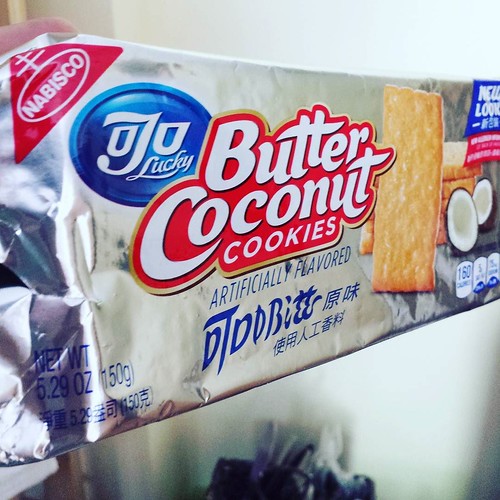
:: Lucky Butter Coconut Cookies!

These aren't bad, but I was hoping for more flavor. #cookies #yum

These are nice. Not great, but nice. They have neither a strong coconut nor a strong butter flavor, but enough of each to be detectable. The cookies are thin and crispy, but not so thin as to completely crumble when you bite them. The individual cookies are nicely big--about two inches by one inch rectangular--and the upper side has a nice buttery sheen and a pretty yellow color throughout. They're quite good with coffee. If you're looking for a pleasantly mild kind of cookie, these are definitely that. And the package is really cheap: I got one pack for under two bucks.

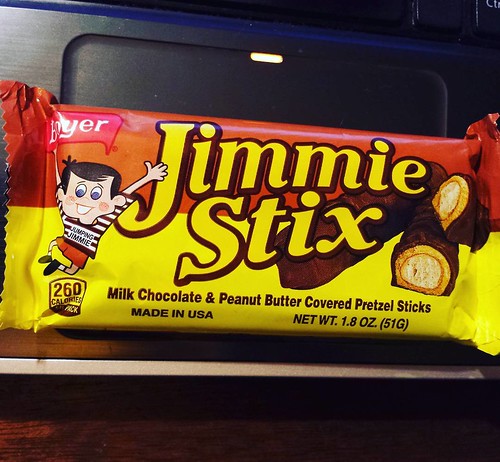
:: Jimmie Stix!

Dessert tonight: Boyer 'Jimmie Stix'!. I like obscure candy bars, and Boyer's Peanut Butter Smoothie (peanut butter cups with a butterscotch shell instead of chocolate) are one of my favorites. #candy #yum

One major reason I love going to Vidler's in East Aurora (which is an old-school five-and-dime store) is its selection of obscure candy. If you're looking to venture beyond the familiar realm of Snickers and Reese's cups, this is the store for you. Vidler's is a constant supplier of my favorite candy bar of all time, the Boyer Peanut Butter Smoothie (a peanut butter cup with a butterscotch shell). Here I have another confection by Boyer, the "Jimmie Stick", or "Stix" in plural. They're literally what the package says: two pretzel sticks covered in peanut butter and then covered in chocolate.

Interior of the Jimmie Stick (see last pic). This is good! Like a peanut butter Twix but with a pretzel. Will buy again. #candy

I liked this thing a lot. It reminds me of the "Take 5" Bar, without the caramel. The peanut butter and chocolate go well together, obviously, but the pretzel interior gives the whole proceedings a very pleasing crunch, and the pretzel's saltiness elevates the proceedings. I really liked this and will definitely buy more next time I'm in Vidler's.

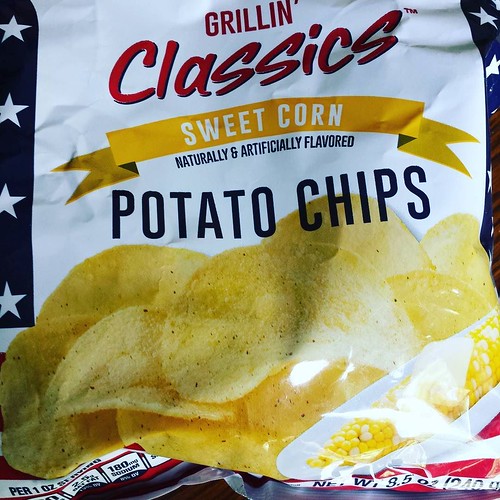
:: And finally, Utz "Sweet Corn" Potato Chips.

These are...odd. Not awful, but I'm not sure I'd buy them again. #yum #potatochips

This summer the fine folks at Utz, who make a lot of fine salty snacks, came out with a line of "Grilling Classics" chips. There are three flavors: Cheeseburger (which are actually really good with a hint of yellow mustard), Grilled Hot Dog (which are really disappointing and taste mostly of char), and now these. If the Cheeseburger chips are the good ones in this line, and the Hot Dog ones are the bad chips in this line, then these are the "Meh". They're not horrible. The chips have a definite taste of corn that has been applied somehow, but it's also an artificial taste of corn, and it literally tastes artificial. Sometimes you can add a non-traditional chip flavor to a chip and result in something that's kind of tasty (like the Cheeseburger ones), but other times you end up with something akin to cognitive dissonance as your tongue screams to your brain, "This should not taste like this. ERROR. ERROR." I think we can call that "culinary dissonance", right?

Anyway, like I said, the flavor of these chips isn't unpleasant. They're not bad at all. But I was not able to get used to them. The last two chips in the bowl tasted every bit as wrong to me as the first two, and that's a problem. I'll finish the bag, but these won't be on my list of Munchie Paths To Trod Again.

So, who out there has tried something new in the Munchie world of late?

Saturday, July 15, 2017

Symphony Saturday

I keep promising Gustav Mahler, and I keep postponing Gustav Mahler. Alas!

And no, no Mahler this week, either--but in a way, this week's symphony does help pave the way a but. Instead we'll revisit Hector Berlioz, because you can never have too much Berlioz. This is one of my handful of "desert island" works: if I were banished from society but I could have recordings of a few classical works to hear for the rest of my days while banished, this would make the cut. It's Berlioz's Romeo et Juliette Symphony, which is one of several works he wrote that are really not easily classified. The work bears no formal resemblance to any symphony written around its time, and at times it seems like it might be straight-up opera. And yet it is not: its most intimate moments are purely orchestral, and its heart lies in the central portion where Romeo meets Juliet at the ball, and then the love scene between the two, and then the scherzo depicting Queen Mab as Mercutio describes her. So much depth of feeling and illustrative color in those movements, along with some frankly amazing melody. Berlioz never gets enough credit for his melodic invention. Berlioz's formal scheme here does anticipate Mahler in a way, for Mahler too was never one to rigidly adhere to the four-movement symphonic model that dominates the form.

This work is on my thoughts anyway of late, because I have been reading Berlioz's memoirs. I haven't got to where he writes of this symphony yet, but I look forward to that. Here is Romeo et Juliette.


Next week, I really do hope to get to Mahler. Really.

Friday, July 14, 2017

Bad Joke Friday

Apologies if you don't remember your high school French!


Thursday, July 13, 2017

Something for Thursday

I've been reading the memoirs of Hector Berlioz lately, having come to the odd and surprising realization that even though he is my favorite classical composer, I've never read his memoirs all the way through! The strength of his opinions is amazing--Berlioz was not a man to ever entertain feelings of 'meh'.

I'll have more to say about the Memoirs another time, but for now, here is Berlioz's Roman Carnival Overture.

Wednesday, July 12, 2017

One Memory of Each Grandmother

I never knew my grandfathers. Both had passed away long before I arrived on the scene. My grandmothers, though? Both lived into my teens, when--quite sadly--both passed away within about six months of each other. Grammy, my father's mother, went first in the fall of 1986. Gramma, my mother's mother, passed later that winter (or maybe it was early spring). Here's a memory I have from each.

Grammy and the Manhattans

The Manhattan was my grandmother's favorite cocktail, and it is my mother's as well. I don't think it's mine -- my heary belongs to the Mojito and to the Dark&Stormy -- but heavens, is Manhattan good! #whiskey #cocktails #manhattan #bourbon #yum #candyisd

Over the last seven or eight years or so, my tastes in adult beverages have shifted from beer to wine and cocktails. My favorite cocktails tend to be rum-based, with my favorites being the Mojito and the Dark-and-Stormy, but over the last few months I've discovered Grammy's favorite cocktail, the classic Manhattan.

Grammy simply adored Manhattans. I don't know of a time when I wasn't aware that there was a drink called a Manhattan and that it was Grammy's favorite drink. One time, toward the end of her life, she was visiting us for a week or two. By this point she was starting to experience some problems with her mobility, but when my father invited her "down the street" (his longtime euphemism for "going to the bar") for a Manhattan, well, suddenly she was a bit more spry. My mother later told me that when I was just a toddler and my family was moving from Pittsburgh to Portland, OR, Grammy gave her a bottle of Manhattans to see her through the trip.

So I decided a while back to try making a Manhattan, mainly out of curiosity. I have several books on mixology, so I grabbed a recipe and picked up the ingredients and had a go. The base recipe I use is as follows:

Stir together in a mixing cup with 1 ice cube:

2 parts bourbon
1 part sweet Vermouth
dash of Angostura bitters

Stir for at least twenty revolutions of the bar spoon (yes, I count them), and then pour over ice in a rocks glass. Garnish with at least two Maraschino cherries.

There are recipes out there that call for both sweet and dry Vermouth, but I haven't tried that mainly because I don't have room in the fridge for two open bottles of Vermouth. I have also used Red Stag whiskey, which has a black cherry flavor. One thing I don't do consistently is include the Maraschino cherries, and I have received stern lectures on this from both my mother and my sister. I like the cherries, but too often our jar of them migrates to the rear of the fridge, and who wants to dig through cups of yogurt and jars of pickles and partial cans of tomato paste and who knows what else every time they want a drink? Not me...but for purism's sake I should probably get with the program.

Besides, the cherries also pertain to Grammy specifically, because she could put the stem in her mouth and tie it in a knot with her tongue. That's some serious stuff, folks. Everyone's grandmother should have at least one eye-popping useless skill, right?


Gramma's Blue Jug

I expect that everyone's grandmother had a particular item in their home, just some ordinary thing that was just an unremarked and unremarkable part of their daily lives, that stays in our memory. We remember this item not for any specific event that we recall in which it played a part; it's just that this particular item, whatever it might be, serves as a kind of totem for a particular time and place. If we're very lucky, we inherit that item. If we're kind of lucky, we at least see one just like it once in a while at an antique store.

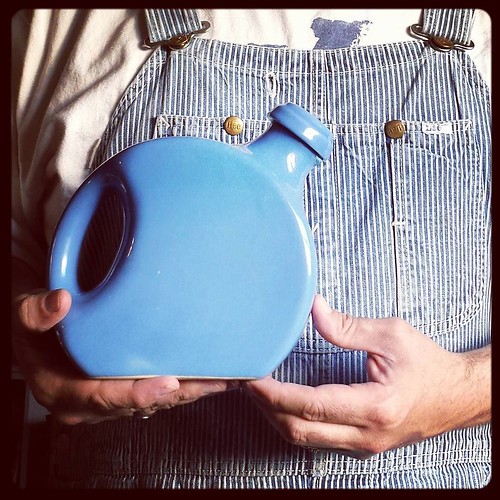
For Gramma, it was a blue ceramic jug.

At her house it always contained ice water. She'd fill it from the tap and put it in the fridge, and I don't remember any ice water in my life ever being so cold and refreshing as that from Gramma's blue ceramic jug. Now, ceramic is a good material for such things because it takes its sweet time in transferring heat. Cold ceramic stays cold (or hot) for a long time. Water from that jug couldn't have physically been colder than anything else in that fridge, but for some reason it felt like it was. This jug was blue, and it was circular in profile with the handle a part of the circle as opposed to being its own protrusion. The cork-inlay stopper matched as well.

As far as I know, Gramma had that jug in her fridge up 'til the day she died. I have no idea what happened to the jug after that. Gramma lived with my Uncle Bob, who wasn't...well, let's just say that Uncle Bob was not a terribly easy man to like and leave it at that. Inheriting the jug wasn't a possibility, and that was that.

Some years later, my sister managed to find one in an antique store, and she bought it for my mother, who was ecstatic to have the jug. For her, it didn't even matter that it wasn't the very jug from Gramma's kitchen. The color was the same, the jug was the same, and for her it was every bit as good as having the real thing. I'm not so avid an antiquer as my sister, but I do go to antique stores a few times a year and I've always kept an eye out for the same jug. I've never yet seen one "in the wild", but I would have bought one if I'd seen it and the price was right. If it was too much, well--I'd look at it in the case and remember drinking out of Gramma's and move on.

Flash forward to just last week, when I went to an antique mall near Rochester, NY with my sister. She found one of the jugs, in the right shade of blue. She bought it and gave it to me. It turns out that she's seen several of them over the years and now she owns two of her own back home, where she lives in Colorado. She was even planning to give one of those to me, but when she saw one right then and there, she figured it would save her some future postage (as well as worry about shipping an antique ceramic jug). How did I not see it, since we were at the same mall? Well, the mall is huge, so when we entered we each went a different direction. Had we reversed course, I might have seen it first and snapped it up.

Anyway, I agree with my mother: having a jug that's exactly the same is pretty much every bit as good as having Gramma's original jug. Right now it's on a shelf in my study. Will I use it as a jug in the fridge, filled with ice water for a hot summer day? I don't know yet. I sure like looking at it, though.

Adventures in Antiquing 8: Ceramic pitcher. My grandmother had one exactly like this. And now I do too! #antiquing #ceramicpitcher

I could, I suppose, mix up a big batch of Manhattans and keep them in the jug in the fridge. That would be a poetic tribute to two wonderful grandmothers....

Tuesday, July 11, 2017

Tone Poem Tuesday

What a dramatic work this is! Peter Ilich Tchaikovsky's symphonic poem Francesca da Rimini is based on a story from Dante's Inferno, and as such, you can imagine how volatile a piece of music it is. The story being illustrated is a tragic one involving a heroine named Francesca da Rimini, who is condemned to Hell along with her illicit lover, where their torments are many and varied. It's not hard to understand how Tchaikovsky came to relate strongly to this story, given what a disaster his own love life was. This work is powerful and illustrative, with little of Tchaikovsky's usual, celebrated lyricism. This is a dark work and a fascinating listen.

Monday, July 10, 2017

Box of Dreams

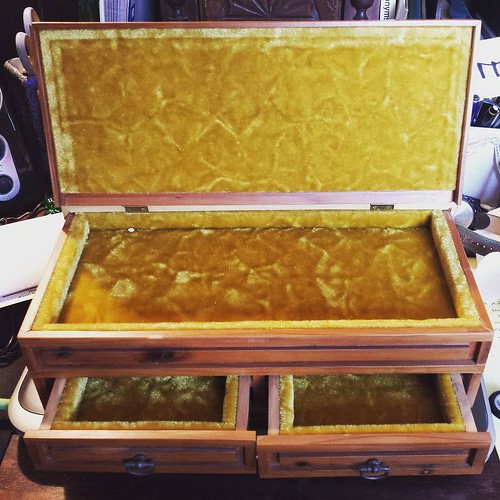
Last week while my sister was visiting from out of town she and I went antiquing. I enjoy antiquing, but she absolutely loves it, and she did some research and found a huge antiques mall located in Canandaigua, NY, which is an easy hour-and-a-half drive from Casa Jaquandor. Among a few other things, I bought this lovely box:

Adventures in Antiquing 7: New jewelry box! Not sure what I'll use it for as of yet. #antiquing #jewelrybox

At the time I had no idea what I was going to do with it, but it's really nice! Well-put-together, with that lovely soft lining. Obviously it's meant for jewelry (or so I think), and I don't own much jewelry of my own, but I couldn't pass it up.

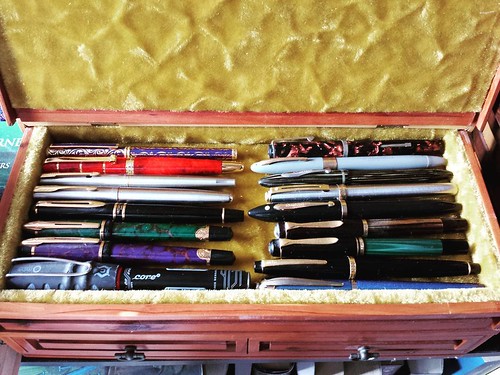
And then, a few days later, the obvious thing to keep in the box--at least the top part--occurred to me.

Behold my entire collection of fountain pens!

The wood box I bought last week is perfect storage for my fountain pens! #fountainpen #antiquebox

That makes me happy. I've been rekindling my love of fountain pens of late, and this is a much better way of holding them than standing them all up in a mug, which is what I had been doing.

However, looking at this set-up, it appears that I have no more space for any more fountain pens. Hmmmmm...maybe next time we go to that antiques mall, I'll look for another box!

Friday, July 07, 2017

Something for Thursday (Friday because of a mid-week holiday that has me confused as to what day it is edition)

Oops.

Anyway, why not kick off the weekend with some adventure music? Lead on, Dr. Jones!


There's a lot to love about Indiana Jones and the Last Crusade, just as there's a lot about it that's frustrating. The score is magnificent, though! It's one of my favorite John Williams scores, and that's saying a lot. The score is just bursting with wonderful melodies from start to finish, the action writing is suitably thrilling, and the whole score is just a wonderful listen. These are a few selections. The second track featured here ("Keeping Up with the Joneses") is especially interesting as it is barely heard in the film at all, despite a really quite wonderful jaunty theme that turns wonderfully lyrical.

Go find some excitement this weekend, folks!

Bad Joke Friday

Wednesday, July 05, 2017

On choosing happiness

A lot of people I know--most people I know, likely—struggle with happiness. They struggle with keeping it once it’s found, and they struggle with finding it in the first place. Some struggle more mightily than that: some have to fight just to believe that happiness is a thing in the first place.

This is why I have problems when people say things like “Happiness is a choice” or otherwise imply (or state outright!) that one can simply decide to be happy. As if happiness is a simple matter of flipping a mental switch.

It’s not.

I had this exchange on Twitter the other day. An acquaintance whom I know to be very smart and energetic and hard-working in the pursuit of the concrete goals which she has set for herself asked this question:

Why is it this hard to be happy?

My answer (and I must grant that maybe she wasn’t even looking for an answer) was this:

In my experience, happiness is like anything else worth having: it requires constant work and can be fleeting.

She thanked me, and that was the end of the exchange.

But there was another exchange earlier that day, this time on Instagram, when someone posted in response to a particular selfie of mine:

I wish to enjoy life the way you do.

That amazed me, because there are many times when I feel as unhappy as anyone else. When I feel like true, enduring happiness is forever beyond my grasp, and that all I can achieve are discrete moments of happiness—a hint of it here, a taste of it there—without ever really being happy.

Other times, I feel just fine—but those moments of melancholy are frequent enough that I recognize them well. But I thought about that comment a lot, about how I look to some outside observers like a person who greatly enjoys life, and some thoughts crystalized.

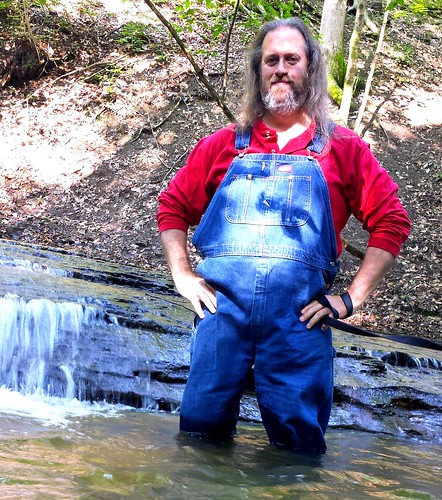
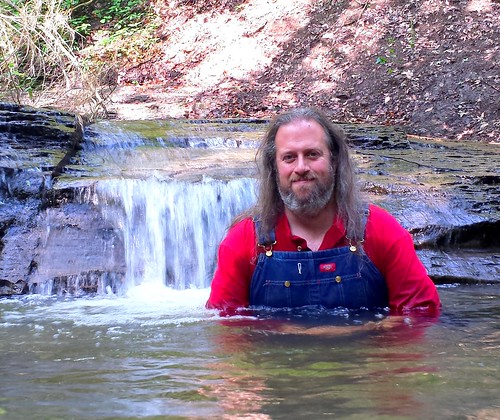
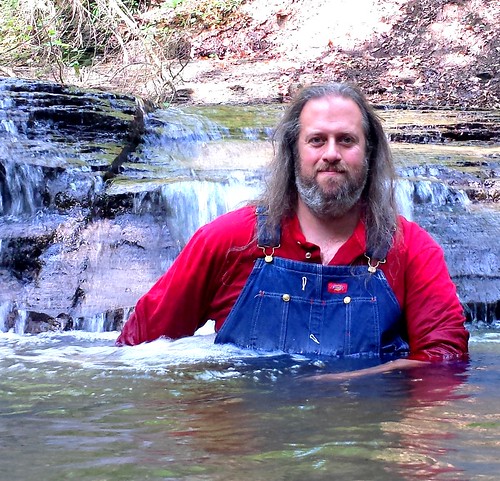
Here’s the photo that earned that comment:

Water frolicking

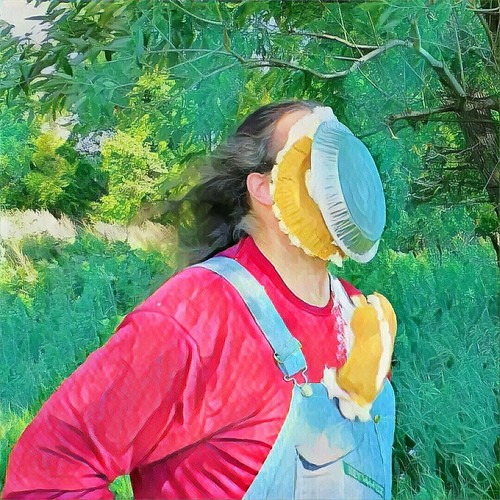
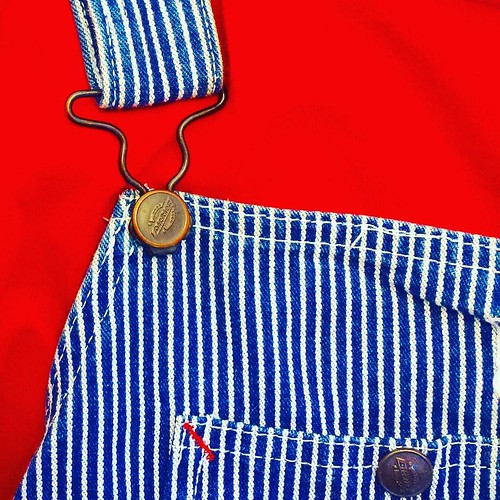
Just a normal photo of me, decked out in blue denim Dickies overalls and a red henley shirt, standing knee deep in a stream with a tiny waterfall behind me.

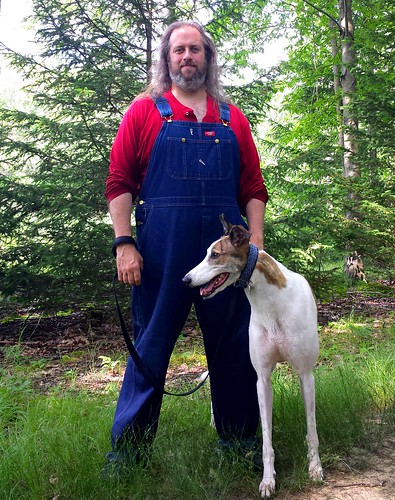
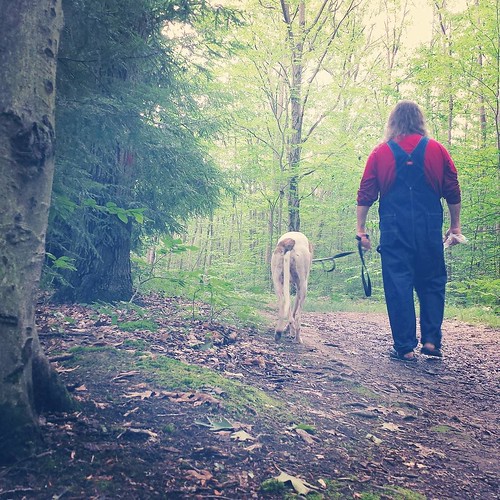
Most Sunday mornings I have a ritual: Cane (or Dee-oh-gee 1.0) go out to one of the local nature parks or other such locations for a nice walk or hike, and then a stop at Tim Hortons on the way home for coffee (for me) and a donut (for him). I always take a bunch of photos as we walk. Cane smells things and looks at things and enjoys his change of scenery. One of our most common locations is Chestnut Ridge Park, which is in the hills just south of Orchard Park. It’s one of my favorite locales because of its rugged terrain, its numerous trails, and the several streams that flow through. (I’ll have a longer “Chestnut Ridge appreciation” post at some point.)

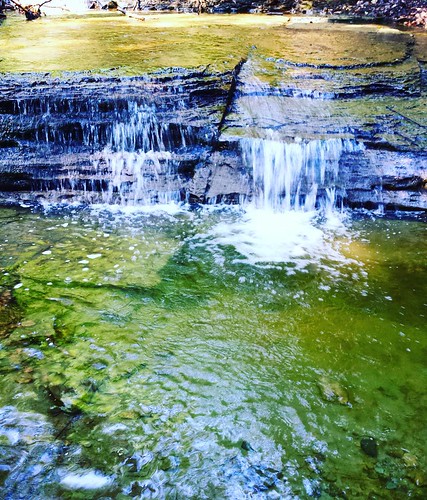
So it was a pleasantly warm morning, and Cane and I went wading in one of the streams. As you start getting to midsummer, the water levels can be iffy. Last year this area experienced a significant (for these parts) drought, which led to the streams being mostly dry for much of the summer. It’s been wetter this year, so there’s been a nice amount of water flowing thus far, and as long as I can recall, I’ve loved wading and swimming and generally frolicking in running streams in the forests. There’s a spot in Chestnut Ridge where the stream (which in most places isn’t much more than ankle deep, or maybe midway up my shins) plunges over a waterfall.

One of my favorite spots in the world. I love this little waterfall and pool. #stream #runningwater #waterfall #ChestnutRidge #wny #OrchardPark #summer

I know, not much of a waterfall—the mighty cataract is about eighteen inches, two feet max. But the sound is pleasant and the pool at the bottom is two, maybe two-and-a-half feet deep. And even better, this spot is a place where nobody almost ever goes! In all the time I’ve been going to Chestnut Ridge I’ve seen someone in that spot exactly twice. It’s easy to get to and it’s really close to the main road through the park, and yet it’s not obvious that it’s there, so almost no one treks down there. It’s a quiet little idyllic spot hidden in plain sight, which is one reason I love it.

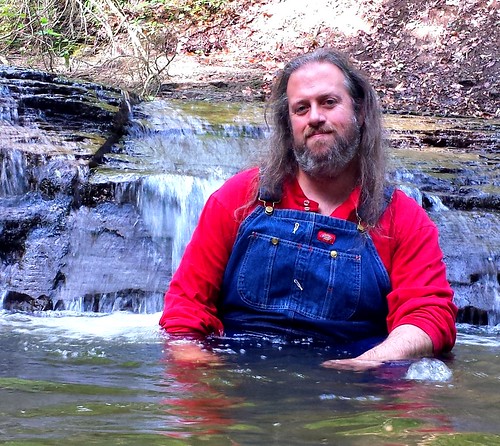
This particular day was sunny and warm and very pleasant, and the water was pleasingly cool, so I waded into that deeper pool, up to my knees. This was pleasant enough, but there are times when the world whispers an invitation into your ear, and it was impossible to ignore. So I sat down in the water, fully clothed, overalls and all. (I emptied my pockets first.)

Water frolicking

Like I said, I’ve always loved running water and streams and especially forest streams, going back to whitewater kayaking I did as a teenager and ever farther. It’s hard-wired into me, so much so that I doubt I’ll ever voluntarily move to a place where there are no such places. A summer hike, to me, implies the existence of a spot somewhere along the hike where I can, if I’m hot and if the water is cool, just jump in for a few minutes.

Water frolicking

The trade-off is that I spent the rest of the hike in clothes that were soaked from neck to toe, but that wasn’t unpleasant in the least. In fact, it kept me pretty cool. And because I keep towels in the car, I didn’t even sully the driver’s seat. A good time was had by all.

Water frolicking

So I suppose I did appear, in those photos, to be enjoying life particularly well, and I really was. It was a set of wonderful moments. Sitting in the water with my back to that waterfall, feeling it rush around me? That was a connection of a kind I rarely feel. And that was some real happiness, right there.

Water frolicking

Thinking about these two exchanges, I have also thought of a passage I wrote in Stardancer several years ago. There’s a beautiful moment that comes for Tariana, and one of her quirks is that she always remembers quotes from poems and books she’s read as things happen to her. It’s how her brain filters her experiences. In this moment, she remembers the words:

A life is a collection of moments. We are shaped by the moments we remember.

Maybe I was having thoughts like these all those years ago when I was writing the book, and maybe I had these thoughts before that. But after thinking through these two exchanges online, I realize: I genuinely do see life as a sequence of moments, and I genuinely do believe that happiness as a large-scale, enduring goal is not the right way to view happiness. All we can do is try to maximize the number of happy moments we enjoy in life.

I do not believe that we can choose to be happy, any more than I can choose to be six foot eight. I can, however, choose to pursue experiences from moment to moment that make me happy. I can choose to take my greyhound out for hikes through beautiful places, and I can choose to eat pizza with sausage and banana peppers on it. I can choose to stop watching the local football team when all it ever does is make me angry, and I can choose to stop in the middle of my hike and dip myself fully-clothed in a pool in a stream.

Another quote?

“It will be as though they dipped themselves in magic waters.”
--Terrence Mann (James Earl Jones), Field of Dreams

I want to be careful about this. I am not endorsing the idea that one can choose happiness, because I generally believe this to be nonsense. And I certainly do not want to belittle the travails of those among us whose mental makeup, or outright mental illnesses, make it deeply difficult to make a choice of any kind at all, or those whose choices for similar reasons would be self-destructive or toxic to loved ones. These are serious problems and we need to be working on them.

But I do think that we chase happiness as a “state of mind” in a massive misframing of the problem. Perhaps constructing a happy life is a matter of constructing happy moments. There is no “holistic”, Zen-like approach to baking a cake: you have to sift your flour and measure your ingredients and mix them in the proper order for the proper time and bake it in the proper pan for the proper time at the proper temperature. Likewise, to build a shelf one must first draw up the design, make a cut-list of wood pieces, then do all the cutting, and only then start laying the thing out. Writing a book? Well, I always return to Stephen King’s metaphor of comparing novel-writing to building the Great Wall of China. One brick at a time, one word at a time.

Maybe a happy life is made of one happy moment at a time. Maybe. I don’t pretend to know entirely, and this thought-process is admittedly half-baked and it doesn’t properly account for people whose lives are a struggle just to function, much less think about making happy moments. But again, maybe reframing the question can shed some light on an approach.

Anyway, I’ll continue making one happy moment at a time, maximizing both my moments of happiness and my ability to create new ones. That’s why I believe in having as many goofy, silly little things to do as we can, whether it’s belting out showtunes in the shower or taking care of a couple of goldfish in a bowl or walking a dog every Sunday in a park. Or writing stories and blog posts. Or watching a lot of movies. Or listening to classical music and baseball games on the radio. Or maintaining a collection of certain things. Or, maybe, jumping fully-clothed into a pool of water or letting a friend hit you in the face with a coconut cream pie.

Adventurers #Cane #DogsOfInstagram #greyhound #ChestnutRidge #wny #OrchardPark #summer #overalls #dickiesworkwear #bluedenim #dungarees

Pies, Prismafied

(Oh, that pie in my face? That's courtesy my friend Joyce, who retired from working at The Store a while back. She had seen photos of one of my other pie-related misadventures and indicated that she would love to pie me, so when I half-jokingly offered her the chance to do just that as my retirement gift to her, she jumped at the chance. The result:


She left happy, I left happy, everybody was happy. Which is the point of this post!)

Tuesday, July 04, 2017

Two Hundred Forty One

I'm not going to lie, folks: it feels different this year. But this is still America and it's still my home.


It is complicated.

Obviously in a country this size we're never all going to be on the same page. Heck, even if the country totaled 200 people, we wouldn't all be on the same page. But the size of the disconnect right now is pretty staggering and more than a little daunting, in terms of the future.

But this is still America and it's still my home.

I don't know where we're going, I don't know where we want to go, and I fear that not enough people want America to go where it seems to me that it really needs to, and should, go.

But this is still America and it's still my home.

I'm not fighting today. I'm celebrating and thinking and reading and listening to music. I'll fight again tomorrow.

Because this is still American and it's still my home.

Happy birthday to the red, white, and blue.

Red, white, and blue. Happy birthday, America! #independenceday #july4th #america

Happy birthday, America! #independenceday #july4th #america

And now, the text of a post I occasionally run on this day:

---

Here's a really weird story. It's so weird, I'm not sure the historians didn't make it up out of whole cloth. It seems that around 235 years ago or so, some folks living in a place under the rule of a King decided that they didn't much like the way that King was ruling them. At all. They pretty much decided, en masse, that their King was behaving, to use a current term, like a douche.

Now, over the many centuries before these folks came along, lots of other folks in other lands have decided that their Kings and Queens were being douchey, so they came up with ways to replace them. They'd organize revolts, usually behind the banner of some obscure relative of the monarch's so they could say that their person has a better claim to the throne, and off they'd go. So you'd expect that the folks we're talking about here would have just said, "You know what? Our King is a douche. Let's replace him with a new King."

But these folks didn't say that. What they said was, "Not only does our King suck, but he sucks so much that we're now thinking maybe we won't even have any more Kings. We'll do it all ourselves."

Over a year or so, there were some battles and skirmishes between these folks and the troops sent by the King to put down the pesky rebels, but it didn't work, and that notion -- "No more Kings and Queens!" -- took hold. It became a really popular idea, so finally, these folks appointed some representatives to gather in one of their cities and talk these issues over. The conversation went like this:

GUY #1: So, we're all agreed then? Kings suck?

GUY #2: Yes, Verily, they suck.

GUY #1: OK, so what do we do?

GUY #3: Well, we're already fighting, so we just keep fighting. But we should probably tell the King that we're being serious and we're not just a bunch of rabble-rousers here.

GUY #1: Right! How do we do that?

GUY #4: How 'bout a letter? I've got some nice parchment, quills, and a new bottle of ink.

GUY #2: Good idea! But you're about as eloquent as my cow. You'll just write "Hey King, sod off" and be done with it. We should be a bit more poetic about it.

GUY #4: How about Tom? He's pretty poetic.

GUY #1: Good idea! Let Tom do it. Now where's that Adams guy with the beer?


So a guy named Tom wrote the King a sternly-worded letter. It was pretty wordy, given the standards of the time, so here's a paraphrase:

Dear King,

We the undersigned, being representatives of the people of your colonies, have collectively decided that you are a douche and we don't want to live under your rule anymore. Furthermore, we're going to come up with a government of our own that won't even have a King. Now, we've just called you a douche, so you're probably thinking that we should be kind enough to at least tell you all the reasons we have for thinking you're a douche, so there's a list of those reasons later on. For now, suffice it to say that we believe in Life, Liberty and the Pursuit of Happiness. And you don't. And since we like the whole Life and Liberty thing a lot more than we like you, we're gonna take those and let you do whatever it is you do with your time in that Palace of yours.

So, here's the list of ways you've pissed us off. Note how long it is. You don't have to be a douche, you know.

...

See? Really, dude. There's no reason for some of that stuff, right? So anyway, have a good life and all. You've still got your island, and Canada seems pretty happy with you for some reason (but really, they're weird folks to begin with, what with that odd game they like to play on ice). But we're out of here.

Signed,
All the guys present

PS: Could you make sure your soldiers always wear those bright red coats? It makes it really easy to see 'em in the forests. KTHXBAI.

And so it came to pass that after some years of war, and some further years of cruddy government, they all got together again and figured out how they wanted to set up their new, "No Kings!" government. Their notion was to spread power out amongst a bunch of folks who were accountable to the people, and to further make sure that their government was required to respect certain rights that couldn't be taken away. It was a really weird idea...and yet, these folks worked hard to make it work, and their children kept working hard to make it work, and their children kept at it, and so on and so on and son on, until today.

Does it still work? Sometimes yes, sometimes not so much. But we're still here, and we're still working at it.

Tone Poem Tuesday

It's July 4, so here is some American music. Enjoy.


Friday, June 30, 2017

Thursday, June 29, 2017

Something for Thursday (Twenty Years of HARRY POTTER edition)

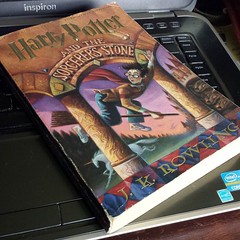
Twenty years. Well done, Mr. Potter! Thank you, @jk_rowling! #books #harrypotter

The other day marked the twentieth anniversary of the initial publication of Harry Potter and the Sorcerer's Stone (or Philosopher's Stone, if you live in Britain--and I guess I should link that first since that's where the book came first). I could wax poetic for quite a long post about Harry Potter and the enormous effects on culture those books had, but others have weighed in more intelligently than I could on those points. I, like many others, have had my own "personal journey" with Harry Potter, starting with sometime in what must have been 1999 when I started noticing these books with the unusual cover art and title font on the front displays at Borders, and very prominently placed in the childrens' section. By the time I was aware of the growing Harry Potter phenomenon, there were already three books out, and I bought the first one out of curiosity.

And I loved it, right from the get go--right from the opening paragraph. I mean, that first book's opening paragraph is some seriously wonderful stuff! Don't take my word for it, either: look what this fan did with it:


I never looked back, eagerly snatching up each book as it came out and squeezing it into my reading time. By the release of Deathly Hallows, the last book, I was in as much a fever-pitch as anyone, and I remember a kind of Devil's bargain I made with The Daughter at the time, who was about eight years old: on a Sunday afternoon I told her that she could play videogames for as long as she wanted. Then I went out on the balcony of our apartment and plowed through the last four hundred or so pages of that book.

I've been meaning to reread the Potter books for some time now, and perhaps this winter it will finally be time to do so. (In honesty, I associate the books--as I do most fantasy--with the cooler months. I've never been sure why that is, because fantasy is not an inherently autumnal genre.) I also need to rewatch the movies, which are, for the most part, excellent adaptations and retellings of the story.

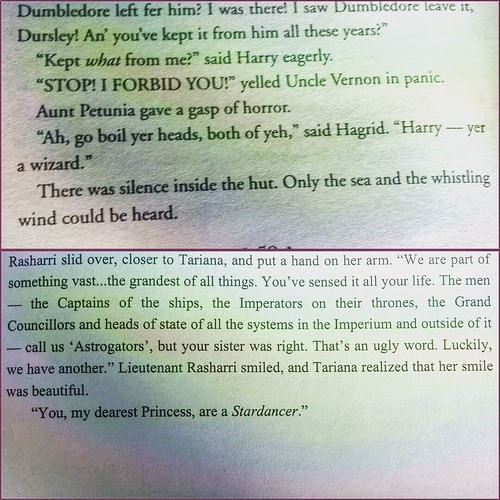
One final note: I included a call-back to Harry in Stardancer. How could I not? While the situation involving Lt. Rasharri's revelation to Tariana Osono of her powers isn't so confrontational as when Hagrid tells Harry that he's a wizard, it was hard not to see this moment in my story as a reflection of the earlier one.

I always meant this scene in STARDANCER to partially be a callback to HP & THE SORCERER'S STONE. #amwriting #harrypotter

And now, since this is Something for Thursday and all, some music!


Tuesday, June 27, 2017

"I believe in Love" (Thoughts on WONDER WOMAN)

SPOILERS for WONDER WOMAN below. Seriously. I make ZERO effort to not spoil the movie.
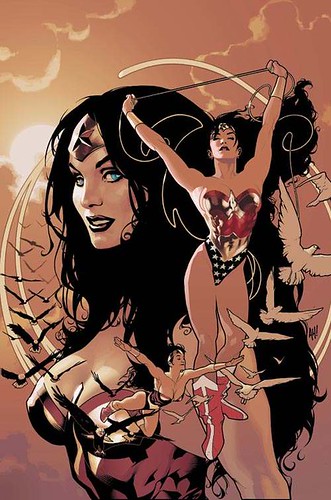
Wonder Woman II

I have always counted Wonder Woman among my favorite superheroes, even though I never read her comics all that much. I wasn't much of a comics reader until I was a teenager, and my main exposure to Wonder Woman as a kid came via the wonderfully fun--if highly campy--teevee show with Linda Carter. When I was seven or eight I bought, with my parents' help, a copy of the Wonder Woman installment in a series of books called the Encyclopedia of Comic Book Heroes. Even though I knew next to nothing about Wonder Woman's lengthy mythology at that point, I still enjoyed thumbing through that book and reading the entries on the various people and villains in Wonder Woman's life and imagining the stories. There are times when reading about stories can be as thrilling to the imagination as reading the stories themselves.

Later, when I became a regular comics reader in the mid-1980s, I didn't read Wonder Woman at all. At that time, DC Comics was in a creative rut and I gravitated toward the exciting and emotional (or downright angsty) Marvel books. Wonder Woman was actually put on a hiatus while DC pulled off a massive reboot of their entire comics universe in an event mega-miniseries (I know, that term makes no sense, deal with it), and after that, Wonder Woman herself received a reboot from Square One in a new series by Len Wein and George Perez. That's when I jumped on board, because I absolutely loved that series. It was bright and cheerful and humorous and filled with adventure and mythology. That book came along, with its colorful tone, right around the time that Marvel was starting to get pretty dark in its own storytelling, what with gang wars and straight-up noir in the Spider Man books and the Mutant Massacre in the X-titles.

Eventually, of course, Wonder Woman had to get her own movie, right? Except even that took forever. There were abandoned scripts and false starts galore, most notably a script by Joss Whedon (which I have not read but which recently came to light and received some criticism from feminist voices I respect). As a Wonder Woman film came closer and closer to being a reality, though, I became nervous. DC's track record in its superhero movies has not been especially inspiring. Yes, the Nolan Batman films are good (the first two, anyway, I haven't seen the third), but the new take on Superman has proven to be a grim, washed-out exercise in violence and grimdark, and while I thought that there was a lot to like in the Green Lantern movie, there was simply too much in that movie, resulting in something of an overstuffed mess. I was skeptical, frankly, that the DC creative voices--with their Superman who kills, and their constantly-brooding Batman--could do justice to Wonder Woman.

Now the movie is here, and they have done justice to Wonder Woman.


They made a wonderful movie that does honor to the character, that isn't depressingly dark, that leaps and soars with all the thrilling wonder that a superhero movie should (doubly so if that word is in the very title), and tells a story of good versus evil that is nevertheless nuanced and thoughtful. Wonder Woman may well join Superman (1978), Spider Man 2, and Guardians of the Galaxy as my favorite superhero films ever.

Every first film featuring a newly-adapted superhero has to be an origin story, which is probably why the most frequent complaint I've seen about Wonder Woman is that we don't really see Princess Diana in full-Wonder Woman regalia until we're halfway (or more) through the film's generous run time. Frankly, I didn't care. Everything that precedes her arrival is engaging and fun, and the film's first act--depicting Diana's youth and coming-of-age on Themyscira--is an engaging mini-film in its own right. We begin with a brief precis of the film's basis in Greek mythology, done with a stylized animation sequence that calls Greek theater to mind and establishes Ares, the God of War, as the main villain behind everything that has happened. How the movie handles that main villain is one of its more interesting aspects, but more on that later, because the film takes us to Themyscira, the secret hidden island of the Amazon warriors whose task it will one day be to fight Ares once and for all. Here we finally meet Princess Diana, but as a young girl who has been forbidden by her mother to train as a warrior. So of course that becomes Diana's greatest dream, and she watches all the training sessions in secret, mimicking her warrior sisters' movements from afar. These moments establish Diana for us: her aspirations show that she is born for battle and will never shrink from it.


Of course, trouble soon intrudes upon the island of the Amazons, in the form of an airplane that somehow punches through the magical mist that conceals it from the rest of the world. The plane crashes in the sea, and Diana rescues its pilot. He is Steve Trevor of the United States, and he will become the great love of Diana's life. But along with him comes war--World War I to be precise--and it is Trevor's arrival that reveals to Diana that Ares has once more come forth. It is her time to leave and confront him.

The film's approach to Ares is very interesting. After listening to Steve Trevor's descriptions of what he is doing--his mission involves stopping a German military scientist who is developing some kind of super weapon--Diana becomes convinced that Trevor's quarry is really Ares in human form. Who else could he be, after all? Who else would be behind the creation of a weapon that can kill thousands if not millions in one strike? More, though, Diana believes that by defeating Ares, she will defeat war itself, and that humanity will put aside its darkness and lay aside their weapons for good. Steve Trevor doesn't know what to do with this. He does not share Diana's belief. But he knows that something must be done, that Diana is a strong ally, and that he stands a far greater chance of success with her than without her.

(Some have complained about the film's backdating Diana's origin story to the WWI era as opposed to the traditional WWII as was the case in the comics, but this whole "Defeating war itself" subtext is served well by being set during what was thought to be "the war to end all wars".)

So in a way the movie gives us two villains for the price of one, embodied in the same character. This dual way of looking at the villain, from the differing viewpoints of two protagonists, is one of the film's master strokes. For Steve Trevor, the German scientist is a clear and present danger to untold thousands of innocent people. He is constantly talking of this villain in practical terms, reminding Diana of those very untold numbers who will die if the man's plan succeeds. Diana, on the other hand, is battling the very idea of war itself and wishes to triumph by destroying the god who fuels it. It's natural that Diana, with her belief system drawn from the ancient Greek pantheon, would see things this way. (And to the film's credit, we get to see Steve Trevor grappling with this notion, while at the same time respecting the belief and the person who holds it.)

There is a problem here for the story, of course. If Diana stops Ares, there can be no more war, and we know that there will be, time and again. As Diana sees things, destroying Ares will unleash upon the world an epoch of peace unlike any other. We know that this does not come to pass...but by the same token, the film introduces Ares (or the concept of Ares) in the very opening minutes. To do all that and not have Ares himself show up would be an unbelievable cop-out. So Ares must show up, and show up he does (and his appearance may or may not surprise you--reaction I've seen seems to run about 50-50 on this), with the answer of how there will still be war in the absence of the very god who creates it. The answer, of course, is that humans themselves are the true engines of war and that all Ares need do is give a little nudge here, and little whispered inspiration in the ear of a superweapon-inventor there. To wage war, Ares tells us, is simply a part of human nature and it will go on with or without him. Thus he flips to dilemma back upon Diana: If humans are the true masters of war, why should she strive to save them at all?

Diana's answer is a common one, but the reason it's common is, I think, because it's true. Even if war is a part of the human condition, so is love, and Diana has come to see this firsthand. Just before she ultimately delivers her final attack on Ares, she says the words that form the title of this post: "I believe in love." It seems to me that Harry Potter came up with the same answer to a similar question, didn't he?


For Diana, her discovery that humans are capable of staggering love in addition to staggering war isn't just born of a romantic attraction to Steve Trevor. It's something else. Not only has she fallen in love with Trevor--or so I believe she has, the movie does not outright state that she has, and I think it's right to do so--but she has also seen that he has fallen in love with her but is also willing to put that love aside for a greater sense of love and duty. She has just witnessed Steve Trevor willingly sacrificing himself to destroy the superweapon before it can be deployed. Even though Trevor's last words to Diana were "I love you," his actions after demonstrate for her everything about humanity that is worth saving, even though Ares speaks truth when he tells her that war also lies at the very heart of humanity. Diana will oppose war with everything she has, but not at the expense of destroying love. In this moment she rejects Ares and his attempts to seduce her to his side.

Steve Trevor's declaration of his love for Diana doesn't come out of nowhere, but the film refreshingly doesn't beat us over the head with their love affair either, such as it is. The film does show some of the romantic tension between the two, but it downplays it, keeping it mildly flirtatious and establishing that the chemistry between Diana and Trevor isn't exclusively romantic. It's a chemistry of two people, newly met, who find themselves fervent allies against a common thing. It is a chemistry of intelligent people who are both, for various reasons, unable to really belong in the world.

It's too bad that Steve Trevor had to die in this film (mainly to accommodate the upcoming Justice League stuff, which I find a little disappointing because I honestly don't care about any of that), because Gal Gadot and Chris Pine have terrific screen chemistry together. I've been liking Chris Pine for a while now. He's good at portraying men of competence who aren't utterly cocksure of themselves, men who make mistakes and learn from them. His Steve Trevor is clearly inferior to his Amazon captors and he is constantly unsure of what to make of all of Diana's talk of Ares and defeating war and the rest of the mythological stuff. Pine does not portray Trevor as condescending or as blowing off Diana's beliefs as naivete; rather, he shows Steve Trevor as believing Diana but not being sure of how any of it fits into his own world. At the end he figures it out in the heartbreaking moment that leads to his demise. Chris Pine has a fine line to walk here: He has to be able to convince Diana of humanity's worth, and he has to be able to portray that he is actually awakening emotions in Diana that are surely alien to her.

And when Steve Trevor's final moment comes, Chris Pine doesn't give us a lantern-jawed hero who is unflinching in the face of his own death. He has to take a few deep breaths, close his eyes, make what little peace he can with what's about to happen. He's afraid, even in the moment of utter bravery. Chris Pine nails every moment of this, and it's fantastic.

Even more fantastic, though, is Gal Gadot. She is the rock at the center of this movie, and the film belongs to her. Her Diana is otherworldly without being alien. She is strong and skilled, intelligent and persistent. She is heroic without that hint of a "dark side" that we seem to demand of our heroes today, where they are always trying to avenge some awful and unavengeable wrong in their past. Gadot vests her Diana with a strong sense of driving purpose, and also with an infecting curiosity and amazement about the world in which she finds herself. In her battle scenes she conveys Wonder Woman's strength and skill without making it look effortless. Her skill is earned, not given. Gadot's Diana is a warrior who has put in the long, long hours sparring with others and training and practicing. Gadot's Diana works in every battle, observing and planning and reacting as she fights, and there are moments when she shows real fear. Gadot's vulnerability in this movie is a practical and real vulnerability, and when the time comes to grapple with Ares's awful dilemma, Diana's resistance isn't a perishing of heart but one of thought: Gadot shows us that Diana is still thinking, trying to reason through the dilemma, looking for a way out that doesn't involve casting her lot with the God of War. For all the great work by the rest of the film's cast, the whole thing would fall apart if not for Gal Gadot's work.

(I overheard one moviegoer afterwards, griping about David Thewlis turning out to be Ares. She said something like "He has no business being the main villain." Look, to each their own and all that, but...no. That's just dumb.)

On a production note, I've read and heard some other complaints regarding the film's appearance. At first glance, it does seem to spend most of its time in a similar kind of muted-color, washed-out appearance like the current incarnation of the Superman movies. This artistic choice made sense to me, though. First of all, the time period seems to almost require it, and the film's look is better compared to the first Captain America film than the other grimdark DC stuff these days. Secondly, though, I like the color scheme as an artistic choice, because the Themyscira scenes are shot in vibrant color and the tone only goes more dark once Diana arrives in the world of humans during an enormous war. This is a reversal of the color scheme of The Wizard of Oz, and as such it makes great sense to me. (I also note that the film's framing sequences, which very briefly establish Diana Prince working in the present day at the Louvre, are shot in vibrant color as well. In all honesty I didn't think the film needed those sequences, which seem present more to establish Diana's presence for future DC cinematic universe stuff than anything else, but I'm willing to overlook them.)

Penny Jenkins's direction is as solid as it gets, too. The focus is always where it should be, and Jenkins gives all of her actors time and room to do their thing. Nothing drags, but nothing is rushed either, and in the battle sequences it is always clear what's going on and why. Maybe the movie makes a little too much use of the "sudden slow-motion", bullet-time kind of thing, but even if so, I'm mostly fine with it. It's hard to show the kinds of superhuman things that superheroes do in any other way, and those sorts of shots seem to me more call-backs to the static-image comic-book origins of these stories.

In the end, I loved this movie. I loved its story and the way that it takes its time letting that story unfold. I love that it manages to make the stakes both hugely epic and deeply personal. I love that it earns every one of its emotional beats and that its characters are real, with real flaws and not a bunch of stereotypes. I am looking forward to a sequel and seeing more of Gadot and her incarnation of Wonder Woman, although I would almost rather see her continue to enjoy solo adventures as opposed to following the Marvel hero route of each film laying more groundwork for a larger story. (This is mostly because thus far the DC movies have not been inspiring confidence.)

Wonder Woman lives, and I could not be happier.

(But hey, can the next movie have the invisible airplane in it?)


Monday, June 26, 2017

Eighteen years and counting....

In the space of the last week, The Daughter has turned eighteen and graduated from high school.

I'm proud and amazed, and more than a little astonished that so much time could have elapsed so quickly.

So what's next? Who knows...but as always, the sky is the limit.

Graduation yesterday. Today...what's next?

Friday, June 23, 2017

Bad Joke Friday

Why you can't tell a knock knock joke to a dog:

*knock knock*

*BARK BARK BARK BARK*

[Editor's note: A greyhound variant of this goes thusly:

*knock knock*

*zzzzzzzzzzzzzzzzzzzzzzzzzz*

Thursday, June 22, 2017

Tuesday, June 20, 2017

Tone Poem Tuesday

Sorry to be so late with this, but I heard the last minute or two of this work yesterday morning while I was driving to work, and I wanted to hear the rest of it before I played it here. It is a concert overture by Scottish Romantic composer Hamish MacCunn, titled Land of the Mountain and the Flood. It is a full-on Romantic depiction of the wilds of Scotland at the time, rugged and mountainous and lyrical. This is the music of adventuring bands of claymore-wielding Highlanders as they roam through the lochs and glens.

Saturday, June 17, 2017

Symphony Saturday

No Mahler yet--I want to do him justice!--but I'll stick with 'M' composers. Here is Felix Mendelssohn's Symphony No. 3, the "Scottish".

Friday, June 16, 2017

Bad Joke Friday

I saw this on Twitter. Yes, it's a little morbid. Gallows humor can be funny....

Thursday, June 15, 2017

Tuesday, June 13, 2017

Tone Poem Tuesday

Charles Martin Loeffler is one of those late-Romantic American composers of whom relatively little is heard nowadays, mainly because their music tends to be too derivative of European traditions, although this is likely unfair in Loeffler's case. His European bona fides are well established, however, by virtue of the fact that he was born near Berlin and moved around Europe a good deal before emigrating to the United States in 1881, when he was twenty. His music apparently abounds in unusual instrument pairings and interesting sounds, especially late in his career when he became interested in jazz. (I'm getting all this from Wikipedia, by the way. I'm being honest when I say that I know nothing about the man.)

Loeffler's A Pagan Poem is a dramatic work indeed, based on a work of Virgil. Apparently he did not mean the work to literally tell the story but convey some of its emotion. I can't speak to his level of success there, but this is a powerful and emotional work.

Here is A Pagan Poem.

Monday, June 12, 2017

In Which I Am Interviewed

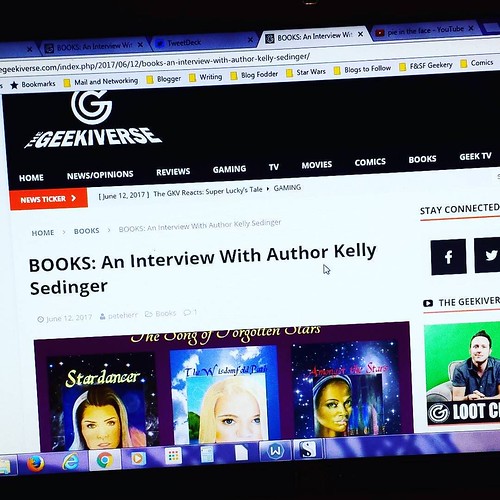
Did you read my interview at TheGeekiverse.com yet? No? Well GO, folks! 😆 #amwriting

I was interviewed at The Geekiverse, on all manner of writerly and authorly things! Go check it out! (The Geekiverse is a nifty site, based in Buffalo, devoted to all manner of, well, geeky stuff.)

Water Dog

Just because....

Water dog #Cane #DogsOfInstagram #greyhound #ChestnutRidge #wny #OrchardPark #stream #runningwater

Saturday, June 10, 2017

Symphony Saturday

I'm still trying to get ahead on writing my Mahler posts -- there's a lot of work involved in listening to Mahler -- so meantime, here's Maestro Mozart and his Symphony no. 41 in C, the "Jupiter".

Friday, June 09, 2017

Thursday, June 08, 2017

Something for Thursday

EDIT: So I'm sitting up last night and I suddenly realize it's Thursday and I hadn't posted anything. What I had forgotten is that I had previously written and scheduled a Thursday thing last week, which is something I do infrequently enough that I completely forgot that I had done it.

I promise I am not losing my mind.

(But if I am, I can declare my bid for the United States Senate!)


Yipes! It's Thursday! Folks, I've spent a big chunk of this week all screwed up as to what day it is. That happens sometimes, huh? I hope it does...anyway, here's a great song from one of my favorite acts, Blackmore's Night. Fronted by Ritchie Blackmore (of Deep Purple fame) and singer Candice Night, Blackmore's Night is a quite wonderful folk-rock group that plays the kind of music you'd want to hear on a warm summer night after a day of hanging around your local Renaissance Festival. This song is "Under a Violet Moon".

Something for Thursday

This speaks for itself.

Tuesday, June 06, 2017

Tone Poem Tuesday

Today is the anniversary of D-Day. In their honor, here is John Williams's Hymn to the Fallen.

Friday, June 02, 2017

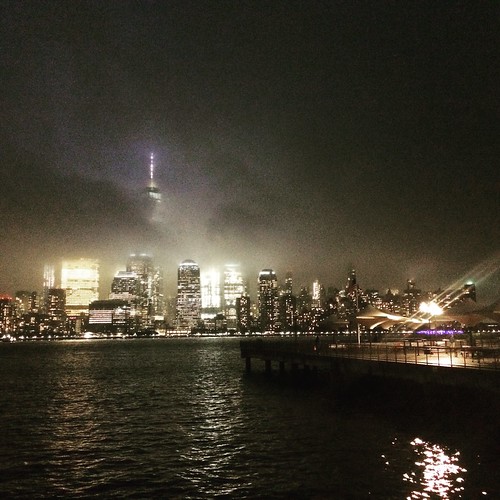
"I beheld, through the mists, a glittering city...."

Untitled

Via Sheila O'Malley. Click through to see the photo larger.

Bad Joke Friday

Via Roger (and I'm not sure this is actually a "bad" joke...it's kinda clever, actually....):

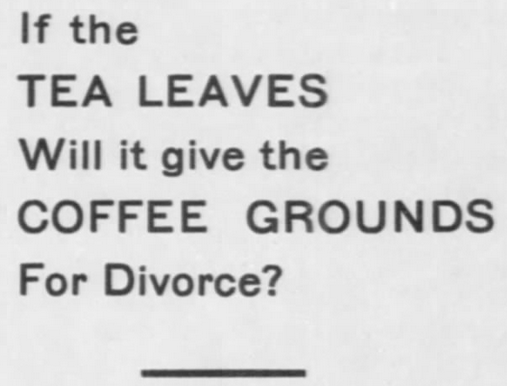
What's the difference between a stepstool and a 3D printer?

The former is a ladder and the latter is a former!

Thursday, June 01, 2017

Something for Thursday

I was watching a clip from the movie Gigi the other day, and this video was suggested as a follow-up. It's from a teevee show that aired in 1961. Hard to believe that this was almost sixty years ago.