Tuesday, April 12, 2016

National Poetry Month, day 12

For being "dead" as poetry is always said to be, I sure have met a lot of poets online. I sure have met a lot of folks who still practice this "dead" art form and who are still invested in its future. I sure have met a lot of people who are knowledgeable about poetry and who still insist that there are new things to say, or new ways to say old things, or new ways to say new things, using the tropes and mechanisms of poetry.

When I go to bookstores, I always see people browsing the poetry section, and I see lots of new poetry books adorning the shelves. I even buy some myself, on occasion. I've bought several poetry chapbooks for my Kindle.

Poetry is dead? Well, if it is, there sure seems to be large number of people who never got the memo.


Natasha Head is a poet I first met on Instagram, and then on Tumblr and Twitter as well. She's active on Facebook, and what's more, she's very active in the Canadian poetry community, and she has appeared on podcasts to read her work and she's been printed in Canadian journals and she has published several collections of her own work. She's quite a wonderful poet who has become an essential voice in my own writing world.

Poetry is dead? I'd tell you not to tell her, but really? I don't think she gives a shit. She's too busy writing poems.

Losers Like Us
by Natasha Head

I had the car and the notebook
You had the weed and the beer
We both had the urge for leaving
Get up and get out of here

We made it as far as the sidewalk
Never knew that at one point it ends
Never knew where the concrete would take us
Never knew that we'd never again

Hid the car in the lot at the old rink
Took the path beaten on the forest floor
Took the notebook the weed and the beer
Took again and then took some more

The camp wasn't much to look at
There really wasn't much to see
Just me with my little notebook
And you with your bag of weed

The bench was hard and splintered
But to us it was good as a throne
The smoke was heavy and skunky
If it wasn't, we would have stayed home

The soundtrack was a walkman
With blaster speakers doctored by you
Suicidal Tendencies, Social Distortion
Back then, the balls and chains were few.

You let me tell you stories
I let you read what I had wrote
I let you sing my simple words
Even then it was poetry you spoke

All we knew for certain
Was that we couldn't be caught
Losers like us have a way of evasion
We slip away with barely a thought.

(via)

Monday, April 11, 2016

National Poetry Month, day eleven

I've occasionally seen comment that JRR Tolkien's poetry in The Lord of the Rings is generally weak, but from my perspective, it's one of my favorite aspects of the book, and I find myself enjoying the verse in LOTR more each time I read it. My favorite poem in the book is almost certainly the "walking song" that is quoted a number of times throughout, and each time has a variation to reflect the events surrounding it and everything that has happened.

It begins like this, at the end of The Hobbit:

Roads go ever ever on,
Over rock and under tree,
By caves where never sun has shone,
By streams that never find the sea;
Over snow by winter sown,
And through the merry flowers of June,
Over grass and over stone,
And under mountains in the moon.

Roads go ever ever on
Under cloud and under star,
Yet feet that wandering have gone
Turn at last to home afar.
Eyes that fire and sword have seen
And horror in the halls of stone
Look at last on meadows green
And trees and hills they long have known.

This is when Bilbo is about to return home to his beloved Shire, but he is forever changed by the things he has seen beyond his home's borders. The next time we encounter a version of this poem, Bilbo is striking out again, after giving up the Ring and heading for Rivendell:

The Road goes ever on and on
Down from the door where it began.
Now far ahead the Road has gone,
And I must follow, if I can,
Pursuing it with eager feet,
Until it joins some larger way
Where many paths and errands meet.
And whither then? I cannot say.

Much later we hear it again spoken by Bilbo, when he is starting to age quickly and after the entire adventure and the War of the Ring have ended. Bilbo is old and tired, and the walking song's symbolism here is obvious:

The Road goes ever on and on
Out from the door where it began.
Now far ahead the Road has gone,
Let others follow it who can!
Let them a journey new begin,
But I at last with weary feet
Will turn towards the lighted inn,
My evening-rest and sleep to meet.

Finally there is a haunting variant that Frodo sings, not long before he boards the ship that will bear him, along with the last of the Elves, to the faraway land:

Still round the corner there may wait
A new road or a secret gate,
And though I oft have passed them by,
A day will come at last when I
Shall take the hidden paths that run
West of the Moon, East of the Sun.

Is Tolkien a great poet? I don't know, and I'm prepared to allow the experts to have their say, but it does seem to me that there's something to be said for the fact that his verse is still being read, recited, and set to music this many decades after it was written.

Sunday, April 10, 2016

National Poetry Month, day ten

I always loved it when Bill Watterson interjected a bit of verse into Calvin and Hobbes, and this one might be my favorite.


Saturday, April 09, 2016

National Poetry Month, day nine

The intersection of music and poetry is a fascinating one. There are song lyrics, which are almost always poetry, and then there's the way in which poetry and music both can sometimes reflect the world in similar ways. There is often a mystery at the heart of both poetry and music, in that the poets and the composers have things to say about the world that really can't be said in any other way.

This is a poem about music. Someone said something once to the effect that "Writing about music is like dancing about architecture," which is clever and pithy and...well, a little wrong. Words can never quite express what music does, but that doesn't mean that words can't point the way or capture something of the emotion we feel about a work of music. This poem does something else, though: it expresses gratitude that music even exists.

There is a story here, of course. When Sergei Rachmaninov premiered his Symphony No. 1, the work's reception was so disastrous that it sent the young composer into a depression that lasted several years, until he finally received therapy that helped him recover enough confidence to finish his Piano Concerto #2, which is merely one of the greatest concertos of all time. Rachmaninov went on to a long life of composition, and lovers of his work -- amongst whom I count myself -- are indebted to Nikolai Dahl, the physician who conducted Rachmaninov's therapy.

This poem, by Diane Ackerman, expresses that very gratitude. I read it in a book called The Music Lover's Poetry Anthology, which I bought whilst in New York City last November. Nikolai Dahl is a curious footnote in music history, but what a footnote!

Rachmaninoff's Psychiatrist
by Diane Ackerman

I'm listening to Rachmaninoff's
Piano Concerto No. 2,
which he dedicated to Dr. Dahl,
the psychiatrist who guided him
through the straights of fever,
not long after Sergei had heard
his own first symphony played.
Horrified by its many defects
which seemed a sewage of noise,
he had fled the hall, ashamed,
a quagmire of self-doubt.

We cannot know all the sounds
Dahl and he exchanged,
but rubbing one word against another,
Dahl gradually restored
Sergei's confidence. History tells
that Dahl used affirmations
and auto-suggestion:
"You will compose again."
"You will write a piano concerto."
"You will write with great facility."
Repeated until the words saturated
His gift from head to fingers.

In truth, nothing can kill a gift,
but it may become anemic
from great shock or stress-
a sprain of the emotions will do,
or a traffic accident of the heart,
or a failure dire as a clanging bell.

For two years, Dahl worked
on Sergei's shattered will.
at last he collected up his senses
in a burst of blood fury
and composed his triumphant
2nd Piano Concerto,
full of tenderness and yearning,
beguiling melodies, raging passion,
and long sensuous preludes
to explosive climaxes,
frenzy followed by strains
of mysticism and trance.

Loaded with starry melodies,
it was a map of his sensibility,
and a wilderness rarely known
-the intense life of an artist
seen in miniature, with rapture expressed
as all-embracing sound.

Will you tell me if you know,
how Dahl might have received
such a gift? I cannot imagine it.
With hugs and shared enthusiasm?
With an austere thank you?
In his private moments, did he weep
at the privilege allowed him?
For a time he held the exposed heart
of a great artist, cupped his hands
around it like a flame, blew gently,
patiently, until it flared again.

For that, he earned the blessings
of history, and soothed millions
of hungry souls he would never meet.
Listening to Rachmaninoff's
concerto today, intoxicated by its fever,
I want to kiss the hands of Dahl,
but he is beyond my touch or game.
Allow me to thank you in his name.

Symphony Saturday

A symphony today by an American woman.

In the late 19th century, the American musical tradition was pretty much an extension of the European musical tradition, which is generally why American composers of that period aren't generally held in the highest regard; American concert music was still maturing, and the first real American musical forms -- rooted in the emergence of jazz -- had yet to fully emerge. But there was still good music being written, and it's really Eurocentrism that keeps a lot of it from being heard more.

A good example is this fine symphony by Amy Beach, who lived from 1867 to 1944. She was a prodigy and a gifted performer who received great acclaim as she took the stage in her late teens, but then she married a man who decided that she shouldn't perform much and that she shouldn't study composition with a teacher, so while she continued making music, I must inevitably wonder what art was stifled by our society's sexist idiocy of the day. During her lifetime, her compositions were actually credited to "Mrs. H.H.A. Beach." The mind, hopefully, reels.

Beach's Gaelic Symphony is reminiscent of Dvorak (who was a heavy influence upon her) in its orchestration, and she used a number of Irish songs in the symphony's melodic material, creating a work that is fascinating to hear. Beach wrote this symphony early in her musical life, before she embraced native musical material, but it is still a fine and invigorating listen. In her later life, Beach would live for 34 years as a widow, composing and teaching. She never wrote another symphony, unfortunately.

Here is the Gaelic Symphony by Amy Beach.


Friday, April 08, 2016

National Poetry Month, day eight

A short poem today, short but powerful. One of the band directors at the music camp which featured in yesterday's post actually wrote a piece for symphonic winds based on this poem, which packs tremendous imagery and emotional power into just four lines. The Western wind has many connotations, few of them bad, and in this case, the speaker is praying for its return so that the "small rain" can return, bringing cleansing and healing. And then, the wish for a return to a familiar warm bed and the arms of a beloved. This is a very old poem, and nothing is known of its writer; in fact, it may be just a fragment of a larger work that is lost to us now. If so, and if the remaining work is as good as this quatrain that has survived to our time, what a loss that must be!

Western wind, when will thou blow,
The small rain down can rain?
Christ! If my love were in my arms,
And I in my bed again!

Nothin' good comes from a can.... (An experiment involving whipped cream)

Pie-in-the-face weirdness below the break....


Bad Joke Friday

I saw this on Tumblr:


Bwwaaaa hahahahaha!!!

Thursday, April 07, 2016

National Poetry Day, day seven

OK, story time. In high school, I attended a summer music camp several times, and then in college, I served there as a camp counselor. This was almost your canonical summer camp, with cabins in the woods and campfires and singalongs and all that stuff, but for music students.

When I was heading into my senior year, I developed a big crush on a bassoon player there, and I tried flirting, which failed badly because I'm terrible at flirting. She was pretty and she had this hippie thing going on that I liked enormously, though, and when I actually conversed with her about stuff, we became pretty good friends, and we exchanged letters during the next couple of school years. All in all, typical. The first letter in the chain came from her, and she was the type to put pretty doodles and jot down poems on the outside of her envelopes, the first of which was the first stanza of this poem by Thoreau.

For that reason, I've loved this poem ever since.

Like any writing, poetry should have a personal dimension to it. I can trace many of my favorite books to times and places that are dear to me, for one reason or another; why shouldn't it be so with poetry?

To the Maiden in the East,
by Henry David Thoreau

Low in the eastern sky
Is set thy glancing eye;
And though its gracious light
Ne'er riseth to my sight,
Yet every star that climbs
Above the gnarled limbs
    Of yonder hill,
Conveys thy gentle will.

Believe I knew thy thought,
And that the zephyrs brought
Thy kindest wishes through,
As mine they bear to you,
That some attentive cloud
Did pause amid the crowd
     Over my head,
While gentle things were said.

Believe the thrushes sung,
And that the flower-bells rung,
That herbs exhaled their scent,
And beasts knew what was meant,
The trees a welcome waved,
And lakes their margins laved,
     When thy free mind
To my retreat did wind.

It was a summer eve,
The air did gently heave
While yet a low-hung cloud
Thy eastern skies did shroud;
The lightning's silent gleam,
Startling my drowsy dream,
     Seemed like the flash
Under thy dark eyelash.

Still will I strive to be
As if thou wert with me;
Whatever path I take,
It shall be for thy sake,
Of gentle slope and wide,
As thou wert by my side,
     Without a root
To trip thy gentle foot.

I 'll walk with gentle pace,
And choose the smoothest place
And careful dip the oar,
And shun the winding shore,
And gently steer my boat
Where water-lilies float,
     And cardinal flowers
Stand in their sylvan bowers.

(Oh, and that girl? The bassoon player? We're friends on Facebook and she's still really cool; she works in ecology. And as luck would have it, I still ended up spending my life with a double-reed player.)

Something for Thursday

A small suite of film music today, from Ridley Scott's underrated film Kingdom of Heaven. (The film is underrated because this is one of those films where the "Director's Cut" is actually a vastly different, and distinctly superior, product to the version that was originally released in theaters.) I love the music from this movie, and the film remains my favorite thing that Ridley Scott has ever done.

Wednesday, April 06, 2016

National Poetry Month, day six

Sometimes there's a poem whose verse is wonderful, but with whose message you disagree. Such is the case here, for me. Walt Whitman was one of the great poets of all time -- in fact, he was probably one of the greatest human artists of all time, in any field -- but this poem falters for me.

I first heard this poem read by a faculty member when I was at Wartburg College -- I think it was my senior year -- when our school's beloved physics professor, Dr. Donald Roiseland, passed away after a fight with cancer. I heard this poem at his memorial service, and I thought "Well, that was lovely," and went about my day. Later I dug out my collection of Whitman and looked the poem up...and when I read it back to myself, I wondered about it.

The poem seems to be arguing that the scientific way of looking at things is somehow lacking, and that it removes the beauty inherent in our universe by burying it under numbers and graphs and charts and diagrams; that to hear what science has to say about the world is dispiriting and that one should atone by going out and looking silently upon the world's beauty.

Well...I have a problem with that, and I have a feeling that Richard Feynman, Carl Sagan, Neil DeGrasse Tyson, Jacques Cousteau, and many others would as well. The learned astronomer has not abandoned the beauty of the world; the learned astronomer has exposed more of it.

I think Whitman can be forgiven his view here, given the time in which he lived, but still...I wish he'd have been able to attend upon some of the beauty in those diagrams and charts and figures.

When I Heard the Learn'd Astronomer
by Walt Whitman

When I heard the learn’d astronomer,
When the proofs, the figures, were ranged in columns before me,
When I was shown the charts and diagrams, to add, divide, and measure them,
When I sitting heard the astronomer where he lectured with much applause in the lecture-room,
How soon unaccountable I became tired and sick,
Till rising and gliding out I wander’d off by myself,
In the mystical moist night-air, and from time to time,
Look’d up in perfect silence at the stars.

Tuesday, April 05, 2016

National Poetry Month, day five

I find prose poems interesting. At first they seem formless, and one wonders why the poet didn't just write a straight-up story or paragraph, but as you read a good prose poem, the melding of the two forms clarifies. This poem is a good example: it starts as simple description of a small town, but then, the speaker enters a fantasy that spins out as he drives through the town and out the other side. There are echoes of history and Shakespeare in here, all suggesting the kind of life one might live in a small town where the bronze Civil War general stands above the little park in the village center.

Passing Through a Small Town
by David Shumate

Here the highways cross. One heads north. One heads east
and west. On the corner of the square adjacent to the
courthouse a bronze plaque marks the place where two Civil
War generals faced one another and the weaker surrendered.
A few pedestrians pass. A beauty parlor sign blinks. As I turn
to head west, I become the schoolteacher living above the
barber shop. Polishing my shoes each evening. Gazing at the
square below. In time I befriend the waitress at the cafe and
she winks as she pours my coffee. Soon people begin to
talk. And for good reason. I become so distracted I teach my
students that Cleopatra lost her head during the French
Revolution and that Leonardo perfected the railroad at the
height of the Rennaissance. One day her former lover returns
from the army and creates a scene at the school. That evening
she confesses she cannot decide between us. But still we spend
one last night together. By the time I pass the grain elevators
on the edge of town I am myself again. The deep scars of love
already beginning to heal.

(Text via.)

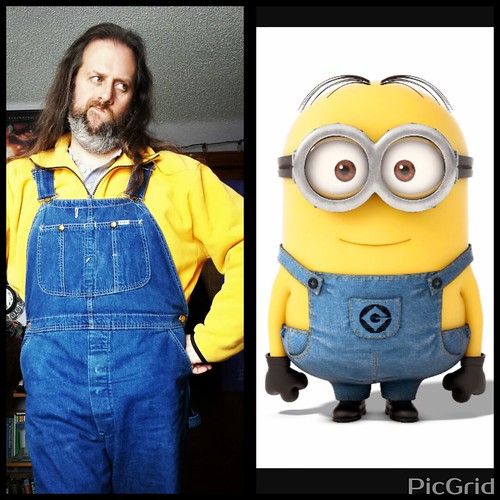
Why I Hate the Minions

Because I can't wear my favorite yellow fleece under blue overalls anymore, that's why.

160403050537

Monday, April 04, 2016

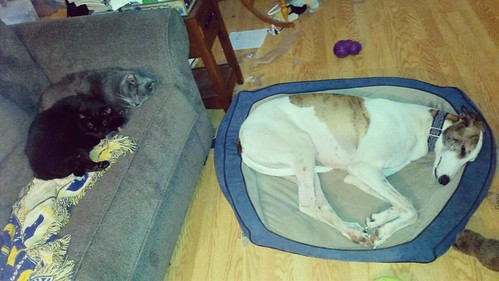
What Apparently Happens When I'm Not Home

Not much.

Meanwhile, at home.... #Lester #Julio #catsofinstagram #Cane #DogsOfInstagram #greyhound

(Remember in Ghostbusters when Venkman says, "Cats and dogs, living together -- MASS HYSTERIA!!!"? He never met our crew.)

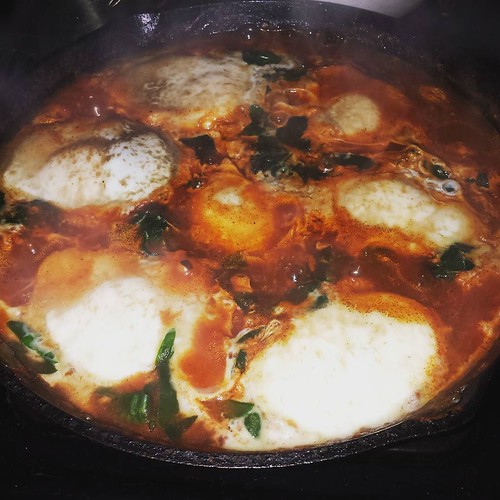
Shakshuka!

The Wife and I have become big fans of the Alton Brown-hosted cooking competition show Cutthroat Kitchen, and not just for its gonzo competition stuff but because it also has actually broadened our food horizons a bit, whenever the challenge dish is something we haven't heard of before. Such an example came up a few weeks ago, when Brown tasked his competitor chefs with making a dish called shakshuka.

Being unfamiliar with the dish, I googled it and discovered that it's a dish of Middle Eastern origin, in which a rich tomato sauce is made and then eggs are poached on top of it. I was intrigued by this on a number of levels: I love eggs, I love tomato sauce, and I love Middle Eastern cuisine, and when I started looking at recipes, I realized that this dish is well within my ability to cook. So cook it I did! I used this recipe from Epicurious.com, and...the results were mixed.

We enjoyed the dish more than enough to put it on the "Make it again!" list, but there were some areas of concern. First, the recipe calls for way too much salt, so I'll be correcting this massively when I make the dish again. Second, the recipe's stated cook-time for the eggs was too long to our taste, resulting in hard-cooked eggs. I'm not sure if we want runny eggs, but hard-cooked was a little too much. But still: for a first-time-attempt, the dish turned out well and I'm looking forward to trying it again.

Here's my finished product:

Shakshuka: well, this was good but not a home run. Recipe called for too much salt and too long a cook on the eggs, with predictable results. Still, the dish was tasty enough to make again, with some tweaks. #yum #shakshuka

Good stuff, but next time it'll be great stuff!

(Oh, and I omitted the bay leaf, because seriously, f*** bay leaf. Those things are useless.)

National Poetry Month, day four

I found this poem in the collection Good Poems for Hard Times, edited by Garrison Keillor. It's a moody poem, not at all optimistic, as it hinges upon an unmet person at an awful time in their lives. It casts Ithaca as a cold, bleak place -- and assuming that the author means Ithaca, NY, this is not my experience at all, but there's nothing about my experience that trumps another's. And besides, perhaps author Leonard Nathan isn't actually referring to Ithaca, NY but calling back to the mythic Ithaca of Odysseus and his long journey home.

Toast
by Leonard Nathan

There was a woman in Ithaca
who cried softly all night
in the next room and helpless
I fell in love with her under the blanket
of snow that settled on all the roofs
of the town, filling up
every dark depression.

Next morning
in the motel coffee shop
I studied all the made-up faces
of women. Was it the middle-aged blonde
who kidded the waitress
or the young brunette lifting
her cup like a toast?

Love, whoever you are,
your courage was my companion
for many cold towns
after the betrayal of Ithaca,
and when I order coffee
in a strange place, still
I say, lifting, this is for you.

More on Leonard Nathan.

Sunday, April 03, 2016

National Poetry Month, day three

An unabashed love poem by Christina Rosetti. This is one of the more heartbreaking poems I know, because it unflinchingly stares at the certainty that all love must end, and that the inevitable ending provides those left behind with terrible choices about how to approach memory.

Remember
by Christina Rosetti

Remember me when I am gone away,
   Gone far away into the silent land;
   When you can no more hold me by the hand,
Nor I half turn to go yet turning stay.
Remember me when no more day by day
   You tell me of our future that you plann'd:
   Only remember me; you understand
It will be late to counsel then or pray.

Yet if you should forget me for a while
   And afterwards remember, do not grieve:
   For if the darkness and corruption leave
A vestige of the thoughts that once I had,
Better by far you should forget and smile
   Than that you should remember and be sad.

Saturday, April 02, 2016

Symphony Saturday

All right, we got a barn-burner here. Seriously, you'll be needing good speakers and you'll be wanting to turn them UP, especially for the last movement. Today it's the Symphony No. 3 in C minor by Camille Saint-Saens, better known as the "Organ" Symphony. This is one of the great warhorse-works in all classical music, and there's a reason for that.

This symphony is, quite simply, awesome. It's amazing. With all respect (well, some respect, anyway) to Tchaikovsky's 1812 Overture, this symphony is the musical equivalent of a fireworks show. Maybe not all the way through, obviously -- it opens with an ethereal chord followed by a meditative passage before the tempo quickens, and there's a wonderful slow movement, but when that final section arrives, with that first gigantic chord in the organ, well, that's when the clouds disperse.

I first heard this work in excerpt form at EPCOT, of all places, as parts of it are used (along with other French works) in the Impressions de France film in the French pavilion. I bought a recording of the symphony within months, and it has been a favorite piece of mine ever since. In fact, my college roommate and I used to use the last movement as background motivational music whenever we were getting dressed for a band or orchestra concert (we were in both). Toward the end, when the entire brass section gets to just let it all loose, the effect is one of the most thrilling in all of classical music.

The Organ Symphony was written in 1886 for the Royal Philharmonic Society in London, although Saint-Saens dedicated the work to Franz Liszt after that great composer's passing. The Symphony's structure is slightly odd: it seems like it's in four movements, but the first two movements and the last two are played without break, so in reality, the work is in two sections. It's easier to refer to the four movements, though, so that's the convention I follow here.

Here is the Organ Symphony by Camille Saint-Saens. And seriously, turn this thing up -- and check out the timpanist in the symphony's closing seconds. That guy is getting every ounce of pleasure out of every single drumbeat!


National Poetry Month, day two

I was going to spend a little time this morning selecting a poem for today...and then I saw this on Tumblr. It's a poem by Neil Gaiman, illustrated by an artist named Chris Riddell. Since Gaiman himself posted it on Tumblr, which is a sharing-based platform, I'm guessing it's OK to share it here.


Friday, April 01, 2016

National Poetry Month, day one

April is National Poetry Month! And every year I forget about it completely, not realizing that we're in the midst of National Poetry Month until April 19 or some such thing. Well, not this year! My goal is to post a poem each day this month. Some will be longer than others, some will be serious and some not, some will be love poems and some not. Who knows? My goal is to spend a month exploring some poetry. I'm a firm believer that writers should read poetry in order to get a sense of what can be done with language, and to learn other ways of expressing ideas.

Since today is April Fool’s Day, here’s a poem that has some of that April Fool’s kind of punch, in that the first time you hear it, you think it just has to end a certain way...and then it famously doesn’t. (Also, baseball's regular season starts on Sunday! Go Pirates!)

Casey at the Bat
by Ernest Lawrence Thayer

The outlook wasn’t brilliant for the Mudville nine that day:
The score stood four to two, with but one inning more to play,
And then when Cooney died at first, and Barrows did the same,
A pall-like silence fell upon the patrons of the game.

A straggling few got up to go in deep despair. The rest
Clung to the hope which springs eternal in the human breast;
They thought, “If only Casey could but get a whack at that—
We’d put up even money now, with Casey at the bat.”

But Flynn preceded Casey, as did also Jimmy Blake,
And the former was a hoodoo, while the latter was a cake;
So upon that stricken multitude grim melancholy sat,
For there seemed but little chance of Casey getting to the bat.

But Flynn let drive a single, to the wonderment of all,
And Blake, the much despisèd, tore the cover off the ball;
And when the dust had lifted, and men saw what had occurred,
There was Jimmy safe at second and Flynn a-hugging third.

Then from five thousand throats and more there rose a lusty yell;
It rumbled through the valley, it rattled in the dell;
It pounded on the mountain and recoiled upon the flat,
For Casey, mighty Casey, was advancing to the bat.

There was ease in Casey’s manner as he stepped into his place;
There was pride in Casey’s bearing and a smile lit Casey’s face.
And when, responding to the cheers, he lightly doffed his hat,
No stranger in the crowd could doubt ‘twas Casey at the bat.

Ten thousand eyes were on him as he rubbed his hands with dirt;
Five thousand tongues applauded when he wiped them on his
shirt;
Then while the writhing pitcher ground the ball into his hip,
Defiance flashed in Casey’s eye, a sneer curled Casey’s lip.

And now the leather-covered sphere came hurtling through the
air,
And Casey stood a-watching it in haughty grandeur there.
Close by the sturdy batsman the ball unheeded sped—
“That ain’t my style," said Casey. “Strike one!” the umpire said.

From the benches, black with people, there went up a muffled
roar,
Like the beating of the storm-waves on a stern and distant shore;
“Kill him! Kill the umpire!” shouted someone on the stand;
And it’s likely they’d have killed him had not Casey raised his
hand.

With a smile of Christian charity great Casey’s visage shone;
He stilled the rising tumult; he bade the game go on;
He signaled to the pitcher, and once more the dun sphere flew;
But Casey still ignored it and the umpire said, “Strike two!”

“Fraud!” cried the maddened thousands, and echo answered
“Fraud!”
But one scornful look from Casey and the audience was awed.
They saw his face grow stern and cold, they saw his muscles
strain,
And they knew that Casey wouldn’t let that ball go by again.

The sneer is gone from Casey’s lip, his teeth are clenched in hate,
He pounds with cruel violence his bat upon the plate;
And now the pitcher holds the ball, and now he lets it go,
And now the air is shattered by the force of Casey’s blow.

Oh, somewhere in this favoured land the sun is shining bright,
The band is playing somewhere, and somewhere hearts are light;
And somewhere men are laughing, and somewhere children
shout,
But there is no joy in Mudville—mighty Casey has struck out.


Celebrate Laughter!


I’ve always had a love-hate relationship with April Fool’s Day. A lot of the humor of the day always seems at least slightly mean-spirited, aimed at getting a “Gotcha!” moment more than an actual laugh that’s shared all the way around. But on the other hand, a day dedicated to laughter and joking and celebrating all things funny isn’t really a bad thing, is it? So try to find some laughter, if you can. Here are few funny things, and remember to take time to laugh today!


Somewhat profane:


And finally:


Laugh it up, folks!

(Note to self: Make arrangements to get a pie in the face soon....)

Bad Joke Friday

I buy all my weapons from a guy named "T-Rex".

He's a small-arms dealer.

Thursday, March 31, 2016

Something for Thursday

I don't know about you all, but in my neck of the woods, it's gloomy and rainy and I'm not finding motivation or oomph easy to come by, so here's a bit of pick-me-up music: the Light Cavalry Overture, by Franz von Suppe.


OK, that helps!

Wednesday, March 30, 2016

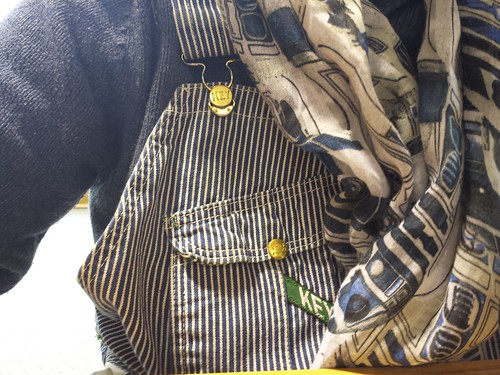
I'm not gonna lie....

...but a big reason I want to be a writer is so that I can wear overalls and an R2-D2 scarf to work every day.

Overalls and R2D2 scarf

Tuesday, March 29, 2016

The Host who can Boast the Most Roast

So I saw an article last week someplace, maybe Facebook, about a recipe that had somehow gone viral: "Mississippi Roast". The recipe is insanely simple:

1. Spray your crockpot with cooking spray.
2. Throw in a chuck roast, around 3 to 4 lbs.
3. Sprinkle directly onto the meat 1 packet of gravy or au jus mix, and 1 packet of Ranch dressing mix.
4. Put a stick of butter on top of this.
5. Scatter 8-10 pepperoncini (banana peppers, pickled in a jar) around the top of the meat.
6. Cook on LOW for eight hours.

That's it.

I read the article with fascination, and then I asked people on Facebook and elsewhere if they'd ever heard of such a thing (they had), and I Googled it to see if this was real (it is). I have to admit that I was skeptical. I'm a sucker for recipes of the "Throw a small number of ingredients in the crockpot, wait six to eight hours, and eat the resulting deliciousness," but this was pushing me a little far.

But not far enough to try it.

So I did.

Here's what it looked like before I put the lid on and turned on the crockpot:


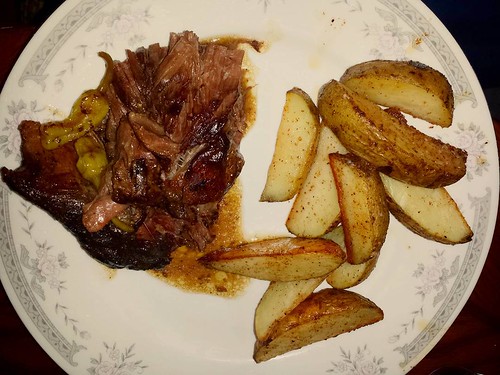
And here's the result, served alongside some roasted potato wedges:


Oh yeah babe. #yum #mississippiroast

It was amazing. I always find that pot roast needs some help in the seasoning department, but somehow this seasoning turned out perfect. The only downside? After we each had two servings of the meat, there weren't many leftovers left, and you want leftovers when the meat turns out that good. You know, sandwiches and stuff.

Next time, I'm doing two roasts.

Monday, March 28, 2016

Pre

I'm not a huge fan of Buffalo News sports reporter Bucky Gleason, but he writes a nice article today about Steve Prefontaine, the great track runner who died in a car crash 41 years ago. I'm not entirely sure of the chronology, but I think we were living in Oregon at the time. I would have been all of three years old and some change, so I had no idea about any of this, but Prefontaine worked at a sports business that went on to become Nike. I do remember something of the rise of Nike -- when we moved to Western New York in 1981, Nike was just beginning to become a national company, and I remember people around here saying "Nike" as if it rhymed with "bike".

Anyway, check out Gleason's piece.

Sunday, March 27, 2016

Some Links....

A few things!

:: The tale of an awful pizza customer. Oddly, I remember a guy who was just like this! He'd stand at the counter and offer his constant input as to how his pizza should be made, and then, when leaving the place, he'd tilt the box on its side. Every friggin' time he came in. Unbelievable.

:: Archaeologists have unearthed evidence of an enormous battle that took place in the Bronze Age in northern Europe. Since it predates written history, we have no idea who fought whom and why. How much history is there that we know nothing at all about?

:: Kraft Macaroni and Cheese has changed...and nobody knew about it. Interesting stuff. (Yes, I do still like this stuff.)

:: Jason ruminates on William Shatner.

:: Finally, John Scalzi on the use of personal pronouns -- i.e., referring to people by the gender they wish.

When someone asks you to refer to them by a particular set of pronouns and you’re reluctant to comply, are you being disrespectful? Yup! Self-identity is important, and refusing to accept someone else’s identity for your own reasons will be taken to mean that you dislike or disagree with their choices about who they are. And this is your right, but it means you’re saying that your choices in this regard are more important than the choices of the person who has to live with their own identity every single moment of their lives.

Read the whole thing. We need to be making the world better.

Later, folks!

Saturday, March 26, 2016

Symphony Saturday

Antonin Dvorak spent several years in the 1890s in the United States, including a time in a community of Czech immigrants in, of all places, Spillville, Iowa. I once drove through Spillville, and it's tiny -- less than 500 people live there. And yet, one of the greatest composers of all time lived there one summer, and some of his experiences there played into the music he composed while living in our country.

Dvorak felt that American music at that time was mainly concerned with echoing the Germanic symphonic traditions, with little attention paid to what he considered the true folk music of America, namely the chants of the Native Americans and the spirituals of the African-American population. He attempted to capture some of the character of those melodies in his Ninth Symphony, but what he mainly did was create new melodies based on the pentatonic scale, which does tend to be common to many aboriginal cultures of the world. There is nothing specifically American in this symphony, despite its being called "From the New World", and Dvorak himself would later insist that the symphony is a purely old-world work, composed in the old-world rhythm (particularly with regard to the use of Czech folk rhythms, something Dvorak would do his entire life), and more intended to convey the emotions Dvorak felt as a European seeing the great expanse of America for the first time.

None of that really matters, though -- whether one hears America or Prague or some blend of the two in this work, Dvorak's Ninth Symphony is one of the enduring works in all classical music, and with good reason. It is loaded with wonderful melodies (particularly that spellbinding second movement), to be sure, but it is also a superb work of musical craftsmanship as well, with every idea in its place and some of Dvorak's finest orchestrations. Here is Dvorak's Symphony No. 9 in E minor, "From the New World".


Friday, March 25, 2016

From the "I Can't Even" files....

A former coworker from The Store with whom I've kept in touch since she left the company dropped in yesterday to give me a small Easter gift:

An old coworker gave me a teeny-tiny coconut cream pie. I CAN'T EVEN. #pie

Yes, it's a teeny-tiny coconut cream pie.

Some of my friends know me so well!

Thoughts on THE FORCE AWAKENS, episode V: The Praise Awakens!


The Force Awakens review, parts one, two, three, and four

By this point, it probably sounds like I hate The Force Awakens and want to excise its memory from every human mind. Not so. My complaints are real, and they frustrate me to no end, because...dammit, there is just so much that this movie gets right. The Force Awakens feels to me like the filming of the third draft of a script, when it really needed a fourth.

I also suspect, in terms of the film’s refusal to explain things, that this is part of a New Media strategy for Star Wars. Remember, Disney specifically declared that the old “Extended Universe” material is no longer canon, and that everything else from now on would be. Not just the stuff in the new movies, but all of the comics now being produced, all of the novels, all of the animated teevee series, all of the events depicted in games. If all this is canon, then it’s clear that Disney can now relegated background material and its explanation to other media formats. Thus The Force Awakens can plow ahead and not tell us anything at all about this old geezer who just happens to have the piece of Luke’s map that will solve the puzzle, and then later on, they can come out with a novel or comic that explains it.

Well, I hate that. I don’t want to have to do extra research to enjoy a movie, or the reverse. If I read a novel, I shouldn’t have to go see some other movie to explain just what’s going on. I’ve no doubt that a lot of this stuff is going to be fleshed out, and I’ve little doubt that a lot of it will be in other media. And I find that incredibly irritating.

But anyway, let’s talk about what’s good with The Force Awakens, starting with the cast.

With one exception, the cast of this film is brilliant and does an amazing job. (The exception is the guy playing General Hux, with his weird blend of Hitler and Anglo-Shatner. I frankly hope that Hux is killed in the first scene of Episode VIII. Along with Captain Phasma...but her failure is one of writing, not acting. Hux is both.)

Seriously, aside from Hux, nobody in this movie turns in a bad performance. In fact, the performances are so good that they really do lift the movie above what I see as its pretty significant problems in the script. Daisy Ridley plays Rey with a nearly perfect blend of confidence in her short-term planning (once she decides to do something, she’s ruthlessly competent and very skilled at sizing up exactly what needs done), and lack of confidence in the big picture. Whenever she’s confronted with the “larger world” beyond her crappy little hole on Jakku, her confidence disappears, because she doesn’t know what she’s supposed to do or want. Ridley’s performance in this movie is as perfect as it gets. I love her strength, her emotion, and her refusal to give up or withdraw into a shell when things get bad. Rey never loses her agency, and that’s really a great thing. Not even when she’s a prisoner does she lose her agency.

Likewise, John Boyega delivers a powerfully skilled performance as the “little stormtrooper who could”. It’s clear that Finn should never have been on that mission to Jakku, but he was, and that’s how a lot of stuff gets started. Finn has skill and training, but he lacks confidence and has to keep doing things like telling himself to be calm and grabbing Rey’s hand, more for his own comfort than hers. Finn is naïve, and in some ways he’s even a child, but he also has a lot of training and is able to call on it in a lot of situations. Best of all, when he realizes that his training is useful, there’s always this little hint of surprise in his eyes: “Hey, guys, I’m contributing!” Even when it’s something simple like “Fly low! It screws up their sensors!” or “Stormtrooper masks filter smoke, not toxins.”

Oscar Isaac is perfect as Poe Dameron. I do wish the script had given him a little more to do during the final battle than just keep saying “Hit it with everything you got!” and then deliver so supremely melodramatic a line as “As long as there’s light, we got a chance!” I don’t have any idea if they plan to go any deeper into Poe Dameron, or if he’s going to be Wedge Antilles with a bit more screentime, so we’ll see.

And yes, I know that Han had to die, because of reasons and structure and Hero’s Journeys and all that stuff. But dammit, Harrison Ford and Carrie Fisher are just so damned perfect together. It’s a bummer that they’ll never be together again on the Star Wars stage. I love the scene when they meet each other again – “Same old jacket.” “No! New jacket.” Harrison Ford really brings his A-game here, and it’s nice to see. His self-satisfied smile as he stands in the Falcon cockpit, his look of dismay as he realizes he’s about to go right back into his old world of Luke and the Force and the rest of it...and my favorite little Solo moment, when after Kylo Ren leaves that one planet with Rey in captivity. Finn runs up to Solo and says something like “They took her! They’ve got Rey!” and Han, who has just seen his son in action and is realizing just how bad things are likely to get and knows that he’s about to be face-to-face with Leia, waves Finn off with a gruff “Yeah, yeah, I know.”


The Force Awakens is also a beautiful film. All the Star Wars movies are beautiful, really; one thing that I’ve always loved about Star Wars is that the eye candy is always beautiful and real, whether it’s the miles-high cityscapes of Coruscant or the dawn clouds of Bespin or the forests of Endor. The Force Awakens keeps this tradition going. We get a desert planet, to be sure, but this movie makes Jakku different enough that we know we’re not just on a Tatooine stand-in; this film’s forest planet is entirely different from ones we’ve seen before, and the Starkiller Station planet is icy without being Hoth again. Abrams has a strong gift for visual flare, and I’m glad that he actually made this movie look like a Star Wars movie, with ships that move with weight and with nifty things like the X-wing assault coming from low across the lake and the Millennium Falcon exploding from the trees.

I also like the film’s implications regarding Force users. The previous six films have all focused on the Jedi and the Sith, but it’s pretty much a matter of faith that there are Force users who are neither. Even the Jedi are prepared for this: in The Phantom Menace, when they learn of this kid who might have more Force-potential than anybody else ever, they’re prepared to send him back to Tatooine and be done with him. The Force, remember, is originally described to us as an energy field that surrounds us and penetrates us and binds the Galaxy together, which ought to make it much bigger than just the Jedi-Sith divide. In fact, what if the Force’s moral “sides” turn out to be less rigid than both Sith and Jedi have always thought? If so, then maybe the “awakening” of the Force, referenced in the film’s title, represents the Force itself starting to shake off the dominant narrative regarding its nature for the last thousand generations. Maybe, just maybe. And maybe not...but The Force Awakens does make some interesting leans in that direction.

What else is good in The Force Awakens? Every action sequence. I’ll give Abrams his due here: he is a very good action director. He manages kinetic energy on the screen very well, and it’s almost always easy to figure out exactly what’s going on. He also manages to make his camera do the right thing from one shot to the next, such as one time when we’re swooping around the sky with Poe, and then we cut to Finn, with the camera still swooping (albeit in closeup) as Finn cheers and shouts, “That is one hell of a pilot!” The first Millennium Falcon sequence, with the TIE Fighters in the desert, is brilliantly done, as is every action sequence in the film. This is no surprise: JJ Abrams managed the hectic action very well in both Star Trek movies (say what you will, the action sequences in those films were not poorly shot or directed) and in his Mission: Impossible movie.

What I love most about The Force Awakens will surely not come as a surprise to anyone familiar with me. John Williams’s score is fantastic. It might not be quite The Empire Strikes Back good, but it’s right up there with every other Star Wars score to date. There’s the undeniable thrill that comes with that magnificent opening fanfare and the opening crawl, but then we start getting the new dark music right off the bat, with the opening sequence – the attack on the Jakku village – culminating in a powerfully bleak motif for Kylo Ren. Next, though, comes the theme that is the heart of this film’s score: Rey’s Theme.

For Rey, John Williams spins some particularly wonderful magic. The theme is lyrical, but not in the usual Star Wars sense. The theme is beautiful, but it is also yearning and hopeful, and it bears some melodic resemblance to the famous Force Theme; more than that, Williams imbues Rey’s theme with a rhythmic sense of urgency and unrest, first with a repeating ostinato that is, in itself, quite the ear worm but later on with a churning under-rhythm that gives Rey’s theme its sense of forward motion.

The score also revisits a number of themes from the Original Trilogy: Leia’s Theme, the Love Theme for Han and Leia, and even the Imperial March, quoted when we see Vader’s wrecked mask. Williams brilliantly repurposes the old Rebel Spaceship Fanfare to stand for the Millennium Falcon herself, and the Rebel Resistance Fighters get their very own march, which is brassy and thrilling. The use of this march lends a sense of legitimacy to the Resistance: this isn’t a group of rag-tag Rebels anymore. Williams does not repurpose the Imperial March for the First Order; neither does he use the Emperor’s old theme in reference to Supreme Leader Snoke. Maybe this is by design, maybe not (recall, the old Imperial March didn’t show up until The Empire Strikes Back). The music from The Force Awakens is one of the most exciting and listenable scores I’ve encountered in years.

With all my complaints about the film’s execution in its details, I do think that it leaves things in a very intriguing place. Everything depends on the next two Episodes, obviously, but there are lot of amazing places to which Episodes VIII and IX can go, based on what’s been established here. I’m not going to make any “educated” guesses – or the other kind – as to the major questions left behind by The Force Awakens. I’m not sure if I hope Rey turns out to be a major relative of one of the beloved heroes and central families, or if I hope Rey’s parentage is similar to Taran’s in Lloyd Alexander’s Prydain Chronicles (we never do find out who his parents are). There needs to be an explanation for who Supreme Leader Snoke is and where he came from, and if Finn is Force-sensitive, that needs explained and fleshed out as well.

What I hope does not happen is any kind of redemptive arc for Kylo Ren. We’ve gone down the “Good side to the Dark side to the Good side” road again, and somehow it will just seem a bit repetitive to do that for Kylo Ren. Besides, quite frankly...I’m not really interested in seeing the guy who killed Han Solo get any kind of reprieve, even if it is something like “Somebody has to say aboard and pilot the Death Star III into the sun! Tell my mother I love her!” or some such. Kylo Ren is not a menacing villain; he’s a pathetic one, and pathetic villains need to stay pathetic until the moment their pathetic nature takes them to ruin. Kylo Ren is no Darth Vader. He is Gollum with a better hair cut, and that’s how he needs to stay.

So, there we have it: The Force Awakens, a fun film to watch that has a lot of great things going for it and which also has a lot of things about it that are maddening. Which, I think, makes it what it is: a pretty decent Star Wars movie.


Next up: Rogue One this winter, then Episode VIII next year, and then (I think) the Han Solo “origin” movie. That could be fun, but I do hope it’s not too much origin – I wouldn’t mind just a straight-up young-Han adventure. In any case, I think a major opportunity will be missed if that film isn’t called Never Tell Him The Odds: A STAR WARS Story.

Until the next movie, Star Warriors!

Bad Joke Friday

Because some folks pointed out that I used dog meme photos the last couple of weeks....


Ha!

(Although my dog doesn't drink out of the toilet. Granted, it's because he's likely unaware of the existence of the toilet, but still...!)

(Photo, and joke, stolen brazenly from here.)

Thursday, March 24, 2016

Thoughts on THE FORCE AWAKENS, episode IV: That Kid Ain't Right


The Force Awakens review, parts one, two, and three

Continuing my examination of The Force Awakens, from the standpoint of character, my stance continues to be that the film does some things well, but not all of them, and not enough. This also applies to character.

(First, let me just get this out of the way: General Hux is terrible. Seriously, every time he’s on screen in this movie, I find myself wincing, worst of all during his Space Hitler speech before unleashing the Starkiller weapon. I don’t know what happened there, but Hux sux.)

(Oh wait: Captain Phasma also sucks. She’s useless and terrible. Her silver armor looks awesome, but in terms of what she gets done in the movie? She’s barely competent at all, between “I don’t know why the janitor I put on that really important mission turned out so poorly” and “Oh, you have a blaster to my head? OK, I’ll turn off Starkiller Station’s shields so your ships can take a whack at blowing it up.” Phasma is terrible. Hux and Phasma: Well, they don’t make ‘em like Grand Moff Tarkin or Admiral Piett anymore, I guess.)

A big deal was made about the movie’s return to beloved characters from the Original Trilogy. Well, Luke Skywalker doesn’t show up until the very last shots, and for the first half of the movie (before Starkiller Station takes over), he’s one Maguffin in a movie full of ‘em. Luke, like Maz, is less a character than a plot point. We’re not really told much at all about why he’s hiding on some distant planet, other than he tried training some Jedi and it went horribly wrong (the implication is that Kylo Ren slaughtered them), and he took his ball and went...someplace. Did he run away out of shame? Or is he licking his wounds until he can rise again and confront Kylo Ren? Guess what...the movie doesn’t tell us.

Then there’s his sister, Leia. She might be handled the best out of the entire batch of characters in this movie. Her place is relatively established; we know what she’s doing and what her role is. The unexplained stuff, with regard to Leia, is more about the film’s murky political stance than anything else. I honestly don’t have much problem with Leia in The Force Awakens. I like her leadership, and I like how the film didn’t make her Han Solo’s angry ex (if she’s even the ex at all).

But then there’s Han Solo. I loved seeing him again, but...well, look. I hate that he basically regressed into being a total loser after his son Ben became Kylo Ren. I really, really, really don’t like that. First, he says that “he went back to the only thing he was ever good at”, which is total BS. Han Solo was good at an awful lot of stuff, which is why he was successful, first as a smuggler (dumping his cargo at the first sign of an Imperial cruiser aside), and then as a military leader for the Rebellion. And not just when he became a General: he was a de facto Rebel leader at the beginning of The Empire Strikes Back; when he decides that he has to go pay his debt to Jabba, both Leia (who isn’t owning up to being in love with him yet) and General Riekkan voice their dismay. The idea that “the only thing I was ever good at” is flying around a shitty cruiser in deep space, looking for the ship that got stolen from him, simply feels wrong.

I made this point in a few different places, and I got a similar response each time: These are realistic reactions to something traumatic happening to one’s child. They saw their beloved son turn to the Dark Side of the Force, and then Leia threw herself into her position as a military leader and Han turned into...a loser. My problem with this argument? I don’t watch Star Wars for the realistic family relationships. That’s what Battlestar Galactica is for.

None of that stuff really added up for me. It ends up negating Han’s arc from the Original Trilogy, when he went from the cynical space pirate to the man who found something to believe in. Now, we’re told, he’s lost everything he ever believed in after all. I don’t know that it had to be this way. It’s nice to see Han Solo again; he has a lot of great moments in this movie. His satisfied smile as he stands in the Millennium Falcon cockpit; his “I always thought the Force was mumbo-jumbo” speech...he has a lot of fine, fine moments. But I didn’t like his starting point.

As for his ending point...well, that brings us to Kylo Ren, doesn’t it?

I found it interesting that after years of having people tell me that one reason the Prequels are terrible is that Darth Vader is basically revealed as a whiny teenager, along comes Kylo Ren, a villain so whiny that I expected to see Tom Brady’s face beneath the mask when he removed it. Before I saw the movie, I saw all manner of commentary about how great a villain Kylo Ren is, but...well, he’s OK, but he suffers from a lot of what holds the other characters back: We don’t know who he is or what he wants.

Seriously, what is Kylo Ren trying to accomplish? Well, we know a few things: he’s looking for Luke Skywalker, presumably so he can kill him and end the Jedi, but other than that, the film leaves Ren’s motivations in the dark. Sure, he tells Darth Vader’s helmet that he will “finish what you [Vader] started”, but that scene stands by itself with no context at all, and what did Darth Vader start, anyway? What is Kylo Ren getting at, here? I honestly don’t know. Killing all the Jedi? Taking over the Galaxy? Is he plotting to destroy Supreme Leader Snoke? We don’t know. All we know is that Kylo Ren is trying to resist the “call of the light”, that he’s keenly interested in Rey, and...that’s about it, actually.

Only, that’s not it: we know that he is Han and Leia’s son, and once Han and Leia meet again and start talking, the film finally gives some explanation. Not much, but a little. Their son was apparently deeply troubled; apparently Han and Leia saw his dark potential early, and Leia sent him to Luke to be trained, in hopes that Luke would keep her son from falling to the Dark Side. Unfortunately, Luke failed, and Kylo Ren killed all of Luke’s students.

That’s a pretty interesting bit of background, isn’t it? We’re being told that Kylo Ren was born evil. Han even says, “He had too much Vader in him.” But they still believe that he can turn back the Force’s good side. Leia hasn’t given up, and neither has Han, because when he has the chance, he goes to confront his son.

The problem here is that we’re given nothing to go on, regarding how and why Kylo Ren fell to the Dark Side. The nature of his temptation is neither explained nor even hinted at, which ends up making me feel like Kylo Ren is here because it’s a Star Wars movie and by God, you have to have a bad guy with a red lightsaber. It’s Star Wars law. Nothing is fleshed out about Kylo Ren in any way, except that he’s evil, he’s tempted by good, and he has a pair of very famous parents.

Maybe this doesn’t seem important, but to me, it is. Character motivations matter. Character histories matter. Again, we don’t need a half-hour of Kylo Ren’s history to establish any of this; leaving details in the dark is entirely permissible. This film, however, once again gives us nothing to go on. And if you respond “Well, the Original Trilogy never established how Darth Vader was tempted!”, I’d say you’re partially right, and so what? The OT had the task of establishing all of this stuff, so the point of establishing Vader in A New Hope as a fallen Jedi isn’t so much to say something about Vader but to say something about the Force and what can happen when its power is misused. Evil is established as a tempting thing. By the time we’re into our seventh movie about this stuff, though, that’s a given. Why did Vader want power? The Prequels give us very real reasons for that. Seriously, though: ask these questions. What does Kylo Ren want, and why does he want it?

The movie doesn’t answer these questions, and in my opinion as a writer, those are the most important questions that one can ever ask about a fictional character. The only time anything every really crystallizes in terms of what Kylo Ren wants is when he is finally confronted by his father.

This is clearly the film’s most interesting scene. The way it’s written, the scene makes us think (or tries to, anyway) that Kylo Ren is fighting the Dark Side, and that he needs his father’s help to turn back to the light. Unfortunately, we realize all too late that it’s the exact other way around: Kylo Ren wants to renounce the good side completely, and he can only do this by killing his father.

This is interesting because it’s a reverse of Return of the Jedi, isn’t it? Back then, in order for Luke to finally become a Jedi, to lay claim to his destiny, both Yoda and Obi Wan tell him that he has to confront Vader. The meaning of this is not lost on Luke, and he protests: “I can’t kill my own father.” To Luke, the very idea is evil and horrible, even though Obi Wan is insistent, first saying “You must face Darth Vader again,” and then sighing and concluding that everything is lost when Luke says that he can’t do it. For Luke, killing his own father is unthinkable, and this is reinforced when the Emperor continually goads Luke into attacking.

Thirty years later, though, here is Kylo Ren faced with the same task: he has been told that he has to kill his father in order to complete his own Force journey, but his is toward the Dark side. For Kylo Ren, killing his father is the ultimate act of evil, the point beyond which he can never turn back toward the light once he does it. And kill Han Solo he does, running him through with his brilliant red lightsaber.

This moment was not a shock to me, owing partly to my general unavoidance of spoilers at the time (I wasn’t seeking spoilers out, but I generally don’t care all that much if someone “spoils” a story for me, as “finding out what happens next” is only one reason for following a story, and hardly the most important one) and to my general familiarity with the Star Wars approach to the Campbellian story structure. Han Solo was cast as this film’s Old Mentor, and the Old Mentor always has to die. The only real mystery was in how it would happen: would he sacrifice his life to destroy Starkiller Station? Would something else happen?

The death of Han Solo was a sharp moment in the film, which is why it’s too bad the film basically ignores it afterward. Yes, it does. Han is never mentioned by name again after he dies. There is some initial wailing and crying, by Rey and Finn and Chewbacca; on the Rebel Base Resistance Base, Leia gets this look like she’s just been clubbed in the stomach...as if three voices have suddenly cried out in terror, a disturbance in the Force...and that’s about it. Leia and Rey share a crying embrace when Rey finally arrives at the Resistance base, but as the two haven’t even met until then, the moment doesn’t feel “real” to me. Han is never mentioned by name again in the film after Kylo Ren runs him through, and worst of all? Chewbacca’s grief is never dealt with.

At the moment it happens, Chewbacca wails and starts blasting everything he can and he detonates the charges...and then? That’s it. No acknowledgment of Chewie’s horror at seeing this man with whom he’s lived so much of his life, with whom he has shared so much, die in such a fashion. And consider: that’s Han Solo’s son killing him. Chewie would have known young Ben Solo. He would have once considered Ben Solo a friend, as much a part of his family as Leia or Luke or...Han himself. I grant that the movie can’t stop in the middle of the Starkiller Station battle to give Chewie much more than a few howls, but afterward? No funeral? No ceremony of remembrance? No one going to cry on Chewie’s shoulder and vice versa? Not even a mention of Han Solo or of the act of evil that took him?

I’m sorry, but that’s pretty weak tea, and it reduces Han’s death – which is a powerful, powerful moment – to little more than a required plot point, and this movie does an awful lot of reducing what should be important characters and things to mere plot points.

(Interesting thought I had after seeing an amazing Kylo Ren cosplay on Tumblr: What if Kylo Ren had been a woman? That might have been interesting. We’ve had a lot of father-and-son stuff in Star Wars; maybe it’s time to explore the mother-daughter dynamic in terms of the Force and whatnot. Of course, maybe that’s where they’re going with Rey, but by being all coy with the whole “We have to hide her real identity for at least another movie!” bullshit, Kasdan-and-Abrams-and-company write themselves out of some very interesting story possibilities. It doesn’t all have to be about saving the revelations for later, folks.)

Ultimately, I think that’s my problem with the approach to character in The Force Awakens. Motivations are muddy and unexplored. Histories are left in abeyance all over the place. It’s the same problem with the plot in general: Very little is explained. How long are we supposed to wait for the explanations? Storytelling is far, far more than just a matter of making sure you have a lot of revelations to unveil toward the end of your tale, and the way this is shaping up, the last third of Episode IX is going to feel like the biggest episode of Scooby Doo ever, with masks being ripped off to reveal Old Man Carruthers all over the place. I really am getting sick of the "We have to keep our secrets as long as humanly possible!" approach to storytelling. It's ruined a lot of teevee shows that just had to have their big long secret-filled mytharcs, it's ruined book series that end up treading water while we wait for the Big Reveals, and now it's in danger of ruining Star Wars.

It’s too bad, too, because it means that JJ Abrams won out in establishing the film’s storytelling. Lawrence Kasdan isn’t perfect, but when it comes to character, he’s better than this.

To be concluded with some actual praise for this movie! No, it ain't all bad, folks -- there's a lot that I really did like about The Force Awakens, and I'll get into that in this post series's finale!

Part Five: It Ain't All Bad
Something for Thursday

When in need of musical balm, and when in doubt of where to seek it...turn to Russia. At least, that's how it's always been with me.

There's just something about the Russian musical character that grabs me whenever I hear one of the greats. There's this quality of epic brooding, but there's also heartfelt lyricism...as if they're allowing themselves just a moment of optimism here and there. Russian music always has an exotic quality to it, as the European and the Asian souls meet somewhere in the middle. Occident and Orient come together and make for something often magical.

I heard this work the other morning on the radio, and I'd forgotten about it until then. It's the Suite from Rimsky-Korsakov's opera The Tale of Tsar Saltan, and like every Rimsky-Korsakov work, it's full of exotic wonder, excitement, and lyrical song-like passages. Listen to this and tell me that it doesn't take you somewhere!

Wednesday, March 23, 2016

Thoughts on THE FORCE AWAKENS, Episode III: Poe, Rey, Me (or, the Whodats and the Waddadaywants)

The Force Awakens review, parts one and two

So, if I found the basic story bones of The Force Awakens unsatisfying on a lot of levels, what about the other area where the film has been picking up major praise: its characters? Well...it’s actually a lot better in that regard than its main story. But I still have problems.


Let’s start with our new hotshot pilot, Poe Dameron. We meet him very early in the film, since he’s the one General Leia Organa has sent to fetch the map from the old dude whose name is never mentioned. (Yes, I know that he has a name and that it’s probably in the credits and that it’s something like Los Mekka Ban or Los Lobos Bananas or something like that, but he’s not important and frankly he’s not even a character so much as a plot device, so I’ll just call him “Abner Ravenwood”.) We get some nice glimpses of Poe’s personality here: he genuinely seems to care about his droid, telling BB8 that he’ll be back for him, and he’s calm in the face of a sudden crisis. This is a fellow who has been through a lot of fighting and battling, and nothing much phases him, not even being forced to his knees in front of Kylo Ren.

There’s something else I found interesting about Poe Dameron, though: he is very quick to size up any particular situation and decide his course of action. At no point in the film does Poe look flummoxed, or at a loss as to what to do next. He sizes up Finn almost immediately; he calmly figures out how to fly a ship with which he’s unfamiliar; he manages to get himself from being lost in the middle of a desert back home. Poe Dameron is confident and competent, but he never seems particularly cocky about it, which is interesting.

And, as our next character tells us, he is “one hell of a pilot.” And if there’s one thing that a good Star Wars story always needs, it’s a character who is one hell of a pilot. If the movie walks right up to the brink of adding a CGI twinkle to Poe's eye, well...fine.

That brings us to Finn. I love this guy. John Boyega plays him almost perfectly. Boyega nails every one of Finn’s emotions, so we know that he is really feeling the things he is feeling. (I know, that’s not a very good way of putting it, but we’re gonna go with it.)

The problem with Finn is that, like so much of this story, things about him aren’t explained sufficiently for them to make sense.

Late in the film, Finn admits that his job on Starkiller Station was sanitation. This is probably intended mostly as a joke, so we can see the look on Han Solo’s face when he realizes that everything is hanging on the actions of an Imperial First Order janitor. Still, I didn’t have a problem with that, really. In fact, I didn’t have a problem with that at all. After all, why not? We’ve already had a moisture farmer save the Galaxy, so why not a janitor?

The problem here is that if you’re going to posit that Finn was a janitor, then you have to explain in some way just why he was in the contingent of stormtroopers being sent on a mission led by Kylo Ren himself to hopefully recover a very important artifact. Otherwise, you’ve got a janitor being sent along to blow up the Guns of Navarone, and that doesn’t work:

GREGORY PECK: Who’s that guy?

DAVID NIVEN: He’s a janitor.

PECK: What’s his specialty?

NIVEN: He cleans the toilets.

PECK: But in terms of this mission--

NIVEN: He’s useless, sir.

Here’s this incredibly important mission, which Kylo Ren thinks sufficiently important to threaten Space Hitler General Hux while possibly disobeying Supreme Leader Snoke, and in the relatively small group of stormtroopers is a guy who seems to be seeing his first action ever. Does that seem right? Maybe it does...if the film establishes Finn as some kind of special stormtrooper. Of course, we see that he is, but why do the Imperials First Order folks?

And like always, this could be done so easily! Just slip a line or two into the scene where Kylo Ren and Space Hitler General Hux question Captain Phasma about him:

PHASMA: FN-2187. He reported to my division for reconditioning.

HUX: Has he shown any signs of insubordination?

PHASMA: This is his first offense.

HUX: It says here that the Jakku village was his first action. Why would you assign so inexperienced a soldier to such an important mission, Captain?

PHASMA: He has been training heavily. His aptitude marks are off the charts. There was nothing in his profile to indicate any such moral questioning of the Order.

HUX: There is now.

See? Just like that you establish that Finn’s special (for some reason), give him a bit of history, and so on. But the movie didn’t bother. Instead, Finn’s allegiances and motivations are pretty sketchy throughout the entire film. That doesn’t have to be a problem, but absent some more explanatory material and heavy lifting by the script, it is. Maybe it sounds like I’m quibbling and splitting hairs, but I don’t think so.

Consider: Finn tells us that he has never known any family or any life outside of the First Order. The implication is that the Order is taking babies and literally raising them to become stormtroopers. Finn doesn’t tell us that he once had a name but they took it from him; he tells us that he’s never had any other name outside of his alphanumerical identifier within the Order. What’s more, Captain Phasma tells us that he’s never shown any signs of insubordination until his break from the Order. This either implies that there’s something very special about Finn, or that there’s something very overrated about Imperial First Order indoctrination techniques. His break comes from seeing a single one of his combat mates killed and leaving a smear of blood on his helmet.

That’s not all about Finn, though, and while his background is problematic given the way the script handles it, there are other fascinating things about him. Finn seems to latch onto new friends as soon as he meets them, forming emotional bonds very quickly. Is this a fault? I don’t know. I’m not inclined to think so just yet. It may be a part of who he is, which would be interesting; that stormtrooper who dies on Jakku, wiping his own blood on Finn’s mask – what if he’s a friend Finn had just met? That would be interesting, but if that aspect of his character vanishes forever, then I may have to suspect that his insta-bonding with Poe and then Rey was just a plot contrivance. And that would be a pity.

(By the way, to step away from character for just a moment...we're never given a timeframe for how long it's been since Return of the Jedi, but I'm assuming it's roughly thirty years. Well, we're told that all of these First Order goons were taken from their families and raised as stormtroopers. That's a hell of a lot of stormtroopers, innit? Wouldn't the Republic notice something like thousands of babies being stolen from someplace? Then again, maybe not, because they also didn't notice a planet being reworked into Death Star 3.0. Anyway....)


And then there’s Rey.

Who is she? We know virtually nothing about her. We meet her as a scavenger, digging through old, crashed Star Destroyers for parts that she thinks are valuable. Is she a mercenary in this? Not quite, because there’s a brief throwaway scene that shows her scrubbing the parts she’s found, in a very slave-like way. Not to say that she’s a slave, but she is clearly in thrall to the partsmonger (whose name I don’t recall and am not looking up).

In terms of exposition, Rey is probably the best thing in the movie. She’s very skilled at getting around, she knows what she’s looking for and how to get it, and she’s willing to work very hard at it. The fact that nobody else is scavenging the ships that she is scavenging suggests that it takes a very good scavenger to get at the parts that are worth anything at all, but it’s too bad the film’s dialogue doesn’t give any kind of confirmation. She just plunks her parts on the counter, the partsmonger gives her “portions”, and that’s it. But why not:

PARTSMONGER: And what have we today? More parts from that old Star Destroyer?

REY plunks the parts on the counter.

PARTSMONGER: Ohhh...impressive. Lots of old pilots swear by these. I figured they were all gone from that wreck.

REY: I know where to look. No one else even tries.

PARTSMONGER: These are worth...one portion.

Some gibbering weirdos online have suggested that Rey is too talented, to the point that it makes her a “Mary Sue” (which is not quite the standard use of that term, but whatever). The piloting issue could have been dealt with better, but the mechanic stuff? That’s pretty obvious from what we see early on. As for her Force abilities...well, more on that in a bit.

Rey informs BB-8 (and, therefore, us) that she’s been separated from her family for a very long time. This is a little hard to swallow, but fine. We’re given no reason for her to have not given up on them, just that she hasn’t given up on them.

Worse, though, is that the film never really gives us any idea of what Rey wants.

Characters need to want things. They need to be motivated. What motivates Rey? I have no idea. She seems to have no motivation other than to stay put and wait for her family. Over the course of the film, this doesn’t change much, at least until the film’s very end, when she seems to want something very much...but what? We’re not really told. The implication is that she wants Luke to teach her to use the Force, but that’s a supposition, really. She might want something completely different.

Her Force-abilities come out of nowhere, jump-started by Luke’s lightsaber (again, in a moment that is not explained at all, so much so that it just feels like a plot contrivance to me), and later brought forward by Kylo Ren’s mental maneuvering. The film doesn’t state this outright, either, but it makes sense: Rey doesn’t really start to do impressive things with the Force until Ren goes playing around in her head. I actually don’t have a problem with Rey discovering that she’s had latent Force-abilities all along, but again, it would have been nice if the script had taken a little more effort to establish this.

So we have two main characters – Rey and Finn – who are clearly at the start of an arc of some sort, but we don’t really know much at all about that because we have no idea what those two characters want. Finn spends most of the movie being motivated to get away from the Empire First Order, but when Rey gets captured, his motivation is now to rescue her. But what about after that? At the end of the film, has he bought into the Republic Resistance? We don’t know, because he’s knocked unconscious during the last battle and never talks again. As for Rey’s arc – again, we have no idea what she wants. Her missing family is never mentioned again after Maz tells her that “whoever you’re waiting for isn’t coming back”, but we don’t really get any idea of what’s motivating her after that, other than getting away from Kylo Ren. She has Force power, but does she want to learn to use it? We have no idea. A New Hope gives Luke Skywalker a line when his old world is destroyed and he’s forced onto his Campbellian path: “I want to learn the ways of the Force and become a Jedi like my father.” What do Rey and Finn want as the film ends? We simply don’t know, and that bothers me. Characters need to have motivations. Characters need to want things.

Rey’s arc, such as it is, seems to me to bear a bit of resemblance to another arc in another story, in which a young girl whose name starts with ‘R’ learns more and more about her latent abilities, attracts the keen interest of malevolent forces, uncorks a huge amount of whoop-ass on unsuspecting villains, and in the end becomes the pilot of a beloved spaceship after that ship’s pilot has died. Rey, in a lot of ways, is River Tam from Firefly.

(And while I’m on the subject, JJ Abrams missed a big emotional moment. When Finn and company find Rey on Starkiller Station, and Finn says “We came back for you,” that should be a huge moment. Rey has waited her whole life for someone to come back for her, and now, someone has. But Abrams lets the moment slide by with a quick hug.)

Rey and Finn kick a lot of ass, they have great chemistry, and...well, that’s about it. Kicking a lot of ass, in itself, does not a great character make. They are engaging and interesting characters, but ultimately they fall a bit flat because we don't know what their motivations are or their desires or what they hope to accomplish. They're basically sympathetic characters, not very well fleshed out, who are along for the ride in a story that is itself not very well fleshed out.

And that's a shame, because they're still really fun to watch.

This entry is long enough by now, so I’ll continue discussing character in The Force Awakens in another post.

Part Four: That Kid Ain't Right

Tuesday, March 22, 2016

When the Sky Gods take pity

Sometimes, when I'm driving in to work for a long shift on a cold Tuesday, the Sky Gods take pity and give me something pretty to look at.

Like this:

Sunrise this morning #sunrise #sky

Thank you, Sky Gods!