Monday, July 22, 2019

Memories of Lester

Lester, one of our two cats, died last week.

He started to seem a bit not-quite-himself last weekend, and we kept an eye on him. Then on Monday morning we couldn't find him anywhere in the house. He eventually turned up in the cabinet under the kitchen sink, which for him was extremely odd. Some cats are keenly interested in cabinets and will become quite adept at opening them, while others will not, and when cats--especially older cats--suddenly start nesting in places that have never apparently interested them before, it's generally not a good sign. So we took him to the vet on Monday, where they kept him in an attempt to help his breathing (which had become labored) and get fluids into him.

Lester got a little better over that day, but then he started relapsing, and we received a phone call from the vet at 4:00am that he was doing significantly worse. When The Wife returned that call, the phrase "it's time to make some decisions" was uttered. We went to the vet's office at 5:00am Tuesday morning, prepared to have Lester ushered into death as painlessly as possible...but somehow, improbably, he waited until we got there, and then he twitched a single time and was gone.

Lester lived with us for thirteen and a half years, along with his brother Julio, who remains. When we adopted them, they were roughly a year old, but we never had any way of knowing exactly. These two cats turned up one morning outside my parents' back door on a cold winter morning. I suppose they were left there by someone who decided they were too much to handle, as my parents were well known in their small-town social circle as enthusiastic cat lovers. My mother has told me often of waking up to a cat howling and scratching at that back door, and when she proceeded to open the back garage door (which opened to the same part of the house's exterior), in came a big gray cat who was quickly followed by an almost-as-big black cat.

My parents were at a bit of a loss as to how to deal with this sudden arrival of two cats. They already had , I think, five cats, all indoor cats, all Persians, and they weren't prepared to suddenly have to deal with these two big lummox barn cats-without-a-barn. Even more, my mother was shortly to undergo surgery, which would leave her unable to really deal with these two energetic yo-yos properly.

Thus we stepped up and took possession of them. By this time my mother had named the big gray one Lester, and the black one Julio. We only had a single cat at the time (Comet), so now we were up to three. We had to play dumb about this because our apartment complex specifically only allowed a single cat. (Suck it, Quakertowne Apartments!)

Lester and Julio's first days with us were rocky. In their first eight hours they broke two drinking glasses, got into a lot of stuff, and were generally quite naughty. They also ganged up on poor Comet, and finally one morning they came very near to getting the boot. But calmer heads prevailed, and we kept them.

Over the years, Lester and Julio would be almost joined at the hip, to a degree that was sometimes kind of gross to behold. (They would often wash each other simultaneously, down there.) But they developed personalities of their own as well. Lester was a big goof who would chew on plastic bags his entire life and who would, for a time, come crying to me at night if he decided that it was time to go to bed and I hadn't come yet. Both cats adapted fairly quickly to the new house when we moved in. Adapting to the presence of dogs? That was more of a struggle, but eventually Lester developed a strange kind of "sibling rivalry" with Cane. Until Carla arrived, the cats and Cane shared a common water dish, and one time Cane saw Lester going to get a drink and ran over to slurp up all the water in the dish, just to piss Lester off. Of course, within half an hour Cane had to pee very urgently, so that plan kind of backfired a bit.

Lester and Julio are the only cats I've ever known who were literally litter-mates, so we often wondered what might happen when one inevitably died before the other. So far Julio seems to be his normal self, but we're keeping an eye on him and we're giving him dollops of yogurt more than just once a day now. Will we ever get another cat? Undoubtedly we will. Except for the time I spent in college in Iowa, I have never lived outside of the presence of cats and I see no reason to start doing so now. Of course it will be a challenge to figure out now that we have dogs in the mix, but eventually I think we'll want another cat.

But there certainly won't be another Lester.

He was a good cat, even when he wasn't.


Saturday, July 20, 2019

Apollo at Fifty


Sam Seaborn: There are a lot of hungry people in the world, Mal, and none of them are hungry ‘cause we went to the moon. None of them are colder and certainly none of them are dumber ‘cause we went to the moon.

Mallory O’Brian: And we went to the moon. Do we really have to go to Mars?

Sam Seaborn: Yes.

Mallory O’Brian: Why?

Sam Seaborn: ‘Cause it’s next. ‘Cause we came out of the cave, and we looked over the hill and we saw fire; and we crossed the ocean and we pioneered the west, and we took to the sky. The history of man is hung on a timeline of exploration and this is what’s next.

--from "Galileo Five", season two of The West Wing, written by Aaron Sorkin

Anniversaries are a good thing, even if they're leavened with the weight of years of thwarted expectations and deferred dreams, as the First Lunar Landing's is: Why have we never gone back? Why are we stuck in low-Earth orbit? Was it all just politics and none of it the call of the stars?

But such anniversaries are a bit of a balm in times such as these, when humanity seems bound and determined to roll back on itself like some kind of distended, drunken serpent consuming its own tail in a weird and awful version of an ouroboros. We can look back on the Apollo missions as a reminder of the kinds of things humanity can do when the primary motive isn't necessarily profit.

I was born in September 1971, which means that I have never lived in a world where the Moon was not a place where humans have gone. I hope that I live to see a day when the Moon is no longer the only place other than Earth that we've gone.


From Pale Blue Dot by Carl Sagan:

It's a sultry night in July. You've fallen asleep in the armchair. Abruptly, you startle awake, disoriented. The television set is on, but not the sound. You strain to understand what you're seeing. Two ghostly white figures in coveralls and helmets are softly dancing under a pitch-black sky. They make strange little skipping motions, which propel them upward amid barely perceptible clouds of dust. But something is wrong. They take too long to come down. Encumbered as they are, they seem to be flying -- a little. You rub your eyes, but the dreamlike tableau persists.

Of all the events surrounding Apollo 11's landing on the Moon on July 20, 1969, my most vivid recollection is its unreal quality. Neil Armstrong and Buzz Aldrin shuffled along the gray, dusty lunar surface, the Earth looming large in their sky, while Michael Collins, now the Moon's own moon, orbited above them in lonely vigil. Yes, it was an astonishing technical achievement and a triumph for the United States. Yes, as Armstrong said as he first alighted, this was a historic step for the human species. But if you turned off the byplay between Mission Control and the Sea of Tranquility, with its deliberately mundane and routine chatter, you could glimpse that we humans had entered the realm of myth and legend.

We knew the Moon from our earliest days. It was there when our ancestors descended from the trees into the savannahs, when we learned to walk upright, when we first devised stone tools, when we domesticated fire, when we invented agriculture and built cities and set out to subdue the Earth. Folklore and popular songs celebrate a mysterious connection between the Moon and love. The word "month" and the second day of the week are both named after the Moon. Its waxing and waning -- from crescent to full to crescent to new -- was widely understood as a celestial metaphor of death and rebirth. It was connected with the ovulation cycle of women, which has nearly the same period -- as the word "menstruation" (Latin mensis = month, from the word "to measure") reminds us. Those who sleep in moonlight go mad; the connection is preserved in the English word "lunatic". In the old Persian story, a vizier renowned for his wisdom is asked which is more useful, the Sun or the Moon. "The Moon," he answers, "because the Sun shines in daytime, when it's light out anyway." Especially when we lived out-of-doors, it was a major -- if oddly tangible -- presence in our lives.

The Moon was a metaphor for the unattainable: "You might as well ask for the Moon," they used to say. Or "You can no more do that than fly to the Moon." For most of our history, we had no idea what it was. A spirit? A god? A thing? It didn't look like something big far away, but more like something small nearby -- something the size of a plate, maybe, hanging in the sky a little above our heads. Ancient Greek philosophers debated the propositon "that the Moon is exactly as large as it looks" (betraying a hopeless confusion between linear and angular size). Walking on the Moon would somehow have seemed a screwball idea; it made more sense to imagine somehow climbing up into the sky on a ladder or on the back of a giant bird, grabbing the Moon, and bringing it down to Earth. Nobody ever succeeded, although there were myths aplenty about heroes who had tried.

Not until a few centuries ago did the idea of the Moon as a place, a quarter-million miles away, gain wide currency. And in that brief flicker of time, we've gone from the earliest steps in understanding the Moon's nature to walking and joy-riding on its surface. We calculated how objects move in space; liquefied oxygen from the air; invented big rockets, telemetry, reliable electronics, inertial guidance, and much else. Then we sailed out into the sky.

...

The Moon is no longer unattainable. A dozen humans, all Americans, have made those odd bouncing motions they called "moonwalks" on the crunchy, cratered, ancient gray lava -- beginning on that July day in 1969. But since 1972, no one from any nation has ventured back. Indeed, none of us has gone anywhere since the glory days of Apollo except into low Earth orbit -- like a toddler who takes a few tentative steps outward and then, breathless, retreats to the safety of his mother's skirts.

Once upon a time, we soared into the Solar System. For a few years. Then we hurried back. Why? What happened? What was Apollo really about?

...

For me, the most ironic token of that moment in history is the plaque signed by President Richard M. Nixon that Apollo 11 took to the Moon. It reads: "We came in peace for all mankind." As the United States was dropping 7.5 megatons of conventional explosives on small nations in Southeast Asia, we congratulated ourselves on our humanity: We would harm no one on a lifeless rock. That plaque is there still, attached to the base of the Apollo 11 Lunar Module, on the airless desolation of the Sea of Tranquility. If no one disturbs it, it will still be readable millions of years from now.

Six more missions followed Apollo 11, all but one of which successfully landed on the lunar surface. Apollo 17 was the first to carry a scientist. As soon as he got there, the program was canceled. The first scientist and the last human to land on the Moon were the same person. The program had already served its purpose that July night in 1969. The half-dozen subsequent missions were just momentum.

Apollo was not mainly about science. It was not even mainly about space. Apollo was about ideological confrontation and nuclear war -- often described by such euphemisms as world "leadership" and national "prestige". Nevertheless, good space science was done. We now know much more about the composition, age, and history of the Moon and the origin of the lunar landforms. We have made progress in understanding where the Moon came from. Some of us have used lunar cratering statistics to better understand the Earth at the time of the origin of life. But more important than any of this, Apollo provided an aegis, an umbrella under which brilliantly engineered robot spacecraft were dispatched throughout the Solar System, making that preliminary reconnaissance of dozens of worlds. The offspring of Apollo have now reached the planetary frontiers.

If not for Apollo -- and, therefore, if not for the political purpose it served -- I doubt whether the historic American expeditions of exploration and discovery throughout the Solar System would have occurred. The Mariners, Vikings, Pioneers, Voyagers, and Galileo are among the gifts of Apollo. Magellan and Cassini are more distant descendants. Something similar is true for the pioneering Soviet efforts in Solar System exploration, including the first soft landings of robot spacecraft -- Luna 9, Mars 3, Venera 8 -- on other worlds.

Apollo conveyed a confidence, energy, and breadth of vision that did capture the imagination of the world. That too was part of its purpose. It inspired an optimism about technology, an enthusiasm for the future. If we could fly to the Moon, as so many have asked, what else were we capable of? Even those who opposed the policies and actions of the United States -- even those who thought the worst of us -- acknowledged the genius and heroism of the Apollo program. With Apollo, the United States touched greatness.

When you pack your bags for a big trip, you never know what's in store for you. The Apollo astronauts on their way to and from the Moon photographed their home planet. It was a natural thing to do, but it had consequences that few foresaw. For the first time, the inhabitants of Earth could see their world from above -- the whole Earth, the Earth in color, the Earth as exquisite spinning white and blue ball set against the vast darkness of space. Those images helped awaken our slumbering planetary consciousness. They provide incontestable evidence that we all share the same vulnerable planet. They remind us of what is important and what is not. They were the harbingers of Voyager's pale blue dot.

We may have found that perspective just in time, just as our technology threatens the habitability of our world. Whatever the reason we first mustered the Apollo program, however mired it was in Cold War nationalism and the instruments of death, the inescapable recognition of the unity and fragility of the Earth is its clear and luminous dividend, the unexpected final gift of Apollo. What began in deadly competition has helped us to see that global cooperation is the essential precondition for our survival.

Travel is broadening.

It's time to hit the road again.

Someday we'll look up with wonder again. Someday we'll go. I firmly believe that.


Footage of Walter Cronkite's live broadcast of the lunar landing. Note his happy amazement at what he gets to report, at the 1:58 mark. He takes off his glasses, shakes his head, and smiles at the person next to him. I can't help contrasting that with another moment when, while reporting on air, he had to remove his glasses and shake his head with disbelief, less than six years prior to this moment.


And I know it's not the right mission, but for the movie Apollo 13, James Horner managed to really catch some of the unbridled optimism of the entire Apollo era.


Seriously, humans: when are we going back, and when are we going farther?


Saturday, July 13, 2019

NOW where the hell have I been???

Yup, that was another unplanned hiatus, folks. This time it was technological in nature: my computer failed spectacularly eight days ago, to the tune of doing a factory reset on the machine (basically, returning it to "Just out of the box" status), after a diagnostic tool told me that my hard drive was failing. This was irritating news after owning this machine for just nine months, so after I got it up and running again with the factory reset, I took it to the Geek Squad for examination and consultation before I risked putting all my stuff back on it and moving on. Luckily, as I am exceedingly religious about backing up my stuff, the only annoying data loss I experienced was a few downloaded teevee shows I was still waiting to watch; these I can grab again or even stream if I need to.

I did learn something, though: apparently Dropbox, which I use as my secondary cloud-based backup, is a massive hog of hard drive resources! And my practice up to now has been to have it running in the background at all times, which means that I'm basically maxing out my poor hard drive each time I use my computer. Ouch. I'm still using Dropbox, but now I'll only be launching it once a week to sync newly-saved files, and then it'll be shut down again. After that it took several days of leaving my machine on, plugged in, and connected to the fast WiFi at work to re-download all my stuff from Dropbox and from Google Drive, and to reinstall some of the software I use. Now I'm pretty much back to normal except that I have not re-downloaded Scrivener yet. I am holding off because the folks behind Scrivener are insisting that August 30 will be the drop-dead date by which Scrivener 3 for Windows will finally be released. I'm skeptical on this point (the ongoing delay of Scrivener 3 for Windows after the program's release for Mac almost two years ago is a sore point with me), but I'm willing to wait, especially since at this point I'm not planning to do any drafting work until fall. Scrivener is the program where I do all of my drafting when it comes to fiction, so I can wait to get it back. (Unless they miss another deadline, in which case I may say "To hell with it" and go back to using LibreOffice for everything.

Anyway, that's the reason for the complete radio silence on the blog front. As of today, though, things seem back to normal (I hope!), so...onward and upward! Zap! Pow!!

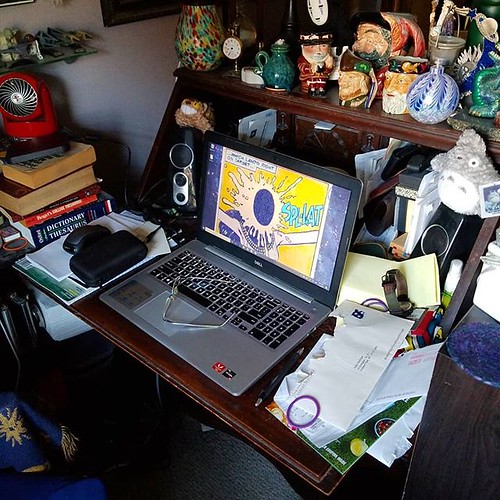
My computer is back up and running, yay! But my desk is a freaking pit and I need to clean it today, boo! #thewritinglife

Tuesday, July 02, 2019

Tone Poem Tuesday

As I write this, it's still Tuesday! Wow!

Romanian composer George Enescu is endlessly fascinating, straddling the line between Romanticism and Modernism. He is probably the greatest composer to ever spring from Romania, and much of his work is of nationalistic origin (particularly his ever-wonderful Romanian Rhapsodies, which are favorites. This piece, though, is pure Modernism through and through, with meditative passages and sharp dissonances and a pervading sense of mystery. Enescu wrote Vox Maris over more than twenty years, and apparently he did not live to hear its first performance. I haven't been able to find a great deal of information about it, but it is indeed a fascinating listen and an amazing piece of orchestral and choral tone painting.

Here is Vox Maris by George Enescu.

Friday, June 28, 2019

Something for Thursday (Friday Edition)

OK, I need to find some consistency here again...I'll get back to that Song Challenge thing soon, but for now, here's a favorite musical number of mine. This comes from the movie High Society, which is a musical remake of The Philadelphia Story, this time with Bing Crosby and Grace Kelly in the parts played originally by Cary Grant and Katherine Hepburn, and with Frank Sinatra playing the nosy reporter originated by Jimmy Stewart in the original. High Society justifies its musical numbers by relocating the story to Newport, Rhode Island and a jazz festival that takes place there as Kelly's Tracy Samantha Lord is remarrying after earlier divorcing Crosby. It's a fine movie, and the musical numbers are all terrific (the film also makes good use of Louis Armstrong and his band), but I'm somehow never quite able to find Bing Crosby convincing as a romantic lead, and when you make a musical with Crosby and Sinatra, it seems odd to me that those two gentlemen are brought together for only one number.

But at least it's a great number.

"Well Did You Evah" lampoons the kind of gossip that takes place in the rich-folks circles of those eastern communities, and the song itself catalogs the growth of a friendship in about four minutes between two men who are vaguely antagonistic toward each other at the beginning. By the time they reach the song's final flourishes both Crosby and Sinatra appear to be having a blast, with one of my favorite lyrics ever: "Have you heard? It's in the stars--next July we collide with Mars!"

Here's "Well Did You Evah."

Tuesday, June 25, 2019

Tone Poem Tuesday

I don't believe I've heard this work before, or even of the composer, Silvestre Revueltas of Mexico. Revueltas lived 1899 to 1940, and was not only short-lived but also a late bloomer, so his output is not large. The work Sensemaya is based on a poem that is in turn inspired by religious cults in the Afro-Cuban culture, with a blend of African and Cuban chants. The work is strikingly rhythmic and redolent of spiritual dance and chant, with rattling percussion instruments and insistent drive. Its energy, constantly growing over the work's roughly eight minutes, is compulsive. Here is Sensemaya by Silvestre Revueltas.

Monday, June 17, 2019

Where the hell have I been?

Why, right here.

DONE! To the beta readers the second draft goes! #amwriting #writersofinstagram #sciencefiction #spaceopera #forgottenstars

And while I've been right here, I've been focusing on applying first edits to The Savior Worlds in order to be able to get the book out to the beta readers, and today, off it went! Whew.

So, what have you all been up to?

Thursday, June 06, 2019

Something for Thursday

I missed last week, boo! But I'm back this week, yay!

Setting aside the Song Challenge thing for a while, here's a nifty bit of movie music...for a teevee movie, anyway. Back in 1983 there was a miniseries on NBC (a two-part movie, basically) called V, in which alien "visitors" appeared in giant ships to contact humanity. Their stated reason for visiting was benign, or so they said, but they quickly turned out to be liars who took over the planet and assumed control as they started robbing the Earth of its liquid water (which, the show told us, is "the rarest, most precious commodity you can imagine, and Earth is blessed with an abundance of it") and harvest humans for food. Now, ignore the ludicrous nature of the show's SF premise (there's a shitload of water out there in the universe), the show was a lot of fun and it had some sober things to say about the nature of resistance in the face of evil. But the first installment left things unresolved, so along the next year came V: The Final Battle, which wrapped up the story over three nights. After some really convoluted stuff in the plot department (the first series was much more tightly written), the humans finally achieved victory by developing a biological agent that would poison the Earth's atmosphere to the aliens (the "Visitors") but be harmless to humans. The humans dispersed this stuff via hot air balloons in a nifty sequence that was pretty entertaining for a war show, eschewing a giant final battle for a more passively peaceful way of depicting victory. (There was action stuff that played out alongside this, of course, because you had to have some kind of action finale.)

The scene in which the balloons launch at dawn is accompanied by this music, which is as charmingly 1980s as you can get, with synths and drum samples and sounds that mimic whale songs, before the soaring melody arrives. It's hard not to be cheered and buoyed by music like this. This is the kind of thing I grew up with, folks!

Here's "The Balloon Theme" from V: The Final Battle.

Wednesday, June 05, 2019

Tone Poem Tuesday (Wednesday, I forgot-to-post-it-yesterday Edition)

Yeah, I just straight-up lost track of my days yesterday. It happens!

Here's a famous piece by Gustav Holst, probably his most famous work after The Planets. He wrote two Suites for Military Band, and both have become essential staples in the repertoire for the concert band or wind ensemble. This one is the First Suite, in E-flat. Enjoy!

Wednesday, May 29, 2019

Letchworth in Spring

The other day we traveled to Letchworth State Park, a stunning place where the Genesee River flows through a massive, deep canyon and over three cliffs on its way north to Lake Ontario. It was a stunning, perfect day to be in one of the most beautiful places I know.

Here's what Letchworth looks like in spring.

Canyon at Letchworth #letchworthstatepark #geneseeriver #nature #hiking #trees

Middle Falls at #letchworthstatepark. Water is high and muddy! Lots of mist in the air, and the falls' roar is much louder. #waterfall #nature #hiking #trees #river

Rainbow in the mist #letchworthstatepark #waterfall

Letchworth canyon, looking north #letchworthstatepark #ilovenewyork #geneseeriver #nature #hiking #trees

Upper falls #letchworthstatepark #ilovenewyork #geneseeriver #nature #hiking #waterfall

Wolf Creek, Letchworth #letchworthstatepark #ilovenewyork #geneseeriver #wolfcreek #nature #hiking #trees #stream #runningwater

The Wife, the Dee-oh-gee, and me #Cane #dogsofinstagram #greyhound #greyhoundsofinstagram #letchworthstatepark #ilovenewyork #geneseeriver #nature #hiking #waterfall #overalls #dungarees #biboveralls #pointerbrand #overallsarelife #hickorystripe

Tuesday, May 28, 2019

Tone Poem Tuesday

It's interesting how many of the great composers push others out of the limelight, isn't it? If not for Antonin Dvorak, likely the greatest of Czech composers, the music of Bedrich Smetana might be better known today. Dvorak's work is always more refined and frequently touched by genius, where Smetana's is earthier, maybe just a bit less memorably melodic, and occasionally awkward. That doesn't make it bad, though--not by a longshot. Here is one of the tone poems from Smetana's symphonic cycle Ma Vlast (My Country), "From Bohemia's Woods and Fields."

Monday, May 27, 2019

Larry Havers, and other Memorial Day thoughts

An annual reposting of some things pertaining to Memorial Day. First, a remembrance of a soldier I never knew.

Fifteen years ago I wrote the following on Memorial Day, and I wanted to revisit it. It's about the Vietnam Veteran whose name I remember, despite the fact that I had no relation to him and clearly never knew him, because he was killed four years before I was born.

Memorial Day, for all its solemnity, has for me always been something of a distant holiday, because no one close to me has ever fallen in war, and in fact I have to look pretty far for relatives who have even served in wartime. Both of my grandfathers fought in World War I, but both had been dead for years when I was born. I know that an uncle of mine served during World War II, but I also know that he saw no action (not to belittle his service, but Memorial Day is generally set aside to remember those who paid the "last full price of devotion"). My father-in-law served in Viet Nam, but my own father did not (he had college deferments for the first half of the war, and was above draft age during the second). So there is little in my family history to personalize Memorial Day; for me, it really is a day to remember "all the men and women who have died in service to the United States".

One personal remembrance, though, does creep up for me each Memorial Day. It has nothing at all to do with my family; in fact, I have no connection with the young man in question.

When I was in grade school, during the fall and spring, when the weather was nice, we would have gym class outdoors, at the athletic field. On good days we'd play softball or flag football or soccer; on not-so-good days we'd run around the quarter-mile track. But the walk to the athletic field involved crossing the street in front of the school and walking a tenth of a mile or so down the street, past the town cemetery. I remember that at the corner of the cemetery we passed, behind the wrought-iron fence, the grave of a man named Larry Havers was visible. His stone was decorated with a photograph of him, in military uniform. I don't recall what branch in which he served, nor do I recall his date-of-birth as given on the stone, but I do recall the year of his death: 1967. I even think the stone specified the specific battle in which he was killed in action, but I'm not sure about that, either.

That's what I remember each Memorial Day: the grave of a man I never knew, who died four years before I was born in a place across the world to which I doubt I'll ever go. And in the absence of anyone from my own family, Mr. Havers's name will probably be the one I look for if I ever visit that memorial in Washington. I hope his family wouldn't mind.

I looked online and found these images, first of Mr. Havers's obituary and then of Mr. Havers himself. The things you remember. I wonder what kind of man he was. He has been gone for more than half a century. His name is not forgotten.


Mr. Havers's service information can be found on the Virtual Vietnam Wall here. He was born 14 October 1946 and died 29 October 1967, in Thua Thien.

Next, my annual repost for Memorial Day.

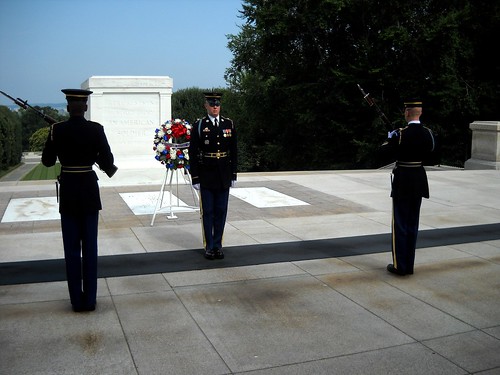
Tomb of Unknown Soldier


Know, all who see these lines,
That this man, by his appetite for honor,
By his steadfastness,
By his love for his country,
By his courage,
Was one of the miracles of the God.


-- Guy Gavriel Kay


"The Green Field of France", by Eric Bogle

Well, how do you do, young Willie McBride,
Do you mind if I sit down here by your graveside?
And rest for awhile 'neath the warm summer sun,
I've been walking all day, and I'm nearly done.
I see by your gravestone you were only 19
When you joined the great fallen in 1916,
I hope you died quick and I hope you died clean
Or, Willie McBride, was it slow and obscene?

Did they Beat the drum slowly, did they play the fife lowly?
Did they sound the death-march as they lowered you down?
Did the band play The Last Post in chorus?
Did the pipes play the Flowers of the Forest?


Did you leave a wife or a sweetheart behind
In some faithful heart is your memory enshrined?
And, though you died back in 1916,
To that faithful heart are you forever 19?
Or are you a stranger without even a name,
Enshrined then, forever, behind a glass pane,
In an old photograph, torn and tattered and stained,
And faded to yellow in a brown leather frame?

Did they Beat the drum slowly, did they play the fife lowly?
Did they sound the death-march as they lowered you down?
Did the band play The Last Post in chorus?
Did the pipes play the Flowers of the Forest?


The sun's shining down on these green fields of France;
The warm wind blows gently, and the red poppies dance.
The trenches have vanished long under the plow;
No gas and no barbed wire, no guns firing now.
But here in this graveyard that's still No Man's Land
The countless white crosses in stand mute in the sand
To man's blind indifference to his fellow man,
And a whole generation who were butchered and damned.

Did they Beat the drum slowly, did they play the fife lowly?
Did they sound the death-march as they lowered you down?
Did the band play The Last Post in chorus?
Did the pipes play the Flowers of the Forest?


And I can't help but wonder, no Willie McBride,
Do all those who lie here know why they died?
Did they really believe when they answered the call,
Did they really believe that this war would end wars?
Well the sorrow, the suffering, the glory, the pain
The killing and dying, was all done in vain,
For young Willie McBride, it all happened again,
And again, and again, and again, and again.

Did they Beat the drum slowly, did they play the fife lowly?
Did they sound the death-march as they lowered you down?
Did the band play The Last Post in chorus?
Did the pipes play the Flowers of the Forest?


Friday, May 24, 2019

Bad Joke Friday

How about another Star Trek joke, with a different franchise altogether thrown in just for good measure?


Thursday, May 23, 2019

Something for Thursday

Yup, the usual. Very busy at work and also very busy at home, what with editing books and other things! I finished manuscript markups on The Savior Worlds, but now I'm finishing up the manuscript markups on Deliverance, Eh? (not the actual title), which is my supernatural thriller about a kayaking expedition in the Alaskan wilds that goes wildly, horribly wrong. Also in the last few weeks we've had our wedding anniversary, a trip to Rochester for the Lilac Festival, and my appearance as part of the Geekiverse team at Nickel City Con! (Post about that coming up on the Official Site.)

Why all this writing activity? Because I want to get back to my original goal of having a book a year ready for release, at least for the next few years. That means that I had to get a nice backlog of manuscripts together, so I can start polishing them off, one by one. Right now there are five of them:

1. The Savior Worlds, being Book IV of The Song of Forgotten Stars.
2. Deliverance, Eh? (not the actual title), being the above-mentioned supernatural thriller.
3. Through the Pale Door, the second John Lazarus novel
4. Orion's Huntress, the first installment in a new series of space operas
5. Lighthouse Boy (not the actual title) Part I, first half of a fantasy duology

That's a lot of writing waiting to be processed and released into the wild, I can tell you!

But anyway, back to the song challenge. This one's a bit heavy: A Song That Makes Me Think About Life. Well then! Here are a few of those.


Tuesday, May 21, 2019

Tone Poem Tuesday

Film music today: a symphonic suite comprising the music of Joe Hisaishi, written for the great Hayao Miyazaki film Nausicaa of the Valley of the Wind. Hisaishi is one of my favorite composers, and this suite is representative of why.

Friday, May 10, 2019

Bad Joke Friday

I need to find more of these, because apparently more exist. If you're not up on your Star Trek: The Next Generation lore, there was a two-part episode where Captain Picard was sent on a special mission and replaced by Captain Jellico (Ronny Cox), who was a very strict, by-the-book kind of captain. Everybody hated him, but by the end he did manage to win over some respect from the crew by the time Picard returned.

But someone has decided to use screenshots from that episode to have Captain Jellico telling bad jokes, like this. I love it!


Something for Thursday (Friday Edition)

So yesterday I was asked (well, I was asked to do this before yesterday, but yesterday was the day) to work not at The Store but rather to fill in for a guy who was on vacation at another location of The Store. Fine...except that The Other Store is in Niagara Falls, NY, and Casa Jaquandor is about 35 miles south of NF, NY. So I had a 45-minute commute, and then an 8-hour shift, and then a return-home commute that took an hour and twenty minutes because of road construction on I-190 through downtown Buffalo. (Couldn't I have taken I-290 around Buffalo? Sure...but it's under construction! And so's the Skyway out of downtown! Huzzah!) So by the time I got home, walked doggos, cooked dinner, showered, walked doggos again, all I wanted to do was drink rum and do some edits on The Savior Worlds.

So here's today's entry into our ongoing song prompt thing, A Song From The Year I Was Born. Ready for some way-back hits from 1971? Here we go!


Tuesday, May 07, 2019

Tone Poem Tuesday

William Grant Still, who lived from 1895 to 1978, is one of the most prominent and important African-American composers. He was prolific, writing five symphonies and eight operas in addition to an impressive array of other works. His is an important voice from the time when jazz was emerging and when the American musical vernacular was starting to move beyond its European-dominated roots.

This suite, the Danzas de Panama, is a chamber work that is heard here performed by full string orchestra. The suite of four selections uses folk source material from Panama, and Still creates the appropriate air of folk dance here, albeit combined with the traditional sounds of the Western orchestra.

Here is Danzas de Panama by William Grant Still.

Thursday, May 02, 2019

Something for Thursday

So, time to get back to our on-again, off-again song challenge! If my reckoning is correct, we're up to A Song I'd Sing With Someone In A Karaoke Duet. Well, I'm honestly not likely to ever sing karaoke in any foreseeable future, but if I did...well, this category vexed me a bit which is why I'm actually so late today with this post. Only one song really leaps to mind for me as one that might get me up to the microphone (and a bit of alcohol infused into my system would also be necessary), and it's this one, from Grease. Am I sure? Yes I'm sure! Yes I'm sure down deep inside!