Saturday, December 12, 2020

The Chairman of the Board will see you now.


 Sheila O'Malley has a typically lovely post about Frank Sinatra, whose birthday is today. I started composing a comment on her site, but then I realized that my thoughts were getting away from me, so I decided to bring it over here. Sinatra has been a part of my universe for as long as I can remember; my parents owned a bunch of his records, which were on constant rotation in my childhood. I remember his distinctive sound, sometimes clear and sometimes with just a hint of rasp (depending on what he wanted to express), his sense of rhythm (he could make a song swing without any assisting percussion at all), his lyricism, and his unfailing sense of how to land the emotional beats of a song. This last gift is rare indeed, and it's interesting to me that I'm featuring two singers so highly gifted in that regard on the same day (scroll down to today's Daily Dose of Christmas post). And of course he wasn't just a singer; Sinatra was also a very fine actor with a lot of range. He was in a lot of movies and he won an Oscar along the way and he still might be underrated as such.

The earliest of his roles that I've seen is Anchors Aweigh, in which he plays a Navy sailor who is very young and naive, who has to be instructed by his older buddy Gene Kelly in the ways of the world (meaning, how to flirt without seeming weird about it...in the late-1940s meaning of 'flirting'). Somehow he pulls this off without getting blown off the screen by Kelly; in fact, the two men have a partnership in that movie that elevates it. Anchors Aweigh isn't quite one of the immortal musicals--it's no Singin' in the Rain--but it's damned close.

Just eight years later Sinatra put his dramatic skills on display in a dark turn as Private Maggio in From Here to Eternity, a movie that hit me between the eyes when I watched it in high school. I was channel-flipping lazily, and I happened to land on the opening credits; next thing I knew it was two hours later and the movie was over and I hadn't touched the remote the entire time. Sinatra plays the cocky, arrogant young hothead whose actions end up costing him everything. There are some weird stories--legends, actually--about how Sinatra got the role in the first place, but it doesn't really matter how he got it. The man ended up winning a Best Supporting Actor Oscar for it, and there's a reason for that. Last time I watched From Here to Eternity I found it every bit as gripping as I did when I accidentally watched it as a sixteen-year-old.

Sinatra would bounce in and out of musicals a lot, and his dramatic turns always seemed to be in the crime genre. There was a teevee movie in the 70s called Contract on Cherry Street that I remember, and there's his amazing performance in The Machurian Candidate. He even turned up in the 1980s in an episode of Magnum PI, a show that often leavened its generally light-hearted tone with detours into espionage thrillers and, in the case of Sinatra's episode, pure noir.

Maybe it's easy to discount Frank Sinatra a little because of the genres in which he worked or the popular forms he pursued, but for my money, you can't tell the story of American art in the 20th century without talking about Frank Sinatra.

Sheila starts her post with this quote (possibly aprocryphal) by Bing Crosby: "Frank is a singer who comes along once in a lifetime, but why did he have to come along in mine?" I can't read that quote without thinking of High Society, a movie that was also a favorite of both my parents. It's a musical remake of The Philadelphia Story, with Crosby as C.K. Dexter Haven (the romantic lead who is pining for Grace Kelly), and Sinatra as Mike Connor, the gossip rag reporter sent to cover Kelly's impending nuptials. (Those roles were originated by Cary Grant and James Stewart, with Katherine Hepburn in the later-Grace Kelly part.) High Society is a fun movie, though this story is really better told in the original, as parts of the script had to be set aside to make room for the musical numbers, and...well, I have to agree with my sister, who once said on a Christmas Eve when one of Crosby's Christmas movies was on and we'd all taken in a few beers, "Whoever thought to cast Bing Crosby as a romantic lead was out of their mind."

Well, I don't know about that, but it's always struck me as very strange that this movie has Bing Crosby and Frank Sinatra together, and it gives them exactly one number together...and that number had to be added at the last minute when the producers suddenly realized that they had Crosby and Sinatra in the same movie with no shared numbers. Astonishing! Can you imagine such a thing? Almost making an entire movie with two of the 20th century's greatest American singers in it and only realizing near the end that you've given them zero duets? That's like having Babe Ruth and Mickey Mantle on the same team, but benching one of them at all times. Luckily for High Society, that one number is a hell of a number:

Of course, I can't write about Sinatra without discussing his singing a little bit. Many years ago I read an interview with one of my personal musical heroes, the great Chicago Symphony orchestra trumpet player Adolph Herseht, in which among many other things he recommended that young trumpet players (among others) listen to great vocalists like Frank Sinatra, on the basis that all music, even for instrumentalists, starts with the human voice, and I remember Herseth citing Sinatra for always telling a story with his singing. That is absolutely true.

I'll close this with my favorite track from my favorite Sinatra album, Frank Sinatra Sings for Only the Lonely. Just listen to Sinatra's absolute control in this song! He fades away at the end, fading fading fading ("Answer, echoes, dying dying dying," Tennyson might write), but his pitch never wavers, which is something that requires enormous technical skill: singing (or playing, if you're on an instrument) a note correctly, and making it sound full, while also making it piano or pianissimo is a skill that many musicians don't realize they need until well into their careers. And I'll have to write sometime about my father's favorite Sinatra song...but that needs a post of its own.


Beethoven at 250: The Cello Sonata no. 5

 For most casual listeners, the words "Beethoven" and "sonata" almost always indicate one of the sonatas for solo piano, and with good reason; the piano sonatas comprise some of the greatest writing for piano in music history, and they are important listening for anyone. And if you happened to be a piano student of any skill, likewise your piano teacher eventually had you work on one of Beethoven's sonatas.

However, Beethoven didn't just write sonatas for piano alone. He also wrote sonatas for solo violin and piano, and for solo cello and piano.

Before turning to a specific sonata, it's interesting to look at the term itself. Sonata is an Italian term, which differentiates an intrumental work to be played rather than a vocal work to be sung (a cantata). Over time, especially in the Classical era when forms began to settle in to certain sets of expectations, a sonata became somewhat standardized as a large-scale work of three movements, which in turn were usually in a standardized sequence: an allegro which used a form in which a single melody (or maybe two) were stated, then developed, before being played again one final time before ending; a middle movement which was usually in a slower tempo; and a fast finale, often much faster than the first movement, and often in a Rondo form. The structure of the first movement--intro, theme, development, recapitulation, coda--became so entrenched that it in itself became known as sonata, or sonata-allegro, form. So important did sonata-allegro form become that it became the almost universal form in first movements of symphonies.

Of course, the history of the symphony is as complicated as that of the sonata, and as Classicism gave way to Romanticism and then to Modernism, adherences to standard forms came and went and came again. Even Beethoven was not always locked into the expected forms: he would start a three-movement piano sonata with a slow movement (the "Moonlight"), or he would write two- or four-movement sonatas. It is best, when thinking about musical forms and definitions of musical terms, that one remember the wise words of Captain Hector Barbossa of Pirates of the Caribbean fame: "The code is more what you'd call 'guidelines' than actual rules."

And when you're a towering genius like Beethoven, who is literally shaping the course of music history for centuries to come, well then...the guidelines are there to be ignored at will. 

After all that, let's turn to Beethoven's Sonata for Cello and Piano No. 5 in D Major, which follows all the usual rules and adheres to the usual structure. Beethoven wrote this sonata at the same time as the one preceding it, the Sonata No. 4, in 1815 when his deafness was reaching its endpoint. He was entering what historians have called his "third period", which is when his most introspective and profound music seems to have resulted.

This sonata is apparently less frequently performed than the Sonata No. 3 (which as of this writing I have not heard), which I find interesting. The Fifth Sonata begins with a simple declarative statement by the piano, which sounds twice, seeming to hesitate after each sounding, before taking off into the initial allegro. The movement then propels through its formal demands before drawing to a close before the listener really expects. The second movement puts the cello's lyrical strengths on display, before a final movement that is fugal in nature. When the entire work ends, it is with a feeling of reflective abstraction as Beethoven, only left with his inner ear at this point, is transcribing sounds he can only imagine.

As much as I love the violin as a solo instrument, the cello is not to be slighted in its uses. The technical demands of the instrument are entirely different from those of the violin (which Beethoven had already mastered). Playing the cello has its own physical demands, and the instrument's voice resides in a much lower register, which means that it has to be treated differently than the violin if it is to be heard in full partnership with its accompanying instrument. Beethoven clearly understood the cello as well as he did the violin, judging by the results in this sonata.

Your Daily Dose of Christmas

 I saw this amusing post online this morning:


And I saw that just as I was starting to think, "Hmmm, I wonder what I should post for my Christmas music of the day?" I love how every once in a while, the Interwebs anticipate my needs.

Here is some Johnny Cash for your wintry morning. (Well, very late autumn, I suppose is technically correct...and as I look outside at this moment there's not much "winter" in evidence yet. We're having one of those years where winter seems to be a slow developing thing, as opposed to other years where at some point in October or early November winter shows up to shout "HEY! I'M HERE!!!" as it wallops us with snow. Right now it's just eternally damp and muddy. What were we talking about? Oh yeah, Johnny Cash. Sorry about that; I'm writing this as the coffee is only just starting to kick in.)


There was always something special about Johnny Cash's voice that I could never put my finger on. It really shouldn't work, that gravelly baritone that doesn't always home in on the exact pitch the way a singer should. Sliding into a pitch instead of hitting it dead on is a standard device of country singing (Reba McIntyre and Garth Brooks are canonical examples of this technique), but what Cash does is...more than that. Sometimes he sounds like he's perfectly content to waver in the vicinity of the actual pitch without actually getting there. If you heard a young music student singing like that, you'd question their ability. When you hear Johnny Cash doing it, you know that you're listening to a master who is doing exactly as he wishes with his voice.

Most of all, though, that guy knew how to home in on the emotional content of a song and use his instrument to make it work. He never stresses the wrong word or puts the em-PHAS-is on the wrong syl-LAB-le, and he somehow makes it sound like every song he sings was written for him and him alone, no matter if he actually did write it or if it's an old standard like "White Christmas" that has been sung by everyone, some of whom are icons with every bit as much stature as Mr. Cash.

Friday, December 11, 2020

Liberatopia: Now with hungry bears!

 Years ago I was driving someplace and an odd segment came on the NPR show This American Life, which was about a libertarian guy who was spearheading what seemed to me a pretty Quixotic notion: rallying a whole bunch of like-minded libertarians to move to a single state, massing enough numerical strength to force through the engines of democracy a large-scale implementation of libertarian policies. Eventually they would be able to show the world entire how wonderful and glorious things are when there is minimal government, minimal idea of public life, and a strong focus on individual freedom.

I remember this very keenly: so strongly did it hit me that I blogged about way back in 2003 (!), when this blog was barely a year old. Here's some of what I wrote back then:

The story focuses on one particular Libertarian, an earnest and intelligent young fellow who is steeped in Libertarian theory, and yet he strikes me as so steeped in theory that he doesn't seem to have a handle on some of the more mundane concerns of life. He completely downplays the inevitable local resistance that his movement is certain to face whenever his twenty-thousand brethren arrive in Vermont or Delaware or Wyoming. His faith in the marketplace strikes me as scary -- private companies will pick up the cigarette butts and maintain all the roads, for instance. We're told that since zoning laws won't exist in Liberatopia, McDonald's will be able to build next door to your house if they so desire. But it's all good, because you'll be allowed to paint your house any color you want. Well, OK…but I fail to see how being allowed to treat my aluminum siding as a Jackson Pollack canvas really compensates for having what goes on behind fast-food restaurants doing so beside my back yard. (I worked in restaurants for years, and I know damn well what goes on outside the back door when the employees are bored. Especially since Liberatopia will have no drug laws.)

Then there is the surreal moment when the guy discusses, as an example of what he doesn't like about public parks. He breezily says, "We'll privatize this common area". He scoffs at all the regulations typical of a town park -- no skateboarding, for instance (this one I can somewhat agree with; there should be more places for skateboard and rollerblade use in this world). But he also scoffs at "No alcohol and no glass containers", which he thinks is Draconian -- but any parent who has ever encountered broken glass around the swings at the playground won't quite share the same view, I suspect. "Parks" equal "theft", he tells us: governmental funding of parks equals theft. When the interviewer points out that no private company is simply going to want to operate a free public park, he concedes, "Yeah, it'll be gated", and then states broadly that there will be no purely public spaces in Liberatopia. I'm glad the interviewer didn't ask what happens to the library. I probably would have broken down in tears at this guy's answer to that one.

This Libertarian travels around Vermont, one of the candidate states for Liberatopia, talking to the locals and trying to get them to sign the pledge promising to move once enough folks are signed up. One guy seems to be hearing these ideas for the very first time, and yet signs on the dotted line almost immediately -- we get to hear the scratching of his pen -- leaving me to wonder if he's really thought things through. I wonder what happens when some of these people move and discover just how much they really, truly, deep-down love little things like parks for the kids and libraries and not having to worry about some company putting a set of dumpsters on the other side of their driveway. I don't know, but something about this whole endeavor makes me envision Bart, after one of Homer's schemes has predictably turned out poorly, saying: "Bet you wish you'd researched this plan a little, eh, Dad?"

After that, I kind of lost track of (and interest in) the Liberatopia Project, because...well, at that time I could claim that I didn't have a lot of experience with libertarians, but now, I have had a lot more experience with them, and suffice it to say that while my reaction to libertarianism back then was a bemused "OK there, champ", my reaction now tends to be "Oh lord, get this nut away from me, and somebody open a window once they're gone."

Well, earlier today I saw this article, which is an interview with the author of a book about what eventually happened with the whole "The Libertarians Are Going To New Hampshire!" movement. Last time I looked in on these goons, they were imagining taking over an entire state; they seem to have eventually scaled down their idea to taking over a town, and they actually managed to pull this off in the unfortunate burgh of Grafton, NH.

Maybe I should give a spoiler warning, but come on: anyone with a pulse knows that this whole notion was bound to be a shitshow, and a shitshow it was:

By pretty much any measure you can look at to gauge a town’s success, Grafton got worse. Recycling rates went down. Neighbor complaints went up. The town’s legal costs went up because they were constantly defending themselves from lawsuits from Free Towners. The number of sex offenders living in the town went up. The number of recorded crimes went up. The town had never had a murder in living memory, and it had its first two, a double homicide, over a roommate dispute.

So there were all sorts of negative consequences that started to crop up. And meanwhile, the town that would ordinarily want to address these things, say with a robust police force, instead found that it was hamstrung. So the town only had one full-time police officer, a single police chief, and he had to stand up at town meeting and tell people that he couldn’t put his cruiser on the road for a period of weeks because he didn’t have money to repair it and make it a safe vehicle.

Basically, Grafton became a Wild West, frontier-type town.

Sean Illing

When did the bears show up?

Matthew Hongoltz-Hetling

It turns out that if you have a bunch of people living in the woods in nontraditional living situations, each of which is managing food in their own way and their waste streams in their own way, then you’re essentially teaching the bears in the region that every human habitation is like a puzzle that has to be solved in order to unlock its caloric payload. And so the bears in the area started to take notice of the fact that there were calories available in houses.

Yikes. Read the whole thing, but as a writer, I have to note that wonderful sentence: "You're essentially teaching the bears in the region that every human habitation is like a puzzle that has to be solved in order to unlock its caloric payload." That's some good stuff, right there!


Your Daily Dose of Christmas

 My most beloved of composers, Hector Berlioz, was born 217 years ago today. While he is often noted (and mocked) for his use of bombast, he was actually very tasteful and strategic in his use of big sounds: Berlioz loved contrast, and he could (and did) write music of surprising delicacy and intimacy. A lot of that can be heard in his oratorio L'Enfance du Christ, which tells the story of Joseph, Mary, and Jesus's flight into Egypt after the Nativity. While Berlioz's music was often met with hostility from the composer's native Parisian audiences, L'Enfance du Christ was embraced from the start and for many years was one of the few works by Berlioz to receive regular performances at all, before the great reassessment of his genius took place in the middle of the 20th century, ninety-plus years too late for Berlioz himself to have enjoyed it.

The Shepherd's Chorus from this work is a common excerpt heard this time of year, but Berlioz is so much more engrossing when one listens to the entire piece, so here it is.


Thursday, December 10, 2020

Beethoven at 250: The Ruins of Athens

 One reason that film music often struggles to get mainstream acceptance as music worthy of interest on its own is the fact that film music is always dependent on the film for its inspiration and genesis. Film composers don't tend to have a great deal of freedom in their work, and they have to compose their scores to accommodate the timing and rhythm of the film given them to score. Obviously some of these composers are masters in their own right and create great works even with these constraints, but the constraints are still there.

Music as an aid to storytelling is best seen, prior to the movies and even after them, in the world of opera, but there is a smaller arena where the great composers of the 19th century often found themselves dealing with at least some of the same constraints that film composers would later confront. I'm talking about incidental music for plays.

Some incidental music has gone on to be quite famous indeed, seen as masterpieces on their own. Felix Mendelssohn's work for A Miidsummer Night's Dream is one of the enduring classics, and one of its melodies has even become a traditional recessional in modern weddings. Hector Berlioz also wrote incidental music, as did Mozart, Schubert, Schumann, Bizet, and Grieg.

And so did Ludwig van Beethoven.

What's interesting about a lot of incidental music is that, Mendelssohn's work for Shakespeare excepted, the music has outlived the plays in nearly every case. Schubert's music for Rosamunde is well known (and in that case, mainly for the overture alone), but the play is almost completely forgotten. Likewise with Beethoven's fine music for a play called The Ruins of Athens. This play was written by August von Kotzebue for performance at a new theater in Pest, and if it's been performed anywhere in the last hundred years, I'd be shocked. But because one of music's greatest of all masters wrote incidental music for it, the play isn't completely forgotten.

Beethoven's suite of incidental music is one of his more pleasing works, even if even this group of pieces is rarely heard except for the Turkish March movement. The suite is not purely instrumental, featuring movements for voices and orchestra. It's all suitably dramatic but also very much Beethovenian. For all his anticipation of Romanticism, Beethoven was even at his most ostentatious always grounded in classical proportion and form. This suite, with its drama and genial melodies, doesn't so much seem to anticipate Wagner as look back at (and, in so doing, extend the reach of) Mozart, and it does so with the geniality of the Beethoven who wrote the Pastoral Symphony.

I've long maintained that one need not necessarily have seen a film to appreciate its score on a separate listen, and when people question me on this point, all I need do is point to music like Grieg's Peer Gynt Suite or Beethoven's The Ruins of Athens and ask, "Do you really need to see a forgotten play to appreciate this music?"

Your Daily Dose of Christmas

 From Mame, which I have never seen and know [Ed: Apparently I can no longer spell] exactly nothing about other than this song, right here.

Oh, and the original Broadway:

And the Muppets:


Wednesday, December 09, 2020

Your Daily Dose of Christmas

 Several settings of my mother's favorite Christmas carol. Enjoy! I'm never sure why this one isn't heard more than it is.

Tuesday, December 08, 2020

Tone Poem Tuesday

 In honor of the passing of Chuck Yeager (with a typically wonderful memorial by post by Sheila O'Malley), here is a suite of music by Bill Conti from the film The Right Stuff, which adapted the Tom Wolfe book that told the story of the early years of the American space program, with interesting focus on Mr. Yeager himself.

Godspeed, Mr. Yeager.


Your Daily Dose of Christmas

 Forty years ago tomorrow, I got up to get ready for school. My mother had Good Morning America or Today or one of those on in the living room, which is when I learned of what happened forty years ago today. John Lennon, shot dead in New York City.

It would be many years before I would finally warm up to the Beatles' music and the enormity of the act of cultural assault that Mark David Chapman committed that day.

Here is John Lennon.


Monday, December 07, 2020

Your Daily Dose of Christmas

 One area of classical music I always tell myself I would like to explore, and yet never quite do, is the operas of Nikolai Rimsky Korsakov. NRK was a brilliant orchestrator, a musical colorist who also had a fine gift of melody. His music teems with the sense of exotic color and adventure and emotion; his Scheherazade is one of the enduring works of orchestral magic.

I have read that NRK's operas constitute a treasure trove of storytelling and music, all based on the legends and fairy tales of Russia. The operas are not often staged, however, mainly because Russian is not one of the more popular languages for singers to learn, which is likely a pity. But we do have orchestral suites derived from NRK's operas, like this one, from an opera called...Christmas Eve. A light romp, this is not; the story involves a plot by the Devil to steal the moon, and it proceeds from there in what I am sure is delightfully operatic fashion.

This is an orchestral suite derived from the score to Christmas Eve, and if it doesn't make use of any traditional musical trappings of this season -- no jingle bells here! -- it nevertheless creates that wonderful sense of NRK's grand orchestrations and music that is full of rhythmic excitement and emotion.


Sunday, December 06, 2020

Beethoven and the Outdoors

"Beethoven's Walk in Nature", Julius Schmid

 One thing that I have in common with Ludwig van Beethoven is that we both find creative rejuvenation in regular walks in the woods near our homes. I don't know of any canine companionship that Beethoven might have enjoyed, but I have a dog with me at almost all times when I am walking through the forests of Chestnut Ridge Park, or Knox Farm, of Hunters Creek, or Sprague Brook, or Letchworth. Beethoven would escape almost daily to the woods around Vienna.

Even in Beethoven's time, pollution was a problem in the city, and Beethoven likely felt it necessary to his physical health to get out of the city on a regular basis. I wonder how he applied those walks along forest trails to his musical life! Did he hum to himself, trying out musical ideas as he strolled? Did he take manuscript paper, quill, and ink with him so he could jot down ideas as they came? Or did he simply take a more meditative approach, using the walks to calm his often troubled soul so that when he returned to his chambers and his piano and his ink and paper, his mind was in a place to actually create?

It doesn't precisely matter how Beethoven's love of nature moved him to create; all that matters is that it did. His music abounds with examples of this inspiration, but the most famous and obvious is in his Symphony No. 6, the "Pastoral", in which Beethoven uses five movements (not four!) to more suggest the emotions of walking in nature than musically depict it. This makes the Pastoral Symphony one of the earliest examples of "program music", even if Beethoven's desires were more impressionistic in nature. Nevertheless, in those five movements, Beethoven deftly creates a series of emotional moments--"melodic moments of feeling," as Wagner would later say--that do suggest a natural setting.

The movements suggest the feelings of refreshment and delight upon arriving in the countryside, and then a scene by the side of a rushing brook. The third movement is a folk dance, followed by a storm and then by the feelings of rain-washed newness that follow a good summer storm. The entire symphony is lyrical and beautiful and at times even charming--note the folk dance in the third movement, which has a lively tune played off the beat by the oboe and a bassoon accompaniment that sounds like the bassoonist can only play three notes--and there's real drama when the storm arrives, before peace settles again. The storm has been frightening, but also rejuvenating.

Here is Beethoven's Symphony No. 6 in F Major, the Pastoral. Few works with more lyrical delight exist.

Your Daily Dose of Christmas

 You know how sometimes a song will have a great tune and a great beat, but when you listen to the lyrics you're kind of repulsed? For me one great example of this is the first of the 1980s pop music charity hits, "Do They Know It's Christmastime", by "Band-Aid", a super-group made up of a whole lot of big names at the time. The song is basically asking if the starving Africans have any idea that it's even Christmastime, so awful has their lot become. I'm always thinking, "Why wouldn't they? They have calendars. Just because they're dealing with a lot of shit doesn't mean they don't know what the date is." And besides, there are a lot of Christians in Africa too. The whole song always bugs me (and not just for Bono's lyric, "Well tonight thank God it's them, instead of you!" Yikes.)

Anyway, yes, they know it's Christmastime in Africa. Here's some musical evidence.


Saturday, December 05, 2020

Your Daily Dose of Christmas

 So far this year we've had about an inch of snow altogether at Casa Jaquandor, and at the moment the grass is green and the woods are brown and everything is wet and muddy. Meteorologically, we just aren't in the Christmas mood yet.

But anyway, here's "Sleigh Ride", in the original orchestral version and the Johnny Mathis version with words, because hey, it's Buffalo! It's gotta snow sometime, right? Six years ago we were still digging out from seven feet of the shit!

Anyway, here's the music.

I wonder if Currier and Ives knew that this song was what would carry their names into the ages....

Oh heck, here's another version, the short Roy Rogers and Dale Evans version that blends Sleigh Ride with Jingle Bells and if you listen to it you'll walk around all day humming "Harses harses harses" to yourself. You may remember this version from Sleepless in Seattle, when Meg Ryan sings along with it while driving....


Friday, December 04, 2020

Your Daily Dose of Christmas

 Songwriter Adam Schlesinger died earlier this year. He was one of the first high-profile deaths from the COVID-19 epidemic. He was also one of the brilliant creative geniuses behind the amazing show Crazy Ex Girlfriend, and many of that show's best songs reflect his creative stamp...including this one.

Here's "California Christmastime" from Season One of Crazy Ex Girlfriend, one of my favorite shows ever.


The other Beethoven piece that everybody knows

 If you took piano lessons as a kid for any length of time, you probably played some Beethoven. And if that's the case, then the odds are very good that the Beethoven you played included his Bagatelle No. 25 in A minor, more familiarly called Für Elise. And if you never did take piano lessons, odds are that you've heard this piece. If not for his Fifth and Ninth symphonies, there's a good chance that Für Elise would be the most familiar piece Beethoven ever wrote.

And that's interesting, because it turns out that the piece was never heard in Beethoven's own lifetime, and in fact would not be discovered by the musical world until four decades after the composer's death. The piece is quite short; in fact, the word "Bagatelle" refers to a small, short piece for piano. And the title? "For Elise"? That seems obvious, right? Beethoven wrote the piece as a gift for someone named Elise...but some scholars have agreed that this is based on a misreading of Beethoven's legendarily awful handwriting, and what he actually wrote on the manuscript (which is now lost) was "For Therese".

Who was "Therese"? Well, this article explains:

Therese was 18 years old and one of Beethoven’s piano students. Her father was a medical doctor who treated Beethoven for some of his many illnesses. Beethoven was quite taken with her from their first meeting and soon began heaping great praise on her piano skills, which weren’t all that notable. There was probably some flirting on Therese’s side, as it would have been very flattering to have a famous musician like Beethoven falling all over himself to impress her. He started cleaning up, ordered new clothing, and even combed his wild mane of hair. 

Last but not least, he wrote her a piece of music, composed deliberately for her skill level. All seemed well, at least to Beethoven. Then everything came crashing down. Although we don’t know exactly what happened, later letters to and from Beethoven speak of an unfortunate incident at the Malfatti home. Beethoven had a little too much punch and behaved rudely with Therese, and she rejected him outright. In a later letter to Therese, Beethoven wrote about the piece he had written for her and invited her to find its hidden meaning. “Work it out for yourself, but do not drink punch to help you,” he wrote, apparently referring to the unfortunate incident that ended their relationship.

Also interesting is how this piece, apparently an unpublished trifle that Beethoven didn't even keep a copy of for his own archives, came down to us:

It was found in Therese’s personal papers in 1851, 41 years after it was probably written. A small piece, Beethoven gave it its formal name, “Bagatelle”. But it was what he wrote at the top of the page that not only gave this piece its informal name, but also created a mystery that has fascinated students of the history of Für Elise ever since. 

At the top of the page, Beethoven wrote (translated from German): “For Elise on 27 April to remind you of L.V. Bthvn”. Ludwig Nohl, a German music scholar, discovered the original manuscript in Beethoven’s own handwriting among her musical papers, transcribed it, and published it in 1867 in a book he edited of Beethoven’s letters. The original has since been lost, so we have had to rely on Nohl’s copy of it. 

Imagine having something you just tossed off one night becoming one of the enduring works of all classical music, so enduring that the piece has become on its own a kind of cliche. Try listening to it again, though, beginning to end! Note the way the harmonies and the melody blend together so you can't have one without the other, and note the contrasts between the famous main melody and the less-familiar intervening sections. And if your memories of your piano teacher are pleasant ones, think of them, too!

(My teacher, Mrs. Hooker, never had me play Für Elise. My personal gateway to Beethoven was the "Moonlight" Sonata.)

Here is Für Elise.


Thursday, December 03, 2020

Something for Thursday

 So I was curious: Did Judy Garland ever record the song "It's Been a Long, Long Time"? I did a very quick search and didn't find anything...but I did find this rendition, by an apparently very young Frank Sinatra. Apparently Sinatra never did a studio recording of this song, but he did do it on a radio show of his, and that recording turns up here.

I still don't know if Garland did the song, so if anyone knows one way or the other, don't keep me in suspense!


Your Daily Dose of Christmas

 British composer Gerald Finzi was not prolific, which can be seen one of two ways: either the world was denied further work of fine quality by his slow process, or his slow process was essential to his work as a composer. Either way, Finzi wrote in a Romantic, English-pastoral vein that reflects influences of Ralph Vaughan Williams. Much of his work is meditative and full of lush harmonies, and his choral writing is outstanding. All of that is on display in In terra pax, one of his last works. Here Finzi combines the text of a poem by Robert Bridges, "Noel: Christmas Eve 1913" with the famous telling of the birth of Jesus from the Gospel of Luke. He gives the words of the poet to a baritone soloist, and the words of the Angel from Luke to a soprano, with the chorus handling the rest. Even though the work starts off hauntingly and quietly, there is drama later on as the dynamic become quite expansive when Luke tells us that the shepherds were "sore afraid".

Here is the text of the start of Bridges's poem:


Pax hominibus bonae voluntatis A frosty Christmas Eve    when the stars were shining Fared I forth alone    where westward falls the hill, And from many a village    in the water'd valley Distant music reach'd me    peals of bells aringing: The constellated sounds    ran sprinkling on earth's floor As the dark vault above    with stars was spangled o'er.

In terra pax is a wonderful choral miniature piece, a masterwork by a composer who isn't heard enough.

Wednesday, December 02, 2020

Your Daily Dose of Christmas

 So far, this Christmas season doesn't seem to be off to the most joyful start, does it? I remember hearing this song quite frequently during the Christmas season, but it doesn't seem to show up all that often anymore. And in truth, it's not really strictly a Christmas song at all, is it? It's set at Christmas, but that's not the same thing. However, I could say the exact same thing about "Same Old Lang Syne" by Dan Fogelberg, which I feature in this space every single year, and almost certainly will later this year.

So here's a sad song about a breakup that happens at Christmastime, which is surely among the worst times such a thing can happen...but really, is there a good time? Here's "River" by Joni Mitchell, performed by the amazing Sarah McLachlan.

And I promise I'll start posting some actually happy music one of these days.

A Fourth of Beethoven

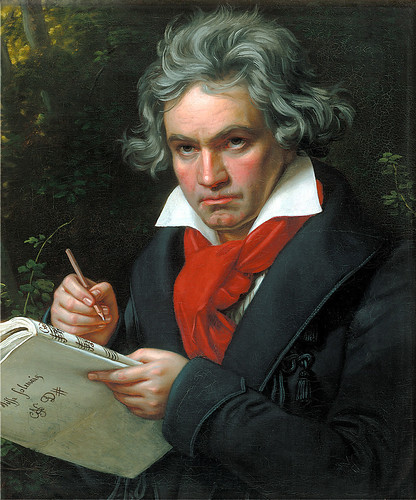
Beethoven

I often feel a bit sorry for Beethoven's Symphony No. 4 in B-flat major. It just doesn't get talked about that much. Symphonies 1 and 2? Those get discussed as the early works they are, when Beethoven was just starting to move beyond the Haydn and Mozart influences on his work. Then, of course, comes the epochal milestone in music that is the Third, the mighty Eroica, famed for the original dedication to Napoleon Bonaparte, which Beethoven ripped asunder when he learned that his French hero had declared himself Emperor.

And of course, there is the Fifth, the great and glorious Fifth, perhaps the single most performed symphony of all time, a work whose opening bars comprise music that is as familiar to the ear as the Mona Lisa is to the eye. Even the Sixth, the Pastoral, gets more respect than the Fourth, with its wonderful rustic tone-painting.

Rivers of ink have been spilled over the centuries since the Seventh arrived, one of the grandest masterpieces in all of music history, and even the Eighth--the slight, small, intimate Eighth--gets some love here and there. And we'll come back to the magnificent edifice that is the Ninth later this month. But there, seemingly alone in the middle of the most perfect collection of symphonies ever composed, is the Fourth, the sunny and genial Fourth.

There is no "Fate knocking on the door" here, nor is there a funeral march in place of a traditional slow movement. There is no "apotheosis of the Dance" to be found in the Fourth, nor is there a plaintive depiction of the woods around Vienna that Beethoven loved so much, and certainly there is no wonderful hymn to Joy.

All there is in this work is Beethoven smiling.

The first movement kicks off with a long minor-key introduction, perhaps hinting at serious thoughts to come...but when we arrive at a series of chords that finally resolve into our home key of B-flat, all the clouds disperse and what follows is pure sun and cheer. The genial mood carries into the slow movement, which is dominated by a pulsing rhythm that puts one in mind of Haydn's "Clock" Symphony, with the same degree of amiability. Toward the end of the movement there is a moment of pure delight as the horn, clarinet, flute, and strings exchange arpeggiated passages.

Our third movement, a scherzo, doesn't thunder or storm the way Beethoven scherzos often do. This one flits and jokes, with Beethoven giving us rhythms that don't quite feel like they line up. There is some fantastic writing for the woodwinds in this movement, especially for the bassoons in the middle. And the finale is pure energy, not quite as propulsive as what would come later in, say, the finale to the Seventh, but compelling in the forward momentum of its moto perpetuo construction, before it finally arrives at the thrilling coda.

Why has the Fourth never quite become as beloved as so many of--if not all of--the other eight of Beethoven's symphonies? I honestly do not know, but I wonder if part of that is because we often seem to like our Beethoven with at least some of his characteristic darkness. We want to hear at least a little of the man who shook his fist at the thundering clouds when he was on his deathbed. We're not sure what to make of this odd Fourth symphony, a work in which this composer who went deaf and who struggled mightily to make musical sense of the ideas he scrawled in his notebooks seems to be largely in a mood of brightness and good cheer.

Maybe, maybe not. All I know is that I really do love the Fourth.


Tuesday, December 01, 2020

Tone Poem Tuesday: The Beethoven Jubilee Begins!

Beethoven

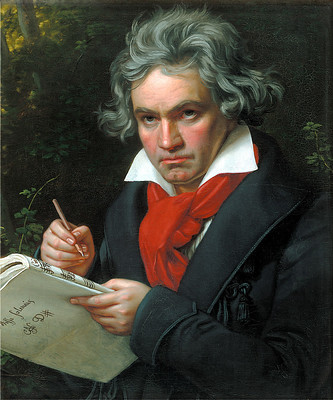
 This is the month when Ludwig van Beethoven turns 250 years old...fifteen days from now, to be precise. In honor of this, I'll be stepping up the frequency of Beethoven-related posts--not quite daily, I expect, but there will be a lot of Beethoven this month, with a special post on the 16th, Beethoven's actual anniversary. Let's kick things off with an overture to one of Beethoven's signature works, his only opera, Fidelio. Among Beethoven's passions--in fact, after music, maybe his greatest passion--were the ideas of freedom and liberty. Beethoven lived in a deeply revolutionary era (I am reading a book about this aspect of his personality right now, but more on that later in the month), and he believed deeply in the liberal ideals that France would express as Liberté, Egalité, Fraternité. These values inform his opera, in which a woman goes undercover as a man to rescue her husband, who has been unjustly accused. The opera itself is a great work, and its overture (which was the last of four that Beethoven composed for it, being ever the perfectionist) is representative of many of Beethoven's finest aspects as a composer.

Let there be Beethoven!


Your Daily Dose of Christmas

Well, it's December 1, do let's get started with this year's musical run-up to Christmas, shall we? I know, I know--this ghastly year is more limping toward Christmas than anything else, but there's nothing we can do about the calendar, and all we really can so is try to find what light we can.

Longtime followers will not be surprised that I'm featuring this particular song, because I do every year...but never on the very first day of December. I usually wait on this one, because it's not obviously cheery. Lontime followers of mine will also know that I always accompany this song with my objection to the changing of the lyrics, at the behest of Frank Sinatra, that has become pretty well standardized ever since he figured that part of the original lyric wasn't sufficiently brimming with Holiday cheer. And this year is no different...in fact, if ever a year made the case for keeping the original lyrics, this is the one.

Someday soon we all will be together,
if the fates allow;
Until then we'll have to muddle through somehow,
So have yourself a merry little Christmas now.

What lyrics could we possibly have this year, when so many of us are unable to be together at Christmastime (or any other time)? "If the fates allow," indeed...and indeed, all we can do is "muddle through somehow". That's all we can ever do, really...but 2020 has made it manifest.

So let's enter December, trying to find what hope we may...even as we muddle through somehow.

Monday, November 30, 2020

Photos from a four-day weekend

 As I'm sure most people did, we enjoyed a quiet and socially-distanced Thanksgiving this year. But since Thanksgiving is always quiet and socially-distanced for us, it really wasn't a big deal. Thanksgiving is always a small event for us, in terms of numbers of people; it sure isn't small in terms of food!

Anyway, even though I had no intention of attempting any shopping, I also took Black Friday off as I always do these days; Thanksgiving Weekend has become over the years one of my favorite weekends of the year. It was pretty nice actually this year as well, even with COVID trying to ruin everything.

Here's some photographic evidence of what transpired this weekend:

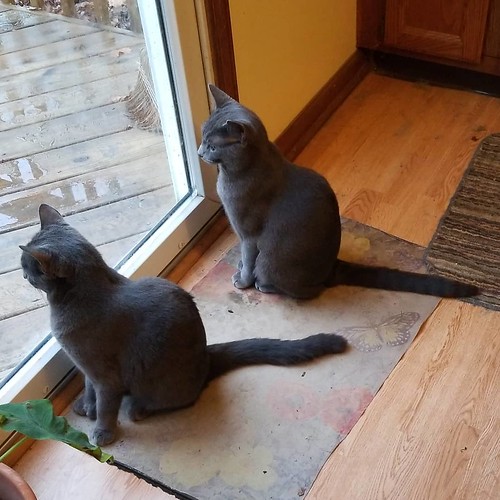
TWO gray cats, ah ah ah ahhhh.... #WhichIsWhich #catsofinstagram #graycat

The Dee-oh-gee wanted back in. Remy and Rosa were not sold on this. #Cane #dogsofinstagram #greyhound #greyhoundsofinstagram #Remy #Rosa #catsofinstagram #graycat

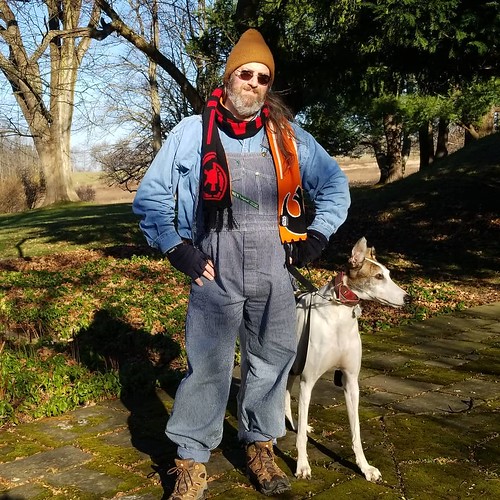
Morning coffee yesterday #overalls #dungarees #biboveralls #vintage #GuessJeans #GuessOveralls #denimoveralls #overallsarelife #vintageoveralls #sweatersandoveralls

Mirror hound #Cane #dogsofinstagram #greyhound #greyhoundsofinstagram

Adventurers #nofilter #Cane #dogsofinstagram #greyhound #greyhoundsofinstagram #KnoxFarm #eastaurora #wny #autumn #nature #hiking #trees #overalls #dungarees #biboveralls #vintage #key #keyoveralls #hickorystripe #vintageoveralls #overallsarelife #denimov

Knox Farm adventures, 11-29-2020

Knox Farm adventures, 11-29-2020

Knox Farm adventures, 11-29-2020

Knox Farm adventures, 11-29-2020

Knox Farm adventures, 11-29-2020


Saturday, November 28, 2020

Fifteen Years Gone....

 Fifteen years seems like a lot, and sometimes it feels like a lot.

Other times it feels like yesterday.

We miss you, Quinn, and we wonder what kind of life you might be living now. How much fighting would you have done? Where would you be? You should be sixteen, not forever frozen in my heart and mind at fifteen months and two days.

Alas.

Father and Son, early on


Friday, November 27, 2020

National Pie In The Face Day!!!

 According to somebody, November 27 is "National Pie in the Face Day". The last few days I've been posting some of my favorite photos of myself in a pied-face state, with nifty quotes attached, to social media because let's face it, if ever we lived in a time where humor of any kind was desperately needed, even if it's an old staple like the pie in the face, it's now. So here are a few selections!


And finally, here is an amusing item from an artist who creates surreal images mixing elements of classic art with real life. Given the apparent state of affairs as I write this, especially in the United States, it's hard not to think that God, if They are out there, is in precisely this kind of mood with regard to humanity:


Indeed.

Stay safe, everybody, and at least try to keep laughing. It's really all we can do in the face of disastrous times, until they end!

Pick My Author Photo!

 Hey, folks! I'm doing this on Twitter and Instagram, and since this blog is the granddaddy of all my "social media" ventures, I should do it here, too. I am in the cover-design phase of The Savior Worlds, Book Four of The Song of Forgotten Stars, which means it's time to update the author photo on the back cover! I've pre-selected these four images, and if a consensus forms around which one is best, I'll go with it. (If it roughly breaks even then I will pick.) What should be my author photo? Let me know!

Hey #WritingCommunity and fans and followers! Help me pick my author photo for the back cover of THE SAVIOR WORLDS! Drop a vote in comments to this post! #amwriting #writersofinstagram #writerinoveralls


Thursday, November 26, 2020

Thankfulness in 2020

 This has been a truly ghastly year, and even the weather today as I write this is metaphorically on point: it's drizzly and rainy and the screen on my library window is filled with raindrops so I can't really even see outside very well.

I won't write my usual long list of things I'm thankful for, but suffice it to say that even in a year like this, it's still quite a long list, when I really put some thought into it.

Stay safe, folks. Please don't take unnecessary trips and please oh please oh please, keep your masks on. It looks like we might very well get through this all right, but if this pandemic is a baseball game, we're only in the bottom of the fifth. Let's play the whole nine innings, folks.

Happy Thanksgiving!

Oh, and here's a sleeping dog.

Having gone outside twice, eaten her breakfast, extorted from me a bite of my donut (a PAULA'S donut, no less), and chased her kitty, Carla settles in for a nap. #Carla #dogsofinstagram #pitbullsofinstagram #pitbullmix #pittie #staffordshirebullterrier #s


Wednesday, November 25, 2020

Working....

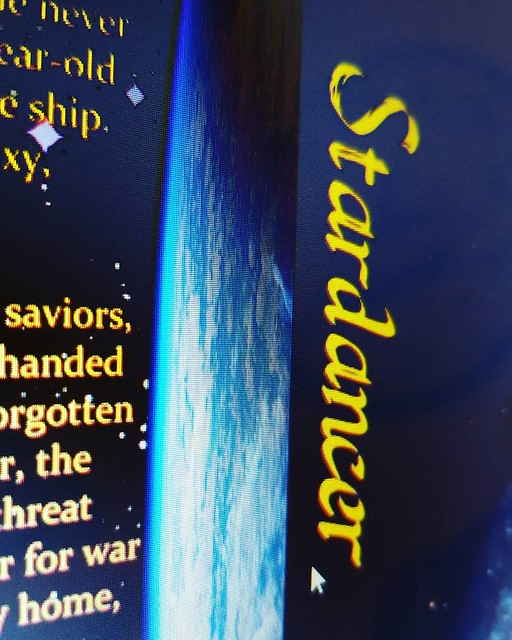
 If you're wondering what I've been up to in terms of writing of late, here's what! I'm doing some revision work on Stardancer, The Wisdomfold Path, and Amongst the Stars as part of a relaunch effort, at the same time that I'm getting The Savior Worlds ready for release. Yay! New stuff!

What's new in the first three books? I'm adding a "Dramatis Personae" to each book, and each volume after Stardancer will have a brief "Our Story Thus Far" summation of the story to that point. I'm also redoing the interiors with some new fonts, and I'm redoing the covers. Watch this space (or the Official Site) for more info as it comes along!

As soon as I get the proof of AMONGST THE STARS in the mail and verify it, I'll reveal the NEW COVERS to THE SONG OF FORGOTTEN STARS I, II, and III! #amwriting #writersofinstagram #WritingCommunity #sciencefiction #spaceopera #forgottenstars #bookdesign


Tuesday, November 24, 2020

Tone Poem Tuesday

 First off, I think it's high time I admitted that this series has morphed away from an exclusive focus on tone poems toward a general focus on whatever piece of classical music I'm grooving on at any point in time, so that's what it's going to be, even if I continue to call it "Tone Poem Tuesday" for reasons of alliterative nature (and the fact that I don't really feel like launching a new posting series with new title). OK? OK!

So, naturally, let's turn our attention to a piano concerto.

Florence Price, a Black composer who lived from 1887 to 1953, has appeared a number of times in this space over the last several months, and when 2020 is over, I wonder if her music might not be the finest musical discovery I make this year. Every work of hers I hear is vibrant and full of drama and color, and this concerto is no exception. It is lush and romantic in its orchestration, but distinctly Black in its musical language and its thematic material.

The work is in a single movement that nevertheless has three distinct sections within: the big first "movement", the slow second movement, and a spritely third. We open with a solo trumpet sounding the first notes of what will be the first section's main theme, a tune that is redolent of a spiritual, and that theme does in fact dominate a movement that is as big and bold in its statements as any great Romantic concerto. Then, in the slow movement, there is another gorgeous melody with a strong folk-like character (its pentatonic nature makes it even sound less moored in a specific time and place), before the final dance-like allegretto begins. It sounds like ragtime to me, but on reading a bit, apparently the finale is based on the juba, a specific dance from the plantations that predated ragtime.

Price's concerto is one of the most delightful things I've heard all year, and I've heard a lot of delightful music this year. There is sweep and energy and emotion and lyricism and, in the end, a compellingly rhythmic dance that leaves the toe tapping, if I may invoke a rather tired cliche.

And it does all this in roughly eighteen minutes. Florence Price does something wonderfully economical here.

The work was performed in the early 1930s, with Price herself as the soloist, but unfortunately it appears to have utterly disappeared since then, until apparently in 2012 a composer named Trevor Weston was commissioned to recreate the work based on orchestral parts. Price's own autograph score is long lost. Once again I am struck by how tenuous our grip truly is on the artistic work of our forebears.

Here is the Concerto in One Movement by Florence Price. Please give it a listen! And really, give it at least two. It deserves it.


Monday, November 23, 2020

"Stuck at home"

 A quite lovely article appears in The Buffalo News by Jeff Miers, describing his struggle with the degree to which the COVID pandemic has disrupted his lifestyle. It's not just his leisure that's affected; it is literally his entire life. Miers writes about music and the arts for the News, and with a beat like that, he's required to be out in the city almost all the time, interacting with music and art and musicians and artists. This has been his life for decades, and now, all of a sudden, he's been forced to...stay at home.

The Wife and I often comment that it's strange how this particular pandemic has basically forced so many other people into our lifestyles: we don't go out a lot at all, and when we do it's mainly to eat someplace, so getting takeout is just fine with us. My trips out by myself tend to be solo trips to the library, or jaunts to a local park to walk The Dee-oh-gee in solitude. We simply don't find ourselves often in situations that involve lots of people are in social situations. But our lifestyle isn't the only lifestyle, and Mr. Miers (who is, by the way, quite a fine writer whose work I usually enjoy) had felt the pinch very keenly:

After months of telling myself that I was far too fortunate to demand such a luxury, I finally admitted that I needed some help, that the ways in which I warded off depression and anxiety in the past – all of them involving music – were no longer enough. I began seeing a mental health therapist, virtually. She immediately pointed out that, in addition to the difficult situation with my parents, I was also quite likely in a state of shock resulting from a core feature of my existence – the live music experience, which has occupied my time an average of five nights a week for 30 years – being ripped away. Allowing myself to admit this, and to mourn it, in a sense, has helped me greatly.

In the course of his article he notes how he discovered that his son's girlfriend is actually the granddaughter of a noted jazz musician named Roosevelt Wardell. I found an album of Wardell's on YouTube, and though I am no expert on jazz by any means, I greatly enjoyed it! This record is quite a compelling listen. You never know which direction art will take in reaching us. Some guy asks a girl out, introduces her to his parents; Dad turns out to be a local writer who mentions her grandfather in a newspaper article, and now I'm listening to a jazz record.

The wheel turns, man.

Here's that album, by the way.


Sunday, November 22, 2020

22 November

 Fifty-seven years since President Kennedy was assassinated in Dallas. I'm surprised to note that I've never written a long piece about Oliver Stone's film JFK, and it's been so long since I last saw it that I don't want to try to write one now; maybe next year, after a rewatch. For now, here's my review of Stephen King's amazing novel 11/22/63, and here is John Williams conducting a suite of his music for Stone's film.

I wonder what kind of America would have emerged from the 1960s had Kennedy not been murdered.


Saturday, November 21, 2020

Adventures in Moonlight

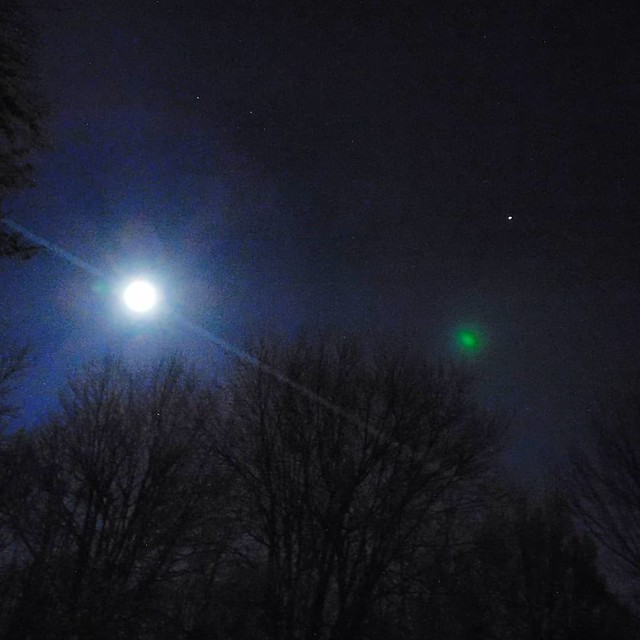
 The Moon put on a show at the very end of last month. Here's a bit of how it looked from my backyard.

Luna

Moon, through tree

Tree, with moon

Moon, Halloween night

Moon and Mars

That last is of the Moon and Mars, visible as the bright light off to the right. (The green is just a photographic accident...or maybe the mythical "Green Flash", meaning that some sailor has returned from Davy Jones's Locker to the world of the living...but more likely the first thing.)


Monday, November 16, 2020

Beethoven at 250: The Violin Concerto

 I've been listening to Beethoven's Concerto in D Major for Violin and Orchestra a lot over the last few months, and I've been struggling to frame how I want to write about it. It's such a scintillating work, full of wit and sparkle--qualities one doesn't always associate with a composer who, while on his deathbed shook his own fist at the thunderstorm raging outside--that stands out all the more when one considers that the Concerto was a failure in Beethoven's lifetime and did not take its rightful place in the repertoire until several decades after his death.

But last month, Edward Van Halen died, and that gave me a new way to think about this piece. Bear with me!

Mr. Van Halen was a self-taught musician, but he was also a curious one who had a strong love of classical music. He would even sprinkle quotes from favorite classical works into his solos on occasion. While his father, a musician himself, encouraged Eddie (and brother Alex) to learn music, Eddie never learned formally; he never learned to read music from the page. Everything for him was done by ear, and he had the kind of ear that only the very greatest of music virtuosi can boast.

Not unlike the inner ear of Ludwig van Beethoven, who would continue composing his greatest works even after his own physical ears had stopped working entirely.

My main thought in drawing Eddie Van Halen into a discussion of Beethoven's Concerto for Violin and Orchestra isn't just that both men had amazing ears, though. A concerto is as much a work designed to put a performer's virtuosity on display as it is a musical work with specific architecture. What makes the concerto such a compositional challenge is that the composer must balance the virtuoso's need to display their skill with the task of crafting a work that is satisfying musically. Plenty of less successful concertos exist that allow for all manner of virtuosic pyrotechnics, either from the piano or the violin or some other solo instrument, while failing to incorporate the soloist into the musical aspects of the work.

(Then there are works that go the other way: Hector Berlioz's second symphony, Harold In Italy, had been specifically commissioned by Nicolo Paganini, who wanted to show off his skill on a new viola he'd acquired, but Berlioz turned in a symphony with little to offer by way of virtuosic display opportunities. Paganini never performed the work.)

Beethoven's Violin Concerto does for the violin what Eddie Van Halen would do with all of his blazing guitar solos. Even when Eddie was "shredding" as hard as he could, there was always melody in his playing. You can always pick out the tune in an Eddie Van Halen solo, and sometimes a Van Halen song will feature a second solo, shorter this time, that is nothing but pure melody ("Dreams", which might well be my favorite Van Halen song, does this to wonderful effect).

Beethoven does the same thing in his Violin Concerto. Whenever the violinist plays, even during the cadenzas, you never get the sense that they are simply showing off. Every note that Beethoven writes contributes to the whole, for one of the most complete concertos I know. The concerto begins surprisingly, with five soft taps of the timpani before the woodwinds give us our first hint of melody. Beethoven's symphonic hand is firmly guiding us, to the point that when the soloist finally enters, it's almost surprising as we remember that we are actually hearing a concerto and not a symphony.

The first movement, comprising more than half the entire concerto's total time, is an epic movement in itself, and yet it teems with the kind of optimism that we don't always associate with Beethoven. This is assuredly the same composer who wrote the Seventh Symphony, and if the inner movement isn't as meditative as that great symphony's amazing second movement, it is still a lovely movement of introspective beauty before it closes not with a resolution but with an unresolved minor chord that leads to a short cadenza that is likewise unresolved--until the soloist brings us into the rondo of the last movement. And that last movement is full of Beethoven's humor. Again, a facet of Beethoven's that is often overlooked--but listen to how that rondo theme seems somehow to put the beats in the wrong place (until you hum it and realize that it's quite correct). Hear the way the soloist must make very wide leaps in the violin's register, and one musical joke where the soloist has to pluck two notes, pizzaicato, before bowing the next immediately.

Near the end of the work, when Beethoven almost gives the soloist free rein, there is a remarkable sequence of passages in which the soloist plays three brief flashy runs that soar into the upper register, alternating with brief orchestral passages. Even there you can hear melody, as those soaring runs are a part of the work's musical fabric and are clearly not just there for a violin virtuoso to enjoy. Even the concerto's very last bars contain good humor, as the soloist leads the orchestra to its final chords.

This approach to writing for a soloist in a concerted work, in which the soloist is musical partner first and virtuoso second, really does put me in mind of Eddie Van Halen's best work as a rock guitarist. There really is a line that connects the two. So it seems to me, anyway.

Here is violinist Hilary Hahn, performing Beethoven's Concerto in D for Violin and Orchestra, with Leonard Slatkin conducting the Detroit Symphony Orchestra.


Sunday, November 15, 2020

Any time things wanna get BETTER would be great by me.

 So, about that lack of updates in this space for something like nine days...this month has been rough, folks.

First, there was the final run-up to the election, which was nerve-wracking in itself. Then Election Night was its own category of annoying, as a hoped-for Democratic landslide resulting in the defeat of some of the more odious Republican voices in Congress failed to materialize. And then the results of the Presidential race just dragged on and on and on. Granted, we all knew that was going to be the case, given the giant emphasis on mailed-in ballots, but it would have been a lot less of a nailbiter if I wasn't also disgusted that the likes of Lindsay Graham, Joni Ernst, and Susan Collins weren't all going back for another six years of being singularly terrible people in the Senate.

Of course, the Presidential result looked more and more favorable as the week went on until finally all the news organizations concluded that yes, Joe Biden had won, and that yes, America had rejected another four years of Donald Trump. Good news, absolutely! That Trump won't be the one setting the nation's agenda is an unabashed good thing. But it definitely gives me pause to note that America seems to have said with this election not "We're rejecting that guy and his agenda," but rather "OK, we don't like this guy, but we do like a lot of what he stands for." Disappointing.

Through all this, The Wife had been suffering some increasingly obnoxious health issues, which finally led to her hospitalization this past Monday when her vitals got seriously out-of-whack. She's home now, having only stayed two days, and doctors are homing in on treatment options moving forward, and none of it is life-threatening...but still, that was very difficult. And now, as I write this, COVID numbers are relentlessly climbing as millions of my fellow citizens seem to have basically thrown in the towel and embraced life whether they get sick or not, and my government has likewise thrown in the towel in favor of election-related court cases that are not likely to do anything other than get tossed out.

I'm ready for 2020 to be over, folks. This entire year has been ghastly, even as the current crisis seems tailor-made to someone with my particular lifestyle: we're not particularly outgoing, and when we do go someplace it's always by ourselves. But still, this level of world-induced anxiety is not something I'm remotely used to. I was reminded just the other day, on the anniversary of the sinking of the Edmund Fitzgerald, that the final transmission from the doomed ship was the Captain saying, "We're holding our own."

Friday, November 06, 2020

What day is it?

 So, on Monday I made a post here, invoking the Les Miserables song "One Day More", as did many of my left-leaning friends on the Internet. And why not! It's a song that so ably lends itself to a Monday before a major election. In the show, all of Act One is building and building and building to a group of events, and then Act One concludes as the entire company gears up for the big day to come:

Tomorrow we'll be far away,
Tomorrow is the judgement day;
Tomorrow we'll discover
What our God in Heaven has in store,
One more dawn,
One more day,
One day more!

Of course, it wasn't just "one day more", was it? As I write this it's looking promising, though everyone on my side of the fence was hoping for more out of this election. There will be time enough to figure out the way forward, but there's a reason that the first rule of treating injury is "stop the bleeding". We've probably done that. I hope.

What I can say definitively, right now, is that "Three days more!" wasn't nearly as catchy.


Monday, November 02, 2020

One Day More

This is the photo I took on the morning of Election Day, 2016. It seemed like a bright and optimistic day. I captioned it on Instagram: "Looks like a nice morning to make some history happen!"

Looks like a nice morning to make some history happen! #sunrise #sky #clouds #imwithher

The next morning, in the midst of reeling with the eventual result of that election, the hulking husk of Bethlehem Steel, the old steel plant on the shore of Lake Erie south of Buffalo, caught fire. The blaze was enormous, and I was able to take this photo of the smoke cloud from the roof of The Store.

/PHOTO_20161109_082611

It was hard even then to not see these two photos, twenty-four hours and some change apart, as some kind of metaphor for what my country had just done...or, maybe if I'm feeling charitable, what my country had allowed to happen through various questionable voting decisions by her citizens and the fact of her simply nonsensical approach to the matter of electing presidents.

I've had various essay-ish thoughts in my mind about the nature of the 2020 election, but obviously I haven't written any of them. Every time I've sat down to do so, I've checked out. While I don't feel a great sense of impending doom just now, I know what America is capable of doing and I know that we still have a chance to snatch epochal defeat from the jaws of hopeful victory.

Suffice it to say that I hope every American who can will vote, and that I hope that when the dust settles, not only has America decided to scuttle the ongoing disaster that is the Donald Trump administration, but that it has also decided to harshly rebuke the party that gave him to us, the party that has been stampeding in this authoritarian and irrational direction for more than fifty years. I know that American voters love to balance things out: "I voted for a Democrat for President, so I'll vote for a Republican for Senate," for example. This is not the time for that. The Republican Party needs to be ruthlessly quashed at every single level for which it can run for things. Every ounce of what is wrong with America can be traced back to either their ill-advised action or their apathetic inaction, and as a party American conservatism needs to be banished to the wilds for years.

I hope that when the dust is settling, America can start to do things like address climate change, the horrible inequities in our economy, the pandemic that holds our country in its tightening grip, our centuries-long struggle with racial hatreds, and more. I hope that the 2016 election will eventually prove to have been a very strange historical accident, not truly indicative of anything other than the last gasp of a political paradigm that has been far too long in passing.

I hope we elect Joe Biden.

[Comments are closed on this post.]