Monday, June 22, 2020

A convert to earbuds

Behold my new Bluetooth earbuds!

Ear Buds: Anker Soundcore


These are Soundcore Spirit x2 earbuds, made by Anker.

I've never been a fan of earbuds...until now. My preference for personal music listening has always been "over-the-ear" headphones, and I have several pairs of them, including a nifty Bluetooth pair that dispenses with the cord. I'm actually a fairly late adapter to the whole Bluetooth thing, for reasons that I honestly couldn't describe for you beyond the simple aesthetic: I tend to like a cord. But once you start to get used to cordlessness, well...it's awfully hard to go back.

Earbuds have never worked terribly well for me, especially in their first iterations. I found that they never stayed in my ear canal very well, and I'd have to jam and twist them in there so they were actually uncomfortable if not outright painful. Inevitably they would twist and vibrate their way out until they fell out of my ear entirely, which somehow always managed to happen during the climactic passage of whatever it was I was listening to at the time. Hence my "over-the-ear" headphones, and I've gone through a bunch of these over the years.

But now I have taken the plunge on a pair of Bluetooth earbuds, and after using them for a few weeks, I can report that my verdict is in. I will never give these up. I love them.

Ear buds now seem to come in neat little carrying cases, and these are no different:


Ear Buds: Anker Soundcore

Now, as someone who only preferred corded headphones until now, I'd never given it much thought, but it turns out the case is a crucial part of the whole cordless ear buds thing. The case is how the buds get charged, and more, the case is the main power source for the buds! The buds carry impressive battery power on their own, but when you pop them back in the case, the case itself recharges the buds. So when you plug in the case for charging, you're really charging the case itself. Those three little LEDs at the front of the case? Those indicate the battery power.

The LEDs on the buds themselves indicate things like pairing status and the like. I haven't dug too deeply into this, but the buds automatically power down when they're put in the case (and they snap into their respective recesses with a satisfying magnetic click), so when you open the case, everything lights up again so you can see that the buds are pairing to one another. (And let's be honest: every piece of cool tech nowadays needs to have some kind of nifty glowing-LED component, no? If you buy a gadget with no glowy LEDs, you pretty much wasted your money, didn't you!)


Ear Buds: Anker Soundcore

Ear Buds: Anker Soundcore

One thing I've noticed is that the one-size-fits-all approach seems to have finally gone away. Ear buds now come with a selection of pads and collars one can switch out, depending on the level of comfort and sound. I played with these buds for a few days and then decided that while I was impressed, maybe I actually did need to trade the pads for a different size. After a little experimenting, I figured out what size works best for me.

In the past, ear buds have become uncomfortable or downright painful for me to use after about half an hour. These ones? I can actually forget they're in my ears (much to the occasional chagrin of The Wife, because the other nifty thing about ear buds these days is that often you can't tell someone is wearing any). 

The other thing that makes these perfect for me is the ear hook. These don't just rely on being stuffed into the ear canal to hold them in place, which I greatly appreciate. I actually prefer ear hooks like this in my earphones, and now my ear buds.


Ear Buds: Anker Soundcore

They're very lightweight; that center part where all the electronics are barely weighs anything at all, and like I've noted, the buds are actually easy to forget. Each bud also has a pair of buttons that control things like volume and allow you to navigate forward or back through tracks of whatever it is you're listening to. There is also functionality to answer phone calls through your phone, but I haven't used that feature at all, so I can't report on it. Likewise the fact that you can click a button three times to activate your phone's voice assistant thing (Siri, Google, or I suppose Bixby on a Samsung Galaxy phone). I don't use voice assistant things, so I have no opinion on that score.

I do have an opinion of the sound in general, which is fantastic. The bass is nice and heavy, without overwhelming. I don't feel much need to tweak the sound settings, which is good because there are only two default equalizer settings. Anker does have an app that supports a lot of its products and provides abilities to fine-tune them, but unfortunately these buds are not supported by their app. Maybe this will change, but if it doesn't, I am hardly disappointed in my purchase. I do wonder how long these will last, having never owned wireless ear buds before. I am not exactly hard on my electronics, though; I try to make things last until either natural failure or eventual obsolescence. Either way, I hope to be listening to music and podcasts on these buds for a long time to come!

Thursday, June 18, 2020

Something for Thursday


Dame Vera Lynn has died at the age of 103.

Lynn was a singer, songwriter, and entertainer whose stardom was brightest during World War II, when she was a big part of maintaining morale within the British forces. After the war she had a long recording career and became an icon of popular culture, even to the point of being referenced, in all places, in a song on the Pink Floyd album The Wall.

I spent some time today at work listening to Vera Lynn, and hearing her songs from the distance of almost eighty years, it's not hard to hear why she was such a star. Her voice in those songs is radiant, carrying the melodies with amazing ease and sonority. She had a nearly perfect voice for the kind of songs that were...well, at the risk of betraying a bit too much bias, I tend to be increasingly of the view that the 1930s and 1940s were the Golden Age of the popular love song.


Here are a few selections I found, including Lynn's best known song, "We'll Meet Again". It's an incredibly effective song, but the one here that really hits me between the eyes is one of my absolute favorite songs of all time, "A Nightingale Sang in Berkeley Square."

Here is Dame Vera Lynn.


Tuesday, June 16, 2020

Tone Poem Tuesday

Florence Price was a Black composer who lived from 1887 to 1953. Her work was always held in fairly high regard--she was the first Black woman to have a work performed by a major symphony orchestra, in 1933, when her Symphony in E minor was played by the Chicago Symphony. And yet, her work was also neglected, much of it forgotten, and quite a bit of it almost destroyed. In an article in The New Yorker, Alex Ross relates this anecdote that is both shocking and not the least bit surprising in any way, assuming one knows something about the history of art, of music, and of race in the United States:
n 2009, Vicki and Darrell Gatwood, of St. Anne, Illinois, were preparing to renovate an abandoned house on the outskirts of town. The structure was in poor condition: vandals had ransacked it, and a fallen tree had torn a hole in the roof. In a part of the house that had remained dry, the Gatwoods made a curious discovery: piles of musical manuscripts, books, personal papers, and other documents. The name that kept appearing in the materials was that of Florence Price. The Gatwoods looked her up on the Internet, and found that she was a moderately well-known composer, based in Chicago, who had died in 1953. The dilapidated house had once been her summer home. The couple got in touch with librarians at the University of Arkansas, which already had some of Price’s papers. Archivists realized, with excitement, that the collection contained dozens of Price scores that had been thought lost. Two of these pieces, the Violin Concertos Nos. 1 and 2, have recently been recorded by the Albany label: the soloist is Er-Gene Kahng, who is based at the University of Arkansas.

The reasons for the shocking neglect of Price’s legacy are not hard to find. In a 1943 letter to the conductor Serge Koussevitzky, she introduced herself thus: “My dear Dr. Koussevitzky, To begin with I have two handicaps—those of sex and race. I am a woman; and I have some Negro blood in my veins.” She plainly saw these factors as obstacles to her career, because she then spoke of Koussevitzky “knowing the worst.” Indeed, she had a difficult time making headway in a culture that defined composers as white, male, and dead. One prominent conductor took up her cause—Frederick Stock, the German-born music director of the Chicago Symphony—but most others ignored her, Koussevitzky included. Only in the past couple of decades have Price’s major works begun to receive recordings and performances, and these are still infrequent.

The musicologist Douglas Shadle, who has documented the vagaries of Price’s career, describes her reputation as “spectral.” She is widely cited as one of the first African-American classical composers to win national attention, and she was unquestionably the first black woman to be so recognized. Yet she is mentioned more often than she is heard. Shadle points out that the classical canon is rooted in “conscious selection performed by individuals in positions of power.” Not only did Price fail to enter the canon; a large quantity of her music came perilously close to obliteration. That run-down house in St. Anne is a potent symbol of how a country can forget its cultural history.
Early in her life, Price knew that the world would be prejudiced against her, as a Black person; so she decided on a course that she hoped would help allay those prejudices. For a time she identified as Mexican. Her early years were spent in Arkansas, but when the situation of living in the South as a Black person (and family) became untenable, she and her family relocated to Chicago. This piece, which I just heard for the first time several days ago and have been listening to repeatedly since, is a startlingly effective three-movement tone poem that includes elements of late Romanticism, jazz, and even hints of African chant. It is entitled Ethiopia's Shadow in America. The movements are delineated as follows:
I. Introduction and Allegretto: The Arrival of the Negro in America when first brought here as a slave
 
II. Andante: His Resignation and Faith
 
III. Allegro: His Adaptation. A fusion of his native and acquired impulses
I have not been able to find much information at all about this piece, beyond what I've cited above. It has only been performed in its entirety in just the last few years, which I find astonishing because it's a very compelling piece! Its middle movement, which takes on an almost hymnlike spiritual quality, is flanked by two movements of tragic brooding on the one hand and energetic optimism on the other.

There is a website devoted to Florence Price; check it out for more information on this fascinating composer. Here is Ethiopia's Shadow in America. 


Thursday, June 11, 2020

Something for Thursday

After too many long and heavy weeks in a row, perhaps something short and happy is called for. Here is William Warfield, performing Aaron Copland's song "I Bought Me A Cat," with the composer conducting.


Tuesday, June 09, 2020

Tone Poem Tuesday

This, by Black composer William Grant Still, is one of the most evocatively titled works I've ever heard, and I only heard it for the first time yesterday. Its title makes clear why I am featuring it today, after I found it simply by searching YouTube under the composer's name. The piece is called And They Lynched Him On A Tree.

It is not a tone poem at all, strictly speaking; composer William Grant Still called it a "choral ballad", but sometimes it is classified as an oratorio or even a music play. It's only about twenty minutes long and it's deeply striking and effective, so one can only conjecture why this piece has apparently been very rarely performed since its composition in 1940. I assume it's the very subject matter that leads to that reticence, because the music itself is fascinating and dramatic. Also, maybe performing groups are put off by the stark symbolism laid bare by the work's scoring. It uses a chamber orchestra with two choruses, one white and one black. The white chorus is the lynch mob, and the black one is the mourners of the man who has been hanged. A contralto soloist plays the victim's mother, and there is a narrator who performs in rhythmic speech to illuminate the story.

Still is a composer who needs further exploration, and not just by me. Every time I hear his music I am struck by its raw originality and the way he couches deep feeling and emotion in the sounds of twentieth-century Modernism. Greg Sandow wrote of Still, when discussing this piece:


And let’s not marginalize William Grant Still. I’m not equipped right now to do a deep assessment of his work, but after listening casually to an array of pieces over the past week, I’d say he’s way overdue for a revival. Music written with great skill, immediately attractive, often (but not always) populist, often (but not always) depicting African-American life. And he’s a master orchestrator. Has a major catalogue of work — five symphonies, eight operas, much more.
 
He hated being called, as he often was, “the dean of black composers.” If he was called that, he’d say (with, I can imagine, such disdain), why wasn’t Copland the dean of white composers?
 
It’s time to honor that thought, and take the label “black composer” away from Still’s memory. He’s an American composer, who along with Roy Harris, Copland, Walter Piston, Howard Hanson, Virgil Thomson, and many others we all can name, was a major figure of his time. He should be ranked with the others.

That sounds about right to me.

Here is And They Lynched Him On A Tree by William Grant Still. Unsettling music, for an unsettling time.


Monday, June 08, 2020

Yes, #BlackLivesMatter

Well, you can't escape what's been going on. You can't ignore it, short of completely disconnecting and retreating to the wilderness somewhere. And that's the point, isn't it? Anyone who has at least the possibility of escaping what's going on, even in a momentary dream, is a person indulging the perk of privilege.

Random stuff. This is in no particular order.

::  I've never actually met Roger Green, but he and I have been mutual blog-friends for years, and with the recent ugliness I've been thinking a lot about Roger and his family. What a hell of a world it is we've made, where the Roger Greens of the world--a retired librarian from Albany, NY who likes getting around town on his bicycle--has to worry about raising his kid in a shitty racist world. That's what gets me: entire generations of children who have to learn, in addition to everything else that's a giant challenge in this world of ours, that large segments of the world will hate them on an a priori basis, and that--even worse, maybe--much of our societal infrastructure is specifically built to reflect that hate.


But I’m also rather annoyed with white liberals who are shocked, SHOCKED that police abuse still takes place. Haven’t you been paying attention? And they’re sending me solutions – “this is a chance for REAL dialogue!” I’ve been having “real dialogue” at least since my sister Leslie and I, as high schoolers, went to the nearly lily-white Vestal (NY) Junior High School to talk to the choir kids.

People Need to STOP Saying “All Lives Matter”. And they REALLY need to quit with, “That’s not what Martin Luther King, Jr. would do.” Remember, they killed him, too.


::  Another name for the list: Maurice Gordon, 28, of Poughkeepsie, NY. Apparently shot to death while waiting for a tow truck. He was unarmed, and he was not under arrest or being detained.


The transformation began after the 2012 homicide spike. The department wanted to put more officers on patrol but couldn’t afford to hire more, partly because of generous union contracts. So in 2013, the mayor and city council dissolved the local PD and signed an agreement for the county to provide shared services. The new county force is double the size of the old one, and officers almost exclusively patrol the city. (They were initially nonunion but have since unionized.) Increasing the head count was a trust-building tactic, says Thomson, who served as chief throughout the transition: Daily, noncrisis interactions between residents and cops went up. Police also got de-escalation training and body cameras, and more cameras and devices to detect gunfire were installed around the city.

::  Kevin Drum has numbers--here and here--that demonstrate part of our problem. We have more police officers by far than we probably need for our level of crime, especially violent crime, which has been plunging for three decades now. Drum is convinced that the big factor in the decrease in violent crime since 1990 has been the reduction in lead emissions from gasoline engines and from lead paint, and the evidence on this score is actually pretty convincing.

::  I could write more on this, but I think there are other voices to whom the world should be listening right now. I'll close with this: if someone says "Black lives matter," and your thought is to reply with some variant of "Don't all lives matter?", you might want to step back and consider why you find it uncomfortable to seriously engage with just why someone thinks that an entire segment of our society has been made to feel, over and over and over again, that it doesn't.

Thursday, June 04, 2020

Something for Thursday

I've featured this song before, in a version from the 1980s that I wasn't aware was a cover at the time. It's one of my favorite versions of any song, ever. It's People Get Ready, performed by Rod Stewart and guitar virtuoso Jeff Beck.


But as I note above, it was actually quite a few years before I learned that the Beck-Stewart People Get Ready was a cover. The original was by the brilliant black musician Curtis Mayfield. Here he is, performing his own song.


Covers are great, but we shouldn't erase original artists. Doubly so, if they are black.

Tuesday, June 02, 2020

Tone Poem Tuesday

Three works today. I leave as an exercise to the reader what the composers have in common.


Saturday, May 30, 2020

Why he took the knee

Meanwhile, in America, yet another demonstration of why Colin Kaepernick took the knee, a simple act that got him run out of the NFL.

He was right.

"It wasn't a miracle. We just decided to go."

That may be my favorite quote from the movie Apollo 13. Jim Lovell says it to his wife as they relax in their backyard, after all of their guests have gone home from their watch party for the Apollo 11 moon landing. Lovell's amazement at the feat of landing on the moon isn't just at the fact of the location, but that all it took to get there was a decade-plus (well, with a lot of stuff coming before) of applied human ingenuity.

The human presence in space hasn't quite gone according to the plan my six-year-old brain thought it would, way back when I first became aware that space wasn't just some grand cosmic realm where the mysterious stars lay; it was just a gigantic place of which we were a part, and we humans could simply go there. When I was six, it was pretty much a foregone conclusion that within a short time--thirty years? forty? fifty, tops!--we'd have permanent space stations, the first moon bases, and maybe even the makings of a colony on another planet, maybe Mars. Of course, it didn't go according to plan, did it? Nothing big ever does.

We humans lost a bit of focus on space, and we made some choices that weren't obvious or perfect, and we have proceeded in fits and starts. As we lost the Cold War impetus that drove so much of that initial development, an impetus of which I was unaware when I was six, it seemed that we lost a lot of focus. The space shuttle was initially exciting but it became less and less so, until one of them exploded; then it settled back into routine until another one failed on re-entry. America had a small space station, that didn't last long; the Soviets had one that lasted a bit longer. Then a bunch of countries got together to build the "International Space Station," which is somehow both amazing and...well, it seems just a bit small to the part of me that still dreams in the same way that I did when I was six.

But it can still be exciting. We got a big reminder of that today, when NASA and SpaceX teamed up to finally succeed in launching a rocket carrying American astronauts into space. Ever since the shuttle was retired, Americans have been hitching rides with the Russians. That may be good from an international cooperation standpoint, but America still needs its own launch capability if it's to maintain a presence in space, and the SpaceX rocket has seen increasingly promising results for the last few years. No longer are multi-stage rockets just dumping their spent stages to fall into the ocean; not only are the stages recoverable, but they actually land on their own power to live to fly another day.

Today, America returned to space under its own power. Maybe I'll get to see those moon bases and Mars colonies yet!

Here are a few screenshots I took from my phone as I watched live streaming coverage of the launch this afternoon (and really, how amazing a sentence is that?):

Just over a minute into flight.


At left, the second-stage engine firing; at right, the first stage's re-entry rockets firing.
More than any aspect of this launch, this blew my mind.

They briefly lost the signal from the ship where the first stage was to land, alas!
But they got it back to show the first stage having successfully landed. At right,
our astronauts in their capsule.

Second stage separation.

The second stage falls farther and farther behind. Ahead, Earth orbit and ISS rendezvous!


Thursday, May 28, 2020

Something for Thursday

Alas! We have just learned yesterday of two major event cancellations this summer, two beloved events that we attend each year, pretty much without fail. One is the Erie County Fair; the other is the Sterling Renaissance Festival. We completely understand why each one had to be struck from the 2020 calendar, as neither is likely to be safe during this pandemic. But still...what a bummer!

Especially the Renaissance Festival, which is just such a charming bit of mental escapism, a kind of stepping back in time. No joust, with Milady In Blue and the Impressive Scotsman! No Queen Elizabeth, presiding over the whole thing! No smoked turkey legs! No...oh well.

But at least I can summon up the mood a bit, through music--actual Renaissance and Elizabethan era music, or contemporary music in that vein, like this from one of my favorite bands, Blackmore's Night.

Here is "Under a Violet Moon".


Tuesday, May 26, 2020

Something for Tuesday: Happy Birthday, Stevie Nicks!

Stevie Nicks, that wonderful singer for Fleetwood Mac, turns 72 today. I always find it hard to describe her voice, which is somehow sultry, nasal, and gravelly all at the same time. Her voice is utterly unique; she only need sing a single syllable for one to know that it's Stevie Nicks.

Here she is with a live performance of "Landslide," which is a song that I either find beautiful or emotionally destroying, depending on how much rum I've consumed.

Tone Poem Tuesday

An interesting piece today that I had forgotten about, by American composer Frederick Shepherd Converse. Converse lived from 1871 to 1940, and he was a fairly prolific composer who wrote in a late-Romantic style, not unlike Richard Strauss, but his inspiration often came from American subjects, and this piece is no exception. It's called Flivver Ten Million, so called because it honors the production of the ten millionth Model-T Ford. The piece has a quiet and mysteriously lyrical beginning, almost suggesting a foggy morning, but as it progresses it becomes more and more frenetic, and includes such wild sonic devices as a wind machine, interesting percussion use, a hammer on an anvil (at least that's what it sounds like), and even a car horn. I imagine that Shepherd was depicting the shift in American life from the pastoral to the frantically urban. One hundred years ago America was in the middle of the first great dawning of the Automobile Age, for good and for ill, and this work is a contemporary meditation on that shift which did not abate a single bit as the Model T went into eclipse when newer and better makes and models of cars came on the market.

This performance is by my own Buffalo Philharmonic Orchestra, by the way! They recorded this piece for the Naxos label almost twenty years ago.

Monday, May 25, 2020

On Memorial Day

An annual reposting of some things pertaining to Memorial Day. First, a remembrance of a soldier I never knew.

Fifteen years ago I wrote the following on Memorial Day, and I wanted to revisit it. It's about the Vietnam Veteran whose name I remember, despite the fact that I had no relation to him and clearly never knew him, because he was killed four years before I was born.

Memorial Day, for all its solemnity, has for me always been something of a distant holiday, because no one close to me has ever fallen in war, and in fact I have to look pretty far for relatives who have even served in wartime. Both of my grandfathers fought in World War I, but both had been dead for years when I was born. I know that an uncle of mine served during World War II, but I also know that he saw no action (not to belittle his service, but Memorial Day is generally set aside to remember those who paid the "last full price of devotion"). My father-in-law served in Viet Nam, but my own father did not (he had college deferments for the first half of the war, and was above draft age during the second). So there is little in my family history to personalize Memorial Day; for me, it really is a day to remember "all the men and women who have died in service to the United States".

One personal remembrance, though, does creep up for me each Memorial Day. It has nothing at all to do with my family; in fact, I have no connection with the young man in question.

When I was in grade school, during the fall and spring, when the weather was nice, we would have gym class outdoors, at the athletic field. On good days we'd play softball or flag football or soccer; on not-so-good days we'd run around the quarter-mile track. But the walk to the athletic field involved crossing the street in front of the school and walking a tenth of a mile or so down the street, past the town cemetery. I remember that at the corner of the cemetery we passed, behind the wrought-iron fence, the grave of a man named Larry Havers was visible. His stone was decorated with a photograph of him, in military uniform. I don't recall what branch in which he served, nor do I recall his date-of-birth as given on the stone, but I do recall the year of his death: 1967. I even think the stone specified the specific battle in which he was killed in action, but I'm not sure about that, either.

That's what I remember each Memorial Day: the grave of a man I never knew, who died four years before I was born in a place across the world to which I doubt I'll ever go. And in the absence of anyone from my own family, Mr. Havers's name will probably be the one I look for if I ever visit that memorial in Washington. I hope his family wouldn't mind.

I looked online and found these images, first of Mr. Havers's obituary and then of Mr. Havers himself. The things you remember. I wonder what kind of man he was. He has been gone for more than half a century. His name is not forgotten.


Mr. Havers's service information can be found on the Virtual Vietnam Wall here. He was born 14 October 1946 and died 29 October 1967, in Thua Thien.

Next, my annual repost for Memorial Day.

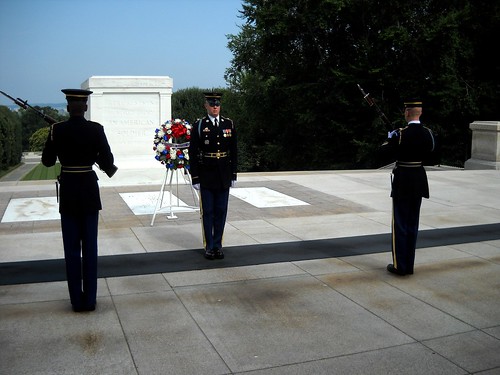
Tomb of Unknown Soldier


Know, all who see these lines,
That this man, by his appetite for honor,
By his steadfastness,
By his love for his country,
By his courage,
Was one of the miracles of the God.


-- Guy Gavriel Kay


"The Green Field of France", by Eric Bogle

Well, how do you do, young Willie McBride,
Do you mind if I sit down here by your graveside?
And rest for awhile 'neath the warm summer sun,
I've been walking all day, and I'm nearly done.
I see by your gravestone you were only 19
When you joined the great fallen in 1916,
I hope you died quick and I hope you died clean
Or, Willie McBride, was it slow and obscene?

Did they Beat the drum slowly, did they play the fife lowly?
Did they sound the death-march as they lowered you down?
Did the band play The Last Post in chorus?
Did the pipes play the Flowers of the Forest?


Did you leave a wife or a sweetheart behind
In some faithful heart is your memory enshrined?
And, though you died back in 1916,
To that faithful heart are you forever 19?
Or are you a stranger without even a name,
Enshrined then, forever, behind a glass pane,
In an old photograph, torn and tattered and stained,
And faded to yellow in a brown leather frame?

Did they Beat the drum slowly, did they play the fife lowly?
Did they sound the death-march as they lowered you down?
Did the band play The Last Post in chorus?
Did the pipes play the Flowers of the Forest?


The sun's shining down on these green fields of France;
The warm wind blows gently, and the red poppies dance.
The trenches have vanished long under the plow;
No gas and no barbed wire, no guns firing now.
But here in this graveyard that's still No Man's Land
The countless white crosses in stand mute in the sand
To man's blind indifference to his fellow man,
And a whole generation who were butchered and damned.

Did they Beat the drum slowly, did they play the fife lowly?
Did they sound the death-march as they lowered you down?
Did the band play The Last Post in chorus?
Did the pipes play the Flowers of the Forest?


And I can't help but wonder, no Willie McBride,
Do all those who lie here know why they died?
Did they really believe when they answered the call,
Did they really believe that this war would end wars?
Well the sorrow, the suffering, the glory, the pain
The killing and dying, was all done in vain,
For young Willie McBride, it all happened again,
And again, and again, and again, and again.

Did they Beat the drum slowly, did they play the fife lowly?
Did they sound the death-march as they lowered you down?
Did the band play The Last Post in chorus?
Did the pipes play the Flowers of the Forest?


Thursday, May 21, 2020

Something for Thursday

Today is the 40th anniversary of the release of Star Wars Episode V: The Empire Strikes Back! I have a longer piece in the works for The Geekiverse, but for now, here is John Williams leading a pretty good music group in one of the most famous themes he has ever composed: the "Imperial March" from that very film.

And the music group? None other than the Vienna Philharmonic Orchestra!


Tuesday, May 19, 2020

Tone Poem Tuesday

In honor of yesterday's 40th anniversary of the major eruption of Mt. St. Helens, a musical work devoted to that very mountain. Alan Hovhaness was an American composer of Armenian descent, and he was very prolific, eventually producing over 500 numbered works in his almost 90 years (and in reality more than that, as when he was a young man he purposely destroyed his entire output to that point in an effort to start again). In 1982 he composed a symphony, his fiftieth, that was inspired by Mt. St. Helens and the 1980 eruption that destroyed its Alpine grandeur and reduced it to a moonscape of rubble. Hovhaness lived in Seattle at the time, so he was about as close to the mountain as I was in Hillsboro (he might have actually been farther away). The piece is in three movements, which Hovhaness described as follows:

When Mount St. Helens erupted on the morning of May 18, 1980, the sonic boom struck our south windows. Ashes did not come here at that time but covered land to the east all across the State of Washington into Montana. Ashes continued to travel all around the world, landing lightly on our house a week later, after their journey all around our planet. In my Mount St. Helens Symphony I have tried to suggest a musical tribute to the sublime grandeur and beauty of Mount St. Helens and the surrounding majestic Cascade Mountains.

The first two movements are evocative of the mountain itself and of Spirit Lake, while the third is most clearly a depiction of the violent cacophony of the May 18 eruption. I don't tend to hear specific things in program music when I listen to it, even if supplied with a program by the composer, but it's not hard to pick up on Hovhaness's mysticism and is willingness to depict that mysticism through interesting orchestral effects. I haven't heard a lot of Hovhaness, and in general he's the kind of composer whose music I find more interesting than emotionally affecting, but this piece is certainly interesting and it does musically depict a sort of naturalistic majesty.

Here is the Symphony No. 50, Mt. St. Helens, by Alan Hovhaness.

Monday, May 18, 2020

"Vancouver! Vancouver! This is it!" Mt. St. Helens, 40 years later

The anniversary is something of a misnomer.


Mt. St. Helens, a mountain in the volcanic Cascade Range in southwestern Washington State, was always thought to be on the verge of significant volcanic activity, and one day when I was in school in March, 1980, my fourth-grade teacher wheeled a teevee cart into the classroom. She plugged it in and started tuning to one of the local stations, which was carrying the event live. An earthquake had jolted Mt. St. Helens, and the mountain was now venting steam from its summit.

If it seems odd that this was on local news, at the time my family and I were living in Hillsboro, OR. We were about sixty miles away from Mt. St. Helens. We had day-tripped there a few times. I don't remember much of those day trips, but I remember the mountain being a lot less of a jagged peak than Mt. Hood, which so famously looms over the Portland skyline. Mt. St. Helens was more graceful, a rounded cone.


I remember watching that exciting footage from the summit of Mt. St. Helens with my classmates, although we were all thinking the same thing, having seen so many movies of volcano eruptions from places like Hawaii: "Where's the lava?" Over the next few weeks we heard about more earthquakes and bulges and things called lava domes. Maybe there'd be lava eventually!


Scientists seemed more and more convinced that a major eruption was likely, and an unlikely local folk hero turned up in the news in the form of an old guy who owned a lodge on the very slopes of the mountain. His name was Harry R. Truman, and he refused to leave his beloved mountain. He was staying right where he was, with his cats. I honestly don't recall if Truman genuinely believed that the mountain wouldn't kill him, or if he couldn't bear leaving it. Given what the mountain looked like for him and what it would look like very soon, I almost can't blame him.

The big blast that everyone was awaiting finally came, forty years ago today, on May 18, 1980. There was no lava, just an enormous earthquake followed by a landslide that took away one entire side of the mountain. And then? Ash and steam and smoke, in a cloud miles high. More than fifty people were killed in that blast, including Harry R. Truman, whose lodge was buried under hundreds of feet of mud and ash and rock and debris.

The scale of destruction is astonishing for me to contemplate to this day. On May 18, the winds were out of the west, so we in the Portland area were spared large amounts of ash-fall. Not so later follow-up eruptions; I remember hosing an inch of ash off our driveway one morning. It was a fine, heavy, gray powder that covered everything. I also remember one day when some friends and I were playing outside and someone's father told us that Mt. St. Helens was erupting again. We rushed to the best vantage point in the housing development, just beyond a stand of trees at the eastern end, and there we saw something that looked very much like this (in fact, it may well have been this):


Although from where we were, we couldn't see the mountain itself. Just this gigantic tower of ash rising into the sky.

Mt. St. Helens continues to be somewhat active to this day, though nothing like what happened in 1980 has happened since.

I remember reading, years later, that as enormous as the devastation was--entire forests leveled, lakes literally sterilized, thousands upon thousands of animals dead--the region came back to life far faster than anyone ever expected. There are fish in Spirit Lake again, and forests are slowly coming back. The evidence of the eruptions still exists, though; Mt. St. Helens will never again be that graceful rounded cone, but a marred shell of a crater, and to this day the waters of Spirit Lake are partially covered by a solid carpet of destroyed trees, blasted from their roots.


Mt. St. Helens and its eruption rank among the most amazing things I've ever lived through (weird phrase, that, since it implies that it was somehow an ordeal in which I took part), and it is thus far the largest natural event I've ever witnessed. It was, quite simply, stunning. I'm glad I got to see it...from a distance. And upwind.

(Images from Wikipedia: here, here, and here. The title of this post quotes the radio transmission sent by geologist David A. Johnston, to his USGS colleagues. Johnston was encamped six miles away from Mt. St. Helens on May 18, and in this transmission he became the first person to report that the eruption was happening. Johnston was swept away and killed by a lateral blast seconds later, and his remains have never been found.)

Thursday, May 14, 2020

Something for Thursday

I haven't seen the movie since the year it came out--1998, I believe--but Shakespeare In Love has always boasted one of my favorite filmscores, composed by Stephen Warbeck. Looking over Warbeck's filmography, it turns out that Shakespeare In Love is the only score of his that I've ever heard. He takes an interesting approach to the film, mostly eschewing the kind of "Elizabethan" sound one might have expected. He also keeps the score mostly on the introspective side, but he also depicts in music a rather optimistic London, which may not exactly be accurate. Warbeck's musical focus is on the developing, and forbidden, relationship between Shakespeare and Viola. This short suite captures a bit of the emotional heft of the music, even though the complete score is well worth a listen. (It's actually joined my rotation of filmscores I play while I write Seaflame! Book Two.)

Tuesday, May 12, 2020

Tone Poem Tuesday

Wow, am I stretching the idea of a tone poem to the breaking point today. This isn't even an entire work, just an excerpt from one...and it's not even a complete excerpt, just a part of the excerpt! Let me sum up:

As the Covid-19 disaster has brought the arts to a standstill just as it has so many other aspects of our lives, people who work in those fields have looked for alternate ways to keep making meaningful art. One thing that's become popular is "socially isolated" musical performances, where individual musicians record their own part, and then the entire thing is stitched together into a larger performance. I've seen a bunch of these over the last few weeks, ranging from performances of the Neil Diamond song "Sweet Caroline" to Ravel's Bolero to...this.

Mahler's Symphony No. 2, subtitled "The Resurrection," is a gigantic work. It's scored for a huge orchestra, full chorus, a soprano and an alto soloist. It takes around an hour and a half to perform, and it runs an astonishing emotional gamut, from stormy and angst-filled passages to meditations on mortality to mysterious passages of solemn power, until it all ends in mystical vastness that is nearly impossible to describe.

About an hour into the symphony, the entire brass section plays a chorale that marks the beginning of the symphony's third act. The strings aren't silenced, but this section belongs to the brass, and I can only imagine what this symphony must sound like in a concert hall with good acoustics. So here we have the brass players of the New York Philharmonic Orchestra (plus a snare drummer and a contrabassoonist) playing the chorale theme from the last movement. It's a fascinating listen, even if it is incomplete.

Sunday, May 10, 2020

From the books: THE HIGH KING

Today, a passage from one of many books that my mother required me to read in moments when my behavior wasn't the best. Actually, though--this isn't from one of those books, but a book downstream in the series that she made me start with Book One. Funny how often those books she made me read were Book One...it's like she knew what she was doing.

This is the closing two paragraphs from Lloyd Alexander's The High King, itself the final volume in Alexander's series The Prydain Chronicles, which was my gateway into epic fantasy and adventure stories. I suppose there are spoilers here, but these books have been around forever, so I make no apologies.

This ending is one of the most perfect endings I know. I hope I can end at least one story half so well as Alexander ended this one.

In the waiting throng beyond the cottage, Taran glimsed Hevydd, Llassar, the folk of the Commots, Gast and Goryon side by side near the farmer Aeddan, King Smoit towering above them, his beard bright as flame. But many were the well-loved faces he saw clearly only with his heart. A sudden burst of cheering voices greeted him as he took Eilonwy's hand tightly in his own and stepped through the door.

And so they lived many happy years, and the promised tasks were accomplished. Yet long afterward, when all had passed away into distant memory, there were many who wondered whether King Taran, Queen Eilonwy, and their companions had indeed walked the earth, or whether they had been no more than dreams in a tale set down to beguile children. And, in time, only the bards knew the truth of it.

Sigh….

Tuesday, May 05, 2020

Tone Poem Tuesday

Film music fans often notice how frequently their favorite composers are tasked with writing wonderful music for movies that really aren't very good. Jerry Goldsmith in particular seems to have made a career of suffering this fate; the poor guy wrote a lot of amazing music for movies that were outright bad.

The phenomenon goes back a lot farther than that, however! Many operas are now rarely heard in full because the librettos aren't very good or the stories have fallen out of favor, but the music lives on, at least in excerpt form or in the overtures. There was also another outlet for dramatic music in the ages before film: incidental music to plays. The famous march that we often hear at the end of weddings? That's by Felix Mendelssohn, who wrote that as part of a suite of incidental music for A Midsummer Night's Dream. Of course, the Shakespeare play has not vanished into obscurity. But virtually gone is a play called Rosamunde, which would be completely and utterly forgotten today if not for incidental music written for it by the great Franz Schubert.

Schubert is, depending on how you think about his music, either the last of the Classical composers or one of the earliest Romantics. Schubert did not live long, but in his short life music poured out of the man, including this suite of incidental music for Rosamunde, a play by Helmina von Chézy. The play, by all accounts, was not terribly successful, and in fact the original text is now lost. The story apparently involved (according to this old New York Times article): "a cursed princess, who had been brought up by sailors, a pursuer, who travels around with poisoned letters - whoever reads them, dies - and a prince, who has to live among shepherds; there is a mysterious shipwreck and, further, ghosts, hunters, and shepherds." Frankly, all that sounds kind of fun to me, so for the play to have failed miserably must be indicative of some terrible writing.

But Schubert did able work in writing the incidental music! The overture is best known, being a suitably thrilling piece that almost evokes Rossini, but the entire suite from the play is something of a delight. Hearing this music, written by one of the greatest composers of all time, we might be tempted to think that the play must have been good, if it inspired music that good. Take the lesson we learn from Jerry Goldsmith's career, though, to heart: This is not so.

Here's the overture and incidental music from Rosamunde, by Franz Schubert.

Monday, May 04, 2020

May the Fourth, and so on and so on....

It's May 4, otherwise known as Star Wars Day! Because "May the Fourth be with you!"

I don't have any major new thoughts to offer today, but here's a bit of music.


The Slow Awakening

I say it every year, and every year I'm given more evidence to back up my hypothesis: Buffalo Niagara's winters wouldn't be nearly so hated by people living here if our springs weren't so godawful each and every year. The three months of winter aren't that hard to negotiate; it's that they are always followed by two more months of cold, muddy, grayness that makes the winters feel less like a season and more like a slog that consumes nearly half the year.

Anyway, it's May now, and only now are the trees starting to show signs of awakening, and only now am I able to see wisps of green around the peripheries of the forests.

The giants are awakening! #KnoxFarm #eastaurora #wny #spring #nature #hiking #trees

Green is starting to show, around the edges.... #KnoxFarm #eastaurora #wny #spring #nature #hiking #trees

"You can't take the sky from me!" #KnoxFarm #eastaurora #wny #spring #nature #hiking #trees #Firefly

I think of this tree as Yggdrasil, writ small. #KnoxFarm #eastaurora #wny #spring #nature #hiking #trees

Of course, it's still Buffalo Niagara. Today it was in the mid-60s, and it's supposed to get colder through the week until the high temperatures next weekend are back in the 40s.

Sigh.

Wednesday, April 29, 2020

Tone Poem Tuesday (Wednesday Edition)

No excuse, I just didn't get to it yesterday. You get what you pay for, folks!

But anyway, a repeat of a favorite work of mine. This twenty-minute concert overture by Edward Elgar is lyrical and exciting. It reminds me of the grand old film scores, in all honesty, with its muscular opening that would accompany the giant "Warner Bros." shield, followed by a big-hearted opening them that would soar as the film's title appears onscreen. Remember when movie titles were GIGANTIC and would take up the entire screen? They don't do that much anymore, do they? And credit montages that set the tone...films nowadays almost never have opening credits at all anymore, saving all credits for the end.

Anyway, Elgar wrote this overture, which he called "In the South (Alassio)", after a winter's holiday in Italy and a village called Alassio. The piece is pure sunlight from start to finish (well, there's a bit in the middle that might be a summer storm, if we're pushing our musical metaphors farther than perhaps we should), and to me it's always a wonderful delight. I don't know why the piece isn't better known, in all honesty; it's one of those works that always leaves me feeling like I've just spent twenty minutes in the company of a master.

Here is Edward Elgar's "In the South" overture, subtitled "Alassio".

Monday, April 27, 2020

Words, and a bird

After a long period--more than a year!--in which I have been mainly focused on editing drafts of various manuscripts, I am finally back to actually drafting one. It's Book Two of Seaflame!, which you may remember by its old not-actual-title of The Adventures of Lighthouse Boy. This one is likely to take most of the rest of the year to draft, because this one is my Alexandre Dumas-inspired doorstop of an epic fantasy (with no magic at all, because I'm weird).

More on that another time, but for now, here's a photo I took a couple weeks ago while walking The Dee-oh-gee at Chestnut Ridge Park. I saw a big crow sitting in a nearby tree, and I went to take his picture, hoping it would turn out. Instead he took wing just as I tapped the shutter release, and...this.

Crow #ChestnutRidge #wny #orchardpark #spring #nature #hiking #trees #bird #crow

Friday, April 24, 2020

Something for Thursday (Friday edition)

Sorry to be a day late, but I had my regular shift at work yesterday, combined with my weekly grocery shopping, combined with having to go back in to work to assist with an overtime job (installing a new refrigerated case). I didn't get home for good until 8:30pm, by which time I figured, "Meh, wait 'til tomorrow."

So here, without a lot of extra comment, is Jimmy Durante. Good night, Mrs. Calabash, wherever you are!

Tuesday, April 21, 2020

Tone Poem Tuesday

Baroque music hasn't always been my cup of tea, but I've made strides in its direction over the years. And even when I wasn't a big Baroque fan, I've always rather liked the music of George Frideric Handel. There's a flashy ostentatiousness to his work that I find appealing, and never moreso than in this piece, which Handel literally wrote to accompany a fireworks display. King George II of Great Britain commissioned the work for a grand fireworks display that was to take place on 27 April 1749, in commemoration of the end of some war or other, and the signing of some treaty or other. The particulars don't seem that important now, as back then some war was always starting or ending and some treaty was always being signed or something, and in any event the weather on April 27th was poor enough to make a general mess of the fireworks, with misfires aplenty, a pavilion catching fire, and several spectators actually being set ablaze. Ouch.

Handel's music, though, provides fireworks aplenty! It starts with joyous drums and fanfares and proceeds from one flourish to another, before we arrive at the more lyrical inner movements and then come back to full-on flourish. If you need a musical boost of enthusiastic pageant in the current crisis, you can't do much better than Handel's Music for the Royal Fireworks.

In this particular performance, take note of the ensemble itself. This is a French ensemble called Le Concert Spirituel, and they specialize in the performance of early and Baroque music on period instruments. This is as close as we can get to what the audiences would have heard in April 1749, minus the rain and miscues from the pyrotechnicians. Note the keyed woodwinds, the valveless horns with their bells held aloft, the drums placed smack in the middle of the proceedings as opposed to being stuck in the back or off to the side. And of course, note the trumpets! Valveless natural trumpets, long and regal, and held one-handed as the trumpeters stand with their other hands on their hips.

Note, too, the flamboyant leader of all this! Herve Niquet looks like a man who just stepped out of the pages of history to conduct this work. The video is worth watching just for the ensemble...but also watch it for the music. Here is George Frideric Handel's Music for the Royal Fireworks.

Monday, April 20, 2020

Poetical Excursion: "The Ruin", from the Anglo-Saxon

This poem is fascinating in that it seems to anticipate Shelley and Ozymandias by almost a thousand years. It describes in some depth the ruins of a Roman city, which has fallen into decay and disrepair, and juxtaposing that imagery with the thoughts of life that must have once flourished there. By the time this poem was written in the 8th or 9th century, the ruins being described (it's not entirely clear which ones specifically are in the poet's heart, or if they're even meant to) had probably been abandoned for centuries already. It's often worth remembering just how much time really passed during the Middle Ages, and how distant a memory the glory of Rome truly was.

The Ruin comes to us from a manuscript called the Book of Exeter, and unfortunately the poem as we have it is incomplete because of fire damage to the book itself. This translation comes from one of my favorite poetry collections. The poem itself is anonymous.

The Ruin

Well-wrought this wall-stone which fate has broken:
The city bursts, the works of giants crumbles.
Roofs are fallen, towers in ruins,
The gate is gone, frost on the mortar,
The shelters in shards, open to showers,
Eaten by age. Earth has in its grasp
Ruler and workman, removed now, perished,
Held fast in the ground while a hundred generations
Went from the land. This wall remained,
Stood under storms, will all around perished.
Bright were the buildings, many bath-houses,
High-gabled homes, and the sound of soldiers,
Many a mead-hall where men enjoyed themselves
Until mighty fate overturned all.
Many men fell in the days of wrath;
Death took all the valor of earth.
Bulwarks became wrecked foundations,
A fortress in fragments. The builders perished.
Defenders gone unver. The courtyard is dreary;
The arch of red stone, the roof with its rafters,
Shed their tiles, and they slip to the earth,
A broken mound. Once many men
Glad and gold-bright, in gleaming array,
Proud and wine-flushed, shone in war-apparel;
Saw the treasure, the silver, the well-set jewels,
RIches, possessions, precious stones,
In the bright fortress of a broad kingdom.
Stone courts stood, the hot stream came
In its broad whelm; a wall enclosed all
Within its bosom. There the baths were,
Hot in the midst. It was a haven.

Translated by Michael O'Brien,
Printed in World Poetry: An Anthology of Verse From Antiquity To Our Time

Thursday, April 16, 2020

Something for Thursday

I've always loved Loreena McKennitt's music, although I did lose track of her for a while. It turns out that she had a new album in 2018, called Lost Souls. Here is the first track from that album, "Spanish Guitars and Night Plazas". I've heard the album all the way through just a couple of times, but I plan to listen to it a lot more, moving forward. Apparently it is comprised of songs recorded or written earlier in McKennitt's career, songs that ended up not included on albums for which they were originally intended; this makes it all vintage McKennitt, and quite wonderful for that.

Tuesday, April 14, 2020

Tone Poem Tuesday

I could do some historical research on this piece, but...nah. Just enjoy the theatrics. Here's Tchaikovsky's 1812 Overture, with chorus! You don't hear the choral version all that often.

Monday, April 13, 2020

Beethoven: the "Hunt" Sonata

Beethoven's Piano Sonata No. 18 (Op. 31, No. 3) has been a favorite piece of mine for years...and for years I didn't know what it was.

I first heard part of it--not the whole work, but a single movement--at my piano teacher's annual end-of-year recital, when a former student of hers returned from college to offer up a quick surprise encore. He play the second movement of this sonata, which is one of the most infectious pieces I know. The movement is a rambunctious and, dare I say it, playful march in a brisk 2/4 time, with one of those Beethovenian melodies that sticks in the head as soon as you hear it.

This sonata is unusual in its construction in that it is in four movements and not the usual three, and that none of the movements is a proper slow movement. The entire work is warm and almost humorous, which is not something one typically expects from Beethoven. However, Beethoven's cultural image is often unfair in itself. This sonata clearly comes from the same mind as the Seventh Symphony and even the Sixth before it, especially that wonderful dance in the Sixth where the bassoon keeps making off-beat entrances.

This performance is excellent, although if you're a traditionalist in your views on deportment in the concert hall, the fact that the pianist is wearing overalls may be distracting. If that's the case, turn your screen off and keep listening, because he performs this sonata wonderfully. As for me, I'm trying to ignore that he's wearing his overalls incorrectly.

Enjoy!

Saturday, April 11, 2020

From the Books: A MAN ON THE MOON (Apollo 13 at 50)


Fifty years ago today, a Saturn V rocket blasted off from Cape Kennedy Spaceport. The destination of the three-man crew--astronauts Jim Lovell, Fred Haise, and Jack Swigert--in the command module perched atop the rocket was the Fra Mauro Highlands on the moon. They never got there. A faulty wire in the service module's oxygen tanks sparked during a routine stirring operation, and the resulting explosion forced the deactivate of the service module's engines and the reliance on the lunar excursion module as a de facto lifeboat, as NASA shifted from a lunar landing to an earthbound rescue operation. Even though the mission's stated purpose of landing on the moon was a failure, the space agency's brilliant work in overcoming one obstacle after another in order to bring the three astronauts safely back to Earth was one of the great success stories of teamwork and technical know-how in history. The mission was Apollo 13. You may have heard of it.


Here's an article from Space.com about the Apollo 13 mission, and here's an excerpt, profiling mission commander Jim Lovell, from Andrew Chaikin's wonderful book about the Apollo moon missions, A Man on the Moon:

At age forty-two, Jim Lovell was the most traveled man alive. With three spaceflights under his belt, he had racked up 572 hours and nearly 7 million miles, more than any other astronaut or cosmonaut. For many men that would have been enough, but not for Jim Lovell. From the day he joined the astronaut corps in 1962, his ultimate goal had been to command a lunar mission. Command was even more important to Jim Lovell than landing on the moon, and most veteran astronauts felt the same way. When [Frank] Borman turned down Deke Slayton's tentative offer to fly the first lunar landing it had everything to do with the fact that he had been the commander of Apollo 8. If Lovell had any disappointment about his commander's decision, it vanished when Slayton assigned him to lead Neil Armstrong's backup crew. Within weeks after Armstrong's team came back from the moon, Lovell and his crew were training for their own landing.

By the spring of 1970, most of Lovell's colleagues from the second astronaut group had moved on to other things. Neil Armstrong had disappeared into the world of postflight P.R. that greeted him on his return from Apollo 11; it seemed unlikely that he would fly again. Jim McDivitt had traded the demands of flying Apollo missions for the equally demanding job of preparing for them, as manager of the Apollo Spaceflight Program Office in Houston. Tom Stafford, though, still on flight status, had replaced Al Shepard as chief of the Astronaut Office, and wasn't scheduled for another mission. And Frank Borman had begun a new life as a vice president with Eastern Airlines. One day Borman came by for a visit while Lovell was in the simulator, and he seemed glad to be free of the training grind. "Jim," he said, "aren't you tired of this? I wouldn't want to go through this again."

Lovell couldn't have felt more differently. This was his seventh time around, counting the stints on backup crews, and even now his appetite for spaceflight was undiminished. He himself described it as an addiction. He could have gone on until NASA said he was too old to fly ano more, but he know that when he came back from Apollo 13 he would face a long wait, perhaps several years, before he flew again. Well aware of the astronauts still waiting for their first flights, he decided he would not get back on line for a fifth. Apollo 13 would be a great finale to a long spaceflight career.

Like every commander, Lovell wanted his mission to stand out, but he couldn't see why people would remember the third lunar landing. And that was fine with him. He wanted badly to land on the moon, and he was glad for the chance to make a contribution to science. The Apollo 13 mission patch read "Ex Lune, Scientia"--From the moon, knowledge--and Lovell thought of that when he christened his lunar module Aquarius, after the god of the ancient Egyptians who brought life to the Nile Valley (not to mention the popular song from the Broadway musical Hair). The command module Odyssey, meanwhile, took its name not only from Homer's epic work but from Arthur C. Clarke's science fiction vision of space travel. When Lovell was back on earth, he would find irony in odyssey's dictionary definition: a long voyage with many changes of fortune.

Thursday, April 09, 2020

Something for Thursday

If you've ever been around piano students or piano teachers, you've heard this work of Beethoven's. The Sonata No. 8 in C minor, also known as the Pathetique, is often a young pianist's first entrance into the world of the Beethoven piano sonatas, and for good reason: it's highly technical but not so demanding as Beethoven's later sonatas, which require very high levels of skill if not outright virtuosity to perform well. The Pathetique also offers a lot of drama, brooding passages, stormy melodies, and drama a-plenty for a young student who is just beginning to engage the last of the Classical composers and, possibly, the first of the Romantics. The work has become almost a cliche, in much the same way that Beethoven's Fifth Symphony has, and it's worthwhile to come to it again once in a while with refreshed ears. Here is the Pathetique Sonata, performed by Daniel Barenboim, one of the greats.

Wednesday, April 08, 2020

A Poetical Excursion: "Love Has Seven Names" by Hadewijch

I read this poem--translated from the original Dutch--in my copy of World Poetry. I had never heard of Hadewijch before, so I did a little digging. It turns out that's about all one can do. Very little is known about the life of Hadewijch, a mystic and poet who likely lived at some point in the 13th century in Brabant, a duchy in what is now Holland. Hadewijch wrote in Brabantian, a language predating modern-day Dutch, and just about everything we know about her comes from the writings of hers that have survived. She had some influence, although she seems to have utterly disappeared from European consciousness in the 1600s, only to reemerge in the 1800s when some of her works were found in the Royal Library in Brussels.

An excerpt from Hadewijch's entry on Poetry Chaikhana:

Little can be said for certain about the life of Hadewijch. Unlike many other women mystics of the time, no biography was written about her, so all we know is what scholars have been able to deduce from her writings themselves.

Hadewijch was probably the head of a Beguine community. The Beguines were a sect of devout women in Belgium, Holland, Germany and northern France. Beguines did not take vows, but they gathered together to live in simplicity and service. Many Beguines were mystics and poets of the highest order.

Hadewijch's poetry has a rich love mysticism. Like her contemporary, St. Francis of Assisi, Hadewijch was clearly inspired by the courtly love poetry of the Troubadours and Minnensingers. The fact that she was familiar with this courtly art form suggests that Hadewijch was probably born to a noble family.

Love Has Seven Names is most certainly a mystical poem, full of lyrical mystery and very clear mysticism, right from the very first line. Seven names for love? Naturally, since seven is a number that is historically beloved of mystics of all kinds.

Love has seven names.
Do you know what they are?
Rope, Light, Fire, Coal
make up its domain.

The others, also good,
more modest but alive:
Dew, Hell, the Living Water.
I name them here (for they
are in the Scriptures),
explaining every sign
for virtue and form.
I tell the truth in signs.
Love appears every day
for one who offers love.
That wisdom is enough.

Love is a ROPE, for it ties
and holds us in its yoke.
It can do all, nothing snaps it.
You who love must know.

The meaning of LIGHT
is known to those who
offer gifts of love,
approved or condemned.

The Scripture tell us
the symbol of COAL:
the one sublime gift
God gives the intimate soul.

Under the name of FIRE, luck,
bad luck, joy or no joy,
consumes. We are seized
by the same heat from both.

When everything is burnt
in its own violence, the DEW,
coming like a breeze, pauses
and brings the good.

LIVING WATER (its sixth name)
flows and ebbs
as my love grows
and disappears from sight.

HELL (I feel its torture)
damns, covering the world.
Nothing escapes. No one has grace
to see a way out.

Take care, you who wish
to deal with names
for love. Behind their sweetness
and wrath, nothing endures.
Nothing but wounds and kisses.

Though love appears far off,
you will move into its depth.

Not exactly the stuff of Hallmark cards, is it? It's a very old view of love, not entirely positive and not entirely negative, either. Hadewijch seems to view love as a natural force in itself, neither positive nor negative. It's something that can go either direction. It is a binding rope, and it is light and fire. It is cleansing dew, and it is actually Hell. That's pretty amazing. Not every love poem is about comparing thee to a summer's day.

Tuesday, April 07, 2020

Tone Poem Tuesday

How about some film music today? And some John Williams?

Steven Spielberg's Catch Me If You Can is one of his more underrated movies, it seems to me; it doesn't come up in conversation all that much, but I think it's just terrific. It tells the story of a young man named Frank Abagnale (Leonardo DiCaprio) who discovers that he has a gift for larceny and for making people believe whatever he's telling them. Frank uses this to escape a home life that he thought was normal but is now realizing is very toxic, and as he makes his way through life cashing fake checks and passing himself off as an airline pilot and a lawyer and a doctor, he inevitably attracts the attention of a particularly focused FBI agent named Carl Hanratty (Tom Hanks). The cat-and-mouse game between Frank and Carl unfolds throughout the movie, and quite brilliantly the movie develops the theme that these two men somehow become dependent on one another. In the end (spoilers, I guess, but the movie's 18 years old and it's based on true events, anyway--Frank Abagnale is a very real former thief and con-man who has since made millions as a security consultant), Carl captures Frank and then brings him on board his own team at the FBI.

There's a wonderful scene in the middle of the movie where, on Christmas night, Frank calls Carl on the phone. Frank is sitting alone in a hotel room somewhere, and Carl is sitting alone at his desk in a deserted FBI office. A somewhat pained conversation takes place; Frank wants to end the chase but he doesn't want to get caught, either. He thinks he's calling Carl to taunt him, but Carl is starting to know his man and has a moment of insight:

Carl: I'll tell you what I am sure of: you're gonna get caught. One way or another. It's a mathematical fact. It's like Vegas: the house always wins.

Frank: ...Well, Carl, I'm sorry, but I-I have to go.

Carl You didn't call just to apologize, did you?

Frank: What do you mean?

Carl: [laughing] You have no one else to call!

That's a great moment. The relationship between Frank and Carl isn't so simple as, say, Valjean and Javert. Both Frank and Carl see themselves as Valjean, and both see the other as Javert. It's quite a brilliant relationship.

John Williams's score for Catch Me If You Can is something of a departure for the great composer, who at this time was in his Harry Potter and the Star Wars prequel phase. Instead of an orchestral epic, Williams returned to his roots as a studio musician in the 50s and 60s, before he really emerged as a composer in the 70s. The score is full of 60s-sounding jazz, with frequent use of melodic percussion, finger snaps, and prominent work for solo saxophone. He writes two bouncy themes, one somewhat dark and one that's incredibly fun, highlighting the dual sides of the film's heist story. But he also leavens all this with some deeply introspective music that draws attention to the loneliness at the heart of each of the two men at the center of the story. The hunter and the hunted are both deeply unhappy, and both realize eventually that all they have is the hunt...until our cop, Carl, the more mature of the two men, realizes that they can work together on a different kind of hunt.

One more thing before the music: Catch Me If You Can has one of the best last scenes I know. Carl and Frank are sitting down, comparing notes over a newly-emerged check fraud case that has landed on Carl's desk, and as they talk, the camera pulls away, across a bustling FBI field office. Frank gives the movie's last line, which is fantastic:

FRANK: Now all we gotta do is catch him.

What a great movie.

Back to the music: this performance, which I just found a couple hours ago as I was writing, is a selection of cues from the film, performed by a student orchestra in Poland, almost as a Concerto for Saxophone and Orchestra. It's an absolutely wonderful performance, and as I write these words, I'm listening to it for the third time today. Here is a suite from John Williams's score to Catch Me If You Can.

Monday, April 06, 2020

Poetical Excursion: A poem about overalls!

So, something cheerful...I'm going to try to post more of that sort of thing over the next few weeks, I think. The world has darkness a-plenty and I'll be occasionally writing about that, too. But here's a poem I found by an author named Tony Johnston. She is a prolific writer of books for children who lives in California. This is from a book called Once in the Country: Poems of a Farm, written in 1996.

My Overalls

The best thing is their color,
old-night or early-dawn.

No, the best thing is their limpness
when I hoist them on.

No, the best thing is their looseness
like the soft skin of a pup

No, the best thing is their buckles
like a suitcase snapping shut.

No, the best thing is their perfume
of cows and hay and dung.

No, the best thing is their many holes
to let in all the sun.

Obviously I don't own any overalls that are redolent of "cows and hay and dung", but I do have a couple of old pairs--vintage!--that aren't quite holey yet, but may get there sooner rather than later.


More poems to come!