Saturday, July 30, 2016

Symphony Saturday

Tchaikovsky wrote one symphony that he did not give a number. This work is quite different from his other symphonies, in that not only is it not numbered, but it is a programmatic work that carries a title: Manfred. In terms of order of composition, Manfred falls between the Fourth and Fifth Symphonies, which is why it's featured in this spot, this week.

I had never heard the Manfred Symphony until just a couple of weeks ago. It is a strange work, to be sure -- it has moments of absolute brilliance, and it also has moments that make clear some of Tchaikovsky's later dissatisfaction with it. The brilliant moments, though, are so brilliant that on balance I end up truly enjoying this piece, and wondering why it seems to languish in obscurity, compared with Tchaikovsky's other symphonies.

From what I've read, the work has never really overcome its programmatic elements, some of which led Tchaikovsky into structural problems. (Or so say the critics.) The result is a work that is at times disjointed and inorganic, especially in its final movement. I'm honestly not sure about all that, but I do know that the work is also technically difficult, occasionally requiring virtuoso skill from its players, and it also calls for a very large orchestra, which contributes to the fact that it is not played all that often outside of recording studios. Opinion on Manfred seems largely divided.

Most interesting to me is the story of the work's genesis. Mily Balakirev had a program, based on Byron's poem Manfred, which he wanted to see composed into a symphony. He first tried to entice Hector Berlioz himself to do the job, after hearing Berlioz's wonderful Harold in Italy, but Berlioz demurred, citing his age and ill health. (As Berlioz had a year left to live, he seems to have been quite correct.) The program ended up finding its way to Tchaikovsky's hands, and Tchaikovsky composed it. The reaction to the work was divided from the outset, and Tchaikovsky himself considered destroying parts of it:

He found progress difficult, but by August 1885 he declared “this will perhaps be the best of my symphonic compositions.” By the time of the première in March 1886, he was qualifying that “because of its difficulty, impracticability and complexity it is doomed to failure and to be ignored,” and by 1888 he declared that “it is an abominable piece, and that I loathe it deeply, with the one exception of the first movement.”

The work's program is as follows:

1.Lento lugubre - Moderato con animo

Manfred wanders in the Alps. Wearied by the fateful questions of life, tormented by the burning anguish of helplessness and by the memory of his criminal past, he feels cruel tortures to the soul. Manfred penetrates deeply into the secrets of magic and communicates imperiously with the mighty powers of hell, but neither these, nor anyone in the world can give him the oblivion which is the single thing he vainly seeks and begs for. A recollection of the lost Astarte, whom he once loved passionately, devours and gnaws at his heart and there is neither limit nor end to the boundless suffering of Manfred.

2.Vivace con spirito

The Alpine fairy appears to Manfred in the rainbow from the spray of the waterfall.

3.Andante con moto

Pastoral - picture of the simple, poor, free life of the mountain dwellers.

4.Allegro con fuoco

Underground devils of Ahriman. Infernal orgy. The appearance of Manfred amid the Bacchanal. Summoning and appearance of the shade of Astarte. He is forgiven. Death of Manfred.

And here is the symphony itself. Let me know what you think!


Next week: The Fifth, which happens to be one of my most beloved works of classical music!

Thursday, July 28, 2016

Something for Thursday

I know, I know -- complete lack of posting of late! As usual, sorry about that. Nothing bad is going on -- quite the opposite, actually! I'm writing and working and this week we've been spending time at night with a couple of good friends from our college days who decided that it was high-time they saw Niagara Falls and some other nifty stuff 'round here, so I actually have not even been at the computer much. And that's a good thing! It's been a tiring week, but in a way that is recharging some other batteries. That doesn't mean we can't have some music, though!

I know I've featured the Polovtsian Dances by Alexander Borodin before, but I don't know how long it's been and hey, I love this music so much that I don't care if I featured it last week! I've been on a big Borodin kick of late, so much so that I'm wondering why it took me this long to really lock onto him. I've been vaguely aware of Borodin for years, but only recently has be really pushed through into my consciousness, and I am very glad that he did. Here is how David Dubal describes Borodin in his book The Essential Canon of Classical Music:

With such a short life of so many demands, Borodin composed little. His music is the most lyrical in spirit of the Russian Five, and his melodies possess a delicate "oriental" atmosphere. His compositions have a special sweetness as well as a legendary character. In highly charged and picturesque music, Borodin idealized the savage life of the Russian steppes. His pieces have the allure of blazing Tartar blades and Arabian steeds in the heat of battle. It is music that leaps forward and seductively whispers mysterious romances in the slow movements.

This particular performance of the Polovtsian Dances is taken from a production of Borodin's opera Prince Igor, and the choreography of this production is as captivating as Borodin's music itself. I'm happy to note that this entire production of the opera is also available online, and I'm really thinking that I need to watch it. (And if you hate opera, it's OK -- the only singing here is by a chorus.)

Here are the Polovtsian Dances from Prince Igor, by Alexander Borodin.

Monday, July 25, 2016

View from a Saturday Morning

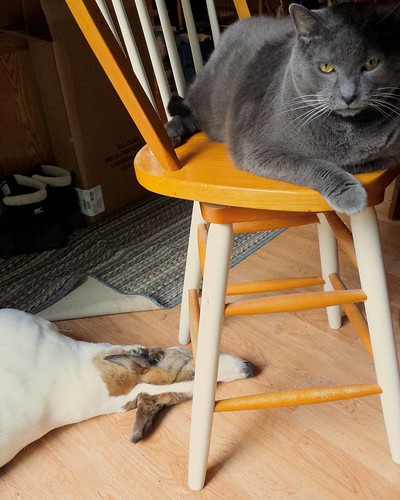
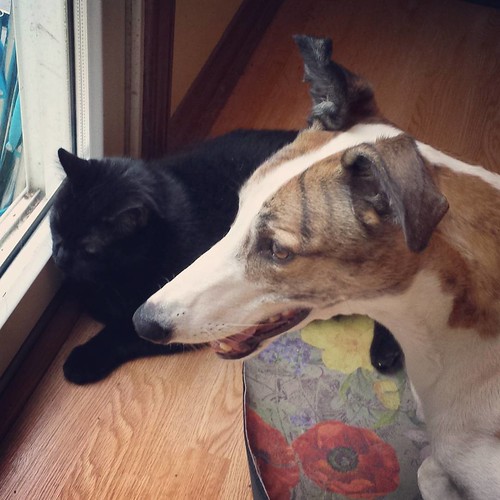
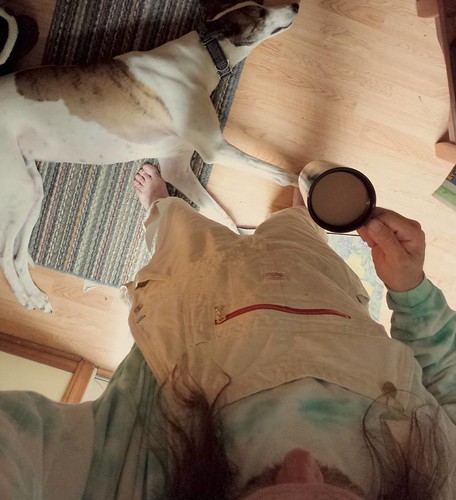
Over coffee the other morning, this was my view:

An exciting Saturday morning at Casa Jaquandor! #Cane #DogsOfInstagram #greyhound #Lester #catsofinstagram

Lots of excitement, let me tell you.

Saturday, July 23, 2016

Symphony Saturday

We now reach the later period of Tchaikovsky's career as a symphonist, which is where things go from "good", "solid", and "promising" to "great". This is the Symphony No. 4 in F minor.

I have to confess that I didn't always like this symphony all that much, but I have warmed substantially to it over the last few years. Tchaikovsky's music is, in a lot of cases, best understood in the light of the events of his life at the time he was composing. This symphony, which has some of the most anguished passages I know, sprang from Tchaikovsky's suicidal days after his ill-advised marriage and the beginning of the great relationship of his life, his patronage by the wealthy Nadezhda von Meck. This symphony begins with a passage he referred to as "Fate knocking at the door", which is a phrase that has also been used to describe the opening motif of Beethoven's Fifth Symphony, and indeed Tchaikovsky seems to have taken that earlier great work as a major inspiration:

Of course my symphony has a program, but of a kind impossible to formulate in words... Was it not the purpose of the symphony as a musical form to express that for which there are no words, but which surges from the soul and demands expression? Basically, my symphony is patterned after Beethoven’s Fifth. Not Beethoven’s musical ideas, but his fundamental notion... The Beethoven Fifth has a program. There can be no doubt what he wishes to express. The same idea underlies my own symphony, and if you have not understood me, then the only conclusion to be drawn is that I am not a Beethoven, which I myself have never doubted. I will add only that there is not a single line in my symphony which I have not felt deeply, and which does not echo true and sincere emotions.

He would dedicate this symphony to Madame von Meck, who prized it highly when he played it for her on the piano. Doubtless she was moved by the work's feel of constant emotional struggle and turmoil, and was then brought to a state of intense excitement by the finale, which sounds in its closing passages as though the orchestra is going to levitate, so great is the energy being expended.

Here is Tchaikovksy's Symphony No. 4 in F minor. (Pay special attention to the conductor at the 12:00 mark. I'm always amazed this doesn't happen more often!)


Next week, we're still with Tchaikovsky but we take a break from his numbered Symphonies for one that's titled.

Friday, July 22, 2016

Bad Joke Friday

Courtesy Bad Science Jokes:

A guy goes to a psychiatrist.

"Doc, I keep having these alternating, recurring dreams. First I’m a teepee; then I’m a wigwam; then I’m a teepee; then I’m a wigwam. It’s driving me crazy. What’s wrong with me?“

The doctor replies:

"It’s very simple. You’re two tents.”

Thursday, July 21, 2016

Conventional Reactions

My reactions to the Republican National Convention have been pretty evenly divided between these two videos:


That's about all. This is just about the weirdest damn thing I've ever seen. I can't even fathom how one whole segment of American politics has become like this.

And just think -- if trends continue, and they don't somehow win with this shitshow this year, in 2020 they'll come back even crazier.

UPDATE: I wrote this post before I read the leaked text of Trump's acceptance speech, and jee-sus, that is some messed up shit. That speech may be the single most twisted thing I've ever read, full of half-truths, twisted facts, and outright lies all used in service of maintaining the notion that white Americans should be cowering beneath their beds in the face of the dystopic hellscape this country has become.

I thought Atlas Shrugged was the most twisted thing I'd ever read, but whoever wrote this speech has topped it. My prayer now is that this election represents the death-throes of a particularly ugly strain of thinking on the American right, and after this they'll start swinging back toward rationality and reality again. A country cannot prosper when so many of its people think like this.

Something for Thursday

I was looking for some music to post on Facebook for SamuraiFrog's fortieth birthday (go say hello to him!), and I found this quite by accident. And what a happy accident it is! Here is the United States Marine Band performing selections from John Williams's score to The Force Awakens. It's a five-selection playlist, so make sure the whole thing plays. I've had trouble posting embedded playlists from time to time.


By the way, the United States Marine Band is an amazing ensemble. It selects its musicians after a rigorous audition process, and its musicians are the equal of musicians in any professional orchestra in the United States. This is not just some band that plays Hail to the Chief and a bunch of Sousa marches. In short, speak ill of the United States Marine Band, and you will quickly incur my wrath!

Tuesday, July 19, 2016

"You can type this shit, George, but you can't say it."

I recently read a fascinating book about the Star Wars phenomenon, titled How STAR WARS Conquered the Universe: The Past, Present, and Future of a Multibillion Dollar Franchise. Written by journalist Chris Taylor, the book traces the history of Star Wars, not as purely a “making of” story, but as a cultural phenomenon. It’s a terrific book that I reviewed on Goodreads, but I wanted to revise and extend those remarks a bit.

This book is one of the most even-handed accounts of Star Wars and the work of George Lucas that I have read. There isn’t much axe-grinding here, which I greatly appreciate. Taylor is interested in just how this thing called Star Wars came to be one of the dominant pop-culture forces today, tracing the influences that led a young George Lucas to think more and more obsessively about his “little space movie”, and then tracing its own influences on those who came after and showing some of the many and surprising ways that Star Wars has enhanced and influenced the lives of several generations of fans, geeks, and whatever else has come afterwards.

Star Wars started as one movie that wasn’t even supposed to be 20th Century Fox’s big picture for 1977, but it became an enormous force, as everyone knows. It is certainly, along with Star Trek, likely the single biggest influence on my creative life, and it’s inspired an astonishing amount of activity over the years, from comics to music to books to fan films to cosplayers, some of whom have organized into the largest amateur costuming group in the world after the Society for Creative Anachronism. All that, from the imagination of a filmmaker from Modesto, California who only became driven to succeed after he nearly died in a car crash in his youth.

From my perspective, the best parts of the book are those that home in on George Lucas’s creative process. A lot of ink and a lot of pixels have been deployed over the years in discussing Lucas, many times in derision. What emerges in this book – and in others I’ve read, such as Rinzler’s wonderful Making of... books for each of the original Star Wars films – is a man with a deeply non-linear creative process. Lucas’s approach seems to be to generate ideas by the dozen, and then mix-and-match them in various ways until something coherent begins to emerge. Sometimes his earliest ideas are set aside only to return many years later, and sometimes his early ideas stick around through most iterations of story.

The genesis of Star Wars, as it went from being an enormous and ungainly thing bogged down in dozens of names and jargon terms, was a very messy process, and it’s always amazing to me to see the long litany of notions that came and went. There are ideas that Lucas entertained in 1975 that would not show up on film until thirty years later (such as the planet Utapau, present in the earliest drafts of Star Wars, when it was called The Star Wars, and which would not actually show up on film until Revenge of the Sith). In this way, Lucas reminds me of some favorite artists of mine, like composer Hector Berlioz, who would think nothing of using a melody in an early work and then using it again many years later, if he felt that he still had use for it.

The messiness of Lucas’s storytelling process stands at odds with things he says later about his own process, which is something that a lot of people have used as a source of criticism. Lucas is often thought to have promised a nine-episode Star Wars saga back in the days of the Original Trilogy, but his actual statements were that he had written an enormous story and then cut it in half, resulting in the Original Trilogy being the second half; the seventh, eighth, and ninth episodes were only conceptual in nature. This seems to be partly true, but Lucas didn’t so much cut an original story in half as he kept reducing his focus. The “Star with Episode IV” approach seems to be more emergent than intentional, which is not a bad thing.

Here, from the book, is just such an example of one of Lucas’s old ideas resurfacing much later on:

The moment Lucas decided to add a kind of rational, scientific component to Jedi knowledge of the Force, in Episode I – the infamous “midi-chlorians,” microscopic organisms that are supposed to help the Force bind to living beings – long-time fans revolted. It didn’t matter that, as Lucasfilm protested, the midi-chlorians are not supposed to be what the Force is actually made of – just a biological indication of its presence. If you dig deep enough into the Lucasfilm archives, you’ll find Lucas talking about midi-chlorians as early as August 1977. “It is said that certain creatures are born with a higher awareness of the Force than others,” he said during a role-playing exercise designed to help him flesh out Star Wars concepts after the original movie. “Their brains are different; they have more midi-chlorians in their cells.” This didn’t matter either. What fans actually want, it seems, is as little detail as possible. They want twenty-eight words, and nothing more.”

The twenty-eight words Taylor refers to is the simple description of the Force given by Ben Kenobi in A New Hope, and nothing more. Without rehashing the whole midi-chlorian thing, it’s certainly interesting that Star Wars fans seem to want to leave things open and mystical and unexplained in a lot of cases. They certainly stand in contrast to, say, fans of JRR Tolkien, who want as much detail as humanly possible, to the point of learning to speak fictional languages and developing their grammars beyond what Tolkien created. (I still maintain that the midi-chlorians are not a category error but a storytelling one. Their existence adds exactly nothing, story-wise, to the Star Wars saga.)

This book also provides some evidence in favor of an oft-cited notion, that Lucas functions best when he has a strong voice to tell him “No.” By the time of the production of the Prequels, Taylor describes Lucas as so revered that literally no one goes against him in any way at all. I’ve never been totally convinced of this, and I’m still not. Producer Rick McCallum doesn’t come off terribly well, being shown as mainly a yes-man, but still: Lucas brought in script help for all three Prequels, in acknowledgment of his own weaknesses in the writing department. (Which are, in my view, a bit overblown.) Taylor’s own negative opinion of the Prequels stands, but to his credit, he does give voice to some pro-Prequel voices, and he acknowledges that they are not the irredeemable films that many have deemed them. (I’d rather he hadn’t even mentioned that awful Red Letter Media guy at all, though.)

Taylor seems fairly bemused, in the closing chapters, by the fact that Star Wars fandom has only strengthened over time, even in the face of three Prequel films that are, shall we say, less than beloved. As the book closes, Lucas has sold it all to Disney, but even then he was starting to knock around ideas for Episodes VII through IX, the ones he had previously said he’d never do. One ends up wishing that George Lucas would simply come out and admit that Star Wars has been his life. That wouldn’t be so bad a thing, would it?

Ultimately, Taylor’s book does a wonderful job of tracing the growth of Star Wars in our cultural life, and he also shows how it came to utterly dominate the life of its creator, a complex man whose own skills, great as they are, were not always a match for what was in his head. I’m grateful for the book’s portrayal of a George Lucas who is flawed genius, instead of a hack who just happened to get lucky a couple of times. I hope Taylor gets to revise the book in five or six years, once the Saga again stands complete. Unless, of course, Disney decides to fire up production on Episode X in due course....
Saturday, July 16, 2016

Symphony Saturday

Sorry for missing last week, but here we are again. Tchaikovsky's third symphony, the Symphony No. 3 in D Major, is an interesting work, almost experimental in its form. The symphony is in five movements instead of four, and in it Tchaikovsky makes use of Polish dance rhythms, which led to the work initially being dubbed the "Polish" Symphony.

The symphony is kind of an odd work. It has a sense of optimism that seems, frankly, a little out of place for the famously brooding Tchaikovsky; this is the only one of his symphonies to be written in a major key.

Here is the Symphony No. 3 in D major. Next week, the Fourth, which is a work I've struggled with over the years.

Friday, July 15, 2016

Bad Joke Friday

In honor of the upcoming Olympics: I used to have a fear of hurdles, but I got over it.

Thursday, July 14, 2016

Something for Thursday

I heard a performance of this on the radio the other day, and since this is one of those "Hear it once and hum it for days and days" pieces, I just have to share it. It's one of the most famous overtures of all time, even if the opera it opens isn't performed very often. The overture is in four sections, and the third and fourth comprise two of the most famous passages of classical music ever, with the slow section often used to accompany pastoral imagery in film and teevee, and the final section...well, everybody knows what association eventually resulted there, don't we?

Here is Rossini's Overture to William Tell.


Wednesday, July 13, 2016

In (partial) defense of SCORPION


So we’ve been watching a show called Scorpion lately. It just wrapped up its second season; we’re four or five episodes into the second year.

Scorpion is a techno-thriller show about a team of supergenius misfits who are all brilliant at something but who all lack social skills to one degree or another (and they're led by Walter O'Brien, the guy among them who boasts both the highest IQ and the least amount of social acumen, and who is apparently based in part on a real guy), and their Homeland Security handler who manages their caseload and the local waitress from a diner who ends up helping the team to interact with people who are not supergeniuses. Together, this team – called “Scorpion”, hence the name of the show – addresses problems.

I’ve always liked this kind of story, the team-of-skilled-folk who put their skills together to accomplish amazing stuff and solve problems. I guess it goes back to The A-Team for me, although this style of story certainly goes back much farther than that; The Guns of Navarone is one such story, I suppose. Maybe Mission: Impossible! is as well. But this show’s most recent ancestor seems to be the wonderful Robert Redford-led ensemble caper flick Sneakers. The formula is always the same: each person in the team has a different skill set, and they are called upon in various ways to help out in the missions. You have the leader, the supergenius hacker; the supergenius psychiatrist; the math genius who is afraid of his own shadow; and the mechanical wizard who can do anything with a set of tools and whose main means of expression is harsh bluntness.

Scorpion is basically our current source of light, fun action entertainment. It’s not a great show, although I do sometimes get the impression that it could be, if it ever really homes in on its tone. The first season never quite got there, and my general impression was that the writers really needed to just let go an embrace the full-on potential their show and its characters have for some really gonzo geeky storytelling. Happily, they seem to be trending in that direction in the second season. There’s been some really gonzo stuff happen already, and hey, the second season gave us a slow-motion shot of Katherine McPhee in a wet t-shirt. (What can I say.)

So Scorpion’s not a great show, but it’s a fun show with some potential. I think it needs to delve even more into its wit and potential for comedy, and avoid the pitfall of getting too “dark and serious”, outside of maybe an episode or two, here and there, just to change things up. Scorpion is at its best when it uses humor along its way, and I hope the writers sharpen the wit as the show moves forward. They've already discovered the fact that with stories like these, once you establish what each character can do it's cool to stick them in situations where one has to call on skills that another member of the team has.

Some other things Scorpion does well? For one thing, the cast is terrific. These aren’t great actors, by any means, but there’s a lot of chemistry here, which is important in a show about a team. You really do get the sense that these people all like and care about each other, even their gruff Homeland Security handler agent (played by Robert Patrick, the T-1000 himself).

For another, I like that Scorpion’s challenges are varied. Sometimes they have to do straight-up espionage, such as an episode in which they have to break into Cuba’s central bank; other times they have to help find a group of lost hikers in an area where wildfires are starting to sweep through. Each episode manages to come up with a different bunch of challenges, so thus far there’s not a real sense of formula yet.

Additionally, while there are serial elements to the show (and I do think that Scorpion is leaning too heavily on romance amongst the team members in this regard), so far there is not some big overarching mytharc story behind it all. I love that. There’s no “Who killed so-and-so’s parents” or any other slowly-unfolding larger story to Scorpion. There’s no “big bad villain” to be sought after over the show’s run, with BIG DRAMATIC DEVELOPMENTS in the major storyline coming in sweeps-month two-parters. We have a few budding romances, and an ongoing story involving hero Walter O'Brien's dying sister. (As of this point in our viewing, she hasn't died yet, but I know that she does go, soon.) In a time when every show seemingly has some continuing story behind its individual episodes, and in a time when those continuing stories often get drawn out to the point of nobody caring anymore (I’m looking at you, Mentalist, with your chase of Red John going on way past the point of giving a crap), it’s refreshing to see a show that really downplays its serial aspect.

Scorpion is mainly exactly what it sounds like: a fun, likable show that isn’t trying terribly hard to be more than that. And you know what? That is just fine.

And besides....
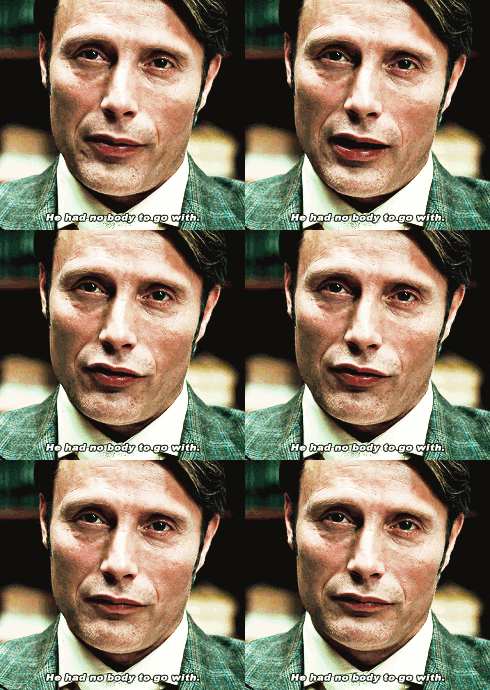


I know. I’m the worst.

Thursday, July 07, 2016

Something for Thursday

When you're a trumpet player, sooner or later you come up against the Concerto for Trumpet and Orchestra by Haydn. It's one of relatively few notable solo works for the instrument between the Baroque period and the modern years; it's by one of the great composers; and it's a fine piece in its own. There are technical reasons why the trumpet didn't really take off as a melodic instrument until after the invention of valves in the 1820s or so (Haydn's own concerto was written for a keyed trumpet, which was a faulty kludge of an instrument that never really took off), but it's disappointing that none of the great Romantic composers ever saw the instrument as a vehicle for solo work.

Here is a performance by Adolph Herseth playing the solo part. Herseth (one of my great musical heroes) was not a soloist by temperament, but you can hear his amazing skill on full display here.


Tuesday, July 05, 2016

The Terrible Dee-oh-gee

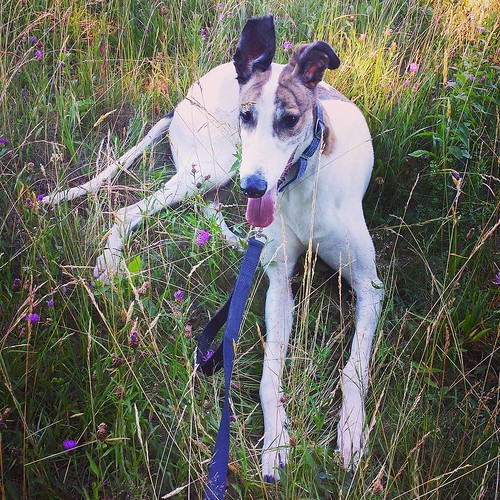
Cane is a terrible dog. I know he doesn't look like a terrible dog, but he is.

Sometimes a brief respite in the grass is nice. #Cane #DogsOfInstagram #greyhound #KnoxFarm #EastAurora #wny

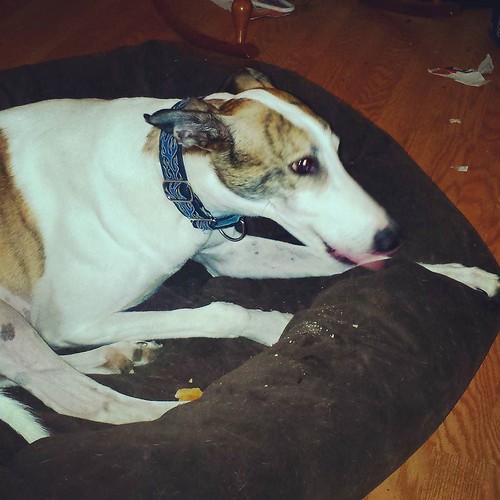
Today when I got home from work, he was outside with The Wife as she was hanging laundry on the line. I came outside and he did the whole "Yay! You're home!" thing, and then he ran a bit and did his business in the corner out by the fence and ran some more and pressed up against me for pets and ear-rubs and all that sort of jazz. Then he went back inside, and I came in with The Wife. We chatted a minute or two about our days, and then I noticed Cane standing near the refrigerator. See, when he comes back inside from doing something, often times he'll get a dog biscuit. Not always, but probably most times. We keep the biscuits atop the fridge. So I noted him standing there grinning at me, and I fetched him a biscuit, which he happily took off to his bed and munched on.

Whereupon The Wife starts laughing and says, "He just totally played you."

I asked, "What are you talking about?"

And she replies, "I gave him a biscuit two minutes before you did! He just had two biscuits in two minutes!"

I looked at Cane, shocked at his conniving behavior. He seemed unmoved by my outrage.

And that is why Cane is a terrible, terrible, terrible dog.

Cane connived me into giving him his second biscuit in two minutes. Because he's a weasel. #Cane #DogsOfInstagram #greyhound

Sunday, July 03, 2016

Sparing no expense for the Prez

I look at this photo and I think one thing:

P091109PS-0503

"Two buckets and a board? Really? The PRESIDENT is coming to see what we're doing and we can't splurge on a friggin' STEPLADDER?!"

Saturday, July 02, 2016

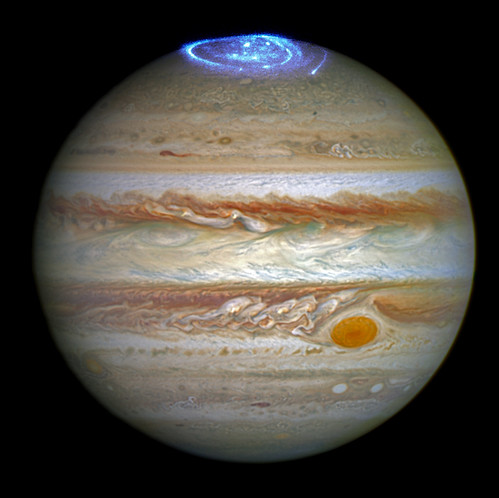
Wow.

That is all.

The Auroras of Jupiter, captured by Hubble.

Hubble Captures Vivid Auroras in Jupiter’s Atmosphere

Symphony Saturday

Tchaikovsky's Symphony No. 2 in C minor is very, very new to me: I first heard it a week ago, after I posted about the Symphony No. 1! I don't really have a great deal to say about this symphony, actually. It's a very nice work, and it would undoubtedly be a lot better known if it hadn't been so overshadowed -- along with the First and Third -- by the back half of Tchaikovsky's symphonic output. The Symphony No. 2 abounds with the feel of Eastern European folk music (he actually used Ukrainian folk songs in the work), and Tchaikovsky's typical fine and transparent orchestration, with some wonderful writing for the horn, strings, and woodwinds.

This is a fairly short symphony, clocking in around 35 minutes. Apparently Tchaikovsky revisited the work some years after its initial composition, and thus we now have two versions -- the original (which ran 40 minutes) and the revised version, which the composer preferred. Critics and musicologists have argued compellingly for each version, but I tend to defer to the wishes of creators in such matters.

Here is Tchaikovsky's Symphony No. 2 in C minor.


Next week: The Third Symphony!

Friday, July 01, 2016

Bad Joke Friday

What do you call a fish with two sodium atoms?

A 2Na fish!

Thursday, June 30, 2016

Monday, June 27, 2016

"Always": On the conclusion of CASTLE


So Castle has ended.

Finally...mercifully...ended.

I would rather it left leaving me wanting more, but as the last weeks of this season ticked by, I found myself actually hoping for the show’s cancellation. When it came, I felt a keen sense of relief, because not only was Season 8 mostly disappointing (and occasionally downright bad), Season 9 was setting up to be awful. Stana Katic was actually released from the show for Season 9, if it happened, so we were actually going to have Castle without Kate Beckett, and that would have been ridiculous. Best to get the thing off the air now, when it’s still in “stuck around too long” territory and not in the “completely bottomed out” region.

So what the hell happened?

A number of things. The worst was that the show was handed off to its third set of showrunners for Season Eight, and these folks simply weren’t nearly as good a group of writers as the previous showrunners, and certainly not as good as they show’s creators. That’s a big thing. Writing is everything, and in the last season, Castle just didn’t have the goods.

For one thing, they felt the necessity of having another Major Story Arc, so they somehow managed to resuscitate the Beckett’s Mother’s Murder thing, which had been long put to bed. The story they cooked up didn’t so much reestablish that as a mystery, but they posited another bad guy out there who had it in for Beckett for some reason, someone so scary that he terrified Senator Bracken, the guy who had actually engineered Beckett’s mother’s death. This person, a shadowy figure known as ‘Loksat’, was up to...well, we have no idea. Maybe this was explained, but I couldn’t tell you what Loksat’s plot was if you held a gun to my head. Loksat was known in intelligence circles, and...well, it was a dull and convoluted story that was never involving at all.

And then there were the complications this story involved. For reasons beyond comprehension, the writers decided that it would be a good idea to have Beckett leave Castle because she had to keep him safe while pursuing Loksat (while still being a Police Captain), so we had half a year’s worth of bullshit stories that had Castle aggressively courting his own wife, who had left him for reasons she wouldn’t tell him, and so on and so forth. This led to an awful lot of terrible shenanigans, some of which made me wonder if Castle had become a detective-story version of Three’s Company. This was all terrible, terrible writing that treated the characters like plot-device caricatures.

Castle has not always been perfect – case in point – but it was never this bad, either. Lots of folks attribute this to the fabled “Moonlighting Curse”, in which the sexual tension is the main driver of story and once you get rid of it, your story goes up in smoke. That might have been true with respect to Moonlighting, which was (let’s be honest) a shitty show in which the sexual tension was the only interesting thing about the characters, but that’s not some holy law carved in stone as many seem to think. There’s no fundamental law of storytelling that says that as soon as Castle and Beckett got married their status as an interesting couple had to be doomed, and the frustrating thing about the way it all unfolded is that the writers actually had a couple of interesting ideas but still screwed them up.

When Beckett “separated” from Castle, it further meant that he couldn’t hang out at the precinct and help the police solve cases. The writers solved this by having Castle become a licensed private investigator, and he took on his daughter Alexis as an assistant. This was actually a great idea, and would have been easily set up without the stupid bit about the separation: since Castle’s original permission to follow the precinct detectives came via his friendship with the mayor of NYC, simply posit that now there’s a new mayor who doesn’t like Castle, and boom! Problem solved! But no, instead the writers had Castle using his PI business as a way to “court” his own wife. This was a good idea whose execution was painful to watch.

Also painful was the use, then non-use, then use-again, of Castle’s father’s status as some kind of superspy. We never saw his father, but his new stepmother showed up just to help with the exposition of Loksat. That’s all that was ever done with any of that, except for referring to it in the context of Castle’s three-month disappearance a season or two ago (a very lame development in itself, which was the first canary-in-the-coal-mine incident that the show’s writers at that time were running low on ideas).

There were interesting episodes here and there in Season Eight, but on the whole, Castle went out on a deeply disappointing and silly note. Alas...there really could have been an interesting show spun out of two married detectives solving crimes. Castle could have morphed into an updated Hart to Hart, for example, or it could have done more with its occasional delving from murder mystery into spy fiction. Alas indeed. ‘Twas not to be.

Oh well. Castle still gave us four terrific seasons, a couple more decent seasons, then one “meh” season and finally a bad one. That’s more than we get from a lot of shows, and eventually I look forward to rewatching those earlier years. So many wonderful moments on this show, and I’ll always appreciate the way Castle managed to set a murder mystery show in New York City without also making NYC look like a horrible place of awful violence where only the crazy go. At its best, Castle was a witty and smart show that used its main character’s status as a writer to wink at the audience about the very tropes of storytelling that it was using. It was also a show with a very fine supporting cast, and a lot of great chemistry all the way around. It was fun and beautiful to look at and it had nifty premises and it gave me one of my favorite teevee literary jokes ever, when a guy survived being shot by virtue of the bullet encountering the copy of Brothers Karamazov in his jacket's inside pocket, leading Detective Ryan to quip, "Good thing this guy likes Russian lit; if he's a Nicholas Sparks fan, he's dead right now."

I plan to give the show a year or so to get the taste of Season 8 out of my mouth, and then? I might start rewatching it. The first five or six seasons, anyway. Because, you know.

Always.


Saturday, June 25, 2016

Symphony Saturday


Peter Ilyich Tchaikovsky.

I've always had a difficult relationship with Tchaikovsky, but over the last few years, I find myself more and more attuned to him. His famous Piano Concerto No. 1 remains a work that vexes the hell out of me, but I like parts of it enough to outweigh the things I find difficult in it; the 1812 Overture and the Capriccio Italien remain fun potboilers, even if the former is really twice as long as it needs to be. Tchaikovsky's symphonies, though? Well, even there I've always had trouble. For one thing, even though he wrote six total, it's the last three that show up on frequent programs; in fact, until I did listening for this post, I'd never even heard the first three. I disliked the Fourth for years (only now changing my opinion), and the Sixth was nice but didn't really do a whole lot for me. (I've yet to relisten to it for this series, but I'm looking forward to it.) What started my transition on Tchaikovsky (whose ballet music I have always loved) was the Fifth Symphony, which I've always liked and which a few years ago grabbed my heart in a way that few works ever have...but we'll get to that.

Tchaikovsky was the consummate tortured Russian Romantic who poured the struggles of his soul into his art. His life was one of constant turmoil, and his relationships were stormy and too often ended in death or, in the case of his patron Nadezhda von Meck, the enigmatic and sudden ending of the relationship with no real explanation. Tchaikovsky was also homosexual at a time when that was not a thing to be, and some think that his death -- from cholera which resulted from his drinking unboiled water during an epidemic -- was at least partly suicidal.

From all this arose some of the most enduring and popular works of classical music ever written, including the last three symphonies. The first three, however, are interesting and fine works in their own right, so I decided to go ahead and just include them all in the course of this series. That's partly why I took a break from these posts for two weeks: I had catchup listening to do!

So, what of Tchaikovsky's Symphony No. 1? It was his first (obviously) real foray into the world of large-scale symphonic works, which he began composing shortly after entering conservatory. As a youthful work, it does show some signs of inexperience at times, but Tchaikovsky's gift for soaring, singing melody is evident early on, and there are some very interesting uses of orchestral color as well. (Russian composers always seem to know how to use the orchestra in the most amazing ways.)

Tchaikovsky's work on the symphony was not easy, though. Here's a brief account, from Wikipedia:

Tchaikovsky started writing this symphony in March 1866. Work proved sluggish. A scathing review by César Cui of the cantata he had written as a graduation piece from the St. Petersburg Conservatory shattered his morale. He also composed day and night. All these factors strained Tchaikovsky's mental and physical health tremendously. He started suffering from insomnia, from pains in his head which he thought to be strokes, and became convinced he would not live to finish the symphony.[5] A successful performance of his revised Overture in F in St. Petersburg lifted his spirits. So did a change of scene for the summer with his family. Nevertheless, he soon worked himself again into nervous and physical exhaustion by continuing to compose day and night. A doctor declared him "one step away from insanity," ordering complete rest. Tchaikovsky complied.

Ouch. Tchaikovsky was also handicapped by teachers who criticized the work heavily for its awkward use of the traditional rules of sonata-allegro form, rules which Tchaikovsky felt too constrictive for his own natural abilities as a composer. Still, he finished the symphony, and now, hearing it recently for the first time -- yes, it's youthful. No, it's not the equal of what was to come. But it's still a fine work that I'm glad to have finally heard!

Here is Tchaikovsky's Symphony No. 1 in G minor, titled "Winter Dreams".


Next week, the Symphony No. 2 (which, as of this writing, I still haven't heard!).


Friday, June 24, 2016

Bad Joke Friday

I bought a pair of shoes from a drug dealer. I don't know what he laced them with, but I've been tripping all day!

Thursday, June 23, 2016

Something for Thursday

Yes, I know you said that you didn't want to listen to some showtunes sung by a big operatic baritone, but you're wrong. Here's Bryn Terfel!


Tuesday, June 21, 2016

Monday, June 20, 2016

Animal Adventures

Here's what happens when one cat gets to go outside on a supervised jaunt, leaving his brother and the dog behind:

Cane and Julio are unhappy that Lester is outside. #Julio #catsofinstagram #Cane #DogsOfInstagram #greyhound

Here's what happens when the dog is waiting for me to finish my morning writing and take him out:

He'd say Good Morning, but he isn't up yet. #Cane #DogsOfInstagram #greyhound

Here's what happens when I wake up the other cat from his nap:

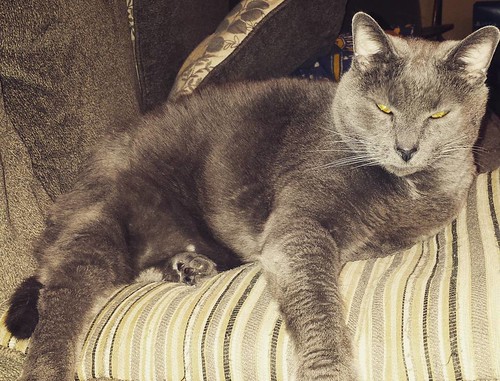
Huh.... #Lester #catsofinstagram
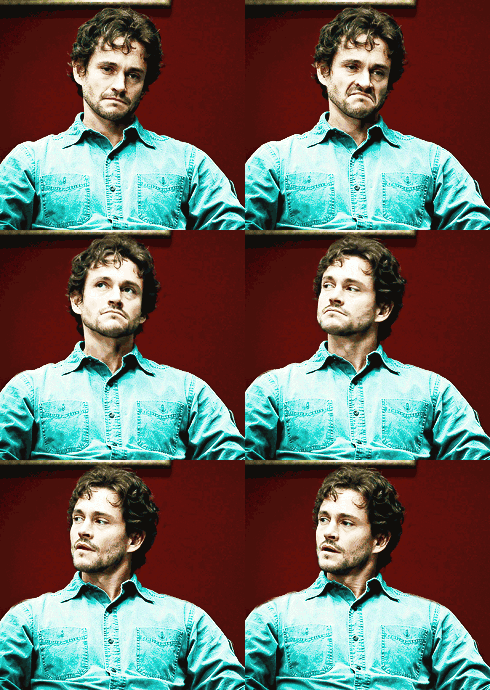
Here's what it looks like when the dog is not cooperative for his photo-op:

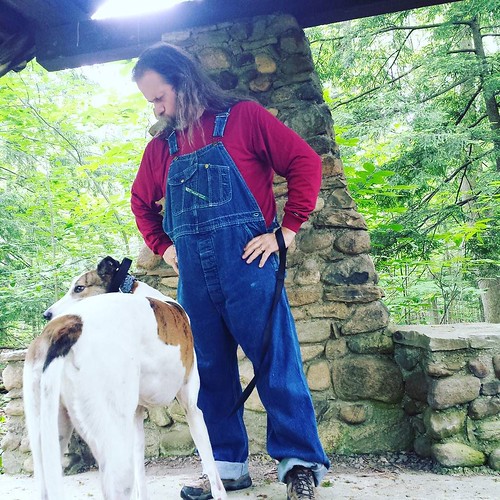
Uncooperative dee-oh-gee is uncooperative. #Cane #DogsOfInstagram #greyhound #overalls #vintage #Key #bluedenim

Here's what happens on a lazy weekend morning:

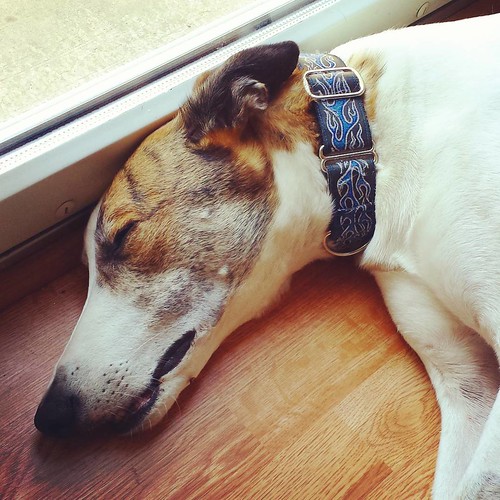
Saturday morning: coffee, overalls, and a sleeping dee-oh-gee. #Ahhhh #overalls #pointerbrand

Here's what happens when we're at the park and the dog get hot and finds some water:

Cane loves water. #Cane #DogsOfInstagram #greyhound #ChestnutRidge #wny #OrchardPark

And here's what happens when the dog actually cooperates for his photo-op.

Good LORD, that is one good-looking dee-oh-gee! Seriously, he is a FANTASTIC fashion accessory. #Cane #DogsOfInstagram #greyhound #overalls #Dickies #bleacheddenim

Saturday, June 18, 2016

Symphony Saturday (holding pattern edition)

Sorry to miss this feature the last couple of weeks! There's a reason for that, though: I was finally going to address the symphonies of Peter Ilyich Tchaikovsky, but just the last three, which are among the greatest symphonies ever written. But then I figured, I've never actually heard his first three symphonies, so I wanted to hear them first before I blogged about them. So starting next week, six weeks of Tchaikovsky!

In the meantime, we'll back up a hundred years. Here's Mozart's Symphony No. 25 in G minor.

Friday, June 17, 2016

Thursday, June 16, 2016

Something for Thursday

Today a brief suite from Elmer Bernstein's score to the film Far From Heaven, a movie which seems to have dropped somewhat off the radar unfortunately. Bernstein died not long afterwards, following one of the great careers in film scoring. For this film Bernstein really captured the story's sense of elegiac sadness, as several characters' lives intersect in a way that leaves most of them unable to live the life they really want. A sad and beautiful score for a sad and beautiful film.

Wednesday, June 15, 2016

Does whatever a spider can!

One of my important weekly tasks at The Store is running our generator load test. This is when I activate our store's generator and let it run the store's emergency systems for a half hour or so, just to make sure it's doing its thing correctly. The generator is located in one of the two power houses, which is an enclosed machine room actually on the roof. The power houses are not sealed against the outside, and therefore during the summer months, the power houses can -- and usually do -- become home to a lot of spiders.

Now, I like spiders a lot. I think they're nifty and they do important work by eating flies and whatnot. (My admiration and respect for spiders vanishes utterly if one actually manages to get on me, though. If that happens, it's Squishing Time.) There was a particularly big spider in there this morning, and while sometimes when there get to be too many of them I'll knock down their webs, this one I decided to let go for a while as he/she was spinning a web.

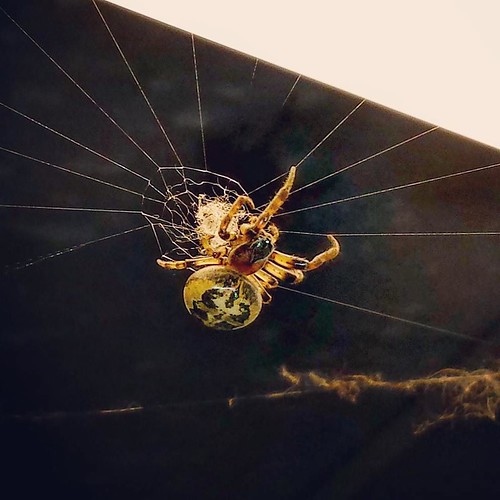
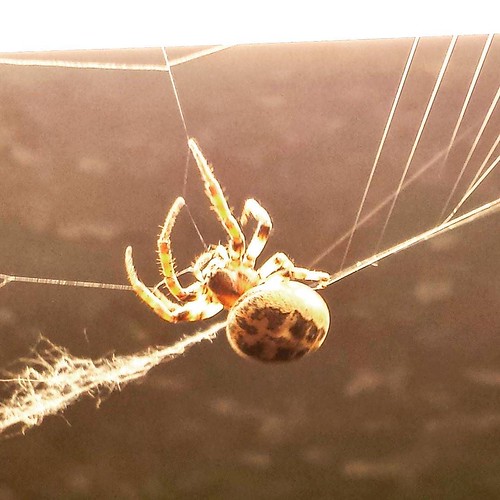
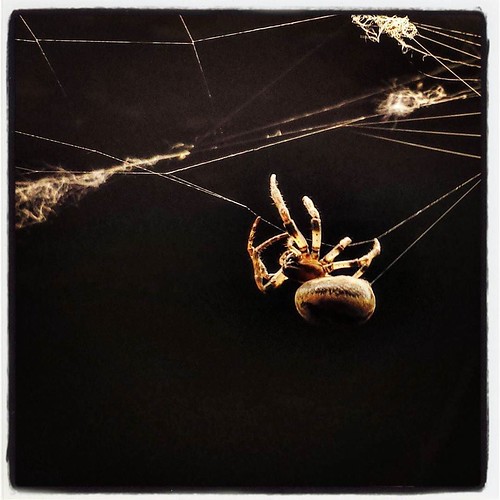
But of course I documented the activity photographically. Here is Phil*, in action!

I name all spiders "Phil". #spiders

Phil (or Philippa) hard at work. #spiders

Phil ignored me. Thanks, Phil! #spiders

*I always dub specific spiders "Phil", in honor of this clip from Friends.


And yes, I'm aware that this might have actually been a Philippa. I have no idea how to tell, though.

Tuesday, June 14, 2016

On the Founding Fathers (a repost)

I've had this post on my mind the last day or so, since I'm seeing as part of the usual dialog regarding guns various appeals to what the Founding Fathers meant by their terrible wording of the Second Amendment. I'm frustrated by this line of argument, on either side, because I don't think that what the Founding Fathers meant or wanted should be terribly relevant at all. Oddly, I went searching for this post and found that I wrote it exactly three years ago.

I've recently read a book called Me the People: One Man's Selfless Quest to Rewrite the Constitution of the United States of America, by Kevin Bleyer. Mr. Bleyer is, among other things, one of the writers for The Daily Show, which means that this book is a mixture of humor and serious discussion, with the occasional problem that at times it's difficult to separate the two. But it still present a fascinating look at the process by which the Founding Fathers arrived at the Constitution, and what kinds of problems exist in trying to force a modern, technological superpower's society on a governmental structure created by a bunch of agrarian former colonists more than two hundred years ago.

In all honesty, I've never been much for idolatry of the Constitution. I recently had a friend try to draw me into a conversation on gun control, and I strongly resisted, not particularly wanting to venture down that particular garden path, well, ever. But my friend did ask me this: "Well, you believe in the Constitution, don't you?" That struck me as an interesting question, because, well, what does it mean?

Do I believe in the Constitution? I suppose so, in that I believe that we have a government that is structured according to the provisions contained within the Constitution's pages. And that's about all that I believe about it. I don't believe that there is anything especially sacred about the Constitution, and I don't believe that the Constitution represents some kind of moment when we rose to greatness. In truth, the Constitution is a muddled mess of a document, and the government it creates isn't so much a brilliantly constructed Machine of Democracy as a hodge-podge, ramshackle mess of compromises with difficulties exacerbated by some really poor writing.

When discussing various issues, I try to never get wrapped up in talking about what "the Founding Fathers wanted", for a number of reasons. To begin with, the Constitution simply does not represent any kind of 'consensus' on the part of the Founding Fathers. A lot of them disliked the resulting document and simply accepted it as "the best thing we're likely to end up with". When the biggest matter of consensus arising from the Constitutional Convention was a general sense of "Meh, this was the best we could do, folks", the idea of ascribing any particular thought or philosophy to "the Founding Fathers" doesn't make much sense. Heck, Thomas Jefferson even thought that we should scrap the entire thing after a few decades and take another whack at it. As far as I can see, referring to "what the Founding Fathers wanted" is a reference to nothing at all, because they all wanted different things.

More importantly, though, is that a lot of water has gone under the bridge since then. The United States Constitution was adopted 224 years ago. Even if there really was some kind of consensus as to what the FF's wanted, why should that even matter now? Maybe because it's our own history, but the time of the FFs was a lot longer ago than I think we tend to realize, and I'm increasingly of the view that keeping our governmental structures rigidly organized according to the thoughts of people who lived and died that long ago may not be a great idea. Consider the following list of things, and consider that FFs lived closer to these things, time-wise, than they did to us:

Queen Elizabeth I
William Shakespeare
The defeat of the Spanish Armada
Johannes Kepler
Nostradamus
Suleiman the Magnificent
Cervantes
Ben Jonson

Did the FFs intend for their Constitution to still be running the show 224 years later? I have no idea. But I suspect they'd be a bit baffled by the lip service that is paid to that old document these days, and it says something to me that they included a mechanism for changing the Constitution for a reason.

Here's how Bleyer sums things up:

Now we understand how it all happened -- or rather, almost didn't.

The Constitution wasn't a "Miracle at Philadelphia" written by "an assembly of demigods". On the contrary; what began as a measured, deliberate effort to rescue a beleaguered country became a perpetual unresolved-motion machine -- a maddening cycle of nonbinding votes by a parade of toothless committees, marked by fits and starts, fights and "full stops", conducted by a combative group of exhausted, drunken, broke, petty, partisan, scheming, squabbling, bloviating, backstabbing, grandstanding, godforsaken, posturing, restless, cow-tipping, homesick, cloistered, claustrophobic, sensory-deprived, under-oxygenated, fed-up, talked-out, overheated delegates so distraught and despairing they threatened violence, secession, foreign allegiance, even prayer -- and concluded, for those who didn't abandon the proceedings altogether, with as much premeditation and forethought as a game of musical chairs: the last, least abhorrent, mutually-somewhat-acceptable idea on the table when the music stopped -- or the heat became too unbearable, or the liquor too strong, or the rioting too loud, or the pressure too intense, or the company too loathsome, or the wigs too uncomfortable, or the patience too thin -- became the law of the land. As much the product of an "assembly of demigods" as a confederacy of dunces.

From page one, the Constitution is, by its own admission, a compromise. It is what you get when you drink beer for breakfast.

Or as Ben Franklin put it as the Convention ended: "Thus I consent to this Constitution, because I expect no better."

If they thought it stank, why should we pretend that it smells of roses and lavender?

Comments are closed on this post.

Sunday, June 12, 2016

Bad Joke Friday (late Sunday edition)

Oh wow. See, I had scheduled something like the last four or five BJF's well in advance, so I assumed that I had one ready to go this past Friday...and yet, apparently I did not. I am the absolute worst.

But hey, here's a terrible joke!

What's the difference between a dog and a marine biologist?

One wags his tale and the other tags a whale!

OK, I feel better now. I'm not sure why....

Thursday, June 09, 2016

Something for Thursday

(Ooops...didn't publish. Ayup!)

I have a weird relationship with country music. I actively dislike a good deal of it, and most of it makes no impression on me at all. But those songs that I like? Well, those I tend to really really like a whole whole lot. Here's an example: a song called "My Church" by Maren Morris. I've noticed that when I like a country song a good deal, it's almost always a song by a female artist, which may or not be interesting. Hmmmm.

Here's "My Church".

Wednesday, June 08, 2016

A Bonus Bad Joke

Sorry for the lack of material here of late! Just garden-variety busy-ness.

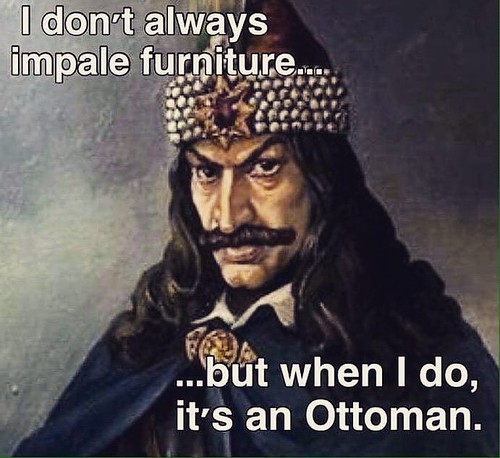
Anyway, here's a bad pun of the historical and literary variety! You have to be up on your history of famous vampires to get this one.

I stole this from Facebook because it made me laugh. #dracula

Friday, June 03, 2016

Bad Joke Friday

A lycanthrope transforms in front of his friend for the first time.

“Oh my god," says his friend, “You just turned into a wolf.”

“Yes," he replies, “I am a were.”

Thursday, June 02, 2016

Something for Thursday

This movie seems rather forgotten nowadays, even though it won Best Picture over Saving Private Ryan. This is legendarily due to some serious politicking done by Miramix in this movie's favor, but frankly, I've always liked it more than SPR, whose reputation seems to me to rest on the strength of one remarkable sequence that is surrounded by some fairly routine storytelling.

Here is a suite of music from Shakespeare In Love. I've listened to this a bit while writing Seaflame! (formerly Lighthouse Boy), because part of that book involves acting and theatrical troupes, and because it's just lovely music.


(By the way, here's an update on my writing progress of late!)

Monday, May 30, 2016

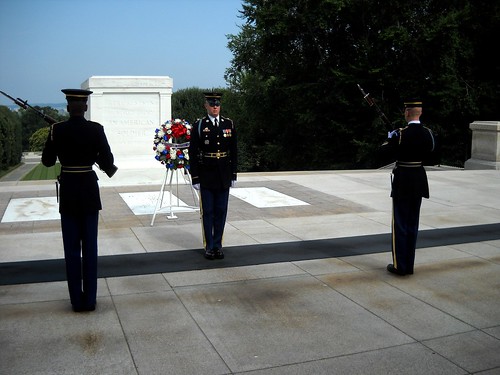
The last full measure of devotion

An annual repost.

Tomb of Unknown Soldier


Know, all who see these lines,
That this man, by his appetite for honor,
By his steadfastness,
By his love for his country,
By his courage,
Was one of the miracles of the God.


-- Guy Gavriel Kay


"The Green Field of France", by Eric Bogle

Well, how do you do, young Willie McBride,
Do you mind if I sit down here by your graveside?
And rest for awhile 'neath the warm summer sun,
I've been walking all day, and I'm nearly done.
I see by your gravestone you were only 19
When you joined the great fallen in 1916,
I hope you died quick and I hope you died clean
Or, Willie McBride, was it slow and obscene?

Did they Beat the drum slowly, did they play the fife lowly?
Did they sound the death-march as they lowered you down?
Did the band play The Last Post in chorus?
Did the pipes play the Flowers of the Forest?


Did you leave a wife or a sweetheart behind
In some faithful heart is your memory enshrined?
And, though you died back in 1916,
To that faithful heart are you forever 19?
Or are you a stranger without even a name,
Enshrined then, forever, behind a glass pane,
In an old photograph, torn and tattered and stained,
And faded to yellow in a brown leather frame?

Did they Beat the drum slowly, did they play the fife lowly?
Did they sound the death-march as they lowered you down?
Did the band play The Last Post in chorus?
Did the pipes play the Flowers of the Forest?


The sun's shining down on these green fields of France;
The warm wind blows gently, and the red poppies dance.
The trenches have vanished long under the plow;
No gas and no barbed wire, no guns firing now.
But here in this graveyard that's still No Man's Land
The countless white crosses in stand mute in the sand
To man's blind indifference to his fellow man,
And a whole generation who were butchered and damned.

Did they Beat the drum slowly, did they play the fife lowly?
Did they sound the death-march as they lowered you down?
Did the band play The Last Post in chorus?
Did the pipes play the Flowers of the Forest?


And I can't help but wonder, no Willie McBride,
Do all those who lie here know why they died?
Did they really believe when they answered the call,
Did they really believe that this war would end wars?
Well the sorrow, the suffering, the glory, the pain
The killing and dying, was all done in vain,
For young Willie McBride, it all happened again,
And again, and again, and again, and again.

Did they Beat the drum slowly, did they play the fife lowly?
Did they sound the death-march as they lowered you down?
Did the band play The Last Post in chorus?
Did the pipes play the Flowers of the Forest?


Saturday, May 28, 2016

Symphony Saturday

This work may not even actually be a symphony, but I'm featuring it nonetheless, because for a time Nikolai Rimsky-Korsakov actually did consider it a symphony (his Symphony No. 2), before redubbing it a "symphonic suite", called Antar. His inspiration here was an Arabian story about a man named Antar who saves a gazelle from a bird of prey, and when the gazelle turns out to be a magical Queen, she decides to reward him by showing him the three greatest joys of life (vengeance, power, and love). Rimsky-Korsakov had a love of Asian and Eastern European myths and tales, which most notably manifested in his masterpiece Scheherazade, but Antar is also a fascinating listen, whether it's a symphony or not.

Here is what might be Rimsky-Korsakov's Symphony No. 2...or what might not be his Symphony No. 2.

Friday, May 27, 2016

Thursday, May 26, 2016

Something for Thursday

A selection from Trevor Jones's score to the teevee movie Merlin. This was made when filmed fantasy was just starting to make its big comeback, a couple of years before The Lord of the Rings, and it's actually not a bad production, if a little dated in some respects. Trevor Jones's music, however, is terrific.

Wednesday, May 25, 2016

Tuesday, May 24, 2016

Mugging!

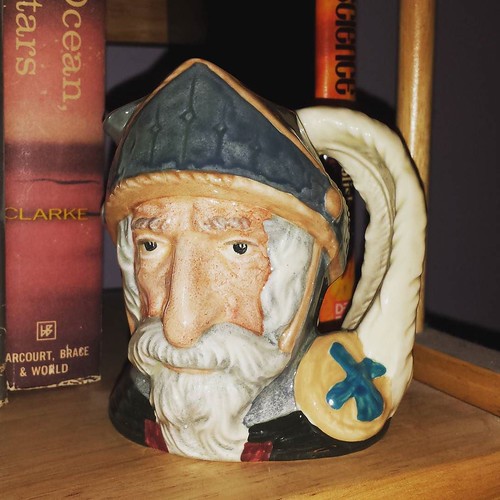
One of my more esoteric fascinations is with Toby mugs and jugs. These are mugs or pitchers or other vessels worked into the detailed likeness of a person, usually just the head if it's a mug, but featuring the entire body (usually seated and holding a pitcher or drinking vessel of their own) if it's a jug. The Wife doesn't get the appeal, but I think they're great. This falls in, of course, with my long-noted love of drinking vessels of all types, from mugs to glassware to ceramic flagons to waterskins to, well, you name it.

I first discovered the existence of Toby mugs in, of all places, a cookbook by Jeff Smith (aka, The Frugal Gourmet), which focused on cooking at Christmastime. There's a photo in that book of a table laden with Christmas fruitcakes and puddings, with a couple of Toby mugs off to one side. Presumably this is because Toby mugs originate in Victorian England, and according to Smith, heavy puddings and cakes such as are served at Christmastime (in properly Dickensian dinners, I suppose) are English in genesis. He notes in the caption that "Toby mugs traditionally held sauces for the table at Christmas." I have no idea if that's accurate or not; I just loved the visual of these head-shaped mugs on the table.

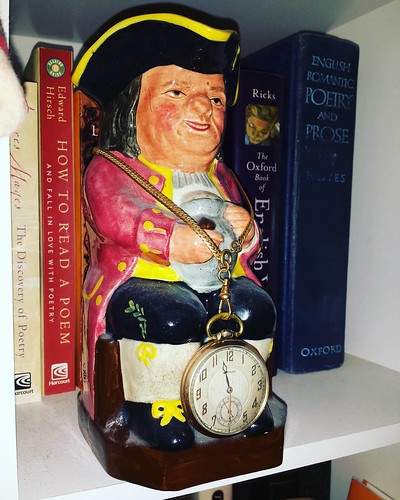
Longtime readers may remember that I bought this handsome guy some years ago, at a local antique place that has since gone out of business.

Toby mug V: I've had this guy for several years, but for completeness's sake, here he is! #antiquing

I love that guy! He makes a good place to display my pocket watch, too!

Flash-forward to the other day, when I traveled with my sister to an antique place near Rochester, NY, and there I found (among other cool things) these four mugs! In one trip, I quintupled my collection!

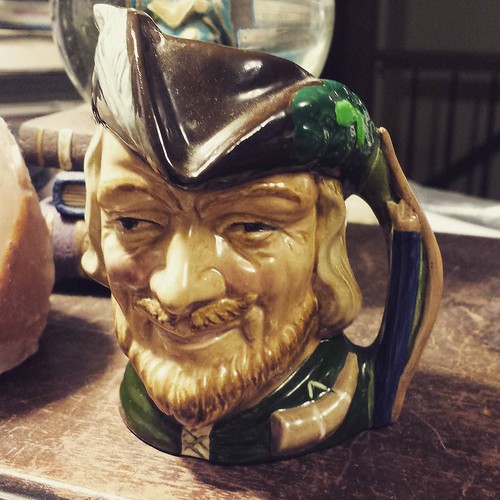
Robin Hood (note that the mug handle is his bow):

Toby mug II: Robin Hood. Note his drinking horn and that his bow is the mug handle! #antiquing

Don Quixote:

Toby mug I: Don Quixote. My wife makes fun of them, but I love these things. #antiquing

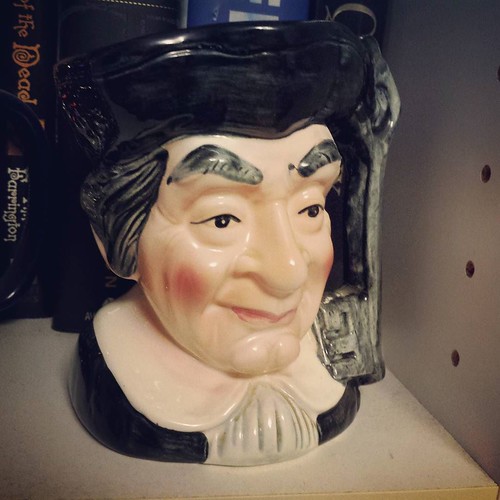
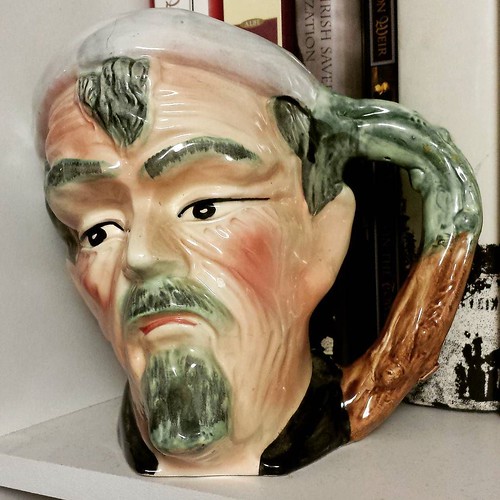
Then two which were not identified, both of which were marked "as is" and both of which sold for five bucks together. I don't know why; the only blemish I can find is a very small crack in the sad-looking fellow, and since I don't plan to use these as drinking or serving vessels, the crack doesn't do anything against the display qualities.

Tobh mug III: I don't know what he's supposed to be, but his handle is a key. Maybe some secretive cleric, protecting a secret? #antiquing

Toby mug IV: No idea who he is, either, but he was marked 'as is' and sold for two bucks. He has a tiny crack in his crown, but as I'm not using these for liquid distribution, I thought I'd give him a bookshelf to hang out on for two bucks. Something abou

Wow, that lower fellow is sad-looking indeed! I wonder what his story is. Anyway, it was fun to scratch that itch for a while. Will I get more? Maybe! But not for now.

(Wondering about this odd bit of drinking-vessel ephemera? Well, as further evidence that for any given thing there is a museum devoted to it somewhere, it turns out that there's an American Toby Jug Museum in Chicago! This just blows my mind.)

Saturday, May 21, 2016

Symphony Saturday

Apologies for missing this feature last week! Last Saturday was a really hectic day that didn't afford me a real chance to sit down and go Whew! until rather late, at which point I was still facing my daily writing quota, so that's what happened. But let's get back into the swing, shall we? Last time I alluded to a major Russian waiting in the wings, and here's a major Russian, just not the one I was referring to. I'm talking to day about Nikolai Rimsky-Korsakov, of whose symphonies I wasn't even aware until just last week.

His first symphony is a student work of sorts, and in honesty, it rather feels like a student work. He makes use of Russian folk melodies throughout, but his orchestration is right out of the German tradition, and the composer even admitted heavily relying on Berlioz's Treatise on Orchestration (one of the classic texts on the subject, to this day) and the advice of his teacher, Mily Balakirev. Of course, Rimsky-Korsakov himself would mature into one of the greatest orchestral colorists of all time, but that was still in his future.

Here is the Symphony No. 1 in E minor, by Rimsky-Korsakov.

Thursday, May 19, 2016

Something for Thursday

I don't remember if I've featured this before, but it's just such a perfect piece of music that it's worth revisiting now and again. Alexander Borodin's In the Steppes of Central Asia depicts the meeting of two trade caravans, on some road in the Asian wilderness. There is no war or conflict here, just two groups coming together -- depicted by two melodies of differing character -- greeting one another and parting. This wonderful piece is so full of warmth and human optimism that it simply glows.

Here is In the Steppes of Central Asia.

Tuesday, May 17, 2016

Nineteen years

On May 17, 1997, I married a beautiful young woman from Iowa. Nineteen years later, here we are!

19 years, married to this amazing woman! Huzzah!!

Here's hoping for another nineteen years...and another nineteen after that...and, well...second star to the right, and straight on 'til morning!

Friday, May 13, 2016

Bad Joke Friday

An Arthurian theme this week!

What was the name of the fattest Knight of the Round Table?

Sir Cumference!

Something From Thursday

Sorry, folks, yesterday was a bit preoccupying, what with a nice visit from my old friends, the Car Repair Gods*.

Here's something fun.


Pro tip: Looking for light, fun classical music to brighten your day? Listen to the overtures of Franz von Suppe. My favorites are this one, "Light Cavalry", "Poet and Peasant", "Morning, Noon, and Night in Vienna", and "The Beautiful Galatea".

* They're not friends. They're jerks, and when they come by, well -- as Ned Flanders noted, I'm obliged to offer them a beer, but it's mostly head.

Monday, May 09, 2016

April Showers bring May...Apples?

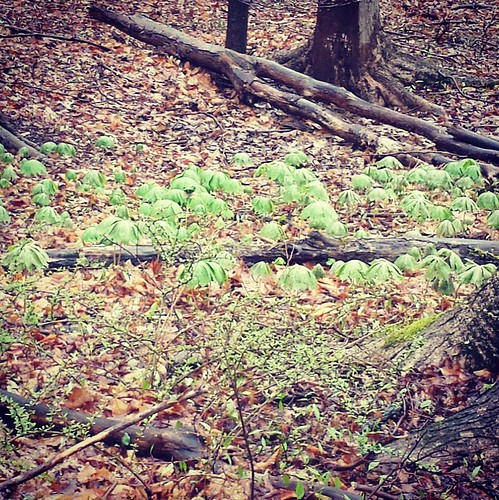
So a few weeks ago I was hiking with The Dee-oh-gee (at Sprague Brook Park in Colden, NY) and I happened across this strange-looking plant:

All right who knows what this is? It's only about 3-inches tall. #mysteryplant #SpragueBrookPark #wny

Odd little thing, innit? I'd never seen anything like it, to my recollection.

A week or so later, I'm hiking with the Dee-oh-gee (at Knox Farm State Park in East Aurora, NY), and I happened across an entire crop of those little plants:

These odd little plants are all over Knox Farm. I wonder what they are. #knoxfarm #wny #EastAurora

And then yesterday, I'm hiking with the Dee-oh-gee (at Chestnut Ridge Park here in sunny Orchard Park), and I happened across another crop of those things, even bigger now.

I'll probably spend all summer documenting whatever these plants are. #ChestnutRidge #wny #OrchardPark

Well, a helpful Instagram user has come to my rescue! They are "May apples", or podophyllum, so named because the flower that generally blossoms from these plants in May that become fruits later on. May apples grow in large colonies, with the 'plants' actually sprouting from a single root that has spread beneath the ground. That's why I'm seeing large patches of these things, when I spot them in the WNY woods.

Wikipedia indicates that they are poisonous, but this article indicates that the fruit can be eaten, albeit with preparation and quantity in mind. I'm not sure if I'm quite that curious, but still, a bit of learning is useful -- especially when it's something that I've been observing on my own!

Sunday, May 08, 2016

Saturday, May 07, 2016

Symphony Saturday

After three consecutive weeks of increasingly lengthy and heavy German symphonies, let's step back and listen to something shorter and much less dense. What's needed right now is a French composer, so this week we'll encounter Vincent d'Indy.

I have heard almost nothing by d'Indy; in fact, it's quite likely that the work featured in this post is the only work I've ever heard by d'Indy. My brief research confirms that his music is little heard today outside of the present piece, although in his Essential Canon of Classical Music, David Dubal does opine that d'Indy is a terribly underrated composer, so perhaps his work is deserving of greater exposure.

This work, the Symphony on a French Mountain Air, is unusual in a number of ways. First, it is in three movements instead of the traditional four; second, its melodic material is mostly derived from a single tune (the "mountain air" of the title, a song d'Indy heard while traveling in the mountains); and third, the work features a prominent (but not quite dominant) part for a solo piano, making it a sort of symphony-concerto hybrid, not unlike Harold in Italy, the symphony by d'Indy's fellow Frenchman Hector Berlioz, which had featured a prominent part for solo viola.

The Symphony on a French Mountain Air is, to my ears, a delightful listen that always feels fresh and light, especially after a steady diet of heavy Germanic romanticism.


Next week: Well, I haven't decided yet, but there is a big-name Russian composer knocking on the door....

Thursday, May 05, 2016

Something for Thursday

My day started annoying and spiraled from there, so no music until now. Sorry.

But here's some cheesy movie music from what may be the cheesiest sci-fi movie of all time.

Monday, May 02, 2016

National Poetry Month, day thirty

Guess what? I wrote this and forgot to publish it, until Roger goosed me. Oops.

Today ends National Poetry Month, and I considered writing some kind of summation, but I'll just leave it at this: Read poetry. It isn't hard and doesn't have to make you feel like you're back in English class. (Unless you liked English class, as I did, in which case, hey, it can totally feel like you're back in English class!)

Here is one of my favorite of Tennyson's poems, whose concluding lines are often quoted in inspirational settings. It's a wonderful paean to the eternal desire for new life and new experiences, even when we are nearing the dusk of our lives.

See you next April!

Ulysses
by Alfred, Lord Tennyson

It little profits that an idle king,
By this still hearth, among these barren crags,
Match'd with an aged wife, I mete and dole
Unequal laws unto a savage race,
That hoard, and sleep, and feed, and know not me.
I cannot rest from travel: I will drink
Life to the lees: All times I have enjoy'd
Greatly, have suffer'd greatly, both with those
That loved me, and alone, on shore, and when
Thro' scudding drifts the rainy Hyades
Vext the dim sea: I am become a name;
For always roaming with a hungry heart
Much have I seen and known; cities of men
And manners, climates, councils, governments,
Myself not least, but honour'd of them all;
And drunk delight of battle with my peers,
Far on the ringing plains of windy Troy.
I am a part of all that I have met;
Yet all experience is an arch wherethro'
Gleams that untravell'd world whose margin fades
For ever and forever when I move.
How dull it is to pause, to make an end,
To rust unburnish'd, not to shine in use!
As tho' to breathe were life! Life piled on life
Were all too little, and of one to me
Little remains: but every hour is saved
From that eternal silence, something more,
A bringer of new things; and vile it were
For some three suns to store and hoard myself,
And this gray spirit yearning in desire
To follow knowledge like a sinking star,
Beyond the utmost bound of human thought.

     This is my son, mine own Telemachus,
To whom I leave the sceptre and the isle,—
Well-loved of me, discerning to fulfil
This labour, by slow prudence to make mild
A rugged people, and thro' soft degrees
Subdue them to the useful and the good.
Most blameless is he, centred in the sphere
Of common duties, decent not to fail
In offices of tenderness, and pay
Meet adoration to my household gods,
When I am gone. He works his work, I mine.

     There lies the port; the vessel puffs her sail:
There gloom the dark, broad seas. My mariners,
Souls that have toil'd, and wrought, and thought with me—
That ever with a frolic welcome took
The thunder and the sunshine, and opposed
Free hearts, free foreheads—you and I are old;
Old age hath yet his honour and his toil;
Death closes all: but something ere the end,
Some work of noble note, may yet be done,
Not unbecoming men that strove with Gods.
The lights begin to twinkle from the rocks:
The long day wanes: the slow moon climbs: the deep
Moans round with many voices. Come, my friends,
'T is not too late to seek a newer world.
Push off, and sitting well in order smite
The sounding furrows; for my purpose holds
To sail beyond the sunset, and the baths
Of all the western stars, until I die.
It may be that the gulfs will wash us down:
It may be we shall touch the Happy Isles,
And see the great Achilles, whom we knew.
Tho' much is taken, much abides; and tho'
We are not now that strength which in old days
Moved earth and heaven, that which we are, we are;
One equal temper of heroic hearts,
Made weak by time and fate, but strong in will
To strive, to seek, to find, and not to yield.