The personal blog of author Kelly Sedinger, chronicling the adventures of one overalls-clad wanderer.
Thursday, April 07, 2016
Something for Thursday
A small suite of film music today, from Ridley Scott's underrated film Kingdom of Heaven. (The film is underrated because this is one of those films where the "Director's Cut" is actually a vastly different, and distinctly superior, product to the version that was originally released in theaters.) I love the music from this movie, and the film remains my favorite thing that Ridley Scott has ever done.

Wednesday, April 06, 2016
National Poetry Month, day six
Sometimes there's a poem whose verse is wonderful, but with whose message you disagree. Such is the case here, for me. Walt Whitman was one of the great poets of all time -- in fact, he was probably one of the greatest human artists of all time, in any field -- but this poem falters for me.
I first heard this poem read by a faculty member when I was at Wartburg College -- I think it was my senior year -- when our school's beloved physics professor, Dr. Donald Roiseland, passed away after a fight with cancer. I heard this poem at his memorial service, and I thought "Well, that was lovely," and went about my day. Later I dug out my collection of Whitman and looked the poem up...and when I read it back to myself, I wondered about it.
The poem seems to be arguing that the scientific way of looking at things is somehow lacking, and that it removes the beauty inherent in our universe by burying it under numbers and graphs and charts and diagrams; that to hear what science has to say about the world is dispiriting and that one should atone by going out and looking silently upon the world's beauty.
Well...I have a problem with that, and I have a feeling that Richard Feynman, Carl Sagan, Neil DeGrasse Tyson, Jacques Cousteau, and many others would as well. The learned astronomer has not abandoned the beauty of the world; the learned astronomer has exposed more of it.
I think Whitman can be forgiven his view here, given the time in which he lived, but still...I wish he'd have been able to attend upon some of the beauty in those diagrams and charts and figures.
I first heard this poem read by a faculty member when I was at Wartburg College -- I think it was my senior year -- when our school's beloved physics professor, Dr. Donald Roiseland, passed away after a fight with cancer. I heard this poem at his memorial service, and I thought "Well, that was lovely," and went about my day. Later I dug out my collection of Whitman and looked the poem up...and when I read it back to myself, I wondered about it.
The poem seems to be arguing that the scientific way of looking at things is somehow lacking, and that it removes the beauty inherent in our universe by burying it under numbers and graphs and charts and diagrams; that to hear what science has to say about the world is dispiriting and that one should atone by going out and looking silently upon the world's beauty.
Well...I have a problem with that, and I have a feeling that Richard Feynman, Carl Sagan, Neil DeGrasse Tyson, Jacques Cousteau, and many others would as well. The learned astronomer has not abandoned the beauty of the world; the learned astronomer has exposed more of it.
I think Whitman can be forgiven his view here, given the time in which he lived, but still...I wish he'd have been able to attend upon some of the beauty in those diagrams and charts and figures.
When I Heard the Learn'd Astronomer
by Walt Whitman
When I heard the learn’d astronomer,
When the proofs, the figures, were ranged in columns before me,
When I was shown the charts and diagrams, to add, divide, and measure them,
When I sitting heard the astronomer where he lectured with much applause in the lecture-room,
How soon unaccountable I became tired and sick,
Till rising and gliding out I wander’d off by myself,
In the mystical moist night-air, and from time to time,
Look’d up in perfect silence at the stars.
Tuesday, April 05, 2016
National Poetry Month, day five
I find prose poems interesting. At first they seem formless, and one wonders why the poet didn't just write a straight-up story or paragraph, but as you read a good prose poem, the melding of the two forms clarifies. This poem is a good example: it starts as simple description of a small town, but then, the speaker enters a fantasy that spins out as he drives through the town and out the other side. There are echoes of history and Shakespeare in here, all suggesting the kind of life one might live in a small town where the bronze Civil War general stands above the little park in the village center.
(Text via.)
Passing Through a Small Town
by David Shumate
Here the highways cross. One heads north. One heads east
and west. On the corner of the square adjacent to the
courthouse a bronze plaque marks the place where two Civil
War generals faced one another and the weaker surrendered.
A few pedestrians pass. A beauty parlor sign blinks. As I turn
to head west, I become the schoolteacher living above the
barber shop. Polishing my shoes each evening. Gazing at the
square below. In time I befriend the waitress at the cafe and
she winks as she pours my coffee. Soon people begin to
talk. And for good reason. I become so distracted I teach my
students that Cleopatra lost her head during the French
Revolution and that Leonardo perfected the railroad at the
height of the Rennaissance. One day her former lover returns
from the army and creates a scene at the school. That evening
she confesses she cannot decide between us. But still we spend
one last night together. By the time I pass the grain elevators
on the edge of town I am myself again. The deep scars of love
already beginning to heal.
(Text via.)
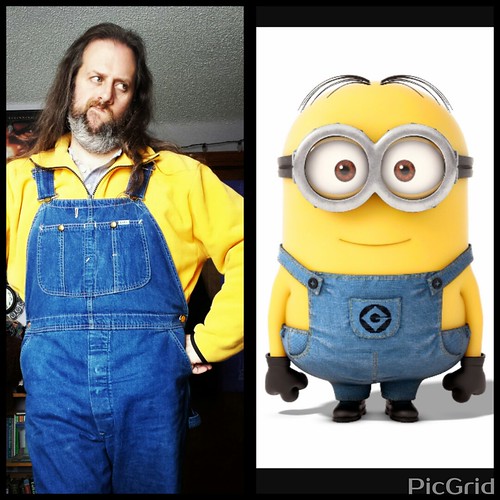
Why I Hate the Minions
Because I can't wear my favorite yellow fleece under blue overalls anymore, that's why.
Monday, April 04, 2016
What Apparently Happens When I'm Not Home
Not much.
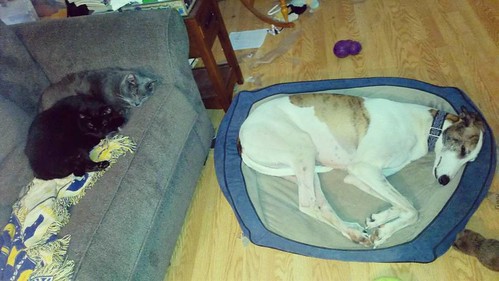
(Remember in Ghostbusters when Venkman says, "Cats and dogs, living together -- MASS HYSTERIA!!!"? He never met our crew.)
(Remember in Ghostbusters when Venkman says, "Cats and dogs, living together -- MASS HYSTERIA!!!"? He never met our crew.)
Shakshuka!
The Wife and I have become big fans of the Alton Brown-hosted cooking competition show Cutthroat Kitchen, and not just for its gonzo competition stuff but because it also has actually broadened our food horizons a bit, whenever the challenge dish is something we haven't heard of before. Such an example came up a few weeks ago, when Brown tasked his competitor chefs with making a dish called shakshuka.
Being unfamiliar with the dish, I googled it and discovered that it's a dish of Middle Eastern origin, in which a rich tomato sauce is made and then eggs are poached on top of it. I was intrigued by this on a number of levels: I love eggs, I love tomato sauce, and I love Middle Eastern cuisine, and when I started looking at recipes, I realized that this dish is well within my ability to cook. So cook it I did! I used this recipe from Epicurious.com, and...the results were mixed.
We enjoyed the dish more than enough to put it on the "Make it again!" list, but there were some areas of concern. First, the recipe calls for way too much salt, so I'll be correcting this massively when I make the dish again. Second, the recipe's stated cook-time for the eggs was too long to our taste, resulting in hard-cooked eggs. I'm not sure if we want runny eggs, but hard-cooked was a little too much. But still: for a first-time-attempt, the dish turned out well and I'm looking forward to trying it again.
Here's my finished product:
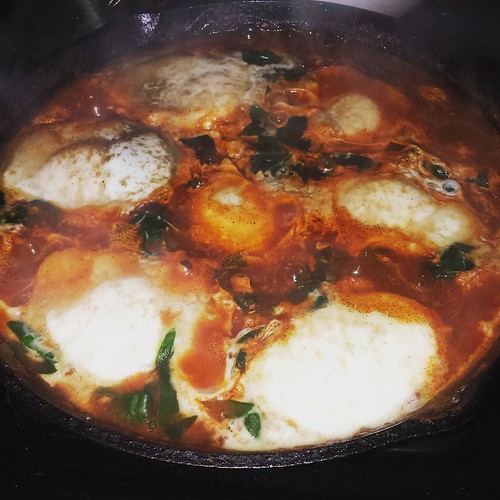
Good stuff, but next time it'll be great stuff!
(Oh, and I omitted the bay leaf, because seriously, f*** bay leaf. Those things are useless.)
Being unfamiliar with the dish, I googled it and discovered that it's a dish of Middle Eastern origin, in which a rich tomato sauce is made and then eggs are poached on top of it. I was intrigued by this on a number of levels: I love eggs, I love tomato sauce, and I love Middle Eastern cuisine, and when I started looking at recipes, I realized that this dish is well within my ability to cook. So cook it I did! I used this recipe from Epicurious.com, and...the results were mixed.
We enjoyed the dish more than enough to put it on the "Make it again!" list, but there were some areas of concern. First, the recipe calls for way too much salt, so I'll be correcting this massively when I make the dish again. Second, the recipe's stated cook-time for the eggs was too long to our taste, resulting in hard-cooked eggs. I'm not sure if we want runny eggs, but hard-cooked was a little too much. But still: for a first-time-attempt, the dish turned out well and I'm looking forward to trying it again.
Here's my finished product:
Good stuff, but next time it'll be great stuff!
(Oh, and I omitted the bay leaf, because seriously, f*** bay leaf. Those things are useless.)
National Poetry Month, day four
I found this poem in the collection Good Poems for Hard Times, edited by Garrison Keillor. It's a moody poem, not at all optimistic, as it hinges upon an unmet person at an awful time in their lives. It casts Ithaca as a cold, bleak place -- and assuming that the author means Ithaca, NY, this is not my experience at all, but there's nothing about my experience that trumps another's. And besides, perhaps author Leonard Nathan isn't actually referring to Ithaca, NY but calling back to the mythic Ithaca of Odysseus and his long journey home.
More on Leonard Nathan.
Toast
by Leonard Nathan
There was a woman in Ithaca
who cried softly all night
in the next room and helpless
I fell in love with her under the blanket
of snow that settled on all the roofs
of the town, filling up
every dark depression.
Next morning
in the motel coffee shop
I studied all the made-up faces
of women. Was it the middle-aged blonde
who kidded the waitress
or the young brunette lifting
her cup like a toast?
Love, whoever you are,
your courage was my companion
for many cold towns
after the betrayal of Ithaca,
and when I order coffee
in a strange place, still
I say, lifting, this is for you.
More on Leonard Nathan.
Sunday, April 03, 2016
National Poetry Month, day three
An unabashed love poem by Christina Rosetti. This is one of the more heartbreaking poems I know, because it unflinchingly stares at the certainty that all love must end, and that the inevitable ending provides those left behind with terrible choices about how to approach memory.
Remember
by Christina Rosetti
Remember me when I am gone away,
Gone far away into the silent land;
When you can no more hold me by the hand,
Nor I half turn to go yet turning stay.
Remember me when no more day by day
You tell me of our future that you plann'd:
Only remember me; you understand
It will be late to counsel then or pray.
Yet if you should forget me for a while
And afterwards remember, do not grieve:
For if the darkness and corruption leave
A vestige of the thoughts that once I had,
Better by far you should forget and smile
Than that you should remember and be sad.
Saturday, April 02, 2016
Symphony Saturday
All right, we got a barn-burner here. Seriously, you'll be needing good speakers and you'll be wanting to turn them UP, especially for the last movement. Today it's the Symphony No. 3 in C minor by Camille Saint-Saens, better known as the "Organ" Symphony. This is one of the great warhorse-works in all classical music, and there's a reason for that.
This symphony is, quite simply, awesome. It's amazing. With all respect (well, some respect, anyway) to Tchaikovsky's 1812 Overture, this symphony is the musical equivalent of a fireworks show. Maybe not all the way through, obviously -- it opens with an ethereal chord followed by a meditative passage before the tempo quickens, and there's a wonderful slow movement, but when that final section arrives, with that first gigantic chord in the organ, well, that's when the clouds disperse.
I first heard this work in excerpt form at EPCOT, of all places, as parts of it are used (along with other French works) in the Impressions de France film in the French pavilion. I bought a recording of the symphony within months, and it has been a favorite piece of mine ever since. In fact, my college roommate and I used to use the last movement as background motivational music whenever we were getting dressed for a band or orchestra concert (we were in both). Toward the end, when the entire brass section gets to just let it all loose, the effect is one of the most thrilling in all of classical music.
The Organ Symphony was written in 1886 for the Royal Philharmonic Society in London, although Saint-Saens dedicated the work to Franz Liszt after that great composer's passing. The Symphony's structure is slightly odd: it seems like it's in four movements, but the first two movements and the last two are played without break, so in reality, the work is in two sections. It's easier to refer to the four movements, though, so that's the convention I follow here.
Here is the Organ Symphony by Camille Saint-Saens. And seriously, turn this thing up -- and check out the timpanist in the symphony's closing seconds. That guy is getting every ounce of pleasure out of every single drumbeat!
This symphony is, quite simply, awesome. It's amazing. With all respect (well, some respect, anyway) to Tchaikovsky's 1812 Overture, this symphony is the musical equivalent of a fireworks show. Maybe not all the way through, obviously -- it opens with an ethereal chord followed by a meditative passage before the tempo quickens, and there's a wonderful slow movement, but when that final section arrives, with that first gigantic chord in the organ, well, that's when the clouds disperse.
I first heard this work in excerpt form at EPCOT, of all places, as parts of it are used (along with other French works) in the Impressions de France film in the French pavilion. I bought a recording of the symphony within months, and it has been a favorite piece of mine ever since. In fact, my college roommate and I used to use the last movement as background motivational music whenever we were getting dressed for a band or orchestra concert (we were in both). Toward the end, when the entire brass section gets to just let it all loose, the effect is one of the most thrilling in all of classical music.
The Organ Symphony was written in 1886 for the Royal Philharmonic Society in London, although Saint-Saens dedicated the work to Franz Liszt after that great composer's passing. The Symphony's structure is slightly odd: it seems like it's in four movements, but the first two movements and the last two are played without break, so in reality, the work is in two sections. It's easier to refer to the four movements, though, so that's the convention I follow here.
Here is the Organ Symphony by Camille Saint-Saens. And seriously, turn this thing up -- and check out the timpanist in the symphony's closing seconds. That guy is getting every ounce of pleasure out of every single drumbeat!
National Poetry Month, day two
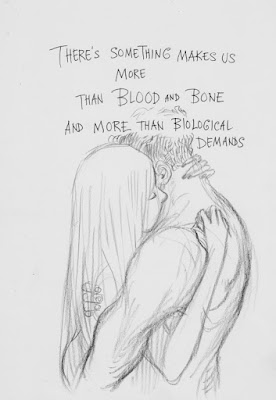
I was going to spend a little time this morning selecting a poem for today...and then I saw this on Tumblr. It's a poem by Neil Gaiman, illustrated by an artist named Chris Riddell. Since Gaiman himself posted it on Tumblr, which is a sharing-based platform, I'm guessing it's OK to share it here.




Friday, April 01, 2016
National Poetry Month, day one
April is National Poetry Month! And every year I forget about it completely, not realizing that we're in the midst of National Poetry Month until April 19 or some such thing. Well, not this year! My goal is to post a poem each day this month. Some will be longer than others, some will be serious and some not, some will be love poems and some not. Who knows? My goal is to spend a month exploring some poetry. I'm a firm believer that writers should read poetry in order to get a sense of what can be done with language, and to learn other ways of expressing ideas.
Since today is April Fool’s Day, here’s a poem that has some of that April Fool’s kind of punch, in that the first time you hear it, you think it just has to end a certain way...and then it famously doesn’t. (Also, baseball's regular season starts on Sunday! Go Pirates!)
Since today is April Fool’s Day, here’s a poem that has some of that April Fool’s kind of punch, in that the first time you hear it, you think it just has to end a certain way...and then it famously doesn’t. (Also, baseball's regular season starts on Sunday! Go Pirates!)
Casey at the Bat
by Ernest Lawrence Thayer
The outlook wasn’t brilliant for the Mudville nine that day:
The score stood four to two, with but one inning more to play,
And then when Cooney died at first, and Barrows did the same,
A pall-like silence fell upon the patrons of the game.
A straggling few got up to go in deep despair. The rest
Clung to the hope which springs eternal in the human breast;
They thought, “If only Casey could but get a whack at that—
We’d put up even money now, with Casey at the bat.”
But Flynn preceded Casey, as did also Jimmy Blake,
And the former was a hoodoo, while the latter was a cake;
So upon that stricken multitude grim melancholy sat,
For there seemed but little chance of Casey getting to the bat.
But Flynn let drive a single, to the wonderment of all,
And Blake, the much despisèd, tore the cover off the ball;
And when the dust had lifted, and men saw what had occurred,
There was Jimmy safe at second and Flynn a-hugging third.
Then from five thousand throats and more there rose a lusty yell;
It rumbled through the valley, it rattled in the dell;
It pounded on the mountain and recoiled upon the flat,
For Casey, mighty Casey, was advancing to the bat.
There was ease in Casey’s manner as he stepped into his place;
There was pride in Casey’s bearing and a smile lit Casey’s face.
And when, responding to the cheers, he lightly doffed his hat,
No stranger in the crowd could doubt ‘twas Casey at the bat.
Ten thousand eyes were on him as he rubbed his hands with dirt;
Five thousand tongues applauded when he wiped them on his
shirt;
Then while the writhing pitcher ground the ball into his hip,
Defiance flashed in Casey’s eye, a sneer curled Casey’s lip.
And now the leather-covered sphere came hurtling through the
air,
And Casey stood a-watching it in haughty grandeur there.
Close by the sturdy batsman the ball unheeded sped—
“That ain’t my style," said Casey. “Strike one!” the umpire said.
From the benches, black with people, there went up a muffled
roar,
Like the beating of the storm-waves on a stern and distant shore;
“Kill him! Kill the umpire!” shouted someone on the stand;
And it’s likely they’d have killed him had not Casey raised his
hand.
With a smile of Christian charity great Casey’s visage shone;
He stilled the rising tumult; he bade the game go on;
He signaled to the pitcher, and once more the dun sphere flew;
But Casey still ignored it and the umpire said, “Strike two!”
“Fraud!” cried the maddened thousands, and echo answered
“Fraud!”
But one scornful look from Casey and the audience was awed.
They saw his face grow stern and cold, they saw his muscles
strain,
And they knew that Casey wouldn’t let that ball go by again.
The sneer is gone from Casey’s lip, his teeth are clenched in hate,
He pounds with cruel violence his bat upon the plate;
And now the pitcher holds the ball, and now he lets it go,
And now the air is shattered by the force of Casey’s blow.
Oh, somewhere in this favoured land the sun is shining bright,
The band is playing somewhere, and somewhere hearts are light;
And somewhere men are laughing, and somewhere children
shout,
But there is no joy in Mudville—mighty Casey has struck out.
Celebrate Laughter!

I’ve always had a love-hate relationship with April Fool’s Day. A lot of the humor of the day always seems at least slightly mean-spirited, aimed at getting a “Gotcha!” moment more than an actual laugh that’s shared all the way around. But on the other hand, a day dedicated to laughter and joking and celebrating all things funny isn’t really a bad thing, is it? So try to find some laughter, if you can. Here are few funny things, and remember to take time to laugh today!
Somewhat profane:
And finally:
Laugh it up, folks!
(Note to self: Make arrangements to get a pie in the face soon....)
Thursday, March 31, 2016
Something for Thursday
I don't know about you all, but in my neck of the woods, it's gloomy and rainy and I'm not finding motivation or oomph easy to come by, so here's a bit of pick-me-up music: the Light Cavalry Overture, by Franz von Suppe.
OK, that helps!
OK, that helps!
Wednesday, March 30, 2016
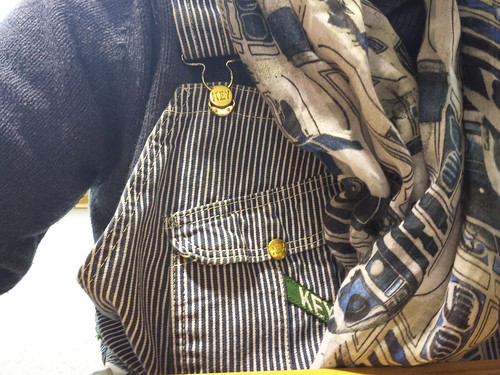
I'm not gonna lie....
...but a big reason I want to be a writer is so that I can wear overalls and an R2-D2 scarf to work every day.
Tuesday, March 29, 2016
The Host who can Boast the Most Roast
So I saw an article last week someplace, maybe Facebook, about a recipe that had somehow gone viral: "Mississippi Roast". The recipe is insanely simple:
1. Spray your crockpot with cooking spray.
2. Throw in a chuck roast, around 3 to 4 lbs.
3. Sprinkle directly onto the meat 1 packet of gravy or au jus mix, and 1 packet of Ranch dressing mix.
4. Put a stick of butter on top of this.
5. Scatter 8-10 pepperoncini (banana peppers, pickled in a jar) around the top of the meat.
6. Cook on LOW for eight hours.
That's it.
I read the article with fascination, and then I asked people on Facebook and elsewhere if they'd ever heard of such a thing (they had), and I Googled it to see if this was real (it is). I have to admit that I was skeptical. I'm a sucker for recipes of the "Throw a small number of ingredients in the crockpot, wait six to eight hours, and eat the resulting deliciousness," but this was pushing me a little far.
But not far enough to try it.
So I did.
Here's what it looked like before I put the lid on and turned on the crockpot:

And here's the result, served alongside some roasted potato wedges:
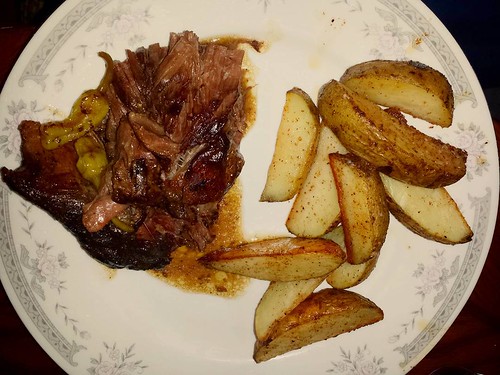
It was amazing. I always find that pot roast needs some help in the seasoning department, but somehow this seasoning turned out perfect. The only downside? After we each had two servings of the meat, there weren't many leftovers left, and you want leftovers when the meat turns out that good. You know, sandwiches and stuff.
Next time, I'm doing two roasts.
1. Spray your crockpot with cooking spray.
2. Throw in a chuck roast, around 3 to 4 lbs.
3. Sprinkle directly onto the meat 1 packet of gravy or au jus mix, and 1 packet of Ranch dressing mix.
4. Put a stick of butter on top of this.
5. Scatter 8-10 pepperoncini (banana peppers, pickled in a jar) around the top of the meat.
6. Cook on LOW for eight hours.
That's it.
I read the article with fascination, and then I asked people on Facebook and elsewhere if they'd ever heard of such a thing (they had), and I Googled it to see if this was real (it is). I have to admit that I was skeptical. I'm a sucker for recipes of the "Throw a small number of ingredients in the crockpot, wait six to eight hours, and eat the resulting deliciousness," but this was pushing me a little far.
But not far enough to try it.
So I did.
Here's what it looked like before I put the lid on and turned on the crockpot:

And here's the result, served alongside some roasted potato wedges:
It was amazing. I always find that pot roast needs some help in the seasoning department, but somehow this seasoning turned out perfect. The only downside? After we each had two servings of the meat, there weren't many leftovers left, and you want leftovers when the meat turns out that good. You know, sandwiches and stuff.
Next time, I'm doing two roasts.
Monday, March 28, 2016
Pre
I'm not a huge fan of Buffalo News sports reporter Bucky Gleason, but he writes a nice article today about Steve Prefontaine, the great track runner who died in a car crash 41 years ago. I'm not entirely sure of the chronology, but I think we were living in Oregon at the time. I would have been all of three years old and some change, so I had no idea about any of this, but Prefontaine worked at a sports business that went on to become Nike. I do remember something of the rise of Nike -- when we moved to Western New York in 1981, Nike was just beginning to become a national company, and I remember people around here saying "Nike" as if it rhymed with "bike".
Anyway, check out Gleason's piece.
Anyway, check out Gleason's piece.
Sunday, March 27, 2016
Some Links....
A few things!
:: The tale of an awful pizza customer. Oddly, I remember a guy who was just like this! He'd stand at the counter and offer his constant input as to how his pizza should be made, and then, when leaving the place, he'd tilt the box on its side. Every friggin' time he came in. Unbelievable.
:: Archaeologists have unearthed evidence of an enormous battle that took place in the Bronze Age in northern Europe. Since it predates written history, we have no idea who fought whom and why. How much history is there that we know nothing at all about?
:: Kraft Macaroni and Cheese has changed...and nobody knew about it. Interesting stuff. (Yes, I do still like this stuff.)
:: Jason ruminates on William Shatner.
:: Finally, John Scalzi on the use of personal pronouns -- i.e., referring to people by the gender they wish.
Read the whole thing. We need to be making the world better.
Later, folks!
:: The tale of an awful pizza customer. Oddly, I remember a guy who was just like this! He'd stand at the counter and offer his constant input as to how his pizza should be made, and then, when leaving the place, he'd tilt the box on its side. Every friggin' time he came in. Unbelievable.
:: Archaeologists have unearthed evidence of an enormous battle that took place in the Bronze Age in northern Europe. Since it predates written history, we have no idea who fought whom and why. How much history is there that we know nothing at all about?
:: Kraft Macaroni and Cheese has changed...and nobody knew about it. Interesting stuff. (Yes, I do still like this stuff.)
:: Jason ruminates on William Shatner.
:: Finally, John Scalzi on the use of personal pronouns -- i.e., referring to people by the gender they wish.
When someone asks you to refer to them by a particular set of pronouns and you’re reluctant to comply, are you being disrespectful? Yup! Self-identity is important, and refusing to accept someone else’s identity for your own reasons will be taken to mean that you dislike or disagree with their choices about who they are. And this is your right, but it means you’re saying that your choices in this regard are more important than the choices of the person who has to live with their own identity every single moment of their lives.
Read the whole thing. We need to be making the world better.
Later, folks!
Saturday, March 26, 2016
Symphony Saturday
Antonin Dvorak spent several years in the 1890s in the United States, including a time in a community of Czech immigrants in, of all places, Spillville, Iowa. I once drove through Spillville, and it's tiny -- less than 500 people live there. And yet, one of the greatest composers of all time lived there one summer, and some of his experiences there played into the music he composed while living in our country.
Dvorak felt that American music at that time was mainly concerned with echoing the Germanic symphonic traditions, with little attention paid to what he considered the true folk music of America, namely the chants of the Native Americans and the spirituals of the African-American population. He attempted to capture some of the character of those melodies in his Ninth Symphony, but what he mainly did was create new melodies based on the pentatonic scale, which does tend to be common to many aboriginal cultures of the world. There is nothing specifically American in this symphony, despite its being called "From the New World", and Dvorak himself would later insist that the symphony is a purely old-world work, composed in the old-world rhythm (particularly with regard to the use of Czech folk rhythms, something Dvorak would do his entire life), and more intended to convey the emotions Dvorak felt as a European seeing the great expanse of America for the first time.
None of that really matters, though -- whether one hears America or Prague or some blend of the two in this work, Dvorak's Ninth Symphony is one of the enduring works in all classical music, and with good reason. It is loaded with wonderful melodies (particularly that spellbinding second movement), to be sure, but it is also a superb work of musical craftsmanship as well, with every idea in its place and some of Dvorak's finest orchestrations. Here is Dvorak's Symphony No. 9 in E minor, "From the New World".
Dvorak felt that American music at that time was mainly concerned with echoing the Germanic symphonic traditions, with little attention paid to what he considered the true folk music of America, namely the chants of the Native Americans and the spirituals of the African-American population. He attempted to capture some of the character of those melodies in his Ninth Symphony, but what he mainly did was create new melodies based on the pentatonic scale, which does tend to be common to many aboriginal cultures of the world. There is nothing specifically American in this symphony, despite its being called "From the New World", and Dvorak himself would later insist that the symphony is a purely old-world work, composed in the old-world rhythm (particularly with regard to the use of Czech folk rhythms, something Dvorak would do his entire life), and more intended to convey the emotions Dvorak felt as a European seeing the great expanse of America for the first time.
None of that really matters, though -- whether one hears America or Prague or some blend of the two in this work, Dvorak's Ninth Symphony is one of the enduring works in all classical music, and with good reason. It is loaded with wonderful melodies (particularly that spellbinding second movement), to be sure, but it is also a superb work of musical craftsmanship as well, with every idea in its place and some of Dvorak's finest orchestrations. Here is Dvorak's Symphony No. 9 in E minor, "From the New World".
Friday, March 25, 2016
From the "I Can't Even" files....
A former coworker from The Store with whom I've kept in touch since she left the company dropped in yesterday to give me a small Easter gift:

Yes, it's a teeny-tiny coconut cream pie.
Some of my friends know me so well!
Yes, it's a teeny-tiny coconut cream pie.
Some of my friends know me so well!
Subscribe to:
Comments (Atom)