
A conversation I'm surprised I haven't had:

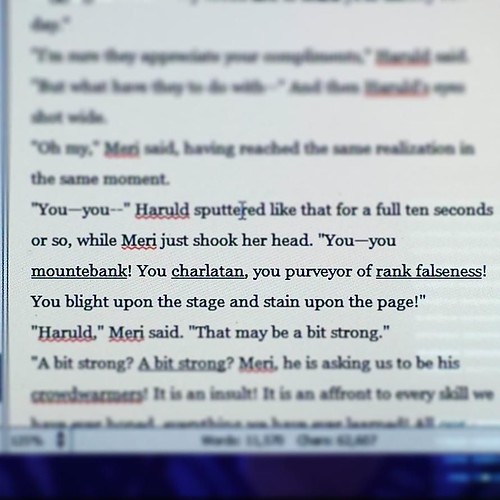
A snippet of my own writing that I rather like:
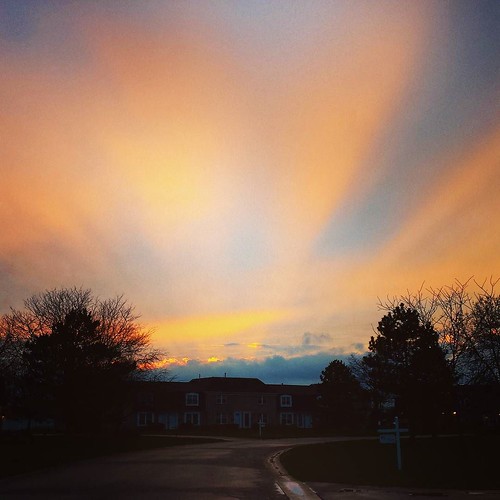
A sunset:
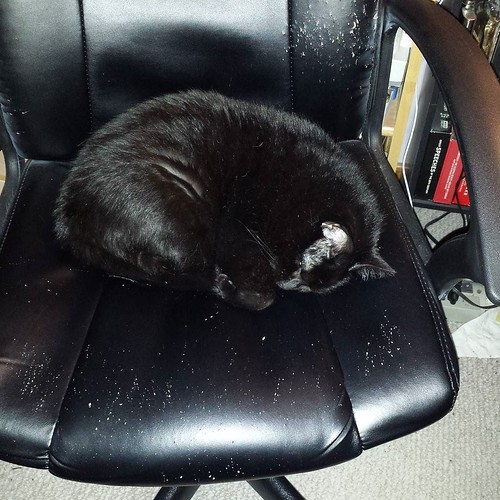
A cat in my chair:
A kick-off to my current vacation:

And on it goes!
The personal blog of author Kelly Sedinger, chronicling the adventures of one overalls-clad wanderer.
I said to heaven that glowed above,
O hide yon sun-filled zone,
Hide all the stars you boast;
For, in the world of love
And estimation true,
The heaped-up harvest of the moon
Is worth one barley-corn at most,
The Pleiads' sheaf but two.
If my darling should depart,
And search the skies for prouder friends,
God forbid my angry heart
In other love should seek amends.
When the blue horizon's hoop
Me a little pinches here,
Instant to my grave I stoop,
And go find thee in the sphere.
The Lady of Shalott
by Alfred, Lord Tennyson
Part I
On either side the river lie
Long fields of barley and of rye,
That clothe the wold and meet the sky;
And thro' the field the road runs by
To many-tower'd Camelot;
And up and down the people go,
Gazing where the lilies blow
Round an island there below,
The island of Shalott.
Willows whiten, aspens quiver,
Little breezes dusk and shiver
Thro' the wave that runs for ever
By the island in the river
Flowing down to Camelot.
Four gray walls, and four gray towers,
Overlook a space of flowers,
And the silent isle imbowers
The Lady of Shalott.
By the margin, willow veil'd,
Slide the heavy barges trail'd
By slow horses; and unhail'd
The shallop flitteth silken-sail'd
Skimming down to Camelot:
But who hath seen her wave her hand?
Or at the casement seen her stand?
Or is she known in all the land,
The Lady of Shalott?
Only reapers, reaping early
In among the bearded barley,
Hear a song that echoes cheerly
From the river winding clearly,
Down to tower'd Camelot:
And by the moon the reaper weary,
Piling sheaves in uplands airy,
Listening, whispers " 'Tis the fairy
Lady of Shalott."
Part II
There she weaves by night and day
A magic web with colours gay.
She has heard a whisper say,
A curse is on her if she stay
To look down to Camelot.
She knows not what the curse may be,
And so she weaveth steadily,
And little other care hath she,
The Lady of Shalott.
And moving thro' a mirror clear
That hangs before her all the year,
Shadows of the world appear.
There she sees the highway near
Winding down to Camelot:
There the river eddy whirls,
And there the surly village-churls,
And the red cloaks of market girls,
Pass onward from Shalott.
Sometimes a troop of damsels glad,
An abbot on an ambling pad,
Sometimes a curly shepherd-lad,
Or long-hair'd page in crimson clad,
Goes by to tower'd Camelot;
And sometimes thro' the mirror blue
The knights come riding two and two:
She hath no loyal knight and true,
The Lady of Shalott.
But in her web she still delights
To weave the mirror's magic sights,
For often thro' the silent nights
A funeral, with plumes and lights
And music, went to Camelot:
Or when the moon was overhead,
Came two young lovers lately wed:
"I am half sick of shadows," said
The Lady of Shalott.
Part III
A bow-shot from her bower-eaves,
He rode between the barley-sheaves,
The sun came dazzling thro' the leaves,
And flamed upon the brazen greaves
Of bold Sir Lancelot.
A red-cross knight for ever kneel'd
To a lady in his shield,
That sparkled on the yellow field,
Beside remote Shalott.
The gemmy bridle glitter'd free,
Like to some branch of stars we see
Hung in the golden Galaxy.
The bridle bells rang merrily
As he rode down to Camelot:
And from his blazon'd baldric slung
A mighty silver bugle hung,
And as he rode his armour rung,
Beside remote Shalott.
All in the blue unclouded weather
Thick-jewell'd shone the saddle-leather,
The helmet and the helmet-feather
Burn'd like one burning flame together,
As he rode down to Camelot.
As often thro' the purple night,
Below the starry clusters bright,
Some bearded meteor, trailing light,
Moves over still Shalott.
His broad clear brow in sunlight glow'd;
On burnish'd hooves his war-horse trode;
From underneath his helmet flow'd
His coal-black curls as on he rode,
As he rode down to Camelot.
From the bank and from the river
He flash'd into the crystal mirror,
"Tirra lirra," by the river
Sang Sir Lancelot.
She left the web, she left the loom,
She made three paces thro' the room,
She saw the water-lily bloom,
She saw the helmet and the plume,
She look'd down to Camelot.
Out flew the web and floated wide;
The mirror crack'd from side to side;
"The curse is come upon me," cried
The Lady of Shalott.
Part IV
In the stormy east-wind straining,
The pale yellow woods were waning,
The broad stream in his banks complaining,
Heavily the low sky raining
Over tower'd Camelot;
Down she came and found a boat
Beneath a willow left afloat,
And round about the prow she wrote
The Lady of Shalott.
And down the river's dim expanse
Like some bold seër in a trance,
Seeing all his own mischance—
With a glassy countenance
Did she look to Camelot.
And at the closing of the day
She loosed the chain, and down she lay;
The broad stream bore her far away,
The Lady of Shalott.
Lying, robed in snowy white
That loosely flew to left and right—
The leaves upon her falling light—
Thro' the noises of the night
She floated down to Camelot:
And as the boat-head wound along
The willowy hills and fields among,
They heard her singing her last song,
The Lady of Shalott.
Heard a carol, mournful, holy,
Chanted loudly, chanted lowly,
Till her blood was frozen slowly,
And her eyes were darken'd wholly,
Turn'd to tower'd Camelot.
For ere she reach'd upon the tide
The first house by the water-side,
Singing in her song she died,
The Lady of Shalott.
Under tower and balcony,
By garden-wall and gallery,
A gleaming shape she floated by,
Dead-pale between the houses high,
Silent into Camelot.
Out upon the wharfs they came,
Knight and burgher, lord and dame,
And round the prow they read her name,
The Lady of Shalott.
Who is this? and what is here?
And in the lighted palace near
Died the sound of royal cheer;
And they cross'd themselves for fear,
All the knights at Camelot:
But Lancelot mused a little space;
He said, "She has a lovely face;
God in his mercy lend her grace,
The Lady of Shalott."
The limerick packs laughs anatomical
Into space that is quite economical.
But the good ones I've seen
So seldom are clean
And the clean ones so seldom are comical.
The limerick’s an art form complex
Whose contents run chiefly to sex;
It’s famous for virgins
And masculine urgin’s
And vulgar erotic effects.
There once was a young lady named bright
Whose speed was much faster than light
She set out one day
In a relative way
And returned on the previous night.
Working in the Rain
by Robert Morgan
My father loved more than anything to
work outside in wet weather. Beginning
at daylight he'd go out in dripping brush
to mow or pull weeds for hog and chickens.
First his shoulders got damp and the drops from
his hat ran down his back. When even his
armpits were soaked he came in to dry out
by the fire, making coffee, read a little.
But if the rain continued he'd soon be
restless, and go out to sharpen tools in
the shed or carry wood from the pile,
then open up a puddle to the drain,
working by steps back into the downpour.
I thought he sought the privacy of rain,
the one time no one was likely to be
out and he was left to the intimacy
of drops touching every leaf and tree in
the woods and the easy mutterings of
drip and runoff, the shine of pools behind
grass dams. He could not resist the long
ritual, the companionship and freedom
of falling weather, or even the cold
drenching, the heavy soak and chill of clothes
and sobbing of fingers and sacrifice
of shoes that earned a baking by the fire
and washed fatigue after the wandering
and loneliness in the country of rain.
Spring, the sweet spring
Thomas Nashe
pring, the sweet spring, is the year’s pleasant king,
Then blooms each thing, then maids dance in a ring,
Cold doth not sting, the pretty birds do sing:
Cuckoo, jug-jug, pu-we, to-witta-woo!
The palm and may make country houses gay,
Lambs frisk and play, the shepherds pipe all day,
And we hear aye birds tune this merry lay:
Cuckoo, jug-jug, pu-we, to-witta-woo!
The fields breathe sweet, the daisies kiss our feet,
Young lovers meet, old wives a-sunning sit,
In every street these tunes our ears do greet:
Cuckoo, jug-jug, pu-we, to witta-woo!
Spring, the sweet spring!
Dulce et Decorum est
by Wilfred Owen
Bent double, like old beggars under sacks,
Knock-kneed, coughing like hags, we cursed through sludge,
Till on the haunting flares we turned our backs,
And towards our distant rest began to trudge.
Men marched asleep. Many had lost their boots,
But limped on, blood-shod. All went lame; all blind;
Drunk with fatigue; deaf even to the hoots
Of gas-shells dropping softly behind.
Gas! GAS! Quick, boys!—An ecstasy of fumbling
Fitting the clumsy helmets just in time,
But someone still was yelling out and stumbling
And flound’ring like a man in fire or lime.—
Dim through the misty panes and thick green light,
As under a green sea, I saw him drowning.
In all my dreams before my helpless sight,
He plunges at me, guttering, choking, drowning.
If in some smothering dreams, you too could pace
Behind the wagon that we flung him in,
And watch the white eyes writhing in his face,
His hanging face, like a devil’s sick of sin;
If you could hear, at every jolt, the blood
Come gargling from the froth-corrupted lungs,
Obscene as cancer, bitter as the cud
Of vile, incurable sores on innocent tongues,—
My friend, you would not tell with such high zest
To children ardent for some desperate glory,
The old Lie: Dulce et decorum est
Pro patria mori.
There are posts about Finn that come across my dash frequently that really concern me.
It’s not that I don’t think musings about what a sweet innocent soul he is and imagining what his humble life must’ve been like are coming from a loving place, but Finn’s character has already been filled in via a canon source, and it was not humble.
Read the novel “Before the Awakening,” where you will learn that while FN-2187 may have pulled shifts as a janitor just like any military trainee has to work some shit jobs, he was actually the absolute rock star of his elite band of Stormtroopers. He was the natural leader, the best of them all, the highest scores in every possible measure, someone Phasma and Hux were well aware of as the shining example of what their pet Stormtrooper program could accomplish. He was everything they’d worked for for years.
The only problem was, he cared too much about his fellow Stormtroopers, even though they didn’t return the feeling, due to indoctrination and some envy of his superiority. It is pretty obvious, reading BtA, that Finn is Force sensitive. It is that Force sensitivity that set him apart, and made him the one who could overcome a lifetime of indoctrination and get out.
I know it’s the fault of the film for sketching him so lightly, but guys, it is crucial that we start acknowledging who Finn is, and his strengths. Which, canonically, are leadership, strategy, all the skills a commander must have. I worry that there is too much PRECIOUS PURE CINNAMON ROLL going on and not enough shared knowledge of his *canon character background and gifts*.
Please spread the word about Finn. This sort of thing shortchanges him horribly. When the FO lost FN-2187, they lost more than just another Stormtrooper. They lost a future general, and the Resistance picked one up.

Losers Like Us
by Natasha Head
I had the car and the notebook
You had the weed and the beer
We both had the urge for leaving
Get up and get out of here
We made it as far as the sidewalk
Never knew that at one point it ends
Never knew where the concrete would take us
Never knew that we'd never again
Hid the car in the lot at the old rink
Took the path beaten on the forest floor
Took the notebook the weed and the beer
Took again and then took some more
The camp wasn't much to look at
There really wasn't much to see
Just me with my little notebook
And you with your bag of weed
The bench was hard and splintered
But to us it was good as a throne
The smoke was heavy and skunky
If it wasn't, we would have stayed home
The soundtrack was a walkman
With blaster speakers doctored by you
Suicidal Tendencies, Social Distortion
Back then, the balls and chains were few.
You let me tell you stories
I let you read what I had wrote
I let you sing my simple words
Even then it was poetry you spoke
All we knew for certain
Was that we couldn't be caught
Losers like us have a way of evasion
We slip away with barely a thought.
(via)
Roads go ever ever on,
Over rock and under tree,
By caves where never sun has shone,
By streams that never find the sea;
Over snow by winter sown,
And through the merry flowers of June,
Over grass and over stone,
And under mountains in the moon.
Roads go ever ever on
Under cloud and under star,
Yet feet that wandering have gone
Turn at last to home afar.
Eyes that fire and sword have seen
And horror in the halls of stone
Look at last on meadows green
And trees and hills they long have known.
The Road goes ever on and on
Down from the door where it began.
Now far ahead the Road has gone,
And I must follow, if I can,
Pursuing it with eager feet,
Until it joins some larger way
Where many paths and errands meet.
And whither then? I cannot say.
The Road goes ever on and on
Out from the door where it began.
Now far ahead the Road has gone,
Let others follow it who can!
Let them a journey new begin,
But I at last with weary feet
Will turn towards the lighted inn,
My evening-rest and sleep to meet.
Still round the corner there may wait
A new road or a secret gate,
And though I oft have passed them by,
A day will come at last when I
Shall take the hidden paths that run
West of the Moon, East of the Sun.

Rachmaninoff's Psychiatrist
by Diane Ackerman
I'm listening to Rachmaninoff's
Piano Concerto No. 2,
which he dedicated to Dr. Dahl,
the psychiatrist who guided him
through the straights of fever,
not long after Sergei had heard
his own first symphony played.
Horrified by its many defects
which seemed a sewage of noise,
he had fled the hall, ashamed,
a quagmire of self-doubt.
We cannot know all the sounds
Dahl and he exchanged,
but rubbing one word against another,
Dahl gradually restored
Sergei's confidence. History tells
that Dahl used affirmations
and auto-suggestion:
"You will compose again."
"You will write a piano concerto."
"You will write with great facility."
Repeated until the words saturated
His gift from head to fingers.
In truth, nothing can kill a gift,
but it may become anemic
from great shock or stress-
a sprain of the emotions will do,
or a traffic accident of the heart,
or a failure dire as a clanging bell.
For two years, Dahl worked
on Sergei's shattered will.
at last he collected up his senses
in a burst of blood fury
and composed his triumphant
2nd Piano Concerto,
full of tenderness and yearning,
beguiling melodies, raging passion,
and long sensuous preludes
to explosive climaxes,
frenzy followed by strains
of mysticism and trance.
Loaded with starry melodies,
it was a map of his sensibility,
and a wilderness rarely known
-the intense life of an artist
seen in miniature, with rapture expressed
as all-embracing sound.
Will you tell me if you know,
how Dahl might have received
such a gift? I cannot imagine it.
With hugs and shared enthusiasm?
With an austere thank you?
In his private moments, did he weep
at the privilege allowed him?
For a time he held the exposed heart
of a great artist, cupped his hands
around it like a flame, blew gently,
patiently, until it flared again.
For that, he earned the blessings
of history, and soothed millions
of hungry souls he would never meet.
Listening to Rachmaninoff's
concerto today, intoxicated by its fever,
I want to kiss the hands of Dahl,
but he is beyond my touch or game.
Allow me to thank you in his name.
Western wind, when will thou blow,
The small rain down can rain?
Christ! If my love were in my arms,
And I in my bed again!
To the Maiden in the East,
by Henry David Thoreau
Low in the eastern sky
Is set thy glancing eye;
And though its gracious light
Ne'er riseth to my sight,
Yet every star that climbs
Above the gnarled limbs
Of yonder hill,
Conveys thy gentle will.
Believe I knew thy thought,
And that the zephyrs brought
Thy kindest wishes through,
As mine they bear to you,
That some attentive cloud
Did pause amid the crowd
Over my head,
While gentle things were said.
Believe the thrushes sung,
And that the flower-bells rung,
That herbs exhaled their scent,
And beasts knew what was meant,
The trees a welcome waved,
And lakes their margins laved,
When thy free mind
To my retreat did wind.
It was a summer eve,
The air did gently heave
While yet a low-hung cloud
Thy eastern skies did shroud;
The lightning's silent gleam,
Startling my drowsy dream,
Seemed like the flash
Under thy dark eyelash.
Still will I strive to be
As if thou wert with me;
Whatever path I take,
It shall be for thy sake,
Of gentle slope and wide,
As thou wert by my side,
Without a root
To trip thy gentle foot.
I 'll walk with gentle pace,
And choose the smoothest place
And careful dip the oar,
And shun the winding shore,
And gently steer my boat
Where water-lilies float,
And cardinal flowers
Stand in their sylvan bowers.


