Sunday, April 05, 2020

The Era of the Virus, one month in

First off: thus far, everyone at Casa Jaquandor is fine.

So, as of this writing, we're roughly one month or so (however you choose to measure such things) into Covid-19's grip on American life. This is roughly about when, in March, I started to think that maybe this wasn't going to simply be one of those diseases that comes and goes but doesn't amount to a whole lot. But looking at the timeline, by the 5th of March, the World Health Organization hadn't even classified Covid-19 as a pandemic yet. That wouldn't happen for another six days. On March 12, Tom Hanks announced that he and his wife, Rita Wilson, had tested positive for the virus while filming a movie in Australia; right around the same time, American sports leagues began canceling events, flirting with the idea of playing in empty venues, and then eventually postponing seasons altogether. From my vantage point, it seems deeply strange that these events aren't even four weeks behind me yet.

You may or may not remember that my day job is in facilities maintenance at a large grocery store. As the food business is considered "essential," for obvious reasons, we are not threatened with closure, which means that unless I get sick or things in the world deteriorate to the point where we do have to close (and in that case, we'd probably be looking at some kind of apocalyptic horror kind of thing), I still have a job and am earning money. The Wife also still has her job, as she can work from home (and really, how fortunate are we right now that she ended her long career in restaurant management a year-and-a-half ago!), and The Daughter has her part-time job. We're OK. In terms of a direct hit to our lifestyle, this crisis isn't really that big of a blow to us. We're all pretty introverted, and mostly we stay at home anyway, except for occasional treks out to stores or restaurants. We've bought some takeout food, and since I'm at The Store anyway, I do my shopping on my work days, thus making extra trips on the weekends unnecessary. When we are out and about (and when I am working), we're observing every precaution regarding social distancing and constant handwashing that we can. It seems to me that we are very well positioned to get through this mess.

There are some unfortunate sides of this, obviously. At least one of our favorite restaurants has closed "temporarily," and we fervently hope that they can reopen once the danger has passed. This is by no means a lock, however, and it would be especially tough for us because The Wife is celiac and finding restaurants that make good gluten-free food is always a challenge. Also, as it's become clear that this pandemic is not going to be over before May, a number of events in that month--including two that we attend each year--will not be happening. Rochester's Lilac Festival and Buffalo's Nickel City Con, both in May, are now officially canceled. The Nickel City Con cancellation is especially hard for me, because that was where I was going to launch The Savior Worlds (The Song of Forgotten Stars, book 4). The next event on which we have our gaze focused is my brother-in-law's wedding in Idaho, which is scheduled for the first week of June. We're hoping, but not optimistic. Meantime, we stay home, we cook, we read and watch our teevee shows in streaming. And we still go on walks with the doggos; at least outside is not denied us! Cane and I still do our weekly nature walks at local parks. We've seen more people out and about in the parks lately, which is expected, and not only that, but more people are venturing off the main roads and paved areas for the trails in the woods. Maybe more people will find themselves back in nature as they can't go anyplace else.

And at least this happened when (a) it's spring after a mild winter, so being outside is an option, and (b) when we're living in a house! That's a huge blessing for us. I can't imagine how this long period of social distancing bordering on (if not being actual) quarantine feels for people in apartments.

If you're wondering what it was like working in The Store through all this...it's been surreal. As the threat started to settle in and the panic buying set in, The Store's sales doubled in a day. It was a Thursday and it was astonishing. The only thing I've ever seen that rivaled it was back in 2014 when The Store was closed for four days after that seven feet of lake effect snow buried Buffalo's Southtowns, and then everybody dug out and The Store reopened. This was truly breathtaking as all the paper products and cleaning supplies and gigantic amounts of the actual food were cleaned out in a matter of hours. I worked an extra day that week to assist with restocking on a Saturday morning, when The Store had already changed its hours from 24-hours-open to opening at 6:00am and closing at 11:00pm just to give everyone a fighting chance to regroup. At 6:10am I pulled an entire pallet of toilet paper onto the sales floor. By the time I got the pallet to the aisle 17 where the TP goes, there was only a third of the pallet left. I just dropped the entire pallet right there and went back for the next one.

TP continues to be an issue, along with paper towels and facial tissue; cleaning supplies are also only starting to filter back onto the shelves. Hand soap and hand sanitizer are also very hard to come by (we have plenty of soap and we don't use sanitizer at home). Those first days, the pasta and pasta sauce were obliterated, as were the dairy supplies. Fortunately, I had just bought three dozen eggs and half-and-half and what cheese we needed days before, and supplies are slowly coming back as we get to needing more of that kind of thing. Also, this is an area where The Wife's celiac disease is a kind of weird pseudo-blessing: the regular pasta was completely gone, but the gluten-free pasta, in another part of the store? Untouched. We've never come close to running out. In fact, as I've been shopping of late, I've been buying heavy on certain staple items. (It also helps that as an employee, I can actually go in and do my shopping before The Store even opens. Hey, we have to eat too, and my management has been very understanding of the reality that in this environment, oftentimes employees are finding essential items long gone by the time they get to shop if they wait until the ends of their shifts.)

I've noticed that a lot of people have no real appreciated for how supply chains work in large retail. Our stores got hammered, with sales doubling in a time that can be meaningfully expressed in hours, so of course the orders went way up; within days the warehouses were emptied. Then the warehouses passed along huge orders to the suppliers and manufacturers, who don't maintain huge back inventories because it's just not cost effective to do so. Demand shot up so high that supply on some items is still likely to not rebound for another week or two. Most of the people I've talked to during this crisis have been understanding and not jerks at all, but still, there's a frightening degree to which the average person is unaware of the gigantic infrastructure that exists to keep them able to get to a grocery store to buy milk and bread.

And that was just the first blast. As the "shelter in place" orders came down, and as the magnitude of what has been unfolding settled in, The Store has changed dramatically. Gone are many of the large displays that filter customers in one direction or another, forcing them to look at some nifty thing we want them to buy; the recommendations for social distancing demand us to open up as much space as we can. Self-serve food bars? We had more than a dozen of these. They are all shut down now. Too risky. Same thing with the bulk foods. The cash register area had to be reconfigured with stanchions and barrier-lines, to force customers into queues, in order to minimize the length of time a customer is standing near a cashier. Just this past week, we installed Plexiglas barriers for added protection. More and more customers are wearing masks and gloves as they shop. And more and more are showing awareness of other peoples' personal spaces, which is a very welcome development.

That's where we are right now. I do have some politically-natured thoughts on all this, but I'll save those for another post. For now, April is upon us. It will likely be worse than March was...but as they sing at the end of Les Miserables:

For the wretched of the earth,
There is a flame that never dies;
Even the darkest nights will end and the sun will rise!

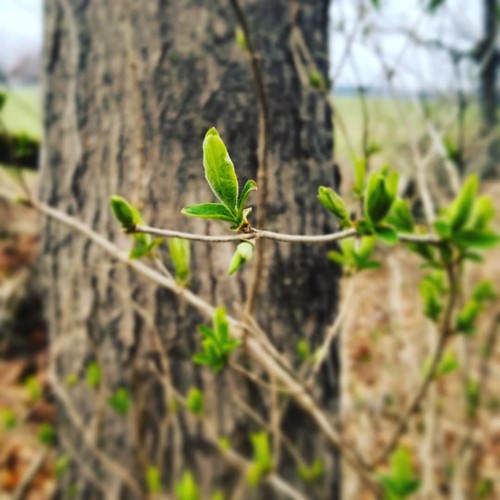
Come on, Spring! You can do it! #KnoxFarm #eastaurora #wny #spring #nature #hiking #trees

Friday, April 03, 2020

Poetical Excursion: Edna St. Vincent Millay and Beethoven

I won't post a poem each day of this National Poetry Month, but I'll try to do so as often as I can! Here's one I found in a collection of music poetry I have, which fits right in with my year-long focus on Ludwig van Beethoven. This sonnet, by Edna St. Vincent Millay, is titled On Hearing a Symphony of Beethoven. Note that Millay does not specify which of the nine symphonies she has just heard! It could as easily be the light and good nature of the 1st, or the power of the 3rd, or the majesty of the 5th, the dance-like awe of the 7th, or the storm-turned-to-joy of the 9th.

Sweet sounds, oh, beautiful music, do not cease!
Reject me not into the world again.
With you alone is excellence and peace,
Mankind made plausible, his purpose plain,
Enchanted in your air benign and shrewd,
With limbs asprawl and empty faces pale,
The spiteful and the stingy and the rude
Sleep like scullions in the fairy tale.
This moment is the best the world can give:
The tranquil blossom on the tortured stem.
Reject me not, sweet sounds! oh, let me live,
Till Doom espy my towers and scatter them,
A city spellbound under the aging sun,
Music my rampart, and my only one.

The lines that hit me hardest here are the ninth and tenth:

This moment is the best the world can give:
The tranquil blossom on the tortured stem.

Unlike a painting or a sculpture or even a poem, a symphony (or any piece of music) can only exist in time. You can't linger on a particular melodic moment that especially strikes your ear, the way you might stop in an art gallery to spend more time gazing upon a particular painting on the wall. Music is only meaningful in time, and thus music only exists as a momentary thing. Beethoven's Fifth Symphony does not exist in the same sense that Michelangelo's David exists. Every performance is a singular event, ephemeral and blossom-like.

And since we're here, let's just go ahead and have a Beethoven symphony. We could hardly do better to honor Edna St. Vincent Millay. Here is the Symphony No. 2 in D Major, with Daniel Barenboim conducting the West-Eastern Divan Orchestra at the BBC Proms in 2012.

Thursday, April 02, 2020

Something for Thursday (Thank you, Adam Schlesinger)

Singer and songwriter Adam Schlesinger has died of complications from Covid-19. He was an amazingly prolific singer and songwriter who worked on his own material with his own bands, as well as songwriting for movies and teevee. I've heard a lot of his work...and I haven't heard a whole lot more. My primary exposure to him came via the amazing, wonderful show Crazy Ex-Girlfriend, a show I adored with each and every episode. Here are some of the songs on which he worked.


Wednesday, April 01, 2020

Poetical Excursions, National Poetry Month 2020: Thomas Nashe

National Poetry Month is upon us.

At last--at long, long, long last--it is finally April. This March was...something, wasn't it? In fact, there's a joke going around online; I've seen a number of variations on the theme and I've no idea who made this joke first, but it roughly goes like this:

Wow, I just realized that I've been alive in seven decades!

-the 70s
-the 80s
-the 90s
-the 2000s
-the 10s
-the 20s
March

Yeah, that about sums it up. And this April is likely to be, for many of us, even worse than March was. But here's hoping April sees some kind of turning-of-the-corner.

For me, the current crisis has yielded more time than I even usually have for digging into my internal world of music and prose and verse, and I don't believe I have heard anything about National Poetry Month being called off just because it feels like the world is spinning off its axis. So, in addition to other things, I plan to spend time in April digging into poetry. If the current pandemic has you feeling powerless, remember: you can still enjoy poetry and explore it. There are, after all, several thousand years' worth of the stuff to dig through.

Let's start, though, on a somber note, for obvious reasons. This year's celebration isn't going to be all joy and cheer; sometimes it will be huddling around a guttering candle as the wind roars without, and sometimes it will be waiting in the dark corner as a pounding comes at the door. But it will also be occasional cheer, or, failing that, at least a shaking of the fist at the booming thunderclaps (a worthy image, that, in this year of Ludwig van Beethoven's 250th anniversary).

Let's start with Thomas Nashe.

Nashe was a contemporary of William Shakespeare's, and reliable biographical information on him seems about as abundant. We have his dates as 1567-1601, but we know nothing at all about his death or where he was buried. Much of what is known about him is by inference. He did, though, live in London during outbreaks of the plague, which led him to write this poem. A Litany in Time of Plague is just that: a lengthy rumination on the inevitability and the finality of death, and the way it reduces everyone and everything, in the end, to the purest equality that exists.

Adieu, farewell, earth’s bliss;
This world uncertain is;
Fond are life’s lustful joys;
Death proves them all but toys;
None from his darts can fly;
I am sick, I must die.
   Lord, have mercy on us!

Rich men, trust not in wealth,
Gold cannot buy you health;
Physic himself must fade.
All things to end are made,
The plague full swift goes by;
I am sick, I must die.
   Lord, have mercy on us!

Beauty is but a flower
Which wrinkles will devour;
Brightness falls from the air;
Queens have died young and fair;
Dust hath closed Helen’s eye.
I am sick, I must die.
   Lord, have mercy on us!

Strength stoops unto the grave,
Worms feed on Hector’s brave;
Swords may not fight with fate,
Earth still holds ope her gate.
“Come, come!” the bells do cry.
I am sick, I must die.
   Lord, have mercy on us.

Wit with his wantonness
Tasteth death’s bitterness;
Hell’s executioner
Hath no ears for to hear
What vain art can reply.
I am sick, I must die.
   Lord, have mercy on us.

Haste, therefore, each degree,
To welcome destiny;
Heaven is our heritage,
Earth but a player’s stage;
Mount we unto the sky.
I am sick, I must die.
   Lord, have mercy on us.

Tuesday, March 31, 2020

Tone Poem Tuesday

It's well known that Beethoven write only a single opera, Fidelio. A bit less well known is that Beethoven also wrote a single ballet, The Creatures of Prometheus. In Beethoven's time, ballet was seen mainly as a dance art, and the music was just a framework for the dance. This being the case, it was generally the job of lesser composers to write ballet numbers, while the finer, more serious composers stuck with opera and symphonies and concertos and all the rest. Beethoven was approached in 1801 by Salvatore Vigano, a composer and dancer who was preparing a new ballet based on the legend of Prometheus, the Greek god who stole fire from the heavens and gave it to humanity. Vigano apparently felt strongly enough about the project to want better music for it than he could himself provide, so he asked his friend Ludwig van Beethoven to compose it for him. Beethoven agreed, perhaps because by this point he hadn't really composed anything for the Vienna stage yet and wanted to establish his name in that arena (Fidelio was still in the future). His resulting ballet is full of Beethovenian classicism and drama, with good cheer and wit throughout. If you're looking for the brooding Beethoven of, say, the Pathetique Sonata or the storm of the Third Symphony (which was still three years away from revolutionizing the symphony as a form), you won't find it here. This is as close as Beethoven probably came to the verve and energy of, say, Rossini.

Here is a suite drawn from Beethoven's music for The Creatures of Prometheus. The work proper starts about a minute in; what's heard at first over the gathering of concertgoers in the Concertgebouw in Amsterdam is a brief snippet of the larger work that you'll hear in full later on. I'd never heard this piece before I gave it several listens this weekend past, and it's an utter delight. It's always worth remembering that Beethoven could be delightful!

Thursday, March 26, 2020

Something for Thursday: Thanks, Kenny

Kenny Rogers died this past weekend. He had a long and productive life of music-making, and I won't try to offer a major retrospective here. I will note that Rogers was just...always there, wasn't he? And he was always there in a good way. Never once did I hear Kenny's rough voice and think, "Uh, no, I'm not in the mood right now, Kenny." He was always good, always reliable, and in his best songs he always knew how to sell the emotion of the tune.

This song, I believe, was a favorite of my father's back in the day. Thanks for the music, Kenny Rogers!

Tuesday, March 24, 2020

Tone Poem Tuesday

Not so much a tone poem, but rather a concerto with tone poem-like qualities...and a concerto that is a multi-movement work and a collaboration between multiple composers. Whew! It's the Yellow River Piano Concerto, arranged into a concerto from themes by composer Xian Xinghai for a work called Yellow River Cantata. The work's history is interestingly messy and problematic, as it was none other than Chairman Mao's wife, Jiang Qing, who ordered a collection of musicians to adapt the Cantata into the Concerto. The work was extremely popular in China initially, but then disappeared from concert halls in that country for many years until it started being heard again in the 1980s. The piece is in four movements, titled as follows: Prelude: The Song of the Yellow River Boatman, Ode to the Yellow River, The Wrath of the Yellow River, and Defend the Yellow River.

The work is brash and very eager to please, and it feels almost like a guided tour of cliches in East Asian music. But there's something unquestioningly compelling about the piece, and it always makes for a vibrant and exciting listen, mostly because its melodies are so gorgeous, its orchestral writing is so good, and (this is key) it's only twenty minutes or so long, so it never overstays its welcome. Here is the Yellow River Concerto.

Friday, March 20, 2020

Beethoven: Two early works

As I noted a while back (before The Virus took hold of our collective imaginations), I'm spending a lot of 2020 digging into the world of Ludwig van Beethoven. I'm currently reading a "life and works" book about him, and I plan to read a few more books about him before this year is out. One thing I learned that I didn't know is that while most of Beethoven's works carry opus numbers, not all of them did. Some of these are works that only survived in fragmentary form, while others are youthful works that an adult Beethoven--whose main source of income was the publishing and printing of his works--kept out of the public eye, likely because he considered them his 'student' works. These were gathered and numbered in the 20th century under the designation Werke ohne Opuszahl, or "Works without opus number", abbreviated as "WoO". As I've been listening to more Beethoven of late, I've listened to a number of these WoO works, and I present two here.

First is a piece of chamber music: the Piano Quartet No.3 in C Major (WoO 36, no. 3). A piano quartet is basically a string quartet with the second violin removed and a piano substituted. Piano quartets are generally uncommon, and the three Quartets in the WoO 36 group are the only ones he composed. In fact, they were never published until after his death, and Beethoven wrote the three Piano Quartets when he was only 15. They show a heavy influence of Mozart, and according to my reading, they even use some of Mozart's thematic material, although I couldn't tell you where. The work is charming and, well, pleasant in the most wonderfully Classical way. And he wrote this when he was fifteen. Yikes!


And if Beethoven at 15 was impressive, let's turn back the clock to when he was just 12. This is, by all accounts, the first published piece Beethoven ever wrote, when he had undertaken lessons with Christian Neefe, one of the most prominent musicians in his hometown of Bonn, Germany. As an exercise, Neefe had assigned his young student to write a series of variations on a march by a composer named Ernst Dressler, and this seven-minute work is the result. It's not particularly profound, but one can definitely tell that this was a twelve-year-old with a keen ear and a strong sense for thematic possibilities.


More Beethoven to come! We're only just getting started.

Thursday, March 19, 2020

Something for Thursday

Here's a bit of film music, by the underheard (at least by me) composer Basil Poledouris. This, from the movie The Hunt for Red October, is "The Hymn To Red October". This cue opens the film as we get our first glimpse of the giant Russian submarine that will dominate the story. Poledouris gives the cue, with the Russian hymn, a certain soaring naval quality that works wonderfully.

Wednesday, March 18, 2020

Checking In....

Well, on the day the world "went viral" in the worst way possible, my hard drive died, remember? So into Best Buy and the Geek Squad the thing went. Now the computer is home and has a spiffy new solid-state hard drive, which I'm told is better for speed because there are no moving parts. The tradeoff is less storage capacity, but I'm fine with that as I have several external hard drives, two cloud-storage accounts, and a bunch of flash-drives. I'm good.

Of more concern, obviously, is the unfolding disaster of the Coronavirus. We're doing fine thus far at Casa Jaquandor. I'm still working, which is good because my workplace (grocery store, for those who don't remember) is exceedingly unlikely to be forced to close because of this event. The Daughter is working at her fast-food job, which is going fine, because they're takeout-only, and The Wife is now working at home for her banking job. So far, so good. Short of me being able to work from home too, I think we're in as good a position to ride this out safely (whilst still pulling in our incomes) as is likely to exist. Of course, that this state of affairs constitutes a really good position for riding this crisis out is a statement in itself, but that's a thought for another time. For now, we're doing well, thought I must admit to being a bit on the ragged side right now, because the flip side of having a pretty safe job in a pandemic is that we've been getting our asses kicked for...about a week now. Ouch!

So, more to come soon. For now, since I missed both Tone Poem Tuesday and St. Patrick's Day, here's the United States Marine Band playing "Irish Tune from County Derry," arranged by the great Percy Grainger.


Thursday, March 12, 2020

Nothing for Thursday....

In the "When it rains, it pours!" department, my poor laptop has suffered the dreaded "Hard Drive Not Found" ailment. It's going to the shop later today, but for now all I got is my phone, and as much as I love my phone, I am decidedly NOT a big fan of it as a device for writing anything longer than a tweet. So, radio silence here starts now. Hopefully it'll just be a few days!

Tuesday, March 10, 2020

Tone Poem Tuesday

Carl Maria von Weber is one of those composers who is better known to historians of music than to actual listeners of it, which always seems to me a pity. His work represents a crucial step in the development of German opera between the Classical era of Mozart and Beethoven and the full-blown Romanticism of Richard Wagner. Weber's final work was an opera called Oberon, for which he worked himself sick (maybe even hastening his own death) to learn English so he could most effectively set the libretto, which was in that language. Oberon has never become an operatic standard the way Weber's earlier masterpiece, Der Freischutz, did, although several excerpts from Oberon have become commonplace in the concert hall. According to David Dubal's The Essential Canon of Classical Music, Oberon's fate is due to serious deficiencies in its libretto. I honestly have no idea if that's the case or not, but I do know that plenty of operas see rare stagings because of libretto concerns: either the stories and plots are ridiculous, or the demands on the singers are too bizarre, or the staging demands are so outlandish as to be unfeasible. Quite a few operas exist in this weird nether-state, with wonderful scores written by great composers that sadly languish in obscurity because the non-musical aspects of the operas aren't up to snuff. One wonders if the current trend to concert performances of operas might help to give some of these works a fresh hearing.

In the meantime, here is the wonderful overture to Oberon. Note its dreamy opening, with that slow horn-call melody, which gradually becomes a vigorous and adventurous piece. If I heard that at the beginning of an opera, I'd certainly be intrigued to hear more!

Monday, March 09, 2020

Bring Back

Since St. Patrick's Day is approaching, I thought I'd listen to some Irish and Celtic music while at work today. A good starting point for such a mood is always The Chieftains, so I looked up one of my favorite albums of theirs, Fire in the Kitchen. This isn't exactly considered an "official" Chieftains album, as its selections were all recorded on the spur-of-the-moment as they toured in Canada and appeared with a number of that country's notable Celtic acts, but it is quite a wonderful album anyway. One of my favorite tracks is this haunting rendition of "My Bonny Lies O'er the Ocean", sung hauntingly by a woman named Laura Smith.

It suddenly occurred to me that I know nothing at all about Laura Smith, so I looked her up.

She died the day before yesterday.

Sigh.

Thursday, March 05, 2020

Something for Thursday

A change of pace today, I think. Over on Twitter today we were discussing the great 1980s geek comedy Real Genius, in the context of Sheila O'Malley's piece about director Martha Coolidge. Real Genius somehow wasn't a big hit when it came out in 1985 or so, but it should have been, and it is rightly seen nowadays as a classic comedy film of the era. Its story involves super-geniuses in the physics department at a California university and what they do when it turns out that their research project, a super-powered laser, is actually a stealth project for the Defense Department, and its humor is warm and witty and the movie creates a world all its own, eschewing a lot of the usual tropes and stereotypes about nerdy, awkward young people. All that is great; it's a fantastic movie! But in terms of music, it's for the most part a typical 1980s-pop song "score", but again with a lot of good choices made in terms of the songs used. It certainly nailed the song for the end credits, the cheerfully goofy "Everybody Wants To Rule The World" by Tears For Fears, which fits the film's mood and subject matter nearly perfectly. Tears For Fears was one of those quintessential 1980s bands, fronted by two odd-looking dudes who played synth-heavy pop music that was often oddly infectious.

So here is Tears For Fears, with "Everybody Wants To Rule The World".

Tuesday, March 03, 2020

Tone Poem Tuesday (Beethoven at 250)

This year has all manner of potential to be...well, roughly on par with its several immediate predecessors, but let's try not to focus on that entirely, OK? Let us instead focus occasionally, for the remainder of the year, on the fact that 2020 will see the two-hundred-fiftieth anniversary of the birth of one of the towering figures in all human art, Ludwig van Beethoven.

I'm planning on going down quite the Beethoven rabbit hole this year. I won't feature him every week in this space; sometimes he'll appear on Something for Thursday, sometimes he'll have a post of his own, and sometimes he might not even appear on this blog for a week or two at a time. But I plan to make old Ludwig quite the presence here for the remainder of the year, leading up to his actual birthdate on December 16.

For today, we will lead off Ten Months of Beethoven with the overture to his one and only opera, Fidelio. This opera springs from Beethoven's eternal concerns about human freedom and liberty, as well as the devotion of love to those causes. In the opera, a woman named Leonore decides to free her husband from his unjust imprisonment, and in so doing, she adopts the costume and identity of a young man named Fidelio. Beethoven's process in composing this opera was typically strained and tortured; he labored over versions of the opera for years and he eventually produced not one but four overtures for the piece, finally settling on this final version, which is shot through with lyrical excitement and light.

Aaron Copland wrote of Beethoven:

Beethoven brought three startling innovations to music: first, he altered out very conception of the art by emphasizing the psychological element implicit in the language of sounds. Secondly, his own stormy and explosive temperament was, in part, responsible for a dramatization of the whole art of music...Both of these elements--the psychological orientation and the instinct for drama--are inextricably linked in my mind with his third and possibly most original achievement: the creation of musical forms dynamically conceived on a scale never before attempted and of an inevitability that is irresistible."

Here is the Fidelio overture by Ludwig van Beethoven.

Friday, February 28, 2020

Something for Thursday (Friday edition)

Concluding a celebration of Black History Month by way of music, we have a selection performed by musical prodigy Philippa Duke Schuyler. Schuyler lived from 1931 to 1967. She was an enormously gifted musician who spent much of her youth touring and performing. She later grew disillusioned with her status as a racial symbol, and she took to a career in journalism and performing overseas. Sadly she was killed while covering action in Vietnam, when the helicopter she was in crashed. Schuyler's name lives on, attached to a middle school for talented and gifted students in Brooklyn.

Here is Philippa Schuyler performing Bach. In recordings like this you can hear worlds meeting, hundreds of years apart.

Thursday, February 27, 2020

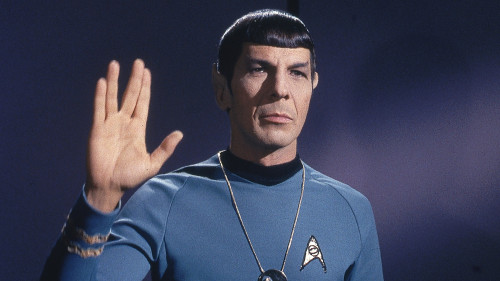
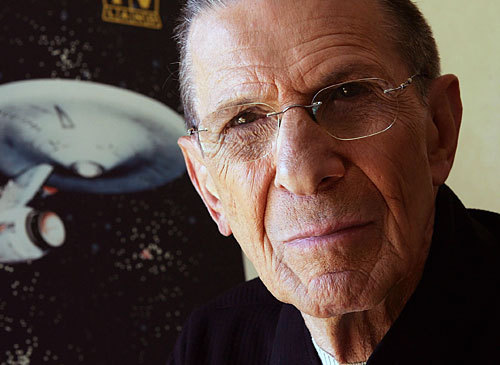
REPOST: Love, Logic, and Why I Don't Write Dystopia: Some Rambling Thoughts on the Occasion of Leonard Nimoy's Passing

Leonard Nimoy died five years ago today. Here's the post I wrote on that occasion.


When The Wife and I were on our honeymoon, one of the stops was the Boston Museum of Science. I'm always a fan of science museums. During our visit, we saw a movie in their OmniMax theater. I don't remember what the movie was, to be honest, but I do recall a bit at the beginning of the show, when the lights dimmed and a voice sounded over the speakers, which said something like this:

Good afternoon! The movie will begin shortly, but before it does, we need to properly calibrate our theater's sound systems for use. To do this, we have enlisted the aid of a person who grew up in this very neighborhood. You may find his voice familiar.

This was followed by a beat of silence, and then another voice said:

Hello. Who put the BOMP in the BOMP shoo BOMP shoo BOMP; who put the RAM in the RAMALAMADINGDONG.

The second voice, the "local kid made good", was Leonard Nimoy's. I think most folks in the audience recognized that voice before he actually said "This is Leonard Nimoy"; his voice was, actually, one of the most familiar I ever knew. Gravelly and distinguished, that voice was, and Nimoy knew how to use it, which words to emphasize and where to pause just ever-so-slightly for effect.


I don't remember a time when I wasn't aware of Leonard Nimoy on some level. More precisely, I should say that I don't remember a time when I didn't know who Mr. Spock was. I remember Star Trek episodes very early on, all the way back to the first house I ever lived in. Trek was my sister's thing, but I remember vague images from it. The most specific one I have is at the end of an episode called "Friday's Child", when, at the end, all is well and the female guest star's character has given birth, and observing Dr. McCoy making baby talk to the kid, Spock asks why baby talk is a thing at all.

A lot can be said about Nimoy and Spock, and a lot has been said about Nimoy and Spock over the years. Most fascinating to me was Spock's arc through the six "Original Crew" movies, from his attempt in The Motion Picture to purge himself of emotion to his own resolution of the "Kobayashi Maru" test to his rescue to his work to put his own brain back together (interesting that no fewer than three major Trek stories, one episode and two movies, devoted large amounts of time to putting Spock's brain and mind back together), and finally to the confident, competent officer we saw in The Undiscovered Country. In that film, when Kirk and McCoy get in serious trouble and are arrested, Spock just calmly assumes command and immediately begins the investigation to find the evidence to free them. Through that film, Spock acts with a calm acceptance that the truth will come out, that they will find the evidence, and that they will find it by searching for it calmly and logically. It is of a piece with his line in the film about the need for faith, to trust that "the Universe will unfold as it should".

My personal favorite Spock moment comes at the end of what is certainly one of the very best Trek episodes ever, "The City on the Edge of Forever". Knowing that if he allows Edith Keeler to live, the future will change and Starfleet and the Federation will never happen, Kirk stops McCoy from pulling her out of the path of the oncoming car. McCoy rages at Kirk:

"You deliberately stopped me. Jim! I could have saved her! Do you know what you just did?!"

And Spock -- ever calm, ever logical, ever accepting of what must be -- simply says:

"He knows, Doctor. He knows."

Nimoy knows that he can't express sadness in that line. He cannot express heartbreak or the awfulness of the choice that Kirk has just had to make, and all the same, Nimoy conveys that Spock knows these things. He knows these things, he knows that they are real, and he does not belittle them in any way.


Since I've no memories at all of a time before Star Trek, it's fair to say that it -- along with Star Wars, obviously -- are the biggest influences of mine in terms of my notion of what the world will look like, hundreds or thousands of years in the future. Will we always face problems and struggles and very real difficulties? Absolutely. But I don't believe in dystopia. I cannot, will not believe that there is a future in the offing when the world is wrecked and everything is in ashes and only a very few are living well while the rest of humanity exists in dimly-lit squalor. I cannot, will not believe that, and that's why I cannot, will not write it.

I believe that whatever difficulties and challenges we eventually face, we will do it from a brightly-lit viewpoint where it's always clear how far we've already come. I believe that when we take to the stars, our ships will be beautiful and that they will explore with grace, and that we will confront our futures with logic and science as well as warmth and a twinkle in the eye that's always there.

Why do I believe those things? In large part, because of a teevee show and some movies that Leonard Nimoy starred in.

After his long and prosperous life, Leonard Nimoy now belongs to the past. But he'll always be a part of my future...my "Undiscovered Country".


Tone Poem Tuesday (Thursday Edition)

Yup, another really busy week...plus, Tuesday fell on The Wife's birthday and I didn't want to bury her post below Tone Poem Tuesday, so here we are.

Interesting piece today, in that there isn't a single string or wind instrument in it. It's a work for percussion only! Composer Julia Perry only lived fifty-five years, but apparently she was a very prolific composer, and her dedication was such that when a stroke robbed her of the use of her right hand, she taught herself to use her left in order to keep composing. Perry was hard-working and highly accomplished, winning not one but two Guggenheim fellowships to further her musical study. I'd never heard of her before Googling "Black classical composers," and once again as I have throughout this exercise, I am led to wonder, "Why have I never heard of this person?"

"Homunculus C.F." is a short piece for percussion ensemble. Perry wrote the work in 1960 while living in an apartment above her father's medical office. She specifically winds the piece around the "Chord of the Fifteenth," hence the initials in the title. The piece is modern and abstract and fresh, sounding almost like it had been improvised yesterday instead of being composed nearly sixty years ago.

Tuesday, February 25, 2020

Happy Birthday My Love (at Fifty!)

The Wife and the Dee-oh-gee at Taughannock Falls. Aren't they beautiful! 😍😍😍 #wife #Cane #DogsOfInstagram #greyhound #taughannockfalls

Today is The Wife's birthday!

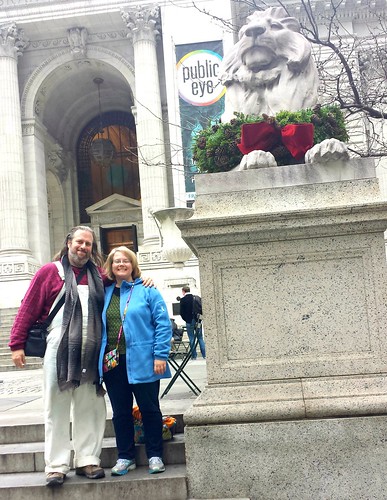
This year is a big one: this year, she turns fifty. We passed the point several years ago when we had been together for over half her life, but that milestone definitely stands out right now. I know that fifty is one of those ages where you're supposed to look back and be introspective and stuff, and I'm sure she is doing some of that. I'm not at fifty yet (September 2021 for me), but for now I think we'll keep doing what we're doing now, because it seems to be working.

Onward and upward, as always!

A brief slideshow of photos (some of which are already on this post, but I like them and it's my blog, so there they are again!) follows. The song is "Live Forever" by Drew Holcomb and the Neighbors, a wonderful band.

Birthday video for The Wife

And now, my annual list of memories and things from our years together. (New items on the list are appended to Number 97, alphabetically. I do this because I'm too lazy to renumber all the stuff after that one every year.)
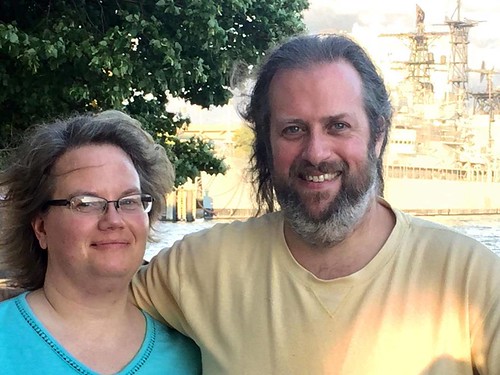


Happy Valentines Day to my beautiful wife! This was taken last summer. We probably need a photo of us with the dee-oh-gee....

Wife and Dee-oh-gee on a nice Christmas walk! #Cane #DogsOfInstagram #greyhound #ChestnutRidge #OrchardPark #wny #winter

Santa, the Wife, and the dee-oh-gee! #Cane #DogsOfInstagram #greyhound

We took the dee-oh-gee for his first ice cream. #Cane #DogsOfInstagram #greyhound

Posing with Patience (or is it Fortitude?)

The Wife and I at the Erie County Fair!

/PHOTO_20151129_213848

The Wife and the dee-oh-gee in Buffalo Creek, West Seneca. #wny #westseneca

I am reasonably sure that I was a placeholder all these years for the eventual dog.

Happy Birthday to Me! VI: The pies go in my face, Huzzah!

1. Her hand fits perfectly into mine, as though our hands were fit for each other.

1a. That said, there's a good chance that she prefers the dog to me.


2. The first time she saw Star Wars was with me. And ET.

2a. The first time I saw Cinderella and Sleeping Beauty were with her.

3. She used to keep an aquarium before a bunch of moves made us give up the fish. Maybe we'll do that again someday. But when we started dating, she had two fish, named Ken and Wanda, named after two memorable characters from A Fish Called Wanda. When Ken went belly-up, she called a friend and solemnly informed her, "K-k-k-ken d-d-d-died." (One of the movie's running gags is Ken's stuttering.)

4. I don't remember exactly when it happened, but I've converted her from someone who hated coffee into a regular coffee drinker.

5. For reasons passing understanding, she has always found Erik Estrada attractive. She and I used to have arguments over who could best the other in a fight: Agent Mulder from The X-Files or Ponch from Chips. (I think Mulder would have blinded Ponch with the beam from those giant blue-beamed flashlights he and Scully were always toting, and then beaten him into submission with his eternally-able-to-get-a-signal cell phone.)

6. One of the first things we cooked together was Spanish rice, which is to this day a comfort dish of ours. The first time we made it together was also the first time she'd ever cooked with actual bulb garlic, as opposed to garlic powder. The recipe called for a clove, but she thought the entire head was a clove, so into the rice the entire head of garlic went. That was the best Spanish rice ever.

7. A few years ago she baked a Bundt cake for The Daughter's birthday, but the damned thing stuck in the pan, resulting not in a ring but a mound. So she just mounded it up, glopped the frosting right over the top, and called it a "Volcano Cake". Now, every year at her birthday, The Daughter says, "Remember the Volcano Cake?"

8. Our first date was to see Edward Scissorhands. So, Johnny Depp's been there since the beginning, from Edward all the way to Captain Jack Sparrow and beyond.

9. We used to go out for chicken wings and beer every Thursday night. We didn't even miss our Thursday night wing night when The Daughter was born: her birth was on a Saturday, and we left the hospital on Tuesday, so at the tender age of five days, The Daughter entered a bar for the first time. This may have made us bad parents, but I don't think so. A girl's got to know how to handle herself in a bar, right?

9a. She's not a huge fan of when I post photos of her sleeping.
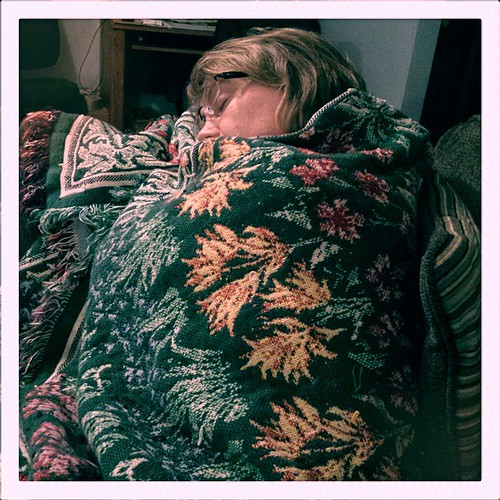
Yes, I will get yelled at for this, but she's so cute when she sleeps...even when it's during her favorite teevee show!

10. She insisted on breastfeeding both The Daughter and Little Quinn, which in both cases required lots of pumping. Especially in Little Quinn's case, since he was never able to eat by mouth. Every drop of breastmilk that entered his body went in via the G-tube, so for as long as her production held up, she pumped six times a day.

11. I'll probably never completely understand how much of herself she sacrificed in fourteen months to keep Little Quinn alive and progressing. It seems, in retrospect, that every free day she had was given to him.

12. That same instinct in her kicked in again when Fiona was in danger. She didn't question the necessity or possibility of spending months flat on her back with her feet inclined, if that was what it took. If commitment was all that was needed, Fiona would be here today. (Of course, if commitment was all that was needed, Little Quinn would be here and Fiona wouldn't have happened.)

13. We used to associate certain teevee shows with the snack foods we'd eat while watching them. NYPDBlue was always chips-and-salsa. ER, when we still watched it, was often good ice cream. Now, good ice cream has been transposed to Grey's Anatomy.

14. "Our" first teevee show was LA Law.

15. Subsequent teevee shows of "ours" included ER, Mad About You, The Pretender, Profiler, CSI, Firefly, and more.

16. On our first Internet account, we set up our combined e-mail identity after the two main characers on The Pretender. We were "Jarod and Miss Parker". People familiar with the show wondered what that said about our relationship, since Jarod and Miss Parker aren't allies. In fact, Miss Parker was initially a villain but as the show went on her character became much more complex.

17. She started roller blading, got me hooked, and then promptly stopped roller blading. Now she prefers biking.

18. It was almost without warning that I met her parents for the first time. We started dating late February 1991; a couple of weeks later was spring break, for a week, so I came home to Buffalo. At the end of that week I tried calling her, only to learn from the old lady she was renting a room from that she wasn't home because of a death in her family. I remembered her saying something about a sick grandfather, and that's what turned out to have happened; her grandfather had passed away from Lou Gehrig's Disease. When I got back out to school, her entire family was there. So I met the future in-laws on the spot. Luckily, I seem to have made some kind of decent impression.

19. Our first long trip together was from Iowa to Idaho, to visit her family, a couple of weeks before school began in August of 1992. She had already graduated college, but I was in my senior year. While we were out there, the infamous Ruby Ridge Incident was taking place twenty miles down the road, so all week there were National Guard vehicles on the roads and helicopters overhead.

20. I am forever amazed at her ability to take some fabric and create a garment. This skill of hers looks like magic to me.

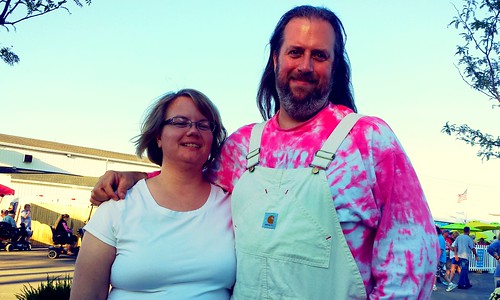
21. Her first pair of overalls were a gift from me. She thought the whole thing was goofy – maybe she still does! - but she wore them for years until at one point they became too small for her, and then a short while later they became too big for her. We didn't start wearing overalls together until we'd been dating for about a year.

22. Back in the 90s, on two different occasions, we picked out Persian kittens. Both were wonderful cats, both are gone now, and we miss them both dearly. The first was a beautiful tortoiseshell Persian named Jasmine; the second was a red Persian named Simba. Both died in the year preceding this blog's launch.

23. Adopting Lester and Julio was The Wife's idea. I'm still unsold on these two giant lummox goofballs.

24. The Wife also took The Daughter to adopt Comet, when The Daughter was only two.

25. Shortly after The Wife moved to Western New York to be near me, she adopted a cat from the shelter she named Lilac. That cat never really liked me all that much. Lilac died a few months after Little Quinn passed.

25a. She is directly responsible for all the animals with whom we currently live.
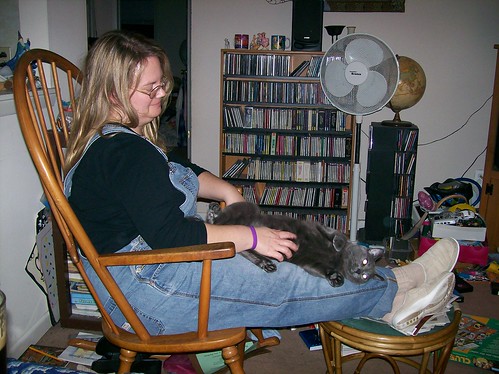
Indulging Lester

Why they invented hotel rooms

Julio's favorite position

Cats and Wife. (And my left shoulder)

Snowmageddon '14, continued

Day 59: Clear wife, blurry dog. #100DaysOfHappiness #NewDog

The Wife is unimpressed with Julio's uninvited advances. (Notice Lester in the background.)

26. She loves to laugh, particularly at my expense. She is convinced I don't think she's funny, but that's just not the case.

27. Things with which she has a deft touch include: a pair of scissors, a needle and thread, a kitchen knife, the mixer, bread dough, a screwdriver, a lug wrench, and a shot glass.

28. It irritates her that The Daughter has inherited my tolerance for sunlight -- I tan, whereas The Wife burns.

29. The Wife likes to read, albeit not quite as much as I do. She always has a book going, and she reads every day.

30. She never used to use a bookmark, until I finally decided I was tired of watching her flip through a book looking for a passage that was familiar to her so she could find her place. I bought her a bookmark.

31. She loves nuts – except for walnuts and pecans, which I love. This makes it occasionally difficult find good brownies and similar items in bakeries, since many people default to putting pecans or walnuts in their brownies or other chocolate cookies.

32. When I first met her, she was a huge Anne Rice fan and read most of what Rice wrote until she decided that Rice's output wasn't interesting her much anymore. Since then she's read a lot of other authors, including a lot of unfamiliar names whose books I've plucked from the stacks of offerings at library book sales over the years. Interesting how obscure even the bestsellers of yesteryear eventually become, huh? Currently she really loves Gregory Maguire, the Wicked guy.

33. When we first met, she was a Washington Redskins fan. So of course, the first Super Bowl we were together was the one where the Redskins knocked the Bills on their collective arse. Oh well, at least she hated the Cowboys.

34. She prefers her KFC "extra crispy", where I'm an "Original Recipe" guy.

35. Movies that are particularly meaningful or nostalgic to us, in addition to Edward Scissorhands and Star Wars are Dances With Wolves, Titanic, The Lord of the Rings, Singin' in the Rain, and the James Bond movies.

36. For some reason we didn't take any pictures when we were on our honeymoon or when we were on our vacation to Disney a year later. I think we were between working cameras at those points...but lately I really wish we'd have addressed that at the time.

37. Things we did on our honeymoon to Cape Cod, Boston, and New Hampshire: road a boat out to sea to watch the whales; visited the New England Aquarium; ate dim sum in Boston's Chinatown; bought lots of kitchenware at an outlet strip (don't laugh, we still have some of that stuff); visited the Boston Science Museum. While doing two days in Boston we stayed at a hotel about forty miles out and road the train into town; on the second day, on the way back, we fell asleep on each other's shoulders.

38. Our first argument as a couple resulted from a common misunderstanding between people when one is from Iowa and one is just living in Iowa for a while. I told her we'd meet for dinner, so she showed up at noon and got annoyed because I wasn't there. Well, duh! I said "dinner", not "lunch". Except, remember, she's a native Iowan, which means instead of eating breakfast, lunch and dinner like most (ahem) normal folks, she ate breakfast, dinner and supper. Thankfully, I've converted her since then. Whew!

39. Our first wedding anniversary saw us spending a week at Walt Disney World. What a wonderful time that was! Even if she managed to rip her toenail out two days into the trip, thus requiring me to push her around in a wheelchair the whole time after that.

40. She had long hair when we started dating, and I had short hair. Now we've reversed that.

41. Before we started dating, I had a beard. When I became interested in her, I shaved it so I'd look better. Then, I learned that she likes facial hair. So I grew the beard back a while later.

42. Foods I've tried because of her: asparagus, squash, rhubarb, grapefruit, and more that I don't recall.

43. She loves George Carlin.

44. She bought me my first cell phone, and my second cell phone.

45. When we were at the Erie County Fair in 2001, she wandered off to look at the Bernina sewing machines. When I came by ten minutes or so later, she was in the process of buying a Bernina sewing machine. I didn't complain; I just stood there, kind of looking shell-shocked.

46. Leading up to our wedding, she rigidly adhered to the notion that the groom should not see the bride in her wedding dress until she comes round the corner to walk down the aisle. So I didn't see her until she came round the corner to walk down the aisle.

47. Starting a family was her idea. Not that I was against it; I figured we'd get there eventually. She just picked the "eventually".

48. She picked The Daughter's first name, so I got to pick her middle name.

48a. And now, this:

Old Photos of Little Quinn

49. Since Thanksgiving Break at college was only a four day weekend, I didn't go home for T-giving my junior year; instead, I spent the weekend with her. We went to see her extended family out in Storm Lake, Iowa, which is on the other side of the state. Since she has family over there on both sides of the family, we ended up having two Thanksgiving dinners that day. Some part of me is still full from those two meals.

50. Iowa delicacies that The Wife and I share are pork tenderloin sandwiches and broasted chicken.

51. Some of our early dates were sufficiently cheap that we had to look for ATM machines that would dispense cash in five dollar denominations.

52. She bought Simba, the above-mentioned red Persian kitten, while we were on a shopping trip to Erie, PA. She fell in love with the kitten as soon as she saw him in the pet store; we then spent the rest of the day walking around the mall with me listening to her as she tried to talk herself out of buying him. (Persian kittens are pricey little buggers.) Finally, while we were at dinner at Red Lobster, she decided to pull the trigger.

53. Before Little Quinn, the most heartbroken I ever saw The Wife was the day we finally had to end Simba's life. His kidneys were in failure.

54. Great gifts she's bought me through the years: my current winter coat, a cupboard-full of drinking vessels of all types, candles, incense burners, the Star Wars original trilogy on DVD, my anniversary edition of The Lord of the Rings with paintings by Alan Lee, my star sapphire ring, my current wristwatch, and many more.

55. The first thing she ever gave me: a stuffed bear, around whose neck she tied a lavender ribbon. I think she doused it with perfume. I named that bear "Bertrand", after philosopher Bertrand Russell.

56. The first thing I bought her: a little two-inch high figurine of a laughing Buddha. I think this confused her a bit.

57. Despite my best efforts for a while, she's never much warmed to baseball. That used to bother me, but these days that doesn't bug me much at all. I'm pretty cool to baseball myself now.

58. For a few years we went to Cedar Point each fall. We haven't been there in a long time, but I always found being there with her in the fall, in the cool air, pretty romantic. I loved riding the Giant Wheel after dark, sitting up there with her hand in mine, looking out over Lake Erie.

59. At Cedar Point, she decided that she liked this one coaster that does loops, so I stayed on the ground while she rode it. I'm terrified of those things.

60. Why don't we play mini golf more often? We both love mini golf. The Daughter loves mini golf. What gives?

61. One day in 1996, we were eating lunch in Buffalo when we had "The Discussion". Any guy who's ever been dating the same girl for a period of time measurable in years will know what "The Discussion" is. So I agreed, it was time for us to take the "next step". Later on, while she was having her eyes examined at LensCrafters, I bopped over to Penney's to buy her a ring. I chose a nice emerald one that looked really pretty. Sadly, they didn't have it in her size, so they had to order it, which would take three weeks. So I figured, OK, I'll get the ring in three weeks and make this thing official. Yay, Me!

62. The next day, she proposed to me.

63. Three weeks later I showed up to get the ring. They had it, but they couldn't find the paperwork, so some poor guy at the pickup counter at Penney's spent his entire lunch hour trying to find the paperwork so I could give my already-fiancee her engagement ring.

64. I don't remember exactly when we picked out her wedding rings, but we each have an Irish wedding band, and each ring is set with the other person's birthstone. So my ring is set with four amethysts, which is her birthstone; hers is set with four sapphires, which is mine.

65. For years I wore my ring incorrectly. Apparently there's one way to wear an Irish wedding band that signifies being married, and another that signifies being single. I was wearing mine the "single" way. I was alerted to this by a guy I worked with at The Store; he said, "Yeah, you're telling all the women that you're available." I replied, "Yeah, and I'm beating them off with a stick."

66. On our honeymoon, it was important to her that she at least get to dip her toes in the Atlantic Ocean. So she did. The water was very cold, though.

66a. She replicated this moment years later when we took a trip to the Jersey Shore.
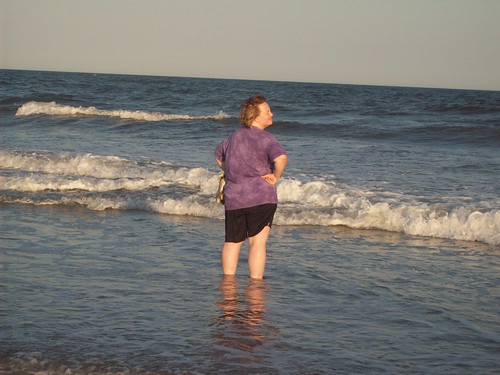
To the sea!

66b. We returned two years later.

The Wife enjoys a bit of quiet. #CapeMay

67. It always bugged her mother that she saw Niagara Falls before her mother did. Later we took her mother to Niagara when she was out for a visit.

68. During the summer of 1991, when I was at home and she was still in Iowa, she came to spend a week with me. I took her to Buffalo and to Toronto, on the way to which we stopped to see Niagara Falls for her first time.

69. She was really confused the first time a Japanese tourist asked her to take his picture in front of the Falls.

70. At the time our beer of choice was Labatt's. It's pronounced "la-BATS", but we had a family friend at the time who liked to say it "LAB-uhts", which is how I said it at college just for fun and habit. So when she visited me that summer, we went to the bar where this friend hung out, and he was so impressed when she ordered a "LAB-uhts".

71. Our favorite mixed drink in college was the sloe gin fizz. A few years ago I tried making these again, discovering that her tastes had changed and she now found them sickeningly sweet. I like them still, but yeah, they're sugary. (And pink. When I told a friend at work who knows everything about liquor that I'd bought some sloe gin, he laughed and said, "Oh good! Now you can make pink drinks!")

72. She taught me the right way to do laundry.

73. I taught her the right way to crack open crab legs so as to not mangle the meat.

74. Our first major mistake of parenting was taking The Daughter to a fireworks display on the Fourth of July in 1999. The Daughter was all of fifteen days old. This was the big display in Lakewood, NY, which is right on the banks of Lake Chautauqua. The Daughter did not respond well to the fireworks detonating right over our heads; the sounds were bad and for years afterwards The Daughter was very scared of loud sounds.

75. We always say that we should go camping. We never actually do go camping. We need to do more camping.

76. Once for dinner I made some frozen cheese ravioli with sauce, a favorite meal of ours that we hadn't had in a long time. She said that she was looking forward to "eating some cheesy goodness". Unfortunately, the raviolis were a bit on the old and tough side, and the cheese never got nice and melty, so after the meal, she commented, "That wasn't really cheesy goodness."

77. She likes eggs over-easy. I'm not a big fan of those, but I try to make them for her when she's getting over being sick.

78. She makes fun of my over-reliance on boxed mixes in the kitchen.

78a. I'm much better about this now. Her main kitchen complaint about me is that I make way too big a mess when I cook.

79. In 1993, when Cheers aired its final episode, she bought pizza for my roommate and I.

80. She only swears when she's really annoyed.

81. She is not happy that her nine-year-old, fourth-grade daughter is now the same shoe size as she is.

82. A while back she had her hair colored a brighter shade of blond than is her natural color. It was awesome.

83. Before that she experimented with red. I've tried talking her into doing that again, but no dice.

84. When my aunt met her the night before our wedding, she made a comment to the effect that I was to be commended for adding blond hair and blue eyes to our gene pool.

85. The Daughter has blond hair and blue eyes. So did Little Quinn.

86. I'm not sure there's a variety of seafood she dislikes.

87. I love the way she looks when she's just come home from work and changed into her PJ's.

88. Adopting Lester and Julio was her idea, but she claims the upper hand on that anyway because she was helping out my mother.

89. For some reason, The Daughter and I like to bring up at the dinner table the fact that The Wife, as a kid, had to help the family out on Chicken Butchering Day. I don't know why.

90. She thinks Orlando Bloom is really attractive. I don't see it, myself, but you can't argue these things.

91. For my birthday in 1992 she drove me to Dyersville, IA so I could see the Field of Dreams.

92. If I want to spoil her, all I have to do is buy her blush wine, cashews, olives and chocolate. Cake helps, too.

93. She spoils me by looking the other way when I go to Borders; by making me waffles or French toast or Spanish rice; by cleaning the kitchen after I've messed it up; by indulging my love of pie; and a thousand other ways.

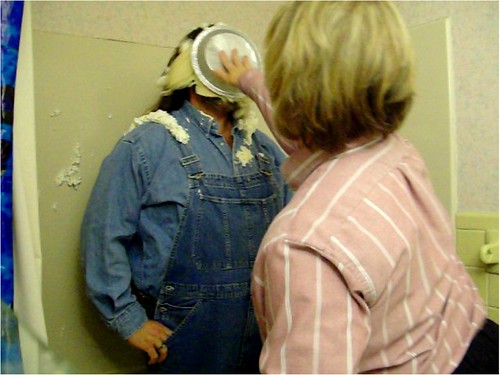
94. I'm always game for a pie in the face, but I'm pretty sure nobody pies me like she does. Or better.
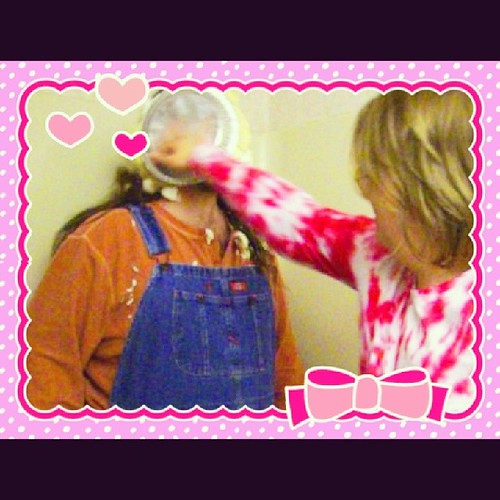
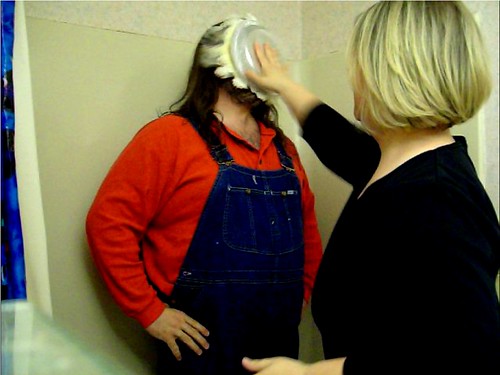
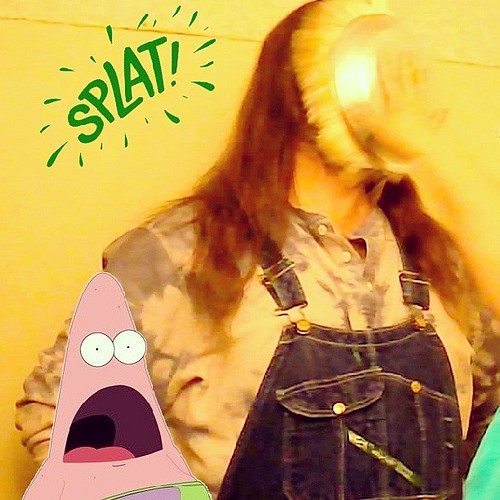
If you can't be ridiculously silly with the person you love, you're doing it wrong! Happy Valentine's Day, everybody!! #ValentinesDay #pieintheface #overalls #splat #SillinessIsAwesome

Splat! The meeting of Pie and Face

Patrick Starfish is surprised by my fate. #PatrickStarfish #pieintheface #overalls #splat

95. I know I've found the perfect girl for me when she describes our Thanksgiving in 2006 as being perfect because, after dinner, we went to see Casino Royale. In her words: "We had a big turkey dinner, and then we watched James Bond kill people."

96. We both love laughing at David Caruso on CSI Miami.

96a. Sadly, CSI Miami is long gone, but now we thrill to the adventures of Team Machine on Person of Interest, of Castle and Beckett on Castle, and we enjoy Alton Brown's delicious brand of pure evil on Cutthroat Kitchen.

97. One time when we were working out at the Y, and she got so engrossed in what she was doing that when I approached her, she didn't recognize me at first.

97a. She loves lilacs.

Rochester Lilac Festival. #LilacFestival #Rochester

97b. She loves sushi, so for a while our Saturday night dinner tradition was I'd buy her sushi at The Store, and she'd eat that while I had a "charcuterie" plate of my own. (I think we can all agree that "charcuterie" is the fancy-schmancy word for "cheese and crackers," yes? Kind of like how "grits" turned into "polenta" at some point and started commanding $15 a plate?) But she'd eye my cheese and ask for a bite or two. Over time this morphed into her and I both having the cheese plate.

But she still loves the sushi, and I still have to buy it for her! It just becomes her lunch at work on Mondays. No escape!

97c. While driving once:

ME: Huh.
HER: What?
ME: I know I've heard this piece but I don't know what it is.
HER: [into phone] What is this song? [holds phone to speaker, then looks at phone] It's the fourth movement of Mozart's Eine kleine nachtmusik.
ME: Wow, I didn't know your phone could do that.
HER: I'm pretty sure it's standard now! Your phone can do it too!
ME: Whoa....

See? She teaches me things.

97d. For years she worked in the restaurant biz, which meant working just about all of the major holidays and struggling just to use her allotted vacation time. Now, she's in banking, so not only does she get the holidays off, she gets off all of them, including the ones I don't! (I have to work MLK Day, Presidents Day, and the other "lesser" holidays that are still "No mail and no banks" days. She gets 'em off now.) She is not shy about gloating about this.

97e. She continues to make fun of my previous claims that I "am not a dog person". To my recollection I never made any claims along those lines, just that I was unfamiliar with dogs, not that I disliked dogs. She just shakes her head and keeps on being amused at how much Cane and Carla like me. What can I say!

97f. Her, a few years ago: "Hey, there's this event where people who own greyhounds all meet up in the Finger Lakes and then we all tour around to wineries and taste wine and have fun with our dogs! Wanna go?" We just got back from our fourth time on that trip the day before yesterday.

98. Maybe this is a personal failing on my part, but I can't bear it when she cries. It kills me inside. But I'm trying to get better at this, since as Gandalf said, "Not all tears are an evil."

99. I wish we were living lives that didn't include so many tears.

100. I love her more than I did last week at this time.

101. Number 100 on this list will be equally true next week at this time. And the week after. And so on.

102. She makes me happier than I thought possible.

103. She...oh, I guess that's where I need to stop. I love you, honey!
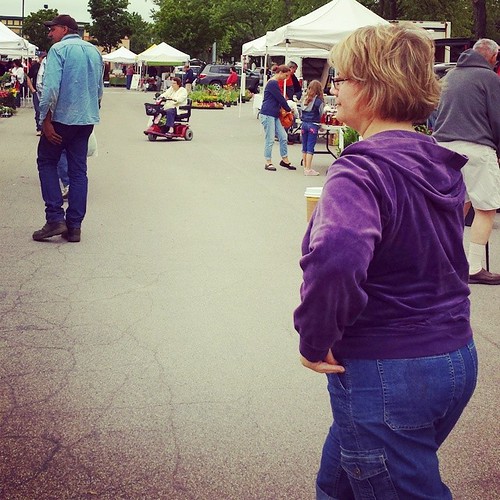
Chilly morning at the Farmers Market. I had to buy The Wife a coffee. #wife #EastAurora #wny

Day 65: Tried taking a photo of my Beautiful Wife looking at Taughannock Falls, but she turned her head toward me at the last second! #100DaysOfHappiness

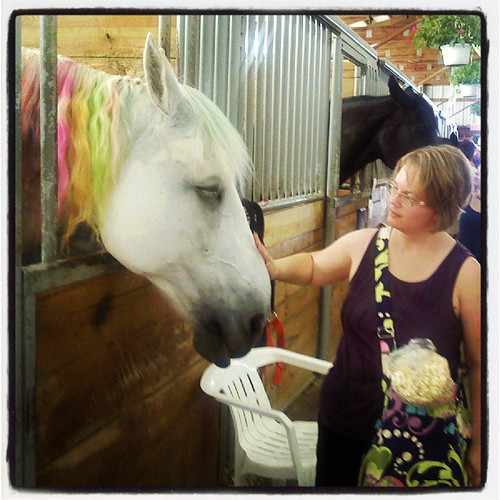
The Wife, with horse. #eriecountyfair #Wife

Pumpkinville: Happy wife, irritated Daughter

Erie County Fair: A couple

Friday, February 21, 2020

Ack! An apology

I've just discovered that Blogger has again done that thing where it fails to notify me via email that there are comments awaiting approval (a few from my Christmas music posts!), so I apologize if you thought I rejected your comment. I would sack those responsible, but that would be me, so...sorry!

Bad Joke Friday

My job is to drill holes in things and then bolt them together.

At first it’s boring, but later on, it’s riveting.

Something for Thursday (posted on Friday because of WRITING WRITING WRITING edition)

Despite my best efforts in high school and college--and I did make a lot of efforts--I never did become a "jazzman," as the term was back then. (I have no idea if the jazz world has adopted a more inclusive expression or not.) I played in the jazz bands, and occasionally dabbled with some friends at small-group work, but eventually I had to admit that the best I could ever hope to be was a decent "session musician", a decent bandmate but not really a soloist or creator. I admire jazz and even love a lot of it, but it's not in my blood the way music needs to be if it's going to be your music.

But I can, and did, and still do, admire the hell out of Miles Davis.

I first became aware of Davis in the way that a lot of young people become aware of major musicians, by wanting to know about famous musicians who play the same instrument as themselves. Young clarinetists likely know about Benny Goodman and Richard Stoltzman, and young flautists about Jean-Pierre Rampal and James Galway. As a trumpeter I certainly knew about Wynton Marsalis, Maurice Andre, Adolph Herseth, and Miles Davis. Funny thing about Davis, though: the more I listened to him (and though his music has fallen off my radar the last bunch of years, I listened to him a lot back then), the less I heard him through the aural prism of his trumpet playing and the more I heard him as a musician. Again, I think that any young musician goes through such a thing, if they're serious about the whole affair of music.

Miles Davis's music was not the kind of flashy, loud, fast, "big band" kind of jazz. He almost seemed more of a jazz chamber musician, a creator of introspective music that combined many influences and always seemed to be teeming with bright intellectual life. Davis's most famous album is almost certainly Kind of Blue, for many reasons, but I feature here not that work but another of his greats, Sketches of Spain. For this album Davis used several classical works by Spanish composers as a starting point, including Rodrigo's famous (perhaps the most famous classical work by a Spanish composer) Concierto de Aranjuez. The album is an early blend of jazz and world music, and it is informed throughout by Davis's often-haunting trumpet playing.

Here is Sketches of Spain, by Miles Davis.

Thursday, February 20, 2020

Tone Poem Tuesday (Late Thursday Edition)

You know how when I get hyper-focused on finishing a writing project, I push everything else aside and work only on that? Sure you do! I spent the bulk of this week's leisure and writing time on finishing second-round edits on The Savior Worlds (The Song of Forgotten Stars, book 4), but I got that done last night, so at long last let's turn to the music of Samuel Coleridge-Taylor.

Coleridge-Taylor was English by birth, and he was mixed race: his mother was a white Englishwoman, and his father was a Sierra Leone Creole physician. Coleridge-Taylor quickly achieved success as a musician and was one of the more popular composers of his day. Musicians in New York even referred to him as the "Black Mahler," so successful was his brand of late Romanticism. Coleridge-Taylor's most famous works are a trio of cantatas he composed based on Longfellow's Song of Hiawatha, and the most successful of those was Hiawatha's Wedding Feast, a work which would have made Coleridge-Taylor a very wealthy man had he not sold the rights for 15 guineas in a moment of financial need. Coleridge-Taylor was far from the only composer to make this mistake; Sergei Rachmaninov would have been extremely wealthy had he retained the rights to his Prelude in C-sharp minor. Alas, the artist must often be concerned with the here and now at the expense of the future, and financial distress may well have contributed to Coleridge-Taylor's ill health that led to his early death when he was just 37.

A year after the trio of cantatas was complete, Coleridge-Taylor added an overture, which we hear today. It is a thrilling, brooding, and lyrical piece of late Romanticism, most reminiscent of Antonin Dvorak in its melodic feel and its enticing energy. Coleridge-Taylor, as an Englishman, was primarily influenced by the music coming from the continent and not from the early threads that would become jazz in America. He belongs to a tradition that was already shifting in new directions, and one wonders what he might have done had he lived to see the dawning of Modernism.

Here is the Hiawatha Overture by Samuel Coleridge-Taylor.

Monday, February 17, 2020

BLASTOFF!!!

Sometimes you just have to admire the awesome power of a rocket's thrust.

Northrop Grumman Antares CRS-13 Launch (NHQ202002150010)

Friday, February 14, 2020

Bad Joke Friday

Maybe I've used this one before. Maybe I haven't. I dunno, it's still bad.


Thursday, February 13, 2020

Something for Thursday

It's Black History Month, so why not feature a man who I consider to be one of the four greatest voices* in the history of pop music? I'm talking about the astonishing, amazing, absolutely one-of-a-kind Sam Cooke. Every time I listen to a song by Cooke, I'm freshly bedazzled by the absolute control he has over his instrument. A voice like his--a kind of gravely high tenor, one of the most unusual kinds of voices to hear--can be so very difficult to control, but Cooke always homes right in on the pitch he intends to hit, and his melismatic gifts are the stuff of legend. Sam Cooke makes singing just about any song sound utterly effortless, but when you try to sing along, you can almost feel him leaving you in the dust, grinning as he goes.

I don't want to dwell on the awful facts of Sam Cooke's very strange death, so I won't. But I will note that the world was robbed of one of its greatest voices that day.

Here are several songs by Sam Cooke.


* The other three are Freddie Mercury, Annie Lennox, and Ann Wilson.

Tuesday, February 11, 2020

Tone Poem Tuesday

Continuing an exploration of work of black composers in this, Black History Month, I turn to William Grant Still, one of the best-known black composers. The difficulty black composers have faced in history can be illustrated in the fact that Still lived from 1895 to 1978, dying in my lifetime, and yet many of his works are already lost. Still was born in Arkansas, where his musical life began, but his life later took him to Ohio, New York (where he is considered part of the Harlem Renaissance), and finally to Los Angeles, where the house in which he lived is now designated a Los Angeles Historical Monument. Still was a prolific composer over his long life, and he achieved things in music that would be the pride of any composer, much less a black one from a country not historically known for rewarding the creative efforts of its minorities.

Still wrote his symphonic poem Africa in 1930, after he had spent his youth working in W.C. Handy's band and studying composition with Edgar Varese. Still's style combines African-American sounds--blues, spirituals--with traditional orchestral writing. Africa comprises a musical depiction of a continent to which Still never traveled, and he would describe the work as "the Africa of my imagination." He even opens the piece with distant drums tapping an almost tribal rhythm before the more plaintive orchestral writing begins. Still described his work, which traces three movements, in a letter thusly:

“An American Negro has formed a concept of the land of his ancestors based largely on its folklore, and influenced by his contact with American civilization. He beholds in his mind’s eye not the Africa of reality but an Africa mirrored in fancy, and radiantly ideal.

I. He views it first as a land of peace; peace that is partly pastoral in nature and partly spiritual.

II. It is to him also a land of fanciful and mysterious romance; romance tinged with ineffable sorrow.

III. Contact with American civilization has not enabled him to completely overcome his inherent superstitious nature. It is that heritage of his forebears binding him irrevocably to the past, and making it possible for him to form the most definite concept of Africa.”

(via)

Africa is a lyrical and rhythmic work that seems to sway and dance with sound that recalls blues and spirituals, but in a more distant way, hinting at the ancestral home of the musical traditions that African-Americans would make central to their often sad experiences in America. It's a fascinating piece.

Here is Africa by William Grant Still.


Monday, February 10, 2020

Winter at the Ridge

What a strange winter we're having in WNY! Our snowfall is way down, well below average, and Lake Erie remains almost entirely ice-free. At this point in the season, the lake is almost certainly guaranteed to remain wide open (we're past winter's halfway point, and as temperatures slowly go up, so will the amount of sunlight the lake receives, thus preventing large formations of ice)...which you would think would mean that we're set up for a lot of the dreaded lake-effect snow, but you have to have really cold air blowing over the lake for that to happen and so far, we haven't even had that. But we did get some snow over the weekend, resulting in these lovely scenes from Chestnut Ridge Park in the hills south of Buffalo....

Farther down the snowy road #ChestnutRidge #wny #orchardpark #winter #nature #hiking #trees #snow

Stream, not quite frozen #ChestnutRidge #wny #orchardpark #winter #nature #hiking #trees #stream #runningwater #snow

Snow-covered stone wall #ChestnutRidge #wny #orchardpark #winter #nature #hiking #trees #snow #stonework

The kicker? Today and tomorrow we're above freezing, so we're already melting all that off. Sigh!

Thursday, February 06, 2020

Something for Thursday

Featuring black musicians this month in honor of Black History Month, here's a good one. If your spine isn't tingled by this, I don't know what to do for you. Here is William Warfield singing "Ol' Man River" from Showboat. Just listen to the lyrics of that final verse:

I get weary,
and sick of tryin';
I'm tired of livin',
and scared of dyin'.
But ol' man river--
he just keeps rollin'
along.

Amazing song, sung in what must be one of the great vocal performances of all time.

Tuesday, February 04, 2020

Tone Poem Tuesday

February is Black History Month, so each of this month's regular music selections (Tone Poem Tuesday and Something for Thursday) will feature music either composed, or performed, or both, by black musicians.

George Walker (1922-2018) was the first black composer to win the Pulitzer Prize for music, for a work entitled Lilacs. Walker was a teacher, a composer, and a performer of note, and he had what was by all accounts a long and successful musical life before he died at the age of 96. This work is an exuberant bit of modern dance that he wrote on commission from the Las Vegas Symphony, in commemoration of that city's centennial celebration. Hoopla: A Touch of Glee is a bright and bold orchestral showpiece that thrums with the odd optimism of Las Vegas, a city that has no reason to exist other than to be a place where the kinds of things that go on in Vegas...go on. I've been listening to this oddly infectious work for several days now, and it's not easy to forget.

Here is Hoopla: A Touch of Glee by George Walker.