Friday, June 08, 2018

"A Rose is what Moses supposes his toeses!" (Thoughts on THE LAST JEDI, part 5)

part 1
part 2
part 3
part 4


FINN: Look, this whole place is beautiful. I mean, come on--why do you hate it so much?

ROSE: Look closer. My sister and I grew up in a poor mining system. The First Order stripped our ore to finance their military...then shelled us to test their weapons. They took everything we had. And who do you think these people are? There's only one business in the galaxy that'll get you this rich.

FINN: War.

This was originally going to be the part about Rey, but I decided to add this one instead after some recent events in Star Wars "fandom" that reveal a great deal of underlying ugliness. Basically, Kelly Marie Tran, the actress who played Rose Tico in TLJ, deleted her Instagram account after she was subjected to relentless criticism, slurs, and abuse pretty much ever since the film opened.

I find this deeply sickening on a number of levels. First is just the basic idea of such abuse, the idea that attacking someone famous online is even an idea that appeals to anyone. Being mean online has been a thing as long as being online itself has been a thing, but it really does seem to have taken off in the era of social media. Tran isn't the first person to deal with such nastiness. "Fans" managed to chase Daisy Ridley off the very same forum after TFA came out.

It's pretty easy, anyway, to see where such impulses come from. Tran is a non-white woman, and for a lot of people who almost without exception turn out to be white men, those are two unforgivable strikes against her. It's one of the most deeply depressing realities of the time we're in. It should be incredibly exciting, these social media platforms that allow us to interact with those whose work we admire. But we humans can be a very ugly and petty lot, so it comes as no surprise that many of us flip that behavior around.

As a lot of these people have crawled out of the woodwork this week, so too have a bunch who claim to be oh so committed to not being pro-harrassment or bigoted in any way, but gosh golly, can't we have the Star Wars of old when it was all just about adventure and good guys and bad guys and none of this dreaded "SJW" stuff?" [For me, the term "SJW"--Social Justice Warrior, if you haven't heard it before--has become a reverse-dog whistle, in that the second I hear someone say it in derisive fashion, I immediately stop listening to them.] This argument always strikes me as colossally weird, as the new Star Wars movies, storytelling issues aside, are certainly chock-a-block full of adventure and good guys and bad guys. This is one of those criticisms that puts me in mind of this exchange from an episode of The West Wing, when Sam is told that right-wingers have taken exception to some incredibly innocuous thing that the First Lady has said:

SAM: I don't see it.
CJ: Well, you have to want it.
SAM: Oh. Now I see it.

Also obnoxious is a kind of response I've seen in a lot of places online, especially Twitter, when someone says that the harrassment Tran has endured is unacceptable: "But her character is awful!" This is either meant as an excuse to justify the harrassment, or it's couched in some kind of mealy-mouthed "I don't condone the harrassment, but Rose is an awful character!" The problem is that the one does not have a single damned thing to do with the other. Think about how stupid that sounds when framed another way: "I don't condone setting the elementary school on fire, but their parking lot has a lot of potholes." These types of formulations are attempts to direct conversation away from extremely toxic behavior by overwhelmingly white and male "fans", and it's bullshit.

But what of Rose Tico as a character, anyway?

Well, I loved her.

Rose is another of this new trilogy's non-Skywalker and non-Force using characters, clearly intended at least partially to expand the focus of what Star Wars can be about. It's not just that she's Asian, although that's frankly a perfectly nice development. It's that she's a mechanic who does her job and does it proudly. She's a part of the Rebellion/Resistance that isn't all lofty and concerned about tactics or finding lost Jedi masters or doing heroic things in an X-wing.

More importantly, though, Rose Tico articulates a moral vision for what she's fighting for that's quite distinct from anything we've heard before in a Star Wars movie. She's not just another entry in the long line of people struggling against the Dark Side, or against the Empire's vague tyranny. She puts a definite, specific spin on the nature of the fight, and she gives reasons for fighting that are very real. She also shines a light on a dark moral underbelly of how the galaxy does business. Maybe that's the "SJW crap" that bothers people, but...yeah, I don't care. That exchange up top, about how war can make people rich like no other thing can? That's not some lofty SJW thing. That's just history.

But Rose isn't great just because of all that. She also shows Finn that there are other things to love, other things that are worthy. Not bad for someone who initially misinterpreted Finn's attempts to escape. Some of her shifts of heart, especially regarding Finn, do come a bit too quickly, but I suppose that's just the way things are going to be in this new trilogy. At the end, is she claiming to love Finn? Well...sure, why not? They've been through a lot together by that point. Is it romantic love? I have no idea. Maybe it is, maybe it isn't. Either way it's fine. Rose has gone from innocent hero worship to being a hero herself, and she's paid a lot along the way.

So yeah: Rose Tico is a terrific character, Kelly Marie Tran does a wonderful job playing her, and every dolt what says otherwise should just go play in traffic. Here endeth the lesson.

Next: Rey. I promise.

Thursday, June 07, 2018

Something for Thursday

I assume that this is a pretty good performance of Ravel's Bolero. As seems to always be the case with this work, I check out about eight minutes in because that's about all I can stand of it.

Monday, June 04, 2018

A Flyboy, A Mechanic, and a Janitor walk into a bar…. (Thoughts on THE LAST JEDI, part 4)

part 1
part 2
part 3


Original TFA screenwriter Michael Arndt has said in interviews that a big problem he faced in drafting that movie was that no matter how hard he worked on making the new characters compelling, as soon as Luke Skywalker showed up he pretty much took over the movie. That's why the structural solution to that problem was to postpone Luke's appearance to the very end of that film, which always struck me as one of the things that TFA genuinely got one hundred percent right. TLJ gives us Luke...and he nearly does take over the movie, but Rian Johnson carefully structures things so he doesn't.

The focus remains, mostly, on our three new main characters: Rey, Finn, and Poe Dameron. I had problems with these characters to varying degrees last time out. As well as they were played onscreen by their respective actors, the characters were all problematic as written. Less so the case with Poe, but Rey and Finn were only sketched very broadly, with no clear explanation at all of their motivations or desires. Rey is Force-sensitive and is pining for the return of the family that left her on Jakku, but so little is given of her backstory that it's a surprise every time another of her considerable abilities is shown. (This is not the same claim that some dippy fans made of her at the time, calling her a "Mary Sue".)

Finn, on the other hand, has skills but develops conscience out of the blue in a situation where that shouldn't even be a possibility, and he forms an instantaneous bond with Rey that almost borders on creepy. Very little about Rey or Finn is explained or shown, and TFA never really gave either character a real, genuine desire, either. As I noted at the time, characters have to want things, and they have to want them for reasons. On either score TFA gave almost nothing to go on.

So here's TLJ, which fares much better--in a way.

Rian Johnson doesn't so much rectify the problems in TFA's characterizations as he pretty much ignores them. He instead takes Rey and Finn and Poe at this point and gives them very clear motivations and desires, even as those change as events warrant throughout the film. There is never a moment's doubt as to what these characters want at any particular point in Johnson's story. This is huge, because for me it led to a lot more investment in the characters.

Poe Dameron came off best in TFA, because he's basically a pretty simple archetype: the action-loving flyboy ace pilot. He's kind of Han Solo and Wedge Antilles blended into one character, always up for an adventure and action. He's the guy who is most likely to stop and smile at the camera just long enough for a CGI twinkle to be added to his teeth.

In TLJ, Poe gets a more meaty storyline (and a bit more problematic in other ways). He's still a brilliant pilot, but now he's the one who chafes against his superiors, the one who always wants to err on the side of action rather than fleeing and trying to live to fight another day. He even goes so far as the defy General Organa's orders in the film's opening battle sequence, not for one second considering the price paid for a temporary victory or the possibility that retreat might be the best course of action. He questions his superiors constantly, flying into rage when he's not told what "the plan" is and when it involves yet more retreat.

There's an unfortunate note of sexism in Poe's reactions throughout the movie. He respects Leia, but not enough to not defy her order and get all the bombers destroyed in an effort to blow up a single Imperial First Order ship. Later, when Leia is incapacitated and command falls to Admiral Holdo (Laura Dern), Poe openly defies her in front of the rest of the crew, and hatches plans to go around her back. He does grow in TLJ, eventually realizing that maybe he really does need to slam the brakes on his constant instinct to "jump in an X-wing and blow something up," but this is...well, it's pretty conventional, isn't it? We've seen this before in any number of stories, right down to the moment when he realizes that Admiral Holdo had a good plan after all and maybe he just should have shut the hell up for a bit. Oscar Isaac does the best he can with the part, but there's nothing new here. Maybe they're setting Poe up to be General Dameron next time out, since everybody else is pretty much dead.

On the other hand, we have Finn, whose story in this movie might be my favorite. (This despite lots of fans who thought his story was utterly useless, but more on that.) When last we saw Finn he was comatose after getting his ass kicked to within an inch of his life by Kylo Ren. And when first we see him now, he's still comatose (it's only been a few days) in a medical capsule of some sort. He awakens suddenly, breaks out of the medical capsule, finds Poe, and asks the one question on his mind: "Where's Rey?"

One of TFA's oddest character moves was Finn's entire set of motivations. No hint was ever given as to why he felt the sudden need to defect the First Order (and no, seeing his buddy's blood on Jakku is not a good reason, not for a stormtrooper who has been assigned to a mission so important it's being led by Kylo Ren and Captain Phasma herself--would you take a total rookie on a mission like that?), nor was any convincing explanation ever given for his instantaneous attachment to Rey. Shared trauma and adventure can explain a lot of it, but not that level of pure devotion. That's where Rian Johnson had to start, though, and start there he does. Finn's first thoughts are of Rey, and then his thoughts turn obsessively to protecting her when he realizes that if she follows the signal of Leia's beacon, she'll fly right into disaster.

His solution to this problem is to snatch the beacon and get himself away from the Resistance fleet, so Rey won't go anywhere near it so long as it's being relentlessly pursued by the Empire First Order. He grabs the beacon and is boarding an escape pod when he is discovered by a young mechanic named Rose (whose sister has just died in the heroic, but ultimately futile, bomber run on the Imperial First Order dreadnaught). Rose makes the same mistake that a lot of fans have made in interpreting Finn's actions: she assumes that he is deserting the Resistance because of cowardice. And yes, a lot of fans have made this mistake, and therefore they interpret what follows as Finn's "redemption arc", which is silly. Finn? A coward? Just days after he personally walked into Starkiller Station with just two other people because he wanted to save Rey?

Finn is no coward. But he does have an odd set of priorities. And that's what changes for him in TLJ.

Rose is dragging Finn off to the brig when he susses out the situation (the Resistance fleet can be tracked through hyperspace) and he quickly figures out not only how that's happening, but how it can be incapacitated. This too will keep Rey safe, but here's something interesting: after he meets Rose, Finn never mentions Rey again.

He becomes invested, focused. He and Rose work very hard to make their plan work. It eventually fails completely (and more on TLJ and failure in a later installment of this series), but there are two key moments when Finn's thoughts are driven to crystalize and he makes his choice. First is when he faces Captain Phasma in combat, gets the better of her, and corrects her when she calls him scum: "Rebel scum. And then when the only chance for the Rebels (by this point in the film we're not even calling them "the Resistance" anymore) to survive is for Finn to destroy himself, he decides to do just that. (This whole scene seems to me, by the way, an allusion to the classic Star Trek episode "The Doomsday Machine".)

Of course, Rose won't let him. She crashes her speeder into his, sustaining bad injuries as she does so, but before she lapses into unconsciousness, she tells him, "That's how we'll win. Not by destroying what we hate, but by saving what we love." This is one of TLJ's best moments.

By the end of the film, Finn has grown. He has learned and he has truly become a part of something. That's not a redemption arc, it's just an arc, and it's a good one. He still loves Rey--the embrace they share when they are reunited, after she moves the rockpile, makes that clear--but he has found something new to believe in and to belong to. In the last scene he is standing over an unconscious Rose, just as Rey once stood over him.

Finally, a common theme I heard about Finn's story is that it's just filler, that it doesn't really go anywhere or add anything. Take it out and everything else plays out the same, doesn't it? Maybe, maybe not. Again, failure is a theme of this movie, maybe the theme of this movie, and in that sense it's important. But even moreso is the movie's very last scene, when the stablehand kids are sharing the amazing story of what's happened on Crait. That one little boy goes off to sweep, calling the broom to his hand with the Force. But he stops and looks up at the sky. He is wearing the ring that Rose gave him, the one with the Rebel insignia on it. Finn and Rose met that kid earlier, and here he is, looking at the sky and holding his broom in such a way that the handle almost looks like a lightsaber.

That might make Finn and Rose's story the most important subplot in the film, as Star Wars transitions beyond the Skywalker family saga. Finn and Rose made a connection, and that connection seems destined to inform the future.

So there we have Poe, Finn, and Rose. But what of Rey? She gets a post of her own...but first, a detour into some more thoughts on Rose and Star Wars fandom in general of late.

Friday, June 01, 2018

"We fought to the end." (Thoughts on THE LAST JEDI, part 3)

part 1
part 2


Star Wars has always had a different thing going on with the mothers, hasn't it? Anakin's mother, Shmi, is killed by the Sandpeople in the event that catalyzes Anakin's descent toward the Dark Side of the Force. Luke Skywalker never knows his mother, and only has a mother figure in Aunt Beru. Leia herself claims to know nothing of her own birth mother beyond vague images and feelings.

In this new trilogy, Leia herself is a mother, and her son Ben is now Kylo Ren, the major villain of this saga. He fell to the Dark Side, and yet she has for some time held out hope that he could be rescued. By all reports, the forthcoming Episode IX was to have delved more deeply into this relationship, but Carrie Fisher's death took that off the table. (For the record: I want no part in a recasting of Leia Organa, no matter who it is.) Now Ben Solo really will be the "last Skywalker", as in, the last person with a claim to that bloodline. As for Leia's death? I'm sure that sad event will be dealt with eventually. Perhaps some notable science fiction author will be allowed to write that story in a novel someday.

Meantime, we have The Last Jedi. Of all the shifts we've seen in the galactic and personal state of affairs between the events of ROTJ and TFA, I am least vexed by the developments in Leia's life. Aside from Claudia Gray's wonderful Lost Stars, I haven't read any of the newly-canonized books in the Star Wars universe, so I don't have much idea of what has officially been going on in Leia's life prior to this. But her evolution from political figure to military one is utterly believable. Even with my issues with the state of things at the beginning of TFA, I had very little problem with the idea of General Organa.

Even better, the films show Leia being truly in command. She isn't one of those movie generals whose role is to basically say "Make it so!" once her brilliant underlings think of something. Leia is really in command here. She really has plans and strategies, she is genuinely invested in her soldiers, and she is willing and able to hold them accountable when they screw up.

Leia was always a person of action in the Original Trilogy, a trait she doubtless inherited from her Prequel Trilogy mother. She is still a person of action in TFA and TLJ, even if now she must be more thoughtful about her actions now that anything she does has even larger ramifications than ever before. It's telling that she is only shown having the very briefest of moments when she can sit down to mourn Han, and her son, and an entire life that she never got to have. And when she gets that moment, it's in front of a window with hyperspace whipping by in the background. Leia's whole life is spent either in battle or on a mission, or on her way to the next battle or mission.

What impressed me most about Leia's story in TLJ is that the film actually didn't shy away from the ramifications for her of Kylo Ren's fall to the Dark Side. He has a moment early in the film when he could blast her away with one shot from his fighter, but he doesn't; later on, however, he knows that she must certainly be among the Resistance fighters left alive in the fortress on Crait, and he gives the order for his forces to storm the fortress and leave no survivors. He knows he is ordering his mother's death in that moment. He has to know it.

Meanwhile, Luke Skywalker arrives and talks to Leia before going out to face the First Order. He tells her that he is going to face Ben Solo, but that he can't save Ben Solo. Leia nods, sadly, and admits that her son is gone. I honestly did not think that the writers were going to have the courage to confront this moment, and maybe if JJ Abrams had written this movie, he wouldn't have been. Rian Johnson, however, does. He also does it in such a way as to acknowledge the Star Wars trope that when one turns to the Dark Side, one effectively destroys their former self. Kudos to Johnson for following that story thread to its logical conclusion.

The film hints again at Leia's Force-sensitivity, which has never apparently never been developed with any real official "training". Should Leia have become a Jedi? I don't recall if the original "Expanded Universe" stories ever went that way, but in these films with their new canon, it's clear that she has not. She can use the Force, though: she Force-communicates with Luke a few times over the course of the Saga, and in TLJ she calls upon the Force to get herself back to the ship after being blasted out of it and into bare space. (The visual here--Leia flying through space in a pose that looks very reminiscent of Mary Poppins--has been much derided, but it didn't bother me and anyway I wonder if it wasn't a visual tipping-of-the-hat to my other favorite space opera film of last year, Guardians of the Galaxy Vol. 2.)

In his exchange with Yoda on Ahch-To, Luke is taken to task for not having passed on what he learned. I wonder if Yoda is upbraiding Luke for not teaching Leia about the Force. Maybe all along it should have been Luke and Leia, working together.

But we don't know that it wasn't, either.

From everything I've read, Episode IX was to have featured Leia most strongly of all. Apparently this trilogy was to conclude with the final act in Leia Organa's story. That can't happen now, but the final Leia story that we actually got is a pretty good one, even if it ends on a sadder note than I would ever have hoped for the heroes I was watching onscreen when I was twelve.

The film does miss an opportunity in Leia's last scene, though. Maybe Rian Johnson thought of it but it was too late to have Carrie Fisher re-record the dialogue, but at the film's end, when all that's left of the Resistance is now the Rebellion and it consists of about a dozen people on the Millennium Falcon, Leia sits down next to Rey, who is holding the broken halves of Luke's lightsaber.

REY: How do we build a Rebellion from this?
LEIA: We have everything we need.

Surely, after Rogue One this exchange should have gone like this:

REY: How do we build a Rebellion from this?
LEIA: Rebellions are built on hope.

If only.

But think about that: when we first met Leia Organa, she was searching for Obi Wan Kenobi, saying "You're my only hope." Now, when we see her last, Leia is that new hope.

Next: we turn to the adventures of our new Star Warriors.

Thursday, May 31, 2018

Something for Thursday

One hundred ninety-nine years ago, the great poet Walt Whitman was born. Here is a setting of some of work by Frederick Delius, a piece called "Sea Drift".

"It's time for the Jedi to end." (Thoughts on THE LAST JEDI, part 2)

Part 1


Ever since Luke disappeared, people have been looking for him...he was training a new generation of Jedi. One boy, an apprentice, turned against him. Destroyed it all. Luke felt responsible. He just walked away from everything...people that knew him best think he went looking for the first Jedi temple.

--Han Solo, The Force Awakens


The Force Awakens ended with Rey flying the Falcon, with Chewbacca and R2-D2, to a distant and lost planet where apparently the Jedi Order first began, on a rocky island in a wide ocean. Here she finds Luke Skywalker, who has disappeared. Rey approaches him and offers him a lightsaber--his lightsaber. His original lightsaber, the one that his father carried when he turned to the Dark Side, the one that Obi Wan Kenobi recovered after defeating Vader on Mustafar, the one with which Luke first fought Darth Vader before losing his hand and seeing that lightsaber plummeting down the central shaft of Cloud City.

In The Last Jedi, we continue this exact moment. Luke takes the lightsaber, looks at it, looks at Rey, looks at the lightsaber again. It's his new "Hero's Journey," his new call-to-adventure--and he immediately rejects it. He tosses the lightsaber over his shoulder and walks away. Luke has no intention of returning to the fight. He tells Rey that he has come here to die. He really did give up on everything. He has come to Ahch-To, the first Jedi planet, to bring it all full circle. When he dies, the Jedi will have begun and ended in the same place. Luke didn't come to the "first Jedi temple" to find some special wisdom or motivation. He really is giving up.

I am not really a big fan of this notion in itself. The Luke Skywalker who refused to give up on the idea of some small bit of goodness still flickering in the heart Darth Vader, his father and the most terrifying Sith Lord of all? That Luke Skywalker? And having the failed Jedi student be none other than Han and Leia's son? No, I am not a big fan of that development. It doesn't resonate with me. But Rian Johnson's script for TLJ treats the idea with respect and logic, which I appreciate. It's an old archetype in itself, the tired and weary onetime hero who has to drag himself out of his final, bitter retirement for one more attempt at glory. Decades after Ben Kenobi looked Luke in the eye and said "You must come with me to Alderaan," along comes Rey to call Luke Skywalker to adventure again.

The problem I have--which Rian Johnson attempts to address, with varying results--is that we've seen Luke's heroism before. We've seen him at his heights, and we've seen him when he's already hit rock bottom and been in the pit of despair. We've seen him triumph, and yet here he is, utterly defeated. But we have seen nothing of his defeat. We haven't seen him lose, we haven't seen his failure. As deftly as Johnson handles Luke's version of the Reluctant Hero and Mentor, he can't do it total justice because the preceding film hasn't done the heavy lifting that it needed to do to justify this story. Johnson tries his best with some flashbacks and a nod to Rashomon, but I am still left wondering the thing I wonder so many times in this sequel trilogy: "How can this be the way it all turned out?"

It's hard to really get invested in a story when I don't buy its premise in the first place.

So Luke has come to Ahch To to die. Fine...but is he sick? Has he become "old and weak," like Yoda was? Or is he planning to live however many years it takes in seclusion on this island? And if he has come to die, then what of the "sacred Jedi texts"? Does he plan to burn them at some point and he just hasn't got around to it? Or does he plan to die and just leave them there on the shelf? Eventually they'd get found again. Maybe he has those weird caretaker beings sworn to the task of destroying the texts if and when he dies.

As near as I can figure, Luke is trying to break the cycle. His father fell to the Dark Side, and his nephew has as well. He is weary of the whole Light Side/Dark Side dichotomy and the endless yin-and-yang of Jedi-and-Sith. He has come to resent the idea that the Jedi and the Sith hold the only claims to be able to speak for the Force, which penetrates all living beings in the universe. In an interesting moment, Luke openly acknowledges the events of the Prequel Trilogy (how that must have rankled some fans), noting that the Jedi at the height of their power still failed to notice the rise of Darth Sidious in time to keep him from utterly destroying them. He gets this wrong, of course (the Jedi of the Prequel era were not at the height of their powers; far from it, actually). But that doesn't matter. What matters is that Luke is sick of the cycle of Light-to-Dark-to-Light again. He wants a new paradigm for relating to the Force, and in the absence of that, he's content to let the old paradigm die.

The only way to win the game, for Luke, is not to play.

Luke's story in TLJ isn't just a second Hero's Journey; it's a redemption story. Luke blames himself for Ben Solo's fall to the Dark Side (more on that whole story, which is one of my least favorite aspects of these new films, in a later post). It takes an appearance by Yoda to make Luke realize that he has a chance for his own redemption, and it is not by somehow redeeming Kylo Ren. Instead his task is to truly serve as a Master for Rey. She is already tremendously powerful, beyond even Luke's abilities. Yoda takes Luke to task for not actually passing on what he has learned, and for being stuck himself in the very paradigm that he is trying to move beyond. Yoda acknowledges that the old ways of Jedi-dom should probably end, but he also points out that this doesn't mean ending the entire thing, forever. He also makes one of the film's wisest points in one of its finest moments when he says to Luke: "We are what they move beyond. That is the burden of all true masters."

So, in light of all this, what should we make of Luke's final actions? Are they pointless? All he really does is buy time for the handful of surviving Rebels to escape. But he has a much-needed confrontation with Kylo Ren, and thus he confronts his own past. There is a peaceful kind of determination about him in these moments, and even a bit of cockyness in the wonderful moment when he flicks an imaginary bit of dust from his shoulder. He is by design driving Kylo Ren to a distracted rage, and he leaves his former student with the bitter taste of a victory that was not a victory at all. The Jedi will endure after all, as will the Rebellion. And all this from Luke walking out with a laser sword to face down the entire First Order.

Luke Skywalker's journey in TLJ is a very layered one. He has been a Campbellian hero before, and now he is the Campbellian mentor figure. But he is also still a hero, and he must walk his own path even as he helps Rey embark upon hers. He has to pass away in this film, because Rey's final steps must be taken alone. Luke completes his job on Ahch To, sending a copy of himself to face Kylo Ren; then, the job done, he sees the binary sunset of his youth one last time as he goes into the Force and as the Force welcomes him home. He goes, as Rey tells us, with "peace and purpose."

Luke's path has always been unique. He was the Jedi who shouldn't have been, the Jedi who arose outside all the old traditions and structures of the Jedi Order, the one who mostly had to figure it all out on his own. Even at the end, when he is planning to the the Jedi die with him, he does not bow to Jedi orthodoxy; it turns out that he has never read those "sacred Jedi texts," and indeed he has cut himself off from the Force. But when he returns, when he lets the Force back in, he does so spectacularly, projecting a physical copy of himself across the stars. (And he is physically there, at least partly. He embraces Leia and puts the dice in her hand. Kylo Ren picks them up...before they, like Luke, disappear.) The film does suggest that maybe it's the sheer effort of this that has led Luke to die, and maybe that's a part of it. But it's probably also partly that he knows that his work is done and that he can let go.

Perhaps it's both.

So, with TLJ, the "Adventures of Luke Skywalker" come to their end. Only two Skywalkers remain, and one will sadly have to die off screen before the next episode begins. But meantime...what of Leia Organa, the last of the original trilogy heroes still alive when TLJ ends?

More on her in Part 3, "We fought to the end."

Wednesday, May 30, 2018

"Amazing. Every word of what you just said was wrong." (Thoughts on THE LAST JEDI, part one)


So here we are, more than six months after the release of STAR WARS EPISODE VIII: THE LAST JEDI, and I'm only just now working out how I feel about it. I suppose this is is how it's going to be with me and Star Wars as it moves forward in its post-Lucasian era. I expect that I will feel a bit conflicted about every successive movie that comes out. My feelings on THE FORCE AWAKENS took a long time to crystalize, until I generally settled on the view that it is two-thirds of a great movie followed by one-third of a terrible one. ROGUE ONE I liked considerably more, especially on the rewatch when its fine qualities stood out even more and its minor flaws receded somewhat (still, my only real objection that that film lies in its final two minutes).

Leading up to TLJ, I was in a strange place. I was looking forward to the film because I liked the new characters established in TFA, even if I didn't care for a lot of the writing behind them thus far. I knew that we'd finally get to see Luke Skywalker again, and I expected some very emotional stuff involving Princess and General Leia Organa, made doubly poignant by the awful fact of Carrie Fisher's passing after she completed filming. Other than that I genuinely had no expectations regarding the movie. As the TLJ release neared, a week or two out I suddenly realized that I knew less about this movie than I had about any Star Wars movie since The Empire Strikes Back. I went into TLJ knowing almost nothing about the story, which was a really interesting sensation. All I knew, literally all I knew, was what I saw in the teasers and trailers.

TLJ makes a lot of interesting choices. Some of its developments are clearly telegraphed, but in such a way as to conceal the telegraphing. Other times, Rian Johnson--our writer and director--seems to be telegraphing things, only to have them never come. Surely I can't be the only one who, catching that throwaway glimpse of Luke's X-wing submerged in the Ahch-To sea, expected a scene later when he would Force-raise it from the water, easily and effortlessly, just as Yoda once did for an unbelieving younger Luke. That didn't happen. The film does contain call-backs to The Empire Strikes Back, but not that one. (In fact, TLJ calls back to nearly every episode thus far.)

For the first time we have a Star Wars film that literally picks up where the last one left off, an interesting nod to one of George Lucas's most famous influences, the movie serials of his youth. We have a Star Wars film that points out gray areas in the established moral fabric of the Star Wars universe, and we have one of the most narrowly-focused Star Wars films yet. For a film with such an initially epic feel, what results is the most intimate Star Wars film ever made.

TLJ also takes what is perhaps the most elegiac tone yet in a Star Wars film. Revenge of the Sith was pure dark tragedy, and there was quite a bit of darkness in The Empire Strikes Back, but with TLJ we get our truest farewell to the Star Wars of old. We've already bid farewell to Han Solo, and now it is time to do the same for Luke Skywalker (at least in the physical sense). All that remains at film's end of the Star Wars of old (aside from C-3PO and R2-D2) is Leia Organa, and given what's gone before in this trilogy already it's hard to imagine that Episode IX would not have depicted her death as well had Carrie Fisher not awfully and finally settled that issue by dying in real life. I imagine Episode IX may well open with Leia's funeral. The feeling is of a conclusive passing-of-the-torch, an ending to the story that George Lucas began. Whatever stories come now are totally new and of a piece with Star Wars but not a part of it. In some ways I left the theater after TLJ with the same feeling that I left Star Trek VI: The Undiscovered Country way back in 1991, after seeing those actors' signatures animated on the screen.

Back in the early 1970s, George Lucas appended a subtitle to one of the early drafts of a script he was working on for "a little science fiction project": From the Adventures of Luke Skywalker. But those adventures are now ended, and this final trilogy in the Skywalker family saga feels perfunctory in many ways. Kylo Ren, Ben Solo, is now the only remaining Skywalker blood relative (barring some sort of JJ Abrams bombshell that keeps the Skywalkers going, and honestly, we can't really rule that possibility out, now can we?).

If George Lucas's original concept was an epic space opera combined with a closely-focused family saga, then this trilogy, despite being cast as Episodes VII, VIII, and IX of that story, feel less like that tale than an appended three-film epilogue designed more to set the stage for other stories than to the completion of this one. I suspect this is borne of a desire to have it both ways: to please the existing fans, but also to start moving Star Wars into the post-Lucas and post-Skywalker era. This approach is not always successful and may explain a lot of what I see as the questionable creative choices of these films. The best of these post-Lucas films thus far, for me, has been Rogue One, but even that film was severely hampered by a closing two minutes of awful fan service after two hours of very compelling storytelling in which the word "Skywalker" was never uttered.

TLJ ultimately suffers from the issues that afflicted TFA, chief among them the saddening notion that after all the crap that our heroes endured over the course of the Original Trilogy--what Yoda once called "all for which they have fought and suffered"--their hard-earned victory amounts to nothing. Their lives basically go to shit anyway: the Republic never takes hold, a new Empire stirs, Han and Leia have a kid who turns to the Dark Side, Han gives up on everything and goes off to being a space loser, Luke gives up on everything and goes to hide on some planet with some really pretty islands, Leia finds herself right back leading a war effort.

Better, perhaps, if this story had been set not thirty years later but a hundred years later, when Luke, Han, and Leia are but beloved memories instead of the weary, haunted star warriors for whom we are less rooting in their elder adventures than to whom we are saying our slow farewells.

I've seen a bit of criticism of Star Wars in general (the films thus far, at any rate) for being too Skywalker-centric. People would speculate on Rey's parentage, wondering if she was a "lost Skywalker," and the retorts would come: "Why does EVERYBODY have to be related in Star Wars!!!" Well, everybody isn't related, but more to the point, George Lucas's saga was always a family saga. It was one piece of galactic history, told through the lens of a couple generations of this one family. This is nothing new. Dallas wasn't about the city of Dallas; it was about the Ewing family. Dynasty was about the Carringtons, not Denver. Bonanza was about the Cartwrights, not the entire West.

TLJ is, for all intents and purposes, the real farewell to the Skywalker family saga. Luke and Han are gone, Leia must be, and it seems beyond the realm of possibility for Kylo Ren to carry on the line. Whatever comes of Star Wars now, it will almost certainly not be the story of the Skywalkers. Maybe you think that's good, maybe not. I'm of mixed mind. I don't mind the Skywalker story ending...but really, they do seem to have all gone out with more whimper than bang. The Skywalker saga is petering out. It's a little as if the last season of Dallas follows the last Ewing, a guy named Pete whose last name isn't even Ewing because of marriages, who has left the oil business, works in a call center in Fresno, and is also an asshole.

I am not saying that Star Wars absolutely has to be about Skywalkers forevermore, until the end of time. One of my favorite Star Wars stories ever is Claudia Gray's amazing novel Lost Stars which follows two young people into adulthood as their lives carry them through the events of the Star Wars saga, with only a few tangential encounters with anything named Skywalker. I am not opposed to opening the Star Wars universe to new possibilities, new stories...but this approach, right now, does feel like a simultaneous offering to fans and a reboot, not unlike the also-Abrams Star Trek reboot of 2009. He couldn't just start over from scratch with the characters and say "We're starting over." He had to make connections to the "real" Trek to keep the fans happy (jury's out as to whether it worked), and now we have some of the same thing going on.

None of that is TLJ's fault, though--this movie had to start with the ending point left for it by its maddening predecessor. So, how did I really feel about TLJ? Indeed, it's complicated. I don't like where the film had to start, and I don't like the baggage it was forced by the previous film to carry...but given those constraints, I actually did like the film a great deal. I may have even loved it, as unenthusiastic as I am about the general direction Star Wars seems to be taking right now.

Part 2: "It's time for the Jedi to end."

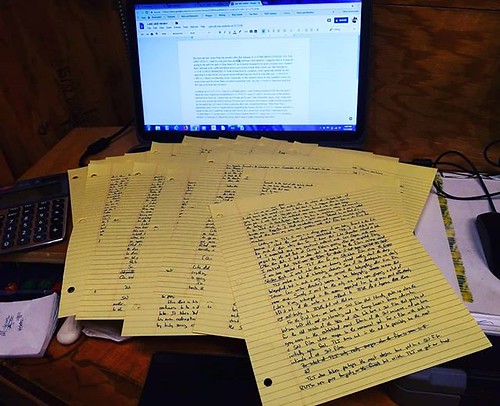
(BTW, one reason this review was so long in coming is that I wrote it out longhand first...and I kept writing...and writing...and writing. Seriously, look at this!

In the "yikes" department, those handwritten pages contain my review of THE LAST JEDI, which I am now starting to type up for the blog. #amwriting #writersofinstagram #essays #blogging #longhand

That's just about the entire review, which I'm now posting here in installments. Yikes indeed!)

Tuesday, May 29, 2018

Tone Poem Tuesday

There are times--and lately, they are frequent--when I have to remind myself that despite our flaws, America is still the nation that produced George Gershwin and Leonard Bernstein.

Monday, May 28, 2018

Larry Havers, and other Memorial Day thoughts

An annual reposting of some things pertaining to Memorial Day. First, a remembrance of a soldier I never knew.

Fifteen years ago I wrote the following on Memorial Day, and I wanted to revisit it. It's about the Vietnam Veteran whose name I remember, despite the fact that I had no relation to him and clearly never knew him, because he was killed four years before I was born.

Memorial Day, for all its solemnity, has for me always been something of a distant holiday, because no one close to me has ever fallen in war, and in fact I have to look pretty far for relatives who have even served in wartime. Both of my grandfathers fought in World War I, but both had been dead for years when I was born. I know that an uncle of mine served during World War II, but I also know that he saw no action (not to belittle his service, but Memorial Day is generally set aside to remember those who paid the "last full price of devotion"). My father-in-law served in Viet Nam, but my own father did not (he had college deferments for the first half of the war, and was above draft age during the second). So there is little in my family history to personalize Memorial Day; for me, it really is a day to remember "all the men and women who have died in service to the United States".

One personal remembrance, though, does creep up for me each Memorial Day. It has nothing at all to do with my family; in fact, I have no connection with the young man in question.

When I was in grade school, during the fall and spring, when the weather was nice, we would have gym class outdoors, at the athletic field. On good days we'd play softball or flag football or soccer; on not-so-good days we'd run around the quarter-mile track. But the walk to the athletic field involved crossing the street in front of the school and walking a tenth of a mile or so down the street, past the town cemetery. I remember that at the corner of the cemetery we passed, behind the wrought-iron fence, the grave of a man named Larry Havers was visible. His stone was decorated with a photograph of him, in military uniform. I don't recall what branch in which he served, nor do I recall his date-of-birth as given on the stone, but I do recall the year of his death: 1967. I even think the stone specified the specific battle in which he was killed in action, but I'm not sure about that, either.

That's what I remember each Memorial Day: the grave of a man I never knew, who died four years before I was born in a place across the world to which I doubt I'll ever go. And in the absence of anyone from my own family, Mr. Havers's name will probably be the one I look for if I ever visit that memorial in Washington. I hope his family wouldn't mind.

I looked online and found these images, first of Mr. Havers's obituary and then of Mr. Havers himself. The things you remember. I wonder what kind of man he was. This year he has been gone for half a century. His name is not forgotten.


Mr. Havers's service information can be found on the Virtual Vietnam Wall here. He was born 14 October 1946 and died 29 October 1967, in Thua Thien.

Next, my annual repost for Memorial Day.

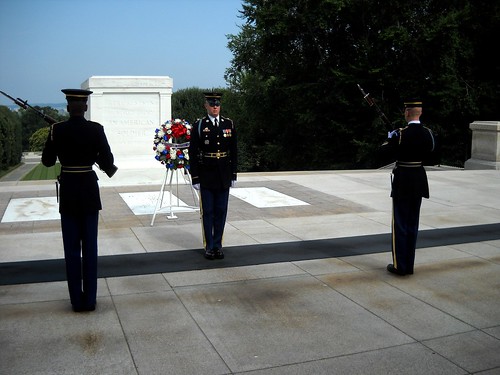
Tomb of Unknown Soldier


Know, all who see these lines,
That this man, by his appetite for honor,
By his steadfastness,
By his love for his country,
By his courage,
Was one of the miracles of the God.


-- Guy Gavriel Kay


"The Green Field of France", by Eric Bogle

Well, how do you do, young Willie McBride,
Do you mind if I sit down here by your graveside?
And rest for awhile 'neath the warm summer sun,
I've been walking all day, and I'm nearly done.
I see by your gravestone you were only 19
When you joined the great fallen in 1916,
I hope you died quick and I hope you died clean
Or, Willie McBride, was it slow and obscene?

Did they Beat the drum slowly, did they play the fife lowly?
Did they sound the death-march as they lowered you down?
Did the band play The Last Post in chorus?
Did the pipes play the Flowers of the Forest?


Did you leave a wife or a sweetheart behind
In some faithful heart is your memory enshrined?
And, though you died back in 1916,
To that faithful heart are you forever 19?
Or are you a stranger without even a name,
Enshrined then, forever, behind a glass pane,
In an old photograph, torn and tattered and stained,
And faded to yellow in a brown leather frame?

Did they Beat the drum slowly, did they play the fife lowly?
Did they sound the death-march as they lowered you down?
Did the band play The Last Post in chorus?
Did the pipes play the Flowers of the Forest?


The sun's shining down on these green fields of France;
The warm wind blows gently, and the red poppies dance.
The trenches have vanished long under the plow;
No gas and no barbed wire, no guns firing now.
But here in this graveyard that's still No Man's Land
The countless white crosses in stand mute in the sand
To man's blind indifference to his fellow man,
And a whole generation who were butchered and damned.

Did they Beat the drum slowly, did they play the fife lowly?
Did they sound the death-march as they lowered you down?
Did the band play The Last Post in chorus?
Did the pipes play the Flowers of the Forest?


And I can't help but wonder, no Willie McBride,
Do all those who lie here know why they died?
Did they really believe when they answered the call,
Did they really believe that this war would end wars?
Well the sorrow, the suffering, the glory, the pain
The killing and dying, was all done in vain,
For young Willie McBride, it all happened again,
And again, and again, and again, and again.

Did they Beat the drum slowly, did they play the fife lowly?
Did they sound the death-march as they lowered you down?
Did the band play The Last Post in chorus?
Did the pipes play the Flowers of the Forest?


Thursday, May 24, 2018

Something for Thursday

This was a favorite of mine in college, especially in my freshman year. I haven't listened to it in a very long time, though. Here is Enya with "On Your Shore."

Tuesday, May 22, 2018

Tone Poem Tuesday (God Save the Queen!)

OK, posting a march is probably stretching the definition of "tone poem" to the breaking point. So be it. In honor of the wedding the other day of Prince Harry (who is my favorite royal, likely because of the eternal "Do you believe that this is my life?!" gleam in his eye) to Meghan Markle, here is the Britishest of all British marches*. Seriously, if this doesn't make you want to do the whole "Stiff upper lip, lads!" thing, there's just not a drop of British affinity in you.

Here is William Walton's "Crown Imperial" March, written for the coronation of King Edward VIII. That particular king abdicated the throne before the coronation, however, so the march ended up being used for the crowning of King George VI instead. You know how it is.


* OK, fine, there is a march that's just slightly more British than Walton's "Crown Imperial," and here it is. God Save the Queen!


(Note how the British audience there bobs up and down in rhythm to the music. This is one of the most endearing bits of audience participation in classical music that I know, probably second only to the clapping along with the "Radetzky March" at the New Year's Concert in Vienna.)

Thursday, May 17, 2018

Something for Thursday

Twenty-one years of adventures with The Wife! Hooray and Huzzah!!! #happyanniversary

Twenty-one years ago today, a lovely girl I'd been dating for a little over six years stood beside me as we exchanged vows. And here we are.

Life's been hard and wonderful and fantastic and awful and great...and I'm ready for the next twenty-one years to start.


Tuesday, May 15, 2018

Tone Poem Tuesday

Not really a tone poem, but it is a rather complete musical statement: "The Flying Sequence" from the score to Superman, by John Williams. This is in honor of the passing of Margot Kidder over the weekend. This music underscores one of the most perfect distillations of pure wonder ever put to film. Superman remains my favorite superhero film yet, and the chemistry between Christopher Reeve and Margot Kidder is a big reason.

Thursday, May 10, 2018

Something for Thursday (for Dr. Janice Wade)

Last month Dr. Janice Wade of Waverly, IA passed away.

Dr. Wade was a member of the music department faculty at Wartburg College when I was there from 1989 to 1993, teaching strings and--in the part of her professional life that made her a part of my creative life--serving as music director of the Wartburg Community Symphony Orchestra, a joint collegiate and community ensemble that played five concerts a year. I played the trumpet in that orchestra all four of my years there, and for three of those years I was the principal. I got to see Dr. Wade's music making up close.

At first, she wasn't even Dr. Wade: she was still completing her doctorate when I arrived, and if memory serves, it wasn't until my junior year that she completed her requirements and became Dr. Wade. Before that she was Ms. Wade, and for a time it seemed to me like she was fighting an uphill battle. There weren't many string players at all at Wartburg when I arrived, and the orchestra was mainly a skeleton crew for most rehearsals. That first year and most of the second we never got to rehearse with full numbers until the dress rehearsals the day before the performance, and there were times when I wondered if the school's string program would ever get off the ground.

It did. Dr. Wade recruited heavily, and by my third year, we had a full complement in the orchestra for nearly every rehearsal, and we played some meaty works: Mozart's Requiem, the Tchaikovsky Piano Concerto No. 1, a work by Amy Beach, and so on. We premiered a work by a Des Moines composer whose name escapes me (I still have those programs around and should look them up), and a lot of other fine works. The Symphony was kind of the odd-child out in the music culture at Wartburg at the time; the jewels in the crown were the Choir and the Concert Band, and then the jazz vocal group (called the Castle Singers) and the jazz band (the Knightlighters). But I was as proud to be a part of that orchestra's evolution as I was of any other musicmaking I was privileged to be a part of while I was there, and Dr. Wade was the driving force.

One particular musical memory: each year we did the Nutcracker Suite as part of our Christmas program, and to this day that is one of the few works I know that is tied in my mind to a very specific time and place. I remember sitting in the orchestra room, rehearsing that piece, while watching snow fall outside through the hall's big windows, and I remember Dr. Wade's annoyance with us each year at the very end of the Waltz of the Flowers. In the very last couple bars, it feels like there should be a dramatic ritardando, slowing to the final smash, but the thing is there's no such ritardando indicated in the score. We would try to play one, and Dr. Wade insisted that we not do it. To this day when I listen to a performance of that work and I hear some great conductor observe the unwritten ritardando, I smile a little and think how Dr. Wade would not approve. Indeed, when Leopold Stokowski conducts the Waltz in the film Fantasia, he does not observe the unwritten ritardando...and when friends and I who were in the orchestra at the time watched that sequence of the movie (it had just come out on VHS right then), we all yelped out, "Dr. Wade's right! It doesn't slow down there!"

Of all the pieces we played in the WCSO, this may well be my favorite. It's the Symphony No. 2 by Howard Hanson, titled the "Romantic". Hanson was a 20th century composer whose language is a conservative throwback to the previous century and its lush Romanticism. The symphony is perhaps the best illustration I know of how a very gifted mind can get a half hour's worth of deeply compelling music from about twelve minutes of actual material: the piece is cyclical to a fault, with the same ideas recurring in each movement, but the overall effect is so effective that one hardly cares. So it was with me when I got to play this symphony under Dr. Janice Wade's baton. As a conductor her overall demeanor was cool and analytical, but for all that she certainly programmed a lot of highly emotional and dramatic music. She kept her fire under control, but there was no questioning its heat.

Here, offered in memory of Dr. Janice Wade of Waverly, IA is Howard Hanson's Symphony No. 2, the "Romantic."


And thank you, Dr. Wade. I never got a chance to say it, but I often thought of you as Maestra Wade.

Friday, May 04, 2018

STAR WARS at 40 (a repost)

This is an essay that I wrote last year on the occasion of the 40th anniversary of the release of the first, the original, STAR WARS, even before it got retitled "A New Hope." I figured I'd repost this today since I am still working on my increasingly enormous reflection piece on The Last Jedi.

May the Fourth be with you!


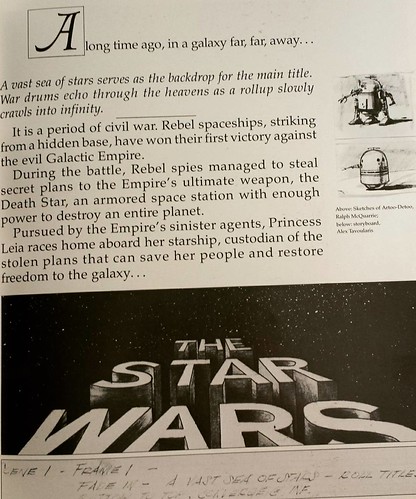
D19 of #IGWritersMay: Novel aesthetics. I make no secret that at its heart, THE SONG OF FORGOTTEN STARS is really my love letter to STAR WARS. (This is a page from the book THE ART OF STAR WARS.) #amwriting #starwars #sciencefiction #spaceopera #Forgotten

I didn't see Star Wars on opening day. In truth I don't even remember exactly when I saw it, but it was later in the summer of 1977. We had just moved from Wisconsin to Oregon, and in that time I was not even aware of this enormous movie phenomenon whose popularity was sweeping the nation.

I finally saw it, though, with my sister, who is six years older than me.

I didn't like it.

It was very loud. It opened with big words flying through space and then there was loud spaceships and talking robots (one of whom only talked in beeps and whistles). There was a girl in white and a bad guy in black whose breath sounded weird. There was a desert planet with weird dwarf-creatures and a kid named Luke who lived with his aunt and uncle. (The uncle could be pretty gruff if Luke was goofing off, to which I could relate.) There were more loud spaceships and one really really big spaceship shaped like a giant ball. There was a guy dressed in black and white who helped the farm kid, and this guy had a giant ape-man friend. There were swords made of light and even more spaceships and a big battle in space.

All of that, and I didn't understand a lick of it.

In my defense, I was all of five years old at the time.

Until Star Wars, my movie experience was pretty much limited to stuff like Bugs Bunny Superstar and Disney live-actions like The Shaggy DA (which contained a hoot of a pie fight). Then there was this movie with loud spaceships and robots and a farm kid and a bad guy in black and...well, I had no idea what to make of this movie.

Luckily for me I had my sister, who is six years older than me.

She went all-in for Star Wars. She ate it, drank it, breathed it. She talked about it a lot, and gradually her enthusiasm began to win me over. She explained the story to me because I hadn't understood it all that well, and I decided that I wanted a part of her enthusiasm for my own. So I went with her to see the movie a second time.

I have never ever ever recovered.


I've been thinking a lot about Star Wars as it nears and achieves 40 years, and I find myself relating to it most as a storyteller myself. As a writer I tend most to look at Star Wars through the prism of story. Many stories have had a deep effect on me, on the stories I want to tell, and the way I go about telling them, but none moreso than Star Wars, even as the Star Wars story itself has changed over the course of its four decades. Most of the core ideas are still there, though, as Star Wars is now no longer in the hands of its creator, George Lucas. Star Wars is still a tale of heroic adventure unfolding in the sky. It is still a tale not just of the wars but more well-focused on the people fighting that war. It is a tale of improbably redeemable villains, of the way our paths mirror those of our parents, and of finding love in the face of desperation. It is a tale of family.

I can't help thinking in most, if not all, of these terms every time I write a story, no matter which genre it's in. Star Wars made me want to be a storyteller (what is playing with action figures, if not storytelling?). It also taught me that stories can focus at times on more mystical matters, and it taught me that story is an excellent way of addressing the challenges people face in their hearts. Most importantly, though, Star Wars taught me about heroes and quests and the wise elders who try to guide the heroes on their way.

Other stories have come since Star Wars arrived, and many have come to places almost as near to my heart. It's not only stories, either; it's all of creative art, really:

Lloyd Alexander's Prydain Chronicles
The Lord of the Rings
Casablanca
On Her Majesty's Secret Service
My Fair Lady
Cosmos
Much Ado About Nothing
The House with a Clock in its Walls
The Lions of Al-Rassan
Mary Stewart's Arthurian trilogy (plus The Wicked Day)
Berlioz's Symphonie fantastique
Rachmaninov's Symphony No. 2 in E minor
Invisible Touch by Genesis
Once and Again
Princess Mononoke

These are all things -- and there are more -- that are at the center of my creative life, but none has ever quite dislodged Star Wars as my Prime Mover. Star Wars is, and continues to be, my Platonic Ideal of what story is.

Even so, I haven't always kept as close an eye on Star Wars as a massive universe as many. I've read only a small handful of all the many novels and comics written over the years, and I haven't played any of the video games. For me, my appreciation focuses pretty exclusively on the movies themselves, and not just the wonderful Original Trilogy but also the admittedly uneven -- but still, in my eyes, uniquely compelling -- Prequel Trilogy and even to a smaller extent the recent "Rebirth" movies, The Force Awakens and Rogue One. Those form the core.

Star Wars is as strong now as it ever was, and it is very likely even stronger. It has more fans than ever, and it is now in the hands of a corporate power whose pockets are deep enough to maintain it at a very high level for decades to come. More fans are created every day, it seems, and yet...I do have to admit to feeling a certain level of possibly grumpy oldsterism. Sure, you kids can love Star Wars and in fact I hope that you will, and that your love for Star Wars will lead you to other things. But I came in on the ground level. My memories may be hazy, but I do remember a time before Star Wars.

I believe that every story one writes -- or rather, every story that I write -- should be, in one way or another, a love letter, either to someone or something. The Song of Forgotten Stars has many influences, but it is ultimately my love letter to Star Wars. If not for Star Wars, there's no way I would be writing this story. It's not just about the internals of Star Wars, though: it's about the way Star Wars impacted me and shaped my life and helped reflected certain relationships in my life. Put it this way: There's a reason why the two main characters in my Forgotten Stars books are two Princesses, one of whom is six years older than the other. It's a dynamic that makes sense to me on a lot of different levels.

I also know, from reading a lot about the making of Star Wars over the years and about the life of George Lucas in particular, that the way by which a creative work comes into existence is often a messy one. Lucas's manner of creation is eerily similar to my own, or maybe vice versa. Lucas is someone who starts out by following ideas in any direction they might go, and only gradually whittles things down and discards this notion or that idea until a streamlined story starts to emerge. I work the same way, at least in part. My rough drafts are often very messy and they always contain entire ideas that I remove entirely, for one reason or another. Lucas has done so much mixing and matching of ideas over the decades (remember that for him, Star Wars is 47 or 48 years old, depending on where he dates The Beginning) that he at times seems to be misremembering his own history. I know how he feels. There are times when an idea seems so organic that it's hard to claim it for my own. Even if it is.

So thank you for forty years, Star Wars! And may the Force be with you, forevermore.


Bad Joke Friday: May the Fourth Be With You!!!

What do you call a potato that has turned to the Dark Side of the Force?

Vader tots!!!

(And there's more where that came from, folks!)

Thursday, May 03, 2018

Something for Thursday

American treasure and icon (and one of my favorite musicians ever) Willie Nelson turned 85 years old the other day. This enchanting duet he did with Ray Charles years ago is, to this day, my favorite thing he's ever done. Congratulations on a great life, Willie Nelson!


And speaking of Willie Nelson, do read this wonderful article about his guitar, Trigger, which has been with him for nearly 50 years. And then there's Sheila O'Malley's tribute, which is typically terrific.

Tuesday, May 01, 2018

Tone Poem Tuesday

It's May Day, so here for the occasion is "A May Day Overture," by British composer Haydn Wood. Enjoy!

Thursday, April 19, 2018

Something for Thursday

You know what? You look like you could use a half hour of Mozart. So here.

(And if you don't think you could use a half hour of Mozart? Shut up and listen to a half hour of Mozart.)

Tuesday, April 17, 2018

Tone Poem Tuesday

Stretching the idea of the "tone poem" somewhat, here is Alexander Glazunov again, this time looking back in time rather than east in direction. This orchestral suite is called "From the Middle Ages," and it is just that: a musical depiction, in Glazunov's thinking, of the climate of medieval Europe. There are big melodic strokes here, to be sure (this is a Russian Romantic, after all), but there are also intimate expressions of medieval dance, the songs of the troubadours, and the marching of the knights off to Crusade. At times this piece almost evokes for me the finest in film music.

Here is Glazunov's suite "From the Middle Ages."

Thursday, April 12, 2018

Something for Thursday

Today is National Holocaust Remembrance Day.


It's not enough to remember that it happened. We must remember why.

Tuesday, April 10, 2018

Tone Poem Tuesday

There is something oddly seductive about the way the Russian Romantic composers, while trained in the musical traditions of the west, often looked eastward for inspiration. That exotic flavor lives so sparklingly in the work of Rimsky-Korsakov and Borodin, and is also found in the works of other Russians of the time, such as Alexander Glazunov. This work here, the Oriental Rhapsody, sounds like it belongs on a program of such music alongside Scheherazade and In the Steppes of Central Asia. It's a musical tribute to an Asia-that-never-was, born in a time when the word "Orient" was used to sum up virtually a third of the entire world and all the peoples therein. There's no real depiction of an actual Asia here, just an imagined one...but the imagination is powerful.

Here is Glazunov's Oriental Rhapsody.

Monday, April 09, 2018

Doggos

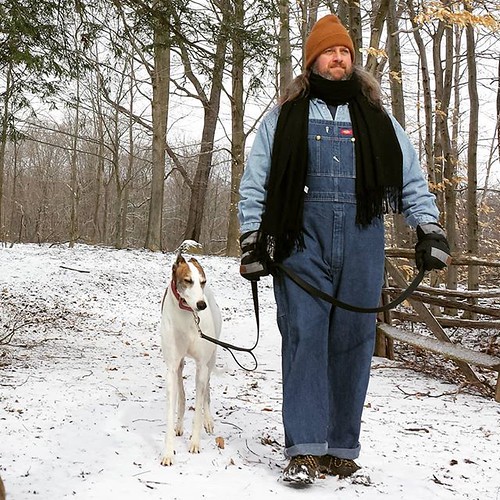
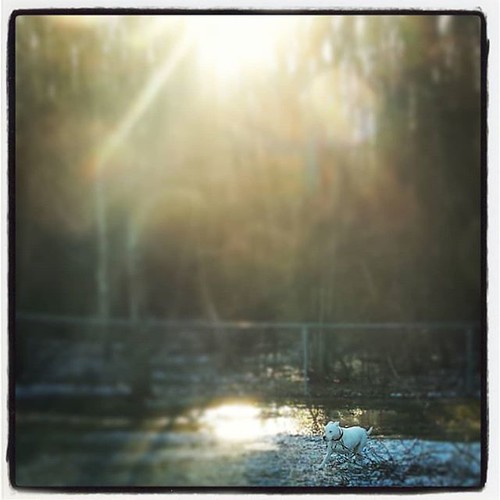
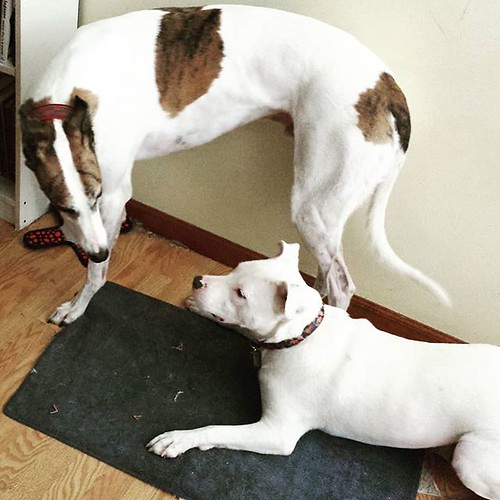
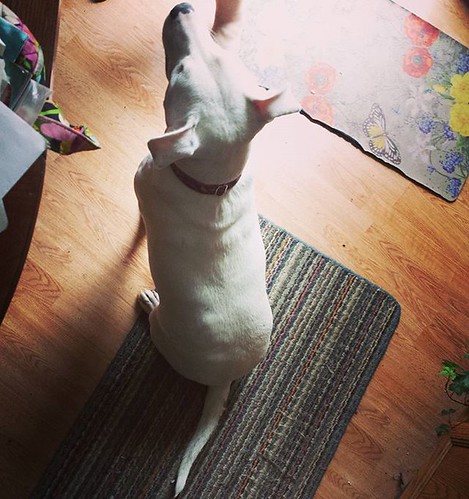
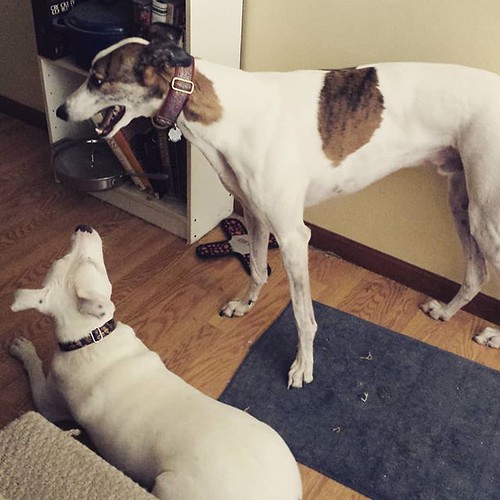
Just because, here are some photos of the dogs.

(I'll take more of the cats soon.)

I interpret the Dee-oh-gee's expression as being sick of winter's shit. #Cane #DogsOfInstagram #greyhound #KnoxFarm #EastAurora #wny #spring #overalls #dickiesworkwear #bluedenim #dungarees #biboveralls #doubledenim

Morning Carla #Carla #dogsofinstagram #pitbullmix #pitbullsofinstagram

The surest sign yet of an impending spring #Cane #DogsOfInstagram #greyhound

WAZZAT!!! #Cane #DogsOfInstagram #greyhound #KnoxFarm #EastAurora #wny #winter

2/2 Carla playing with her brother. #Cane #DogsOfInstagram #greyhound #Carla #pitbullmix #pitbullsofinstagram

Carla awaits the unwrapping of her new ball. #Carla #dogsofinstagram #pitbullmix

Tell Mr. DeMille that Carla is ready for her close-up. #Carla #dogsofinstagram #pitbullmix

Friday, April 06, 2018

Bad Joke Friday

Wow, I need to get back into the swing over here, don't I? Here's something! It's not even a bad joke. I liked it, actually!


(via)

Thursday, April 05, 2018

Something for Thursday

I really love the movie Catch Me If You Can. One reason is John Williams's wonderful score, with its mix of caper-jazz and its wistful tone depicting Frank Abagnale's (Leonardo DiCaprio) unspoken wish for some kind of normal life. Williams edited his masterful score, one of his most underrated gems, into this suite.

Thursday, March 29, 2018

Something for Thursday

A very young Judy Garland--even before she would travel over that rainbow--sings to a photograph of Clark Gable.

Tuesday, March 27, 2018

Tone Poem Tuesday

Max Reger was a late-Romantic era composer who isn't heard a lot these days, owing to his reputation of having written mostly very dense works that aren't the easiest listens in the world. I'm all for difficult listening, but I'm not sold on Reger, whose work strikes me (based on what little I've heard) as very heavy and ponderous. But I'll let you all be the judge: here is Reger's Symphonic prologue for a tragedy.

Monday, March 26, 2018

Running Hound

I've always found it hard to get really nice pictures of Cane as he's running. From certain angles a greyhound running is a magical thing, but from others they look like a randomized collection of overlong limbs flailing in every direction.

I finally got lucky a couple of weeks ago.

Snowhound (1 of 3) ##Cane #DogsOfInstagram #greyhound

Snowhound (2 of 3) #Cane #DogsOfInstagram #greyhound

Snowhound (3 of 3) #Cane #DogsOfInstagram #greyhound

In other news, it appears that springtime may actually be in the offing. I try to not be overly optimistic on this point, but...well, I can hope, too.

The surest sign yet of an impending spring #Cane #DogsOfInstagram #greyhound

And yes, Carla is still here, and yes, she still loves her brother.

1/2 Carla playing with her brother. #Cane #DogsOfInstagram #greyhound #Carla #pitbullmix #pitbullsofinstagram

Dogs, man. What a life development this has been!

Thursday, March 22, 2018

Something for Thursday

It's been a busy week...but not so busy that we can't take some time for Itzhak Perlman playing Bizet by way of Pablo de Sarasate.

Friday, March 16, 2018

Something for Friday

Sorry I didn't get around to posting yesterday, but here is a bit of film music from a movie that is one of the better ones out there at depicting the sense of wonder and grandeur in the universe that science can illuminate. The film is Contact, and I offer this in memory of Stephen Hawking, who died the day before yesterday (on Pi Day, and Albert Einstein's birthday, for a couple of odd synchronicities). Hawking was a complicated person, as most are, but his contributions to science cannot be diminished. He is now one of the "Giants" upon whose shoulders future generations will stand.

Wednesday, March 14, 2018

Three One Four

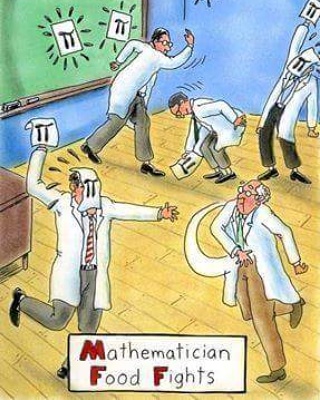
It's Pi Day, everyone!

It is also Albert Einstein's birthday and, sadly, this year's edition marks the passing of Stephen Hawking, about which I'll have more to say later. But for now, let's celebrate Pi!


Calculate Pi yourself!

NASA's Pi in the Sky Challenge

A few videos:


(That one's titled "Pi Day" but the video has nothing to do with Pi so far as I can see, but it's a cool video anyway, so there it is.)


And finally:


Happy Pi Day, everyone!

Tuesday, March 13, 2018

Tone Poem Tuesday

Film music is often rearranged by the composers into suites that make for better performance in concert settings, and this is one of the better ones. I had this performance on a cassette tape many moons ago, but I never was able to track it down on CD...and then I happened to find it on Google Play the other day. Lo and behold, here it is on YouTube: a suite of John Williams's music to Close Encounters of the Third Kind, performed by the Los Angeles Philharmonic and conducted by Zubin Mehta. This was recorded way back in 1978, before Mehta made his name in a big way as music director of the New York Philharmonic.

Enjoy!

Thursday, March 08, 2018

Something for Thursday

In honor of Roger's birthday, in which he turned 65, here is Camille Saint-Saens's Septet for piano, trumpet, and strings. Why this piece? Because it's Saint-Saens's Opus 65!


Happy birthday, Roger!

(It was actually yesterday, but I couldn't do Something for Thursday on Wednesday. That's just not done.)

Tuesday, March 06, 2018

Tone Poem Tuesday

There's always something fascinating about obscure Beethoven. You can't help listening to it, trying to find hints of the staggering genius that would craft some of the greatest works of art in human history, and not just musical art. You can hear Beethoven's style in this piece, and even though it is fairly obscure (coming from a longer work with choral movements, where only the overture is much heard today), you can still hear the great master within it.

Here is the Overture to King Stephen by Ludwig van Beethoven.

Thursday, March 01, 2018

Something for Thursday

Play enough marches in band in high school and college and they get into your blood. I heard this one on the radio yesterday, and while I've known it for years via recordings, I never played it that I can recall. It's The Florentiner March by Julius Fucik, a Czech composer who is best known for his marches, and in the United States for one march in particular, Entry of the Gladiators, which was appropriated by circuses throughout the country. Florentiner is the one I prefer, though. Fucik's output of waltzes, marches, galops, and polkas makes him something of a Czech answer to Vienna's Strauss family, and his concentration on the brass and wind bands in his compositions makes him something of a Czech answer to John Philip Sousa.

Florentiner is interesting in its structure: it starts out full military brass pomp, complete with opening fanfare and then two strains of pleasing martial tunes. But when we get to the trio, the march takes a deeply lyrical turn, and by the end it's pretty much singing its heart out.

Here is the Florentiner March by Julius Fucik.