I haven't tried to write one yet, so I can't be sure, but it seems to me that haunted house stories must be fairly hard to pull off successfully. The tropes are by now very familiar: the brooding mansion sitting on a large estate out in the country; the history of eccentric owners who met dolorous ends in the house; the fact that people who have attempted to stay in the house have failed miserably; the odd, almost robotic housekeeper who still stays on at the house; decriptions of the house itself as "evil", "malevolent", et cetera.
All of these tropes are present in Shirley Jackson's The Haunting of Hill House. Maybe it's the familiarity of the haunted house story that made the book suffer a bit for me, as I found the story rather hard to really get involved in. The feeling of malice in the book never really came alive, at least not until near the end. The book does not so much "build" as "meander", and then it suddenly arrives. The only real indicator of an impending climax in the book is the dwindling page-count as one reads it, which I found disappointing. I've admired Jackson's short fiction, and I have also read a great deal of praise for her novels (and this novel in particular), so I am quite surprised by my reaction.
The story is fairly simple: four people go to live for a time in Hill House, as an experiment at the behest of a researcher into the paranormal. Living in the house tends to bring out the worst in all of the characters, for some reason, and it is to Jackson's credit as a writer that each character becomes unpalatable in his or her own way. Unfortunately, though, the characters are not balanced, as the tortures and self-loathing of Eleanor overtake everyone else. (Yes, I know that in the end there is a reason for that, but it still doesn't help the two-hundred plus pages leading up to it.) There are the standard "things that go bump in the night", but some plausible explanations for this are provided along the way. In fact, nearly everything that happens in the book seems to have a plausible explanation, so we are never particularly certain if Hill House really is haunted or not. That's an interesting angle, but it never really takes flight.
I wanted to like The Haunting of Hill House much more than I did. My attention was simply never grabbed as a good horror story should (or any good story, for that matter). For a very similar story executed in more involving fashion, check out Richard Matheson's Hell House.
The personal blog of author Kelly Sedinger, chronicling the adventures of one overalls-clad wanderer.
Monday, September 09, 2002

Sometimes in sports when a bad team rebuilds, a specific progression can be traced. First, they are the bad team that everyone wants to play because they're an easy target; that was the Buffalo Bills last year. Then, they become the bad team that nobody wants to play: they still lose most of the time, but they scrap and claw and fight and always keep the game close. That could very well be the Buffalo Bills this year, especially after the opener yesterday, which they lost, 37-31 in overtime, to the New York Jets.
Most of the Bills' "question marks" going into the game actually did well. The offensive line was able to run-block effectively, allowing Bills RB Travis Henry to put up over 140 yards rushing. Their pass-blocking wasn't as good -- Drew Bledsoe faced an awful lot of pressure -- but that will most definitely get better. The defense also did a good job of keeping the Jets offense from ever really developing a rhythm for more than a series or two. So how did the Bills end up losing? Because their special teams, which for more than three years now have been substantially less than "special", blew the game by giving up a blocked punt and two kickoff returns for touchdowns -- including the opening kickoff in overtime, so the game ended in OT before there was ever a play from scrimmage. Special teams play has been a train-wreck for the Bills ever since that playoff game in Tennessee that they lost (also on a kickoff return, this one with twenty seconds or so left in the game). Oh, where is Steve Tasker when you need him?
How was Drew Bledsoe's performance? Well, it's wonderful to be able to watch the Bills and have some confidence in the quarterback again, something which has not really been the case since Jim Kelly's retirement. He did throw two interceptions, although I only consider one of them to be a true interception because the other was one of those deals where the receiver gets a hand on the ball, but then the defender pops him, knocking the ball into the air where another defender, who happens to be in the right place at the right time, plucks it from the air. Calling those against a QB's stats has always struck me as a bit unfair. Maybe they should be called "deflections" instead of "interceptions". Bledsoe also engineered a last-minute drive to tie the game, which was utterly thrilling. Welcome to Buffalo, Drew.
(An interesting side note: Drew Bledsoe's first play from scrimmage in his NFL career, back in 1994 with the Patriots, was a pass play on which he was sacked by Bruce Smith of the Bills. His first play from scrimmage as a Bill was a pass play on which he was sacked. Weird.)
Sunday, September 08, 2002
A quick maintenance note: I have removed the permanent link to James Lileks's site, not because I don't care for his viewpoints -- although I don't -- but because his writing style has become grating to me. I was originally interested in his writing because I found a certain kind of warm humor in it, but that element appears to have vanished completely.
I expect that every writer has a shelf full of reference books to which they turn on a regular basis. Even a writer who works in fantasy, making up his or her setting and details as the work goes along, has to rely on a number of references for things like environmental information, literary techniques, poetic allusions, and the like. Some of my more frequently used reference works include the following.
:: The Rand McNally Atlas of the World: Masterpiece Edition. This is one of those gigantic atlases with close-up, topographical maps of just about every place on the earth. Immensely useful.
:: The Oxford Essential World Atlas. Why have two atlases? Because the Oxford one is smaller, being a large trade paperback as opposed to an eighteen-inch high, two-inch thick tome like the Rand-McNally. Sometimes I don't need the close-up view, so the Oxford suits me fine.
:: Historical Atlas, by William R. Shepherd. And then there are times when I need to know what the borders of the Ottoman Empire were, or perhaps the ecclesiastical districts of Plantagenet-era England, or the route of Marco Polo's journey to China, or the limits of Mongol encroachment into the West. This book has all that and more. I've meant to update this book over the years -- the one I own dates from 1956 -- but the old one hasn't lost its usefulness one whit.
:: Scientific American's How Things Work Today. I haven't had a whole lot of use for this book in my own writing yet, but it's full of information on the current state of technology for laypersons.
:: The New York Public Library Science Desk Reference. This is a big catch-all book about the current state of the sciences. If I ever turn to writing SF, I suppose I will use it more than I do now, although it's a fascinating book to dip into.
:: The Oxford Book of English Verse. Here's another one that I should probably update, as my copy is seventy years old. Every writer needs an all-purpose collection of poetry....
:: Immortal Poems, edited by Oscar Williams. ....or two. This one's more compact, being a mass-market paperback. It also contains a lot that the Oxford doesn't.
:: World Poetry, edited by Washburn, Major and Fadiman. This is just what the title says, and it's as wonderful as useful.
:: Merriam Webster's Encyclopedia of Literature. Also just what the title says. This book has capsule bios of authors, capsule entries on their major works, entries on literary techniques and movements, and a lot more.
:: The Bible, King James Version. I'm not much concerned with the theological aspects of the Bible, so I keep the KJV, which is a towering achievement of the language.
:: Almanacs. I'm not loyal to any particular almanac. I buy a new one every three years or so; currently I have the TIME Magazine almanac. I bought this one, as opposed to the World Almanac, simply because it was cheaper at the bookstore I was in on the day that I decided to update my almanac. You never know when you're going to need some tiny little fact like who won the 1949 World Series or when the Chrysler Building was erected or the dates of King Henry VII's reign in England.
:: The Elements of Style, by Strunk and White. This book is absolutely essential.
:: Dictionaries. Currently I own two: The American Heritage Dictionary, Second College Edition and The Oxford Pocket Dictionary and Thesaurus, American Edition. (I'm not sure how the Oxford can be remotely considered a "pocket" dictionary. The thing won't fit in any pocket I've ever seen.) My AHD has more entries than the Oxford, but the Oxford has the thesaurus in the same volume. I am also a member of a book club that includes access to the full Oxford English Dictionary online, although I don't use that perk as often as I originally thought I might.
Of course, there are a large number of other books that I use as reference materials, but the ones listed here are my main workhorses.
This weekend was a sad one in my family: our oldest cat, the nine-year-old Persian named Jasmine, passed away. It was very sudden and very quick, which is bad because of the shock but is also good because of the quickness of the whole thing. We are one of those families for whom pets are pretty much full family members, so her loss was hard. Also hard is explaining what has happened to our three-year-old daughter. She understood that something happened that made Mommy and Daddy very sad, and she understood that Jasmine became very sick...but she evidently hasn't put the emotions and the reality of the event all together yet. This is the first death in the family that she has experienced.
Thursday, September 05, 2002
IMAGE OF THE WEEK

Multnomah Falls, Oregon.
I've lived near one of the world's greatest and most famous cataracts, Niagara Falls, for more than twenty years now; but before that I lived near another of the most beautiful of the world's waterfalls, the spectacular Multnomah Falls. This cataract is located in the Columbia River Gorge, an hour or so from Portland. The water volume is certainly nowhere near Niagara, but Niagara can't begin to boast Multnomah's amazing height. The falls are created when a lovely but unremarkable stream plunges more than six hundred feet over an escarpment. The hiking trails in the park devoted to the Falls yield a number of amazing views, from the pool where the Falls land to the bridge at the Falls' midheight to the observation deck located at the very brink of the Falls. It's been more than two decades since I saw Multnomah last, and I would dearly love to go back.
The image links to an official National Parks Service website devoted to Multnomah Falls.
IT'S ALL IN THE DETAILS, part one.
This is a new semi-regular thing I'll be doing whenever I feel like it, not unlike my "Poetical Excursions". We've all had the experience of seeing a movie and noticing a small detail that either enhances the mood of the film or imagination of its setting (these are almost always intentional), or that detracts from the goings-on in a bad way (these are not). Basically, in this mini-series I will simply cite some details that I've noticed in films I've seen, for good or ill. These details won't always reflect on my overall opinion of a film, however; I may cite a detail that I love in a film I dislike, or vice-versa.
So, here we go....
GOOD: Dumbo. In the film's very last scene, after Dumbo has learned how to fly with his ears and has saved the circus and become a celebrity, he is flying along behind his circus train while his mother, the previously harshly-treated Mrs. Jumbo, relaxes in style in her new luxury car. As the music climaxes, Dumbo swoops down into his mother's waiting arms, and returns her embrace by wrapping his immense ears around her. I love that.
BAD: Contact. There are a few grating details in this film, which all arise from the digital creations of things that weren't there to begin with. Now, I can deal with actual CNN personalities appearing in the film, although I would really rather that Bob Zemeckis and the film's crew had gone the way of, say, The West Wing and created their own White House Press Corps and news reporters. Seeing Bernard Shaw report on fictional events in the film is jarring. Equally jarring are the appearances by Bill Clinton, who was President at the time of the film's making. They use actual speeches of his, with the words edited so as to reflect the President's reaction to the film's events, but still the whole thing seems fake. And finally, there are some aerial tracking shots over the immense crowds that gather at the VLA in New Mexico and Cape Canaveral for the testing of The Machine. In these shots, the same green tent appears...over and over and over. Ugh.
GOOD: Star Wars Episode II: Attack of the Clones. After the big chase through the Coruscant skyline, which began when Obi Wan Kenobi lept through a glass window to grab onto the flying assassin droid, some worker droids are shown replacing the glass. A lovely touch.
BAD: Star Wars Episode II: Attack of the Clones. Now, you'd think that a filmmaker of George Lucas's attention to visual detail would notice the fact that late in the film, Padme presses the exact same button on her ship's control panel to do completely different things. This is not unlike the fact that the "Fire Phasers" button on Star Trek is rarely in the same place twice.
BAD: Star Trek IV: The Voyage Home. Speaking of Trek, how can the bridge of the Klingon Bird of Prey in STIV be completely different from the bridge of the Bird of Prey in the preceding STIII: The Search For Spock, when they're the same ship? Were Kirk and crew sufficiently bored during their time on Vulcan that they rebuilt the bridge and still left it looking like a Klingon bridge?
GOOD: Superman. When Lois Lane is hanging for dear life from the helicopter that has crashed on the roof of the Daily Planet building, Clark Kent exits the building at street level. Something flutters to the ground behind him, and it turns out to be Lois's hat. That's pretty good, as is Clark's small expression of frustration when he looks for someplace to change into Superman and notices that phone booths have been replaced by phones-on-poles.
BAD: Raiders of the Lost Ark. When Indy and Sallah take the headpiece of the Staff of Ra to the Imam for deciphering, they are told that the staff is to be "six qadam high". (I have no idea how that unit of measure is really spelled, by the way.) Sallah helpfully puts in that this is about seventy-two inches, which we can deduce is six feet. Therefore, one "qadam" equals one foot. But on the reverse of the headpiece is the direction to subtract one "qadam" to "honor the Hebrew God whose Ark this is". That makes for a five-foot staff. So far, so good -- until the actual scene in the Map Room, where the Staff of Ra is shown to be at least six inches taller than Indy himself. So, are we to conclude that Indy's height is four foot six?
Tune in again....
Wednesday, September 04, 2002
I watched part of the Frontline special on PBS last night, the subject of which was Faith and Doubt at Ground Zero, an examination of religious themes surrounding the events of 11 September 2001. What I saw of the show was fascinating, and I hope to see it in its entirety again. The most striking segment depicted a rabbi who has used transcriptions of those gut-wrenching cellphone calls from those who died in his daily chants. Hearing those words -- Tell the children I love them, take care of them, I love you, goodbye -- sung to those Hebrew chant melodies is utterly haunting.
Until now, author Neil Gaiman has been primarily known as the writer behind the remarkable Sandman comic book series. He's written other things -- a couple of novels, some other comics, and a battery of short fiction -- but he's still been mostly known as the Sandman guy. That's likely to change, though, now that Gaiman's novel American Gods has won both the Hugo and the Bram Stoker awards for Novel of the Year and now that his newest book, Coraline, is drawing rave notices.
I actually finished reading American Gods on Saturday, the day before it was awarded with the Hugo. Now, I haven't read the other novels that were nominated this year, so I cannot honestly say whether the award was given correctly. I can only say that Gods is an excellent novel. The story is about a man called Shadow who has been paroled from prison on the same day that his wife is killed in an automobile accident. With nowhere else to go, Shadow ends up in the employ of a strange man named Wednesday who moves in some very strange circles. It turns out that Shadow is to play a part in a war between the fading, old-world Gods and the new-fangled American Gods, deities such as commerce and the Internet. Along the way, lessons are learned and secrets revealed, as is always the case in large-scale works like this in which nothing is ever as it seems.
Gaiman achieves an interesting mix of literal description and metaphorical construct in depicting the conflicts of his novel. At one point, he goes so far as to write:
The book is at times quite literal in its description of events, and at other times it takes on a dreamier, surrealistic tone -- especially in passages involving Native American spirituality and its relation to the onset of American society and the constant arrival of new Gods. This can seem facile at times, for how else would one contrast the businesslike demeanor of America versus the more spiritual concerns of others? However, it gradually becomes clear that Gaiman is after something else, and the line blurs substantially as the novel progresses, and as we begin to suspect that the two sides depicted in the novel may not be quite as we are told they are.
Gaiman's use of setting is also fascinating. The book is set mostly in the upper Midwest. (Gaiman himself lives in Minneapolis.) He invokes landmarks and attractions that will be well-known to anyone familiar with that area as settings in his novel, and particularly fascinating is his depiction of the seemingly idyllic town of Lakeside, Wisconsin which may not be quite as idyllic as it seems.
The novel is very episodic in structure, basically moving from one set-piece to the next. There isn't so much of a linear development of the plot, which may bother some readers. Gaiman also includes small vignettes that take us out of the main action of the novel entirely in order to depict side-struggles and events in his America, where Gods interact with mere mortals. The most impressive of these, to me, was the lengthy vignette involving an Arab immigrant to New York City. American Gods was written before 11 September 2001, but it is difficult to not read this section of the book in that light. In fact, reading this book after 11 September is an exercise in the American spiritual landscape, as Gaiman makes us wonder just who our gods really are.
The book's only flaw, in my estimation, is its conclusion. Gaiman leaves one particular story thread, and a fairly minor one at that, unresolved until after everything else has been dealt with; then he returns to that story thread and ties it up with a few more revelations. The answers Gaiman gives are satisfying, but the episode still feels a bit out-of-place. Perhaps, though, this is Gaiman's intent -- his way of depicting the continuing cycle of divinity at play with the profane. I'm not really sure.
I found American Gods immensely enjoyable, as a piece of contemporary fantasy in the manner of Charles de Lint or Robert Holdstock. Recommended.
I actually finished reading American Gods on Saturday, the day before it was awarded with the Hugo. Now, I haven't read the other novels that were nominated this year, so I cannot honestly say whether the award was given correctly. I can only say that Gods is an excellent novel. The story is about a man called Shadow who has been paroled from prison on the same day that his wife is killed in an automobile accident. With nowhere else to go, Shadow ends up in the employ of a strange man named Wednesday who moves in some very strange circles. It turns out that Shadow is to play a part in a war between the fading, old-world Gods and the new-fangled American Gods, deities such as commerce and the Internet. Along the way, lessons are learned and secrets revealed, as is always the case in large-scale works like this in which nothing is ever as it seems.
Gaiman achieves an interesting mix of literal description and metaphorical construct in depicting the conflicts of his novel. At one point, he goes so far as to write:
None of this can actually be happening. If it makes you more comfortable, you could simply think of it as a metaphor. Religions are, by definition, metaphors, after all: God is a dream, a hope, a woman...religions are places to stand and look and act, vantage points from which to view the world.
The book is at times quite literal in its description of events, and at other times it takes on a dreamier, surrealistic tone -- especially in passages involving Native American spirituality and its relation to the onset of American society and the constant arrival of new Gods. This can seem facile at times, for how else would one contrast the businesslike demeanor of America versus the more spiritual concerns of others? However, it gradually becomes clear that Gaiman is after something else, and the line blurs substantially as the novel progresses, and as we begin to suspect that the two sides depicted in the novel may not be quite as we are told they are.
Gaiman's use of setting is also fascinating. The book is set mostly in the upper Midwest. (Gaiman himself lives in Minneapolis.) He invokes landmarks and attractions that will be well-known to anyone familiar with that area as settings in his novel, and particularly fascinating is his depiction of the seemingly idyllic town of Lakeside, Wisconsin which may not be quite as idyllic as it seems.
The novel is very episodic in structure, basically moving from one set-piece to the next. There isn't so much of a linear development of the plot, which may bother some readers. Gaiman also includes small vignettes that take us out of the main action of the novel entirely in order to depict side-struggles and events in his America, where Gods interact with mere mortals. The most impressive of these, to me, was the lengthy vignette involving an Arab immigrant to New York City. American Gods was written before 11 September 2001, but it is difficult to not read this section of the book in that light. In fact, reading this book after 11 September is an exercise in the American spiritual landscape, as Gaiman makes us wonder just who our gods really are.
The book's only flaw, in my estimation, is its conclusion. Gaiman leaves one particular story thread, and a fairly minor one at that, unresolved until after everything else has been dealt with; then he returns to that story thread and ties it up with a few more revelations. The answers Gaiman gives are satisfying, but the episode still feels a bit out-of-place. Perhaps, though, this is Gaiman's intent -- his way of depicting the continuing cycle of divinity at play with the profane. I'm not really sure.
I found American Gods immensely enjoyable, as a piece of contemporary fantasy in the manner of Charles de Lint or Robert Holdstock. Recommended.
Everything that the vibraphone is today can pretty much be traced to a single musician: the amazing Lionel Hampton, who used his proficiency on that instrument to become one of jazz's leading lights.
Sadly, Lionel Hampton has passed away at the age of 94. NPR's tribute to Hampton can be heard here.
Sadly, Lionel Hampton has passed away at the age of 94. NPR's tribute to Hampton can be heard here.
Tuesday, September 03, 2002
A couple of nifty links:
:: ABCNews has a nice article about people who collect things that actually doesn't make collectors look like, well, weirdos of The Simpsons's "Comic Book Guy" variety.
:: Slate has an interesting article making the case for Randall Cunningham as a member of football's Hall-of-Fame. I never thought that Cunningham's career was quite up to that level, but after reading this, I'm not so sure. And that touchdown pass of his against my beloved Bills in 1990, where he dropped back into his own end zone, ducked under a certain Bruce Smith sack (and this was Bruce Smith in his prime, mind you) and then put the ball in the air for what turned out to be a 102-yard touchdown pass, remains etched on my brain after twelve years. (The Bills won that game, by the way.)
:: More football stuff. (Get used to it!) All the ESPN gurus have their predictions up on one handy page. The Rams appear to be a majority pick to win it all, although it's not unanimous. What is unanimous is that nobody is picking the Patriots to repeat. On a page to himself, of course, is the Tuesday Morning Quarterback, who is back writing football-related haikus.
On the day before the Hugos were awarded to various luminaries in SF-dom, I got my latest rejection slip in the mail from F&SF. This was not surprising, really. The story in question -- "Stains" -- is a psychological horror story with a very muted supernatural element, inspired by Poe's "The Tell-tale Heart". F&SF doesn't seem to print many stories like it. So why did I send it there at all? Well, for a number of reasons. First, there is F&SF's track record for response times: my responses from them (all rejections, by the way) have always come within ten days of submission, allowing me to get the thing out to another market. Second, there is the matter of word-limits. I am almost incapable of writing a story in under nine thousand words, and most of mine gravitate to novellette length (twelve to fifteen thousand words, roughly). There just aren't that many markets for short fiction willing to handle those kinds of lengths, so I pretty much submit to all the ones that do. I suppose I could figure out how to write actual short stories, thus giving myself more markets to submit to and (theoretically) increasing my chances for publication, but somehow that doesn't seem right. I would rather write the stories that I have to write, in the manner that I have to write them, than try to shoehorn myself into some other category. (One proviso: I don't think that I am overly wordy in my fiction. When I edit my stories for submission, I can get pretty draconian. I always remove at least ten percent of the original wordage, and in one case I actually excised twenty-five percent. That particular story came closest to being published, with an editor holding onto it for nearly six months while he tried to find a spot in his publication for it. Alas, 'twas not to be....)
So, what's next for "Stains"? Tomorrow it's off to Alfred Hitchcock's Mystery Magazine.
So, what's next for "Stains"? Tomorrow it's off to Alfred Hitchcock's Mystery Magazine.

Congratulations to all the lucky folks who won one of these at ConJose (the World Science Fiction Convention, held at San Jose) on Sunday night. I'd love to win one of these someday, but I think I'd rather win the Bram Stoker since I write more horror than fantasy (and I write no science fiction currently). I'd also like to actually be published, which is probably a prerequisite of sorts. Sigh....
Sunday, September 01, 2002
The Buffalo Philharmonic Orchestra has released its first recording under the Naxos label. The CD is a disc of three orchestral works by American composer Frederick Converse (1871-1940), a composer of whom I had never heard until I learned of this recording, which is part of Naxos's effort to explore the rich history of American classical music beyond the usual "big names". It's also thrilling to see my hometown orchestra finally appearing on recordings that are nationally available.
This is the text of a post I made to the Usenet newsgroup rec.music.movies back in March, about Howard Shore's Oscar-winning score to Lord of the Rings: Fellowship of the Ring. I've linked to the article on the Google Groups Archive, but I wanted to have a copy here on Byzantium's Shores as well.
Now that Howard Shore has won his Oscar for Lord of the Rings: The Fellowship of the Ring, I should like to explore for a moment the score’s remarkable qualities.
It seems at first to be precisely the kind of score one would expect for a large-scale epic fantasy, and in many ways it is. It is full of gigantic orchestral passages, fanfarish heroics, darkly scored passages with lots of low brass for the villains, big choral passages, ethereal choral passages, and melodies both happy and melancholy. Shore’s work is deftly done in all those regards and more. While his orchestral and choral writing are indisputably splendid, with Shore directing his massive resources with consummate craftsmanship and aplomb, the score is hardly unique in that regard; instead his work here stands squarely in the tradition of Goldsmith, Williams, Herrmann, Rozsa, Korngold and all the other great composers of epic scores. What makes this score so remarkable, especially in this day of frequently substanceless bombast, is its construction: its symphonic and leitmotifistic cohesion in which many themes are interrelated and manipulated with a constant eye and ear for Story.
When the track-listing for the LOTR:FOTR CD was made public, the striking detail was that most of the track titles were actual chapter titles from the book. And then, in his Oscar acceptance speech, Shore specifically noted "the words of Tolkien". These are not coincidences. The LOTR film project is tied to its literary forebear to a much greater degree than most other notable book-to-film translations, and this turns out to be the key to Shore’s work on the LOTR score. Shore uses his music not just to create mood but to reflect Tolkien’s themes and stories. In fact, while Shore’s score almost perfectly enhances Peter Jackson’s film, it is Tolkien’s story that dictates how Shore uses his themes.
Consider, first, what can probably be called the score’s "main theme": the theme for the Fellowship of the Ring itself. In its boldest form, it is a fairly obvious heroic theme, and it is heard in full at the film’s most overtly heroic moments: when the Fellowship is first formed at Rivendell, and when Aragorn and Frodo leap the bottomless gap in the Mines of Moria. These are moments of undeniable triumph, and the use of the Fellowship theme there is entirely appropriate. What makes the theme interesting is in how it is formed. Shore gives us very brief snippets of it throughout the score up to the Fellowship’s official formation, musically depicting the slow coming-together of the Fellowship’s core. And then, after Gandalf’s fall in Moria, the Fellowship’s theme is never heard in full again. It is quoted as the Fellowship leaves Lothlorien by a single horn, so soft as to almost be offstage. We hear it again a few moments later, louder but no more complete. The musical symbolism is clear: the Fellowship itself is incomplete, and the lack of balance in the theme foreshadows the eventual final breaking of the Fellowship. We next hear it partially quoted as Aragorn, Legolas and Gimli pledge to go after Merry and Pippin. However, the theme immediately seques into the score’s other main theme, that of the Hobbits.
The Hobbit theme is first heard when we first lay eyes on the Shire, and the theme is similar in contour to the second phrase of the Fellowship theme. That interrelatedness of the Fellowship and the Hobbit themes allows Shore to effortlessly switch between the two, and this similarity – the way the middle section of the Fellowship theme echoes the Hobbit theme – musically depicts the fact that the Hobbits are central to the mission of the Fellowship itself. Shore is musically illustrating Tolkien’s conceit that a race long-ignored is about to step to the fore of the crucial moment in Middle-Earth’s history.
It is also important that the Hobbit theme is first heard when we actually see the Shire, but not when we first see a Hobbit in the film: in the Prologue we see Bilbo finding the Ring, but the Hobbit theme is not heard until we see Frodo in the Shire. Thus Shore tells us several things musically: that it is Frodo, not Bilbo, who is to form the central focus of the Fellowship, and that the Hobbits are bound up very closely with their homeland. Hobbits, Tolkien tells us, rarely leave the Shire; in fact, they rarely leave their own communities within the Shire. Thus it is that when we first hear the Hobbit theme it is played as a folk-tune on a fiddle over a playfully tapping drum-rhythm. The next notable use of the Hobbit theme comes at Rivendell. Shore does this to convey a sense of homecoming – Tolkien calls Rivendell "The Last Homely House" – but Shore scores the theme for solo clarinet, the purest sounding of instruments, and gives it some extra ornamentation, enough of a variation to make the theme sound somewhat different. The sense of homecoming is fleeting, and we know from the music that it is not to be permanent.
As noted above, the Fellowship theme at the end of the film yields to a lush string statement of the Hobbit theme. This is an obvious musical depiction of the separation of the Fellowship; but the strong relation between the two themes allows Shore to make the transition from the former to the latter without some kind of "bridge" section, highlighting the sense of separation to an even greater degree. Thus it is that at the film’s end the Hobbit theme plays, in its saddest incarnation, as Sam and Frodo head down into Mordor. But even then, Shore gives us something more: underneath it can be heard the same tapping drum rhythm from the theme’s first statement. Shore is here depicting that it is more than Hobbit against Sauron; it is the Shire against Mordor.
The interrelation of themes in Shore’s LOTR score is not limited to the Fellowship and the Hobbit themes. There is a militaristic theme for Saruman and his Uruk-Hai, and this theme opens with three notes (C-B-C), very similar to the notes that open the Fellowship theme (C-b-flat-C). Where the Fellowship theme uses the major-second interval and solid rhythms to create a sense of heroism, the Saruman theme uses the minor-second and an off-center syncopated rhythm to create a sense of malice. Why would these two themes be so related? Because the C-B-C motif, the germ from which both themes are grown, can be said to be the "Man" motif. It is no accident that the first full statement of the Fellowship theme is not heard until the arrival of Men at Rivendell. A scene with Gandalf and Elrond makes clear that the fate of Middle Earth is now in the hands of Men, for good or ill. Thus two themes for the key men in the story, one good and one evil. It is further worth noting that we do hear a variant of the Fellowship theme, in a minor key, when Gandalf rides to Isengard to confer with Saruman. Shore is musically foreshadowing the betrayal. He is telling us, through music, that Gandalf’s trust in this particular man is misplaced and will come to ill.
So Shore gives strong, thematically-based depictions of the story’s two most prominent races. His treatment of the other two is more muted, more impressionistic. This is also perfectly in keeping with the story. There is no theme per se for the Elves; instead there is a kind of tone-painting that is ethereal in nature, hinting musically that the Elves are outside the history of Middle Earth. Shore employs shimmering strings and soprano vocalists to suggest the almost alien nature of the Elves. Their music is entirely different from nearly everything else in the score. But Shore also recognizes that the film’s two Elvish locales, Rivendell and Lothlorien, are very different in character, and thus while he takes a similar approach to each they both still sound very different. Lothlorien has a darker, earthier sound with hints of Middle-Eastern flavor, and Shore even goes so far as to employ a different soprano vocalist for the Lothlorien music, one with a different sound than Enya. The difference in tone is carefully considered, as is the entire decision to not define the Elves with a single theme of their own. He is musically reinforcing Tolkien’s conceit that the Age of the Elves is ending. The Elves are, to a certain extent, "outside" of Tolkien’s history, and thus their music by Shore is "outside" of his symphonic conception.
Something similar can be said for the fourth race, the Dwarves. Of them we only see Gimli alive; the rest is hinted at through the shattered remnants of the Mines of Moria. Here Shore employs very low sounds – men’s chorus, low strings and brass, et cetera – and he takes a leaf from Wagner and uses anvil-like percussion. Like the Elves, there is no Dwarf-theme per se; this allows Shore to compose Dwarvish music that feels incomplete. This is most striking when the music swells as Gandalf illuminates the Great Hall of Moria, but even then we don’t get a full melody. The story tells of empty, cavernous spaces; thus Shore creates music that is empty and cavernous. And he does so brilliantly before moving onto frenetic action music for the escape from Moria.
Finally, there is the Ring theme itself. Shore does not use the Ring theme nearly as often as one might expect; we hear it several times in the Prologue, primarily as the Ring’s journeys from one "owner" to the next are detailed. Its most striking use occurs late in the film as the Fellowship rows past the Gates of Argonath. Aragorn points the great statues out to Frodo, and the symbolism of the exiled King of Gondor coming home is hard to miss; so why is the Ring motif used instead of, say, the Fellowship theme or perhaps some other permutation of the "Man" motif for Aragorn’s return? Because Shore knows his story, and he knows that Aragorn’s return home is not to be – at least, not yet. He knows that soon Aragorn will have to turn west and go to Rohan (in "The Two Towers"), while the Ring’s journey to its home will continue. Thus it is the Ring theme that we hear. Once again, Shore’s sense of Story guides and
illuminates his themes and how he uses them.
And to think of the at-least six hours of "Lord of the Rings" score that Shore still has ahead of him to compose. Music for the Ents, for the Riders of Rohan, for Minas Tirith, for the Stairs of Cirith Ungol, for Shelob and her lair, for the Cracks of Doom, for the Battle at Helm’s Deep, for the Gray Havens….bring it on, Mr. Shore.
Saturday, August 31, 2002
Author Neil Gaiman can be heard here on Minnesota Public Radio discussing his new book, Coraline, writing for comics, the difference between writing "journalism" and writing fiction, writing horror in the post-September 11 world, his future projects, the linguistic problems faced by a writer from Britain who now lives and works in the United States, and fly-fishing. (Well, not fly-fishing, but he does discuss all those other things. It's a fine interview, twenty-four minutes long, by a writer who I am admiring more each time I read him.)
Are you ready for some FOOTBALL???
In celebration of Major League Baseball's avoidance yesterday of a work-stoppage that would have crippled the game, I will now offer my NFL predictions for the 2002 season, which kicks off one week from tomorrow. I love football, and it is in large part because of football that my favorite time of year is autumn and early winter. This is what I expect to happen this season. (BTW, I am no expert on the subject. I don't participate in a Fantasy league; I don't watch SportsCenter at all, since we don't have cable; and I don't subscribe to Sports Illustrated. Basically, I expect at least fifty percent of what I say here to end up being wrong. So, at the end of the season when the Arizona Cardinals are playing the Cincinnati Bengals in the Super Bowl, don't write to laugh at me.)
In question-and-answer format:
:: Will the New England Patriots repeat?
No.
Not only do I not expect that Patriots to repeat as Super Bowl champions, I don't even expect them to repeat as division champions. Yes, the 2001 Patriots were a great story, the scrappy bunch of no-names led by a no-name quarterback to the Super Bowl championship after a 1-3 start, in the process beating a heavily-favored offensive juggernaut in the big game. But before we strike the mold for Bill Belichick's bust at Canton, let's consider the astonishing amount of luck that the Patriots enjoyed on the way there. They were able to capitalize on down-the-stretch swoons by three division rivals (the Dolphins, Jets, and Colts); they got an amazing break thanks to an obscure rule in holding on to defeat the division doormat (my beloved Bills); they got another amazing break thanks to an obscure rule in holding on to defeat a team which had outplayed them in a snowy playoff game in their own park (the Raiders); they went to the AFC Championship Game against a team whose premiere running back was not ready to play and whose quarterback has been a model of inconsistency throughout his career (the Steelers, Jerome Bettis and Kordell Stewart); and in the Super Bowl they were lucky enough that their opponent's head coach decided, for reasons passing understanding, not to respond to their defensive-back heavy scheme with a power running game that his team was more than capable of executing (the Rams and Mike Martz). The Patriots went on the most amazing lucky streak in NFL history last season, but any person who has ever set foot in a casino will tell you that sooner or later lucky streaks end. The Patriots are a decent team -- I expect them to make the playoffs again -- but they won't be hoisting the Lombardi Trophy again.
:: Are the Rams still the "Greatest Show on Turf"?
Yes, I suppose they are -- unless either Kurt Warner or Marshall Faulk is injured and misses a significant amount of playing time, in which case the door will be wide open for at least three other teams to march through and seize their NFC title from them.
:: So, if the Rams falter, who will be the best in the NFC?
There is a logjam in the NFC this year. On paper, the Rams are still the best, but as Chris Berman says: "That's why they play the games." The Eagles, Packers, 49ers, and Bears could all usurp the Rams' spot.
:: Can Bill Cowher win the big one?
Lord, I hope so.
:: Could this year's Super Bowl teams both hail from the same state?
Yes. There could very well be an all-California or an all-Pennsylvania Super Bowl this year. (In fact, I'm picking one of these two to happen. Keep reading.)
:: Is Steve Spurrier going to be the answer in Washington?
I don't know; maybe he will, maybe he won't. I don't think he's going to revolutionize things, and I don't expect him to have the Redskins performing miracles this year. Keep in mind, Spurrier won't really be able to use his recruiting skills to lure talent to his team, as he did at Florida; the NFL's commitment to parity will make that quite hard, as will the mechanics of the draft. Plus, he won't have five or six games against the Northeastern Florida Typewriter Repair College Butterflies each year to post scores of 93-3 and pad his record. I do think that Spurrier could turn things around in Washington, given three or four years to do it -- that's how long it took the last really big name from the college ranks, Jimmy Johnson, to turn his team around. This, however, assumes that Daniel Snyder is willing to give him that much time, which is something I would never bet on.
:: Will the Buffalo Bills be a better team this year?
Yes. This is the good news: it was a big offseason for the Bills. They landed Drew Bledsoe, finally acquiring a franchise quarterback which they have lacked since Jim Kelly retired. (Enough, Flutie fans! Doug Flutie is not a franchise quarterback, not now and not ever.) After years of ignoring the offensive line, they finally realized how bad things were up front and used their top draft-pick, the fourth overall, on Mike Williams. They also upgraded their receiving corps, their special teams, and their linebacking corps. The 2002 Bills could easily double their win total from 2001.
And that, sadly, is the bad news, because even if the Bills double their win total from 2001, they will still post double-digit losses. Their offensive line will be vastly improved, but still very young; their defensive line is also very young and very thin. Some observers think that the Bills may actually challenge for the playoffs, but I still think they are a year away. I'm expecting a 6-10 finish from the Bills this year.
:: So who will win the divisions and the wild-card berths this year?
My predictions are as follows:
AFC East: Miami
AFC North: Pittsburgh
AFC South: Tennessee
AFC West: Oakland
AFC wildcards: New England, Denver
NFC East: Philadelphia
NFC North: Green Bay
NFC South: Tampa Bay
NFC West: St. Louis
NFC wildcards: San Francisco, Chicago
:: Who will win the Super Bowl?
OK, here is my prediction, which is almost certainly wrong: the Pittsburgh Steelers will win Super Bowl XXXVII, defeating their fellow Pennsylvanians, the Philadelphia Eagles.
OK, I think I've got the template looking the way I want it. The "tile" background fits the "Byzantium" inspiration for the site, and I've added a small rose as a divider between posts (which I think looks better than a hard return, anyway). The new images appear courtesy of the Absolute Web Graphics Archive, a free-graphics site that I was fortunate enough to discover last night.
Friday, August 30, 2002

Earlier this week I saw the film Road To Perdition, and the next day I read the graphic novel on which the film is based. SPOILERS follow.
The film and the graphic novel are both fascinating works of gangland fiction, and they are actually much more different than one might expect. In fact, the storylines of each are only roughly similar -- sharing a few scenes, but in general diverging greatly -- and the themes of each are very different. Anyone coming to either the film or the book with expectations based on the other will be quite surprised. Pleasantly so, I think.
The film, as Roger Ebert notes in his review, is steeped in the feel of Greek tragedy. The subtext of the film is centered wholly on the dynamic between fathers and sons, with Paul Newman as the patriarch of the crime family and Tom Hanks as his most trusted enforcer, whom he loves as a son. The problems arise from Newman's actual son, a weaselly and cowardly man who manipulates events to come out in his favor, setting the Hanks character -- Michael Sullivan -- up to be murdered. The plot fails, but Mr. Rooney (Paul Newman) has no choice but to stand by his real son and foresake the adoptive one, even though emotionally the adoptive one is a far truer son than the real one. Watching the film, I was reminded somewhat incongruously of the part of the Arthurian legend when King Arthur's illegitimate son, Mordred, comes along and sets in motion the collapse of Camelot.
The dynamic between the father figure of Paul Newman and his two sons is likewise reflected in Tom Hanks and his two sons, one of whom he seems to love more than the other -- until the one he seems to love more is murdered. There are scenes in the film that show Sullivan (Hanks) and his surviving son, Michael Jr., trying to connect with one another, including one particularly moving scene where the child actually asks if his father loved the brother more. Sullivan denies it, but he is forced to make an admission about his surviving son and his hopes for his future that is heartbreaking in its simplicity and seeming impossibility. He does not want Michael to grow up to be like him, but we get the feeling that it is already coming to pass. As Ebert notes, this sense of fate being played out is palpable throughout the film, whose theme seems to be that cycles exist in families that are immutable, unbreakable. As we watch the film's events transpire, we hope that Michael Jr. will not be forced to become like Michael Sr. -- that he will not have to kill -- but we almost know that he will, and we wait for it to happen. Thus, it feels almost like divine intervention when, in the end, he does not. The film ends on an unexpectedly hopeful note, because the cycle has been broken and now Michael Jr. may grow up along a different path.
Much of this father-son subtext is absent in the graphic novel, however; the theme of the novel seems to be atonement. There is a great deal more religious imagery in the novel, with Michael Sr. finding a Catholic church and confessing his sins after each time that he kills. "God made Irishmen pale," Michael Jr. says, narrating his tale, "but not as pale as those priests who came out after Papa had unburdened his soul to them." The book is much more concerned with the possibility of men like Michael Sr., even while wreaking such terrible violence, still being absolved of their sins and going to Heaven than is the film, in which everyone seems totally accepting of the inevitability of Hell. Likewise, the concern of Michael Sr. that his son never have to kill is not much present in the novel, because about halfway through the novel Michael Jr. does kill. So the focus becomes not on breaking the familial cycle of fate, but on gaining atonement and absolution. The novel's final denouement reveals Michael Jr.'s fate as an adult, whereas the film ends with Michael Jr. still as a child facing an uncertain future.
There are other, more mechanical differences between the film and the novel. The novel's story is more of a historical, "true crime" type of story, drawn from actual events; thus the "Rooney" crime family from an un-named city in the film is actually based on the novel's historically accurate Looney Gang, from the Tri-Cities (the Quad Cities, before Bettendorf was added). The action in the film is much more centralized on the enmity between Sullivan and Connor Rooney, whereas in the novel Sullivan is going after the entire Looney clan -- including the father, who was actually the one who betrayed him. More historical events are used in the book, including Eliot Ness's raid on a New Mexico hideout of Al Capone's, and the burning of an illegal riverboat casino. And the biggest difference between the book and the graphic novel is that the film's photographer hitman, played by Jude Law, does not exist in the book. Thus the book avoids what I found to be the film's biggest flaw: the fact that, when everything else has been resolved, the film's last fifteen minutes or so boil down to waiting for Jude Law to reappear. The book does not totally avoid the deus ex machina, but it doesn't crank as noticeably as in the film.
Both the film and the graphic novel are impressive visually; the film's atmosphere of cold dampness was so pervasive that I don't recall ever being quite so glad to exit a theater into sunshine, and the novel's illustrations -- by Richard Piers Rayner -- are superb black-and-white images that look like woodcuts, and have a not-insignificant similarity to the style of illustration used by Goseki Kojima in the brilliant Lone Wolf and Cub manga on which the entire story was partly based in the first place. (The novel's epigram is a quote by Kazuo Koike, the writer of Lone Wolf and Cub.)
"The book is better than the movie" is often proferred as an immutable truth, but it's not always so. In the case of Road To Perdition, both are interesting and complementary of each other.
Baritone William Warfield died earlier this week. He was most noted for his portrayal of Joe in Showboat and Porgy in Porgy and Bess. I didn't know much about him until I heard this obituary on NPR. Isn't it amazing how many remarkable people pass through this world, and we never know a thing about them until they are gone?
UPDATE to yesterday's IMAGE:
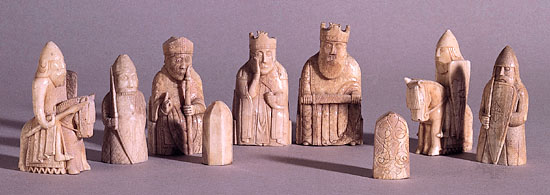
The image that I selected of the Isle of Lewis chessmen appears to be a tad temperamental -- it's not always loading as it should. To see that image, try clicking this link. Otherwise, here are a few extra images of Lewis chessmen, including a very nice image of one of the Kings in the sets.


The image that I selected of the Isle of Lewis chessmen appears to be a tad temperamental -- it's not always loading as it should. To see that image, try clicking this link. Otherwise, here are a few extra images of Lewis chessmen, including a very nice image of one of the Kings in the sets.
Thursday, August 29, 2002
IMAGE OF THE WEEK
(EDIT: Image removed due to broken link. For substitute images, see the post directly above this one.)
Several of the Isle of Lewis Chessmen.
In 1831 a group of small figurines, ninety-three in all and mostly carved from walrus tusks, was unearthed on the Isle of Lewis in the Outer Hebrides islands (off the northwestern coast of Scotland). The figurines were later identified as chesspieces. The chessmen are believed to have originated in Norway. They are the oldest chessmen in existence. Replica sets are widely available; I am fortunate enough to own one. (Due to the presence in my home of a three-year-old child and also three cats, this prized possession of mine is still in its box.)
I've always found something fascinatingly primal about the design of the Lewis Chessmen. Even though they don't date back nearly that far, it is easy to imagine them being moved around a board in a Celtic chieftain's meadhall -- in the pages of Beowulf, perhaps, or maybe the halls of Bran the Blessed in The Mabinogion.
The Schoyen Collection is one of the largest collections of ancient and medieval manuscripts in the world, and has a nifty web page devoted to it. There is something wonderful about the thought that the books of today might survive two or three thousand years hence, and be the objects of a collector's passion. So much of the human heritage is transitory, being plowed under to make room for the new, that the handful of items that survive are truly priceless.
Wednesday, August 28, 2002
POETICAL EXCURSION #7
"The Solitary Reaper", by William Wordsworth (1770-1850).
Behold her, single in the field,
Yon solitary Highland Lass!
Reaping and singing by herself;
Stop here, or gently pass!
Alone she cuts and binds the grain,
And sings a melancholy strain;
O listen! for the Vale profound
Is overflowing with the sound.
No Nightingale did ever chaunt
More welcome notes to weary bands
Of travellers in some shady haunt,
Among Arabian sands:
A voice so thrilling ne'er was heard
In spring-time from the Cuckoo-bird,
Breaking the silence of the seas
Among the farthest Hebrides.
Will no one tell me what she sings?--
Perhaps the plaintive numbers flow
For old, unhappy, far-off things,
And battles long ago:
Or is it some more humble lay,
Familiar matter of to-day?
Some natural sorrow, loss, or pain,
That has been, and may be again?
Whate'er the theme, the Maiden sang
As if her song could have no ending;
I saw her singing at her work,
And o'er the sickle bending;--
I listened, motionless and still;
And, as I mounted up the hill,
The music in my heart I bore,
Long after it was heard no more.
:: I like this poem a great deal, mostly for its sense of sadness for a question that shall perhaps never be answered. The speaker is traveling, and he encounters a Highland woman working in her field. She is singing, and though he does not know the song its melody moves him greatly. He exhorts his fellow travelers to tell him what the song is, and what she is singing about, but none answer, and thus he must go away never knowing what the woman is singing about although he will forever remember that tune which has captivated him so.
The poem is full of rich imagery. The Highlands themselves suggest a rugged place, where working the fields is as much the province of women as men because the land is so difficult. There is also a sense of loneliness, because the woman is alone; Wordsworth tells us that in the very title. Is she a widow? Is her husband off to war or market? We never learn, and the question is only implied and never asked, because the speaker is more concerned with the woman's song than with the woman herself. He tells us that the tune is melancholy, and his speculations as to its subject are all sad ones, and yet the melody is more welcome to him that any birdsong. The speaker seems to be starved of beauty, and he wants to stay and hear the song and pray that it never ends, but he cannot -- he can only move on and carry the song with him in his heart.
This seems an apt poem to read as August wanes and September arrives, with its autumnal imagery and its tone of wistful remembrance. We reap in the fall, and things like a lovely song can help us to get through the long, cold winter.
Tuesday, August 27, 2002
Courtesy of The New York Times, an article on one writer's struggles with procrastination by novelist Ann Patchett. (NYT registration is required, but it's free -- for now, of course, and with the shady clause that "Our privacy policy is subject to change at any time".)
Something shared by the vast majority of writers, I suspect, is a gift for procrastination. I am no different from any other; despite the fact that I love writing and nearly always have at least a pleasant time writing and, many times, a wonderful time doing so, I often find other ways to spend my time. One general term, used as a generic noun for any activity whose stated purpose is one thing but whose actual purpose is to delay the time when one must sit down and string words together, is "cat-vacuuming" -- probably because many writers own cats, and anyone with cats can attest that there is pretty much always a need to run the vacuum cleaner when cats are about. Personally, I hate vacuuming, so I find other ways to postpone writing: I'll wash the dishes, perhaps; or I will catch on e-mails; I might play a "quick game of Hearts" (Minesweeper has long since lost its hold on my attention); and sometimes I will even post to Byzantium's Shores. (Yes, that's what I'm doing right now. As of this writing I have a folder on my desk, containing a rough draft of Chapter 14 of the novel-in-progress covered with underlines, margin notes and directions all in red, sitting next to the computer. And the folder is closed. Fancy that.)
This is probably why every writing book I have ever read includes the advice, "Write every day and do not fail to write every day". The Latin expression of this idea is particularly elegant: Nulla dies sine linea, or "Never a day without lines". This is excellent practical advice, as writing -- for many writers -- is a matter of momentum, and if the momentum is lost the work can seriously suffer. But as Isaac Asimov once wrote, "That moment you just lost by not writing isn't only gone, but it's the best moment that you'll ever have, because all future moments will come when you're that much closer to dying." (That's not an exact quote, but it's pretty close -- it comes from an essay that I can't just now locate but have read several dozen times.) Of course, this comes from a man whose personal solution to this problem was to write so much that he is one of the most prolific writers in memory.
This advice is also given, quite strongly, by Stephen King in his wonderful On Writing, where he prescribes a steady diet of daily writing for anyone who wishes to be a writer. He speaks of people like Thomas Harris, who writes a book every seven years or so, wondering what these people do when they're not writing their books. For King, it's almost a moral imperative: "If God gives you something you can do, why in God's name wouldn't you do it?" I have to agree, although I certainly can't match King's schedule -- not even close, to be honest. Then why am I so blasted good at finding reasons to not write? There is certainly no reason why the dishes can't wait until the chapter is done and not before. I suspect that it's actually a habit that became ingrained when I was just starting writing, a holdover of the American-Puritan ideal that holds that things like writing are nice things to do, but only when the milking and the wood-chopping and the water-pumping are done. (If even then; those Puritans weren't much on fun -- and a lot of times, we Americans aren't much on fun either. So much of our "funtime" is observed in a grudging, obligatory fashion.)
There is a particularly dangerous form of cat-vacuuming, though, that is rarely cited by writers (at least in my experience), but can lead to more consumed time away from the desk than any other. It is reading. I have found that it is perilously easy to read rather than write, since many times I can call it "research" or "preparation" or "keeping up with the genre" or any number of other justifications. Writers are a reading lot; I've only encountered one writer who claimed to dislike reading, and that is because that particular writer is dyslexic (Nicholas Negroponte, in his book Being Digital). Writers have to be well-read, not merely to keep up with the genre and to know what territory has been mapped out before and to research the pesky details that are to come into play in the next project, but also because writers are by definition persons whose lives depend on the written word. As King so excellently puts it, "If you don't have time to read, then you don't have the time (or the tools) to write." And, in the very next paragraph: "Reading is the creative center of a writer's life." We read because we have to, but it's all to easy to walk away from the desk and pick up a book because it's part-and-parcel of the whole "writer" gig. I've heard of Master's or Doctoral candidates falling prey to this kind of thing: "I can start the dissertation after I read just one more book on my subject, or track down just two or three more articles...."
Well, I've probably said enough on that for now....after all, I have Chapter 14 crying for help, and it's time to throw it a rope. After all, I'm the writer. As Patchett says in her essay, "Sometimes if there's a book you really want to read, you have to write it yourself."
Before my wife and I were married, we underwent the obligatory meetings with the Pastor who would perform our ceremony to discuss our wishes for the wedding, as well as other issues. When it came to the issue of music, we worked with the church's music director, a fine organist and musician who had a wealth of suggestions to make as to what to use for the Processional, the hymns, the Postlude, and so on. The only rule we were asked to observe, with respect to music, was that we could only select music that was religiously themed -- i.e., no pop tunes. We were only too happy to observe this stipulation; it never occurred to us to use some popular song for our wedding. However, this is not the case for everyone; at a wedding we attended two years later, "My Heart Will Go On" was given a central position smack dab in the middle of the ceremony.
Well, it's not just weddings that are being popularized these days. According to this NPR story, in the United Kingdom popular music is turning up more and more at funerals. Wow. There is even a Top Ten of songs used most often at funerals. I won't reprint the Top Ten here -- it can be read at the link above -- but I will say that it's an interesting list. (And that "My Heart Will Go On" is on it.)
Well, it's not just weddings that are being popularized these days. According to this NPR story, in the United Kingdom popular music is turning up more and more at funerals. Wow. There is even a Top Ten of songs used most often at funerals. I won't reprint the Top Ten here -- it can be read at the link above -- but I will say that it's an interesting list. (And that "My Heart Will Go On" is on it.)
As usual, there are few things more conducive to starting conversations and debate than making a list of "The {number} Best {things}". (Or "Worst", as the case may be.) That said, ESPN has named the Top Twenty Sports Films of All Time. I haven't seen all of these, but the ones that I have are quite deserving of their accolades here. I would, though, include Tin Cup, but maybe that's because I'm not a golfer. I have yet to find an avid golfer who actually likes that movie. And personally, I would omit Eight Men Out in favor of Major League. And since I'm including Major League, I'd ditch The Bad News Bears in favor of The Karate Kid. You can't help but love a movie that added "Wax on, wax off" to the national lexicon.
Monday, August 26, 2002
These days it's pretty hard to keep straight all of the comic-book adaptation film projects that are either filming, casting, being written, being talked about, especially if you're not quite up-to-speed on who all the superheroes are in the first place. (When I heard that a Fantastic Four movie was in the works, I wondered if it was the version with She-Hulk in place of The Thing; and will the cinematic X-Men be the revolving door group that the comic version is?) Anyway, here is a site that explains it all.
Friday, August 23, 2002
Kevin J. Anderson is a pretty hot property in science-fiction these days, almost exclusively on the basis of his media tie-in novels and his novels set in other authors' universes. He has written a number of Star Wars novels, several X-Files novels, and also books set in Frank Herbert's Dune mythos. Anderson has done a lot of playing in other people's playgrounds, although to my eyes not always successfully. His Star Wars books, most notably his Jedi Academy trilogy, are partially successful -- they capture the "flavor" of Star Wars fairly well, but his villains are not particularly menacing. (As a friend of mine put it, "Every time Admiral Daala appears she is either scheming or getting another one of her Star Destroyers blown up.") I thought the Jedi Academy trilogy suffered from overplotting; the trilogy was filled with events that really had no bearing on the main story, and so the whole thing really could have been reduced to a duology or perhaps a single novel. His other fault was his tendency to throw in cute allusions to the movies that were really somewhat distracting. (Just because George Lucas sticks a THX-1138 reference into all of his movies doesn't mean that the novels have to include them as well.) On the basis of Anderson's Star Wars books, of which I was mainly ambivalent, I've avoided his other tie-in work. But now he's got his very own backyard to play in, with Hidden Empire: The Saga of Seven Suns, Book One.

According to Anderson's website, there are to be four books total when the series is complete. Thus, Hidden Empire is what one might expect: a set-up novel, in which the setting is established, the characters introduced, and the conflicts begun. Set five hundred years in the future, humans are colonizing the universe and coming into conflict with both themselves and an alien force called the Ildiran Empire. In typical fashion, the arrogant humans manage to set in motion events that have terrifying consequences as a war with a previously-unknown alien species erupts.
I enjoyed Hidden Empire, and I definitely plan to read the next volume if not the entire rest of the series. Anderson has a lot of interesting ideas here, and I want to see how they play out. Just about every trope of grand space opera is here: alien empires, both past and present; ancient artifacts of staggering power and unexpected results; mystical priests; space merchants and their travails with space pirates; the conflict of societies high and low; giant fleets of starfaring warships; high government conspiracies; antagonisms that must be buried in the face of grander conflict; unknown antagonisms that arise at the worst possible time; star-crossed romance; et cetera. Reading this stuff, you can imagine the sights appearing on a giant movie screen with a suitably-bombastic score -- by John Williams or Jerry Goldsmith, of course -- highlighting the action. There are things here that I would love to see. I'd love to see the Skymines, floating through the upper atmospheres of the gas giant planets. I'd love to see the Ildiran home planet, with its seven suns. I'd love to see the diamond-hulled warships of the Hydrogues. I'd love to see the ancient Klikiss ruins, and the robots they left behind when they mysteriously disappeared. Anderson has a gift for evoking visuals in his prose, which was always a strength of his Star Wars work.
There are, though, a number of problems with the book. Some of them are problems of the "Book One" variety. Mainly, Hidden Empire is a set-up novel, so in reality not a whole lot happens in the first 120 pages; we simply look on as Anderson introduces us to character after character, gives us lengthy history lessons, shows us his technology, and establishes the conflicts that will play out later on. And even when things start to happen (roughly around page 120), it still takes to book a long time to build up momentum. In fact, the book doesn't so much "build" as it suddenly kicks into high gear (around page 300 or so), and the last fifty pages are especially frenetic as Anderson goes about the business of leaving his characters, one by one, in a precarious spot to be resolved in Book Two. The pacing is wildly uneven, and I remember that being a prime fault of his Star Wars work as well. Perhaps if he had used fewer characters at the outset, and only introduced more once the pot was nicely boiling, the pacing would work better.
Anderson's model in writing Saga of the Seven Suns is obvious: George R. R. Martin's titanic fantasy epic A Song of Ice and Fire. That series also features a cast of thousands operating in a war-torn world, and Martin's books are even longer than Anderson's. (The most recent volume of Martin's series, A Storm of Swords, comes in at over 900 pages, in hardback, and that's not including the Appendices.) Anderson borrows Martin's device of telling each chapter from the viewpoint of a different character, so through the novel our viewpoint is constantly changing. Thus, there is no "Luke Skywalker" or "Frodo Baggins" in Hidden Empire; there is no single protagonist, but a series of characters -- some likable, some not -- who have their own parts to play. In Anderson's hands, though, the device gets confusing because he uses too many viewpoint characters at once, from all over his world; Martin, on the other hand, starts with a small number of viewpoint characters and only adds more once he is sure we know who is who with respect to the characters we've already met. With Martin, while we need to refer to his Appendices to identify the supporting players, we don't forget who Ned Stark or Tyrion Lannister are. With Anderson, though, I had to constantly flip to the back of the book to remind myself who Nira or Rememberer Di'osh were. This is distracting, to say the least. The other key bit of genius in Martin's application of this viewpoint device is that we are never sure of who the villains are; everything is ambiguous. We think we are rooting for the Starks -- except that Tyrion Lannister is a sympathetic character, and some of the Starks just aren't likable. (And there is one character whom Martin grooms us to hate, only to have us sympathizing with him in the third book.) Anderson can't match Martin's subtlety of character; and so the wonderful sense of ambiguity that keeps Martin's work fresh is absent in Anderson's.
The other problem I have with Anderson, as I noted above, is his cute allusions. He specifically alludes to Martin's work, borrowing a couple of Martin's names for minor characters in his own work (Bronn and Stannis, to be precise). In Martin, to join the Men of the Night's Watch is called "taking the black", so in Anderson we have the joining of the Green Priesthood "taking the green". The most irritating allusion was the name of the space pirate, Sorengaard. Of course, if I hadn't been a philosophy major, I'd likely not have noticed the contraction of Soren Kierkegaard's name; but I was, and I noticed. Little things like that seem minor, and I suppose they are, but they do have the effect of disgorging a reader who notices them. It's the literary equivalent of going to see a movie and spotting the mike boom, only here it's not the fault of the projectionist but actually the filmmaker. (And now there's a contest for someone to actually get their name into next book. Sheesh!)
And finally, not really a complaint, but an observation: I hope the cover artist for Hidden Empire pays a royalty or something to Doug Chiang at Lucasfilm, because that cover painting is strikingly similar to the early designs for the underwater Gungan City in The Phantom Menace.
Hidden Empire is not a bad book, by any means. It does what every Book One is supposed to do: it's got me planning to read Book Two. But it really could have been a lot better than it is.
A trio of interesting articles from Slate today:
:: A commentary on the stodginess of the recent Sight & Sound polls of the ten greatest films of all time that considers the question of why the most recent film on the list was released in 1974, and why the disparity between the critics and the directors who responded to the poll.
:: What is the worst sports stadium in the US? A couple of years ago it would have been Three Rivers Stadium in Pittsburgh, which was passable for football but an ugly monstrosity of a baseball park. Well, now that Three Rivers is history, Slate surprisingly turns to tennis for its choice as worst stadium.
:: Is President Bush's newly-unveiled forestry plan a bit of environmental idiocy that sells out our forests in favor of votes in Western states where logging is still an industry? or is it actually a wise new response to years of poor forest management that has led to the destruction of immense amounts of forest and property? According to Slate, it's both.
Thursday, August 22, 2002
IMAGE OF THE WEEK

Ginger Rogers and Fred Astaire in Top Hat (1935).
:: I've loved musicals nearly all of my life, and some of the most wonderful are the ones made for RKO Studios starring the legendary dance duo Fred Astaire and Ginger Rogers. Fans of these films tend to be divided on which Astaire-Rogers film was the best, but the two that will usually be named are either Top Hat or Swing Time (1936). My personal favorite is Top Hat, probably because I saw it first. It's a beautiful entertainment, full of music and romance. Its frothy story hinges on mistaken identity, that device which drives so many comedies, but rarely is it handled with as much aplomb as in Top Hat. And the dancing? Well, it's Fred Astaire and Ginger Rogers. Nothing more need be said than that. In this day and age of young women scantilly clad and gyrating in an effort that is theoretically supposed to suggest eroticism, what Astaire and Rogers accomplished was actual romance -- an idealization of love that is at once breathtaking and life-affirming. Britney Spears can thrash about in all the Pepsi commercials she wants, but she will likely never approach the level of artistry that Astaire and Rogers achieve in all of their numbers, some of which are truly sublime.
Heaven, I'm in Heaven, and my heart beats so that I can hardly speak....
I am now participating in a group-blog called Collaboratory, which was conceived by Sean Meade, the owner of Interact. This project is in its infancy, and we're not even totally certain of our "mission" (if there even is one), but here's hoping. Check it out. (As of this writing there are only a handful of posts and no front-page bells or whistles, though I'm sure those are to come.)
It's interesting how the same idea will crop up in multiple places in creative circles, and roughly within the same timeframe. Consider 1993, when two films about Wyatt Earp came out, or a few years later when legendary distance runner Steve Prefontaine was the subject of not one but two biopics. I wrote last week about the television series Millennium, which involved a former FBI agent named Frank Black who used an almost-psychic gift to track down serial killers; the same year that Millennium debuted on FOX, another series showed up on NBC that was about an FBI agent named Samantha Waters who used an almost-psychic gift to track down serial killers. This show was Profiler, which lasted four seasons to Millennium's three.
All of these examples jumped to mind when I read this MSN article about a recent spate of novels centering on, of all things, the Jewish golem. I read one of these novels recently -- Michael Chabon's The Amazing Adventures of Kavalier & Klay, which I reviewed here -- and I am a bit surprised that the golem is suddenly such a popular item. (It was also the subject of an episode of The X-Files during that show's fourth season.)
All of these examples jumped to mind when I read this MSN article about a recent spate of novels centering on, of all things, the Jewish golem. I read one of these novels recently -- Michael Chabon's The Amazing Adventures of Kavalier & Klay, which I reviewed here -- and I am a bit surprised that the golem is suddenly such a popular item. (It was also the subject of an episode of The X-Files during that show's fourth season.)
Which brings us to the Bills uniform revision. When Tuesday Morning Quarterback saw the design he had a simple, primal reaction: to run from the room screaming, "aaaiiiiiiiiyyyyyyyyeeeeeeeeeeee!"
The new Buffalo garb looks so much like current New England attire that when the Bills play the Pats, Drew Bledsoe isn't going to know which huddle to join. And the Bills have tossed out red as their accent color, replacing it with gray. Gray -- now there's a color that really pops. And the away jerseys are so fussy, they make Denver's rollerball duds seem a clean design. But these are not the reasons for TMQ's primal scream. The reason is that Buffalo had been using traditional American flag red-white-and-blue, and now abandons that combination. In other words, the Buffalo Bills thought they could improve on red, white and blue.
-- Gregg Easterbrook, Tuesday Morning Quarterback, on the Bills' new uniforms.
:: I have to say, I agree with TMQ on this one. I was fairly ambivalent about the Bills' new duds when they were unveiled (well, actually I was ambivalent about the home uniform while I immediately disliked the new road uniform), but now that I've seen more of it....I don't like the look. The Bills don't look distinctive anymore; instead, they look like every other team that has hopped on the New Uniform Bandwagon in recent years. (The Bills' new look is inspired by the Broncos and the Titans, apparently.)
Easterbrook's AFC preview is up, with the NFC to come next week. If you haven't read Easterbrook before, please do so. He is funny, engaging and literate. He also knows a hell of a lot about football.
(BTW, it seems that my middle-of-the-road view regarding the Doug Flutie vs. Rob Johnson fiasco was the correct one. While Bills fans were either jumping on the Johnson bandwagon or burning their Bills gear after the team had the audacity to send Flutie on his way, I was saying: "They both stink". Guess what? Neither Johnson nor Flutie is starting this year.)
Tuesday, August 20, 2002

Courtesy MSN: a good article about the development of a space elevator, which could be an excellent alternative to loading up the shuttle with a seven-person-crew each time we need to ferry something into space. (Although, after reading Kim Stanley Robinson's Mars Trilogy, all I can say is: the security around the elevator had better be foolproof.)
Voters for the Pro Football Hall of Fame are going to have a hard decision to make in five years, because that is when Terrell Davis will become eligible. His career, which officially (and sadly) ended yesterday, was a short one -- but it was still stunningly productive: in seven seasons, he rushed for 7,607 yards and sixty touchdowns. Those are low numbers, and they may keep him out of the Hall of Fame -- but as far as I am concerned, he belongs there. He is one of only four running backs in history to rush for 2000 yards in a single season, and more impressively he did it for a team that went on to win the Super Bowl (the 1998 Broncos). That may not seem like much, but it is often the case that the leading rusher in the NFL comes from a team that is only suited to the run; in fact, it wasn't until 1993 that the team with the NFL's leading rusher even made it to the Super Bowl (the Cowboys, who won the game). And the year before Davis's 2000-yard season, he was merely the Super Bowl MVP when he put up 157 yards and three touchdowns against the Packers (a game in which he famously missed part of the second quarter due to a migraine headache). I'm not a Broncos fan, but Terrell Davis was a magnificent player who -- like baseball's Kirby Puckett -- was, for a time, the heart-and-soul of a championship club (with all due respect to John Elway). He'll be missed.
I am no expert on H. P. Lovecraft, so I don't know if he'd be amused by this. But this does now make me think of some interesting directions a possible Toy Story 3 could take.
Two items of surpassing niftiness (it's my blog, I can make up any word I want) appeared at AICN today. First is a trailer for the newly-restored version of the SF classic Metropolis, a film that established tropes which influenced many a filmmaker (not the least of which is George Lucas). It appears that just about every minute of previously-missing footage from Metropolis that can be found, has been found and that this new version is as close as we are ever going to get to the original version seen in 1927. While I won't be able to see the new version until a DVD is issued (and I get a DVD player), it's still exciting to note the wonderful treatment a cinematic SF classic has received. (Roger Ebert also wrote about this new Metropolis restoration last week. Ebert is a long-time champion of restoration of classic films, so many of which are in horrible shape due to neglect of the prints and negatives. I wish he'd become more musically aware, though, and bring his passion to bear on filmscore restoration.)
The other goodie on AICN today is also a film trailer, the first glance I've had of Hayao Miyazaki's Spirited Away. My God, I can't wait for this film. If you, dear Reader, are one of those people who will only go see an animated film if it bears the "Disney" imprint, go see this one! (It's being distributed by Disney, but that didn't help Princess Mononoke two years ago.) Check out the trailer. It's breathtaking, and that's saying something for an image the size of a business-card on my monitor.
The other goodie on AICN today is also a film trailer, the first glance I've had of Hayao Miyazaki's Spirited Away. My God, I can't wait for this film. If you, dear Reader, are one of those people who will only go see an animated film if it bears the "Disney" imprint, go see this one! (It's being distributed by Disney, but that didn't help Princess Mononoke two years ago.) Check out the trailer. It's breathtaking, and that's saying something for an image the size of a business-card on my monitor.
Monday, August 19, 2002
The alternative comic strip Tom the Dancing Bug appears weekly in Artvoice, Buffalo's alt-press paper. As a political commentary it's generally not quite as good as This Modern World, but sometimes it's very good. Case in point: this week's parody of Spider-man, "The Amazing George W.". I found this hilarious.
I'm really not terribly excited about Star Trek Nemesis. Rick Berman and company did a lot of good things in their day, but I think the current regime in charge of Trek has pretty much run out of ideas. (I have not seen a single episode of Enterprise, so I can't comment on that; it's only on cable in Buffalo and we don't have cable.) From what I've read of the Nemesis storyline, it seems like a rehash of a lot of earlier Trek stories (with a lot cribbed from The Wrath of Khan). I know that the story focuses on Data's long-standing "quest" to become more human; my problem there is that sometimes quests are achieved without our knowing it. Data reached a point of "closure" in First Contact, and I really don't think there's any point in keeping it going. Likewise, I'm not all that interested in the ongoing tribulations of the Romulan Empire. I'd much rather see a Trek film that actually explores strange new worlds and seeks out new life and new civilizations. If this is to be the last voyage for the Next Generation crew, why not show them actually, well, boldly going where no one has gone before?
(The film was also to feature a brief cameo by Wil Wheaton as a grown-up Wesley Crusher; I suppose he finally wrapped up his Grand Tour of the Mysteries of the Universe with that "Traveler" guy. But, as reported on WWDN, the scene in question has been cut. So Wesley won't save the day one last time; ah, well....)
(The film was also to feature a brief cameo by Wil Wheaton as a grown-up Wesley Crusher; I suppose he finally wrapped up his Grand Tour of the Mysteries of the Universe with that "Traveler" guy. But, as reported on WWDN, the scene in question has been cut. So Wesley won't save the day one last time; ah, well....)
In the "Hell hath no fury" department, check out Peter Gammons's take on the looming baseball strike. If MLB does have a work stoppage, I will officially set baseball aside. The owners and the players have demonstrated that they collectively do not care about the game, but only about their particular slice of the pie and their control over the knife that's dividing the rest of the pie. A pox on baseball, and all of their houses.
Saturday, August 17, 2002
Barely a week after I proclaimed On Her Majesty's Secret Service the best Bond film ever made, its director, Peter Hunt, has died. Hunt was also a prominent film editor, working on all of the Bond films of the 1960s along with many other films. I read of his passing via AICN. Hunt's filmography can be found here.

Last week I saw M. Night Shyamalan's new movie, Signs. I will now review it in SPOILER-HEAVY fashion. I repeat: There WILL be SPOILERS. I shall make no effort to conceal any plot element of Signs that I think is germane to my opinion of the film. Got it? OK.
And for those who are still squeamish, I will include some blank space so as to require scrolling down to get to the actual review.
That should be enough. From here on out, if you read this and you haven't seen the movie yet and you read something that you might not want to know prior to seeing it, I accept no responsibility.
Signs is, first and foremost, a very good film. Seeing it, I kept thinking: "This is how The X-Files used to be, back in its early seasons, before it became a Franchise for FOX." Or, even better, this is how Millennium was at its best: not merely scary but also thought-provoking, a meditation not just on What Is Out There Waiting For Us, not just on Things That Go Bump In The Night, but on what purpose there may be to everything. It seems to me that horror is probably the genre most suited to meditations on the problem of evil: Why would a good God allow so much Evil in his own universe? Of course, my own personal thoughts on this subject are not the focus of this article. Suffice it to say, Shyamalan's answer isn't totally satisfactory; in fact, in some ways I find it incredibly faulty. Even at the end, when things have played out the way they were supposed to and faith has been restored where before there was none, it still seems to me a bit capricious, a bit of whimsical action on the part of God. If God could set things up so that everything leans toward the outcome that Mel Gibson's son doesn't die, including his wife's dying words which at first seem so arbitrary as to send Gibson into a tailspin away from his faith but eventually turn out to be the key to everything, then why can't God set things up so that Gibson's beloved wife doesn't die in the first place? Shyamalan's film attempts to answer the question that bedeviled Job, but in the end I don't think he provides an answer at all, much less a satisfying one. Gibson seems to return to faith well before the key event in the film that is supposed to make it all possible. Is this a fault with the film? Not really. I rather suspect that it's a fault with the entire question of evil in the first place. I simply am not sure that there is an answer that satisfies all formulations.
So I don't think that Signs really works as a theological statement, but thankfully that's not really the level that I think it should be evaluated upon. In fact, in this day and age one almost gets positive yardage just for being willing to ask these questions in the first place. Signs is a horror film, first and foremost; and as such, it's probably the most effective one I have ever seen.
Much was made about the role of silence in Shyamalan's earlier films. (Actually, this seems true of The Sixth Sense; I never saw Unbreakable, however.) This is even more true this time out. There are long passages of this film where nothing more can be heard than the breathing of the characters, and Shyamalan likes to stretch out his silences. We know that the silence will be broken, and probably by something calculated to make us jump. Shyamalan does make us jump, but he does so in unexpected ways. The "jump" moments happen not just when characters are walking slowly through an area in which they are terrified to be, but during other moments when the "jump" moment can slip in under our radar. An early example involves a well-timed bark and snarl by a dog, during a scene where two characters are talking in fairly mundane fashion. It's not something jumping out at us in the midst of silence, backed by a fierce chord in the soundtrack; instead, we jump because it's so unexpected at that particular moment.
This careful use of unexpected moments, woven throughout the film, is how Shyamalan generates so much suspense. There is a scene where what may (or may not) be an alien is locked behind a door, and Mel Gibson picks up a butcher knife – not to use it as a weapon, but as a mirror so he can look under the door and catch a glimpse of whatever is behind the door. The film is full of unexpected moments like that, and they add to the suspense and the overall feeling of fear. He also uses humor at odd moments to defuse our fear, so that he can pop one of his unexpected moments at us again. There are some very funny moments in the film, some of them occurring during moments of high tension. The fact that they occur during moments of tension does not defuse the tension one whit, but somehow elevates it.
More interesting is the way almost nothing in Shyamalan's script is wasted. Nearly every single detail in the screenplay has some bearing on the outcome, even moments that in other films are generally used as "filler" or throw-away moments designed only to give us more information on a character. Gibson's brother (Joaquin Phoenix), for example, is a failed baseball player. This seems only to explain why he is so unfocused in his life, and why he has hung around his brother's farm for so long – until the film's climactic scene, when the nature of his baseball failure, coupled with the formerly inexplicable last words of Gibson's wife ("Swing away"), come together in startling fashion. Other details are easily overlooked: early on, we barely notice that Gibson chooses to call his human doctor rather than the vet for the family's ailing dog; only later on do we realize that he has a very real reason for not wishing to involve the local vet. Shyamalan's theme in Signs is the conflict between two worldviews: that there are no coincidences, and that everything is a coincidence. Since he comes down on the side that there are no coincidences, the structure of his screenplay – such that there are, in fact, no coincidences in his story – is all the more remarkable.
Signs works as a horror film. It is less than plausible from the standpoint of science fiction: how can the aliens fly across interstellar space but then be thwarted by wooden doors? if water is literally a corrosive poison to them, why would the aliens come to a planet that is three-quarters covered in the stuff? Questions like these, however, should not be asked. Nothing about the aliens is ever explained, and that is actually a strength, because we never know anything that the family in the film cannot also know. Again, the tension is heightened. I've rarely seen a film that displays as much calculation in every facet of its story and visuals as Signs. This film is a bravura performance by M. Night Shyamalan.
I have a fairly high threshold for things that are creepy and skin-crawling. This site, however, very nearly exceeds even my limit. There can now be no doubt: the King of Pop is the single strangest human being on the planet.
Thursday, August 15, 2002
IMAGE OF THE WEEK

Frank Black (Lance Henriksen), Millennium. (Image links to The Millennial Abyss, a fine fan site for the show.)
This is one of my favorite television series ever. It was the second series from Chris Carter, the creator of The X-Files, and it debuted to great fanfare in 1996 and had good ratings initially; however, over time its ratings dropped as the show's tone never varied much from the dark and grim atmosphere of the early episodes. The show centered on Frank Black, a criminal investigator who had a psychic ability to see into the minds of the killers he tracked. As he notably said in the pilot episode, "It's my gift....it's my curse." Thus Frank was torn in two directions, between delving into the darkest parts of the world in which we live and protecting his family from the darkness. Lance Henriksen played Frank Black with immense gravity, creating a character who was absolutely the moral center of everything that went on around him. Even now, three years after the show's cancellation, Henriksen's accomplishment on Milennium amazes me.
The general impression of the first season was that the show basically trotted out a "Serial Killer of the Week", and was thus a fairly hard sell. That criticism was partially accurate, but it downplays the general high quality of those first-season shows. In the second season of Millennium, the subject matter was expanded a bit to include a mix of serial killers, secret societies, Christian mysticism, and Biblical prophecy. Many fans of the series felt that Year Two was the show's best, and I agree; this was when Millennium displayed the most interesting storytelling, with excitement and emotional depth. The standout episode, for me, was the amazing "Midnight of the Century", in which Frank Black must come to terms with his mother's death in his childhood, through ghostly visits and visions. The second season was managed by executive producers Glen Morgan and James Wong, who were also responsible for some of the more memorable early episodes of The X-Files.
The third season of Millennium, though, was a seriously mixed bag that eventually fell apart completely. Part of the problem was the preceding season, which had ended with events of near apocalyptic horror; it is possible that there really was no way for the show to go on after that and remain convincing. Also, Morgan and Wong left for other pastures, and the writing that replaced them was generally nowhere near the quality of the first two seasons. The stand-alone "serial killer" episodes of the third season were not particularly well written; even worse, the "mytharc" episodes brought in all manner of X-Files-style conspiracies, ignored previously established continuity, turned former ally characters into villains with no justification (most egregiously, Terry O'Quinn's character of Peter Watts, a wonderful character from the first two seasons who became a Cigarette-Smoking-Man-style caricature in the third season), and generally foundered. Frank's wife, who had died at the end of Season Two, was replaced by Emma Hollis (Klea Scott), a new FBI partner for Frank who was never sharply drawn as a character at all. By the time Season Three was half-done, it was clear that the show would not be back for a fourth, and Chris Carter took quite a bit of heat from fans for seemingly abandoning a show that had had so much promise and had reached such heights during its first two years. Still, Season Three had some good moments, particularly a Christmas episode called "Omerta". Nevertheless, I remember Millennium almost solely on the basis of the first two seasons -- much like fans of the original Star Trek series, who will waste little time telling you how bad their Season Three was.
It was Millennium, coupled with The X-Files, that led to my re-discovery of the horror genre. For that alone I am forever in its debt.
This is who we are.
Subscribe to:
Posts (Atom)