Thursday, February 20, 2014

Something for Thursday


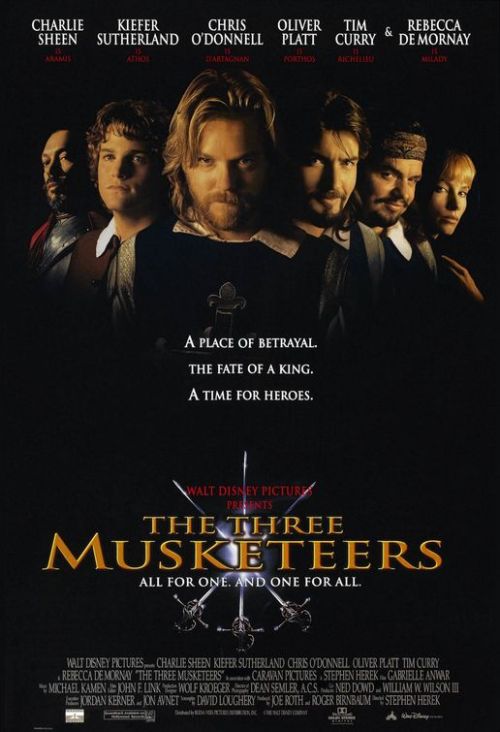
No, I'm not going to try convincing anyone that this is a good movie, because it's really not. But it's a decent enough Sunday afternoon flick for when you're in the mood for crossed swords without too much to tax the brain. The sword fights are fairly well-done, Tim Curry's Cardinal Richelieu swoops around with a red Vader-esque cape uttering lines like "I want those Musketeers, not excuses!", there's an evil henchman in black who wears an eye-patch, and you have American actors trying to act French and, for the most part, failing miserably. Oliver Platt as Porthos brings some energy to the proceedings; there's a gleam in his eye that makes clear how full of shit the entire thing is. There are many, many, many better swashbucklers than this one. But there are also a lot worse, so there's that.

The best thing about the film is the score by Michael Kamen, which is bright and energetic and full of lots of energy and dance-like rhythms, along with a bewitching use of the harpsichord. Kamen was a gifted composer taken too early, and it really is amazing how often it turns out that the best thing about a movie is its score. Here -- assuming I've done the embedding correctly -- is the entire score to The Three Musketeers.

Wednesday, February 19, 2014

Tuesday, February 18, 2014

Should the dead guy be blinking? (a writing update)

When they were filming From Russia With Love back in 1962, there was a scene the producers really liked. But they had to cut the scene because, when they screened the film for friends and family, the director's 12-year-old kid pointed to a character in the scene and said, "Hey, didn't that guy die in the last scene?"

Oops.

So I don't feel too bad that one of my trusty beta-readers for Princesses Back In SPACE!!! (not the actual title) found an instance of a character I had very clearly rendered incapacitated turning up very much capacitated fifty pages later. Hey, it happens. Easy fix, but still -- yeesh!

In other news, I'm back to work on Lighthouse Boy, and I think I may have figured out the way through the plot difficulty that had been vexing me for some time on that book. We'll see.

As for Princesses I and its release later this year, well...nothing new to report there. I plan to make that my major focus come summertime. I may even launch a new website for myself...hmmmm....

Onward and upward! Zap! Pow!

Answering Anything, part the first!


Yes indeed, it is time for ANSWERS! Wheeeeeee!!!

My ever-entertaining high school mate Andy asks:

I have thought about your response to my question about 'The Dukes of Hazard' question I asked last time. Do you think the reason for all the dirt roads in the county was that Boss Hog was embezzling the funds that the federal government was giving to the county to pave the roads? Or do you think he was funneling the money to buy all the cop cars Roscoe and Ennis were tearing up?

Heh! Either or both! But I've always had this odd notion that Hazzard County is like an American version of Brigadoon, that Scottish town that is magically enchanted to only emerge from the mist into the real world every 100 years. Hazzard exists in its own little world, with its own laws of physics and traffic and fashion.

Andy adds:

I can tell you one thing that is for sure!!! Boss Hog wasn't putting ANY ebezzled money into his bar, 'The Bore's Nest'. That place was a DUMP!!!!!!

He didn't need to, though, did he? That joint was always packed! But really, what the hell did Boss Hogg spend his money on? A new white suit every day?

Paul asks:

Winter or Summer Olympics... and which sport?

Oh, Winter, most definitely. The Winter games are prettier, and their events always look like something I'd like to try for the heck of it. The Summer games is a combination of stuff that reminds me of gym class. Which isn't to say that I dislike the Summer games, because I love the Olympics in general. Even if they're corrupt as hell and even if the expense of putting on the Olympics is really hard to justify at times.

Which sport? I'm a figure skating fan, although I've missed most of it thus far this year. I didn't even know there was a "team event" now until I saw that Russia had won the thing! Most of the Winter events look really neat, with one major exception: I must come to grips with the fact that I will simply never, ever, ever love hockey. Never ever. I tried, I really did.

As I write this, I'm watching two-man bobsledding coverage, and I've always loved all these various ice-run sports: bobsledding, luge, and skeleton. I'd love to ride one of those bobsleds one day!

Summer sports? I could watch swimming all day, as well as the track-and-field events.

And I am bummed that Olympic pie-throwing never came to anything. Alas!

Ben asks:

How are you supporting yourself until the writing ship comes in?

The day job -- for ten years now, wow -- is Maintenance at a large grocery store in the Buffalo area. I don't like to name the chain, simply because I don't want anything I write here to be taken as a statement by "a representative of the company", but of the two major chains in this region, it's not the one that rhymes with "Schmops". I'm responsible for the upkeep of the physical plant, making sure that things work, and ensuring that our warp field maintains integrity and doesn't do anything to disrupt the space-time continuum. You know, like Scotty.

More answers to come! And feel free to ask more, if you like -- I always accept questions, and follow-ups are welcome!

Why NOT write fiction?

I was going to link this post by longtime blogging acquaintance Will Duquette in a Sentential Links post, but I realized that there's an awful lot going on in that post, so much so that it warrants its own response post. Or something like that.

Anyway, Will is apparently gearing up to commit acts of fiction, to which I say, Huzzah!. To that end, he has a few thoughts on the fictional enterprise, a couple of which interested me.

Some folks, when asked, will say they wrote a novel or a short story because “that was the only way they could say what they wanted to say.” This strikes me as disingenuous: the sort of thing an author says when someone asks him what a story means, and he has to say something if he doesn’t want to be rude. It isn’t untrue, precisely, because fiction is all about story-telling: the only way to tell to a story is to tell a story, and if the author in question simply wanted to tell a story then indeed that was the only way he could do it.

What the phrase “they wanted to say” seems to imply, though, is some kind of message the author wants to get across. I suppose many authors do write fiction with a message in mind, but I’ve always thought that to be the straight road to fictional wrack and ruin. Certainly, I can’t do it, not and make the story interesting.

I'm not sure who said it, but it's a favorite quote of mine. I tried sourcing it, and it seems to spring from the days of the studio film industry, but I've seen it attributed to Samuel Goldwyn, Jack Warner, and Frank Capra, so who knows who actually said it, but it goes like this:

If you want to send a message, use Western Union.

That tends to be my approach as well. I never write with the intention of saying anything, specifically. But I can't help saying something along the way. It's just that whatever I'm saying is coming out of my subconscious mind. I never craft a story with any particular message in mind.

I don't know what other authors do, or what the "greats" did, along those lines. Charles Dickens seems to have had a great deal on his mind in his novels, but he tells fascinating stories along the way. So does John Steinbeck -- The Grapes of Wrath is certainly a book that says a lot, but he could have said those things in an essay, too. So I think I tend to have a bit more sympathy for the idea of "saying something in a story", but not because that's the only way of saying it, but for this writer or that writer, it's the best.

And this still doesn't take into account the problem of which comes first, the message or the tale in which it's embedded. There are some novelists who definitely seem to me to approach their books with their "something to say" strongly in mind, to the point where the story is just window dressing for a lecture or sermon. This is one reason why I find Ayn Rand so abysmally disgusting as a writer -- not only do I find her message morally odious and logically faulty, but she's a crappy storyteller, too.

Am I trying to "say" something in Princesses In SPACE!!! (not the actual title)? Not really, at least, not so much as I can tell...beyond my general view that the Universe is a pretty spectacular place.

Next from Will:

S’Mary’s World is different. There I actually started with an idea: an explicitly Catholic colony world, isolated from the rest of the galaxy, and forced to fall back on the monastic model in order to preserve its technology and culture. How could such a place come to be? How would it evolve? And then, what stories would naturally arise in such a place? That led me to the bits of history I’ve been publishing.

As a Catholic, I always write from a Catholic point of view—like Tolkien, I like worlds where Catholic theology is true even if not known. But though S’Mary’s World is Catholic in world-view and Catholic in setting, it isn’t meant to be Catholic fiction, i.e., fiction for Catholics. It’s meant to be just plain fiction with a Catholic setting. (Can’t help the world-view; that’s just me.)

So now I’m trying something I’ve not done before: to write a complete story in a world that I’ve already imagined, instead of letting the world form as part of the process of writing the story. I’ve got a character, and a situation, and a story—and I’ve got to figure out how to tell it, instead of letting it tell itself. Frightening, really. We’ll see how it goes.

A lot to unpack here. Starting with the last point first, I tend to take a pretty lax approach to world building myself. As I write -- which is, ultimately, really the first time the story is being read -- I am finding things out about its world. When I started Princesses a few years back, I knew very little about the world. Very little. I didn't even know the name of the main planet on which the tale takes place. I actually only knew one thing about that planet, which created the book's central dramatic conflict. The other details filled themselves in as I went. I did not spend lots of time generating notebooks full of stuff on the flora and fauna of this planet, making this stuff up as I went. I posited a particular large predatory beast, which then required (a) some other stuff for that beast to eat, and (b) a reason why that beast may or may not have been domesticated. I had to come up with some geography for the planet's main two locations, and I had to generate a bit of historical detail to explain the situation there.

But I did all this on the fly, cheerfully making up the details and slotting them in as needed (and making notes about each new detail in my files as I went). This worked pretty well -- or at least it seems to have worked pretty well -- but now, first with Princesses II and likely with future books in the series, events will be partially determined by the details I already established. Once you put your main character in a mountain village, you can't have him wake up in a city at the bottom of the ocean, right? Or at least if you do, you'd better come up with something good to explain it.

So I'm not totally making it all up as I go, but at the same time, I don't know each detail as it comes. Yes, this can result in problems along the way, when I need to remember something.

That's all well and good for the Princesses books, and also for GhostCop (not the actual title), which I have set in my own city of New Mowbray, Michigan (which I have done mainly so I can set a book in Buffalo but free myself from troubling things like Buffalo's actual geography and history). What about Lighthouse Boy (not the actual title)? Well, this book is more of a historical swashbuckler, set in a land that never existed. For this one, I had to do a lot more heavy lifting than I did with Princesses, because this book is all about history and historical forces and how things that happened a hundred years ago still affect things today. It's about Kings and Princes and what happens to realms when rulers die without heir and all the rest of that sort of thing. So Lighthouse Boy has several maps, along with quite a few pages of notes detailing who rules what and where, what the various alliances are, why this Duke wants to go to war against that Duchess, and so on and so forth. A lot of this may never show up in the finished book, and I tried to only do the worldbuilding I felt necessary for the story I want to tell -- if I'm writing a story in a fake Victorian England, there's really not much reason to worldbuild my way all the way back to the Plantagenets. If I need more detail, I'll make it up when I need it. And dutifully write it down. But I did have to come up with some stuff to start with.

Finally, I'm intrigued by Will's approach to Catholicism in his writing. I'm not Catholic, so I am under no such "obligation" (if that's even the right word), but I do recall reading an interview with Gene Wolfe in which Wolfe, one of the finest writers alive today and a devout Catholic, says that Catholicism does indeed inform and infuse all of his writing, even if it's not about any kind of specifically Catholic subject matter at all. I'm paraphrasing here -- I don't remember where I read this interview -- but I remember Wolfe basically indicating that if something is as deeply a part of someone as his Catholicism is a part of him, then it's not possible for it not to be present in the fiction in some way. I think that's true, to a large extent; writers may make stuff up, but even writers ultimately can't be who they aren't. As a non-Catholic, I know that JRR Tolkien's Catholicism can be found in The Lord of the Rings, but it's not obvious at all, and in fact, to the non-Catholic, it even has to be explained at times just where one may find bits of Catholic world-view laying about. Of course, that's at a lower level than what Will's talking about; Will indicates that his setting is specifically Catholic. And that's fine. I've read those kinds of tales, too.

So, what spiritual views of mine will show up in my fiction? I don't know, and that's likely because I tend to have relatively little idea of what my real spiritual views even are. But if I've got any writing chops at all, I hope it will be at least somewhat clear from my work how I look at things here on Earth and how I think we little humans relate to our big, amazing Universe. I don't want to get too obvious in all that, though. For one thing, I don't know where I'd even find a Western Union office anymore.
Monday, February 17, 2014

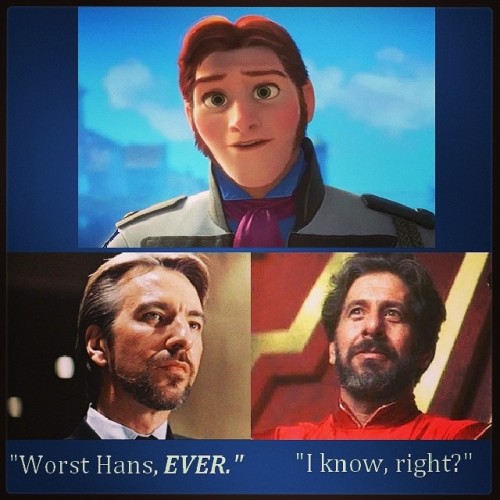
Some obscure geek humor....

...after watching Frozen.


Sentential Links

Linkage....

:: I think it could work, but I don't know enough about fantasy football to be able to construct a workable baseline for weekly points scored, and that's needed in order to be able to build workable monsters for the party to kill. Anyone know more about fantasy football and want to help me out on this? (Hmmmmm....)

:: It’s all about intentions, and today, I intend to have a really fantastic day.

:: It was just negative energy I didn’t want. I thought the CORRECT response to something on FB that was not of interest to one is to ignore it; I do it ALL THE TIME. (Yup, that's the correct response. I ignore stuff all the time. I have hidden people who seemed to make it their mission in life to post things that I disagreed with, but I've never unfriended over it. Unfriending, banning, or hiding people who feel a compulsive need to share their negativity with me? Begone!)

:: Hands up: who thinks being afraid of the man you're with is a sign you're in a healthy relationship? (SamuraiFrog continues his slog through Fifty Shades of Gray. I can't believe people like this book.)

:: Somehow the poor dear had become stuck on the idea that rubber bands must be in sewing notions and simply could not wrap her brain around the concept of them being in stationary. (You'd be amazed how often shit like this happens in retail: people come in with a notion about your store or restaurant, and dammit, that's the way it was and that's the way it should still be. I remember working at Pizza Hut and having people come in on a Sunday and get incensed that we had ended our Sunday Buffet...over a year before. Or people getting pissed at me at Bob Evans because when did we start closing? We used to be open 24-7! (No, we didn't. Ever.) Or people who come into The Store and bitch because they can never find the milk. Now, we move a lot of stuff, but not the milk. We could move the milk, but it's in a walk-in cooler the size of a small house and moving it would cost hundreds of thousands of dollars and months of construction.)

:: When people talk about how they came to know James Bond, the story I most often hear is that they were introduced to the movies by an older relative. When I was a kid in the pre-cable, pre-home video ‘70s, that meant catching the old movies as they aired on network TV. (For me, it was seeing Moonraker in 1979, in its theatrical release. But I didn't know anything about this spy dude; all I knew, based on the teevee commercials, was that Moonraker was a space movie with lasers and stuff. It was post-Star Wars, folks, and I wanted me some space. Of course, once I saw Moonraker, that was that. I was hooked. I didn't read any of the books until much later, in high school; I never finished the series after Dr. No. I should probably go back and read them one of these days.)

:: Though a teenager in the 1980s, can you believe I'd never seen any of the Bill & Ted movies? This, despite the overt Doctor Who reference? (The Bill&Ted movies are surprisingly clever, really. It's not easy, getting dumb stoners to be sympathetic.)

More next week!

Saturday, February 15, 2014

Symphony Saturday

After the monumental edifice last week that is Beethoven's Ninth, we turn now to something much shorter: a symphony by Franz Schubert that may or may not even be complete. It's his Symphony No. 8, often referred to as "the Unfinished".

This symphony only has two completed movements, and just why this is the case has long been a vexing question for musicologists. There are sketches for a good portion of what would have been the Scherzo movement, but nothing at all is known to exist for a fourth movement -- maybe. It's all very strange, really -- this symphony isn't like Mozart's Requiem, left incomplete due to the composer's death. Schubert did die young, but he still lived another six years after he completed the two existing movements of this work. Some believe that another piece, in the same key and using the same instrumentation, was intended as the symphony's finale but was then used instead as a piece of incidental music for a play, but there just isn't enough evidence in favor of such a hypothesis to really make a strong case. And then there are some -- Leonard Bernstein was one -- who believe that Schubert simply decided that the first two movements were sufficiently good that he didn't need to write another two. I find this idea a bit hard to believe. Schubert was a pretty staunch classicist and tended to stick to established forms, for the most part, and in any event, he did complete another four-movement symphony after this one, his own Ninth (which is often called simply "the Great").

My own guess is that it's a combination of the above. Other projects came along, maybe he had ideas that he ended up using other places, maybe he always intended to get back and finish this one but then he got sick, and so on. We'll almost certainly never know, unless some kind of evidence -- a letter in Schubert's hand, or maybe even scores to two never-known movements -- turn up in some old attic in Vienna.

I don't really know a great deal about Schubert, to be honest. I've never explored his music much beyond the last few symphonies. He's best known for his art songs, which is a part of classical music that doesn't always engage me all that much (my failing, not that of the art song). Nevertheless, this work is an intriguing bit of music history. Schubert wrote it in 1822, but it wasn't even performed until the 1860s!

Thursday, February 13, 2014

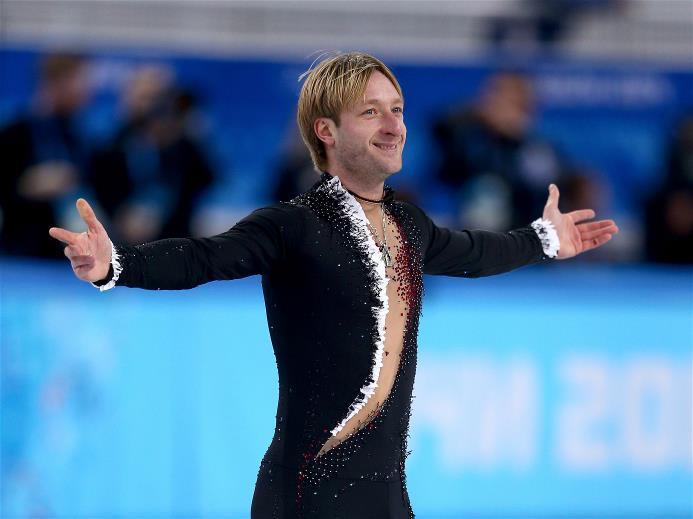
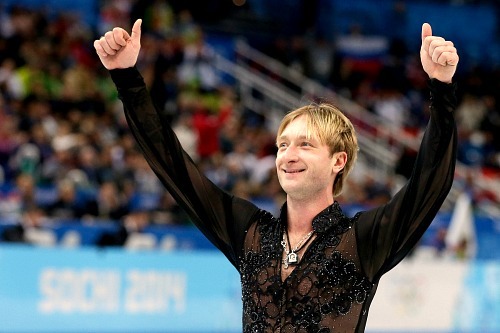
Evgeni


I've "hated" Evgeni Plushenko for years...not really, but in that sense of "hate" in which, if you were a Bills fan during the 1980s and 1990s, you "hated" Dan Marino, or in the way I "hate" Tom Brady now. You "hate" the guy who wins a ton while committing the crime of not being your guy.

But damn, Evgeni Plushenko has been a hell of a skater and competitor for a long time, and it's a shame that he didn't get to go out on the ice, but because he was -- as many athletes become -- just too damned banged up to keep going. And imagine being a football player and realizing you simply cannot go out on the field, minutes before kickoff in the Super Bowl. That's what happened to Plushenko: he was warming up for his Olympic short program, but realized...it wasn't happening.

Yeah, I "hated" Evgeni Plushenko. But damn, what a career he had! Good luck to him in the future!


Something for Thursday

Ach! I can't find my copy of this CD! I know it's somewhere and I haven't looked exhaustively for it yet, but I wanted to listen to it the other day. It's called The Long Black Veil, and it features The Chieftains with a lot of crossover guest artists. Here's the title track, with Mick Jagger joining the band for this haunting song.

Wednesday, February 12, 2014

A Random Wednesday Conversation Starter

So here's an intriguing case study in how musical works are affected by the nature of their creation. There is a composer from Japan named Mamoru Samurgoch, whose work has been highly regarded for a number of years. He's done a lot of very high-profile concert works, as well as provided scores to some highly popular videogames. The quality of his music seems all the more impressive because, like Beethoven, he has been deaf for a number of years.

Here's is his Symphony No. 1, titled "Hiroshima":


Last week, though...it turned out that the whole thing is a fraud. Samuragoch revealed that he has been using a ghost composer for years, and that ghost composer has speculated that Samuragoch may not be deaf at all. The whole thing is a mess.

But here's the question: Do you think this has any effect on the works themselves? This seems to me a different kind of case than, say, my decision to never read Orson Scott Card again because of that author's odious beliefs. Here, the works themselves are inexorably tied in with the very controversy about them. So what should our reaction be? Forget the works and move on? Scratch Samuragoch's name off them, relabel them as the work of Takashi Niigaki, and keep on listening?

To me it's kind of like the old Milli Vanilli controversy. Sure, those two guys were fakes -- but somebody had to record that music that a lot of people liked, so should the works themselves just disappear down the scandal memory hole?

What say you?

Tuesday, February 11, 2014

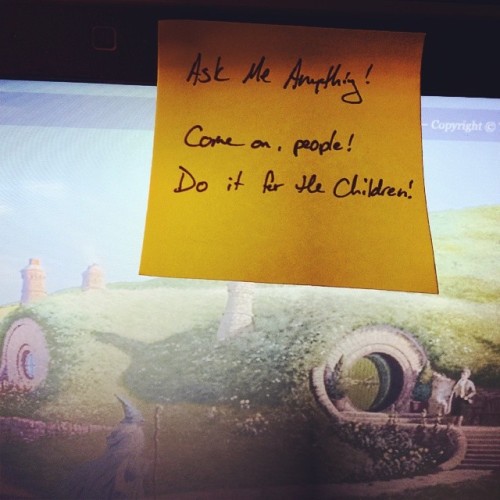
Another reminder: Ask Me Anything!


Yar, what ye be waitin' for, mateys! Ask Me Anything! (Leave questions there as opposed to on this post, because it's easier for me to keep 'em in one place.)

Or ask via Facebook or Twitter or Instagram or Flickr or parcel post.

Since the invention of the kiss there have been five kisses that were rated the most passionate, the most pure....

Some awesome kisses:


And to these we add the newest Entry Into The Pantheon:


I honestly have to give credit to the writers on The Big Bang Theory. Character development on this show tends to proceed at a pretty glacial pace, to the point where often there's quite a lot of tension just from the standpoint of thinking "Wow, they have to do something soon, right?" Howard got married a couple years back, but everyone else is in kinda-limbo. Sheldon and Amy keep on plugging, with Sheldon completely unaware of Amy's increasing need for physical sensation; Leonard and Penny keep plugging along in a relationship that persists despite a seeming utter lack of anything in common; Raj keeps plugging along in...well, that's wrong. Raj isn't plugging along at all.

But then, after a fight during a "romantic dinner" on a train -- which Amy arranged because Sheldon is a train nut -- Sheldon mocks Amy, asking if she wants to do various "romantic" things, such as "gazing into each other's eyes". ("You blinked, I win!") But when Sheldon says, "Hey, kissing is romantic, let's do that!", he plants a not-terribly-nicely-intended kiss on Amy's lips...and then...he holds it. And moves in closer. And puts his hands on her hips. And holds the kiss a bit longer. And notes, afterwards, "That was nice", and invites her to the locomotive to fulfill an invitation the engineer gave him.

I may be frustrated by the slow way the characters unfold on Big Bang Theory, but the show is still hilarious and mostly warm in its humor (I could do with a bit less geek-bashing), and these writers cannot ever be accused of not knowing their characters. They came up with perhaps the only possible way Sheldon Cooper could ever voluntarily kiss a girl for the first time. What a great moment!

Now, Sheldon and sex? I suspect we're still a good four seasons away from that.

(By the way, I was just randomly thinking up great kisses off the top of my head for a few minutes. Which ones did I miss? Consider this a Random Tuesday Conversation Starter!)

Monday, February 10, 2014

Stuff in the time of the Bard

I recently read a delightful history book called Shakespeare's Restless World: A Portrait of an Era in Twenty Objects, by Neil MacGregor. This book takes a great approach to painting a picture of Elizabethan London: MacGregor finds twenty objects from that era and writes about each, telling how each particular item reflects the era and describing for us what we learn from these objects. There's no dry recitation of facts and dates here; MacGregor's book genuinely captures what it was like to be alive at that point in history, in terms of what you would carry with you, what you would read, what you would think about by way of politics, and what you ate.

I think most of us have some idea of what people are likely to have felt when they first watched the great love scenes from Romeo and Juliet or heard Macduff being told of the killing of his children. The words move us now as we imagine thay must have always moved an audience. But in this chapter I want to ask a less elevated question: what did Shakespeare's public eat in the theatre? What were you likely to be nibbling or crunching as you first heard "To be or not to be"? Modern audiences embark on films and plays armed with chocolate and popcorn, glasses of wine or bottles of water. What about the ELizabethans? It is a question that recent archaeological work has taken us a long way towards answering. Over the last few decades the Museum of London has excavated the sites of a number of Elizabethan theatres: they have found huge quantities of glass and pottery fragments, fruit seeds, nuts and mussel shells, and, in among all the detritus, this sharp and stylish fork.

It has a slender shape, a little longer (9 inches) and much narrower than the kind of fork we use today, with two fierce-looking prongs at the end; it is easy to imagine somebody languidly pronging a delicacy with it while watching a play. But this is not the equivalent of disposable plastic cutlery, thrown away at the end of a performance: this fork is made of durable iron and it once had an elegant wooden handle -- you can still see the pins that held the wooden plates in place -- with at the end a tiny brass knob (a rounded ornamental handle) beautifully engraved with the initials "A.N." This sort of fork, a sucket fork as it is known, is for spearing suckets or sweetmeats -- selections of marchpane (marzipan), sugar-bread, gingerbread and the like, the equivalent of a box of chocolates. This is very smart cutlery, and it is meant to last. And last it did, for this particular fork lay for centuries on the site of the Rose Theatre on the south bank of the River Thames.

Good book! Check it out if the Elizabethan world or Shakespeare is of any interest. And even if they're not.

Sunday, February 09, 2014

If my calculations are correct, when I start pouring this in, you're gonna see some serious shit!


I'm making my world-famous (using an extremely liberal definition of "world-famous") chicken wing soup, after much familial pressure to do so. It's been a while!


Oh yeah. We need a Food Hall of Fame, and Frank of Frank's Red Hot fame needs to be one of the inaugural inductees.

Sunday Burst of Weird and Awesome!

Oddities and Awesome abound!

:: A friend on Facebook shared this video today, and after a bit of looking around, I found on YouTube. If you like "big machines doing impressive jobs", check this out. Who needs Paul Bunyan!


:: I have to admit a certain amount of amusement at the horror stories of the infrastructure in Sochi during the Olympics. Today's entry? Push elevator button, wait for doors to open, and...no elevator!

Luckily this did not result in a real-life sports version of one of the worst moments in the history of teevee.

More next week!

Saturday, February 08, 2014

Symphony Saturday

Finishing up with Beethoven this week, we have...the Ninth.

Last week, I referred to an old debate as to which was the greatest of Beethoven's symphonies, the Seventh or the Ninth. The best case for the Seventh, it seems to me, lies in a look at the work and nothing else. When one considers the influence of each particular work, though, the Ninth really takes flight. It is a work that loomed incredibly large in the musical imagination of the entire Western world for most of the 19th century. Beethoven's Ninth an amazing example of a game-changing work, opening the realm of symphonic music to epic heights beyond even what Beethoven himself had done in the Third. It opened the world of symphonic music to the human voice, and it firmly placed the symphonic world into that of the political. Beethoven's Seventh may be the more perfect work in terms of its own quality, but the Ninth? With the Ninth, Ludwig van Beethoven cast a shadow which fell over nearly every musician for the next hundred years.

As for the music itself? If it has a flaw that I can detect, speaking purely personally, I always find my attention flagging just a bit during the slow movement. But that's about it; other than that, I am nearly always caught up anew in this symphony's amazing sweep every time I come to it.

The first movement starts with a hushed tremolo in the strings, which is followed by a descending motif that will later form the backbone of the entire movement. What's fascinating here is the way Beethoven does not establish his tonality at first; he omits the third of the chord, which happens to tell us if we are listening to major or minor. This type of delayed effect will play out throughout the entire symphony, in different ways, even as the first movement goes on to ebb and flow through some of the most wonderfully stormy music I've ever heard.

Next comes the scherzo, which opens with four thunderous blasts of the motif that will run its course (including one by the timpani). Beethoven's scherzi always have a relentless feel to their unstopping momentum, even when he changes meter and takes us into a lighter, sunnier world for a brief time.

The third movement always loses me just a bit toward the end, which I'm not sure is even Beethoven's fault; a lot of conductors tend to take it so slow that the movement's architecture takes a very devoted musical attention span to perceive it as a set of variations winds its way through two separate, and achingly beautiful melodies. Even so, I always find myself returning as the movement starts to come to its close. Beethoven has a supreme knack for drawing me back in.

And then there is the finale, which again starts off with a stormy figure before giving three fascinating looks back at what has gone before. The orchestra samples each of the earlier movements, only to have each summarily rejected by the low strings in a kind of musical dialog. Then there is an amazing passage in which the woodwinds hint at a fourth theme, a new melody we haven't heard yet, and the low strings interrupt again. But the winds try again, and are again interrupted, and a kind of by-play takes place before the low strings stormily usher in a moment of silence before playing one of the most famous melodies in musical history.

What happens next is...I'm not sure I know enough superlatives for it, actually. It's the same melody, heard first in the low strings. It's hushed and mysterious; it seems to have no character at all, just a tentative musical thought. But then the violas come in and play the tune again, with the bassoons offering a countermelody that sounds like an improvisation. (I have to think that this passage ranks among the very favorite musical moments for bassoonists.) The tune sounds sunnier now, even optimistic, and then the violins arrive and the tune becomes one of astonishing beauty. Three statements of the exact same tune, three different characters, just because of the instrumentation.

And Beethoven isn't done yet, because now he gives the theme to the entire orchestra. It's one of music's grandest statements of humanity that I think even likely possible.

What's next? The chorus and soloists, who lead the proceedings through a series of variations on that glorious tune, sometimes soft and meditative, other times in such a way as to allow the sun to break through the clouds by its own force of will. I love how the first order of business is another straight statement of the "Ode to Joy" tune, this time adding the vocal soloists one at a time, alternating with the chorus in full glory until it all arrives at a magnificent chord that seems to hang there, in the heavens, unchanging, forever. This is followed by a section featuring the tenor soloist that sounds like drum-and-fife -- but as usual, with Beethoven, there is so much more going on than that.

I could spend a dozen blog posts and more, perhaps, doing nothing but detailing my favorite moments from Beethoven's Ninth. It's a work that has never once seemed tired to me, a work that rewards constant return and reengagement. There's a reason why this work dominated musical thought for a century after its composition, and why it has endured for as long as it has. Put it this way: there is a legend, which may or may not be true, that in the 1970s, when electronics companies were trying to come to an agreement as to the standard length of play of the music on the new compact disc, the figure of 74 minutes was finally agreed upon in part because that's how long a typical performance of Beethoven's Ninth is.

Another word about Daniel Barenboim and his amazing group of young performers. Making ensemble might be the single human pursuit that most demands, and rewards, precision teamwork. With all due respect to football and other team sports, the team only has to act as one during each play. Imagine a football game where a single play went fifteen minutes or more, and where you can never talk to the next person -- you just have to know what they're doing and when they'll be doing it, and you have to have unshakable faith and knowledge that they will do it right, just as they have to have the same faith that you will, too. These musicians play with as much passion and precision as just about any serious, professional orchestra in the world. Watch as Maestro Barenboim conducts: there are times when he doesn't have to conduct at all, when his arms stop and he simply stands there, knowing that his young musicians have come together into a single entity that, for just a second or two, doesn't need him at all. That's when you know the conductor has done things right.

Next week we'll do something shorter -- much shorter. Here's Beethoven's Ninth.

Friday, February 07, 2014

Another Reminder!!!

Ask Me Anything! Leave questions in comments here, or Tweet them, or Facebook them, or e-mail them (jaquandor AT gmail DOT com), or whatever!