Military Science Fiction is a potent and growing sub-genre of SF in general these days. Prominent authors of military SF are John Ringo, Eric Flint, David Drake, and David Weber. Military SF is just that: SF stories generally involving violent, bloody wars fought by grunt soldiers wearing immense spacesuits that would dwarf Darth Vader's and weilding blaster-cannons the size of bazookas against horrible, detestable alien enemies. This isn't Space Opera, a la Star Wars or Lensmen; think of Starship Troopers. The focus in military SF tends to be on how a military unit would function in a futuristic war, with futuristic weaponry; tactics are paramount and a badge of honor among authors of this type of SF is how clearly they can write a very complex battle. I actually don't read much military SF; I find that a little of it goes quite a long way. I did enjoy On Basilisk Station, the first of David Weber's series of novels detailing the adventures of Captain Honor Harrington (initials HH....not unlike another famous literary Captain, albeit a seafaring one), even though Weber's characterizations aren't very complex and he demonstrated a strange tendency to break off in the middle of a fairly tense action-filled sequence to provide a lengthy infodump of some sort. Military SF is related to Space Opera, but it doesn't tend to have the galactic scope, the grand sense of wonder, and the Eternal-Battle-of-Good-Versus-Evil thing that attracts me so strongly to Space Opera. But Military SF is very popular these days.
The book I finished yesterday, The Forever War by Joe Haldeman, can be considered military SF, but having been initially published in 1975 (with portions appearing three years prior to that in Analog), it is quite different from the military SF of today. Haldeman's book is told first-person by William Mandella, who at the outset is a Private in a military strike force that is training for a war that has just begun against the Taurans, a race of beings encountered in a system a number of lightyears from Earth. The enemy is extremely distant, and some might not even consider them much of a threat, but the war goes on -- and on and on, for years and years. Also complicating things is the nature of space travel itself: transit between star systems is accomplished via "collapsar jumps", which accelerate the ships to something like .9c (nine-tenths of the speed of light), meaning that the soldiers spend years moving from one battle to the next -- while, in keeping with relativity, the time progressing from their perspective is measurable only in weeks. The effect is that when the soldiers finally do get their chance to return home, they are returning to a home that has changed drastically from the one they left, a home which doesn't welcome them with open arms (or even welcome them at all). The Forever War, then, becomes a SF-based allegory on the American experience in Viet Nam.
Private Mandella gets to know his comrades only by very broad strokes, and many of them are killed horribly and in ways that are surprising for their timing and mundane nature. He rarely has any idea (and thus, neither do we) of the military strategy at work behind the actions of the troops, and he at times suspects that there is no strategy per se, other than "Lose no more territory than has already been lost". Haldeman also employs his science very well: in addition to time marching on for Earth while grinding to a near halt for the soldiers, he makes us realize that this same fact of spacetime means that the enemy and the humans may at times be fighting with one side or the other at a clear advantage. In this way Haldeman captures the uncertainty that made the Viet Nam War so harrowing for the soldiers who fought it, that feeling that one not only knows when the enemy may attack but where he may attack from. During the military scenes there is a constant sense that the Taurans may arrive at any second, and they often do.
Equally effective are the scenes on Earth, when Mandella returns home after his service is up. He discovers what seems to him a world gone mad. The Earth that Haldeman shows us is rather dystopic, but what is interesting isn't so much the Earth as Haldeman shows it as Mandella's response to that Earth, as he attempts to carve out a niche where he can live his life and, maybe, enjoy love.
The Forever War suffers a bit in its third act, which felt a bit perfunctory. Mandella is re-drafted into service, this time as a commanding officer. I think that Haldeman is trying to show that the war was just as choatic and horrible for commanders as it was for the "grunts". A bit of this comes through, and the trials-and-tribulations that Mandella experiences in his first command post -- for which he really isn't cut out -- are interesting, but this part of the book still seems to be striving too hard toward the massive Final Battle, which is almost obligatory in stories like this. Haldeman's ending, too, seems a bit too easy and a bit too happy after such a harrowing book. But it does work, though, being based as it is squarely on the science that forms the basis of Haldeman's entire enterprise. Even though I'm not sure if things should work out the way they do, I'm glad that they do.
The Forever War is a very impressive work.
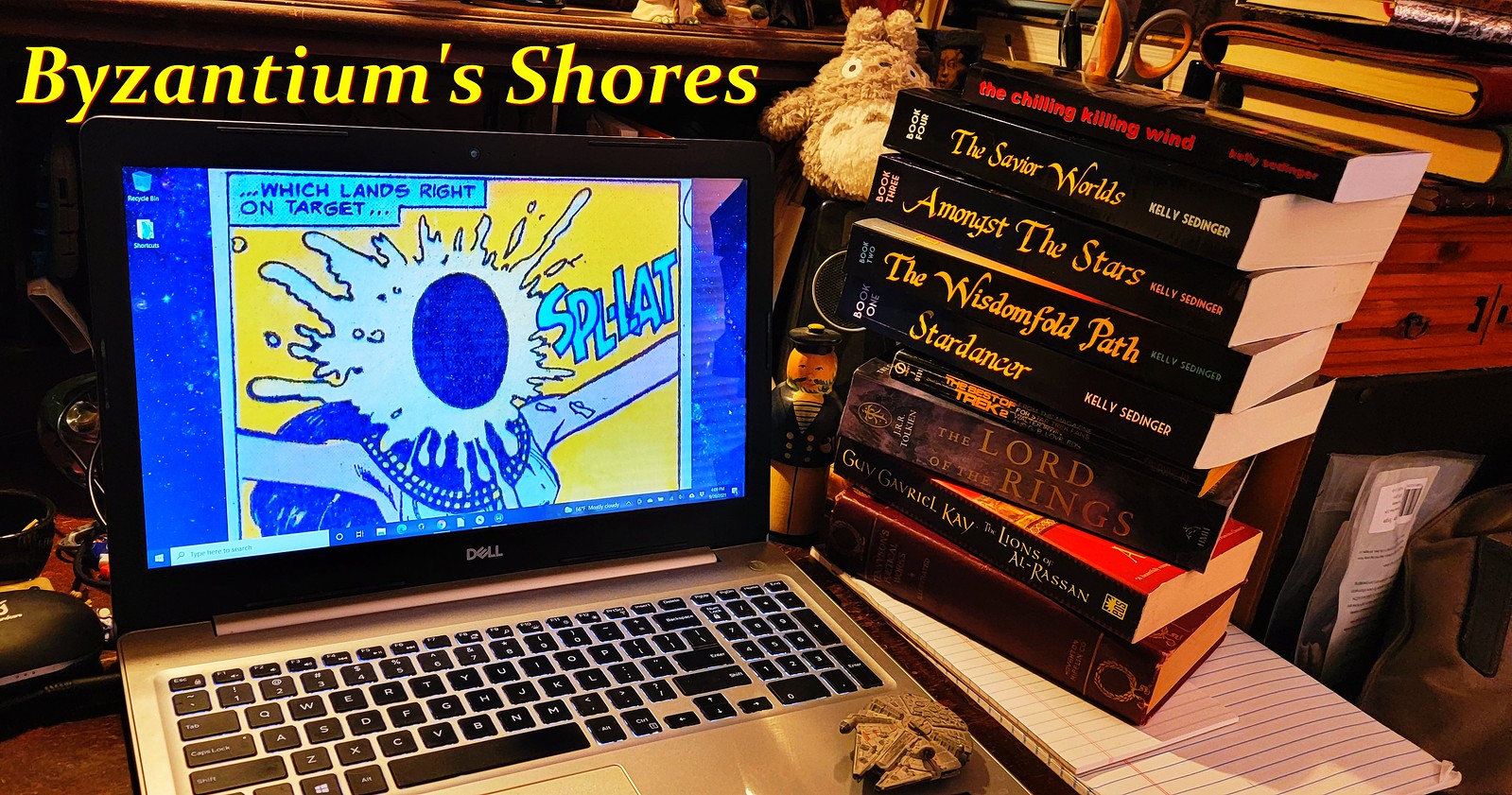
The personal blog of author Kelly Sedinger, chronicling the adventures of one overalls-clad wanderer.
Wednesday, June 12, 2002

In my post yesterday about the AFI's top 100 romantic films, I commented that I found it bizarre that Jennifer Love Hewitt provided commentary on the listed films that starred Audrey Hepburn. I have now been informed that Miss Hewitt played Miss Hepburn herself in a biopic recently, which probably explains it. OK, but I still think it's weird -- not unlike that ABC interview with Bill Clinton (while he was President) that was conducted by Leonardo DiCaprio. But I concede that it's not completely inexplicable.(Thanks for the tip, Meg!)
Tuesday, June 11, 2002
The American Film Institute has spoken. In a special that aired on CBS tonight, they revealed the top 100 romantic films of all time. Number Three was West Side Story. Number Two was Gone With the Wind. And number One?
Casablanca.
I can live with that.
The list was fascinating. I love these shows, not just for debating their choices but also for the trip down memory lane for wonderful films that I may not have seen in quite a while (I really want to watch From Here to Eternity right now) and the reminder of films that I really do need to see (The Quiet Man and The Goodbye Girl leap to mind). I didn't even have as many quibbles with this list as I have with the previous AFI "Lists" (the 100 greatest movies, the 100 funniest comedies, the 100 most exciting action films). I am convinced that Kevin Costner has starred in two of the finest cinematic love stories of all time: Dances With Wolves and Bull Durham, which were not on the AFI's list. One of my favorite cinematic love stories, believe it or not, is the Bond film On Her Majesty's Secret Service -- the one Bond film in which Bond actually falls in love. I've also always had something of a soft spot for Somewhere in Time. And there's the wonderful suspense-mystery-reincarnation-dual love story starring Kenneth Branagh and Emma Thompson, Dead Again. I'm sure I could come up with a few more, given time.
As for films the AFI named which I would omit from their list, there weren't a whole lot of these. I really don't consider It's a Wonderful Life a love story (and, to be frank, I don't much like the film in the first place). If they had to include two Gene Kelly movies, Brigadoon or For Me and My Gal would have been a better choice than the colossally-overrated An American In Paris, an overlong film that suffers greatly in the love department because Leslie Caron is, to my eyes, completely uninteresting. She and Kelly have no chemistry together. I also can't stomach Love Story, which I've always found treacly and overly manipulative. But my heart soared to see my single favorite musical, My Fair Lady, on the list. (One confusing thing about the show, though: why did they feel the need to have Jennifer Love Hewitt comment on every Audrey Hepburn film that was on the list? Were they symbolically trying to anoint Miss Hewitt as the next Miss Hepburn? Good lord, I hope not....)
I wonder if the AFI will do another list for next year. I'm not sure if there are any topics left that lend themselves to 100 films; perhaps a series of specials devoted to specific genres? I'd tune in to see the AFI's Top 25 SF films, Top 25 Westerns, Top 25 Film Noir's, et cetera.
(By the way, according to the AFI's website the next recipient of the AFI Lifetime Achievement Award will be Tom Hanks.)
Casablanca.
I can live with that.
The list was fascinating. I love these shows, not just for debating their choices but also for the trip down memory lane for wonderful films that I may not have seen in quite a while (I really want to watch From Here to Eternity right now) and the reminder of films that I really do need to see (The Quiet Man and The Goodbye Girl leap to mind). I didn't even have as many quibbles with this list as I have with the previous AFI "Lists" (the 100 greatest movies, the 100 funniest comedies, the 100 most exciting action films). I am convinced that Kevin Costner has starred in two of the finest cinematic love stories of all time: Dances With Wolves and Bull Durham, which were not on the AFI's list. One of my favorite cinematic love stories, believe it or not, is the Bond film On Her Majesty's Secret Service -- the one Bond film in which Bond actually falls in love. I've also always had something of a soft spot for Somewhere in Time. And there's the wonderful suspense-mystery-reincarnation-dual love story starring Kenneth Branagh and Emma Thompson, Dead Again. I'm sure I could come up with a few more, given time.
As for films the AFI named which I would omit from their list, there weren't a whole lot of these. I really don't consider It's a Wonderful Life a love story (and, to be frank, I don't much like the film in the first place). If they had to include two Gene Kelly movies, Brigadoon or For Me and My Gal would have been a better choice than the colossally-overrated An American In Paris, an overlong film that suffers greatly in the love department because Leslie Caron is, to my eyes, completely uninteresting. She and Kelly have no chemistry together. I also can't stomach Love Story, which I've always found treacly and overly manipulative. But my heart soared to see my single favorite musical, My Fair Lady, on the list. (One confusing thing about the show, though: why did they feel the need to have Jennifer Love Hewitt comment on every Audrey Hepburn film that was on the list? Were they symbolically trying to anoint Miss Hewitt as the next Miss Hepburn? Good lord, I hope not....)
I wonder if the AFI will do another list for next year. I'm not sure if there are any topics left that lend themselves to 100 films; perhaps a series of specials devoted to specific genres? I'd tune in to see the AFI's Top 25 SF films, Top 25 Westerns, Top 25 Film Noir's, et cetera.
(By the way, according to the AFI's website the next recipient of the AFI Lifetime Achievement Award will be Tom Hanks.)
My new issue of WIRED Magazine came in the mail today....thus reminding me that I never read last month's issue, which is now online at the WIRED website. I found several articles particularly notable:
:: An interview with Steven Spielberg on the eve of Minority Report, his new film based on a short story by Philip K. Dick. What I found most interesting is Spielberg's rejection of purely digital cinema. He really feels that something will be lost when celluloid is a thing of the past, and judging by the mixed reviews I've seen of the digital projections of Star Wars Episode II: Attack of the Clones, I have to wonder if maybe he's right.
:: This article on the upcoming LucasArts game, Star Wars Galaxies. This game will create the Star Wars universe in an online environment that could involve as many as millions of gamers whose actions will create and shape the ongoing mythology of Star Wars once the films are complete. I'm wondering: suppose one user becomes as powerful and as charismatic a figure, in the game, as the fictional Dark Lords of the Sith? Will Lucas allow the Empire to rise again in his creation, once it's in the hands of the gamers?
:: A profile of Stephen Wolfram, the at-times megalomaniacal genius behind Mathematica and the new book, A New Kind of Science, which -- according to its author -- is just that, a grand new paradigm that may be the most important development in science since Einstein or Newton, or -- according to its critics -- merely repackages some old ideas in unscientific fashion, a sin doubly compounded by Wolfram's decision to forego the traditional mechanism of peer review in science in favor of self-publishing and self-promoting.
:: An interview with Steven Spielberg on the eve of Minority Report, his new film based on a short story by Philip K. Dick. What I found most interesting is Spielberg's rejection of purely digital cinema. He really feels that something will be lost when celluloid is a thing of the past, and judging by the mixed reviews I've seen of the digital projections of Star Wars Episode II: Attack of the Clones, I have to wonder if maybe he's right.
:: This article on the upcoming LucasArts game, Star Wars Galaxies. This game will create the Star Wars universe in an online environment that could involve as many as millions of gamers whose actions will create and shape the ongoing mythology of Star Wars once the films are complete. I'm wondering: suppose one user becomes as powerful and as charismatic a figure, in the game, as the fictional Dark Lords of the Sith? Will Lucas allow the Empire to rise again in his creation, once it's in the hands of the gamers?
:: A profile of Stephen Wolfram, the at-times megalomaniacal genius behind Mathematica and the new book, A New Kind of Science, which -- according to its author -- is just that, a grand new paradigm that may be the most important development in science since Einstein or Newton, or -- according to its critics -- merely repackages some old ideas in unscientific fashion, a sin doubly compounded by Wolfram's decision to forego the traditional mechanism of peer review in science in favor of self-publishing and self-promoting.
Monday, June 10, 2002
For some light reading, I checked out from the library Molly Ivins's collection of columns entitled You Got to Dance with Them What Brung You: Politics in the Clinton Years. This made for an enjoyable evening, but it was slightly eerie to read her mentioning offhandedly the World Trade Center bombing, and realize that she was talking about the botched demolition attempt of 1993. This was rather eerie.
I've finally figured out why I've been writing so much horror recently: because I want to win one of these. If this isn't the coolest trophy out there, I don't know what is. Who wouldn't want a Bram Stoker Award on the mantelpiece?
Congratulations to all the winners. (Neil Gaiman took the Stoker for Best Novel of 2001, for American Gods.)
Congratulations to all the winners. (Neil Gaiman took the Stoker for Best Novel of 2001, for American Gods.)
The New York Times has this interesting article about blogging and, specifically, a rift that is apparently developing between "war bloggers" and "regular bloggers". (I suppose that's what you'd call them.)
This seems a good time to discuss my stance just a bit, perhaps violating my own "no politics" policy. In the menu to the left, there is a quote from one of the characters in Guy Gavriel Kay's magnificent novel The Lions of Al-Rassan. Stripped of its context, the quote probably seems anti-war, almost pacifist in nature. The novel, though, is a fantasy inspired by the fall of Moorish Iberia and the rise of Catholic Espana; war is one of the book's central themes. The words of this particular quote are spoken by a man who is one of the great poets of his day, in Kay's world; this same man, though, is one of the most dangerous men in the world. He is extremely skilled with a number of weapons, and he kills a number of men in the course of the novel. War, for this man, is a necessary evil, a part of the world that must be accepted -- but must not be allowed to become everything.
That, I suppose, is the reason for what I am doing with this blog. The current war is extremely important and will be for a long time to come; but it is not everything. There is still a world full of books and music and art, and I offer my oft-inadequate musings here as a reminder of that. I am not a pacifist; I generally support the war, although I am troubled by a number of aspects of it. It worries me, for example, when we are told by the Vice President that "The war will not be over in our lifetime"; I worry that this is simply a means for rescusitating a formerly-shaky defense industry. I am disturbed by the idea of military tribunals. I wonder just what our plan is for all those detainees at Guantanamo Bay. I question whether or not we should go after Saddam Hussein (my opinion on this changes daily). All this is irrelevant, though, to my writing here.
When we are asked why we fight, so often we answer, "Freedom". Art -- be it great art, shallow art, or junk-food art -- is born of Freedom. What do we fight for? Freedom. But what do we want to produce as a result of our freedom? I recently read a comment by some historian -- whose name I cannot recall -- that went something like, "Every epoch is known for two things: its art and its wars." I'm glad we have warbloggers to write about the wars. I prefer to write about our art.
This seems a good time to discuss my stance just a bit, perhaps violating my own "no politics" policy. In the menu to the left, there is a quote from one of the characters in Guy Gavriel Kay's magnificent novel The Lions of Al-Rassan. Stripped of its context, the quote probably seems anti-war, almost pacifist in nature. The novel, though, is a fantasy inspired by the fall of Moorish Iberia and the rise of Catholic Espana; war is one of the book's central themes. The words of this particular quote are spoken by a man who is one of the great poets of his day, in Kay's world; this same man, though, is one of the most dangerous men in the world. He is extremely skilled with a number of weapons, and he kills a number of men in the course of the novel. War, for this man, is a necessary evil, a part of the world that must be accepted -- but must not be allowed to become everything.
That, I suppose, is the reason for what I am doing with this blog. The current war is extremely important and will be for a long time to come; but it is not everything. There is still a world full of books and music and art, and I offer my oft-inadequate musings here as a reminder of that. I am not a pacifist; I generally support the war, although I am troubled by a number of aspects of it. It worries me, for example, when we are told by the Vice President that "The war will not be over in our lifetime"; I worry that this is simply a means for rescusitating a formerly-shaky defense industry. I am disturbed by the idea of military tribunals. I wonder just what our plan is for all those detainees at Guantanamo Bay. I question whether or not we should go after Saddam Hussein (my opinion on this changes daily). All this is irrelevant, though, to my writing here.
When we are asked why we fight, so often we answer, "Freedom". Art -- be it great art, shallow art, or junk-food art -- is born of Freedom. What do we fight for? Freedom. But what do we want to produce as a result of our freedom? I recently read a comment by some historian -- whose name I cannot recall -- that went something like, "Every epoch is known for two things: its art and its wars." I'm glad we have warbloggers to write about the wars. I prefer to write about our art.
One can find here the top 20 science fiction films of all time, as selected by WIRED Magazine.
I haven't seen all of their picks, so I can't judge the list entirely. In fact, I haven't seen seven of their twenty films, though one -- Akira -- is on my shelf, still shrinkwrapped and waiting to be watched. (Viewing films like Akira is logistically difficult when one's home includes a two-year-old.) The list purports to judge films by their "adrenaline rush" and by how well the films' worlds are realized. World-building is, of course, of tantamount concern in SF and fantasy (and, to a lesser extent, horror), so judging films on those grounds is certainly understandable. I don't understand their third criterion, though: Precision, or how well the science holds up. Quite frankly, some of their films are so scientifically implausible as to merit serious consideration as fantasy. Star Wars is not hard SF, and that is that. How can we approach the science of a film that gives us FTL-drives as standard equipment, super-laser beams that can obliterate entire planets, a space-station the size and configuration of the Death Star (where are its thrusters?), weapons comprised by a laser beam that stops in mid-air, et cetera? And for all the wonderful gee-whizzery of Jurassic Park, that film is on no better scientific ground. Splicing ancient DNA with frog DNA, and thus being able to create full-fledged organisms? And since when do we know anything about the visual acuity of a T-Rex? I am more inclined to judge the films on the basis of their influence, their storytelling, and their worldbuilding than in judging their science. On that basis I will gladly admit both Star Wars (which is, after all, in my opinion the finest film ever made -- sorry, Citizen Kane) and Jurassic Park.
I would, though, omit a number of the films on this list. I have never liked Bladerunner much, and I wouldn't call it a "Top 20" film, and I certainly wouldn't rank it first. I find Bladerunner anemic on the adrenaline side; its story never draws me in and excites me. As for the worldbuilding, according to this film 2019 Los Angeles looks like a futuristic Tokyo....when, given the rapid ascent of the Latino population in California, would seem to imply a futuristic Mexico City. The acting always seems flat; how Rutger Hauer parlayed this role into a career playing basically the same part over and over again is beyond me. To be fair, I haven't seen the much-praised Director's Cut of the film. (Bladerunner's music score, by Vangelis, is wonderful.)
Likewise, I would omit Alien and I would not allow any of its sequels anywhere near The List. I found the original Alien to be a fairly effective horror-in-space movie, but I also find that it loses a great deal of its punch on repeat viewings. A scare-movie that depends on horrible beasts leaping out from behind things and general gross-out effect for its suspense doesn't have that much to offer in a second go-round; as for the worldbuilding, it's nothing spectacular -- just a claustrophobic spaceship. As for Aliens, that film has never been one of my favorites either, mainly due to its predictability. The film had no surprises for me, and again its worldbuilding is basically a series of claustrophobic sets of mostly dank metal and smoke.
I also have to reluctantly omit The Matrix, a film which I liked immensely upon first seeing it but which has suffered on repeat viewings. The film's pseudo-myth of "The One" seems hollow the more I examine it, and the idea of a "reality beyond the reality" is toyed with intriguingly only to be tossed aside in favor of a massive gunfight at the end. And I must admit to great difficulty believing Keanu Reeves as a martial-arts genius, or whatever it is he's supposed to be.
Tron is a film that I actually like, but I wonder if it's more of a cult-film than one of the standing greats. Nevertheless, I can excuse its presence here. Its worldbuilding is quite amazing, really, being steeped in the video-game culture of the early 1980s. As a cyber-thriller, I find Tron to be much more inventive -- and effective -- than The Matrix. The same objection -- that it is more of a cult-film than one-for-the-ages -- applies to Road Warrior, a fun bit of post-apocalyptic dystopia that isn't really as good as WIRED seems to believe.
There are some glaring omissions, as there will be in any such list. Close Encounters of the Third Kind maybe suffers in the worldbuilding department, simply because it's set in the real world and thus isn't much subject to the same kind of flights of fancy that populate a film like Star Wars. But its storytelling is nothing short of amazing, and in this film we can see many of the tropes that would later surface in The X-Files and other "government paranoia" stories. Terminator 2: Judgement Day probably deserves recognition on the list even more than its predecessor, The Terminator. T2 is a masterpiece of adrenaline-pumping action, and it features one of the most menacing villains of all cinema, in the T-1000. The WIRED listmakers were right to include two James Cameron films; I just think they named the wrong ones. The Abyss is one of the most underrated films of all time. It is loaded with SF "sense of wonder"; it shows us a new world (one on our very doorstep); it is exciting and moving and touching; and it's even highly influential, being one of the earliest examples of the "morphing" special effect that would later be used to such amazing effect in T2 and would later pave the way for Jurassic Park and the marvels in the Star Wars prequels. (NOTE: I prefer the Director's Cut of The Abyss to the original, despite the fact that the Director's Cut makes the film's ending far more preachy than it should be.) And while I personally might want to make a case for all five (and probably the sixth, when it arrives in 2005) Star Wars films, certainly a case could be made for The Empire Strikes Back, the film which fleshes out the Star Wars universe and gives its mythology its soundest basis. Plus, it's exciting as hell -- pure adrenaline -- and a wonder of worldbuilding.
I also think that a historical case could be possibly made for King Kong, Forbidden Planet, and Fritz Lang's Metropolis.
I haven't seen all of their picks, so I can't judge the list entirely. In fact, I haven't seen seven of their twenty films, though one -- Akira -- is on my shelf, still shrinkwrapped and waiting to be watched. (Viewing films like Akira is logistically difficult when one's home includes a two-year-old.) The list purports to judge films by their "adrenaline rush" and by how well the films' worlds are realized. World-building is, of course, of tantamount concern in SF and fantasy (and, to a lesser extent, horror), so judging films on those grounds is certainly understandable. I don't understand their third criterion, though: Precision, or how well the science holds up. Quite frankly, some of their films are so scientifically implausible as to merit serious consideration as fantasy. Star Wars is not hard SF, and that is that. How can we approach the science of a film that gives us FTL-drives as standard equipment, super-laser beams that can obliterate entire planets, a space-station the size and configuration of the Death Star (where are its thrusters?), weapons comprised by a laser beam that stops in mid-air, et cetera? And for all the wonderful gee-whizzery of Jurassic Park, that film is on no better scientific ground. Splicing ancient DNA with frog DNA, and thus being able to create full-fledged organisms? And since when do we know anything about the visual acuity of a T-Rex? I am more inclined to judge the films on the basis of their influence, their storytelling, and their worldbuilding than in judging their science. On that basis I will gladly admit both Star Wars (which is, after all, in my opinion the finest film ever made -- sorry, Citizen Kane) and Jurassic Park.
I would, though, omit a number of the films on this list. I have never liked Bladerunner much, and I wouldn't call it a "Top 20" film, and I certainly wouldn't rank it first. I find Bladerunner anemic on the adrenaline side; its story never draws me in and excites me. As for the worldbuilding, according to this film 2019 Los Angeles looks like a futuristic Tokyo....when, given the rapid ascent of the Latino population in California, would seem to imply a futuristic Mexico City. The acting always seems flat; how Rutger Hauer parlayed this role into a career playing basically the same part over and over again is beyond me. To be fair, I haven't seen the much-praised Director's Cut of the film. (Bladerunner's music score, by Vangelis, is wonderful.)
Likewise, I would omit Alien and I would not allow any of its sequels anywhere near The List. I found the original Alien to be a fairly effective horror-in-space movie, but I also find that it loses a great deal of its punch on repeat viewings. A scare-movie that depends on horrible beasts leaping out from behind things and general gross-out effect for its suspense doesn't have that much to offer in a second go-round; as for the worldbuilding, it's nothing spectacular -- just a claustrophobic spaceship. As for Aliens, that film has never been one of my favorites either, mainly due to its predictability. The film had no surprises for me, and again its worldbuilding is basically a series of claustrophobic sets of mostly dank metal and smoke.
I also have to reluctantly omit The Matrix, a film which I liked immensely upon first seeing it but which has suffered on repeat viewings. The film's pseudo-myth of "The One" seems hollow the more I examine it, and the idea of a "reality beyond the reality" is toyed with intriguingly only to be tossed aside in favor of a massive gunfight at the end. And I must admit to great difficulty believing Keanu Reeves as a martial-arts genius, or whatever it is he's supposed to be.
Tron is a film that I actually like, but I wonder if it's more of a cult-film than one of the standing greats. Nevertheless, I can excuse its presence here. Its worldbuilding is quite amazing, really, being steeped in the video-game culture of the early 1980s. As a cyber-thriller, I find Tron to be much more inventive -- and effective -- than The Matrix. The same objection -- that it is more of a cult-film than one-for-the-ages -- applies to Road Warrior, a fun bit of post-apocalyptic dystopia that isn't really as good as WIRED seems to believe.
There are some glaring omissions, as there will be in any such list. Close Encounters of the Third Kind maybe suffers in the worldbuilding department, simply because it's set in the real world and thus isn't much subject to the same kind of flights of fancy that populate a film like Star Wars. But its storytelling is nothing short of amazing, and in this film we can see many of the tropes that would later surface in The X-Files and other "government paranoia" stories. Terminator 2: Judgement Day probably deserves recognition on the list even more than its predecessor, The Terminator. T2 is a masterpiece of adrenaline-pumping action, and it features one of the most menacing villains of all cinema, in the T-1000. The WIRED listmakers were right to include two James Cameron films; I just think they named the wrong ones. The Abyss is one of the most underrated films of all time. It is loaded with SF "sense of wonder"; it shows us a new world (one on our very doorstep); it is exciting and moving and touching; and it's even highly influential, being one of the earliest examples of the "morphing" special effect that would later be used to such amazing effect in T2 and would later pave the way for Jurassic Park and the marvels in the Star Wars prequels. (NOTE: I prefer the Director's Cut of The Abyss to the original, despite the fact that the Director's Cut makes the film's ending far more preachy than it should be.) And while I personally might want to make a case for all five (and probably the sixth, when it arrives in 2005) Star Wars films, certainly a case could be made for The Empire Strikes Back, the film which fleshes out the Star Wars universe and gives its mythology its soundest basis. Plus, it's exciting as hell -- pure adrenaline -- and a wonder of worldbuilding.
I also think that a historical case could be possibly made for King Kong, Forbidden Planet, and Fritz Lang's Metropolis.
One of Buffalo's biggest arts events, the Allentown Art Festival, was this weekend. And I missed it by not realizing when it was, and making other plans. How revolting.
Saturday, June 08, 2002
I've been delayed from writing my thoughts on the series finale of The X-Files, so here they are: The episode itself was well done, but I think it came a bit too late. The show really should have gone to movies after the end of Season Seven, when Scully had been revealed pregnant and Mulder abducted. Everything that has transpired since then has felt padded. I envision a scene like this at Ten Thirteen:
CHRIS CARTER: "We've gotta come up with two more seasons of stuff. How about, oh, supersoldiers?"
STAFF WRITER: "What are those, Chris?"
CHRIS CARTER: "They're government-created humans who can't be killed, which will save us from the aliens when they come. And maybe Scully's baby is one of them. And since David won't be around, we'll need a new agent to pair with Scully. Anybody like the name 'Doggett'?"
STAFF WRITER: "What about the black oil?"
CHRIS CARTER: "I'm still talking about this guy Doggett. And of course he should have a partner...."
STAFF WRITER: "Wait. Isn't his partner Scully?"
CHRIS CARTER: "Hmmm. Well, I'm about to make Scully a single mom, so we can't have her flying off into unknown danger all the time. Responsibilities, you know. So we'll do what we did six years ago when Gillian was pregnant in real life: we'll have Scully do a lot of desk-work and autopsies."
STAFF WRITER: "Well, OK. Not really the best use for an actress of Gillian's talent, but then, she looks better in scrubs and a lab coat than half the women on ER."
CHRIS CARTER: "Gillian's a trooper. I mean, when we did 'Humbug' she actually ate a beetle! You can't buy that....Now, about these Super Soldiers...."
STAFF WRITER: "Hey, is Smoking Man really Mulder's father? We never really came out and said so."
CHRIS CARTER: "Hmmmm. Well, if we did come out and say so, it would seem like a rip-off of Star Wars."
STAFF WRITER: "Say, I have a question. Remember how on Frasier, when Daphne realized she was in love with Niles, someone told her that maybe it was time to stop calling him "Dr. Crane"? Well, Mulder and Scully have a kid now. Should they really call each other by their last names still?"
....and so on.
It took me a long time to really get into The X-Files. I watched it intermittently during its first two seasons, but I didn't get hooked until the brilliant two-parter "Piper Maru/Apocrypha" from the third season. At its best, The X-Files was a smart and witty blend of paranoia, fin-du-siecle anxiety, and good old fashioned horror storytelling. I even liked the first movie, even though it admittedly was skewed a bit too much toward the show's already-converted fans. And I still liked some of episodes from the wildly uneven eighth and ninth seasons. It was hard to watch the show peter out as Chris Carter and the folks at Ten Thirteen made a game effort to keep drawing a story out of a franchise that had really given all it had to give, in terms of its overall mytharc, two years before.
As for the finale episode, again, it was well-done. Putting Mulder on trial was a fun idea (although the way it was set up is one of the more contrived plot devices I've ever seen). I'm glad Mitch Pileggi got such a chance to shine, and I liked seeing the Cigarette Smoking Man living as some kind of Indian ascetic. The episode's biggest flaw isn't even the episode's fault. The entire series once was clearly leading up to Mulder's discovery, at long last, of just what happened to his sister. Unfortunately, the series "resolved" that issue a few years back, and not in entirely satisfactory fashion, either. That was really the "Truth" that was out there; for Mulder, everything revolved around that particular quest; I think that is really why everything that came after felt so deflated. When The X-Files was at its best -- and it was at its best for quite a long time -- it was centered squarely on Mulder, Scully, and the quest for Samantha. The attempt to make it about something else simply didn't work (although perhaps it could have worked, given the very high quality of the episode in which Agent Doggett learned how his son was murdered).
So, the show limped through its final two seasons, bereft of the story that had been at its heart. Nevertheless, I will miss the show. Maybe sometime soon I'll watch one of the amazing three-part episodes: Duane Barry/Ascension/One Breath, perhaps; or maybe Gethsemane/Redux/Redux II. And then there will always be the pinnacle of The X-Files: Anasazi/The Blessing Way/Paper Clip. And then some of the almost-as-good two parters: Colony/End Game, Talitha Cumi/Herrenvolk, Tunguska/Terma....and the great standalone episodes like Home, Jose Chung's From Outer Space, Small Potatoes, Humbug, Squeeze, Tooms....the truth may not be out there anymore, but it's sure somewhere.
"Is there any way I can get it off my fingers quickly without betraying my cool exterior?" --Fox Mulder, Tooms.
"Well, I could have done without that Flukeman thing." --Dana Scully (I don't recall the episode).
CHRIS CARTER: "We've gotta come up with two more seasons of stuff. How about, oh, supersoldiers?"
STAFF WRITER: "What are those, Chris?"
CHRIS CARTER: "They're government-created humans who can't be killed, which will save us from the aliens when they come. And maybe Scully's baby is one of them. And since David won't be around, we'll need a new agent to pair with Scully. Anybody like the name 'Doggett'?"
STAFF WRITER: "What about the black oil?"
CHRIS CARTER: "I'm still talking about this guy Doggett. And of course he should have a partner...."
STAFF WRITER: "Wait. Isn't his partner Scully?"
CHRIS CARTER: "Hmmm. Well, I'm about to make Scully a single mom, so we can't have her flying off into unknown danger all the time. Responsibilities, you know. So we'll do what we did six years ago when Gillian was pregnant in real life: we'll have Scully do a lot of desk-work and autopsies."
STAFF WRITER: "Well, OK. Not really the best use for an actress of Gillian's talent, but then, she looks better in scrubs and a lab coat than half the women on ER."
CHRIS CARTER: "Gillian's a trooper. I mean, when we did 'Humbug' she actually ate a beetle! You can't buy that....Now, about these Super Soldiers...."
STAFF WRITER: "Hey, is Smoking Man really Mulder's father? We never really came out and said so."
CHRIS CARTER: "Hmmmm. Well, if we did come out and say so, it would seem like a rip-off of Star Wars."
STAFF WRITER: "Say, I have a question. Remember how on Frasier, when Daphne realized she was in love with Niles, someone told her that maybe it was time to stop calling him "Dr. Crane"? Well, Mulder and Scully have a kid now. Should they really call each other by their last names still?"
....and so on.
It took me a long time to really get into The X-Files. I watched it intermittently during its first two seasons, but I didn't get hooked until the brilliant two-parter "Piper Maru/Apocrypha" from the third season. At its best, The X-Files was a smart and witty blend of paranoia, fin-du-siecle anxiety, and good old fashioned horror storytelling. I even liked the first movie, even though it admittedly was skewed a bit too much toward the show's already-converted fans. And I still liked some of episodes from the wildly uneven eighth and ninth seasons. It was hard to watch the show peter out as Chris Carter and the folks at Ten Thirteen made a game effort to keep drawing a story out of a franchise that had really given all it had to give, in terms of its overall mytharc, two years before.
As for the finale episode, again, it was well-done. Putting Mulder on trial was a fun idea (although the way it was set up is one of the more contrived plot devices I've ever seen). I'm glad Mitch Pileggi got such a chance to shine, and I liked seeing the Cigarette Smoking Man living as some kind of Indian ascetic. The episode's biggest flaw isn't even the episode's fault. The entire series once was clearly leading up to Mulder's discovery, at long last, of just what happened to his sister. Unfortunately, the series "resolved" that issue a few years back, and not in entirely satisfactory fashion, either. That was really the "Truth" that was out there; for Mulder, everything revolved around that particular quest; I think that is really why everything that came after felt so deflated. When The X-Files was at its best -- and it was at its best for quite a long time -- it was centered squarely on Mulder, Scully, and the quest for Samantha. The attempt to make it about something else simply didn't work (although perhaps it could have worked, given the very high quality of the episode in which Agent Doggett learned how his son was murdered).
So, the show limped through its final two seasons, bereft of the story that had been at its heart. Nevertheless, I will miss the show. Maybe sometime soon I'll watch one of the amazing three-part episodes: Duane Barry/Ascension/One Breath, perhaps; or maybe Gethsemane/Redux/Redux II. And then there will always be the pinnacle of The X-Files: Anasazi/The Blessing Way/Paper Clip. And then some of the almost-as-good two parters: Colony/End Game, Talitha Cumi/Herrenvolk, Tunguska/Terma....and the great standalone episodes like Home, Jose Chung's From Outer Space, Small Potatoes, Humbug, Squeeze, Tooms....the truth may not be out there anymore, but it's sure somewhere.
"Is there any way I can get it off my fingers quickly without betraying my cool exterior?" --Fox Mulder, Tooms.
"Well, I could have done without that Flukeman thing." --Dana Scully (I don't recall the episode).
Thursday, June 06, 2002
IMAGE OF THE WEEK

The scene of destruction is very familiar to us all. But consider the spherical object at the lower left. This is what it looked like before 11 September 2001:

The spherical object is Fritz Koenig's sculpture, "The Sphere", which used to stand in the concourse between the WTC's twin towers. The destruction of the World Trade Center carried with it an almost unimaginable loss of life. Not to be discounted, though, is the loss to the human heritage of art and creativity. The WTC was not merely a pair of very large office buildings; it was also the repository of a surprisingly large number of artworks and historical documents that are now lost. It is clearer than ever that the magnitude of what was lost that horrible day might never be known.
(The first of these images links to an AP article about the items lost in the WTC attack.)
The scene of destruction is very familiar to us all. But consider the spherical object at the lower left. This is what it looked like before 11 September 2001:
The spherical object is Fritz Koenig's sculpture, "The Sphere", which used to stand in the concourse between the WTC's twin towers. The destruction of the World Trade Center carried with it an almost unimaginable loss of life. Not to be discounted, though, is the loss to the human heritage of art and creativity. The WTC was not merely a pair of very large office buildings; it was also the repository of a surprisingly large number of artworks and historical documents that are now lost. It is clearer than ever that the magnitude of what was lost that horrible day might never be known.
(The first of these images links to an AP article about the items lost in the WTC attack.)
Wednesday, June 05, 2002
Sometimes I encounter a book that, upon its completion, makes me wonder: "Just why did this author feel the need to write this book?" I encountered just such a book this week. It is 3001: The Final Odyssey by Arthur C. Clarke.
2001: A Space Odyssey is one of the classics of science fiction, a truly fine novel that is often obscured by the elephantine shadow cast by its companion film. The sequel, 2010: Odyssey Two, was an excellent book, if not on the level of its predecessor. I don't recall much about 2061: Odyssey Three, except that I wasn't particularly impressed. 3001 gives the series some closure, which is Clarke's biggest mistake. This is not a story that should have closure, at all.
The book opens with a comet-prospector finding a non-cometary object floating in a near-deepspace orbit. It turns out to be the body of astronaut Frank Poole, the co-pilot of the spaceship Discovery who was killed in the first book by the schizophrenic computer HAL-9000. Medical technology has advanced such that Poole is able to be revived, and the book then deals mostly with his assimilation into a society that is as far ahead of him as he was ahead of the people of the Dark Ages. The society that Clarke presents is really nothing new; it's the standard Star Trek-style utopia in which religion has been left behind (and is even characterized as a form of psychosis), material needs are a thing of the past, et cetera. The most interesting thing in the book is Clarke's construct of a gigantic artificial ring-system around the earth, but this strangely is left undeveloped. Clarke posits that people who live on the Rings cannot live long on Earth, and yet he never develops the hint that two entirely different societies would evolve from such a state. Do the Earthbound folks look on the Ring-people with suspicion? do the Ring-people look down -- figuratively and literally -- on the Earthbound? Clarke doesn't indicate anything of the sort. His society here is conflictless, and thus not very interesting to read about. This is a pity.
The book's most serious problems, though, come when Frank Poole journeys to the Galilean Moons (formerly of Jupiter, the gas-giant planet having been converted into a second sun late in 2010). Here he apparently means to make contact with his old friend, Dave Bowman, who along with HAL has become one with the monolith. Frank doesn't seem to feel any emotions at all in this. Would he feel any anger toward HAL for killing him? would he feel concern for Dave's plight? would he feel anything? Not really, if Clarke is to be believed. This was a lost opportunity. Perhaps it couldn't be any other way; Clarke's books and stories have never much been about emotion and feeling. But the lack of it here totally undermines his characters. They begin to feel like automatons in a plot.
The book's climax arrives when it is discovered that the Monolith (the really big Monolith, the one on Europa, as opposed to its smaller twins on Earth and the Moon) may very well be on the verge of destroying humanity (the reasons for this involve time, distance, and the speed of light). Poole must play the vital role in defusing the threat of the Monolith in a way which is unfortunately reminiscent of the ending of Independence Day, a fact which Clarke bemoans in his Afterword. The whole threat lacks conviction, though, and instead it makes plain the book's largest error: it explains the Monolith. What made 2001 so memorable is the fact that even at the end, after Dave Bowman has been reincarnated as the Star Child, we still don't know what the Monolith is or who made it or why it has been left here or what its purpose at all is -- we don't even know if the Monolith is an alien artifact or an alien itself. It was this air of mystery, that sense of the cosmic unknown, that elevated 2001 to the level of a classic. Even 2010 left much of the mystery intact, even as it continued the story. But in 3001, Clarke tells us that the Monolith is a mindless automaton, and he even refers to its internal circuitry. We shouldn't know that much about the Monolith. It ceases to be a constant pointer to the eternal reality that there will always be an unknown, and instead joins the ranks of things we've figured out. It has been said that the most critical aspect of the best science fiction is the intangible "sense of wonder". 2001: A Space Odyssey had it in spades; 2010 had it but to a lesser extent; 2063 didn't have a whole lot of it but was still a readable novel. 3001's biggest problem is simple: no wonder. Reading it makes me feel as if Samuel Beckett had written a second play, called Oh, There's Godot.
2001: A Space Odyssey is one of the classics of science fiction, a truly fine novel that is often obscured by the elephantine shadow cast by its companion film. The sequel, 2010: Odyssey Two, was an excellent book, if not on the level of its predecessor. I don't recall much about 2061: Odyssey Three, except that I wasn't particularly impressed. 3001 gives the series some closure, which is Clarke's biggest mistake. This is not a story that should have closure, at all.
The book opens with a comet-prospector finding a non-cometary object floating in a near-deepspace orbit. It turns out to be the body of astronaut Frank Poole, the co-pilot of the spaceship Discovery who was killed in the first book by the schizophrenic computer HAL-9000. Medical technology has advanced such that Poole is able to be revived, and the book then deals mostly with his assimilation into a society that is as far ahead of him as he was ahead of the people of the Dark Ages. The society that Clarke presents is really nothing new; it's the standard Star Trek-style utopia in which religion has been left behind (and is even characterized as a form of psychosis), material needs are a thing of the past, et cetera. The most interesting thing in the book is Clarke's construct of a gigantic artificial ring-system around the earth, but this strangely is left undeveloped. Clarke posits that people who live on the Rings cannot live long on Earth, and yet he never develops the hint that two entirely different societies would evolve from such a state. Do the Earthbound folks look on the Ring-people with suspicion? do the Ring-people look down -- figuratively and literally -- on the Earthbound? Clarke doesn't indicate anything of the sort. His society here is conflictless, and thus not very interesting to read about. This is a pity.
The book's most serious problems, though, come when Frank Poole journeys to the Galilean Moons (formerly of Jupiter, the gas-giant planet having been converted into a second sun late in 2010). Here he apparently means to make contact with his old friend, Dave Bowman, who along with HAL has become one with the monolith. Frank doesn't seem to feel any emotions at all in this. Would he feel any anger toward HAL for killing him? would he feel concern for Dave's plight? would he feel anything? Not really, if Clarke is to be believed. This was a lost opportunity. Perhaps it couldn't be any other way; Clarke's books and stories have never much been about emotion and feeling. But the lack of it here totally undermines his characters. They begin to feel like automatons in a plot.
The book's climax arrives when it is discovered that the Monolith (the really big Monolith, the one on Europa, as opposed to its smaller twins on Earth and the Moon) may very well be on the verge of destroying humanity (the reasons for this involve time, distance, and the speed of light). Poole must play the vital role in defusing the threat of the Monolith in a way which is unfortunately reminiscent of the ending of Independence Day, a fact which Clarke bemoans in his Afterword. The whole threat lacks conviction, though, and instead it makes plain the book's largest error: it explains the Monolith. What made 2001 so memorable is the fact that even at the end, after Dave Bowman has been reincarnated as the Star Child, we still don't know what the Monolith is or who made it or why it has been left here or what its purpose at all is -- we don't even know if the Monolith is an alien artifact or an alien itself. It was this air of mystery, that sense of the cosmic unknown, that elevated 2001 to the level of a classic. Even 2010 left much of the mystery intact, even as it continued the story. But in 3001, Clarke tells us that the Monolith is a mindless automaton, and he even refers to its internal circuitry. We shouldn't know that much about the Monolith. It ceases to be a constant pointer to the eternal reality that there will always be an unknown, and instead joins the ranks of things we've figured out. It has been said that the most critical aspect of the best science fiction is the intangible "sense of wonder". 2001: A Space Odyssey had it in spades; 2010 had it but to a lesser extent; 2063 didn't have a whole lot of it but was still a readable novel. 3001's biggest problem is simple: no wonder. Reading it makes me feel as if Samuel Beckett had written a second play, called Oh, There's Godot.
Monday, June 03, 2002
I was tinkering with my blog setup, and it occurred to me that my "current reading" section was inadequate. After all, how long could it take to read a tome on English history or a book of poetry? (In the latter case, quite a while. It's a big book.) I realized that I was approaching some of those books differently than the others that I list there. Thus I arrived at my current metaphor: reading as a journey.
I like the idea of "companion books". These are books that have a long-term place on the table beside my chair or on my desk, books into which I dip frequently and over a long period of time, be it a page or two or a chapter or two or a poem or two. These are different from what I now call "waypost books", which are the books to which I actively devote more time at once -- but are left behind when they are done. The waypost books yield an experience that is very different from that afforded by the companion books. All books need not be read in the same manner. A book may start out as a waypost book, but may reach the level of companion book; likewise, a companion book may become a waypost book if the journey leads in such a direction. Neither change is good nor bad; they are necessary events in the evolution of a reader and his/her relationship to the books.
I like the idea of "companion books". These are books that have a long-term place on the table beside my chair or on my desk, books into which I dip frequently and over a long period of time, be it a page or two or a chapter or two or a poem or two. These are different from what I now call "waypost books", which are the books to which I actively devote more time at once -- but are left behind when they are done. The waypost books yield an experience that is very different from that afforded by the companion books. All books need not be read in the same manner. A book may start out as a waypost book, but may reach the level of companion book; likewise, a companion book may become a waypost book if the journey leads in such a direction. Neither change is good nor bad; they are necessary events in the evolution of a reader and his/her relationship to the books.
I've recently noticed a seasonal trend in my fiction reading. My genres of choice tend to be science fiction, fantasy, and horror. I'm likely to read horror any time of year, but as for the other two I tend to read fantasy in the fall and winter while turning toward science fiction in the spring and summer. Maybe there is something about fall and winter which lend themselves to the nature-type tropes that abound in fantasy; and maybe my summertime science fiction tendency is a holdover from my childhood, when each third summer was marked by the arrival of a Star Wars movie. I haven't noticed any remarkable seasonal tendencies toward my nonfiction reading; my interests tend to be all over the map, and thus I tend to grab whatever looks interesting and jump in.
Anyhow, I finished a couple of books this weekend, one SF and one about baseball.
The Price of the Stars by Debra Doyle and James D. MacDonald is the first book in a series of space operas called Mageworlds. (For those unfamiliar with the various sub-genres in science fiction, "space opera" denotes those types of stories with larger-than-life heroes, staging that is galactic in scale, and generally concerned with the classic struggle of good versus evil. Star Wars is pure space opera, as is -- in many of its episodes -- Star Trek. The classic example of a space opera from the standpoint of literary SF is E. E. "Doc" Smith's Lensmen Chronicles.) At first glance, Mageworlds appears to be a riff on Star Wars: scoundrels and space pirates abound, toting weapons called "blasters"; there is an order of warriors called "Adepts" (read: "Jedi") who tap into the universe's lide energy (read: "The Force") and fight with specialized weapons (staffs, but in the Adept-fight scenes my mind kept substituting lightsabers).
The story involves a female space pilot, Beka Rosselin-Metadi (one of the most cumbersome names I've ever encountered in a novel), who is trying to make her way in the Universe despite the fact that her father is a prominent military officer and her mother some kind of Very Important Person. Beka's life is changed forever when her mother is assassinated and her father presses her into finding those responsible, promising in exchange to give her his personal spaceship: the Warhammer, an apparently circular-shaped freighter that has been equipped with souped-up engines that make it the fastest hunk-of-junk in the Galaxy. (Yes, I kept picturing the Millennium Falcon.) As she pieces together the trail of the assassins, Beka assembles a motley crew of allies -- her hulking brute of a brother, a kind-hearted medical technician whose skills extend greatly into non-medical areas, an Adept who suffers from a lack of self-confidence, and a mysterious elderly figure known only as "The Professor" (and whose voice sounded, in my reader's imagination, a bit like Sir Alec Guinness).
The book is enjoyable as an action-romp, although the two main action set-pieces tend to ramble, and the characters are fairly interesting. The problem I had with the book was this: it feels like a rough draft for a longer work, with character motivations too often left unexplained and historical events constantly referred to but never explored. Just a day after finishing the book I couldn't explain why Beka's mother is killed even if I wanted to, and the "Mageworlds" named in the series title are never explained. We are told that a war with the Mageworlds has just ended, with the defeat of the Mages, and we gather that the Mages are a people to be greatly feared -- but we never know why. Maybe this is all explained in subsequent novels in the series. I do plan to read them, but I'm not making that a high priority. I recommend The Price of the Stars as a quick, entertaining diversion.
The other book I read was Joe Morgan's baseball volume Long Balls, No Strikes: What Baseball Must Do to Keep the Good Times Rolling. Joe Morgan has been my favorite baseball commentator for years (he generally provides the color commentary for games on ESPN, while Jon Miller provides play-by-play). This is because Morgan not only conveys his immense love of the game, but he also communicates his immense knowledge of it as well. I learned a great deal about the game by listening to Joe Morgan, and I learned some more by reading his book.
Baseball may be the most troubled of the four major professional sports in the United States. While only the NFL has avoided a labor-related work stoppage in the last decade (the last NFL strike was in 1987), baseball is the only sport to have actually forced the cancellation of its playoffs and championship due to a strike. It happened in 1994, when the owners and the players' union collided mainly on the issue of a salary-cap, which the owners insist will restore financial sanity to the game and which the players reject as foolish and unfair. In the years following that strike, which forced then-acting Commissioner Bud Selig to cancel the World Series, baseball saw its attendence plummet and the sales of MLB-related merchandise suffer a related drop. Only in 1998 did baseball begin to show signs of recovery, and Morgan's book outlines his thoughts on what baseball must do to build on the successes of that amazing season.
(A bit of recent baseball history is in order. In 1998, the New York Yankees won 115 games, nearly eclipsing the all-time record for regular season victories en route to their second World Championship in three years. David Wells pitched a perfect game. Cal Ripken Jr. ended his consecutive-games streak. And most memorably, Mark McGwire and Sammy Sosa chased each other into baseball immortality as both eclipsed Roger Maris's 37-year-old record by hitting 70 and 66 home runs, respectively.)
Morgan's suggestions for improving the game on the field are fascinating. He is wary of the current trend toward over-reliance on the home run, noting that where it once took a player more than one hundred stolen bases to lead the league in that category over a season, in recent years base-stealing has fallen off to where season leaders in SBs now post numbers like 65 or 70. He believes that restoring base-stealing as a key to offense will liven up the game, and it is hard to disagree with him. Morgan also advocates elevating the pitcher's mound and requiring umpires to enforce the official strike zone, which would tilt the balance-of-power back toward hurlers.
Morgan also writes about improving the game's financial problems, arguing convincingly for comprehensive revenue sharing. Baseball's lack of revenue sharing, a staple in the other major sports leagues (and handled with particular brilliance by the NFL), is the largest reason why teams like the Yankees can compete every year by putting forth whatever payroll they need to win, while teams like the Pittsburgh Pirates can never hope to enter into bidding for players like Ken Griffey, Jr or Greg Maddux. Contrast that to the situation in the NFL: in 1992, the most coveted football free agent was defensive end Reggie White. He ended up signing with the Green Bay Packers, the NFL's smallest market. That would be utterly impossible in Major League Baseball, where the richest teams can pay one player more than some teams pay all of their players combined. However, Morgan doesn't let the small-market teams off the hook, pointing out instances where the teams have made very bad decisions -- such as the Pirates' signing a few years back of B J Surhoff, a decent but unremarkable player whose salary would have been better spent on young talent and prospects for a moribund farm system.
These are all good ideas, and Morgan writes them engagingly. The book's last chapter, though, is both remarkable and depressing. It is the book's longest chapter, and it deals with baseball's problems with race. Minorities are almost never hired -- or even interviewed -- for front office positions in baseball today, and it is a travesty. Morgan writes with barely-contained outrage that white men who have no managerial experience in baseball have been made major-league managers in recent years, while Cito Gaston -- who managed the Toronto Blue Jays to four division titles and two World Championships between 1989 and 1993 -- has been relegated to once again "proving himself" as a hitting coach or wherever he is right now. And it isn't just in the front office or managerial ranks that baseball's quiet racism rears its head. The Arizona Diamondbacks, in their inaugural season, had Devon White -- a black man -- as their centerfielder. White is one of the finest fielders ever, and his presence in an expansion team's outfield -- plus his experience as a member of two World Series champions (the 1992 and 1993 Toronto Blue Jays) -- should have been invaluable to a group of young players. But after their first year, the Diamondbacks refused White a contract, saying they couldn't afford him. They then proceeded to sign as his replacement the white outfielder Steve Findley for twice the amount of money for which White had asked. I found that anecdote rather saddening. Morgan further sees baseball's treatment of African-Americans in general as a reason why so few blacks are now entering baseball, instead turning toward football and basketball.
I enjoyed this book, and I wouldn't mind hearing what Morgan has to say on these same topics now that more than three years have passed since that great season. He has a chapter where he compares the 1998 Yankees to the 1975 Cincinnati Reds ("The Big Red Machine"), and of course he finds in the Reds' favor. (He played for them, after all!) But then he says something interesting: for the Yankees to be truly considered great, they would have to win not one championship but two in a row -- because that is a much more remarkable feat. Well, Joe, the Yankees won not one more championship but two more, and they nearly won a third. So how do they match up to the Big Red Machine now?
Anyhow, I finished a couple of books this weekend, one SF and one about baseball.
The Price of the Stars by Debra Doyle and James D. MacDonald is the first book in a series of space operas called Mageworlds. (For those unfamiliar with the various sub-genres in science fiction, "space opera" denotes those types of stories with larger-than-life heroes, staging that is galactic in scale, and generally concerned with the classic struggle of good versus evil. Star Wars is pure space opera, as is -- in many of its episodes -- Star Trek. The classic example of a space opera from the standpoint of literary SF is E. E. "Doc" Smith's Lensmen Chronicles.) At first glance, Mageworlds appears to be a riff on Star Wars: scoundrels and space pirates abound, toting weapons called "blasters"; there is an order of warriors called "Adepts" (read: "Jedi") who tap into the universe's lide energy (read: "The Force") and fight with specialized weapons (staffs, but in the Adept-fight scenes my mind kept substituting lightsabers).
The story involves a female space pilot, Beka Rosselin-Metadi (one of the most cumbersome names I've ever encountered in a novel), who is trying to make her way in the Universe despite the fact that her father is a prominent military officer and her mother some kind of Very Important Person. Beka's life is changed forever when her mother is assassinated and her father presses her into finding those responsible, promising in exchange to give her his personal spaceship: the Warhammer, an apparently circular-shaped freighter that has been equipped with souped-up engines that make it the fastest hunk-of-junk in the Galaxy. (Yes, I kept picturing the Millennium Falcon.) As she pieces together the trail of the assassins, Beka assembles a motley crew of allies -- her hulking brute of a brother, a kind-hearted medical technician whose skills extend greatly into non-medical areas, an Adept who suffers from a lack of self-confidence, and a mysterious elderly figure known only as "The Professor" (and whose voice sounded, in my reader's imagination, a bit like Sir Alec Guinness).
The book is enjoyable as an action-romp, although the two main action set-pieces tend to ramble, and the characters are fairly interesting. The problem I had with the book was this: it feels like a rough draft for a longer work, with character motivations too often left unexplained and historical events constantly referred to but never explored. Just a day after finishing the book I couldn't explain why Beka's mother is killed even if I wanted to, and the "Mageworlds" named in the series title are never explained. We are told that a war with the Mageworlds has just ended, with the defeat of the Mages, and we gather that the Mages are a people to be greatly feared -- but we never know why. Maybe this is all explained in subsequent novels in the series. I do plan to read them, but I'm not making that a high priority. I recommend The Price of the Stars as a quick, entertaining diversion.
The other book I read was Joe Morgan's baseball volume Long Balls, No Strikes: What Baseball Must Do to Keep the Good Times Rolling. Joe Morgan has been my favorite baseball commentator for years (he generally provides the color commentary for games on ESPN, while Jon Miller provides play-by-play). This is because Morgan not only conveys his immense love of the game, but he also communicates his immense knowledge of it as well. I learned a great deal about the game by listening to Joe Morgan, and I learned some more by reading his book.
Baseball may be the most troubled of the four major professional sports in the United States. While only the NFL has avoided a labor-related work stoppage in the last decade (the last NFL strike was in 1987), baseball is the only sport to have actually forced the cancellation of its playoffs and championship due to a strike. It happened in 1994, when the owners and the players' union collided mainly on the issue of a salary-cap, which the owners insist will restore financial sanity to the game and which the players reject as foolish and unfair. In the years following that strike, which forced then-acting Commissioner Bud Selig to cancel the World Series, baseball saw its attendence plummet and the sales of MLB-related merchandise suffer a related drop. Only in 1998 did baseball begin to show signs of recovery, and Morgan's book outlines his thoughts on what baseball must do to build on the successes of that amazing season.
(A bit of recent baseball history is in order. In 1998, the New York Yankees won 115 games, nearly eclipsing the all-time record for regular season victories en route to their second World Championship in three years. David Wells pitched a perfect game. Cal Ripken Jr. ended his consecutive-games streak. And most memorably, Mark McGwire and Sammy Sosa chased each other into baseball immortality as both eclipsed Roger Maris's 37-year-old record by hitting 70 and 66 home runs, respectively.)
Morgan's suggestions for improving the game on the field are fascinating. He is wary of the current trend toward over-reliance on the home run, noting that where it once took a player more than one hundred stolen bases to lead the league in that category over a season, in recent years base-stealing has fallen off to where season leaders in SBs now post numbers like 65 or 70. He believes that restoring base-stealing as a key to offense will liven up the game, and it is hard to disagree with him. Morgan also advocates elevating the pitcher's mound and requiring umpires to enforce the official strike zone, which would tilt the balance-of-power back toward hurlers.
Morgan also writes about improving the game's financial problems, arguing convincingly for comprehensive revenue sharing. Baseball's lack of revenue sharing, a staple in the other major sports leagues (and handled with particular brilliance by the NFL), is the largest reason why teams like the Yankees can compete every year by putting forth whatever payroll they need to win, while teams like the Pittsburgh Pirates can never hope to enter into bidding for players like Ken Griffey, Jr or Greg Maddux. Contrast that to the situation in the NFL: in 1992, the most coveted football free agent was defensive end Reggie White. He ended up signing with the Green Bay Packers, the NFL's smallest market. That would be utterly impossible in Major League Baseball, where the richest teams can pay one player more than some teams pay all of their players combined. However, Morgan doesn't let the small-market teams off the hook, pointing out instances where the teams have made very bad decisions -- such as the Pirates' signing a few years back of B J Surhoff, a decent but unremarkable player whose salary would have been better spent on young talent and prospects for a moribund farm system.
These are all good ideas, and Morgan writes them engagingly. The book's last chapter, though, is both remarkable and depressing. It is the book's longest chapter, and it deals with baseball's problems with race. Minorities are almost never hired -- or even interviewed -- for front office positions in baseball today, and it is a travesty. Morgan writes with barely-contained outrage that white men who have no managerial experience in baseball have been made major-league managers in recent years, while Cito Gaston -- who managed the Toronto Blue Jays to four division titles and two World Championships between 1989 and 1993 -- has been relegated to once again "proving himself" as a hitting coach or wherever he is right now. And it isn't just in the front office or managerial ranks that baseball's quiet racism rears its head. The Arizona Diamondbacks, in their inaugural season, had Devon White -- a black man -- as their centerfielder. White is one of the finest fielders ever, and his presence in an expansion team's outfield -- plus his experience as a member of two World Series champions (the 1992 and 1993 Toronto Blue Jays) -- should have been invaluable to a group of young players. But after their first year, the Diamondbacks refused White a contract, saying they couldn't afford him. They then proceeded to sign as his replacement the white outfielder Steve Findley for twice the amount of money for which White had asked. I found that anecdote rather saddening. Morgan further sees baseball's treatment of African-Americans in general as a reason why so few blacks are now entering baseball, instead turning toward football and basketball.
I enjoyed this book, and I wouldn't mind hearing what Morgan has to say on these same topics now that more than three years have passed since that great season. He has a chapter where he compares the 1998 Yankees to the 1975 Cincinnati Reds ("The Big Red Machine"), and of course he finds in the Reds' favor. (He played for them, after all!) But then he says something interesting: for the Yankees to be truly considered great, they would have to win not one championship but two in a row -- because that is a much more remarkable feat. Well, Joe, the Yankees won not one more championship but two more, and they nearly won a third. So how do they match up to the Big Red Machine now?
Wednesday, May 29, 2002
IMAGE OF THE WEEK

Detail from Tuesday, by David Wiesner.
David Wiesner won the Caldecott Medal for this book in 1992. What is so interesting about his books isn't merely the stunning artwork, but the fact that Wiesner tells inventive, whimsical stories that are full of fantasy and charm without using any words at all. His work is visual storytelling in the purest sense of the word, and his clean pictures -- with their sense of motion, as well as their simultaneous realism and fantastic qualities -- make plain the events that are transpiring. He even conveys a sense of character, no mean feat for a person not using words to tell his stories. He is one of the finest authors of children's books today.
(The picture links to Wiesner's official website.)
Detail from Tuesday, by David Wiesner.
David Wiesner won the Caldecott Medal for this book in 1992. What is so interesting about his books isn't merely the stunning artwork, but the fact that Wiesner tells inventive, whimsical stories that are full of fantasy and charm without using any words at all. His work is visual storytelling in the purest sense of the word, and his clean pictures -- with their sense of motion, as well as their simultaneous realism and fantastic qualities -- make plain the events that are transpiring. He even conveys a sense of character, no mean feat for a person not using words to tell his stories. He is one of the finest authors of children's books today.
(The picture links to Wiesner's official website.)
My current screensaver is the SETI@Home program, which uses those ununsed CPU cycles -- the ones that would otherwise be drawing pictures of pipes or scrolling marquees or a Star Trek-like scrolling starfield -- to process data collected by radio telescope, in hopes of identifying possible signals from alien civilizations. I am a big fan of the SETI project, and I am thrilled to have this opportunity to help.
This kind of "distributed computing" project is not unique. There are many such projects out there, harnessing computer time donated by regular people to process data. Using a single computer to process these data would require a machine of enormous computing power, and many of these peojects do not have the funding to secure sufficient time on, say, a Cray mainframe or a Big Blue machine to do the work. Thus, they break it up into small chunks and farm it out to people with smaller machines like the Hewlett-Packard with 1.3 GHz Athlon processor sitting on my desk. It's a wonderfully fun way to participate in a cause in which I believe strongly.
SETI@Home may be the most famous distributed computing project, but it is by no means the only one. If looking for LGM's isn't your speed, you may find a more interesting project here.
This kind of "distributed computing" project is not unique. There are many such projects out there, harnessing computer time donated by regular people to process data. Using a single computer to process these data would require a machine of enormous computing power, and many of these peojects do not have the funding to secure sufficient time on, say, a Cray mainframe or a Big Blue machine to do the work. Thus, they break it up into small chunks and farm it out to people with smaller machines like the Hewlett-Packard with 1.3 GHz Athlon processor sitting on my desk. It's a wonderfully fun way to participate in a cause in which I believe strongly.
SETI@Home may be the most famous distributed computing project, but it is by no means the only one. If looking for LGM's isn't your speed, you may find a more interesting project here.
Tuesday, May 28, 2002
Did you know that the scene in Star Wars Episode II where Obi Wan eludes Jango Fett's ship in the midst of a dense asteroid field is scientifically impossible?
If you're in the mood to scientifically nitpick Star Wars Episode II or a number of other SF films and TV shows, check out Bad Astronomy. This site is fun (the author loves his subject, but doesn't take himself too seriously) and informative. Check it out.
(That scene is impossible because in a planetary ring system the "asteroids" would have long-since ground each other to dust particles.)
If you're in the mood to scientifically nitpick Star Wars Episode II or a number of other SF films and TV shows, check out Bad Astronomy. This site is fun (the author loves his subject, but doesn't take himself too seriously) and informative. Check it out.
(That scene is impossible because in a planetary ring system the "asteroids" would have long-since ground each other to dust particles.)
Last week I wrote about Buffalo wings. I should note the other great Buffalo delicacy: Beef on Weck.
At first glance, this is a roast-beef sandwich. However, the meet is generally sliced a bit thicker than what you'll find on the sandwiches at Arby's. It is also kept sitting in its own juices until the sandwich is made, when it is piled high on a Kummelweck roll (hence the "Weck"). A Kummelweck roll is a hard, Kaiser-style roll which has also been topped with caraway seeds and pretzel salt toward the end of baking. Then, the thing is slathered in fresh horseradish (again, the real thing, not that "Horsey sauce" from Arby's) and devoured -- preferably with a very cold beer.
I'm not sure how these compare, healthwise, with Buffalo-style chicken wings. There is no deep-frying involved, but the Weck rolls are very salty, and these sandwiches are generally stuffed very generously with meat. But the plus side is that the proper amount of horseradish will keep one's nasal passages wide open while eating the thing.
(An addendum to the earlier article on wings: True Buffalo-style chicken wings are NEVER breaded. Hooter's can call their wings Buffalo wings until the End of Time, but the breading means that they are NOT Buffalo wings.)
At first glance, this is a roast-beef sandwich. However, the meet is generally sliced a bit thicker than what you'll find on the sandwiches at Arby's. It is also kept sitting in its own juices until the sandwich is made, when it is piled high on a Kummelweck roll (hence the "Weck"). A Kummelweck roll is a hard, Kaiser-style roll which has also been topped with caraway seeds and pretzel salt toward the end of baking. Then, the thing is slathered in fresh horseradish (again, the real thing, not that "Horsey sauce" from Arby's) and devoured -- preferably with a very cold beer.
I'm not sure how these compare, healthwise, with Buffalo-style chicken wings. There is no deep-frying involved, but the Weck rolls are very salty, and these sandwiches are generally stuffed very generously with meat. But the plus side is that the proper amount of horseradish will keep one's nasal passages wide open while eating the thing.
(An addendum to the earlier article on wings: True Buffalo-style chicken wings are NEVER breaded. Hooter's can call their wings Buffalo wings until the End of Time, but the breading means that they are NOT Buffalo wings.)
This article from The Buffalo News today reports that the City of Buffalo has been named the 9th best destination for the arts in the United States by American Style Magazine. The top ten, by ranking, are:
1. New York City
2. Santa Fe/Taos, NM
3. San Francisco/Berkeley
4. Pittsburgh
5. Chicago
6. Seattle
7. Washington, DC
8. Boston
9. Buffalo
10. Philadelphia
Buffalo's appearance on a list like this will come as no surprise to people familiar to the area, with its vibrant arts community that includes such facilities as the Albright-Knox Art Gallery, the Hallwalls Contemporary Arts Center, the Burchfield-Penney Art Center, and events like the annual Allentown Arts Festival. It's somewhat amazing to think that Buffalo, a city that has been experiencing economic hardships for nearly two decades and that is known nationwide for its weather and its football team's failure to win a Super Bowl, could nevertheless be a better arts destination than such cities as Los Angeles, Portland, Minneapolis, or Atlanta. And this recognition appears to be based mainly on the visual arts; Buffalo's performing arts scene is also fairly healthy: the Shea's Performing Arts Center has in the last few years been renovated and its stage expanded so as to be able to meet the demands of today's blockbuster touring productions (Phantom of the Opera, for example). The Buffalo Philharmonic Orchestra, under the leadership of music director JoAnn Falletta, has in recent years overcome the kind of financial hardships that have plagued many of the nation's major orchestras (including such powerhouses as the Chicago and St. Louis Symphonies); the orchestra has even begun recording (for the Naxos label) and has had several concerts broadcast nationally on public radio. Add to all this artistic variety and life the fact that Buffalo is home to a large number of buildings that are considered to be architectural masterpieces, and one must conclude that the arts are what Buffalo does best, and that the arts are the key to Buffalo's future now that the days of the Erie Canal and the steel mills are over.
Sadly, the powers-that-be in Buffalo have apparently drawn a different conclusion. Budgetary mishaps of staggering proportion -- for example, the recent admission by City Controller Anthony Nanula that he is unable to account for the city's recent budget shortfall -- and the failure of the State of New York to ride to Buffalo's rescue (it seems that some other uses for the state's money cropped up unexpectedly, right around September 11) led to the elimination of all arts funding by the City. Of course, the City government managed to come up with a large set of incentives in order to keep a single K-MART location open after that company recently announced plans to close four local stores following its declaration of bankruptcy. Of course, the City and State governments rolled out the red carpets for Adelphia Cable to build a new office building downtown, insisting that this would create upwards of 1000 new jobs in the city. That project is now in serious jeopardy in the wake of Adelphia's "Enron"-style meltdown which also seems to be leading toward bankruptcy. And of course, the City and State are lurching toward casino gambling as the latest bit of ambrosia that will bring Buffalo back to life.
I remember exactly one thing that the guest speaker at my high school graduation said: "Figure out what it is that you do best, and then do it better than anybody else." It seems to me that Buffalo has just been told what it does best, and that except for a few exceptions Buffalo does it better than anybody else. Maybe Buffalo's leaders might realize it too.
1. New York City
2. Santa Fe/Taos, NM
3. San Francisco/Berkeley
4. Pittsburgh
5. Chicago
6. Seattle
7. Washington, DC
8. Boston
9. Buffalo
10. Philadelphia
Buffalo's appearance on a list like this will come as no surprise to people familiar to the area, with its vibrant arts community that includes such facilities as the Albright-Knox Art Gallery, the Hallwalls Contemporary Arts Center, the Burchfield-Penney Art Center, and events like the annual Allentown Arts Festival. It's somewhat amazing to think that Buffalo, a city that has been experiencing economic hardships for nearly two decades and that is known nationwide for its weather and its football team's failure to win a Super Bowl, could nevertheless be a better arts destination than such cities as Los Angeles, Portland, Minneapolis, or Atlanta. And this recognition appears to be based mainly on the visual arts; Buffalo's performing arts scene is also fairly healthy: the Shea's Performing Arts Center has in the last few years been renovated and its stage expanded so as to be able to meet the demands of today's blockbuster touring productions (Phantom of the Opera, for example). The Buffalo Philharmonic Orchestra, under the leadership of music director JoAnn Falletta, has in recent years overcome the kind of financial hardships that have plagued many of the nation's major orchestras (including such powerhouses as the Chicago and St. Louis Symphonies); the orchestra has even begun recording (for the Naxos label) and has had several concerts broadcast nationally on public radio. Add to all this artistic variety and life the fact that Buffalo is home to a large number of buildings that are considered to be architectural masterpieces, and one must conclude that the arts are what Buffalo does best, and that the arts are the key to Buffalo's future now that the days of the Erie Canal and the steel mills are over.
Sadly, the powers-that-be in Buffalo have apparently drawn a different conclusion. Budgetary mishaps of staggering proportion -- for example, the recent admission by City Controller Anthony Nanula that he is unable to account for the city's recent budget shortfall -- and the failure of the State of New York to ride to Buffalo's rescue (it seems that some other uses for the state's money cropped up unexpectedly, right around September 11) led to the elimination of all arts funding by the City. Of course, the City government managed to come up with a large set of incentives in order to keep a single K-MART location open after that company recently announced plans to close four local stores following its declaration of bankruptcy. Of course, the City and State governments rolled out the red carpets for Adelphia Cable to build a new office building downtown, insisting that this would create upwards of 1000 new jobs in the city. That project is now in serious jeopardy in the wake of Adelphia's "Enron"-style meltdown which also seems to be leading toward bankruptcy. And of course, the City and State are lurching toward casino gambling as the latest bit of ambrosia that will bring Buffalo back to life.
I remember exactly one thing that the guest speaker at my high school graduation said: "Figure out what it is that you do best, and then do it better than anybody else." It seems to me that Buffalo has just been told what it does best, and that except for a few exceptions Buffalo does it better than anybody else. Maybe Buffalo's leaders might realize it too.
Sunday, May 26, 2002
Yesterday I finished Maus: A Survivor's Tale by Art Spiegelman. This two-part graphic novel mostly tells the story of Spiegelman's father, Vladek, who along with his wife survived Auschwitz through both guile and luck -- probably more luck than guile. The book is also the story of Spiegelman's attempts to come to know his father, a seemingly bitter man who despite great business success has become so miserly that he will actually attempt to return partially-eaten groceries to the store for credit. Spiegelman seems to be trying to come to terms with his mother's suicide some years before, although this is never stated outright.
What makes the book so interesting is its metaphoric construction. Jews are not depicted as people, but as mice (hence the name, Maus). The Germans are portrayed as cats, the French as frogs, and so on -- the effect being a sort of Animal Farm construction, as well as a commentary on how so often people only seem to fill in "roles" rather than live distinct lives of their own. In several parts of the book, instead of actually showing the people of his book as mice, for example, he instead depicts them as humans wearing mouse masks -- suggesting not only the continuation of past antagonisms into the present, but also reinforcing the idea that so much human suffering is a result of a failure to look beneath our real masks and glimpse what lies beneath. It is worth noting that Vladek Spiegelman's bitterness, born in the depths of the worst of human atrocity, is passed on to a son who has grown up privileged and healthy in America. And yet the subtext is woven throughout the book, because of Anja Spiegelman's suicide, that great pain always exists beneath the outward calm of our lives. The overriding emotions of the book are fear and anger, with sadness only placing third, and the book's most angry moment comes not in one of the concentration camps but in the present, when Art learns that Vladek has long since destroyed his mother's diaries. "Goddamn you!" Spiegelman cries, and then he calls his father a murderer -- because what he has done is to kill the memories that his mother left behind.
Unlike, say, Schindler's List, Maus: A Survivor's Tale does not end on a hopeful note. It does not reassure us that heroism is possible even in times of greatest darkness, nor does it reaffirm that life goes on -- unless it concedes the point through its main message, that pain endures. Toward the end of the book, Vladek reacts with unbelievable anger because Art's girlfriend, Francoise, picks up a black hitch-hiker. Francoise is incensed, wondering how someone who has been through the horror of the Holocaust can still be a racist. Vladek fires back, "Do not even compare the blacks to the Jews." The point is not belabored, nor is it expanded. Spiegelman is not endorsing his father's disappointing racism, nor is he rejecting it; he only reports it, matter-of-factly, as if to say, "This is the world we have created." And the book does not end with any sense of closure or understanding; it simply ends. It's been a long time since I read a book that I would call "haunting", but that seems the best descriptor for this one.
Maus: A Survivor's Tale won a Pulitzer Prize in 1992. Art Spiegelman is currently a features editor for The New Yorker, and frequently produces covers for that magazine.
What makes the book so interesting is its metaphoric construction. Jews are not depicted as people, but as mice (hence the name, Maus). The Germans are portrayed as cats, the French as frogs, and so on -- the effect being a sort of Animal Farm construction, as well as a commentary on how so often people only seem to fill in "roles" rather than live distinct lives of their own. In several parts of the book, instead of actually showing the people of his book as mice, for example, he instead depicts them as humans wearing mouse masks -- suggesting not only the continuation of past antagonisms into the present, but also reinforcing the idea that so much human suffering is a result of a failure to look beneath our real masks and glimpse what lies beneath. It is worth noting that Vladek Spiegelman's bitterness, born in the depths of the worst of human atrocity, is passed on to a son who has grown up privileged and healthy in America. And yet the subtext is woven throughout the book, because of Anja Spiegelman's suicide, that great pain always exists beneath the outward calm of our lives. The overriding emotions of the book are fear and anger, with sadness only placing third, and the book's most angry moment comes not in one of the concentration camps but in the present, when Art learns that Vladek has long since destroyed his mother's diaries. "Goddamn you!" Spiegelman cries, and then he calls his father a murderer -- because what he has done is to kill the memories that his mother left behind.
Unlike, say, Schindler's List, Maus: A Survivor's Tale does not end on a hopeful note. It does not reassure us that heroism is possible even in times of greatest darkness, nor does it reaffirm that life goes on -- unless it concedes the point through its main message, that pain endures. Toward the end of the book, Vladek reacts with unbelievable anger because Art's girlfriend, Francoise, picks up a black hitch-hiker. Francoise is incensed, wondering how someone who has been through the horror of the Holocaust can still be a racist. Vladek fires back, "Do not even compare the blacks to the Jews." The point is not belabored, nor is it expanded. Spiegelman is not endorsing his father's disappointing racism, nor is he rejecting it; he only reports it, matter-of-factly, as if to say, "This is the world we have created." And the book does not end with any sense of closure or understanding; it simply ends. It's been a long time since I read a book that I would call "haunting", but that seems the best descriptor for this one.
Maus: A Survivor's Tale won a Pulitzer Prize in 1992. Art Spiegelman is currently a features editor for The New Yorker, and frequently produces covers for that magazine.
Saturday, May 25, 2002
Now that May Sweeps are over, television is officially a wasteland of reruns, unsold pilots, unending NHL and NBA playoffs, and the like. This year's glut of nostalgic "reunion" shows was endearing at first, but by the time ABC decided to air a That's Incredible! reunion, whatever bloom the nostalgia rose had had was completely gone.
Anyhow, here are some thoughts on the season finales of shows I watch. (My thoughts on the series finale of The X-Files will appear in a separate article.)
:: ER. This season ended rather strangely, I thought. The whole "death of Dr. Greene" storyline really wasn't handled very well, in my estimation. The episode where the ER staff learns, via faxed letter, of Mark's passing was superb, and that really should have been the season finale. Dr. Greene's actual death episode felt limp to me; we had to endure forty-five minutes of tortured attempts to connect with the rebellious teenage daughter. The acting was fine, but this really wasn't anything we haven't seen in any number of other television dramas. The last portion of the episode, where Mark finally dies, was very well done indeed -- although I must admit that when I saw every cast member in attendance at Mark's funeral, I couldn't help thinking: "Who is running the ER right now? What if there's one of those multi-car pileups that floods the ER with patients at least once a season right now?" And then, the actual season finale -- in which the spectre of smallpox was raised -- felt perfunctory (although it was nice to see the show finally start to fulfill the chemistry that exists between Noah Wyle and Maura Tierney). The last few episodes of the season tried to emphasize that with only Wyle remaining from the show's first season -- Sherry Stringfield doesn't count, having departed for four years in the middle of the show's run -- a page has been turned and a new chapter begun. Unfortunately, the episode that best captured that feeling was the one that aired two weeks before the season actually ended.
:: Friends. The writing certainly isn't as sharp as it once was, being too willing to descend these days into farce. The character's carefree lifestyles are getting more unbelievable as time passes. It's probably a good thing that the coming season -- the show's ninth -- is set to be its last. But I still enjoy the show. It still delivers more laughs on a consistent basis than any other (The Simpsons has become very inconsistent lately, and FOX doesn't air Futurama enough to qualify), and the writers do still know how to deliver a nifty twist on a story -- if only NBC would ever stop with its incessant "You won't believe the last five minutes!!!"-style promos. (NOTE TO NBC: A great part of the pleasure of a surprise ending is that there is a surprise ending at all, not just the surprise event of the ending!!!) In the case of Friends, Ross is heading to Rachel's hospital room to propose marriage -- except that Rachel thinks that Joey has just proposed (and Joey, in true Joey fashion, has absolutely no idea what's going on). I'm looking forward to next season.
:: That 70s Show. This season ended in similar fashion to Friends: Eric is planning to tell Donna that he loves her, but before he can the possibility is raised that Donna may end up with Kelso. This show is still hilarious -- the addition of Tommy Chong to the cast as perpetually-stoned Leo was brilliant -- and the writing still sharp, although the show's 1970s focus has faded somewhat recently.
:: Ed. Yet another series that ended its season with an unresolved love triangle: Ed is in love with Carol Vessey, who is at this moment going to spend a summer with boyfriend Dennis Martino. Much of the season finale dealt with Ed's inability to tell Carol how he feels, though just before she leaves for her trip he surprises her with a passionate kiss. The tone of Ed, on the whole, tends toward the bittersweet, so I suspect that the show will acknowledge that when "love triangles" appear in real life, one of the three people involved usually ends up hurt. The show has been fairly unflinching on this point, refusing to make Dennis Martino a mere foil or plot-device designed to delay the moment when Ed and Carol will come together -- Dennis is a well-rounded character in his own right, and the show does not ignore his feelings whilst exploring Ed's and Carol's.
:: The West Wing. In the episodes leading up to the season finale, a known terrorist -- meant, probably, to be the Yasser Arafat in the show's world -- is coming to the United States to visit with the President, and President Bartlett must decide whether or not to have the man assassinated on his way home after a foiled plot to attack the Golden Gate Bridge is traced to this particular person. As a storyline, this was less involving by far than last year's plotline involving the President's disclosure of his multiple sclerosis, although its resolution was nicely done -- the assassination is carried out while the President attends a play about England's Wars of the Roses, a period where violence was more often than not the vehicle by which power was transfered from one King to another. Less well-done, though, was the storyline about CJ Cregg's stalker and the romance between her and the Secret Service agent assigned to protect her. The resolution to the stalker storyline is handled off-camera -- CJ's agent gets a call on his cell phone that the stalker has been arrested -- and then the Agent walks into an armed robbery in a New York City store, foils one of the robbers, fails to notice the other, and is shot and killed. The manner of the agent's death was surprising, even if the fact of it was not -- Mark Harmon was not announced as joining the show's cast for next season, so clearly something had to happen to him -- but we are left wondering what the whole reason for the storyline was in the first place. Is Aaron Sorkin merely illustrating the idea that "There but for the Grace of God go we"? Or will this serve as some kind of turning-point for CJ? As it is, the whole stalker story seems pointless. Two additional comments: Lily Tomlin's addition to the cast, as the replacement for Mrs. Landingham (the President's beloved secretary, who was killed last year in a car crash), is very welcome -- although her introduction, in this year's finale, felt odd -- why would a major new character be introduced in the last episode of the year? Nevertheless, I've always like Lily Tomlin and look forward to seeing her next year. Not so Mary Louise Parker, though. She's a lovely woman, but something about her voice has always bothered me -- no matter what I've seen her in, she seems to always deliver her lines in a flat monotone, and she doesn't enunciate very well. I'd rather see Jennifer Jason Leigh in this role.
:: CSI. It was a standard episode for the show, an effective mystery solved through science and deduction. There is the revelation that Grissom is losing his hearing, which ended the show on something of a down note, but this is still one of the most entertaining hours on television. (I'm looking forward to the spinoff next year, if only for a weekly dose of Emily Procter, whose West Wing appearances were too few.)
Anyhow, here are some thoughts on the season finales of shows I watch. (My thoughts on the series finale of The X-Files will appear in a separate article.)
:: ER. This season ended rather strangely, I thought. The whole "death of Dr. Greene" storyline really wasn't handled very well, in my estimation. The episode where the ER staff learns, via faxed letter, of Mark's passing was superb, and that really should have been the season finale. Dr. Greene's actual death episode felt limp to me; we had to endure forty-five minutes of tortured attempts to connect with the rebellious teenage daughter. The acting was fine, but this really wasn't anything we haven't seen in any number of other television dramas. The last portion of the episode, where Mark finally dies, was very well done indeed -- although I must admit that when I saw every cast member in attendance at Mark's funeral, I couldn't help thinking: "Who is running the ER right now? What if there's one of those multi-car pileups that floods the ER with patients at least once a season right now?" And then, the actual season finale -- in which the spectre of smallpox was raised -- felt perfunctory (although it was nice to see the show finally start to fulfill the chemistry that exists between Noah Wyle and Maura Tierney). The last few episodes of the season tried to emphasize that with only Wyle remaining from the show's first season -- Sherry Stringfield doesn't count, having departed for four years in the middle of the show's run -- a page has been turned and a new chapter begun. Unfortunately, the episode that best captured that feeling was the one that aired two weeks before the season actually ended.
:: Friends. The writing certainly isn't as sharp as it once was, being too willing to descend these days into farce. The character's carefree lifestyles are getting more unbelievable as time passes. It's probably a good thing that the coming season -- the show's ninth -- is set to be its last. But I still enjoy the show. It still delivers more laughs on a consistent basis than any other (The Simpsons has become very inconsistent lately, and FOX doesn't air Futurama enough to qualify), and the writers do still know how to deliver a nifty twist on a story -- if only NBC would ever stop with its incessant "You won't believe the last five minutes!!!"-style promos. (NOTE TO NBC: A great part of the pleasure of a surprise ending is that there is a surprise ending at all, not just the surprise event of the ending!!!) In the case of Friends, Ross is heading to Rachel's hospital room to propose marriage -- except that Rachel thinks that Joey has just proposed (and Joey, in true Joey fashion, has absolutely no idea what's going on). I'm looking forward to next season.
:: That 70s Show. This season ended in similar fashion to Friends: Eric is planning to tell Donna that he loves her, but before he can the possibility is raised that Donna may end up with Kelso. This show is still hilarious -- the addition of Tommy Chong to the cast as perpetually-stoned Leo was brilliant -- and the writing still sharp, although the show's 1970s focus has faded somewhat recently.
:: Ed. Yet another series that ended its season with an unresolved love triangle: Ed is in love with Carol Vessey, who is at this moment going to spend a summer with boyfriend Dennis Martino. Much of the season finale dealt with Ed's inability to tell Carol how he feels, though just before she leaves for her trip he surprises her with a passionate kiss. The tone of Ed, on the whole, tends toward the bittersweet, so I suspect that the show will acknowledge that when "love triangles" appear in real life, one of the three people involved usually ends up hurt. The show has been fairly unflinching on this point, refusing to make Dennis Martino a mere foil or plot-device designed to delay the moment when Ed and Carol will come together -- Dennis is a well-rounded character in his own right, and the show does not ignore his feelings whilst exploring Ed's and Carol's.
:: The West Wing. In the episodes leading up to the season finale, a known terrorist -- meant, probably, to be the Yasser Arafat in the show's world -- is coming to the United States to visit with the President, and President Bartlett must decide whether or not to have the man assassinated on his way home after a foiled plot to attack the Golden Gate Bridge is traced to this particular person. As a storyline, this was less involving by far than last year's plotline involving the President's disclosure of his multiple sclerosis, although its resolution was nicely done -- the assassination is carried out while the President attends a play about England's Wars of the Roses, a period where violence was more often than not the vehicle by which power was transfered from one King to another. Less well-done, though, was the storyline about CJ Cregg's stalker and the romance between her and the Secret Service agent assigned to protect her. The resolution to the stalker storyline is handled off-camera -- CJ's agent gets a call on his cell phone that the stalker has been arrested -- and then the Agent walks into an armed robbery in a New York City store, foils one of the robbers, fails to notice the other, and is shot and killed. The manner of the agent's death was surprising, even if the fact of it was not -- Mark Harmon was not announced as joining the show's cast for next season, so clearly something had to happen to him -- but we are left wondering what the whole reason for the storyline was in the first place. Is Aaron Sorkin merely illustrating the idea that "There but for the Grace of God go we"? Or will this serve as some kind of turning-point for CJ? As it is, the whole stalker story seems pointless. Two additional comments: Lily Tomlin's addition to the cast, as the replacement for Mrs. Landingham (the President's beloved secretary, who was killed last year in a car crash), is very welcome -- although her introduction, in this year's finale, felt odd -- why would a major new character be introduced in the last episode of the year? Nevertheless, I've always like Lily Tomlin and look forward to seeing her next year. Not so Mary Louise Parker, though. She's a lovely woman, but something about her voice has always bothered me -- no matter what I've seen her in, she seems to always deliver her lines in a flat monotone, and she doesn't enunciate very well. I'd rather see Jennifer Jason Leigh in this role.
:: CSI. It was a standard episode for the show, an effective mystery solved through science and deduction. There is the revelation that Grissom is losing his hearing, which ended the show on something of a down note, but this is still one of the most entertaining hours on television. (I'm looking forward to the spinoff next year, if only for a weekly dose of Emily Procter, whose West Wing appearances were too few.)
The recent history of Marvel Comics has not been rosy. Hopes are high that better times for Marvel may be in the offing, with the company's fortunes being jumpstarted by the resounding success of the Spiderman movie, the establishment of The X-Men as another cinematic franchise, and other Marvel silver-screen adaptations (The Hulk, The Punisher) in development. There is an interesting article on Slate today about Marvel's future and the pitfalls that may await.
I stopped reading comics on a regular basis about the same time I went to college; when my budget reached a point where a pizza from Domino's was an extravagance, I quickly realized that reading twenty or twenty-five comics titles on a monthly basis was simply out-of-the-question. I've started reading comics again in the last year, albeit in trade-paperback compilations as opposed to the monthlies, and I'm coming to appreciate comics as the most unfairly-castigated medium for storytelling currently in existence. If movies help Marvel to keep comics afloat, then more power to them. (These well-wishes of mine, though, are subject to withdrawal if Marvel should ever attempt a Power Pack movie.)
I stopped reading comics on a regular basis about the same time I went to college; when my budget reached a point where a pizza from Domino's was an extravagance, I quickly realized that reading twenty or twenty-five comics titles on a monthly basis was simply out-of-the-question. I've started reading comics again in the last year, albeit in trade-paperback compilations as opposed to the monthlies, and I'm coming to appreciate comics as the most unfairly-castigated medium for storytelling currently in existence. If movies help Marvel to keep comics afloat, then more power to them. (These well-wishes of mine, though, are subject to withdrawal if Marvel should ever attempt a Power Pack movie.)
Thursday, May 23, 2002
My mother had a sneaky way of getting me to read when I was a kid. Whenever I did something that warranted being taken off television for a while (more often than I care to admit), she always had some book conveniently lying around which I would then be required to read in its entirety before I could watch any more television. (And more often than not, the books she chose were initial books in a series. She knew what she was doing, all right.) One of the authors to whom I was thus introduced was John Bellairs, a wonderful writer of gothic novels for children. Bellairs died in 1991, but an author named Brad Strickland has carried on his characters in new books. (Strickland also finished a couple of works Bellairs had going at the time of his untimely passing.) Bellairs had three main series: the Lewis Barnavelt books, the Johnny Dixon series, and the Anthony Monday series. The first books of each series, respectively, are: The House with a Clock In Its Walls, The Curse of the Blue Figurine, and The Treasure of Alpheus Winterborn. All of Bellairs's books are wonderful, full of interesting detail and quirky, memorable characters. And some of these books are downright scary, but never violent or gory -- Bellairs is a master of atmosphere and creating a sense of malice. They are a great alternative to those Goosebumps books, and will also come in very handy now that it's looking like the fifth Harry Potter book will be longer in coming than originally thought.
For more information on Bellairs, check out The Compleat Bellairs.
For more information on Bellairs, check out The Compleat Bellairs.
Rick Norwood, a film and TV reviewer for SFSite, has written this review of Star Wars Episode II: Attack of the Clones. He likes the film, and says so in a lot less words than I did. Ah well....
(He also likes Spiderman, which I have yet to see -- despite the fact that Spidey has always been my favorite superhero. I probably spend too much time blogging....what a good thing I swore off newsgroups.)
(He also likes Spiderman, which I have yet to see -- despite the fact that Spidey has always been my favorite superhero. I probably spend too much time blogging....what a good thing I swore off newsgroups.)
IMAGE OF THE WEEK

"The Lady of Shallott". Oil on canvas, 1888, John William Waterhouse. (Click on image for enlargement)
In Victorian-era England there was a great resurgence of interest in the legends of King Arthur and his Knights of the Round Table, which was felt as high as England's great poet laureate Alfred, Lord Tennyson. His Idylls of the King are one of the indispensible tellings of the Matter of Britain (along with Malory's Le Morte d'Arthur and T.H. White's The Once and Future King), and his earlier poem "The Lady of Shalott" is also one of his most famous works.
The fascination with Arthurian legend was also felt by the visual artists of the time, including Edmund Blair Leighton and John William Waterhouse (1849-1917). Biographical information on Waterhouse can be found here.

"The Lady of Shallott". Oil on canvas, 1888, John William Waterhouse. (Click on image for enlargement)
In Victorian-era England there was a great resurgence of interest in the legends of King Arthur and his Knights of the Round Table, which was felt as high as England's great poet laureate Alfred, Lord Tennyson. His Idylls of the King are one of the indispensible tellings of the Matter of Britain (along with Malory's Le Morte d'Arthur and T.H. White's The Once and Future King), and his earlier poem "The Lady of Shalott" is also one of his most famous works.
The fascination with Arthurian legend was also felt by the visual artists of the time, including Edmund Blair Leighton and John William Waterhouse (1849-1917). Biographical information on Waterhouse can be found here.
Wednesday, May 22, 2002
POETICAL EXCURSION #3
"The Ruins of Time", by Luis de Gongora (1561-1627)
This chapel that you gaze at, these stern tombs,
the pride of sculpture...Stop here, Passer-by,
diamonds were blunted on this porphyry,
the teeth of files wore smooth as ice. This vault
seals up the earth of those who never felt
the earth's oppression. Whose? If you would know,
stand back and study this inscription. Words
give marble meaning and a voice to bronze.
Piety made this chapel beautiful,
and generous devotion binds these urns
to the heroic dust of Sandoval,
who left his coat of arms, once five blue stars
on a gold field, to climb with surer step
through the blue sky, and scale the golden stars.
(translated from the Spanish by Robert Lowell. From the collection World Poetry: An Anthology of Verse from Antiquity to Our Time, edited by Katharine Washburn and John S. Major.)
I read this poem a week or two ago, skimming it fairly quickly. Since then I've kept coming back to it. There is something compelling in the way de Gongora directly addresses the reader and forces him to pay tribute to the one interred within the tomb on which these words are inscribed. The poem appears to be an epitaph for the Duke of Sandoval, a patron of de Gongora's. (I am not sure on this point; my attempts to locate information specific to this particular poem were not successful.) In any event, de Gongora uses the physical characteristics of the tomb itself to pay tribute to Sandoval's greatness. We are told nothing of Sandoval's deeds or acts or qualities as a person; all we know is that this is man who warranted the "blunting of diamonds" and the "wearing smooth of files" on the marble of his tomb. All this is done, de Gongora tells us, to give meaning to blank stone and voice to mute bronze. Also notable is the reversal of the color in the last portion of the poem. Sandoval has died, leaving behind his coat of arms -- blue stars in a gold sky -- to walk amongst the gold stars set in the blue firmament of Heaven. Luis de Gongora is one of the most important Spanish poets of the baroque era; his works were deemed praiseworthy by Cervantes. And to think, until a week or two ago I had never before heard of him.
"The Ruins of Time", by Luis de Gongora (1561-1627)
This chapel that you gaze at, these stern tombs,
the pride of sculpture...Stop here, Passer-by,
diamonds were blunted on this porphyry,
the teeth of files wore smooth as ice. This vault
seals up the earth of those who never felt
the earth's oppression. Whose? If you would know,
stand back and study this inscription. Words
give marble meaning and a voice to bronze.
Piety made this chapel beautiful,
and generous devotion binds these urns
to the heroic dust of Sandoval,
who left his coat of arms, once five blue stars
on a gold field, to climb with surer step
through the blue sky, and scale the golden stars.
(translated from the Spanish by Robert Lowell. From the collection World Poetry: An Anthology of Verse from Antiquity to Our Time, edited by Katharine Washburn and John S. Major.)
I read this poem a week or two ago, skimming it fairly quickly. Since then I've kept coming back to it. There is something compelling in the way de Gongora directly addresses the reader and forces him to pay tribute to the one interred within the tomb on which these words are inscribed. The poem appears to be an epitaph for the Duke of Sandoval, a patron of de Gongora's. (I am not sure on this point; my attempts to locate information specific to this particular poem were not successful.) In any event, de Gongora uses the physical characteristics of the tomb itself to pay tribute to Sandoval's greatness. We are told nothing of Sandoval's deeds or acts or qualities as a person; all we know is that this is man who warranted the "blunting of diamonds" and the "wearing smooth of files" on the marble of his tomb. All this is done, de Gongora tells us, to give meaning to blank stone and voice to mute bronze. Also notable is the reversal of the color in the last portion of the poem. Sandoval has died, leaving behind his coat of arms -- blue stars in a gold sky -- to walk amongst the gold stars set in the blue firmament of Heaven. Luis de Gongora is one of the most important Spanish poets of the baroque era; his works were deemed praiseworthy by Cervantes. And to think, until a week or two ago I had never before heard of him.
NPR had a trio of stories about electronic gaming today on All Things Considered. First was this story about some colleges that are offering degree programs in game design. Second is a report on the Los Angeles Electronic Entertainment Expo, a big trade show where the big gaming companies (and some smaller ones) unveil their new wares. And third comes a profile of voice-over actor Charles Martinet, who is now the voice of the Super Mario Brothers.
Also, this week's TIME Magazine has an article about the new wave of "world-immersion" games -- EverQuest, Final Fantasy, The Sims -- that are more and more popular, branching out into online gameplay that can involve thousands of users at a time. Read the article online here.
Some of these games really look cool, but somehow I wonder if we're not missing out on the old magic of walking into the arcade with a pocketful of quarters and seeing that, by some miracle, there is no one playing Defender just now....
Also, this week's TIME Magazine has an article about the new wave of "world-immersion" games -- EverQuest, Final Fantasy, The Sims -- that are more and more popular, branching out into online gameplay that can involve thousands of users at a time. Read the article online here.
Some of these games really look cool, but somehow I wonder if we're not missing out on the old magic of walking into the arcade with a pocketful of quarters and seeing that, by some miracle, there is no one playing Defender just now....
The City of Buffalo, New York has given to the world one of the greatest of all indulgent foods: the Buffalo-style chicken wing. The problem is, Buffalo wings -- which retain the fatty skin, are deep-fried, and are then tossed in a sauce comprised of hot sauce and butter -- are, from a health standpoint, a disaster of a food item. (What makes them even worse is their amazingly addictive quality. Remember that old Dorito's slogan, "Betcha can't eat just one"? Well, try eating just one Buffalo wing.)
Many people have attempted to come up with a "healthier" version of the classic Buffalo wing. Most such attempts involve baking the wings instead of deep-frying. But today I read, courtesy The Buffalo News food critic Janice Okun, of a truly bizarre method of cooking the little morsels. Read about it here. (Okun is a longtime defender of the wings of Buffalo.) Wings encrusted in oatmeal? The mind boggles....if you suggested such a thing at The Anchor Bar, you'd probably be tossed out on your ear.
Many people have attempted to come up with a "healthier" version of the classic Buffalo wing. Most such attempts involve baking the wings instead of deep-frying. But today I read, courtesy The Buffalo News food critic Janice Okun, of a truly bizarre method of cooking the little morsels. Read about it here. (Okun is a longtime defender of the wings of Buffalo.) Wings encrusted in oatmeal? The mind boggles....if you suggested such a thing at The Anchor Bar, you'd probably be tossed out on your ear.
Tuesday, May 21, 2002
Just in time for summer, Slate has an article up about a crucial issue that arises each and every summer, a question which divides the country into geographical camps where each is convinced of the absolute correctness of its own position and deeply suspicious of the folks from different parts who are muddled enough to think differently. Yes, it is an article about....
....which barbecue sauce is best.
....which barbecue sauce is best.
In my post about Attack of the Clones below I mention the Knights Templar. Here are some books regarding those ill-fated Knights:
:: The Templars: The Dramatic History of the Knights Templar, the Most Powerful Military Order of the Crusades, by Piers Paul Read. This book has been firmly ensconced on my "To Read" pile for a long time now. I really should get to it....
:: Dungeon, Fire and Sword: The Knights Templar in the Crusades, by John J. Robinson. This is one of my favorite history books. Robinson writes with a grand sweep of history, and he was a fine historical storyteller, able to make the actual events of history as rivetting as any of the sensational speculations that have gathered around the legendary Templars.
:: Born In Blood: The Lost Secrets of Freemasonry, by John J. Robinson. This book describes how some of the Templars escaped their ruthless purge and settled in Scotland, helping the Scots to break free of their Plantagenet rule and eventually form the basis for what became Freemasonry. A fascinating book.
:: The Temple and the Lodge, by Michael Baigent and Richard Leigh. This book also deals with the Templars in Scotland and their role in the beginnings of Freemasonry.
The books named above are historical works, concerned with the actual history of the Knights Templar. The legends surrounding the Templars have grown through the years, and the Templars figure into a number of historically-based conspiracy theories. A few books in this vein are:
:: Holy Blood, Holy Grail by Michael Baigent, Richard Leigh, and Henry Lincoln. Now this is what all good conspiracy theories should be: large-scale, ambitious, and a little bit blasphemous. Here the Templars become stewards of a long-lost bloodline sired by Jesus.
:: The Templar Revelation: Secret Guardians of the True Identity of Christ, by Lynn Picknett and Clive Prince. Another fine gonzo theory involving the Templars and Christ -- but not necessarily Jesus. Yes, you read that right.
:: The Lost Treasure of the Knights Templar: Solving the Oak Island Mystery, by Steven Sora. Legend has it that when the Templars were purged, their vast hordes of treasure were placed aboard several ships which sailed and then were never seen again. And then, 200 years ago, an ancient vault was discovered on Oak Island, Nova Scotia....
And finally, a good novel involving the Templars:
:: Foucault's Pendulum, by Umberto Eco. Not the easiest read, but this book involves a group of conspiracy researchers and the theories they create from all manner of medieval esoterica.
:: The Templars: The Dramatic History of the Knights Templar, the Most Powerful Military Order of the Crusades, by Piers Paul Read. This book has been firmly ensconced on my "To Read" pile for a long time now. I really should get to it....
:: Dungeon, Fire and Sword: The Knights Templar in the Crusades, by John J. Robinson. This is one of my favorite history books. Robinson writes with a grand sweep of history, and he was a fine historical storyteller, able to make the actual events of history as rivetting as any of the sensational speculations that have gathered around the legendary Templars.
:: Born In Blood: The Lost Secrets of Freemasonry, by John J. Robinson. This book describes how some of the Templars escaped their ruthless purge and settled in Scotland, helping the Scots to break free of their Plantagenet rule and eventually form the basis for what became Freemasonry. A fascinating book.
:: The Temple and the Lodge, by Michael Baigent and Richard Leigh. This book also deals with the Templars in Scotland and their role in the beginnings of Freemasonry.
The books named above are historical works, concerned with the actual history of the Knights Templar. The legends surrounding the Templars have grown through the years, and the Templars figure into a number of historically-based conspiracy theories. A few books in this vein are:
:: Holy Blood, Holy Grail by Michael Baigent, Richard Leigh, and Henry Lincoln. Now this is what all good conspiracy theories should be: large-scale, ambitious, and a little bit blasphemous. Here the Templars become stewards of a long-lost bloodline sired by Jesus.
:: The Templar Revelation: Secret Guardians of the True Identity of Christ, by Lynn Picknett and Clive Prince. Another fine gonzo theory involving the Templars and Christ -- but not necessarily Jesus. Yes, you read that right.
:: The Lost Treasure of the Knights Templar: Solving the Oak Island Mystery, by Steven Sora. Legend has it that when the Templars were purged, their vast hordes of treasure were placed aboard several ships which sailed and then were never seen again. And then, 200 years ago, an ancient vault was discovered on Oak Island, Nova Scotia....
And finally, a good novel involving the Templars:
:: Foucault's Pendulum, by Umberto Eco. Not the easiest read, but this book involves a group of conspiracy researchers and the theories they create from all manner of medieval esoterica.
Random Thoughts on Star Wars Episode II: Attack of the Clones
The last two days I indulged a lengthy essay on the new Star Wars film, concentrating on its structure. Now I should like to discuss some other aspects of the film.
:: What a visual marvel this movie is! Take the very opening sequence, as Senator Amidala's ship arrives on Coruscant. Instead of just swooping down into the same cityscape that we saw in The Phantom Menace, this time the landing takes place on an overcast day on Coruscant -- but the buildings are so high, they tower above the clouds. The ships fly past the tops of buildings that look almost wraith-like as they rise from the cloud cover, before finally setting down on a landing platform. It's a brilliant piece of construction, and just the beginning as the film gives us more details in every shot than we could possibly take in at once. These visuals have been derided by some as overly busy, and George Lucas has been blamed for being more interested in visuals than in the story. I differ greatly on that point, but in any event the visual constructions of this film are staggering in the degree of their world-building. After Obi Wan dives through a window early in the film, would any other filmmaker think to show that window being replaced by a couple of mechanic droids? Or consider the air traffic on Coruscant. Many films like this which assume wide-spread aerial vehicles in their futuristic cities depict the skies as a free-for-all, with vehicles and ships and whatnot flitting every which way possible, like bees around a hive. Not so with the Coruscant that George Lucas and his ILM technicians have envisioned; the air traffic of Coruscant travels in very orderly fashion, with the vehicles remaining in specific lanes at specific altitudes. We even see vehicles peeling away from one lane and into another, much like a standard expressway interchange in the Real World. This orderliness conveys the sense of a real world going on beyond the confines of the Senate Chamber and the Jedi Palace.
:: If I could have one item from the Star Wars movies, of course it would be a lightsaber. But if I had to pick a non-weapon, I might well go for Obi Wan's pocket-sized holographic planetarium.
:: It seems to almost be an article of faith that the acting in Attack of the Clones is sub-par. I cannot agree. Just watch Hayden Christensen's eyes in this film, particularly when he and Padme are talking politics and he says that "Someone should make everyone agree." Before he relents with a sly grin, there is a look in his eyes that makes clear that on some level he is being perfectly serious. And the moment when he snaps and kills the Tuskens, as well as the moment when he confesses the deed to Padme, are absolutely chilling. As for Natalie Portman, she has a couple of stiff scenes early in the film, but then her acting is fine. Ewan McGregor commands the screen in all of his scenes, and of course Samuel L. Jackson, Christopher Lee, and Ian McDiarmid provide solid performances. Is Attack of the Clones a masterpiece of thespianship on par with Casablanca or Schindler's List? No. But neither is it inept, as many critics would have us believe.
:: The John Williams score to this film is a revelation. I reviewed the score CD here, but now I can say a few words about the score as used in the film. There are a number of new themes and motifs, most prominent being the new Love Theme, a supple and gorgeous melody that lends a tone of sadness to every scene in which it is heard, never more so than at the end when Anakin and Padme are wheeled into the arena. There is also a motif which I call the "conspiracy" motif; this is first heard when Obi Wan lands on Kamino. It is heard quite often in scenes involving water -- partly, even, during the lake scenes on Naboo. This is an unsettling motif, constantly churning. Williams also uses older themes from his previous Star Wars scores, including the Imperial March at the end as the Clone Army takes to the skies above Coruscant. We also hear the Imperial March -- Vader's Theme -- when Anakin tells Padme what he has done to the Tuskens. However, just before that we hear another theme: the Emperor's Theme, which for these films is being used for Darth Sidious. This only underscores the fact that everything that happens in the film has been orchestrated by Sidious. John Williams manages to both highlight a plot point and foreshadow what is to come with a single musical cue.
Oddly, the film's climactic scenes -- the battle, mostly -- are scored with battle music tracked from The Phantom Menace. The music used fits the scenes perfectly, but I still wonder why Williams did not write new battle music for this film, or why it was not used if in fact he did write new music. This choice struck me as odd, although not nearly as distracting as many film music afficionadoes have found.
:: Yoda's fight scene with Count Dooku was thrilling. Cheers went up in the theater when he hobbled into the landing bay, glared at the Count, and tossed his walking stick aside. I have to admit that I could not envision a Yoda fight scene when I learned that there was going to be one in the film. I'm glad that someone could.
And now, a few speculations and questions regarding Attack of the Clones and its implications for Episode III:
:: Consider the plight of the Jedi: an order of Knights, fairly monastic in nature, that is charged with keeping the peace and maintaining order. But gradually they become absorbed with their own concerns, and as the body they serve becomes more and more threatened by forces internal and external, they find themselves increasingly unable to perform their appointed duties. And even as this all transpires, they are unaware of forces conspiring against them from quarters that they believe to be beyond mistrust. They are betrayed completely and utterly, and in one horrible and violent event (or series of events) they are hunted down and ruthlessly exterminated or driven into hiding in the farthest reaches of the realm. This sounds very, very similar to the historical events surrounding the fall of the Knights of the Temple of Solomon -- the Knights Templar -- in the late 13th and early 14th centuries AD.
The Templars served the Catholic Church until Pope Clement V was convinced by King Philip IV of France that they had succumbed to evil and were undermining the power of the Papacy. The Templars were taken by surprise, and their slaughter was stunningly easy. Some of them eventually fled to Scotland, where the Church had little real power and where they were able to help Robert the Bruce in his struggles against the English throne. Now, we know that Yoda survives the Jedi holocaust, but does that leave Mace Windu to fill the role of Jacques de Molay, last of the Templar Grand Masters? (de Molay was burned at the stake.) Does the story of the Templars point the way toward what may come for the Jedi?
:: I like the idea that the villains found a way to conceal a planet from the Jedi, erasing it from the archives. I've been wondering for a long time why Yoda is allowed to live after the Jedi holocaust; surely the Emperor and Darth Vader, once ascendent, would not allow the greatest of the living Jedi to escape -- unless Yoda has taken a page from their playbook and gone hiding on a planet whose records he himself has deleted from the archives. Thus he will be able to use one of their own schemes against them.
:: As of this film, we have seen the traits in Anakin Skywalker's character that will lead him to the Dark Side, but we haven't seen his real temptation yet. We haven't seen him truly indulge his anger and fear and hatred, and I wonder what the event will be that will finally drive him away. Many think it will involve Obi Wan, and perhaps it will, but I rather suspect that Padme will be the one to do whatever it is that pushes him over the edge. Will it be lost love, or (even worse) love betrayed, that sends Anakin into Darth Sidious's waiting arms?
:: Was the fate of Shmi Skywalker an extremely unfortunate event, or were the Tuskens prompted to abduct this particular woman at this particular time?
:: How will C-3PO and R2-D2 come to forget the man they've served? Or do they at some point think that he is dead, and that it is Vader who doesn't remember them? In any event, it has to be explained why it is that, upon meeting Luke in A New Hope, Threepio doesn't say something like "I think I knew someone named Skywalker once...."
:: Will the Death Star plans prove to be a plot point in Episode III, or were they simply a nifty Easter egg in AOTC?
:: Will we see Mon Mothma and the beginnings of rebellion?
:: Will we get to meet any Correllians?
:: Will we get to see the enslavement of the Wookiees?
:: In Return of the Jedi, Leia says that her birth mother died when she was very young. So, in Episode III, will we see Padme die?
It's a long time to 2005....
The last two days I indulged a lengthy essay on the new Star Wars film, concentrating on its structure. Now I should like to discuss some other aspects of the film.
:: What a visual marvel this movie is! Take the very opening sequence, as Senator Amidala's ship arrives on Coruscant. Instead of just swooping down into the same cityscape that we saw in The Phantom Menace, this time the landing takes place on an overcast day on Coruscant -- but the buildings are so high, they tower above the clouds. The ships fly past the tops of buildings that look almost wraith-like as they rise from the cloud cover, before finally setting down on a landing platform. It's a brilliant piece of construction, and just the beginning as the film gives us more details in every shot than we could possibly take in at once. These visuals have been derided by some as overly busy, and George Lucas has been blamed for being more interested in visuals than in the story. I differ greatly on that point, but in any event the visual constructions of this film are staggering in the degree of their world-building. After Obi Wan dives through a window early in the film, would any other filmmaker think to show that window being replaced by a couple of mechanic droids? Or consider the air traffic on Coruscant. Many films like this which assume wide-spread aerial vehicles in their futuristic cities depict the skies as a free-for-all, with vehicles and ships and whatnot flitting every which way possible, like bees around a hive. Not so with the Coruscant that George Lucas and his ILM technicians have envisioned; the air traffic of Coruscant travels in very orderly fashion, with the vehicles remaining in specific lanes at specific altitudes. We even see vehicles peeling away from one lane and into another, much like a standard expressway interchange in the Real World. This orderliness conveys the sense of a real world going on beyond the confines of the Senate Chamber and the Jedi Palace.
:: If I could have one item from the Star Wars movies, of course it would be a lightsaber. But if I had to pick a non-weapon, I might well go for Obi Wan's pocket-sized holographic planetarium.
:: It seems to almost be an article of faith that the acting in Attack of the Clones is sub-par. I cannot agree. Just watch Hayden Christensen's eyes in this film, particularly when he and Padme are talking politics and he says that "Someone should make everyone agree." Before he relents with a sly grin, there is a look in his eyes that makes clear that on some level he is being perfectly serious. And the moment when he snaps and kills the Tuskens, as well as the moment when he confesses the deed to Padme, are absolutely chilling. As for Natalie Portman, she has a couple of stiff scenes early in the film, but then her acting is fine. Ewan McGregor commands the screen in all of his scenes, and of course Samuel L. Jackson, Christopher Lee, and Ian McDiarmid provide solid performances. Is Attack of the Clones a masterpiece of thespianship on par with Casablanca or Schindler's List? No. But neither is it inept, as many critics would have us believe.
:: The John Williams score to this film is a revelation. I reviewed the score CD here, but now I can say a few words about the score as used in the film. There are a number of new themes and motifs, most prominent being the new Love Theme, a supple and gorgeous melody that lends a tone of sadness to every scene in which it is heard, never more so than at the end when Anakin and Padme are wheeled into the arena. There is also a motif which I call the "conspiracy" motif; this is first heard when Obi Wan lands on Kamino. It is heard quite often in scenes involving water -- partly, even, during the lake scenes on Naboo. This is an unsettling motif, constantly churning. Williams also uses older themes from his previous Star Wars scores, including the Imperial March at the end as the Clone Army takes to the skies above Coruscant. We also hear the Imperial March -- Vader's Theme -- when Anakin tells Padme what he has done to the Tuskens. However, just before that we hear another theme: the Emperor's Theme, which for these films is being used for Darth Sidious. This only underscores the fact that everything that happens in the film has been orchestrated by Sidious. John Williams manages to both highlight a plot point and foreshadow what is to come with a single musical cue.
Oddly, the film's climactic scenes -- the battle, mostly -- are scored with battle music tracked from The Phantom Menace. The music used fits the scenes perfectly, but I still wonder why Williams did not write new battle music for this film, or why it was not used if in fact he did write new music. This choice struck me as odd, although not nearly as distracting as many film music afficionadoes have found.
:: Yoda's fight scene with Count Dooku was thrilling. Cheers went up in the theater when he hobbled into the landing bay, glared at the Count, and tossed his walking stick aside. I have to admit that I could not envision a Yoda fight scene when I learned that there was going to be one in the film. I'm glad that someone could.
And now, a few speculations and questions regarding Attack of the Clones and its implications for Episode III:
:: Consider the plight of the Jedi: an order of Knights, fairly monastic in nature, that is charged with keeping the peace and maintaining order. But gradually they become absorbed with their own concerns, and as the body they serve becomes more and more threatened by forces internal and external, they find themselves increasingly unable to perform their appointed duties. And even as this all transpires, they are unaware of forces conspiring against them from quarters that they believe to be beyond mistrust. They are betrayed completely and utterly, and in one horrible and violent event (or series of events) they are hunted down and ruthlessly exterminated or driven into hiding in the farthest reaches of the realm. This sounds very, very similar to the historical events surrounding the fall of the Knights of the Temple of Solomon -- the Knights Templar -- in the late 13th and early 14th centuries AD.
The Templars served the Catholic Church until Pope Clement V was convinced by King Philip IV of France that they had succumbed to evil and were undermining the power of the Papacy. The Templars were taken by surprise, and their slaughter was stunningly easy. Some of them eventually fled to Scotland, where the Church had little real power and where they were able to help Robert the Bruce in his struggles against the English throne. Now, we know that Yoda survives the Jedi holocaust, but does that leave Mace Windu to fill the role of Jacques de Molay, last of the Templar Grand Masters? (de Molay was burned at the stake.) Does the story of the Templars point the way toward what may come for the Jedi?
:: I like the idea that the villains found a way to conceal a planet from the Jedi, erasing it from the archives. I've been wondering for a long time why Yoda is allowed to live after the Jedi holocaust; surely the Emperor and Darth Vader, once ascendent, would not allow the greatest of the living Jedi to escape -- unless Yoda has taken a page from their playbook and gone hiding on a planet whose records he himself has deleted from the archives. Thus he will be able to use one of their own schemes against them.
:: As of this film, we have seen the traits in Anakin Skywalker's character that will lead him to the Dark Side, but we haven't seen his real temptation yet. We haven't seen him truly indulge his anger and fear and hatred, and I wonder what the event will be that will finally drive him away. Many think it will involve Obi Wan, and perhaps it will, but I rather suspect that Padme will be the one to do whatever it is that pushes him over the edge. Will it be lost love, or (even worse) love betrayed, that sends Anakin into Darth Sidious's waiting arms?
:: Was the fate of Shmi Skywalker an extremely unfortunate event, or were the Tuskens prompted to abduct this particular woman at this particular time?
:: How will C-3PO and R2-D2 come to forget the man they've served? Or do they at some point think that he is dead, and that it is Vader who doesn't remember them? In any event, it has to be explained why it is that, upon meeting Luke in A New Hope, Threepio doesn't say something like "I think I knew someone named Skywalker once...."
:: Will the Death Star plans prove to be a plot point in Episode III, or were they simply a nifty Easter egg in AOTC?
:: Will we see Mon Mothma and the beginnings of rebellion?
:: Will we get to meet any Correllians?
:: Will we get to see the enslavement of the Wookiees?
:: In Return of the Jedi, Leia says that her birth mother died when she was very young. So, in Episode III, will we see Padme die?
It's a long time to 2005....
Monday, May 20, 2002
Those who love science and knowledge have lost a keen mind, a wonderful writer, and a good friend.
Stephen Jay Gould has died.
Stephen Jay Gould has died.
Star Wars Episode II: Attack of the Clones -- an Exercise in Structure, Part II.
(Read Part I here)
How does structure work in Attack of the Clones? The film begins with a fairly visceral event -- the assassination attempt on Senator Amidala -- and then proceeds into a mixture of mystery and political intrigue. Nearly every event along the film's main storyline exposes new levels of plotting and scheming. Obi Wan and Anakin identify Amidala's would-be assassin, but fail to learn exactly why she has been targeted. Obi Wan succeeds in identifying the weapon used to kill the assassin, and follows that trail to a planet called Kamino -- but not before he learns that all records of Kamino have been erased from the Jedi library archives, thus revealing a further facet of scheming and conspiracy. What started as a simple political assassination attempt is now taking on deeper and darker overtones, and this becomes even more pronounced when Obi Wan learns that the Kaminoans are constructing an army of clones at what they believe to be the behest of the Republic itself -- only, no one in the Republic knows anything about it. Here Obi Wan locates the bounty hunter responsible for the death of Amidala's would-be assassin, Jango Fett, but Fett escapes (with his son, Boba). Obi Wan tracks Fett to the planet Geonosis, where he discovers a gathering of the Republic's breakaway factions -- the Trade Federation, the Banking Clan, and others -- at the beck and call of Count Dooku, a renegade former Jedi. The puzzle is apparently solved.
All this is fairly straight-forward -- except that we know from The Phantom Menace that there is another Dark Lord behind the scenes, manipulating events. So it is that at nearly every key juncture in the story, we find the hand of Chancellor Palpatine -- who will eventually be the Emperor -- nudging things along. It is he who suggests that Obi Wan and Anakin be assigned to Amidala's security detail. He is aware, well aware, of Anakin's crush on Amidala. The suggestion is that he wishes to use his feelings to some end, although we don't know what. It could be that he is already planning to tempt Anakin toward the Dark Side of the Force, or it could be that he is trying to keep the Jedi off balance. It could be that he sees Anakin as a potential threat, as he even says that he sees Anakin becoming "the greatest of all the Jedi". Is he moving Anakin into position for his fall from grace, or is that merely a fortunate happenstance that arises later on? We don't know. But the structure of the film -- the scenes of Palpatine's clever manipulations juxtaposed with Obi Wan's investigations -- implies that even as the Jedi work to learn who is behind the dark events that are transpiring, they are being maneuvered unthinkingly into a position to be destroyed.
The film's main subplot is, of course, the blossoming love between Anakin Skywalker and Senator Amidala. (ASIDE: I need some clarification here. Is her first name "Padme", or "Amidala"? The film seems to imply "Padme", but I like "Amidala" better. Ah well....) This is the aspect of Attack of the Clones that has received the strongest attacks from the critics, mainly on the basis of dialogue. And if dialogue is all that we should expect from a screenplay, then perhaps they are right: Hayden Christensen has some very awkward lines to deliver, such as "I don't like sand; it's coarse and rough and irritating....not like you; you're everything smooth and soft." Or, "You are in my very soul, tormenting me." It is easy to hear lines like that and conclude that George Lucas has lost any skill as a screenwriter that he may have once had (and Lucas himself has admitted that dialogue has never been his strong suit). But when the love story is examined in the light of structure, the dialogue is easier to understand -- or at least, the reason for that dialogue becomes more clear. The key is that all of those overwrought, awkward lines are given to Anakin. These lines make the audience uncomfortable, but judging by Padme's reaction to having these things said to her, I can only assume that the discomfort of these lines is intentional.
Here is where Harry Knowles, in his AICN review of AOTC, calls the film's romance "teen love". And that is precisely what it is. Anakin is a teenager who has fallen desperately, hopelessly, in love with Padme. At the film's beginning, it is more like a schoolboy crush -- note how he awkwardly tries to praise her beauty, how he humbly approaches her when she finally recognizes him standing there behind Obi Wan -- but soon it grows, and it does so very quickly. (I'm wondering if Palpatine has a hand in this, partially engineering the fact that Anakin is sent off alone with her.) Anakin, in his immaturity, says things that he hopes and prays are poetic and beautiful, but they keep coming off as stiff and awkward and overwrought. He is at that point in life where love isn't a deep and delicate and beautiful thing; rather, it is a scary and terrifying and overwhelming force that can totally dominate every other emotion. This, I think, is what Lucas is trying to convey here. This is why the "love story" scenes seem awkward, and why they are not as emotionally involving as what comes later. It is no accident at all that the most emotional love scene in the film comes when Padme finally professes her love for Anakin, just before they are wheeled into the arena on Geonosis for their executions. It is then that she can finally express her love, because it isn't until then that she can be sure of her feelings. She is an adult, while Anakin is in many ways still a child, and as such her love needs to grow, to be nourished by the weight of shared experiences. She cannot truly love Anakin until she has been through harsh times with him -- and on Tatooine, she goes through a very harsh time indeed. The ride to the execution is the film's emotional high point, and here even John Williams's wonderful score gets into the act as his Love Theme -- the saddest, most poignant Love Theme in the entire Star Wars series -- swells while the camera pans across the crowds that have gathered to witness the Jedi and his love being put to death.
So the awkward and stiff dialogue in the early love scenes is explained by the structure they are assigned to serve. However, I must note that the love story is still the biggest weakness in Attack of the Clones precisely because of structure. Simply put, Lucas missed an opportunity to really put Anakin and Padme through an emotional wringer -- even moreso than what transpires with Anakin's mother. Anakin is being sent alone to provide for Padme's protection; surely the people who want her dead would rejoice at this -- instead of having to deal with a Jedi master and his capable Padawan, they would only have to overcome the Padawan alone. There should have been a brazen attack on Padme, which Anakin have to fight off alone. The attack could come on Naboo, revealing that Padme is really not safe there at all. Then, Anakin could seize the initiative and take her someplace where he thinks she could be safe: Tatooine. In so doing, though, he would be able to deceive Padme: his real reason for choosing Tatooine would be to investigate his increasing dreams of his mother's distress. As it is, in the film now, Anakin seems almost willing to abandon Padme utterly to go to his mother's side. This seems very contrived, and to my mind was the only truly false moment in Attack of the Clones. Here Lucas's structure partially failed him, and he attempted to cover it over by constructing the deus ex machina to resemble Luke's quandary in The Empire Strikes Back, when he too chooses to abandon duty in favor of an attempt to save his friends from a dark Force-vision he has experienced.
The rest of the film plays out fairly straight-forwardly, as the story gains momentum and plotlines come together for the climax. Lucas's skills as an editor are still with him, and he puts together a massive battle scene that genuinely ebbs and flows. The entire last half-hour of Attack of the Clones is exhilarating as first we see a riveting Gladiator-style fight in the arena, followed by something I have wished for ever since I saw Braveheart: a line of lightsaber-wielding Jedi charging into battle. All hell breaks loose, but then there is a momentary lapse into silence as Count Dooku offers to spare the lives of the remaining Jedi. There are a number of such silent moments sprinkled throughout the gigantic battle scene, which separate the action, allow the audience to momentarily relax, and keep the entire battle from becoming an overwhelming morass of over-the-top ILM-generated action. And the battle that starts small -- as two Jedi and a woman against three horrible monsters -- and grows to a massive assault then shrinks back to small again, as the Jedi confront the evil Count Dooku. This change of focus -- from narrow to wide and back to narrow -- is deftly and wonderfully handled, and the gigantic battle in the middle of it all is unlike anything ever seen in a Star Wars film before, dwarfing the Battle of Hoth from The Empire Strikes Back and possibly even the Battle of Endor in Return of the Jedi. The film's climax is a triumph of structure. Even when things are at their most frenetic, the story is still perfectly clear. (Of course, as Steven Denbeste shows here, it probably helps if you're not something of an expert on military tactics....)
The film ends, as we might (and should, if we are intelligent viewers in any sense of the word) expect, with a non-resolution. The battle is won and the separatists who would divide the Republic are defeated -- but the Jedi have been greatly reduced in number and have been forced to adopt artificial means of keeping the peace. And it is then revealed that Count Dooku is actually in league with Darth Sidious (who is probably Chancellor Palpatine). The events of Attack of the Clones turn out to have been orchestrated from behind the scenes. Lucas has stated his belief that complacent democracies will eventually slide into totalitarianism by their own choices, and that is certainly what is happening here. A threat is created which devastates the Jedi and necessitates the creation of the clone army. The Republic is gradually deciding to become the Empire, and Lucas's structure confirms and reinforces the point.
Finally, a note on the film's "metastructure". By this I mean the fact that the current trilogy is clearly being conceived by Lucas as a single story told in three parts; these films (The Phantom Menace and Attack of the Clones are less meant to be viewed as stand-alone stories than their antecedents, the original classic trilogy). Harry Knowles made the comment that AOTC makes TPM a better film, by illuminating aspects of that film's story and making the reasons for certain events and storytelling decisions more clear. I can only assume that the same will be true once Episode III arrives, when everything should be explained and clarified. I, for one, look forward to watching TPM, AOTC, and Episode III consecutively. It's all about the structure. (Lightsabers and neat spaceships don't hurt, though.)
Thank you, George Lucas, and see you in 2005.
(I will have some more things to say about Attack of the Clones tomorrow, in what will probably be a "random thoughts" type of article.)
(Read Part I here)
How does structure work in Attack of the Clones? The film begins with a fairly visceral event -- the assassination attempt on Senator Amidala -- and then proceeds into a mixture of mystery and political intrigue. Nearly every event along the film's main storyline exposes new levels of plotting and scheming. Obi Wan and Anakin identify Amidala's would-be assassin, but fail to learn exactly why she has been targeted. Obi Wan succeeds in identifying the weapon used to kill the assassin, and follows that trail to a planet called Kamino -- but not before he learns that all records of Kamino have been erased from the Jedi library archives, thus revealing a further facet of scheming and conspiracy. What started as a simple political assassination attempt is now taking on deeper and darker overtones, and this becomes even more pronounced when Obi Wan learns that the Kaminoans are constructing an army of clones at what they believe to be the behest of the Republic itself -- only, no one in the Republic knows anything about it. Here Obi Wan locates the bounty hunter responsible for the death of Amidala's would-be assassin, Jango Fett, but Fett escapes (with his son, Boba). Obi Wan tracks Fett to the planet Geonosis, where he discovers a gathering of the Republic's breakaway factions -- the Trade Federation, the Banking Clan, and others -- at the beck and call of Count Dooku, a renegade former Jedi. The puzzle is apparently solved.
All this is fairly straight-forward -- except that we know from The Phantom Menace that there is another Dark Lord behind the scenes, manipulating events. So it is that at nearly every key juncture in the story, we find the hand of Chancellor Palpatine -- who will eventually be the Emperor -- nudging things along. It is he who suggests that Obi Wan and Anakin be assigned to Amidala's security detail. He is aware, well aware, of Anakin's crush on Amidala. The suggestion is that he wishes to use his feelings to some end, although we don't know what. It could be that he is already planning to tempt Anakin toward the Dark Side of the Force, or it could be that he is trying to keep the Jedi off balance. It could be that he sees Anakin as a potential threat, as he even says that he sees Anakin becoming "the greatest of all the Jedi". Is he moving Anakin into position for his fall from grace, or is that merely a fortunate happenstance that arises later on? We don't know. But the structure of the film -- the scenes of Palpatine's clever manipulations juxtaposed with Obi Wan's investigations -- implies that even as the Jedi work to learn who is behind the dark events that are transpiring, they are being maneuvered unthinkingly into a position to be destroyed.
The film's main subplot is, of course, the blossoming love between Anakin Skywalker and Senator Amidala. (ASIDE: I need some clarification here. Is her first name "Padme", or "Amidala"? The film seems to imply "Padme", but I like "Amidala" better. Ah well....) This is the aspect of Attack of the Clones that has received the strongest attacks from the critics, mainly on the basis of dialogue. And if dialogue is all that we should expect from a screenplay, then perhaps they are right: Hayden Christensen has some very awkward lines to deliver, such as "I don't like sand; it's coarse and rough and irritating....not like you; you're everything smooth and soft." Or, "You are in my very soul, tormenting me." It is easy to hear lines like that and conclude that George Lucas has lost any skill as a screenwriter that he may have once had (and Lucas himself has admitted that dialogue has never been his strong suit). But when the love story is examined in the light of structure, the dialogue is easier to understand -- or at least, the reason for that dialogue becomes more clear. The key is that all of those overwrought, awkward lines are given to Anakin. These lines make the audience uncomfortable, but judging by Padme's reaction to having these things said to her, I can only assume that the discomfort of these lines is intentional.
Here is where Harry Knowles, in his AICN review of AOTC, calls the film's romance "teen love". And that is precisely what it is. Anakin is a teenager who has fallen desperately, hopelessly, in love with Padme. At the film's beginning, it is more like a schoolboy crush -- note how he awkwardly tries to praise her beauty, how he humbly approaches her when she finally recognizes him standing there behind Obi Wan -- but soon it grows, and it does so very quickly. (I'm wondering if Palpatine has a hand in this, partially engineering the fact that Anakin is sent off alone with her.) Anakin, in his immaturity, says things that he hopes and prays are poetic and beautiful, but they keep coming off as stiff and awkward and overwrought. He is at that point in life where love isn't a deep and delicate and beautiful thing; rather, it is a scary and terrifying and overwhelming force that can totally dominate every other emotion. This, I think, is what Lucas is trying to convey here. This is why the "love story" scenes seem awkward, and why they are not as emotionally involving as what comes later. It is no accident at all that the most emotional love scene in the film comes when Padme finally professes her love for Anakin, just before they are wheeled into the arena on Geonosis for their executions. It is then that she can finally express her love, because it isn't until then that she can be sure of her feelings. She is an adult, while Anakin is in many ways still a child, and as such her love needs to grow, to be nourished by the weight of shared experiences. She cannot truly love Anakin until she has been through harsh times with him -- and on Tatooine, she goes through a very harsh time indeed. The ride to the execution is the film's emotional high point, and here even John Williams's wonderful score gets into the act as his Love Theme -- the saddest, most poignant Love Theme in the entire Star Wars series -- swells while the camera pans across the crowds that have gathered to witness the Jedi and his love being put to death.
So the awkward and stiff dialogue in the early love scenes is explained by the structure they are assigned to serve. However, I must note that the love story is still the biggest weakness in Attack of the Clones precisely because of structure. Simply put, Lucas missed an opportunity to really put Anakin and Padme through an emotional wringer -- even moreso than what transpires with Anakin's mother. Anakin is being sent alone to provide for Padme's protection; surely the people who want her dead would rejoice at this -- instead of having to deal with a Jedi master and his capable Padawan, they would only have to overcome the Padawan alone. There should have been a brazen attack on Padme, which Anakin have to fight off alone. The attack could come on Naboo, revealing that Padme is really not safe there at all. Then, Anakin could seize the initiative and take her someplace where he thinks she could be safe: Tatooine. In so doing, though, he would be able to deceive Padme: his real reason for choosing Tatooine would be to investigate his increasing dreams of his mother's distress. As it is, in the film now, Anakin seems almost willing to abandon Padme utterly to go to his mother's side. This seems very contrived, and to my mind was the only truly false moment in Attack of the Clones. Here Lucas's structure partially failed him, and he attempted to cover it over by constructing the deus ex machina to resemble Luke's quandary in The Empire Strikes Back, when he too chooses to abandon duty in favor of an attempt to save his friends from a dark Force-vision he has experienced.
The rest of the film plays out fairly straight-forwardly, as the story gains momentum and plotlines come together for the climax. Lucas's skills as an editor are still with him, and he puts together a massive battle scene that genuinely ebbs and flows. The entire last half-hour of Attack of the Clones is exhilarating as first we see a riveting Gladiator-style fight in the arena, followed by something I have wished for ever since I saw Braveheart: a line of lightsaber-wielding Jedi charging into battle. All hell breaks loose, but then there is a momentary lapse into silence as Count Dooku offers to spare the lives of the remaining Jedi. There are a number of such silent moments sprinkled throughout the gigantic battle scene, which separate the action, allow the audience to momentarily relax, and keep the entire battle from becoming an overwhelming morass of over-the-top ILM-generated action. And the battle that starts small -- as two Jedi and a woman against three horrible monsters -- and grows to a massive assault then shrinks back to small again, as the Jedi confront the evil Count Dooku. This change of focus -- from narrow to wide and back to narrow -- is deftly and wonderfully handled, and the gigantic battle in the middle of it all is unlike anything ever seen in a Star Wars film before, dwarfing the Battle of Hoth from The Empire Strikes Back and possibly even the Battle of Endor in Return of the Jedi. The film's climax is a triumph of structure. Even when things are at their most frenetic, the story is still perfectly clear. (Of course, as Steven Denbeste shows here, it probably helps if you're not something of an expert on military tactics....)
The film ends, as we might (and should, if we are intelligent viewers in any sense of the word) expect, with a non-resolution. The battle is won and the separatists who would divide the Republic are defeated -- but the Jedi have been greatly reduced in number and have been forced to adopt artificial means of keeping the peace. And it is then revealed that Count Dooku is actually in league with Darth Sidious (who is probably Chancellor Palpatine). The events of Attack of the Clones turn out to have been orchestrated from behind the scenes. Lucas has stated his belief that complacent democracies will eventually slide into totalitarianism by their own choices, and that is certainly what is happening here. A threat is created which devastates the Jedi and necessitates the creation of the clone army. The Republic is gradually deciding to become the Empire, and Lucas's structure confirms and reinforces the point.
Finally, a note on the film's "metastructure". By this I mean the fact that the current trilogy is clearly being conceived by Lucas as a single story told in three parts; these films (The Phantom Menace and Attack of the Clones are less meant to be viewed as stand-alone stories than their antecedents, the original classic trilogy). Harry Knowles made the comment that AOTC makes TPM a better film, by illuminating aspects of that film's story and making the reasons for certain events and storytelling decisions more clear. I can only assume that the same will be true once Episode III arrives, when everything should be explained and clarified. I, for one, look forward to watching TPM, AOTC, and Episode III consecutively. It's all about the structure. (Lightsabers and neat spaceships don't hurt, though.)
Thank you, George Lucas, and see you in 2005.
(I will have some more things to say about Attack of the Clones tomorrow, in what will probably be a "random thoughts" type of article.)
Subscribe to:
Posts (Atom)