In the wonderful movie Mr. Holland's Opus, Richard Dreyfuss plays Mr. Holland, a classically-trained composer who needs to make ends meet so he gets a job as a high school music teacher and band director. He figures this will be an easy gig leaving him plenty of time to write his masterworks, and yet, very quickly he is buried by the difficulties of a job he never saw himself doing.
After a lot of teeth-gnashing and garment-rending over his complete inability to reach his students, he decides to change his approach. He sits down at the piano in front of his class, which is full of students who have come to view him with near disdain, and he says something like, "Who can tell me what this piece is?" and he starts to play. They all brighten up: "Lover's Concerto!" they all say, and he smiles and says, "Wrong!" as he informs them that the piece is actually the Minuet in G by JS Bach.
Mr. Holland is making a larger point about the connecting tissue between the staid, almost cute, little minuet and the thrill of honky-tonk, but it's also worth noting, for our purposes here, that pop musicians have made it a standard practice to not just write their own melodies, but to feel free to swipe melodies wholesale from the work of classical masters. Big-voiced ballad belters would be lost without "All By Myself", which takes its tune from Rachmaninov's Piano Concerto #2. The entire show Kismet wouldn't even exist if it hadn't been able to mine Alexander Borodin for its tunes (I knew the song "Stranger in Paradise" long before I knew the "Polovtsian Dances").
And Billy Joel did the same thing in his song "This Night", in which he cheerfully apprehends for his own purposes the melody from the second movement of Beethoven's Piano Sonata no. 8 in C minor, the "Pathetique" (previously featured here). That melody is one of Beethoven's finer ones, and the movement comes as a welcome lyrical respite after the storm of the sonata's opening movement; the Joel song is...well, it's a perfectly nice Billy Joel song, but it's not exactly one of his better-known efforts, even despite the fine pedigree of its chorus. Maybe that's even partly why? To me, the song loses a bit of authenticity by virtue of its melody putting me in the mood to turn off Joel and turn on Beethoven.
But it's another indication of Ludwig van Beethoven's long musical reach in the 250 years since his birth, isn't it? Not even the "Piano Man" is immune.
One of my favorite Christmas carols is "The Wexford Carol", which has that pre-Western harmony thing going on that gives it an air of mysterious beauty. Here it is, performed by Allison Krauss, Yo Yo Ma, and others. Just wonderful!
Music is the one incorporeal entrance into the higher world of knowledge which comprehends mankind but which mankind cannot comprehend.
--Ludwig van Beethoven
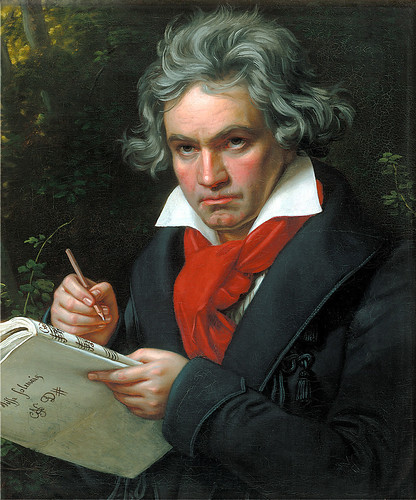
Two hundred fifty years ago today, Ludwig van Beethoven was likely born.
We don't know if this is his actual birthdate. All we can surmise is that he was likely born on this date because he is known, by church records, to have been baptized on December 17, 1770, and it was common practice in his time for infants to be baptized the day after their birth.
I'm not done with Beethoven yet, not by a longshot! I'll be celebrating his life and music for the rest of this month, right up until December 31. But for now, here are some things that others have written about him.
Harold Schonberg, from his book THE LIVES OF THE GREAT COMPOSERS:
The difference between Beethoven and all other musicians before him--aside from things like genius and unparalleled force--was that Beethoven looked upon himself as an artist. Where Mozart moved in the periphery of the aristocratic world, anxiously knocking but never really admitted, Beethoven, who was only fourteen years Mozart's junior, kicked open the doors, stormed in, and made himself at home. He was an artist, a creator, and as such superior in his own mind to kings and nobles.
Edna St. Vincent Millay, "On Hearing a Symphony of Beethoven":
Sweet sounds, oh, beautiful music, do not cease! Reject me not into the world again. With you alone is excellence and peace, Mankind made plausible, his purpose plain. Enchanted in your air benign and shrewd, With limbs a-sprawl and empty faces pale, The spiteful and the stingy and the rude Sleep like the scullions in the fairy-tale. This moment is the best the world can give: The tranquil blossom on the tortured stem. Reject me not, sweet sounds; oh, let me live, Till Doom espy my towers and scatter them, A city spell-bound under the aging sun. Music my rampart, and my only one.
Schonberg:
Beethoven had decidedly revolutionary notions about society, and Romantic notions about music. "What is in my heart must come out and so I write it down," he told his pupil Carl Czarny. Mozart would never have said a thing like this, nor Haydn, nor Bach. The word "artist" never occurs in Mozart's letters. He and the composers before him were skilled craftsmen who supplied a commodity, and the notion of art or writing for posterity did not enter into their thinking. But Beethoven's letters and observations are full of words like "art", "artist", and "artistry". He was of a special breed and he knew it. He also knew that he was writing for eternity. And he had what poor Mozart lacked--a powerful personality that awed all who came in contact with him. "Never have I met an artist of such spiritual concentration and intensity," Goethe wrote, "such vitality and great-heartedness. I can well understand how hard he must find it to adapt to the world and its ways." Little did Goethe understand Beethoven. With Beethoven, it was not a matter of adapting himself to the world and its ways. As with Wagner later on, it was a matter of the world adapting its ways to him.
Jan Swafford, from THE VINTAGE GUIDE TO CLASSICAL MUSIC:
Above the proscenium in Boston's Symphony Hall, one name rests in a marble medallion, presiding over the music like a resident demigod: Beethoven. In many concert halls around the world that design is repeated in one form or another. The reason for this single-minded iconography is that most of these halls were built in the nineteenth century, when Beethoven was the unquestioned sovereign of composers, seeming to epitomize all music. Common opinion in this century has inherited that attitude.
Albert Einstein:
It would be possible to describe absolutely everything scientifically, but it would make no sense. It would be without meaning, as if you described a Beethoven symphony as a variation of wave pressure.
Victor Hugo:
[In Beethoven's music] the dreamer will recognize his dreams, the sailor his storms, and the wolf his forests.
Hector Berlioz:
In the life of an artist thunderclaps sometimes follow each other in quick succession as in great storms, when the clouds, charged with electricity, seem to bounce lightning around and blow up a hurricane.
I had just had a double vision of Shakespeare and Weber, when immediately on another point of the horizon I saw the immense figure of Beethoven arise. The shock I received was almost comparable to that from Shakespeare. He opened up a new world in music, just as the poet had unveiled to me a new universe in poetry.
Leonard Bernstein in THE JOY OF MUSIC:
Many, many composers have been able to write heavenly tunes and respectable fugues. Some composers can orchestrate the C-major scale so that it sounds like a masterpiece, or fool with notes so that a harmonic novelty is achieved. But that is all mere dust--nothing compared to the magic ingredient sought by them all: the inexplicable ability to know what the next note has to be. Beethoven had this gift in a degree that leaves them all panting in the rear guard. When really did it--as in the Funeral March of the Eroica--he produced an entity that always seems to me to have been previously written in Heaven, and then merely dictated to him. Not that the dictation was easily achieved. We know what agonies he paid for listening to the divine orders. But the reward is great. There is a special space carved out in the cosmos into which this movement just fits, predetermined and perfect...Form is only an empty word, a shell, without this gift of inevitability; a composer can write a string of perfectly molded sonata-allegro movements, with every rule obeyed, and still suffer from bad form. Beethoven broke all the rules, and turned out pieces of breathtaking rightness. Rightness--that's the word! When you get the feeling that whatever note succeeds the last is the only possible note that can rightly happen in that instant, in that context, then chances are you're listening to Beethoven. Melodies, fugues, rhythms--leave them to the Tchaikovskys and Hindemiths and Ravels. Our boy has the real goods the stuff from Heaven, the power to make you feel at the finish: Something is right in the world. There is something that checks throughout, that follows its own law consistently: something we can trust, that will never let us down.
Here is what might well be the most famous piece of classical music ever written. Try and listen to it anew, if you can: not just to the thundering opening that is almost a cliche now, but to the varying moods of the slow movement, and the scintillating way the scherzo builds into the soaring chords that dispel the clouds and return us from the land of C-minor to that of C-major. There's a reason that the Fifth Symphony is one of classical music's foundational stones. If Beethoven had written nothing else in his life but this symphony, his place would be ensured.
Thankfully, he wrote so much more than this.
Happy Birthday, Ludwig van Beethoven! Your music endures, and thus, so do you.
Because we are privileged to live alongside one of the very greatest of all Americans, a person who has generated more light for the world than most power plants...here is Dolly Parton.
On the eve of what is likely Beethoven's two-hundred fiftieth birthday, one might ask, "Why do we still listen to him? Why is this music still potent? Why is it still relevant?"
More tomorrow and for the rest of the month, but...this is why. All it takes is being willing to listen, and to go where the music takes you, and Beethoven does all the rest.
Thanks to Sheila O'Malley, who shared this with me over on her blog.
I feature this song every year: Dan Fogelberg's "Same Old Lang Syne", which to me perfectly captures a normal part of the emotional fabric of Christmas: the wistful looking-back as we get ready to add another year to the pile. It's easy to gaze into the past and wonder about the futures that might have been had we made one decision or another along the way, and this song describes a moment in Fogelberg's life--a real moment, as it turns out--where he came face to face with someone with whom he shared a past before their lives diverged.
There's something about the work that results from a genius deciding to just...go on autopilot for a bit. Beethoven found himself in 1813 being requested by a friend to write a piece of music for an automated music device, basically a wind-up machine with wind instruments and such, not unlike a player piano but a bit more complicated. The gizmo was called a panharmonicon, and I wouldn't mind hearing what one of these sounds like. Apparently Beethoven wrote a piece too large for the actual machine, so he expanded it further for full orchestra with a lot of extra percussion and brass, and then he performed it at a concert benefitting surviving soldiers of the Battle of Hanau. The work is a musical depiction of Wellington's defeat of Joseph Bonaparte, and as such it is simply called Wellington's Victory.
The music starts with snare drums, playing softly and getting louder, as if to suggest the marching infantry. Then...well, it's not really a piece on describes or analyzes. It's a series of popular martial tunes, some of which are still familiar to this day. There is also a sequence of actual "battle" music, complete with muskets. The whole thing is just...well, it's a fun listen. It really is. It is also impossible to take seriously. There is no sense at all that Beethoven put any serious effort into this piece whatsoever. He needed a piece that could be played by a machine, so he wrote a mechanistic potboiler. And yet...well, it's Beethoven. When a towering genius does something that for them is no real effort whatsoever, they still have a habit of turning out something of interest.
And Beethoven himself knew this, because when the thing was criticized, he made a rather pointed retort: "What I shit is better than anything you could think up." Ahhh, Beethoven. Ever the social charmer, even when he was right.
Here's Wellington's Victory. The thing that staggers my mind about this piece is that it was programmed on the exact same program as his genuine masterpiece, his Symphony No. 7. One of the enduring masterworks of not just music, but of all Western art...and a trifle commemorating a battle no one much remembers. It's the kind of thing that makes you remember that Abraham Lincoln's little speech at Gettysburg wasn't actually the headlining event that day; that was a two-hour droning oration that Lincoln followed with ten sentences that endured into history.
I just heard this a few minutes ago on Sirius XM and thought, "Well, there's today's selection!" I had, to my current recollection, never heard this before. It's called "Joys Seven", and our performers are the Ensemble Corund. It is based on an older carol, "The Seven Joys of Mary", which numbers seven specific joys Mary experienced as she beheld the life of her son, Jesus Christ. This subject matter is not specifically Christmas, but Christmas is a lot of things, isn't it?
Ahhh, the numbering of the works of the classical masters! If you're old enough, you may well remember owning an LP of Dvorak's Symphony No. 9 (From the New World), but it would have been labeled as his Symphony No. 5, before scholars renumbered it. Likewise, Beethoven's Piano Concerto No. 1 in C Major was actually the second piano concerto he wrote, after the one that would later be published as the Second Concerto. (There had also been an unpublished student work, but we don't need to consider that one here.) Beethoven chose to publish this concerto first, so the numbering reflects not the compositional order but the publishing order.
Classical music can be confusing.
So let's listen to both concertos, No. 1 in C Major, and No. 2 in B-flat Major.
Both of these works reflect the youthful classicism of Beethoven's early period. In each of these concertos you hear the strong influences of Mozart (who was already gone) and Haydn (who was not). But in each you do catch glimpses of the more expansive Beethoven to come, the Beethoven who would take classical forms and stretch them to unprecedented lengths. More important than that, though, is that in each work you hear Beethoven's humor and musical wit, which are characteristics not always called to mind when considering this composer. Of particular note for me in a Beethoven concerto is the third movement, the rondo, when Beethoven always seems to have a great deal of fun with the rhythms, almost making the listener wonder, at first, where the bar line and the beat even are. There's a feeling of syncopation even where there's no technical syncopation happening at all.
In the first performance I am featuring here, of the Piano Concerto No. 1, the Israel Philharmonic Orchestra, conducted by Zubin Mehta, is joined by pianist Khatia Buniatishvili, who is a wonderful artist I've just discovered this year. She plays with technical control that is amazing to behold, and she's also one of those pianists who does put on a bit of a show as she plays. (Her hair would be quite the distraction if she were playing from the score as opposed to memory.) But note also how attentive she is when she goes tacit and the orchestra picks up the main thrust of the music. Buniatishvili performs truly as a partner with the orchestra and with Maestro Mehta, and it's a fantastic performance.
In the second performance, the Piano Concerto No. 2 is played by soloist Martha Argerich and conductor Daniel Barenboim, leading the West-East Divan Orchestra. Some years ago I listened to the entire cycle of the Beethoven symphonies that Barenboim and this orchestra performed at the BBC Proms, and this combination of musicians has, to my ear, a particularly special touch with Beethoven. Argerich is, of course, an absolutely brilliant musician of Argentine and Swiss descent, and she brings here the weight of experience and years of musical training and insight to her performance of the Second Concerto. Which was really the first...but we won't go into that again.
For some years now, The Wife's cars have had Sirius XM radio enabled, in order to make our road trips more pleasurable. One thing I've noticed about the Sirius channels--in addition to there simply being VERY MANY of them, enough to satisfy a whole lot of music tastes--is that since their revenue is already built-in, not only are ads minimal, but the channels aren't limited to small but popular playlists. If you listen to an "oldies" station now, the only Van Morrison you'll ever hear is "Brown Eyed Girl", and this despite the man's very long and prolific recording career. On Sirius you'll hear obscure deep-cuts, songs that were hits back in the day but which have not stood the test of time, and more.
(I know, that all sounds like a paid ad, but I'm getting somewhere with this, I swear! The Sirius folks have not paid me for any of this.)
So yesterday I'm driving about to run a couple of errands, and I'm in The Wife's car, so I'm playing one of the Sirius Christmas channels--the one that's devoted to older songs, so it's the channel where you'll hear Roy Coniff's "White Christmas" and Doris Day's "Silver Bells". A song came on that I don't recall hearing before, or if I did, it's been a long time and it's certainly not a Christmas standard. It was called "Pretty Paper", and after an introduction by a pop-music chorus, the main singer starts in, and I was floored. Did you ever hear a song that you'd never heard by a singer whose voice was unmistakeable? That's what happened yesterday. This fellow has one of the recognizable voices of all time.
Sheila O'Malley has a typically lovely post about Frank Sinatra, whose birthday is today. I started composing a comment on her site, but then I realized that my thoughts were getting away from me, so I decided to bring it over here. Sinatra has been a part of my universe for as long as I can remember; my parents owned a bunch of his records, which were on constant rotation in my childhood. I remember his distinctive sound, sometimes clear and sometimes with just a hint of rasp (depending on what he wanted to express), his sense of rhythm (he could make a song swing without any assisting percussion at all), his lyricism, and his unfailing sense of how to land the emotional beats of a song. This last gift is rare indeed, and it's interesting to me that I'm featuring two singers so highly gifted in that regard on the same day (scroll down to today's Daily Dose of Christmas post). And of course he wasn't just a singer; Sinatra was also a very fine actor with a lot of range. He was in a lot of movies and he won an Oscar along the way and he still might be underrated as such.
The earliest of his roles that I've seen is Anchors Aweigh, in which he plays a Navy sailor who is very young and naive, who has to be instructed by his older buddy Gene Kelly in the ways of the world (meaning, how to flirt without seeming weird about it...in the late-1940s meaning of 'flirting'). Somehow he pulls this off without getting blown off the screen by Kelly; in fact, the two men have a partnership in that movie that elevates it. Anchors Aweigh isn't quite one of the immortal musicals--it's no Singin' in the Rain--but it's damned close.
Just eight years later Sinatra put his dramatic skills on display in a dark turn as Private Maggio in From Here to Eternity, a movie that hit me between the eyes when I watched it in high school. I was channel-flipping lazily, and I happened to land on the opening credits; next thing I knew it was two hours later and the movie was over and I hadn't touched the remote the entire time. Sinatra plays the cocky, arrogant young hothead whose actions end up costing him everything. There are some weird stories--legends, actually--about how Sinatra got the role in the first place, but it doesn't really matter how he got it. The man ended up winning a Best Supporting Actor Oscar for it, and there's a reason for that. Last time I watched From Here to Eternity I found it every bit as gripping as I did when I accidentally watched it as a sixteen-year-old.
Sinatra would bounce in and out of musicals a lot, and his dramatic turns always seemed to be in the crime genre. There was a teevee movie in the 70s called Contract on Cherry Street that I remember, and there's his amazing performance in The Machurian Candidate. He even turned up in the 1980s in an episode of Magnum PI, a show that often leavened its generally light-hearted tone with detours into espionage thrillers and, in the case of Sinatra's episode, pure noir.
Maybe it's easy to discount Frank Sinatra a little because of the genres in which he worked or the popular forms he pursued, but for my money, you can't tell the story of American art in the 20th century without talking about Frank Sinatra.
Sheila starts her post with this quote (possibly aprocryphal) by Bing Crosby: "Frank is a singer who comes along once in a lifetime, but why did he have to come along in mine?" I can't read that quote without thinking of High Society, a movie that was also a favorite of both my parents. It's a musical remake of The Philadelphia Story, with Crosby as C.K. Dexter Haven (the romantic lead who is pining for Grace Kelly), and Sinatra as Mike Connor, the gossip rag reporter sent to cover Kelly's impending nuptials. (Those roles were originated by Cary Grant and James Stewart, with Katherine Hepburn in the later-Grace Kelly part.) High Society is a fun movie, though this story is really better told in the original, as parts of the script had to be set aside to make room for the musical numbers, and...well, I have to agree with my sister, who once said on a Christmas Eve when one of Crosby's Christmas movies was on and we'd all taken in a few beers, "Whoever thought to cast Bing Crosby as a romantic lead was out of their mind."
Well, I don't know about that, but it's always struck me as very strange that this movie has Bing Crosby and Frank Sinatra together, and it gives them exactly one number together...and that number had to be added at the last minute when the producers suddenly realized that they had Crosby and Sinatra in the same movie with no shared numbers. Astonishing! Can you imagine such a thing? Almost making an entire movie with two of the 20th century's greatest American singers in it and only realizing near the end that you've given them zero duets? That's like having Babe Ruth and Mickey Mantle on the same team, but benching one of them at all times. Luckily for High Society, that one number is a hell of a number:
Of course, I can't write about Sinatra without discussing his singing a little bit. Many years ago I read an interview with one of my personal musical heroes, the great Chicago Symphony orchestra trumpet player Adolph Herseht, in which among many other things he recommended that young trumpet players (among others) listen to great vocalists like Frank Sinatra, on the basis that all music, even for instrumentalists, starts with the human voice, and I remember Herseth citing Sinatra for always telling a story with his singing. That is absolutely true.
I'll close this with my favorite track from my favorite Sinatra album, Frank Sinatra Sings for Only the Lonely. Just listen to Sinatra's absolute control in this song! He fades away at the end, fading fading fading ("Answer, echoes, dying dying dying," Tennyson might write), but his pitch never wavers, which is something that requires enormous technical skill: singing (or playing, if you're on an instrument) a note correctly, and making it sound full, while also making it piano or pianissimo is a skill that many musicians don't realize they need until well into their careers. And I'll have to write sometime about my father's favorite Sinatra song...but that needs a post of its own.
For most casual listeners, the words "Beethoven" and "sonata" almost always indicate one of the sonatas for solo piano, and with good reason; the piano sonatas comprise some of the greatest writing for piano in music history, and they are important listening for anyone. And if you happened to be a piano student of any skill, likewise your piano teacher eventually had you work on one of Beethoven's sonatas.
However, Beethoven didn't just write sonatas for piano alone. He also wrote sonatas for solo violin and piano, and for solo cello and piano.
Before turning to a specific sonata, it's interesting to look at the term itself. Sonata is an Italian term, which differentiates an intrumental work to be played rather than a vocal work to be sung (a cantata). Over time, especially in the Classical era when forms began to settle in to certain sets of expectations, a sonata became somewhat standardized as a large-scale work of three movements, which in turn were usually in a standardized sequence: an allegro which used a form in which a single melody (or maybe two) were stated, then developed, before being played again one final time before ending; a middle movement which was usually in a slower tempo; and a fast finale, often much faster than the first movement, and often in a Rondo form. The structure of the first movement--intro, theme, development, recapitulation, coda--became so entrenched that it in itself became known as sonata, or sonata-allegro, form. So important did sonata-allegro form become that it became the almost universal form in first movements of symphonies.
Of course, the history of the symphony is as complicated as that of the sonata, and as Classicism gave way to Romanticism and then to Modernism, adherences to standard forms came and went and came again. Even Beethoven was not always locked into the expected forms: he would start a three-movement piano sonata with a slow movement (the "Moonlight"), or he would write two- or four-movement sonatas. It is best, when thinking about musical forms and definitions of musical terms, that one remember the wise words of Captain Hector Barbossa of Pirates of the Caribbean fame: "The code is more what you'd call 'guidelines' than actual rules."
And when you're a towering genius like Beethoven, who is literally shaping the course of music history for centuries to come, well then...the guidelines are there to be ignored at will.
After all that, let's turn to Beethoven's Sonata for Cello and Piano No. 5 in D Major, which follows all the usual rules and adheres to the usual structure. Beethoven wrote this sonata at the same time as the one preceding it, the Sonata No. 4, in 1815 when his deafness was reaching its endpoint. He was entering what historians have called his "third period", which is when his most introspective and profound music seems to have resulted.
This sonata is apparently less frequently performed than the Sonata No. 3 (which as of this writing I have not heard), which I find interesting. The Fifth Sonata begins with a simple declarative statement by the piano, which sounds twice, seeming to hesitate after each sounding, before taking off into the initial allegro. The movement then propels through its formal demands before drawing to a close before the listener really expects. The second movement puts the cello's lyrical strengths on display, before a final movement that is fugal in nature. When the entire work ends, it is with a feeling of reflective abstraction as Beethoven, only left with his inner ear at this point, is transcribing sounds he can only imagine.
As much as I love the violin as a solo instrument, the cello is not to be slighted in its uses. The technical demands of the instrument are entirely different from those of the violin (which Beethoven had already mastered). Playing the cello has its own physical demands, and the instrument's voice resides in a much lower register, which means that it has to be treated differently than the violin if it is to be heard in full partnership with its accompanying instrument. Beethoven clearly understood the cello as well as he did the violin, judging by the results in this sonata.
And I saw that just as I was starting to think, "Hmmm, I wonder what I should post for my Christmas music of the day?" I love how every once in a while, the Interwebs anticipate my needs.
Here is some Johnny Cash for your wintry morning. (Well, very late autumn, I suppose is technically correct...and as I look outside at this moment there's not much "winter" in evidence yet. We're having one of those years where winter seems to be a slow developing thing, as opposed to other years where at some point in October or early November winter shows up to shout "HEY! I'M HERE!!!" as it wallops us with snow. Right now it's just eternally damp and muddy. What were we talking about? Oh yeah, Johnny Cash. Sorry about that; I'm writing this as the coffee is only just starting to kick in.)
There was always something special about Johnny Cash's voice that I could never put my finger on. It really shouldn't work, that gravelly baritone that doesn't always home in on the exact pitch the way a singer should. Sliding into a pitch instead of hitting it dead on is a standard device of country singing (Reba McIntyre and Garth Brooks are canonical examples of this technique), but what Cash does is...more than that. Sometimes he sounds like he's perfectly content to waver in the vicinity of the actual pitch without actually getting there. If you heard a young music student singing like that, you'd question their ability. When you hear Johnny Cash doing it, you know that you're listening to a master who is doing exactly as he wishes with his voice.
Most of all, though, that guy knew how to home in on the emotional content of a song and use his instrument to make it work. He never stresses the wrong word or puts the em-PHAS-is on the wrong syl-LAB-le, and he somehow makes it sound like every song he sings was written for him and him alone, no matter if he actually did write it or if it's an old standard like "White Christmas" that has been sung by everyone, some of whom are icons with every bit as much stature as Mr. Cash.
Years ago I was driving someplace and an odd segment came on the NPR show This American Life, which was about a libertarian guy who was spearheading what seemed to me a pretty Quixotic notion: rallying a whole bunch of like-minded libertarians to move to a single state, massing enough numerical strength to force through the engines of democracy a large-scale implementation of libertarian policies. Eventually they would be able to show the world entire how wonderful and glorious things are when there is minimal government, minimal idea of public life, and a strong focus on individual freedom.
I remember this very keenly: so strongly did it hit me that I blogged about way back in 2003 (!), when this blog was barely a year old. Here's some of what I wrote back then:
The story focuses on one particular Libertarian, an earnest and intelligent young fellow who is steeped in Libertarian theory, and yet he strikes me as so steeped in theory that he doesn't seem to have a handle on some of the more mundane concerns of life. He completely downplays the inevitable local resistance that his movement is certain to face whenever his twenty-thousand brethren arrive in Vermont or Delaware or Wyoming. His faith in the marketplace strikes me as scary -- private companies will pick up the cigarette butts and maintain all the roads, for instance. We're told that since zoning laws won't exist in Liberatopia, McDonald's will be able to build next door to your house if they so desire. But it's all good, because you'll be allowed to paint your house any color you want. Well, OK…but I fail to see how being allowed to treat my aluminum siding as a Jackson Pollack canvas really compensates for having what goes on behind fast-food restaurants doing so beside my back yard. (I worked in restaurants for years, and I know damn well what goes on outside the back door when the employees are bored. Especially since Liberatopia will have no drug laws.)
Then there is the surreal moment when the guy discusses, as an example of what he doesn't like about public parks. He breezily says, "We'll privatize this common area". He scoffs at all the regulations typical of a town park -- no skateboarding, for instance (this one I can somewhat agree with; there should be more places for skateboard and rollerblade use in this world). But he also scoffs at "No alcohol and no glass containers", which he thinks is Draconian -- but any parent who has ever encountered broken glass around the swings at the playground won't quite share the same view, I suspect. "Parks" equal "theft", he tells us: governmental funding of parks equals theft. When the interviewer points out that no private company is simply going to want to operate a free public park, he concedes, "Yeah, it'll be gated", and then states broadly that there will be no purely public spaces in Liberatopia. I'm glad the interviewer didn't ask what happens to the library. I probably would have broken down in tears at this guy's answer to that one.
This Libertarian travels around Vermont, one of the candidate states for Liberatopia, talking to the locals and trying to get them to sign the pledge promising to move once enough folks are signed up. One guy seems to be hearing these ideas for the very first time, and yet signs on the dotted line almost immediately -- we get to hear the scratching of his pen -- leaving me to wonder if he's really thought things through. I wonder what happens when some of these people move and discover just how much they really, truly, deep-down love little things like parks for the kids and libraries and not having to worry about some company putting a set of dumpsters on the other side of their driveway. I don't know, but something about this whole endeavor makes me envision Bart, after one of Homer's schemes has predictably turned out poorly, saying: "Bet you wish you'd researched this plan a little, eh, Dad?"
After that, I kind of lost track of (and interest in) the Liberatopia Project, because...well, at that time I could claim that I didn't have a lot of experience with libertarians, but now, I have had a lot more experience with them, and suffice it to say that while my reaction to libertarianism back then was a bemused "OK there, champ", my reaction now tends to be "Oh lord, get this nut away from me, and somebody open a window once they're gone."
Well, earlier today I saw this article, which is an interview with the author of a book about what eventually happened with the whole "The Libertarians Are Going To New Hampshire!" movement. Last time I looked in on these goons, they were imagining taking over an entire state; they seem to have eventually scaled down their idea to taking over a town, and they actually managed to pull this off in the unfortunate burgh of Grafton, NH.
Maybe I should give a spoiler warning, but come on: anyone with a pulse knows that this whole notion was bound to be a shitshow, and a shitshow it was:
By pretty much any measure you can look at to gauge a town’s success, Grafton got worse. Recycling rates went down. Neighbor complaints went up. The town’s legal costs went up because they were constantly defending themselves from lawsuits from Free Towners. The number of sex offenders living in the town went up. The number of recorded crimes went up. The town had never had a murder in living memory, and it had its first two, a double homicide, over a roommate dispute.
So there were all sorts of negative consequences that started to crop up. And meanwhile, the town that would ordinarily want to address these things, say with a robust police force, instead found that it was hamstrung. So the town only had one full-time police officer, a single police chief, and he had to stand up at town meeting and tell people that he couldn’t put his cruiser on the road for a period of weeks because he didn’t have money to repair it and make it a safe vehicle.
Basically, Grafton became a Wild West, frontier-type town.
Sean Illing
When did the bears show up?
Matthew Hongoltz-Hetling
It turns out that if you have a bunch of people living in the woods in nontraditional living situations, each of which is managing food in their own way and their waste streams in their own way, then you’re essentially teaching the bears in the region that every human habitation is like a puzzle that has to be solved in order to unlock its caloric payload. And so the bears in the area started to take notice of the fact that there were calories available in houses.
Yikes. Read the whole thing, but as a writer, I have to note that wonderful sentence: "You're essentially teaching the bears in the region that every human habitation is like a puzzle that has to be solved in order to unlock its caloric payload." That's some good stuff, right there!
My most beloved of composers, Hector Berlioz, was born 217 years ago today. While he is often noted (and mocked) for his use of bombast, he was actually very tasteful and strategic in his use of big sounds: Berlioz loved contrast, and he could (and did) write music of surprising delicacy and intimacy. A lot of that can be heard in his oratorio L'Enfance du Christ, which tells the story of Joseph, Mary, and Jesus's flight into Egypt after the Nativity. While Berlioz's music was often met with hostility from the composer's native Parisian audiences, L'Enfance du Christ was embraced from the start and for many years was one of the few works by Berlioz to receive regular performances at all, before the great reassessment of his genius took place in the middle of the 20th century, ninety-plus years too late for Berlioz himself to have enjoyed it.
The Shepherd's Chorus from this work is a common excerpt heard this time of year, but Berlioz is so much more engrossing when one listens to the entire piece, so here it is.
One reason that film music often struggles to get mainstream acceptance as music worthy of interest on its own is the fact that film music is always dependent on the film for its inspiration and genesis. Film composers don't tend to have a great deal of freedom in their work, and they have to compose their scores to accommodate the timing and rhythm of the film given them to score. Obviously some of these composers are masters in their own right and create great works even with these constraints, but the constraints are still there.
Music as an aid to storytelling is best seen, prior to the movies and even after them, in the world of opera, but there is a smaller arena where the great composers of the 19th century often found themselves dealing with at least some of the same constraints that film composers would later confront. I'm talking about incidental music for plays.
Some incidental music has gone on to be quite famous indeed, seen as masterpieces on their own. Felix Mendelssohn's work for A Miidsummer Night's Dream is one of the enduring classics, and one of its melodies has even become a traditional recessional in modern weddings. Hector Berlioz also wrote incidental music, as did Mozart, Schubert, Schumann, Bizet, and Grieg.
And so did Ludwig van Beethoven.
What's interesting about a lot of incidental music is that, Mendelssohn's work for Shakespeare excepted, the music has outlived the plays in nearly every case. Schubert's music for Rosamunde is well known (and in that case, mainly for the overture alone), but the play is almost completely forgotten. Likewise with Beethoven's fine music for a play called The Ruins of Athens. This play was written by August von Kotzebue for performance at a new theater in Pest, and if it's been performed anywhere in the last hundred years, I'd be shocked. But because one of music's greatest of all masters wrote incidental music for it, the play isn't completely forgotten.
Beethoven's suite of incidental music is one of his more pleasing works, even if even this group of pieces is rarely heard except for the Turkish March movement. The suite is not purely instrumental, featuring movements for voices and orchestra. It's all suitably dramatic but also very much Beethovenian. For all his anticipation of Romanticism, Beethoven was even at his most ostentatious always grounded in classical proportion and form. This suite, with its drama and genial melodies, doesn't so much seem to anticipate Wagner as look back at (and, in so doing, extend the reach of) Mozart, and it does so with the geniality of the Beethoven who wrote the Pastoral Symphony.
I've long maintained that one need not necessarily have seen a film to appreciate its score on a separate listen, and when people question me on this point, all I need do is point to music like Grieg's Peer Gynt Suite or Beethoven's The Ruins of Athens and ask, "Do you really need to see a forgotten play to appreciate this music?"
In honor of the passing of Chuck Yeager (with a typically wonderful memorial by post by Sheila O'Malley), here is a suite of music by Bill Conti from the film The Right Stuff, which adapted the Tom Wolfe book that told the story of the early years of the American space program, with interesting focus on Mr. Yeager himself.
Forty years ago tomorrow, I got up to get ready for school. My mother had Good Morning America or Today or one of those on in the living room, which is when I learned of what happened forty years ago today. John Lennon, shot dead in New York City.
It would be many years before I would finally warm up to the Beatles' music and the enormity of the act of cultural assault that Mark David Chapman committed that day.