Showing posts with label Teevee. Show all posts

Wednesday, April 21, 2021

Figure out a new funny.

 For years, Ken Levine has done a "summation" post of the annual Oscar telecast, full of pithy humor. I don't normally do much more than skim these over, because I don't watch the Oscars and therefore I never have the full context for what Levine is making fun of, and in all honesty, I occasionally find Levine's sense of humor a bit mean-spirited.

Well, yesterday he wrote a surprisingly whiny post announcing that he's not doing the Oscar posts anymore, and not for the obvious reason (this year's telecast is likely to be a colossally unentertaining train wreck), but because of...sigh...he doesn't want to run afoul of "cancel culture" or "the woke crowd".

But the major reason is the current woke culture.  God forbid I offend anybody.  What good is being snarky if you’re not allowed to criticize?  And it goes beyond possibly being insensitive.  Now you’re branded as a racist.

In the privacy of our homes, part of the attraction of watching the Oscars (and especially at Oscar parties) is taking shots at the horrible gowns and stupid tuxedos and ridiculous hairdos.  What makes them so funny is how those offenders thought they were looking so glamorous and elegant.  Bringing down people who take themselves too seriously is a comedy staple.   And you may not be proud of yourself for making fun of these entitled people, but you do. 

However, if I say one despairing thing about Viola Davis’ dress I’m loudly pegged a racist.  If Penelope Cruz mangles her turn announcing the nominees and I point it out, I’m a racist.   If I’m happy for a deserving winner who happens to be white I’m a racist.

I find this incredibly disappointing, and it's really tiresome hearing from comedians who are upset that they apparently have no avenue to being funny other than by offending somebody. Maybe a Black actor is wearing a dress inspired by traditional African tribal wear; maybe Cruz has a speech impediment. I don't know, and maybe it's occasionally unfair if someone takes your funmaking moment that's directed at someone and interprets as not being motivated simply by a desire to be funny. But then, maybe your little joke actually is rooted in a preconceived notion, a prejudice, and maybe we should be a bit more intellectually curious about that. In short, I have become very weary of white people who whine about "the race card" getting played.

And to be honest, elevating "Hahaha, look at what someone decided to wear!" isn't punching up. It's just making fun of someone's looks, whether they're rich or poor or whatever, and I suppose it's up to the person laughing to decide if it's even "comedy". It frankly isn't to me. It's why the least appealing part of Joan Rivers's career was her "make fun of the people on the Oscar carpet" phase.

Levine wraps up thusly, though, which just made my jaw drop:

It’s a shame because comedy suffers.  And as a society we need comedy.  Now more than ever.  But if those who provide it have to walk on eggshells, then what’s the point?  

Yet another comedy writer or comedian complaining that comedy is all hard, now! It's so hard! But we need comedy! I'm providing a desperately needed service in dark and gloomy times, but you're all being mean to me for it!

Well, look. I grant the premise that we need to laugh and we need comedy. Absolutely. But...do we really need this particular kind of mean-spirited comedy that's not so much motivated by finding the funny things in life but by primarily making fun of specific people? Levine sounds like everybody else who I ever hear complaining about "Everybody's offended now!" When I hear people talking about this, I like to ask: "Just what specifically do you feel you can't get away with saying now?" The hemming and hawing starts immediately, because no matter how hard I press, they're never going to admit that they really want to be able to tell mean and sadistic jokes about n*gg*rs or k*kes or sp*cs or f*gg*ts or whatever. But that's what it almost always boils down to, in my experience.

Maybe not for Levine specifically, but as I look around at a world where certain things are not really seen as viable sources for comedy, I'm not seeing comedy itself suffer as a whole. There's funny stuff out there a-plenty. The last ten years have seen shows like Brooklyn Nine Nine and The Unicorn and Kim's Convenience, all of which are funny without resorting (much) to potentially offensive minefields. (B99 has come in for some criticism for its treatment of asexual/aromatic people). Christopher Moore and other humorists are still writing books. Daily comic strips still generate humor; the venerable Nancy has been rejuvenated of late by a new writer/artist, and no "offensive" content is needed.

What's more--and this is what's really bugging me about Levine's rant--is that comedy has not always needed to rely heavily on the kind of material that's now seen as unfunny or outright offensive, and Levine of all people should know this. He's been writing comedy for years! He wrote episodes of M*A*S*H, for God's sake, and that show was on almost fifty years ago. The idea that comedy is somehow being hobbled today by "the woke crowd" simply doesn't hold up when one considers just how much older comedy is still funny and didn't need to do any of the eggshell-walking stuff to be funny.

Recently The Wife was on bed rest following a medical procedure (she's fine!), and one thing she did to pass the time, during which I joined her a bit, is watch a lot of old episodes of Bewitched. That show holds up as being pretty damned funny, even if its sense of humor is dated by being a sixty-year-old show. Some jokes fall flat because we've moved on in a lot of ways, but the show really does hold up. A lot of M*A*S*H still holds up. Monty Python's Flying Circus was airing fifty years ago and a ton of that material is still hysterical, and not much of it at all needed to lean on anything that might get 'canceled' now to get laughs. The "Reverend Jim takes his driving test" scene from Taxi? Forty years old, and funny. The "Ralph Kramden and Ed Norton figure out golf" scene from The Honeymooners? Still funny, and nothing to be canceled here (unless it's Ralph's absurd pseudo-Scottish outfit). We also watched an older George Carlin HBO special, one from the late 1980s (Carlin wore a light blue shirt, which tells you something since he spent his last several decades only wearing black), and it was still hysterical, despite a few jokes that didn't age well.

Of course there's a lot of comedy that has not withstood the test of time; I never see Sam Kinison or Andrew Dice Clay mentioned much these days when the subject of older comedy that's still funny comes up. I never found either of those two amusing, even when they were popular and using their shock value to generate nervous laughter. My point isn't that everything stays funny, but that shifting mores and evolving societal choices don't neuter all old comedy, which would have to be the case if we really were making comedy so much more difficult now.

There's plenty of stuff that's making me laugh, so what am I to make of the idea that comedy is somehow in handcuffs now, that it's so hard to be funny without offending? Frankly, not much, because I'm too busy laughing. And sure, maybe I'm not a great test subject--I'm one who is still amused by a pie in the face, after all--but the material that makes me laugh exists, so I can't be the only one. It's not comedy that's suffering, it seems to me; it's people who want to make people laugh a certain way and are discovering that people don't want to be made to laugh that way anymore. And how surprising is that, really? An awful lot of people probably never found that stuff funny, and if amplifying their voices means some jokes don't get told, well, that's a trade I'm willing to make.


Monday, April 12, 2021

"Can you tell me how to get to Mandalore?" "This is the way."


 A couple weeks ago, we finished watching Season Two of The Mandalorian, so here are my thoughts on the show, including thoughts on Season One. None of this is in any particular order. In fact, it's pretty damned random, because that's how I blog. This is the way.

(Note: I know that his name is actually "Din Djarin", but I'm going to refer to him as either "The Mandalorian" or "Mando", as he is dubbed by the Carl Weathers character.)

ITEM the ZEROTH: OK, before I begin talking specifically about The Mandalorian, I have to once again complain about how lax the Internet is with spoilers. Many are careful, but it seems to me that most are not, and even if the ones who are not do not actually constitute a majority, there are enough of them out there that it really doesn't matter. We did not watch The Mandalorian as it unfolded; we waited until the seasons were complete to enjoy them. This, of course, meant that nearly every major development was spoiled for us.

When the era of streaming shows began, the original Netflix-led model was to make the entire show and then put all the episodes online at once, so you could watch the entire series in a weekend if you wanted to. Now, the streaming services seem to be leaning more toward an adaptation of the original broadcast model, in which one episode is dropped a week for however many weeks it takes to get the entire thing out there. That's how The Mandalorian worked, with the result that within a day or two of each episode appearing online, the major events would be spoiled. And brazenly so! I'm not talking about people posting "WHOA!!! Did you SEE what happened on MANDALORIAN tonite!!!" and then discussing in the threads. No, they would post the spoiler right in the text so you had no chance to avoid it...or they'd post "SPOILERS!" but then also attach a screenshot from the show that had the spoiler right in it.

Disney very clearly structured the marketing of The Mandalorian, before Season One, to keep the appearance of Grogu (then dubbed by fandom "Baby Yoda") a surprise at the end of Episode One. That surprise lasted, I think, mere hours. I knew about "Baby Yoda" before noon of the very next day, and this went on for every major development in the show, over both seasons, right up to the appearance of Luke Skywalker.

I don't know that there's a solution to this, but it is most definitely an irritating aspect of 21st century fandom and geek culture. I'm not super-militant about maintaining my spoiler-virginity on everything I watch, but I would like the choice there to be mine.

On to actual stuff from the show:

ITEM THE FIRST: It's cool how this show has easily added its catchphrase, "This is the way", to the Star Wars lexicon. A lot of Star Wars teminology eventually does so, starting with "May the Force be with you!" being on everybody's lips way back in 1977, and leading up to Prequel terms like padawan and youngling showing up in general conversation. Now we have "This is the way". I also liked [character]'s habit of finishing his thoughts with "I have spoken!". This one hasn't caught on as well, but I like it and I try to use it from time to time.

This is a good thing for writers of sci-fi and fantasy to do, I think. People have things that they say repeatedly, out of ritual or habit, and I like it when writers of such material create such--is there a word for what I'm talking about?--slogans. George RR Martin is really good at this in A Song of Ice and Fire, as an example.

Having Mandalorians salute each other with "This is the way" is a really cool way of establishing their insular, internal culture.

ITEM THE SECOND: It's something of an article of faith that Star Wars, at least at first in A New Hope, was essentially a Western translated into a space opera. I've never quite bought into this notion. It seems to me less that Star Wars was a space Western than Star Wars used older tropes that many Westerns use as well. Star Wars's influences do include Westerns, but they also include the films of Akira Kurasawa, many of which also share tropes with Westerns without actually being Westerns. This show, more than any other of the Star Wars projects of the post-George Lucas era, put those tropes on display. You have the lone hero who lives his lonely life going from place to place, you have the dusty frontier outposts, you have the minor chieftains or warlords or outlaws who are ruling their little regions.

But again, I wouldn't say that The Mandalorian is a Western. I'd say that it shares a similar feel, with all those tropes. The closest analogue is the great Japanese manga Lone Wolf and Cub, which has a lone Samurai warrior traveling throughout old Japan, as he cares for his infant companion.

ITEM THE THIRD: In all honesty, I was never a big Boba Fett fan (more on him below). That said, it's interesting to finally get some of the backstory about the Mandalorian warriors. Our hero's commitment to his order's rules and laws gives him plenty of opportunity for internal conflict as he negotiates a deeply dangerous universe.

ITEM THE FOURTH: This story is set in the years after Return of the Jedi, when the Empire has fallen but the New Republic is still trying to gather its strength. This is a largely unexplored part of Star Wars lore. I liked seeing pockets of remaining Imperial strength, as surely much of the old infrastructure will keep on functioning, even in the absence of the Emperor. Factions will be jockeying for power, which is definitely something we see in this show. The show's structure dealt with this better in Season One, I think, as it showed our hero and baby Grogu moving into and out of these stories that are still going on.

But in Season Two, we start off with thrilling episodic adventures that take us from one world to another as Mando and baby Grogu have interesting adventures. This part of the series felt like the old Marvel Star Wars comics, the ones that were the first-ever tales told in the Star Wars universe beyond the scope of any movie. At that time, there was only one movie and just the barest beginnings of all the mythology that would unfold over the next four-and-a-half decades of Star Wars storytelling, so you had tales that had Han and Chewie going to a dusty backwater world for a Magnificent Seven type of adventure (and that was way more of a "space Western" than A New Hope ever was!), and then Luke and company had an adventure in a little local war on a planet that was nothing but oceans, and then there was some intrigue on a space casino...well, you get the point. Back then, the only Star Wars storytelling in town was a sequence of fun space adventures. In its best episodes, for me, The Mandalorian hearkened back to that feel.

Toward the end of Season One, our hero and his young charge run afoul of an Imperial official and his still-loyal soldiers who are looking for young Grogu (who hasn't been named yet, by this point), and the first season ended with a bit of a cliffhanger that made clear that our Imperial official, Moff Gideon, was going to be a continued problem. And that was pretty cool, as it's still interesting that all the Big! Grand! Events! that have redefined Galactic history elsewhere (Vader killing Palpatine, the Rebels defeating the Empire) really haven't had that great an effect in the Outer Rim. Still, my hope was that all the Empire-versus-New Republic stuff would be kept firmly in the background.

Sadly, about halfway through Season Two, the tone shifts completely, away from the cool adventures and into Bigger Mythology, which is when I started to lose a bit of my enthusiasm. Mando learns that Grogu is clearly a powerful being, and that he can only be safe with a member of a race of wizards called "Jedi", who were apparently a major enemy of the Mandalorians at one point. This quest, for Mando to deliver Grogu to "his people" (not necessarily his species, which has still never been named!), forms the backbone of the second season: Moff Gideon is still searching for Grogu for his own purposes, while Mando is trying to get him to the Jedi. As this story takes over, we're squarely back in Empire-versus-Jedi again, albeit looking in from the outside.

Structurally, this quest takes on a repetitive note: someone tells Mando that they've heard of a Jedi or something Jedi-like on some planet; he goes to that planet and finds what he can find, but it's not the right place, so he's told..."Go to this planet instead." There's a kind of lather-rinse-repeat feel in the middle episodes of Season Two because of this.

Then there's an episode which a lot of fans were really looking forward to: Mando goes to a planet where he's heard there's a Jedi, but it's actually Ahsoka Tano, a character from the Clone Wars animated series (which I haven't watched). Ahsoka was a Jedi padawan way back when, but since the fall of the Jedi and the rise of the Empire she's been on her own (and my understanding is that she's actually left the Jedi order, for whatever reason). There's an adventure here, and then at the end of the episode, Ahsoka says that no, she can't take Grogu and train him, but if Mando goes to [insert planet], he'll find someone! So off we go again. Meanwhile, Ahsoka captures the episode's Villain-of-the-Week and demands, before the episode ends, "Where is Grand Admiral Thrawn?"

Nothing ever comes of that. It's just there.

And that's my main problem with the back half of Season Two: just about all of it feels like set-up for stuff to come later, or fan service, or an odd tying together of seemingly every story and every character who is already out there.

This has actually been a long-time problem with Star Wars, and it can infect other large franchises, too: for worlds that are supposedly incredibly vast, it sure is odd how everyone ends up knowing everyone else. When Boba Fett showed up in Season Two, I had to go look up the character's history post-Return of the Jedi, because I just haven't kept up with a lot of it. (Remember, if all you watch is the movies, the last word on Boba Fett was that he got eaten by the Sarlacc, so to find him quite alive and well is a bit of a shock...but then, in every post-ROTJ story ever, starting with Marvel's own comics back in 1983, he's gotten himself spit out by the Sarlacc, because writers just can't quit the guy.) In The Mandalorian, it's never mentioned how Fett got out of the Sarlacc, so I figured I'd check it out. It turns out that in all the comics and books (and maybe shows too, which I haven't watched), Boba Fett has had a long history in which he has interacted at one point or another with everybody in the Star Wars universe.

Surely not all of Star Wars needs to boil down to "Ain't nothin' but a family thing."

But to go back to Ahsoka Tano's mention of Grand Admiral Thrawn...that's nothing but set-up for something to come. Ditto all the mentions of retaking the Mandalorian home planet, or whatever. For the entire back half of Season Two, I felt like I wasn't watching a story but rather a long sequence of set-up events, like the end-credits scenes from MCU movies, each expanded to episode length.

ITEM the FIFTH: There's a lot more fan service in Season Two than there is in Season One, but for the most part I was cool with it...until the very end. It was nice seeing Boba Fett's ship again, and yes, I'll admit an internal squeal when I realized he was going to deploy the seismic charges (the most underrated weaponry in all of Star Wars: how can you not love a bomb that detonates with a colossal electric-guitar TWANGGGGG!) But this show really went way too far with the idea that Imperial Stormtroopers are terrible shots. In scene after scene after scene after scene, we see Mando and his allies picking off the Stormtroopers one by one, while the Stormtroopers flail and fire randomly and seemingly can only win by virtue of sending hundreds of themselves into battle against two people.

But the worst fan service comes at the very end of the last episode.

Judging by the reactions I saw online after this episode aired, I am in a very small minority here...but I did not like Luke Skywalker's appearance.

First, from a pure storytelling stance, it was pure Deus ex machina. Our heroes are backed into the corner, there seems to be no way out...and along comes, at just the right moment, the Greatest (and, currently, Only) Jedi in the Galaxy to bail them out, carving his way effortlessly through the legion of battle droids (who, having been disposed of earlier in episode, manage to turn around and show back up again, in a kind of Diabolis ex machina to make the Deus necessary). This whole scene seems visually designed to echo the Darth Vader scene at the end of Rogue One, which is another scene that I, contrary to just about everyone else, greatly dislike.

Now, by the time I got around to watching this I had been long-spoiled (thanks, Internet!), but even so...while everyone else was cheering at this, I found it just...well, sigh. And not just because it was Deus ex machina, but it put me in mind of the Sequel Trilogy of movies, whose events lie a decade or two in the future of these characters. Luke takes Grogu off to properly train him in the ways of the Force...but here's the thing. We know from those movies (about which I need to write some final thoughts, I guess) that Luke's efforts to establish a new Jedi order come to spectacular ruin. It's entirely possible that Kathleen Kennedy, Jon Favreau, and Dave Filoni (the current High Poobahs of the Star Wars enterprise) have ideas to the contrary, but since we know that eventually Luke Skywalker ends up depressed and dejected on Ahch To as the Empire's remnants rise again as the First Order and come very close to retaking the Galaxy, and since in none of those events does an older and fully-trained Grogu show up to do useful stuff, I have to assume for now that Grogu is simply one of Luke's students who is later murdered by Ben Solo/Kylo Ren.

I know, there's a lot of story that can unfold between now and then, and maybe we do get a story later on someday of Grogu's Last Stand...or maybe the Star Wars writers can actually come up with a satisfying way of sparing Grogu the fate of falling before the Knights of Ren and also not playing a part in the whole First Order War. (Or maybe they end up just retconning those movies out of existence, which would in all honesty not bother me at all, as much as I love The Last Jedi.)

ITEM the SIXTH: To bring this back to a positive note, since I really did enjoy both seasons on balance even with my reservations and my genuine distaste for Season Two's ending, I love this show as a production. It just looks fantastic, with a lot of imagination in its visuals and yet still firmly tied to familiar Star Wars aesthetic. The end credits are even worth watching, as they scroll over illustrations of scenes from each episode that stylistically hearken back to the great Ralph McQuarrie paintings that helped George Lucas establish his visual vocabulary for Star Wars in the first place. The music is neat, adding a whole new sound world to the Star Wars universe and moving well beyond the general John Williams sound. And despite my misgivings noted above, the writing is often excellent! Individual episodes move quickly and the dialogue is surprisingly crisp and witty.

What really makes The Mandalorian work as well as it does is the acting, though. There's not a bad performance to be had here, and each actor in this show creates a unique character. I would single out Pedro Pascal for special mention here, since except for a couple of scenes, he has to convey everything through body language and his voice work...and it works completely. Mando is as vivid a character as any in the Star Wars universe.

As for the other main lead? Grogu is terribly well-done, isn't he? I haven't looked it up at all, but I assume that he is a blend of CGI and puppetry. He's cute, but not nauseatingly so; he has real facial expressions and at times his behavior is not cute at all. I have to admit that I hope Season Three somehow manages to reunite our Lone Wolf with his cub.

ITEM the SEVENTH: I also want to note the nifty spaceship design in The Mandalorian. The aesthetic here is much more Original Trilogy Star Wars than Prequel Trilogy Star Wars; everything here is old and used and lived-in and beaten up. Living spaces are tight and cockpits are cramped and ships look and sound like what they are: machines that have been put through their paces and asked to do things that they were never built to do in the first place. Mando's ship, in particular, is great, and it's quickly become one of the iconic ships in all of Star Wars. It's sad that it got destroyed at the end of Season Two. (I do note that its outboard thrusters, which rotate on their axes depending on where the thrust is directed to go, owe a conceptual debt to the Serenity of Firefly fame.)

ITEM the EIGHTH: I loved the music for this show! It's Star Wars meets the spaghetti westerns, indebted both to John Williams and to Ennio Morricone.

IN CONCLUSION, YOUR HONOR: I really did enjoy both seasons of The Mandalorian and I'm looking forward to what is to come. I do hope, however, that the show steers back toward being its own mostly-self-contained thing, and not a vehicle for backdoor-piloting other Star Wars stories. I also hope that it doesn't delve too much into larger stories about Galactic politics and ancient wars. I have absolutely nothing against those things! But...I'd like to think that Star Wars can still be more than that. There's nothing wrong with smaller stories where the stakes aren't galactically high. In fact, sometimes the most compelling stakes are the small ones, and I prefer The Mandalorian when it's concerned with a few people trying to hold on to what they have.

Like a Western. In space.

I have spoken.


(art credit)


Monday, August 03, 2020

Happy Birthday, Martin Sheen!

Today is Martin Sheen's birthday! He turns 80 years old, which I can hardly believe. In his honor, I'd like to note just one scene from his amazing life of work. This is from The West Wing's Season Two opener, called "In the Shadow of Two Gunmen". The previous season had ended with an assassination attempt on President Bartlet (Sheen), and as the finale ended we didn't know who had been shot or even killed.

When Season Two began with this two-part episode, we learned that President Bartlet and his Deputy Chief of Staff, Josh Lyman (Bradley Whitford), had both been shot. Bartlet's injuries weren't life-threatening, but Josh's were critical, and the episode unfolds as doctors work to save Josh and the White House and the nation react to the attack. Meanwhile, in flashbacks, we learn how the cast came together in a quixotic campaign to elect a long-shot candidate President.

Throughout all of the flashbacks, much is made of Bartlet's prickly nature, the fact that he's not especially nice to those in his inner circle, and that he simply isn't ready to be President. Aaron Sorkin's script even has a description: "There's something about Bartlet that seems smaller somehow." I don't know how Sheen managed to suggest "being somehow smaller", but at the end of the episode comes this scene.

It's one of the flashbacks. On the very night that Governor Josiah Bartlet wins the Illinois primary, thus becoming the almost-certain Democratic nominee, Josh receives the phone call that his father has suddenly died of cancer. As the campaign celebrates and gets ready for the trip to California, Josh instead has to go to the airport to fly home for his father's funeral. He's sitting at the gate when he notices Secret Service agents forming a perimeter around him...and then there's Bartlet, the last person he expected to see.

In this scene Bartlet finally shows some warmth to the people who have given up other careers to try and elect this guy, and it really is quite a wonderful scene between Sheen and Whitford. But the real amazing thing comes at the end of the scene, when Josh is heading off to catch his flight. Leo McGarry (John Spencer), Bartlet's oldest friend and campaign manager and eventual White House Chief of Staff, comes up from behind and asks Bartlet if Josh will be OK; Bartlet replies, "He's gonna be fine," and then...Bartlet turns around to face Leo.

And in that simple act of turning around and straightening up just a bit, we see that indeed Bartlet had been "somehow smaller", but now...he's not. He turns to face Leo, and he straightens just a bit, and he says: "Leo, I'm ready." I love when actors can create a completely different tone in their characters just by altering their posture in the tiniest bit.

Here is the scene, and Happy Birthday, Martin Sheen!


Thursday, April 06, 2017

"Let me help" (Thoughts on "The City on the Edge of Forever", on its 50th anniversary)


Edith Keeler: And you, um, don't want to talk about it? Why? Oh. Did you... did you do something wrong? Are you afraid of something? Whatever it is, let me help.

Capt. Kirk: "Let me help." A hundred years or so from now, I believe, a famous novelist will write a classic using that theme. He'll recommend those three words even over "I love you."

Fifty years ago today, "The City on the Edge of Forever" aired for the first time. This episode of Star Trek is, for me, not only the best episode of any Trek series ever filmed, but it's also the best Trek story of all time. It's one of the great science fiction stories, one of the great science fiction romances, one of the great time travel stories, and its ending packs one of the greatest gut-punches ever.

If you've never seen it...you should. Really. The story doesn't really require a huge amount of knowledge of Trek. The Enterprise is investigating strange "ripples in time" that are emanating from a particular planet, and during one such jolt, Dr. McCoy accidentally injects himself with an enormous overdose of a drug that drives him temporarily insane. He flees to the planet surface, and Kirk follows, with Spock and some others. They find themselves in the ruins of an ancient city, with one functioning artifact remaining: a giant portal which is actually a portal through time itself. McCoy, still mad, jumps through and into history, and suddenly the members of the landing party realize that the Enterprise is gone. McCoy has changed history so that the Federation never happened.

With no choice but to try and put things right, Kirk and Spock follow, and find themselves in 1930s New York City. While trying to figure out what McCoy did and where he is, they enter the employ of a woman named Edith Keeler, a visionary who runs a soup kitchen. Kirk falls in love with her...only to have Spock discover that what McCoy did was prevent Edith Keeler from dying in a car accident. If she survives, she lives to found a peace movement that prevents America's entry into World War II, allowing the Nazis to win and take over the world.

Spock: Jim, Edith Keeler must die.

The story unfolds so organically that the episode feels longer, heftier, than its 50-minute or so running time. The episode feels large, and yet all of its key moments play out on an intimate stage, such as when Jim Kirk and Edith are walking along the street at night and Kirk tells Edith some things about the future, things that don't even strike her as strange to be hearing from this man she's just met. And the way she sizes up Kirk and Spock's relationship:

Edith Keeler: [to Kirk] I still have a few questions I'd to ask about you two. Oh, and don't give me that "Questions about little old us?" look. You know as well as I do how out of place you two are around here.

Spock: Interesting. Where would you estimate we belong, Miss Keeler?

Edith Keeler: [to Spock] You? At his side, as if you've always been there and always will. [to Kirk] And you... you belong... in another place. I don't know where or how... I'll figure it out eventually.

Spock: [to Kirk] I'll finish with the furnace.

Edith Keeler: [to Kirk] "Captain." Even when he doesn't say it, he does.


"The City on the Edge of Forever" involves relatively little action. It relies on its character work, showing us that Kirk is falling in love with Edith Keeler before Spock's discovery that she is the key focal point around which history will pivot. William Shatner, Leonard Nimoy, and Joan Collins likewise turn in amazing work in this episode. Collins's Edith Keeler is probably the woman in James T. Kirk's history, the one he could not save even though he desperately wanted to. Her death is the memory that he will carry with him forever. Shatner sells every single minute of this, never once over-emoting, never once going too far. His Kirk doesn't just fall for a pretty woman. Shatner portrays a Kirk who has just discovered, hundreds of years in his past, a kindred spirit. He has found someone whom he can understand and who can understand him. And when he realizes that he may well have to stand by as she dies...Shatner's portrayal of a man torn on both sides of the awfullest of dilemmas is so stark, so aching, that it always moves me nearly to tears.

And then the moment arrives.

The script's other masterstroke is that Spock can't determine when the awful event will occur. There is no "She dies on November 12, 1937." This isn't like Stephen King's (masterful) 11-22-1963, when we know exactly when the events are going to occur. Kirk has no idea it's happening, even as we do. He sees her coming back across the street. He starts out to help her...and then he stops. He knows. The moment is upon him, and it unfolds as quickly as it has to. No slow-motion here, no long-held gazes. It comes so quickly that for us, the viewers, it's almost like--what? Was that it? Oh my God, that was it. Over, that quickly.

But Kirk not only had to let Edith die, his choice -- his only choice -- was more awful than that. Because Dr. McCoy was there too, and he didn't know. They had just found him, seconds before, and now McCoy too is watching Edith Keeler walk into the path of the truck. Kirk can't just stand aside, or stand still, and watch Edith die, because if the script allowed him that much, he'd be able to say later, "I couldn't have saved her. She was too far away."

The script doesn't pull its punches. It doesn't give Jim Kirk that one possible out, that one possible way he can morally justify it all to himself.

Jim Kirk doesn't just passively allow Edith Keeler to die. Jim Kirk grabs McCoy and holds him back. Jim Kirk stops McCoy from saving her.

Kirk's choice is an active one.

McCoy doesn't know this. He doesn't know any of it. He only knows that he could have saved her. His voice fills with rage.

McCoy: You deliberately stopped me, Jim! I could have saved her. Do you know what you just did?

And then Spock, summing it up so logically, so heart-breakingly, in a line that no actor other than Leonard Nimoy could have delivered:

Spock: He knows, Doctor. He knows.

One thing about Star Trek II: The Wrath of Khan that has always bothered me was the idea of the Kobayashi Maru test, the idea that a false scenario could somehow test a cadet's approach to a situation in which there is no possible "victory". In that movie, Kirk openly says "I don't believe in the no-win scenario," and later on, after Spock's death, he says that he has never really faced death. But in "The City on the Edge of Forever", he faces both a no-win scenario, and he faces death. The idea that Kirk can later on claim otherwise has always seemed deeply false to me. Maybe he's blocked the memory of Edith Keeler? Maybe it's so painful that he doesn't admit it in either case? Certainly Kirk never mentioned her again in any filmed episode or movie, which isn't that surprising given the tendency of teevee shows back in that period to not mention previous events much. But the story here, this love between starship captain and soup-kitchen owner three hundred years before his time, is so iconic, and it carries so much weight, that it's almost offensive to me to think that a James T. Kirk can exist who isn't carrying her memory around. Maybe better, then, if in reply to his son David's accusation that he never has faced death, Jim Kirk were to say, "There was one. She died saving us all, too."

But then, you can't have too many mentions, either. Trek would never again visit that City on the Edge of Forever, except in one episode of the animated series, and with good reason. No story involving the Guardian of Forever could possibly stand up to comparison with this one. Trek would not eschew time travel, by any means, but this particular means was left as a singular part of Trek mythology. I wonder if any Next Generation writers were tempted to visit it. I'm glad they didn't. It is interesting, though, that Jean-Luc Picard would get his own kind of iconic time-travel story in "The Inner Light", as would Benjamin Sisko in "The Visitor".

James T. Kirk is an explorer at heart, and an adventurer. But his experiences in the past, via the Guardian of Forever, have a profound effect on him. At episode's end, when he and Spock and McCoy return to the present with everything restored, the Guardian appeals to that part of his soul, offering to guide him and the others through history. What an offer to someone whose life is charged with boldly going! And yet, all Kirk can muster in that moment is a gruff, "Let's get the hell out of here."

"The City on the Edge of Forever" is the kind of story I dream of writing. For a single one-hour episode of a teevee show to hit so many emotional highs and lows? To linger in the memory as it does? I wonder if, as they were shooting it -- maybe at the first table read -- anyone either thought or muttered, "They'll still be talking about this one in fifty years."

Who knows? If my health permits, I'll still be talking about this episode when it hits one hundred.


Tuesday, January 24, 2017

Why not "The Force Gets Coffee"?

Some geeky stuff!

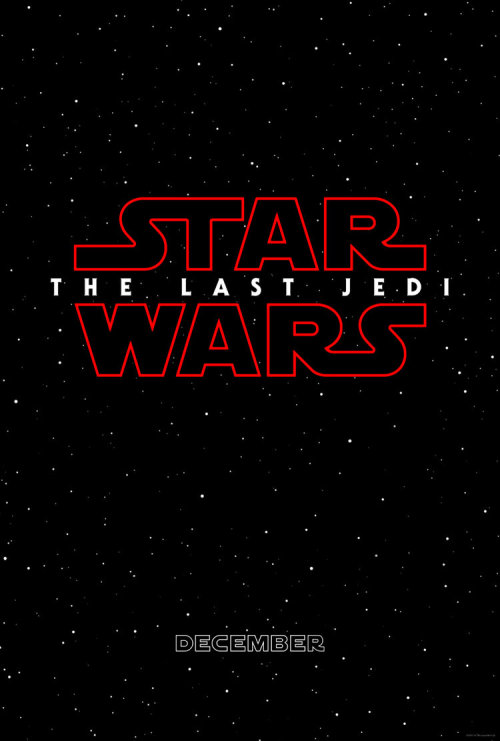
:: Star Wars Episode VIII has itself a title:


I honestly don't have an opinion of this as a title. Star Wars titles tend to be greeted as events, and then...well, they're titles. OK, The Last Jedi.

It does break a little with previous "middle installment" titles from previous Star Wars trilogies. The opening films generally have three-word titles that suggest a story beginning: A New Hope, The Phantom Menace, The Force Awakens. Then, previously, we're had four-word titles that indicate a middle installment based on action: The Empire Strikes Back, Attack of the Clones. But this breaks that "tradition". Is this a problem? Not really. If the movie's terrific, they could call it Jedi Boogaloo for all I care.

::  This has been making the rounds of Facebook the last few days: a poster for Star Wars in which the characters are re-cast as the kids from Stranger Things.


The artist, Michael Maher, has done quite a bit of cool Star Wars art, as well as other things. Check out his work!

::  I have no idea how I missed this show's existence entirely, since I have to think this would have been right up my alley when I was seven or eight years old, but miss it I did. It was an NBC show called Supertrain.


The show is described thusly:

The series was one part sci-fi, one part The Love Boat. It revolved around a nuclear-powered bullet train that could travel from New York to Los Angeles in 36 hours and had amentities like swimming pools and shopping centers.

Just like The Love Boat, the plot focused on the passengers and their connecting storylines. Supertrain could have been a minor a hit, but there was one issue. It cost way too much money.
New York to LA in 36 hours? WOW!!! In an era when planes can do it in six! I assume the show had some explanation for why there were no planes.

Apparently to make the show look good, the producers had to make really large and expensive models. Look at this thing:


Unfortunately, the show's big budget took an even bigger hit when -- well, anybody who ever played with an electric train must know what happened.


My favorite part of that pic is the guy standing in the foreground, wreckage behind him, cigarette in hand as he undoubtedly wonders if he's ever going to work in this business again.

Apparently the ratings were awful, leading to desperate casting stunts like Tony Danza and Zsa Zsa Gabor, making the show another in the 1970s-era super-genre of shows designed to have rotating All-Star Casts every week. Fantasy Island and The Love Boat meet...Silver Streak? I dunno, but this concept for a show seems gonzo enough to have really appealed to me as a post-Star Wars kid.


Wednesday, October 19, 2016

“She’s so broken insiiiiiide!” (or, why CRAZY EX-GIRLFRIEND is the best thing ever)


Crazy Ex-Girlfriend is about to debut is second season! Huzzah!!

Rachel Bloom has been on my radar screen for quite a while. She’s a hilarious comedian whose main thing, at least as far as I’ve known, has been hysterically funny (and incredibly raunchy) music videos on YouTube and other places on the Internets. The first thing of hers I encountered? A song expressing her sci-fi fandom called “F*** Me Ray Bradbury”, which is still one of the funniest things I’ve ever heard. (Of course it’s NSFW!!!)

Now, along comes Bloom’s show Crazy Ex-Girlfriend, which I knew existed but held off watching until the season was almost over because that’s what I do with new shows. I wait and see if they’re successful before I even try to jump on board, because unless the show is universally agreed upon as being superb, I just don’t want to get invested in shows that only get a single season. I’ve had My So-Called Life and Firefly and I still need to write a post appreciating Freaks and Geeks, but I don’t want another one-year wonder show. Unless, again, it’s awesome.

The good news is that Crazy Ex-Girlfriend is coming back for Season Two. The better news? Well...this might well be a show good enough to watch even if it had only survived for Season One.

The show also filled a niche for us in that we needed a comedy to watch. Finding good comedies is harder than it sounds, and yet, we need some comedies to balance out some of the heavier-toned stuff we watch from time to time. So it was that I learned that Crazy Ex-Girlfriend was doing well, and it was highly regarded, and I already knew that Rachel Bloom is the show’s major creative force, all of which are good signs.

The first episode opens in flashback to young Rebecca Bunch (Bloom), on the last day of summer camp. When we first see her, she is an extra in the camp’s big Summer Musical number, a fact which will inform quite a bit of what the series does later on. Then we cut to the obligatory Final Moments of Camp, when she is bidding farewell to her camp boyfriend, Josh. It’s clear that she’s really invested in this relationship, where Josh is not. They part, and then cut to years later in New York City, where Rebecca is an unhappy lawyer who is having enormous career success but is miserable. Then, by pure chance, she runs into Josh on the streets of NYC. Josh tells her how happy he is living in West Covina, California – and Rebecca, once again smitten with the boyfriend of yesteryear and deeply dissatisfied with her life in NYC, decides on the spot to move to West Covina as well, so she can pursue the great lost love of her life.

Rebecca gets a new job in West Covina, which is one of those suburbs of LA that is somehow just a few miles from the ocean but it takes hours to drive there, and she reconnects with Josh. She makes new friends in the bartender at the local athletic club place and a new best friend in the middle-aged administrative aid at her new law firm, a woman whose own home life is unsatisfying on its own terms and who ends up living vicariously through Rebecca’s various goofy schemes to try to get back together with Josh. Unfortunately, Josh is already seeing someone else, a yoga instructor named Valencia who seems horribly shallow. And the bartender guy, Greg, also has feelings for Rebecca.

Along the way, other things happen, too: Rebecca’s new boss suddenly starts to realize that he may be attracted to men as well as women. Rebecca’s college-student neighbor shows up...a lot. Rebecca’s relationship with her mother is revealed to be problematic. And so on.

If all this seems hard to follow, the show's theme song quickly clarifies some of it:


This all has the makings of dull melodrama, doesn’t it? Well, it’s not. For one thing, it’s often hysterically funny. The writing on Crazy Ex Girlfriend is as sharp as anything I can remember on teevee, and what’s great is that all of the characters, every single one, is portrayed as a genuine person with real feelings and goals and desires. Even Valencia, the rival for Josh’s affections, is refreshingly complex. How easy and lazy would it be to have her be a shallow harpy? But that’s not what we see here. Valencia has some genuine issues of her own. She never becomes quite sympathetic, but there are times when the show acknowledges that if things work out the way Rebecca wants, Valencia will have to get hurt. And Rebecca herself has to acknowledge that.

Rebecca’s craziness is also depicted perfectly, with just the right amount of craze. She’s oh so close to being a creepy stalker, but for one thing, Rachel Bloom plays her so wonderfully, and for another, the show’s writers never let Rebecca go all the way into loony-ville. She is always aware on some level just how weird she must be coming off, and she is always aware of when she is nearing the line and never actually crosses it (until she is, well, pushed across it through no genuine fault or plan of her own).

What’s really impressive about Crazy Ex Girlfriend is that it acknowledges a truth about people that isn’t often realized: it’s hard enough in life to pursue what you want, but often the real challenge is figuring out exactly what we want in the first place. The first season seems like it’s heading for something like a happy ending, but the show doesn’t shy away from the fact that in a story like this one person’s happy ending is another person’s tragedy; but secondly, Crazy Ex Girlfriend is open about the fact that most of its characters don’t actually know or understand what it is that they are feeling.

All of that is well and good, but Crazy Ex Girlfriend is also a comedy show that wanders back and forth between wit and farce, and it handles each with ease. There are screwball things in every episode that could be right out of some 1950s romantic comedy, and Bloom has that wonderful quality of being absolutely willing to make herself the butt of every joke possible.

Oh, and did I mention that the show is actually a musical comedy? It is! And that’s the best part of it, really. Every episode features two or three original song (and usually dance) numbers, integrated into the action as well and as organically as any song (and dance) number from a classic musical. Bloom has been doing comedy songs for years, so it’s no surprise that she and her cohorts on the show are so easily able to nail this aspect of their show. What’s even more impressive is the variety in the numbers, from the sunny optimism of “West Covina!” to the sad torch song, performed by Bloom when Rebecca has really screwed up, “You Stupid Bitch”. Then there’s the zany “Heavy Boobs”, and my favorite, the take-off on Les Miserables’s “Do You Hear the People Sing?”, “Flooded With Justice”.

Crazy Ex Girlfriend is one of the most unique things on teevee right now. Oh my God, I think I like it!

Wednesday, July 13, 2016

In (partial) defense of SCORPION


So we’ve been watching a show called Scorpion lately. It just wrapped up its second season; we’re four or five episodes into the second year.

Scorpion is a techno-thriller show about a team of supergenius misfits who are all brilliant at something but who all lack social skills to one degree or another (and they're led by Walter O'Brien, the guy among them who boasts both the highest IQ and the least amount of social acumen, and who is apparently based in part on a real guy), and their Homeland Security handler who manages their caseload and the local waitress from a diner who ends up helping the team to interact with people who are not supergeniuses. Together, this team – called “Scorpion”, hence the name of the show – addresses problems.

I’ve always liked this kind of story, the team-of-skilled-folk who put their skills together to accomplish amazing stuff and solve problems. I guess it goes back to The A-Team for me, although this style of story certainly goes back much farther than that; The Guns of Navarone is one such story, I suppose. Maybe Mission: Impossible! is as well. But this show’s most recent ancestor seems to be the wonderful Robert Redford-led ensemble caper flick Sneakers. The formula is always the same: each person in the team has a different skill set, and they are called upon in various ways to help out in the missions. You have the leader, the supergenius hacker; the supergenius psychiatrist; the math genius who is afraid of his own shadow; and the mechanical wizard who can do anything with a set of tools and whose main means of expression is harsh bluntness.

Scorpion is basically our current source of light, fun action entertainment. It’s not a great show, although I do sometimes get the impression that it could be, if it ever really homes in on its tone. The first season never quite got there, and my general impression was that the writers really needed to just let go an embrace the full-on potential their show and its characters have for some really gonzo geeky storytelling. Happily, they seem to be trending in that direction in the second season. There’s been some really gonzo stuff happen already, and hey, the second season gave us a slow-motion shot of Katherine McPhee in a wet t-shirt. (What can I say.)

So Scorpion’s not a great show, but it’s a fun show with some potential. I think it needs to delve even more into its wit and potential for comedy, and avoid the pitfall of getting too “dark and serious”, outside of maybe an episode or two, here and there, just to change things up. Scorpion is at its best when it uses humor along its way, and I hope the writers sharpen the wit as the show moves forward. They've already discovered the fact that with stories like these, once you establish what each character can do it's cool to stick them in situations where one has to call on skills that another member of the team has.

Some other things Scorpion does well? For one thing, the cast is terrific. These aren’t great actors, by any means, but there’s a lot of chemistry here, which is important in a show about a team. You really do get the sense that these people all like and care about each other, even their gruff Homeland Security handler agent (played by Robert Patrick, the T-1000 himself).

For another, I like that Scorpion’s challenges are varied. Sometimes they have to do straight-up espionage, such as an episode in which they have to break into Cuba’s central bank; other times they have to help find a group of lost hikers in an area where wildfires are starting to sweep through. Each episode manages to come up with a different bunch of challenges, so thus far there’s not a real sense of formula yet.

Additionally, while there are serial elements to the show (and I do think that Scorpion is leaning too heavily on romance amongst the team members in this regard), so far there is not some big overarching mytharc story behind it all. I love that. There’s no “Who killed so-and-so’s parents” or any other slowly-unfolding larger story to Scorpion. There’s no “big bad villain” to be sought after over the show’s run, with BIG DRAMATIC DEVELOPMENTS in the major storyline coming in sweeps-month two-parters. We have a few budding romances, and an ongoing story involving hero Walter O'Brien's dying sister. (As of this point in our viewing, she hasn't died yet, but I know that she does go, soon.) In a time when every show seemingly has some continuing story behind its individual episodes, and in a time when those continuing stories often get drawn out to the point of nobody caring anymore (I’m looking at you, Mentalist, with your chase of Red John going on way past the point of giving a crap), it’s refreshing to see a show that really downplays its serial aspect.

Scorpion is mainly exactly what it sounds like: a fun, likable show that isn’t trying terribly hard to be more than that. And you know what? That is just fine.

And besides....


I know. I’m the worst.

Monday, June 27, 2016

"Always": On the conclusion of CASTLE


So Castle has ended.

Finally...mercifully...ended.

I would rather it left leaving me wanting more, but as the last weeks of this season ticked by, I found myself actually hoping for the show’s cancellation. When it came, I felt a keen sense of relief, because not only was Season 8 mostly disappointing (and occasionally downright bad), Season 9 was setting up to be awful. Stana Katic was actually released from the show for Season 9, if it happened, so we were actually going to have Castle without Kate Beckett, and that would have been ridiculous. Best to get the thing off the air now, when it’s still in “stuck around too long” territory and not in the “completely bottomed out” region.

So what the hell happened?

A number of things. The worst was that the show was handed off to its third set of showrunners for Season Eight, and these folks simply weren’t nearly as good a group of writers as the previous showrunners, and certainly not as good as they show’s creators. That’s a big thing. Writing is everything, and in the last season, Castle just didn’t have the goods.

For one thing, they felt the necessity of having another Major Story Arc, so they somehow managed to resuscitate the Beckett’s Mother’s Murder thing, which had been long put to bed. The story they cooked up didn’t so much reestablish that as a mystery, but they posited another bad guy out there who had it in for Beckett for some reason, someone so scary that he terrified Senator Bracken, the guy who had actually engineered Beckett’s mother’s death. This person, a shadowy figure known as ‘Loksat’, was up to...well, we have no idea. Maybe this was explained, but I couldn’t tell you what Loksat’s plot was if you held a gun to my head. Loksat was known in intelligence circles, and...well, it was a dull and convoluted story that was never involving at all.

And then there were the complications this story involved. For reasons beyond comprehension, the writers decided that it would be a good idea to have Beckett leave Castle because she had to keep him safe while pursuing Loksat (while still being a Police Captain), so we had half a year’s worth of bullshit stories that had Castle aggressively courting his own wife, who had left him for reasons she wouldn’t tell him, and so on and so forth. This led to an awful lot of terrible shenanigans, some of which made me wonder if Castle had become a detective-story version of Three’s Company. This was all terrible, terrible writing that treated the characters like plot-device caricatures.

Castle has not always been perfect – case in point – but it was never this bad, either. Lots of folks attribute this to the fabled “Moonlighting Curse”, in which the sexual tension is the main driver of story and once you get rid of it, your story goes up in smoke. That might have been true with respect to Moonlighting, which was (let’s be honest) a shitty show in which the sexual tension was the only interesting thing about the characters, but that’s not some holy law carved in stone as many seem to think. There’s no fundamental law of storytelling that says that as soon as Castle and Beckett got married their status as an interesting couple had to be doomed, and the frustrating thing about the way it all unfolded is that the writers actually had a couple of interesting ideas but still screwed them up.

When Beckett “separated” from Castle, it further meant that he couldn’t hang out at the precinct and help the police solve cases. The writers solved this by having Castle become a licensed private investigator, and he took on his daughter Alexis as an assistant. This was actually a great idea, and would have been easily set up without the stupid bit about the separation: since Castle’s original permission to follow the precinct detectives came via his friendship with the mayor of NYC, simply posit that now there’s a new mayor who doesn’t like Castle, and boom! Problem solved! But no, instead the writers had Castle using his PI business as a way to “court” his own wife. This was a good idea whose execution was painful to watch.

Also painful was the use, then non-use, then use-again, of Castle’s father’s status as some kind of superspy. We never saw his father, but his new stepmother showed up just to help with the exposition of Loksat. That’s all that was ever done with any of that, except for referring to it in the context of Castle’s three-month disappearance a season or two ago (a very lame development in itself, which was the first canary-in-the-coal-mine incident that the show’s writers at that time were running low on ideas).

There were interesting episodes here and there in Season Eight, but on the whole, Castle went out on a deeply disappointing and silly note. Alas...there really could have been an interesting show spun out of two married detectives solving crimes. Castle could have morphed into an updated Hart to Hart, for example, or it could have done more with its occasional delving from murder mystery into spy fiction. Alas indeed. ‘Twas not to be.

Oh well. Castle still gave us four terrific seasons, a couple more decent seasons, then one “meh” season and finally a bad one. That’s more than we get from a lot of shows, and eventually I look forward to rewatching those earlier years. So many wonderful moments on this show, and I’ll always appreciate the way Castle managed to set a murder mystery show in New York City without also making NYC look like a horrible place of awful violence where only the crazy go. At its best, Castle was a witty and smart show that used its main character’s status as a writer to wink at the audience about the very tropes of storytelling that it was using. It was also a show with a very fine supporting cast, and a lot of great chemistry all the way around. It was fun and beautiful to look at and it had nifty premises and it gave me one of my favorite teevee literary jokes ever, when a guy survived being shot by virtue of the bullet encountering the copy of Brothers Karamazov in his jacket's inside pocket, leading Detective Ryan to quip, "Good thing this guy likes Russian lit; if he's a Nicholas Sparks fan, he's dead right now."

I plan to give the show a year or so to get the taste of Season 8 out of my mouth, and then? I might start rewatching it. The first five or six seasons, anyway. Because, you know.

Always.


Wednesday, May 20, 2015

My Top Ten Letterman Moments

I haven't watched David Letterman in a long time, not because I lost my taste for him, but because the realities of my day job forced me to leave late-night teevee behind. However, even though I had an appreciation for Jay Leno, I was always more of a Letterman guy. I personally always thought he was an underrated interviewer, but by and large, I always loved his completely off-kilter humor. You never really knew what was going to happen next with Letterman.

So here is my personal tribute to him and his years of late-night hilarity, in his iconic form of a top-ten list.

10. The Top Ten Words that Sound Better When Said by James Earl Jones. (I couldn't find a video clip.)

9. Dick Assman!


8. The Donut-a-pult. This was an ongoing gag in which Letterman kept revising his concept for a catapult that would shoot donuts into the audience. They eventually came up with one so powerful that it exploded the powdered-sugar donut into a cloud of sugar.

7. The Quiz Machine. This was always fun and goofy.

6. Stupid Pet Tricks was always fun, and this one was my favorite:


5. Let's look for Swedes!


4. Emma Thompson visits and shares her thoughts on pie-throwing.


3. Oprah, Uma.


2. Occasionally Letterman would lower his guard and let his real opinions come out. It was always interesting when this happened. One night, for some reason someone mentioned that President Bush was going to be on The Tonight Show, and Letterman muttered, "Yeah, there's a real summit meeting."

1. Letterman after 9-11-01.


So long, Dave!

Monday, December 22, 2014

"Shiny in the Black": A FIREFLY Christmas! (part four and conclusion)

(Concluding my repost of this Very Special, but not in the Blossom way, Episode of Firefly.)


part three
part two
part one

"Those aren't toys," Kaylee said. "Those are agricultural supplies for a new colony. Did you change the job while you were out?"

"Seal it back up," Mal said. "That stuff is perishable, and by breaking the seal, we've started the decay process."

The crew stood around, staring at the crate that was supposed to contain toys for the children of the orphanage on Haven but really contained farming seed and fertilizer that had supposedly been destined for Whitefall. Jayne and Book lifted the facing of the crate back into place and restored the seals. When they were done, Jayne stepped back and looked at Mal.

"Well, Mal, guess we got ourselves another hiccup."

"Yeah, looks that way." Mal muttered another curse in Chinese and then he kicked the crate for good measure.

"That won't hurt the crate," River said.

"It will hurt your foot if you do that again, though," Simon said.

"So, what now?" Jayne said. "That's it then, isn't it?"

"I don't know," Mal said. "I'm thinkin'."

Zoe cleared her throat. "Captain, you know Jonas better than any of us. How likely is he to hold this against us?"

"Worried about us having another enemy?"

"I'm running out of space on the piece of paper where I keep their names written down, sir."

"Yeah. Preacher, how did this happen?"

"I have no idea, Captain," said Book. "I double-checked the numbers. We had the right slot number in the warehouse. The only way this happens is if the warehouse workers put the crates in the wrong slots themselves."

And with that, a silence settled over the crew as they realized what had happened.

"Well, this is new," said Jayne. "Never stolen the wrong goods before."

"Yeah, this is definitely a wrinkle we haven't tried before," said Mal. "All right, I'm open to suggestions."

"Suggestions for what?" It was Wash, who had just come down from the bridge. "Everyone's looking awfully glum here."

"We stole the wrong goods, honey," Zoe said.

"Now there's something we haven't done before!" Wash said. "Now what?"

"See?" Mal said. "Took him all of two sentences to get up to speed on this."

"What do we do?" Kaylee asked. "Captain?"

"Maybe the children want to play as farmers," River offered. "They can grow their own vegetables and work the soil."

"River," Book said, "the orphanage is in the middle of a city that's a hundred miles in diameter. There's no soil except what's in the decorative flower pots."

"That sounds depressing," River said. "Children need space."

"Well, we can't solve every problem at once," Zoe said. "Captain, Jonas is gonna know that he can't open the crate without breaching the shelf-life of the goods that he thinks are in there."

"I was thinking the same thing," Mal said. "If that's the case, then Jonas has no idea that he's got a crate full of toys on his ship. Which means that he's on his way to Whitefall. He won't know anything is wrong until Patience does. Of course, knowing Patience, she'll have already tried to shoot him."

"So that's it then," said Jayne. "We ain't gotta do a gorram thing. Let them shoot each other and then we can sell this stuff to whoever takes over for Patience. Make back our coin, and then some."

Mal considered this. After a moment, Shepherd Book stepped forward.

"Captain, I know that your ship is not a democracy, but I must voice my opposition to what Jayne has suggested."

"Yeah, I thought you might," Mal said. "Wash, go get us on a course for Whitefall. Get us there fast. We want to get there before the shooting starts."

"You got it," Wash said as he headed back up the stairs. "A pilot's job is never done! Until he lands, then he's done until the next job...."

"Zoe," Mal said, "I'm gonna need your help figurin' out how to approach this one. We've got to make a switch without both Jonas and Patience deciding that I'm cheating them."

"Sounds like a challenge," Zoe said.

"Why I'm givin' it to you."

"Wait a minute!" Jayne said. "We're gonna try to get the toys back? Anybody else think that's crazy?"

Simon shrugged. "I think it's kind of shiny," he said. Kaylee grinned at him.

"Doc, I'm gonna do somethin' hurtful to you someday soon," Jayne said. "Mal, how can you even consider this?"

Mal looked at Shepherd Book. "I took a job," he said. "And even though the job's starting to bring some trouble, truth is, that's what jobs do. And there ain't a job in the 'Verse that I'm like to walk away from once I take it."

Jayne shook his head. "I can't ruttin' believe this."

"Hey, look at the bright side," Mal said. "We're goin' to Whitefall to try and do business with Patience."

"Probably be some shooting," Zoe added.

Jayne laughed harshly. "Day's gonna come when you're not gonna be able to buy me off by lettin' me shoot some folk," he said.

Mal considered that. "Well, that's gonna be an interesting day. Come on, Zoe. We need to brainstorm."

***


It took them the better part of a day to get to Whitefall, which was a pretty miserable and dusty rock way out on the fringes. Malcolm Reynolds didn't much like this world; it was run by a crusty woman named Patience who didn't tend to practice any, and who had a nasty habit of trying to shoot him. She'd succeeded once, but the last time, Mal had got the better of her. He'd done the job, and despite some unkind words as regarding his character, he'd gotten paid. But this one was going to be tricky, no doubt about that.

"OK, Mal, we're here," Wash said as Whitefall loomed before the ship. "Now what?"

"Well, Patience is a woman of habit," Mal said. "So I'm thinkin' she'll want to meet with Jonas in that same spot she chose to meet us in last time we were here. Good spot for an ambush. So we'll go there and hope we're in time to avoid some fisticuffs and general tomfoolery."

Zoe looked at Mal. "'Tomfoolery', sir?"

"What? You know I like to dust off archaic words now and then."

"Part of what makes you charming, sir."

"Thanks for sayin'. Now, if I'm Patience, I'm puttin' two snipers in the hills around that meeting spot, after we took care of the one she ahd there last time. And Jonas is gonna have his own sniper up there somewhere too. So Jayne and the Shepherd will take care of the snipers for us, and then we walk in and make everybody happy."

"Aren't we doin' an awful lot of counting on the Shepherd to shoot people on this job?" Zoe asked.

"Probably, but that book of his is nonspecific as regards kneecaps and elbows, if I remember right. Wash, same landing spot as before."

"Sure thing, Mal," Wash said. "And I've got Jonas's ship on the scanner now. They're landing as we speak, two hilltops over. Looks like we got here in time."

"It's a Christmas miracle, Captain," Zoe said.

Mal rolled his eyes. "Now don't you start," he said. "Let's go get ready. Wash, put her down."

"Sure thing, Captain," Wash said.

Mal and Zoe walked down to the hold, where Jayne and Shepherd Book were waiting.

"Captain," Book began, "I feel I should apologize for having gotten you into this business."

"Did it with my eyes open," Mal said. "But if you're volunteering for a month of mess duty, I don't think I'll hear any objections from the rest of the crew." He glanced around at Kaylee, Simon, River, and Inara, who all just stood there placidly. "And a month it is! All right, Zoe and me have come up with what we think is a nicely nuanced plan."

Jayne grunted. "Book and I take out the snipers and cover you while you and Zoe try to talk some sense into Patience and Jonas?"

"Yeah, that's about it."

"We gotta start comin' up with plans that don't have quite as much 'if' in 'em," Jayne grumbled.

"Every time I ask you for input, your first words are 'I shoot them'."

"Yeah. Not a lot of 'if' when the other guy's got bullets in him."

"OK. Get that crate ready. And Kaylee, keep the engines warm. We may need to make a fast break for it."

"Be easier if you'd let me replace that drive inducer that I keep warning you about," Kaylee said.

"New year's comin'," said Mal.

***


The scene that confronted Mal and Zoe when they peered over the edge of the knoll above Patience's rendezvous spot was about what Mal expected: Patience sat atop her horse, while her men had Jonas at gunpoint, and Jonas's men had Patience's men at gunpoint. Everybody had everybody else at gunpoint.

"Whole lot of gunpoint," Mal muttered.

"Not too late to find a desk job, Captain," Zoe replied.

"More of us than there are of you, Jonas," Patience said. "And I've got a sniper aimin' at you right now. You're not walkin' away."

"I got a man took out your sniper," Jonas replied. "I'm not stupid, Patience. And my men are better shots than yours. Now how about you toss me the coin and we'll be on our way?"

"All I see here is a big crate," Patience said. "You might as well open her up and let us see the goods."

"Suits me fine," said Jonas. "Randy? Open it."

Keeping his hands visible at all times, Randy popped open the crate and swung it open. "Uh, Captain?" he said.

"This some kind of joke, Jonas?" Patience asked. "That don't look like seed and fertilizer to me."

"What?" Jonas turned to Randy. "What is she gorram talking about?"

"This crate, sir," Randy said. "It's full of...toys."

"Toys?"

"Toys, sir."

"Toys?!"

"This some kind of joke, Jonas?" Patience sounded annoyed. "So you're gonna dump fake goods on me after you have my money?"

Jonas looked uncomfortable.

"Do we go down now?" Zoe asked.

"Shhhh," Mal said. "Things haven't gone south enough yet."

"Patience," Jonas said. "Uhhhh...."

"I'd like to hear an explanation," Patience said. "Before I shoot you myself." She pulled out her pistol.

"Malcolm Reynolds cheated me!" Jonas said.

"Reynolds?" Patience's eyebrows went up. "What's he got to do with this?"

"Funny you should ask!" Mal called out as he rose up and sauntered over the knoll, his pistol in his hand but not aimed at anything. Zoe came behind him, her shotgun in her hand as well.

"Reynolds!" shouted both Patience and Jonas at the same time. Both also pointed their pistols at him, at the same time.

"Well there we go," Mal said. "Two criminals suddenly united in purpose. Warms the heart, eh, Zoe?"

"Sure does, sir."

"Mal, I'll shoot you where you stand," Patience said.

"And I'll shoot you again before you hit the ground," Jonas said.

"Sure," Mal said. "But then you wouldn't hear the explanation and my counter-proposal."

"Explanation?" Jonas roared. "You switched the crates and took the good stuff! What were you going to do, let me get shot and then sell Patience the real goods?"

Mal thought. "Huh. Zoe, that might have worked."

"Surprised you didn't think of it, sir."

"I gotta be goin' soft in my old age."

"Happens to the best of us, sir."

"Jonas, we didn't switch a gorram thing. The warehouse workers screwed up. Those crates were in the wrong spots. We took what we thought was our crate, but it was really yours. And you got ours, thinkin' it was really yours. Kind of an irony, ain't it?"

Patience rolled her eyes. "Right now I'm wondering which of you is the less competent one," she said.

"Well, that would be him," Mal said. "No offense, Jonas, but at least we discovered the problem and we're here to make it right. Now here's our proposal. We take our crate and go on our way. You get your crate, which we stashed about a mile away from here. Then you two finish your business and everybody goes away happy. Or we go away happy and you shoot each other. Whatever you prefer."

"Or I just take all the goods and keep my coin," Patience said. "Mal, you're still not very bright. Neither are you, Jonas. You may have taken out one of my snipers, but I put two up there."

"Yeah, Patience," Mal said. "As to that, we took out Jonas's sniper who took out your sniper. And then we took out your other sniper. So now the only two snipers up there are mine. And they're good, believe me. Aren't they, Zoe?"

"The best, sir."

"Yup. So, Jonas, we'll take this crate now. Yours is a mile that way." He pointed. "No reason for anybody to get shot."

"You takin' my hauler too, Mal?"

Mal shrugged. "I suppose we can leave it behind once we get our goods back on my ship. As a good-will gesture and all."

"Or we can come with you and make sure we get it back," Jonas said.

Mal shrugged. "Or that," he conceded. "We just want our goods."

"A bunch of toys?" Jonas shook his head. "What are you up to, Reynolds?"

"I'm doin' a job," Mal said. "Why does everybody keep asking me that?" He turned to Patience. "Give him the coin, Patience, and go get your box and keep running your little world. Nobody needs to get shot here. It's Christmas."

Patience blinked. "It's what?"

"Never mind. Just get out of here."

Patience sighed. "Every time you show up on this world I end up losing money," Patience said as she tossed a sack of coin to Jonas. "That crate ain't there and I'm puttin' a bounty on you, Mal."

"Yeah, well, I've got a track record here, Patience," Mal said. "I get you the goods and then I get paid. The way a transaction's supposed to be. You're the one likes shootin' people and tryin' to get out of paying, so I'd just as soon you rode off with your men and stopped disparaging me."

Patience laughed. "Fine, Mal, have it your way. But if you don't mind some advice, you need to stop expecting transactions to run the way they're supposed to. That's why you're still flying around in a rustbucket." She gestured to her men, who stood down, and then they rode off.

"She only says that because she can't fly in a ship for ten minutes without puking," Zoe said.

"Yeah, well, let's get this stuff back to Serenity. We've still got a job to do. Jonas, if you would?"

Jonas sighed. "You heard him, men. Let's go. Least we can with him saving our bacon on this one."

Jonas's men grumbled but obeyed. Mal spoke into the mouthpiece on the wire he wore under his coat. "Jayne? Preacher? You can come down now. We're all good here."

"How'd you know where to find us, anyway?" Jonas asked.

"Dealt with Patience before," Mal replied. "Let's move."

"Did you really leave her goods a mile away?"

"Yup."

Jonas shook his head. "You could've kept them, sold them someplace else. Made double profit."

"Thought of that," Mal said. "But I need to be able to do business. No need to make an enemy out of Patience until I have to."

They moved the crate of toys back to Serenity, whereupon Jonas ordered his men to start back to their own ship. Mal ordered his crew to get the ship ready for departure, and then he went outside with Jonas.

"Well, Mal," Jonas said, "it was a pleasure, as always. Now, if that's all--"

"Not quite," Mal said. "I'll be taking the coin that Patience gave you."

Jonas blinked. "What?"

"You heard me," Mal said. "You took coin from me that wasn't yours to take. And despite that, I still came here and saved your gorram hide. Way I see it, you owe me. Let's square up right now. Get it over with."

Jonas stared at him. Mal sighed.

"Jonas, you really want to see what a good draw I am? And what a good shot?"

Jonas sighed and pulled the bag of coin from his jacket pocket and flipped it to Mal. "Every time I wonder how it is you stay in business, you pull something like this out of your hat."

"Not much of a secret," Mal said. "I don't set my sights too high. I just keep flyin'."

"Yeah. Well, do me a favor and don't tell anyone you took my coin from me."

"As far as I'm concerned, it was a payment offered in good will."

Jonas nodded. "Yeah, call it that. But stay away from me for a while, would you?" He lit a cigar and went to join his men. Mal turned and went aboard the ship.

"OK, Wash, let's fly. We need to be in Haven's air within twelve hours."

"We can just make it," Wash replied over the loudspeaker.

Serenity lifted off.

***


Eleven and one half hours later, they were flying toward Haven. Mal came up to the bridge, where Wash was looking at a scanner.

"So?" Mal asked. "What's the new problem?"

Wash blinked. "I didn't call you!"

"I know, but we're due for the next problem with this job. What is it?"

Wash pointed to the scanner. "Alliance ship in orbit. They haven't scanned us yet, and maybe they won't, but if they do--"

"They might board us," Mal said. "Then again, they might not. They're in stationary orbit?"

"Uh-huh," Wash said. "Right above the part of town where our Shepherd's orphanage is."

Mal muttered several curses in Chinese.

"That's what I said," Wash replied.

"All right. Let me think." Mal thought. And then he pressed the intercom button. "Would everybody please report to the hold? You too, Inara. I need everybody."

***


The plan was this: Mal, Zoe, and Wash would stay aboard Serenity, in stationary orbit on the other side of the planet. They would load all of the toys onto Inara's shuttle – individually, because the shuttle wasn't big enough for something the size of that crate – and then Inara would fly down to the orphanage in the middle of the night, when Shepherd Book assured them no one would notice something like a shuttle landing on the roof. Then, Jayne, Book, Simon, Kaylee, and River would take each toy individually to a child.

It wasn't one of Mal's most thought-out plans, but it was the best he could come up with on fairly short notice. Mal thought it was a decent enough plan, until Zoe said "Nice plan, sir," which was what she usually said when she thought his plans were scenarios for utter disaster. But that was the plan, and so it was that on the night before Christmas, when all through the orphanage not a child was stirring, a shuttlecraft flown by a registered Companion came down to land on the roof.

"All right, we're here," Jayne said as he grabbed an armful of toys. "Let's get this ruttin' job over with."

"Said with the true spirit of the day," Shepherd Book said. "All right, everyone follow me. And keep quiet. The whole place is asleep."

"They always knew when I was sleeping," River said. "They knew when I was awake."

"She's gonna be all right, isn't she?" Jayne asked.

"Sure," Simon said. "Isn't she always?"

Jayne shook his head as Shepherd Book led them across the roof and into the orphanage via the roof access door, which Book lockpicked open in seconds.

"Real great security here," Jayne remarked.

"It's an orphanage," Book said. "One where everybody knows there's nothing worth stealing."

They went downstairs, where they found themselves in a very large room, with bunk beds running down each side, and a child sleeping in each bed.

"All right, there are four more rooms like this," Book whispered. "Every child gets a toy."

"Right," Jayne said, and he ran off and started randomly sticking a toy on each bed.

"Jayne!" Kaylee protested. "You can't do it like that! You can't give a boy a doll!"

"Why not?" Jayne asked. "They don't like it they can trade."

"Just do it right," Kaylee said.

"What kind of toys did he play with?" Simon muttered.

In this way they went through the room, distributing a toy to each child. Somehow, miraculously, they got through all of the rooms without waking a single child, giving a toy to each one, one toy to each of three hundred children.

Except the last bed, which, when Jayne approached it, he discovered was empty. No child here, just rumpled sheets. Kid probably got up to go to the bathroom, or get a drink of water. "Huh," Jayne thought. He looked at the toy in his hand – a teddy bear – and decided that he rather liked it. He'd always wanted one when he was a kid, and never got one. And this one was real nice, with a bow around its neck and everything. So there was a toy left over. So what? Kid shoulda been there in bed. Kid's loss. He turned and headed back for the ship.

Meanwhile, River was taking her time over each gift, gently laying it on each bed, and whispering a rhyme over each child. What made it take even longer was that she was inventing each rhyme off the top of her head. Simon wondered if he should intercede, but since she was speaking in verse about things that weren't somehow grimly dark or eerily foreboding, he thought it was best to just let her go.

Also meanwhile, Kaylee found herself wondering if it was really fair to try to pigeonhole these kids into girl toys and boy toys. After all, her toys had been wrenches and hammers and drivers and blast drills and parts from a hundred different ship engines, and look how she'd turned out! Nothin' to be ashamed of. It was a fine life, even if once in a while she wanted something a little more than engine parts and dirty overalls.

Also meanwhile, Inara saw that the orphanage's one lone security guard had had his curiosity piqued by some strange noises, and he came shuffling up the stairs to find a shuttle sitting on his roof. He was about to blow an alarm whistle when she came down and silenced him with a look and a flash of leg. It always worked, especially with young men like this. Barely old enough to grow a beard. Staring at her as though he'd just seen an angel. Sad world, Haven, she thought. No wonder Companions almost never come here.

"Is there a girl you like?" she asked him.

He managed to nod.

She removed a ruby brooch from her robe and handed it to him. He gulped.

"Give this to her," she said. "And say nothing of me tonight."

He managed to nod, again. A major accomplishment, that. And so she sent him on his way, knowing that this would be their little secret, forever. Inara could keep secrets, and what would he say? Would he talk of the beautiful woman in the spaceship on his roof? No. Of course not. She smiled.

Finally meanwhile, Shepherd Book went all the way to the lowest level of the orphanage, where the oldest kids were. These kids were in the worst shape, the ones most likely to end up in something a bit worst than Mal's line of work, the ones most likely to end up on the wrong end of someone's gun or floating dead through the Black. He had little hope that a toy, just one toy, would be enough to budge more than maybe one or two of them off the trajectory their lives had them on, but lots of miracles had started from smaller stuff than a single toy. He laid each one on a bed, and tried not to linger too much over the one particular bed, the one over there on the left. On his way back up to the roof, he paused at the door to the headmaster's apartment. He wondered if he might say hello, under other circumstances. Or if he might rather go in there with a gun instead of a bible. He lingered there only a moment and then returned to the roof.

"Are we all here?"

"We're just waiting on Jayne," said Simon.

"Where is he?!"

At that moment, Jayne was muttering, "Where's the gorram stairs around here?" He'd gotten lost. It was a bigger orphanage than he'd though, and now he had no idea how to get back up to the roof. But he had to get up there, fast; the night was getting old and people would be getting up soon. He rushed around, all over the place, looking behind every door, until he found the stairs up. "'Bout time," he said. And then he stopped, because there was an eight-year-old girl looking at him.

"Uhhh...hi there," he said. "You should be in bed, youngster."

"I couldn't sleep," said the girl. "I have bad dreams. I wanted a drink of water."

"Well, you got your drink, so back to bed."

"You're not from here," the girl said. "Are you here to steal things?"

"No," Jayne said. "Not this time, anyway. Maybe tomorrow, haven't figured out the next job yet. Don't know. Gotta keep moving." But he didn't move. That girl just stood there, looking at him. All big-eyed, with her tangled hair and bedrobe that wasn't filthy but had seen better days anyway.... "I think your eyes are stuck," he said. "I gotta go."

"Bye," she said. And she stood there watching as he went halfway up the stairs, where he stopped.

"Aww, gorram it," he said as he turned back and came back down. "This is for you." He handed her the teddy bear. "Hold onto it tight when you sleep. Might help with them dreams. I got a preacher friend who says this is Christmas, so...have a ruttin' happy Christmas." And then he went up the stairs, practically running up them, to get away from the girl with the big eyes.

"That all the toys?" he asked when he got on board the shuttle.

"There were about twenty or so left over," said Simon. "I left those in a playroom."

"We're all ready, right?" Inara called back.

"We're all here!" Book said. "Close her up and let's go home."

Inara guided the little shuttle back into the air, and up into the sky toward the planet's other side, where Serenity lay in orbit.

"What took you so long, Jayne?" Kaylee asked.

"Got lost," Jayne said. "And...there was a little girl. Don't worry, I gave her a toy."

River pointed at his shirt, his red shirt. "A man with a beard wearing red came in the night to give her a present," she said. "Just like the old stories!"

Jayne stared at her. "What is she ruttin' talkin' about?"

"Nothing," said Book.

When they arrived on Serenity, Mal was there, waiting.

"Nice work," he said.

"Thank you, Captain," said Shepherd Book. "I appreciate it."

"I did a job," Mal said. "Soon as that tree gets dry and starts dropping those sharp needles all over my mess--"

"I'll have it down, sir."

Mal nodded and headed for his bunk. "Nice work, everyone," he called out. "Zoe, wake me when we get to Persephone."

***


A few weeks later they'd done another job, and they all had a little extra money. Not a lot, but some. So they all decided to exchange gifts. Mal wasn't sure whose idea it was, or if it even was anyone's idea, but it seemed to happen anyway.

Zoe gave her dear husband Wash that stegosaurus figurine he'd wanted. Wash gave his beloved wife Zoe a brand new leather vest.

Shepherd Book gave Simon an old copy of a very old anatomy book, a 'classic text' on the subject, from Old Earth. Simon gave River a rose made out of glass, with gold leaf on the petals; she commented on the fact that it had thorns. River gave the Shepherd a new Bible, which she promised him she would leave 'uncorrected'.

Kaylee gave Jayne a new carrying case for Vera, his favorite gun; Jayne gave Inara a robe that she knew she would look stunning in but would never ever ever wear in front of Jayne. And Inara gave Kaylee a new engine stabilizer and one of her own robes.

And Mal? He got what he always wanted. He got to keep flying.

The End
Merry Ruttin' Christmas
and a Happy Gorram New Year!!!