Showing posts with label Comics. Show all posts

Wednesday, May 19, 2021

Recent Book Notes!

 Here's some recent reading I've done! I don't have pictures of the covers, unfortunately. (Several of them I forgot to snapshot before I whisked them back to the library.)

::  Maybe you didn't know that you needed a graphic novel about the Bronte sisters, their brother, and the imaginative life they lived in their youth, but you do need that graphic novel, and thankfully for you, it exists! It's called Glass Town: The Imaginary World of the Brontes, by Isabel Greenberg. Apparently in their younger years, the Bronte sisters (Charlotte, Emily, and Anne) and their brother Branwell passed the time by creating a fantasy world called Glass Town, which they populated with all manner of interesting characters (no doubt providing the girls with valuable experience in character creation that would serve them well when they turned to their own literary works years later). As the siblings fight over the nature of their world, two break off and make their own world, and in Greenberg's graphic novel--based on extensive research into the materials left behind by the Brontes themselves about this period of their lives--Charlotte Bronte becomes the focus. She seems to have the strongest relationship with the people of Glass Town, to the point where she actually speaks to them and finds herself drawn into their struggles.

Greenberg's art is unusual; I'm not sure how to describe it. It took me some work to get used to, and even until the end I didn't always find it easy to tell which character was which. But the narrative as a whole has some interesting things to say about stories, how we relate to them, and the difference between how adults relate to stories and how kids do. If you've never seen a couple of kids get in a fight over a fictional character or world, well...that can be some serious stuff. Good book.

:: I've read of the graphic novel series Monstress over the years, so I decided to give the book a try. It's a highly regarded fantasy set in a steampunk Asia kind of world...and honestly, even though I read the whole first volume (collecting issues 1-6), it was long enough ago that I honestly remember very little of the story at all. I do remember the series's incredible art--the book is worth looking at on that basis alone--but I also remember finding it very hard to care about the characters, and disliking the story's tone. This is along the lines of SAGA and A Song of Ice and Fire: tons of violence and rape and murder and cruelty. Monstress isn't remotely my cup of tea, but if you like your fantasy full of horrible people being awful, there it is.

::  More my speed was Elizabeth May's The Falconer, the first book in a trilogy set in Edinburgh about a willful young lass named Aileana who has to contend with societal expectations, her father's desire to see her wed, and the fact that she can see the magical beings who are obsessed with killing humans, so she has made it her mission to kill them first. Yup!

May (who I've been following for years on Twitter, she's awesome) writes a really fun book here, with enough humor and "comedy of errors" kind of stuff, along with crackling dialogue, to offset the story's occasionally grim tone. There are steampunk elements and cool magical doings, fairy beings whose loyalties aren't entirely clear, and on our side of the magic-realism divide, people who want what's best for Aileana and people who think what they want is best for Aileana and people who just want her married off so they don't have to think about her anymore.

Aileana's efforts to balance her "Magic hero" thing with her societal obligations put me in mind of the best Spider-Man stories, when Peter Parker was always this close to getting his high school or work or romance shit together, only to have to run off to fight Green Goblin when he was just on the cusp of getting a job or a date with Mary Jane or some such thing. May keeps that whole pot boiling nicely. I liked this book immensely and I look forward to the other two books in the trilogy. (They're all out already; this series has been out for a few years.)

All for now! Keep reading, folks!


Sunday, February 07, 2021

2021 in the Books: Beethoven, Merlin, and the Hardy Boys meet Veronica Mars

 Here's some of my recent reading!

::  Beethoven: The Relentless Revolutionary by John Clubbe is simply superb. I wanted to get this one done in time to blog about it during 2020, but getting it done this year is fine.

Beethoven: The Relentless Revolutionary, Clubbe

While not really a "life and works" biography, Clubbe's book has enough of that within its pages that it would suffice if one was looking for a single-volume account of Beethoven's life. Clubbe is more interested in tracing through Beethoven's life and music the influences of late-18th and early-19th century revolutionary history and politics. Beethoven emerges not just as a towering figure in art, then, but as an important historical figure in his own right. Many histories of music and biographies of artists don't really do this kind of heavy lifting; any history is often treated as incidental. Mozart, for example, is often shown not as a part of history, but as a force of his own, only occasionally interacting with history, such as in his dealings with Emperor Joseph II of Austria.

Beethoven, on the other hand, was profoundly impacted by history, and Clubbe shows this readily by tracing Beethoven's artistic influences and artistic goals in the light of the revolutions in human rights and political philosophy that shaped that time. Napoleon Bonaparte turns out to be a deeply important figure in Beethoven's world, going far beyond the famous anecdote of the great composer initially dedicating his Symphony No. 3 in E flat major to Napoleon, and then ripping the dedication away when the Frenchman declared himself Emperor.

Clubbe writes:

Beethoven's music thus reflects both the turmoil of the age in which he lived and no less the turmoil within himself. As he matured, he affirmed ever more passionately the ideals in which he believed. By focusing on the revolutionary origins of his music, itself a response to the revolutionary age in which he lived, we enter the heart of his genius. For listeners, past and present, who have yearned for political and social change, Beethoven's music has been and remains an inspiration.

This book is outstanding and I highly recommend it.

::  The Crystal Cave, by Mary Stewart.

The Crystal Cave, Mary Stewart

This was a re-read of the first book in Stewart's Merlin trilogy, which I first read almost thirty years ago when I went on a massive Arthurian binge during my collegiate years. I was obsessed with "the Matter of Britain" back then, and those stories have held a special place in my heart ever since. I remember finding Stewart's trilogy, with a fourth book she added on later, in a boxed set in a shopping mall bookstore while on a tour with my college band, someplace in Wisconsin, and I read the four books the following summer. I remember loving them as I read them, but I never re-read them until now, although I've intended to re-read them for several years now. Time to get that job done!

Stewart wrote The Crystal Cave in 1970. How does it hold up fifty years later? Quite well, in all honesty. Stewart writes a very historically-focused story here, keeping the fantastical elements to a minimum. The Arthurian saga has always presented problems to those who would write stories based on it, seeing as how there is no single "Arthurian saga"; what we call that, or "the Matter of Britain", is a collection of tales and stories that accrued and gathered and evolved over hundreds of years. This can result in a lot of versions to take on a disjointed feel, which Stewart avoids by making Merlin, not Arthur, her main character; in fact, Arthur himself doesn't arrive on the scene, and then only by virtue of being born, until the very end of The Crystal Cave. Everything up to then is Merlin's story: his questionable birth, his entry into the world of post-Roman Britain mysticism, and his dealings with the pre-Arthurian Kings like Vortigern and Uther.

Stewart's prose is cooler than I remember, heavy on description and with long paragraphs. In this she might not appeal quite as much to modern readers, but I like this Tolkienesque approach. Her characters are sharply drawn, though, and Merlin's adventures are interesting throughout. There's a lot of military maneuvering in this book as armies tromp all over Wales, which is something I didn't remember from my first reading, but then...it's been a while!

I will be reading the other two books in the trilogy later this year.

::  The Montague Twins: The Witch's Hand, by Nathan Page and Drew Shannon.

I checked this out of the library on a whim, because I like to use graphic novels as way to cleanse my reading palate from time to time. This one is an absolute delight. I loved it!

The Montague Twins: The Witch's Hand, Page and Shannon

Basically, what you have here is something that reads like The Hardy Boys mashed up with Veronica Mars, set in a small New England town in the 1960s, with magic and witchcraft thrown in. Actual magic and witchcraft, mind you, not the Scooby-Doo fake magic-and-monsters that always turns out to be Old Man Carruthers in a rubber suit and latex mask, who "woulda got away with it if it hadn't been for you meddlin' kids."

Our leads here are, yes, "the Montague twins", but they have a larger supporting cast to the point where it seems like actually calling the book The Montague Twins feels like a bit of a misnomer. But they're two late-teen twin brothers who wear their hair in stylish pompadours and who investigate local crimes. As the book opens, they've successfully located the missing dog of the local Very Rich Family Who Owns Everything, and yet oddly, the Very Rich Family doesn't seem quite as happy with this as they should, which does play in later in the book. There's a lot of bad-blood history in this book that comes out over the course of its story, not all of which is exactly surprising but a lot of which is satisfying in the "A-ha, I knew it!" way.

What I loved most about this one is that it takes its time. We live in a storytelling epoch in which pacing is seemingly everything, in the sense that the faster-paced the better. One bit of writing advice I see all the time is "Every word must advance your story, and if it doesn't, cut it!" This has resulted in stories that are constantly rush rush RUSHing their way through their plot beats, with no time for the reader to digest or think or linger in the world or enjoy a quiet moment here or there with characters. The Montague Twins: The Witch's Hand does not rush, which pleased me greatly. Not every story has to whip by like a damn episode of a CBS procedural, folks!
I read that a sequel is forthcoming to this book. I hope it's a success and there are more to come!


Monday, September 21, 2020

In which a daily newspaper comic strip delivers the greatest single sentence in the history of the English language

 I thought I had blogged about the current incarnation of the venerable comic strip Nancy at some point, but apparently I haven't! Or if I have, I can't find the post in the archives. Anyway, today's installment contains one sentence that almost made me literally squeal with delight when I read it. See if you can guess which sentence it was!


(I'll still write about Nancy sometime, but for right now, suffice it to say that its current incarnation is one of my favorite things. It has a very gonzo and off-kilter sense of humor right now that really does feel like Ernie Bushmiller's unique brand of zany, updated for 2020.)


Wednesday, January 04, 2017

Richard Thompson and CUL DE SAC

2016 was an awful year for creative people passing away, but one death that I didn’t see a whole lot of comment about was that of cartoonist Richard Thompson of complications from Parkinson’s Disease. Thompson was the brilliant mind behind the wonderful comic strip Cul De Sac, which can still be read online in its entirety, and for which Thompson maintained a blog occasionally delving into his creative thoughts behind each individual strip.


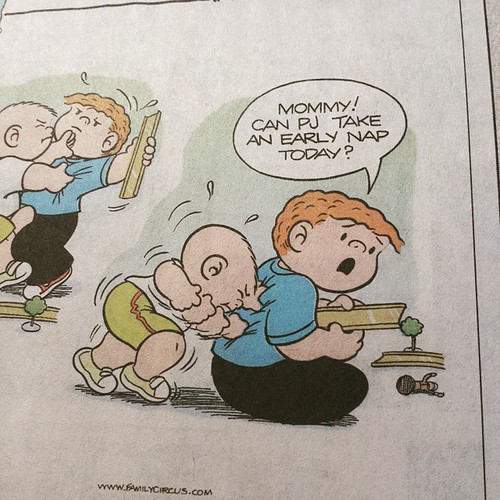
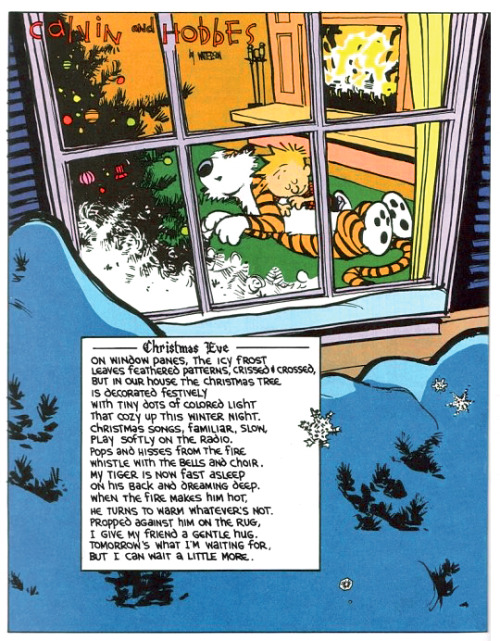
Cul De Sac may be the truest heir on the comics page to the spirit of Calvin and Hobbes, in that Thompson has an effortless understanding of the way children appear to see the world and interact with it. The strip’s star is kindergartener Alice Otterloop, who looks on the world with that wonderfully skewed (and hard to argue against) logic that every four-year-old brings to the table. Alice is pushy and loves being the center of attention, which makes for a lot of hilarity when she doesn’t get her way.


Alice isn’t a female Calvin, though. She is not primarily a loner. She has friends with whom she interacts (or fights), and she has an older brother in addition to her parents. Alice doesn’t get along well with everybody, and there’s one kid that she doesn’t like at all, and Thompson has the genius to show this poor kid as being pretty nice and, well, just a normal kid. This isn’t Calvin getting bullied by Moe. We never get a real reason as to just why Alice so dislikes poor Kevin (whom she always refers to as “bucket-headed Kevin”), and she bosses poor Dill around. Alice isn’t perfect at all. But then, neither was Calvin.

Older brother Petey isn’t a supporting character, though. At times he becomes the star in his own right, in his preference for inaction and his neurotic dislike of everything, including just about all foods. (Petey actually maintains his own “Picky Eater” rating online.) Thompson is adept at showing the differences between the way Alice views the world and the way Petey sees it, and some of his best work has the two worldiews clashing together.


The adults in Cul De Sac are also done quite well. Mrs. Otterloop is apparently the one with the best grip on reality, although she has a wicked sense of humor that she lets fly once in a while, even if nobody gets it. Mr. Otterloop seems slightly clueless – well, maybe clueless isn’t quite the word. He doesn’t seem quite equipped to interact with his children on their terms, though, and he always seems mildly nonplussed by what happens when he gets a glimpse of what they’re up to.


Best of all is Thompson’s art. His style is surprisingly elaborate for the demands and space restrictions of the comics page, and he often does wonderful things to suggest the flow of time and manages to elude the bonds of the panel. Thompson’s best drawing often comes when Alice finds herself interacting in some way with either the world of adults or with larger children, whether it’s the enormous jungle gym and slide that has mythologically entrapped some children for years, or her oddly scary grandmother with the gentle-and-confused-but-still-terrifying giant dog, or her father’s tiny car into which Dad must fold himself in contorted ways.


I discovered Cul De Sac some years ago when Stephan Pastis actually plugged it in an installment of his Pearls Before Swine (an episode I blogged about when it happened, and it was with sadness that I noted Thompson’s reluctant decision to retire from the strip when his Parkinson’s Disease became too much of a hindrance to continued work.

Richard Thompson was a wonderful, wonderful humorist and poet of the comics page, and I’ll treasure Cul De Sac forever.


(She's right -- where the heck is the Pie Fight Button, anyway?!)

Monday, February 01, 2016

Monday, August 03, 2015

Tuesday, June 23, 2015

I hate you, Les.

I stopped reading Funky Winkerbean a while back, because it just got too...too...how to put this...the people in it are all assholes. But I still catch it on Sundays because we get that paper, so now I know that Les Moore finished a book.


Eff you, Les. Nobody does that.

Tuesday, February 24, 2015

You mean, like those non-educated idiots working at Montoni's Pizza?

For some unknown reason, I've been reading Funky Winkerbean for a number of years now, despite the fact that it's awful. It's probably the only real instance of "hate watching" I have. That term came about mostly in reference to teevee shows, with the idea that there's a show you hate and watch anyway because the act of hating it is just so much fun. That may be why I've hung in there with Funky Winkerbean for so long, watching Tom Batiuk write awful storyline after awful storyline with the apparent notion that he's creating humor and insight; the strip is like a little piece of a tire fire every morning, and really, reading it only takes about nine seconds (with another nine to think about how terrible it is), and then it's on to the next thing. I usually read it in the morning before I even get dressed, while the coffee is brewing.

But no more. Last week came an installment that made me realize that I have no more use for the strip. It expresses a point of view that I find ridiculous and insulting and condescending, and with this, I've decided that Mr Batiuk's terrible strip will take no more of my time, tiny though that investment may be.

If you're curious, the installment that ended my reading of Funky Winkerbean for good is mocked, and rightly so, by The Comics Curmudgeon here. One less comic strip in the morning, oh well; I guess I'll use the extra time to study the art in Cul de Sac more.

Monday, October 20, 2014

Clobberin' Time, no more?

I was never a really big fan of the Fantastic Four during my comics-reading days*, but they are one of the iconic comics team, featuring characters nearly as foundational as Superman himself.

And now, Marvel is apparently canceling The Fantastic Four, for reasons that are...give me a minute, I'm struggling to come up with an apt descriptor for them...umm...F***ING STUPID.

Sorry, but that's really all I can think of to describe this nonsense.

(Original link via Roger.)

* When I say "my comics-reading days", I refer to that period when I was buying individual issues of comics on a monthly basis. I didn't stop reading comics.

Tuesday, September 02, 2014

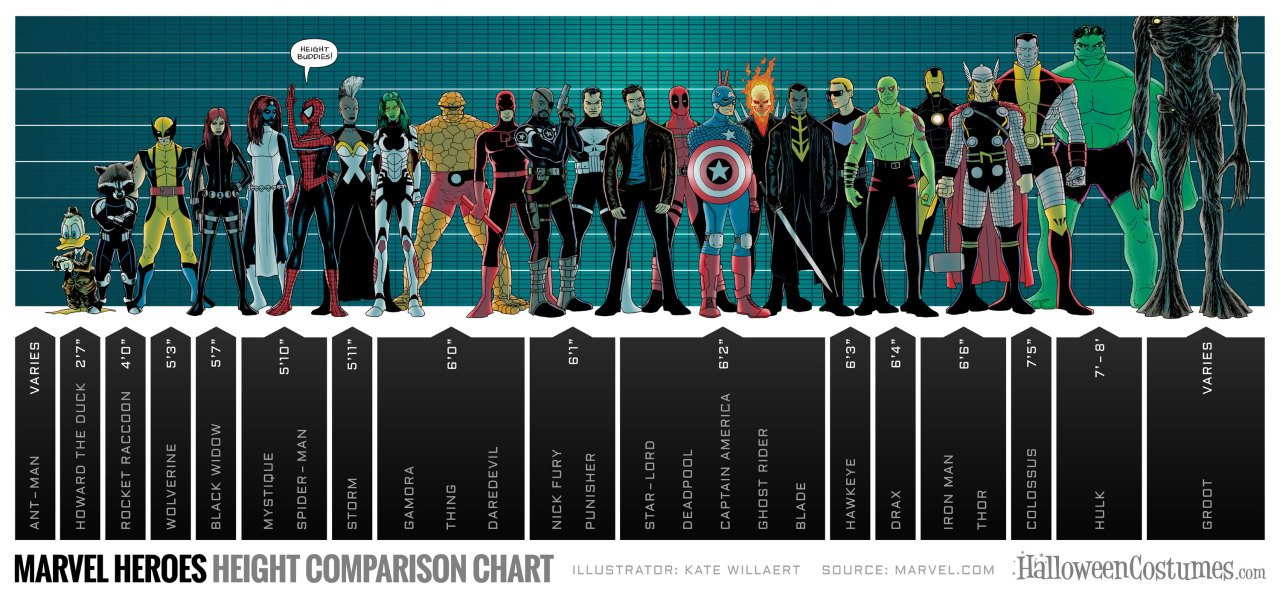
Marvel Heroes By Height

I saw this on Tumblr. According to this, Spider Man and I are also "height buddies"! (I doubt Mystique would give me the time of day.)


Where do you fall?

Saturday, June 07, 2014

BOW BEFORE ME, FOOLISH MORTALS

The other day I speculated on who might be drawing the substitute art on the comic strip Pearls Before Swine.

Today, the Internets are afire as Pearls creator Stephan Pastis has confirmed my hypothesis, with details as to how it came to be.

Go read Pastis's post -- it's great. Meanwhile, I'll sit here basking in my air of smug self-satisfaction!

Thursday, June 05, 2014

Speaking of Comics....

One of the recurrent storylines in Funky Winkerbean of late has been the quest of Holly, the wife of the strip's title character, as she seeks to complete her son's collection of the entire run of a comic book called Starbuck Jones. Her son, Cory, is serving in Afghanistan, see, so it would be the neatest thing if he could come home to his collection being complete.

So, every few weeks we return to this tale (amidst the usual glum and depressing stuff that goes on 'round Funkyville), and I always find it oddly amusing. In one segment, Holly got word that the comics store across town, the other comics store, the creepy one, had an issue that the town's main store doesn't. So she goes there and tries dealing with the proprietor, who is dressed like a rowdy biker-dude and stares at her as if he's planning to fleece the living hell out of her for the issue he has that she wants. But he suddenly quotes a ridiculously low price to her after she tells her tale of filling the collection belonging to her son who is serving, and we get a look at the back of the guy's jacket: he served, too.

Anyway, flash forward to the current incarnation of this tale, when Holly has gone to the giant mansion belonging to a guy named Chester Hagglemore, who is apparently the supreme comics collector of all time. Seriously, he lives in a house that looks like Mr. Burns's mansion on The Simpsons, and Mr. Hagglemore himself looks like Ernst Stavro Blofeld.


I have to confess that I usually read FW for the same reason one slows down to stare at a bad traffic accident. The overall sense of existential gloom that overhangs the poor people in this down, and the way everyone's prime coping mechanism seems to be to smirk at bad puns, is kind of affecting in a weird manner. But this particular storyline is actually amusing in an odd way. The idea of a comics collector with the Superman emblem on the wrought-iron gates of his mansion just cracks me up, and his rejoinder in the strip pictured above actually made me chuckle, which is frankly a very rare thing for Funky Winkerbean. So for now I'm willing to go along for this ride, setting aside my certainty that the story will end with Holly finally acquiring that last issue, the one completing the run, at which point she will stand back and look upon the entire run, secure in the knowledge that she has done a good thing for her son, a thing which he will just love when he returns home...and at that moment, the Army chaplain will ring her doorbell....

So....

One of my favorite comic strips is Pearls Before Swine, which this week is running one of its "breaking the fourth wall" storylines. Stephan Pastis, the creator, does this frequently, by including a smoking, pot-bellied version of himself in the strip, often being mocked by the other characters who have to play out his tales, which are often egregiously complex set-ups for awful puns.

This week's storyline has a little girl in Pastis's neighborhood telling him that he sucks at drawing, and Pastis challenging her to do better, which she may well be doing:


But...my eye got caught by that second panel. There's something awfully distinctive about the art there...something that makes me wonder that if this goes on, maybe this comic strip whose characters are all talking animals might see the appearance of a certain hamster named Huey....

(And if the 'mystery artist' is who I think it is, I can't wait to hear the 'Inside Baseball' story of how he came to do this.)

Tuesday, October 22, 2013

Friday, September 06, 2013

Mr Pastis will take your lunch money now.

The last two days, Pearls Before Swine (one of my favorite newspaper comic strips) ran these two installments:


They're OK, not all that funny, really. But these characters -- the polar bear and the penguins -- have never been seen before. Since Pearls often abounds in meta-style humor and the breaking of the fourth wall (creator Stephan Pastis often includes himself as one of his own characters, with the characters commenting on the quality of his work), I figured that something was up. Meanwhile, each day, there were people in the comments section offering the complaint that "Polar bears are Arctic beasts, while penguins are Antarctic." Which is true.

But then, today Pastis pulls this:


Heh. The last two days were mere set-up for this, which wouldn't have worked if the comments sections and message boards didn't do exactly what he figured they'd do when he drew these strips months ago.

Well played, Stephan Pastis! Well played, indeed!

Sunday, August 04, 2013

On Death and Villainy

John Seavey, one of the regular posters at MightyGodKing, writes at length about Norman Osborn, the human alter-ego of Spider-Man villain Green Goblin. I don't much have a dog in that fight, but I did like two different side points Seavey made along the way.

First:

I have gone on record multiple times as saying that if contrived resurrections cheapen deaths, the answer is to stop killing off characters so frequently and not to have fewer resurrections. Killing off a character in a shared universe is generally an act of colossal arrogance and short-sightedness, a statement along the lines of, “Well, I can’t think of anything more to do with this character, and I’m the Most Creative Person of All Time! The only interesting thing left to do is kill them off.” It’s never true. There are always more interesting stories to be told with a living character than a dead one, and that’s what makes resurrections so inevitable no matter how contrived they wind up being. The blame should be placed squarely on the shoulders of the killing writer, not the resurrecting one.

I think death is kind of overrated as a narrative device. It's kind of cheap, really, an easy way of amping up the stakes -- just kill someone off, to show that everything is real, that we're playing for keeps. I find that a lot of deaths in stories feel like they're there more for narrative effect than for any other reason, and a lot of them end up ringing false when it's obvious they're supposed to be incredibly shocking.

Good examples of this can be found all over the place: A Song of Ice and Fire, for instance. (Game of Thrones, for you who know it by the teevee.) George RR Martin gets heaped with praise all the time for being willing to sacrifice main characters, but I'd posit that by the point we've now reached, it's clear that he's not sacrificing main characters at all; he's just disposing of secondary characters at surprising junctures.

More oddly, though, is the odd notion that a character should develop only so much, and then they should die. This strikes me as deeply silly, and the two best examples I know are characters who didn't die: Han Solo, and Martin Riggs (of the Lethal Weapon movies). Harrison Ford has gone on record in the past as believing that Han should have died in Return of the Jedi, because he'd reached the end of his narrative and because it would have given the story a lot more gravitas. And Lethal Weapon writer Shane Black apparently left the series after his intention to kill off Martin Riggs at the end of Lethal Weapon 2 -- pretty much for the same reasons -- was shot down by the producers.

The problem here is, our lives don't end when we reach handy points in our development as human beings. Well, for some of us they do, but that's just the accident of timing, not some existential thing about the Universe dispensing with us upon our reaching of our inner Zen. It's a silly reason to kill off a character, and Seavey is one hundred percent correct: a character doesn't run out of potential stories just because one particular writer does.

And besides, "Death as route to gravitas" is...well, it's just plain overrated anyway. How many major, named characters among the protagonists die over the course of The Lord of the Rings? Two: Boromir and Theoden. That's it. And yet nowhere in that entire story would I ever claim that the stakes don't feel pretty damned high, nor that a price will have to be paid for victory.

(For the record: Yes, I do think that Joss Whedon overdoes death as well, but his deaths tend to be a lot more visceral, given his skills at getting me to care about his characters in the first place.)

And second:

(W)hen you go back and read the original Green Goblin stories, he wasn’t much of a villain. He was a C-list Kingpin wannabe who failed at everything he tried, lost pretty much every fight he was in, and whose only talent was in running away. He didn’t even really have a backstory, because Stan Lee and Steve Ditko couldn’t decide who he was going to be under the mask. (Ditko wanted it to be a totally unmemorable nobody, to show that villains didn’t always have to be someone important to the hero. Lee felt like they’d spent so long building up the mystery of the Goblin’s identity that the audience would be upset if it wasn’t someone they recognized. The dispute was one of the reasons that Ditko left the title.) Basically, the Green Goblin was by no means the most important of Spider-Man’s bad guys.

Now, I'm not sure about this, and a couple commenters in the thread over there take issue with Seavey's description of Ditko's views and departure from the series. But Ditko's point here, even if it wasn't really Ditko's point, is a good one, an interesting one.

There was a very effective episode of Magnum, PI that did this to really extraordinary effect -- so much so that it's one of my favorite episodes of that series. Magnum receives a strange telephone call from a cackling guy who promises to kill and leaves Magnum bits of nursery rhymes as clues. This pattern repeats several times, and it becomes very clear that this killer knows Magnum well and has a very specific beef with him. It's a very well-made episode -- Magnum occasionally eschewed its Rockford Files-esque tone for a kind of "Hawaii Noir" mode, usually to very good effect -- but what makes it stand out is the resolution. Eventually the killer stands before Magnum, unmasked and grinning and waiting for his sick payoff...and Magnum doesn't recognize him. Even later, after the killer has been dealt with and the whole mess is over, Magnum doesn't remember him at all. He has to go back into his own personal records to figure out who this guy is, and it turns out that Magnum investigate the guy's wife some years back in a possible divorce case, but the case turned up nothing at all and Magnum didn't even take the guy's money. I don't recall what caused the guy to spiral into insane killing, and there's a good chance that the episode doesn't even fill in that detail, leaving it a complete mystery. But that's one of the things that makes it really memorable: that the villain isn't some significant figure from Thomas Magnum's past; it's just some guy with whom he had a completely mundane association for a short time years before, so mundane that he doesn't even remember him.

Of course, I can turn this back to Star Wars. One thing that really incensed fans as the Prequel Trilogy unfolded was the idea that at the very heart of the mystery that is Darth Vader is a pathetic teenager, a guy who couldn't get over the loss of his schoolboy crush.

It's a hard thing, explaining villainy. Sometimes no explanation whatsoever is the most disturbing way to go.

Tuesday, July 30, 2013

For Cal....


(Cul de Sac is one of the best things ever, by the way. I'm so sad that it ended.)

Sunday, April 07, 2013

Carmine Infantino

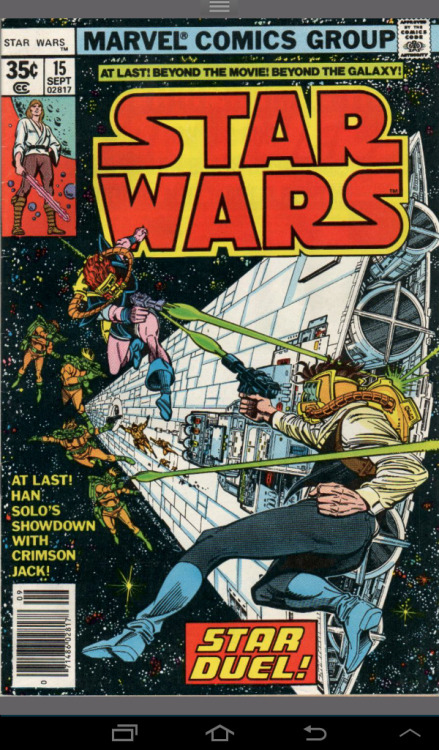
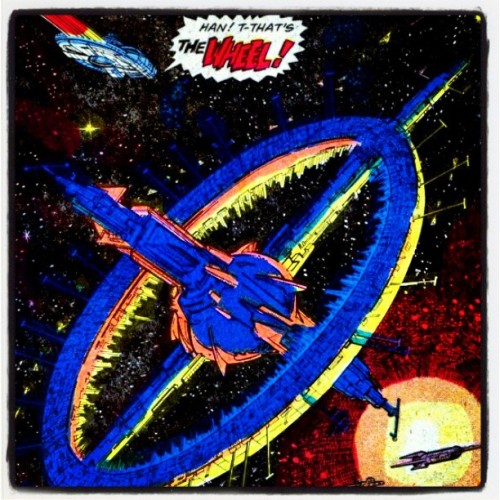
Comics artist Carmine Infantino died the other day. I primarily remember his work on the Marvel Star Wars series, which he drew during a hefty chunk of the period between A New Hope and The Empire Strikes Back, which was actually a really wild-and-wooly time for the Star Wars comics. At that point, nobody had any idea what was to come in terms of the Star Wars mythology and backstory and so on, so Marvel was flying about as blind as could be. The result was a sequence of issues that told some really fun and entertaining space opera adventure stories, and Infantino's art was a big part of that.


A fine, fine artist.